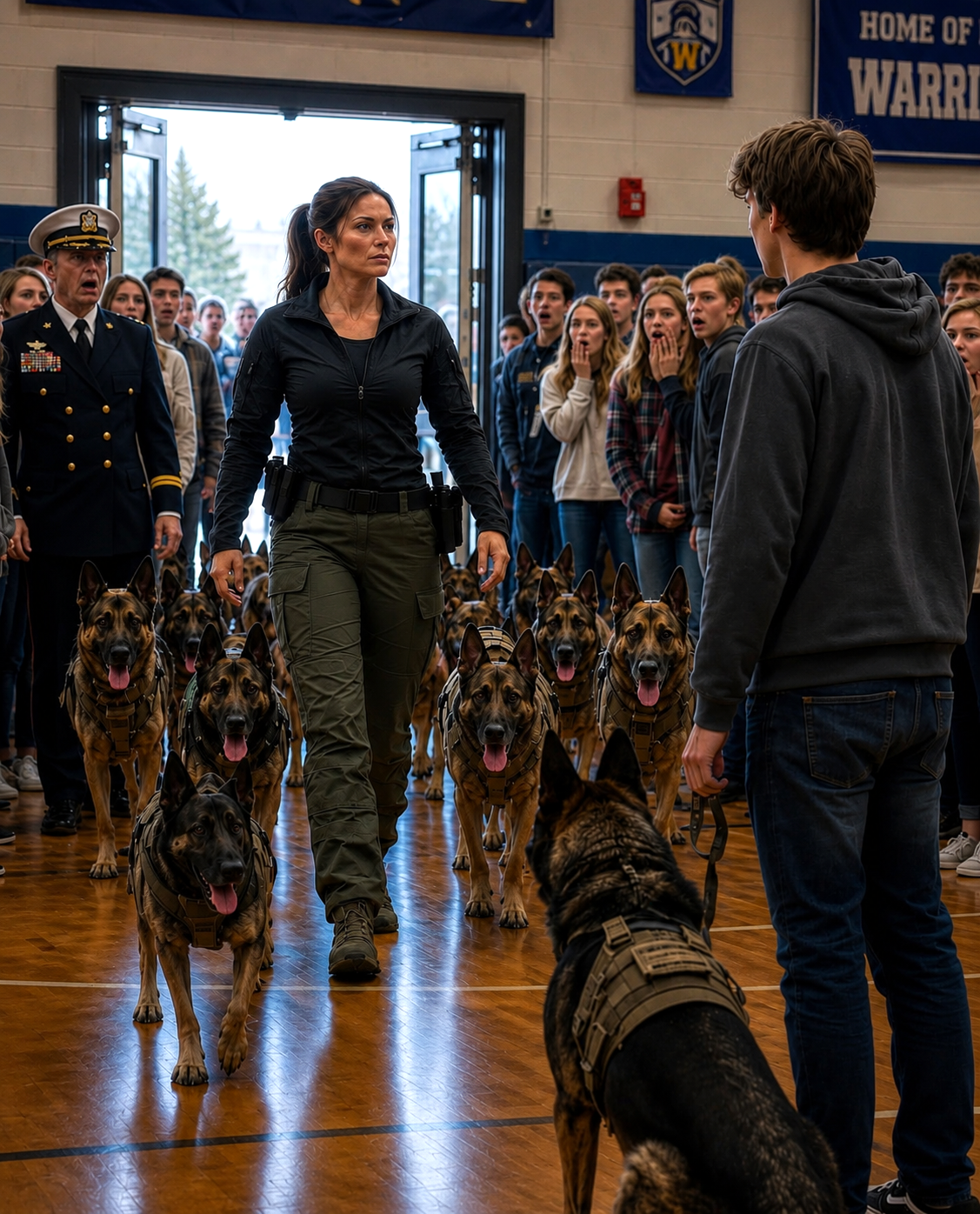
My mother looked at me then, and I knew she was proud. Not because I had won. Not because he had apologized. But because I had not needed to make him smaller in return.
Lieutenant Carter lowered the microphone.
Chief Ramirez stepped forward again.
“Students,” he said, his voice calm and firm, “today was supposed to be about military careers. So let this be part of the lesson. You will meet people whose experience does not match your assumptions. You will hear stories that sound unlikely because you have never lived close enough to the truth behind them. In uniform, arrogance is not strength. Discipline is.”
No one moved.
Even the dogs remained seated in silent formation.
Chief Ramirez continued.
“You do not measure someone’s service by how easily it fits into your expectations. You measure it by record, conduct, sacrifice, and respect.”
My mother looked uncomfortable with the attention, but she did not interrupt him.
That was another thing people never understood about her. She did not enjoy being seen. She did not want applause. She did not want stories told about her at dinners or ceremonies. She wanted things done correctly. She wanted people trained well. She wanted promises kept.
And she wanted her son to know the difference between being loud and being strong.
A student near the front raised her hand.
Everyone looked at her.
She was a sophomore named Emily, one of the students who had laughed at first. Her face was red now, and her voice trembled.
“Ma’am,” she asked, “why didn’t you say something sooner?”
My mother looked at her for a long moment.
Then she answered.
“Because being underestimated tells you a lot about people.”
The words landed softly, but everyone felt them.
She continued.
“It shows you who listens before judging. It shows you who follows the crowd. It shows you who needs another person to be embarrassed so they can feel certain of themselves. And it shows you who is willing to correct themselves when they are wrong.”
Her eyes moved briefly to Lieutenant Carter.
He accepted it without looking away.
Then she turned back to the students.
“If any of you choose service, remember this. Your uniform may earn attention. Your rank may earn obedience. But respect is something you must protect every day by how you treat people who cannot do anything for you.”
Nobody clapped.
Not yet.
It did not feel like a speech that needed applause. It felt like a lesson people needed to sit with.
Then Titan stood beside me.
His leash tightened gently in my hand.
My mother glanced at him and gave one small motion with her fingers.
Titan crossed the gym calmly, weaving between the rows of seated dogs, and stopped at her left side. He sat without being told.
For some reason, that was the moment that made the students react.
Not the simulator.
Not the badge.
Not even the fifty dogs.
It was Titan.
The same dog they had barely noticed beside me earlier.
The same dog some people had probably assumed was just there for display.
Now he sat beside my mother like he had always known exactly where he belonged.
The applause started quietly.
One person.
Then another.
Then the whole gym.
Teachers clapped.
Students stood.
Chief Ramirez remained still, but I saw his eyes lower for a moment in respect.
Lieutenant Carter did not clap at first. He seemed unsure whether he had the right to. Then he slowly brought his hands together, not loudly, not for show, but with humility.
My mother did not smile.
But I saw her shoulders loosen.
Just a little.
When the applause faded, she turned to the handlers near the entrance.
“Reset formation,” she said.
No shouting.
No drama.
The handlers moved. The dogs rose in perfect order. Lines shifted. The aisle cleared. Within seconds, the gym floor looked organized again, as though the entire demonstration had been planned all along.
Maybe some of it had been.
Later, I learned that my mother had been invited quietly by Chief Ramirez as part of a regional working dog training showcase. She had not planned to reveal anything about herself. She had come only to observe, support the handlers, and leave before most people knew she was there.
But then she heard my question.
Then she heard the laughter.
And she decided that silence had served its purpose long enough.
The rest of Career Day did not continue the way it had started.
The Army booth still had brochures.
The Marines still had pull-up challenges.
The Coast Guard still answered questions.
But the students moved differently now. They asked better questions. They listened more. When they passed me, some nodded awkwardly. A few apologized.
Bryce, the senior who had held the simulator record for half the day, came up to me near the bleachers.
“Your mom is terrifying,” he said.
I looked at him.
He quickly added, “In a respectful way.”
I almost laughed.
“She gets that a lot,” I said.
Emily came over too.
“I’m sorry I laughed,” she said. “I didn’t think.”
That was the most honest apology I received that day.
I nodded.
“It’s okay.”
But it was not completely okay.
Not yet.
Because humiliation leaves a mark even after the room changes sides.
People think an apology erases the moment. It does not. It only gives the moment somewhere better to go. That day still stayed with me, but not as a wound. It became something else. A reminder. A line in my memory between who I had been before and who I became after.
Near the end of the event, Lieutenant Carter approached my mother privately.
I stood close enough to hear, though I pretended not to.
“Ma’am,” he said, “I let certainty speak for me before discipline did.”
My mother studied him.
“That happens,” she said. “The question is whether it happens twice.”
He nodded.
“No, ma’am.”
She held his gaze a second longer.
Then she said, “Good.”
That was all.
No long lecture.
No public punishment.
No dramatic ending.
Just a standard set and a man expected to meet it.
When we left the gym that afternoon, Titan walked between us. The late sunlight came through the school windows, cutting long bright lines across the hallway floor. Students watched from doorways as we passed. Some whispered, but not the way they had earlier.
This time, the whispers were different.
I looked up at my mother.
“Why didn’t you tell me Chief Ramirez knew you were coming?”
She kept walking.
“Because you did not need to know.”
I frowned.
“That’s not an answer.”
“It is absolutely an answer.”
I looked at Titan.
He looked straight ahead, loyal as ever.
After a few steps, my mother spoke again.
“You handled yourself well.”
I swallowed.
“I wanted to argue.”
“I know.”
“I wanted to prove him wrong.”
“I know.”
“Why didn’t you?”
She stopped near the main doors and looked at me.
The hallway behind us was still full of distant voices, but around her, everything felt quiet.
“Because proof given in anger is usually dismissed as noise,” she said. “Proof delivered at the right time becomes impossible to ignore.”
I remembered the gym doors opening.
The dogs entering.
The silence.
Lieutenant Carter’s face when he realized the truth was not something he could laugh away.
“Did you plan all of that?” I asked.
My mother looked toward the parking lot.
“No.”
Then, after a pause, she added, “Not all of it.”
That was as much as I was ever going to get.
Years later, people would still ask me about that day. Some remembered it as the day fifty military working dogs entered Harborview High School in perfect formation. Some remembered it as the day Lieutenant Carter apologized in front of everyone. Some remembered my mother’s simulator score, or Chief Ramirez standing at attention, or the sentence she said about being underestimated.
But I remember something smaller.
I remember sitting in that chair while everyone laughed.
I remember Titan’s ears twitching.
I remember my mother standing by the back wall, still and calm, not needing anyone to believe her before she became real to them.
And I remember the lesson she left behind.
The truth does not need to shout.
It does not need to humiliate.
It does not need to chase applause.
Sometimes it simply waits outside the door, disciplined and patient, until the moment comes.
Then it walks in.
And the entire room gets quiet.
THE END! THANKS FOR READING!