 Reading Time: 12 minutes
I gave up twenty-two years of my life raising my triplet nieces. What they did at their college graduation made me drop to my knees. The girls were six months old when my brother left them on my porch with three car seats, one diaper bag, and a note written on the back of a gas receipt.
I still have that receipt. It is folded into a plastic sleeve inside my nightstand drawer, yellowed now, the ink faded but still readable. I’m sorry, Noah. I can’t do this. That was all he wrote. No explanation. No goodbye to his daughters.
No instructions about formula, diapers, doctor appointments, allergies, insurance cards, nothing.
Just three babies lined up on my porch before sunrise like someone had delivered a mistake he wanted returned.
Their mother, Elise, had died eleven days earlier.
A blood clot after complications no one saw coming.
One day she was sending me pictures of the girls wearing matching sunflower onesies.
The next, my brother was calling me from a hospital hallway, sobbing so hard I could barely understand him.
For eleven days, I thought grief had simply swallowed him.
Then he vanished.
I was twenty-seven years old.
Unmarried.
Living above the hardware store where I worked.
I had three hundred and twelve dollars in my checking account, two cracked dinner plates, one couch with a spring sticking out, and no idea how to warm a bottle.
When I opened the door that morning, Ava was crying.
Claire was asleep.
June was staring straight up at me with solemn blue eyes as if she had already decided I was late.
I remember standing there barefoot in the cold, looking down at them, thinking there had been some terrible misunderstanding.
Then I saw the note.
I read it once.
Then again.
Then I sat down right there on the porch step and said the only thing that came to mind.
“Oh, girls. What are we going to do?”
My neighbor, Mrs. Pritchard, came out in her robe.
She saw the car seats.
Saw my face.
Saw the note in my hand.
“Oh, Noah,” she whispered.
Within an hour, my apartment looked like a storm had hit a daycare.
Bottles.
Blankets.
Diapers.
Three different cries.
Three tiny bodies needing everything at once.
Mrs. Pritchard helped me call social services.
A caseworker came by that afternoon.
She was kind, professional, and honest.
“You do not have to take this on,” she said. “There are emergency placements. Foster homes. Relatives can be contacted.”
Relatives.
That word almost made me laugh.
Our parents were gone.
Elise’s family lived two states away and had already said they were “too old” to take infants.
My brother was missing.
And those three little girls had just lost their mother.
The caseworker looked around my tiny apartment.
“You can’t raise three babies alone,” Mrs. Pritchard said softly from the kitchen.
She was probably right.
But then the smallest one, Claire, wrapped her fist around my finger before I could call anyone.
Her fingers were barely bigger than matchsticks.
She held on with all the strength in her tiny body.
And something in me answered before my brain could protest.
“I’ll keep them,” I said.
The caseworker looked at me carefully.
“Temporarily?”
I looked down at Claire.
Then at Ava, still crying.
Then at June, still staring like she expected competence I did not have.
“As long as they need me.”
I became Uncle Noah first.
Then guardian.
Then Dad by accident.
No one teaches you how to become a father to three babies overnight.
I learned by failing.
I made bottles too hot.
Then too cold.
I put diapers on backward.
I once cried in the grocery aisle because I could not remember which formula the doctor said was best.
The first month, I slept in ninety-minute pieces.
Ava had colic.
Claire refused to sleep unless my hand rested on her back.
June watched everything, silent and suspicious, as if taking notes for a future complaint.
Money disappeared faster than I could earn it.
Diapers alone felt like a second rent.
I sold my guitar.
Then my motorcycle.
Then the watch my father left me.
At work, I stocked shelves with one baby monitor clipped to my belt and two more in my pockets, because Mrs. Pritchard watched them downstairs in the storage room during emergencies.
My boss, Mr. Landry, pretended not to notice when I clocked in late with spit-up on my shoulder.
One day he handed me an envelope with an extra three hundred dollars inside.
“Inventory bonus,” he said.
“There wasn’t inventory this week.”
He looked at me over his glasses.
“Then maybe don’t argue with blessings.”
People helped.
Not enough to make it easy.
But enough to keep us alive.
The girls grew.
Slowly.
Loudly.
Beautifully.
Ava learned to walk first and used that skill immediately to escape every room.
Claire spoke first, mostly to ask where I was.
June read first, sitting upside down on the couch with a picture book in her lap, correcting me when I skipped pages.
Triplets, but never copies.
Ava was heart first.
She felt everything before anyone else knew there was something to feel.
She cried during commercials with sad music.
She hugged strangers.
She loved hard and forgave quickly.
Claire was sunshine with a stubborn streak.
She made friends in every grocery line and once convinced the entire second-grade class to write thank-you notes to the janitor because “Mr. Walt fixes everything and nobody claps.”
June was the serious one.
Quiet.
Sharp.
Always listening.
At eight, she asked why her biological father had not come back.
I sat across from her at the kitchen table, the other two asleep upstairs, and felt my heart crack.
“He was very sad,” I said carefully.
June looked at me.
“Sad people can still call.”
I had no answer.
So I told the truth.
“Yes. They can.”
For twenty-two years, I packed lunches.
Braided hair badly.
Signed permission slips.
Worked double shifts.
Sat through fevers, science fairs, spelling bees, broken hearts, and three separate phases where they all hated me at once.
At thirteen, Ava accused me of being too strict because I would not let her go to a concert three towns away with a boy who had already failed driver’s education.
At fifteen, Claire screamed that I was not her real father.
Then cried harder than I did when I quietly said, “I know.”
At sixteen, June stopped speaking to me for four days because I refused to let her quit school to work full-time after she overheard me on the phone with the bank.
That was the year I sold the house.
Not the apartment.
The house.
By then, I had bought a small old place on Maple Street.
Three bedrooms.
Leaky roof.
Crooked porch.
A backyard just large enough for a swing set.
It was the first place that felt like ours.
I painted their room pale yellow.
They drew stars on the ceiling with glow paint.
Every birthday candle, every Christmas morning, every emergency school project, every first-date argument happened in that house.
Then college acceptance letters came.
All three.
Different schools, but close enough that they could visit one another.
Scholarships helped.
Grants helped.
Loans helped.
But not enough.
I had promised Elise’s grave years earlier that her girls would have every chance I could give them.
So I sold the house.
I told the girls I was downsizing because stairs were bad for my knee.
They believed me only because they wanted to.
June cried when we packed her books.
Claire took photos of every room.
Ava kissed the front door before leaving.
I rented a small one-bedroom apartment near the hardware store and told myself walls were just walls.
They were not.
But neither was tuition just money.
The girls left for college, and for the first time in twenty-two years, my life became quiet.
Too quiet.
No hair ties in the sink.
No cereal bowls in bedrooms.
No one shouting, “Uncle Noah, where are my shoes?” while wearing the shoes.
People told me I could finally live for myself.
I did not know how.
I had missed weddings.
Vacations.
Friendships.
The chance to have a family of my own.
Not because the girls asked me to.
Because someone had to stay.
And I stayed.
By graduation day, I had gray in my beard, a bad knee, and a cheap camera shaking in my hand.
The auditorium was packed.
Families filled every row.
Balloons.
Flowers.
Proud mothers.
Fathers with teary eyes pretending allergies were acting up.
I sat alone, because the girls had insisted I sit near the front.
“You need the best view,” Claire had said.
I thought that was sweet.
I did not know it was a setup.
The ceremony began with speeches.
Then names.
Hundreds of names.
I clapped for strangers because somewhere in the room, someone loved them.
Then came mine.
Not my name.
Theirs.
Ava Brooks.
She walked across the stage crying before they even called her name.
That was Ava.
Heart first.
She accepted her diploma, then looked toward me and pressed her hand to her chest.
I held up the camera, but my eyes were already blurred.
Claire Brooks.
Claire practically danced across the stage.
She waved at me like she was still eight years old and I had just arrived late to her school play.
People laughed.
I laughed too.
June Brooks.
June walked calmly, serious as always.
Her chin lifted.
Her eyes steady.
She shook the president’s hand.
Then she turned.
At first, I thought she was looking for her sisters.
Then she pointed straight at me.
Ava and Claire stepped beside her, still in their caps and gowns.
The announcer looked confused as June leaned toward the microphone.
“Before we accept these diplomas,” Ava said, her voice shaking, “we need to honor the man who made them possible.”
My camera slipped from my hands.
It hit the floor between my shoes, but I could not move to pick it up.
Claire unfolded a paper.
“Our uncle Noah gave up his twenties, his money, his sleep, and his dreams to raise three girls he never planned for.”
A sound moved through the auditorium.
A soft wave of surprise.
June looked directly at me.
“People always ask where our father is,” she said. “He’s sitting right there.”
The entire auditorium turned.
I could not breathe.
I wanted to disappear.
I wanted to run to them.
I wanted their mother to be alive to see them.
Behind the girls, the large screen lit up.
A slideshow began.
Me at twenty-seven, asleep on the floor beside three cribs.
Me feeding three babies at once, my hair sticking up like I had been electrocuted.
Me in my hardware-store vest holding report cards.
Me wearing a paper crown at a kindergarten tea party.
Me crying at their high school graduation, though I had sworn I did not.
Photos I did not know they had kept.
Videos too.
Ava at six saying, “Uncle Noah makes pancakes shaped like clouds.”
Claire at ten yelling, “He doesn’t braid good, but he tries!”
June at seventeen, caught on camera saying, “He sold the house. Don’t tell him we know.”
My heart stopped.
They had known.
All three of them had known.
Claire spoke again, crying openly now.
“You didn’t miss having a family,” she said. “You became ours.”
Then all three walked off the stage.
The president did not stop them.
Nobody did.
They crossed the aisle in their caps and gowns while hundreds of people stood to watch.
I tried to stand.
My knee gave out.
Then they were in front of me.
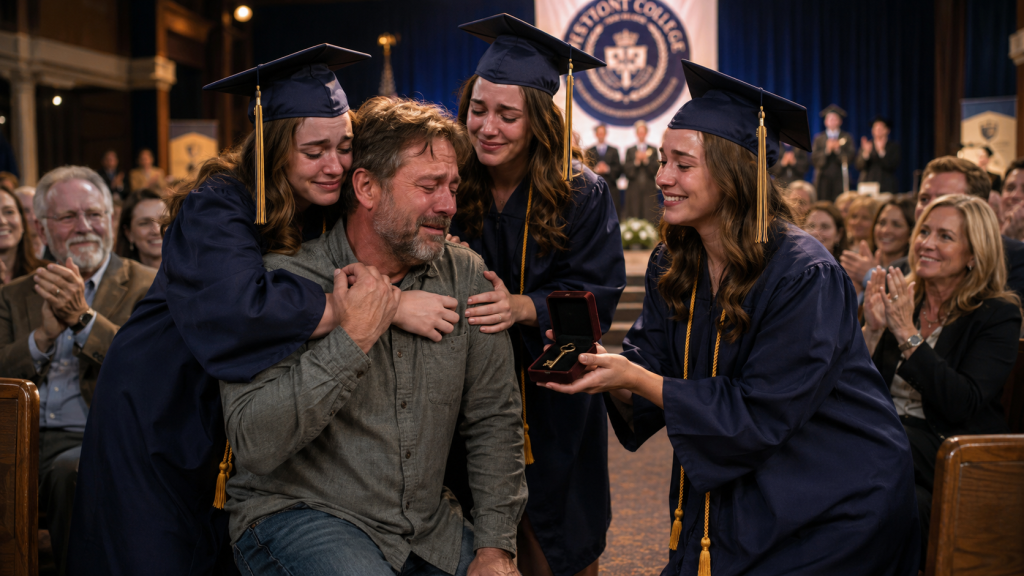
Ava knelt first.
Then Claire.
Then June.
Three grown women kneeling in front of the man who once did not know how to warm a bottle.
Ava placed a small velvet box in my shaking hands.
“Open it,” she whispered.
I could barely see.
Inside was a key.
Not new.
Old.
Brass.
Familiar.
My breath caught.
June said, “We bought back the old house.”
I stared at her.
“What?”
Claire wiped her face.
“We found the couple who bought it. They were retiring to Arizona. We used graduation money, savings, and the signing bonuses from our jobs.”
Ava laughed through tears.
“And probably some irresponsible loans, but don’t lecture us today.”
The auditorium chuckled.
I could not.
I was holding the key to Maple Street.
The house with the yellow bedroom.
The glow stars.
The crooked porch.
The backyard where three little girls learned to ride bikes while I ran behind them, terrified.
June placed her hand over mine.
“You gave us every home we ever had,” she said. “Now we’re giving one back.”
Claire leaned in.
“Come home, Dad.”
Dad.
Not Uncle Noah.
Not guardian.
Dad.
My knees hit the floor.
Maybe from the bad knee.
Maybe because twenty-two years of holding myself together finally broke.
I pulled all three of them into my arms.
The auditorium rose in applause.
But I barely heard it.
All I heard was Ava crying into my shoulder.
Claire laughing and sobbing at once.
June whispering, “We got you. We’ve got you now.”
For years, I had thought love meant staying upright.
Being strong.
Paying bills.
Fixing broken things.
Not asking for thanks.
But on that auditorium floor, surrounded by applause and the three girls who had become my whole life, I understood something else.
Love also means letting yourself be held.
After the ceremony, people came up to shake my hand.
Strangers called me a hero.
I hated that.
Heroes are people in stories.
I was just a tired man who did not know how to walk away from babies on a porch.
Mr. Landry’s son, who had taken over the hardware store, hugged me and said his father would have been proud.
Mrs. Pritchard, now ninety and using a walker, had been hiding two rows behind me.
The girls had flown her in.
When I saw her, I nearly collapsed again.
She tapped my chest with one crooked finger.
“Told you that you couldn’t do it alone,” she said.
I laughed through tears.
“You were right.”
“Of course I was.”
The next morning, the girls drove me to Maple Street.
The house looked smaller than I remembered.
Older.
The porch still crooked.
The maple tree in the front yard taller now.
I stood on the sidewalk holding the key, unable to move.
Ava slipped her hand into mine.
Claire rested her head on my shoulder.
June stood on my other side, arms crossed, pretending not to cry.
“You sure?” I asked.
All three answered together.
“Yes.”
I unlocked the door.
The house smelled different.
Fresh paint.
Lemon cleaner.
Sunlight.
But beneath it, somehow, was us.
The living room where I had built blanket forts.
The kitchen where I burned birthday pancakes.
The hallway where I measured their heights in pencil on the doorframe.
I walked to that frame first.
The marks were still there.
Ava 5.
Claire 5.
June 5.
Then higher.
Age 8.
Age 12.
Age 16.
I touched the lines with shaking fingers.
“They kept them,” I whispered.
“We asked them to,” June said softly.
I turned toward the girls.
“You contacted the owners years ago?”
Claire shrugged.
“We had a plan.”
Ava smiled.
“We’re very sneaky.”
June added, “Efficient.”
I laughed.
Then cried again.
That became a pattern for a while.
Laughing.
Crying.
Touching walls.
Remembering.
In the old yellow bedroom, the glow stars were still faintly visible on the ceiling.
The girls had repainted the room, but left one corner untouched.
Claire pointed up.
“See? Space.”
I sat on the floor, the same floor where I had once zipped pajamas, matched socks, and listened to bedtime prayers whispered by three little voices.
“I don’t deserve this,” I said.
Ava knelt in front of me.
“Yes, you do.”
“I did what anyone would have done.”
June raised an eyebrow.
“No. You did what Dad didn’t do.”
The words were sharp, but true.
Their biological father never returned.
Not for birthdays.
Not for school plays.
Not for emergencies.
Not for graduation.
Years ago, he sent one email asking if the girls “ever asked about him.”
I deleted it.
Maybe I should not have.
Maybe they deserved the choice.
But at the time, I was too angry to hand them another abandonment.
When they were eighteen, I told them everything.
I gave them the gas receipt note.
They read it together at the kitchen table.
Claire cried.
Ava stared out the window.
June folded the note carefully and said, “He was not our father.”
Then she handed it back to me.
I kept it safe.
Not because it mattered more than love.
Because it proved where the story began.
On a porch.
With three babies.
And a man who stayed.
We moved me back into Maple Street slowly.
The girls had jobs waiting in three different cities.
Ava at a nonprofit counseling center.
Claire in environmental design.
June in finance, because of course June chose numbers and control.
They could not stay forever.
But for two weeks after graduation, they filled the house again.
Boxes.
Laughter.
Arguments over furniture placement.
Claire insisting the couch should face the window.
June insisting that was inefficient.
Ava crying over a chipped mug she remembered from childhood.
One night, we sat on the porch eating takeout from paper containers.
The sun was setting.
Fireflies blinked in the yard.
For a moment, they were little again.
Knees scraped.
Hair tangled.
Voices overlapping.
Then Ava said, “Do you ever regret it?”
The porch went quiet.
I knew what she meant.
Them.
The years.
The sacrifices.
The life I never had.
I looked at my hands.
Older now.
Scarred from work.
Shaking slightly when I was tired.
“Yes,” I said.
All three looked at me.
I continued.
“I regret that you lost your mother. I regret that my brother left. I regret that I was too tired sometimes. I regret missing school things when work got in the way. I regret selling this house and letting you think I wanted to.”
Ava’s eyes filled.
“But do I regret keeping you?” I asked.
I looked at each of them.
“Not for one second.”
Claire wiped her face.
June looked away.
Ava moved first, folding herself against my side the way she had as a child.
Then Claire.
Then June.
My girls.
Not by blood in the way people measure it.
But by bedtime stories.
Emergency rooms.
Tuition bills.
Bad braids.
Burned pancakes.
And twenty-two years of choosing one another every morning.
People say I gave up my life.
Maybe I did.
The life I imagined at twenty-seven disappeared the morning three car seats arrived on my porch.
But another life began.
Harder.
Louder.
More expensive.
More exhausting.
And infinitely more beautiful.
Now, when I wake up in the old house, sunlight comes through the same kitchen window.
The porch still creaks.
My knee still hurts.
The girls call every Sunday.
Sometimes more.
Ava sends photos of flowers.
Claire sends articles about sustainable housing.
June sends spreadsheets of my budget, which I pretend to resent and secretly appreciate.
The key from the velvet box hangs near the front door.
Beside it, in a small frame, is the gas receipt note my brother left.
I used to think that note was proof of abandonment.
Now I see it differently.
It was the page where my real fatherhood began.
I gave up twenty-two years of my life raising my triplet nieces.
At their college graduation, they gave me back the house I sold, the name I never asked them to use, and the truth I had been too tired to see.
I had not missed my chance to have a family.
I had been living inside it the whole time.
THE END! THANKS FOR READING!