 Reading Time: 15 minutes
My eight-year-old adopted granddaughter called me at 1:58 a.m. and whispered, “Grandpa, I feel so hot.” Her parents had taken her brother to Florida for his birthday. But one note left on the kitchen counter proved this was not an accident.
At 1:58 in the morning, my bedroom was so still I could hear the refrigerator humming through the floor vents and the air conditioner clicking somewhere in the hall. Then my phone lit up on the nightstand. Sadie.
Not my son, Wesley.
Not his wife, Maren.
Sadie.
My eight-year-old adopted granddaughter.
The little girl who still thanked people for passing the salt and slept beneath a yellow blanket covered in tiny moons.
I answered before the second buzz.
“Sadie, sweetheart? What happened?”
For a moment, I heard only her breathing.
Small. Uneven. Then she whispered, “Grandpa Harlan?” Her voice sounded weak and dry, and my chest tightened before she said another word.
“I feel really hot,” she said. “And when I close my eyes, the room moves.”
I sat up immediately.
“Where’s your dad? Where’s Maren? Did you wake them?”
The silence that followed was too careful.
“They went to Florida,” she finally said. “For Carter’s birthday weekend. Mom said I had to stay because I turn sick days into problems, and Carter deserved one trip where nobody ruined it.”
I had spent nearly thirty years working as a court-appointed family advocate in Oregon.
I had heard children say terrifying things in quiet voices before.
But nothing prepares you for hearing it from your own granddaughter.
“Sadie,” I said carefully, already reaching for my clothes, “are you alone in the house?”
“They left medicine on the counter,” she whispered. “And a note.”
A note.
Some people do not fail a child in one sudden moment.
They train that child slowly not to ask.
Not to interrupt.
Not to need too much.
Then one night, the cruelty stops pretending to be a mistake.
I grabbed my keys.
“Listen to me. Don’t get up again. Don’t try to get water. Keep the phone close and stay with me.”
“I’ll be quiet,” she said quickly. “Please don’t tell Mom I bothered you.”
For one second, I wanted to call Wesley and force him to hear his daughter’s voice at nearly two in the morning.
But Sadie needed help.
Not anger.
So I drove.
Wesley’s neighborhood near Lake Oswego looked perfect, as always.
Trimmed lawns.
Clean driveways.
Porch lights glowing over flowerpots.
A little flag by the mailbox making the whole street look safe and decent.
I kept Sadie on speaker the entire way, asking small questions whenever her breathing sounded too soft.
“What blanket do you have tonight?”
“Yellow,” she murmured. “The moon one.”
“The one from the craft fair?”
“Because it looked like space.”
For half a second, there she was.
My Sadie.
The little girl who loved planets and could explain Saturn’s rings with complete seriousness.
Then she coughed again, and I pressed harder on the gas.
I used the spare key Wesley had given me years earlier.
The house was warm and still.
Too warm.
The thermostat glowed in vacation mode, set for an empty house.
Not for a sick child upstairs.
In the kitchen, the under-cabinet lights were on.
Everything looked clean and carefully arranged.
On the counter sat children’s fever medicine, a plastic measuring cup, crackers, and a folded pastel note from Maren’s planning pad.
Her handwriting was neat.
Sadie, take one dose before bed and stop turning every illness into a scene. We are taking Carter to Orlando because he earned a happy birthday weekend, and you need to rest instead of stealing everyone’s attention. Do not call the neighbors unless it is a real emergency, and do not make your brother feel guilty.
I read it once.
Then again.
This was not panic.
Not confusion.
Not a rushed accident.
This was planned.
Beside the note was a digital thermometer.
I pressed the memory button.
The screen flashed.
103.7.
They had checked.
They had known.
And they left anyway.
I folded the note and put it in my pocket.
Then I slipped the thermometer in beside it.
Anger can blur details.
Evidence does not.
Upstairs, family photos lined the hallway.
Carter at a theme park.
Carter in soccer gear.
Wesley and Maren on vacation.
Sadie appeared only a few times, usually near the edge of the picture.
At her bedroom door, I heard a small cough.
I opened it gently.
Sadie was curled beneath her yellow moon blanket.
Her hair was damp against her forehead.
Her cheeks were flushed.
Her lips were dry.
When she saw me, she tried to sit up.
“No,” I said softly. “Stay still.”
“I’m sorry,” she whispered.
I sat beside her and touched her forehead.
She was burning.
Across the room, a cup of water sat on the dresser.
Full.
Untouched.
Too far for her to reach.
“I tried to get it,” she said. “But when I stood up, the floor moved.”
That was the truth of the room.
Medicine downstairs.
Water out of reach.
A note telling her not to ask for help.
Then Sadie looked at me with tired eyes.
“Did I ruin Carter’s trip?”
My throat tightened.
“No, sweetheart,” I said. “You didn’t ruin anything.”
I helped her take a small sip of water, then wrapped her carefully in the yellow blanket.
“We’re getting you help.”
“Will Mom be mad?”
“I’ll handle your mom.”
Her eyes closed for a moment.
“Dad said Mom handled it.”
And there it was.
Wesley had not written the note.
But Wesley had left too.
I lifted Sadie carefully.
She felt far too hot and far too light in my arms.
Before carrying her downstairs, I took one photo of the room.
Not for memory.
For proof.
Then I carried my granddaughter past the glowing thermostat, past the spotless kitchen, and past the note that explained everything.
Outside, the porch lights still shone warmly.
The neighborhood still looked perfect.
But now I knew the truth.
A house can look beautiful from the street and still fail the child inside.
At the emergency room, Sadie’s fever was still dangerously high.
The nurse’s face changed when I handed over Maren’s note and the thermometer.
“They knew?” she asked quietly.
“Yes,” I said. “They measured it and left anyway.”
Within an hour, a doctor, a social worker, and a police officer were standing outside Sadie’s room.
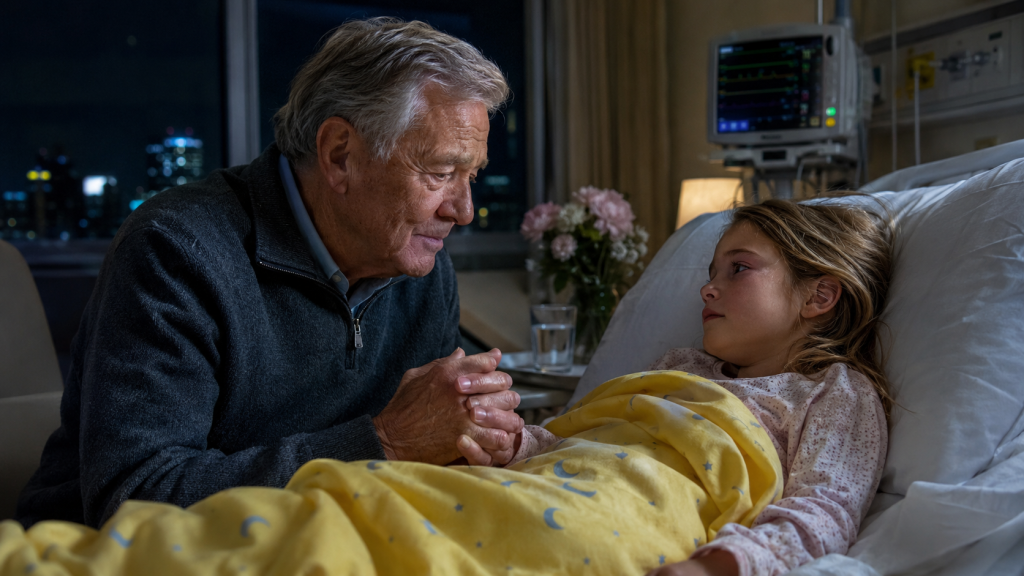
Sadie lay in the hospital bed with an IV in her arm and her moon blanket tucked under her chin.
She looked smaller beneath those clean white sheets.
Too small for the weight adults had placed on her.
The doctor explained that she was dehydrated and needed monitoring.
Her fever was responding to treatment, but they wanted to be careful.
Careful.
A word her parents should have remembered before boarding a flight.
The social worker introduced herself as Dana Fields.
She had soft eyes and a direct voice.
“I understand you have experience as a family advocate,” she said.
“I used to.”
“Then you know why I need to ask difficult questions.”
“Yes.”
Dana looked toward Sadie.
“Has she ever said anything like this before?”
I wanted to say no.
I wanted to protect my son from what I already knew was true.
But I had spent too many years watching adults choose comfort over children.
So I told the truth.
“She says sorry too often. She gets nervous when Maren is upset. She avoids asking for things. And in family photos, she’s treated like a guest.”
Dana wrote that down.
The officer, a young woman named Officer Lenox, took the note, the thermometer, and my photos into evidence.
Then she asked if I would call Wesley.
I did not want to.
But I did.
He answered from Florida with music and laughter behind him.
“Dad, why are you calling so late?”
“Because your daughter is in the hospital.”
Silence.
The music in the background suddenly sounded obscene.
Then Maren’s voice cut in, sharp and annoyed.
“She called you? I told her not to make this dramatic.”
Officer Lenox looked at me.
I put the phone on speaker.
“Maren,” I said carefully, “Sadie had a 103.7 fever before you left.”
She laughed once.
“Kids get fevers.”
Wesley whispered, “Dad, we thought she was fine.”
I looked through the glass at Sadie sleeping with the IV line taped gently to her hand.
“No, son. You thought Carter’s birthday mattered more.”
“That’s not fair,” Wesley said.
“No. What happened to Sadie is not fair.”
Maren snapped, “She always does this. Every time Carter gets something special, suddenly she’s sick or sad or scared. She ruins everything.”
Officer Lenox’s jaw tightened.
Dana stopped writing and simply listened.
I felt something inside me harden.
“She is eight years old,” I said.
“She knows exactly what she’s doing,” Maren replied.
That sentence settled the matter in my heart.
Not legally.
That would take time.
But for me, the door closed.
By morning, child protective services had opened a case.
Wesley and Maren rushed back from Florida, but it was too late to control the story.
The note existed.
The thermometer existed.
The photos existed.
The phone call had been heard by witnesses.
And Sadie’s hospital record now showed what neglect looks like when it wears clean clothes and takes family vacations.
When Wesley arrived, he looked terrified.
His hair was messy, his shirt wrinkled, and for one second I saw the boy I had raised.
The boy who once cried when he accidentally stepped on a robin’s egg.
The boy who used to bring stray cats home and ask if we could keep them.
That boy was still somewhere inside the man standing in the hospital hallway.
But he had failed his daughter anyway.
“Dad,” he said. “Please.”
I looked at him.
“Please what?”
“Let us see her.”
“That’s not my decision anymore.”
His face crumpled.
“Maren said the doctor told her it was just a virus.”
“Did the doctor tell her to leave Sadie alone overnight?”
He looked away.
“Dad, I messed up.”
“No. You chose not to look too closely because looking would have made you responsible.”
He swallowed hard.
Maren arrived behind him.
She was still dressed like someone returning from vacation, white linen jacket over a sundress, sunglasses pushed into her hair.
Her face was pale with anger.
Not fear.
Anger.
She marched toward Sadie’s room.
“I want to see my daughter.”
Officer Lenox stepped in front of her.
“Ma’am, you need to wait.”
Maren’s mouth opened.
“I am her mother.”
Dana, the social worker, came down the hall carrying a clipboard.
“Mrs. Calloway, given the circumstances, access is restricted until we complete an initial safety assessment.”
Maren looked at me.
“You did this.”
“No,” I said. “You wrote it down.”
Her face tightened.
“It was a note. She exaggerates everything. She’s been difficult since the adoption.”
Wesley closed his eyes.
“Don’t,” he whispered.
Maren turned on him.
“Don’t what? Tell the truth?”
The truth.
That word should not be allowed in the mouths of people using it as a weapon against a child.
Sadie woke during the argument.
Through the glass, I saw her eyes open and search the room.
I stepped inside quickly.
She looked past me and saw Maren in the hallway.
Her small hand reached for mine.
“Grandpa,” she whispered, “please don’t let her take me home.”
Dana heard it.
So did Officer Lenox.
Maren did too.
For once, she had nothing to say.
The temporary safety plan placed Sadie with me for seventy-two hours after discharge.
Then an emergency hearing extended it.
Wesley sat in court looking stunned, like a man who had fallen asleep during his own life and woken up surrounded by consequences.
Maren sat beside him, stiff and offended.
Her attorney tried to make it sound like a misunderstanding.
A fever.
A busy travel day.
A child prone to dramatics.
Then Dana read the note aloud.
Sadie, take one dose before bed and stop turning every illness into a scene.
The courtroom shifted.
Words look different when someone else reads them in a quiet room.
Then the thermometer record was entered.
103.7.
The ER doctor’s report.
The photo of the unreachable water cup.
The thermostat in vacation mode.
The phone call where Maren said, She always does this.
My son lowered his head.
Maren stared straight ahead.
The judge ordered Sadie to remain with me pending investigation.
Wesley was granted supervised visitation.
Maren’s contact was suspended until further review.
When the order was read, Maren finally cried.
But her tears did not look like grief.
They looked like humiliation.
As we left the courthouse, Wesley caught up with me.
“Dad.”
Sadie was walking beside me, holding my hand.
At the sound of his voice, her fingers tightened.
I stopped but did not turn her toward him.
“What?”
“I love her.”
I looked at my son.
“Then learn what love does when a child is inconvenient.”
His face twisted.
“That’s cruel.”
“No,” I said. “That’s the lesson you should have learned before you adopted her.”
Sadie came home with me that afternoon.
My house was smaller than Wesley’s.
Older.
The kitchen cabinets stuck in humid weather.
The guest room had faded wallpaper and a dresser that had belonged to my wife before she passed.
But when Sadie stepped inside, she looked around like she was entering a castle.
“Can I put my blanket on the bed?”
“You can put anything anywhere you want.”
She looked uncertain.
“Anywhere?”
“Anywhere safe.”
That became our word.
Safe.
Safe cup beside the bed.
Safe lamp left on.
Safe snacks in the drawer.
Safe phone on the nightstand with my number, Dana’s number, and 911 taped beside it.
The first night, I tucked her in and left the door open.
I was halfway down the hall when she called, “Grandpa?”
“Yes?”
“Am I allowed to be thirsty at night?”
I gripped the doorframe.
“Yes, sweetheart. You are allowed to be thirsty. Hungry. Sad. Sick. Scared. Bored. Anything.”
She considered this seriously.
“What if it wakes you up?”
“Then I wake up.”
“What if I wake you up twice?”
“Then I wake up twice.”
“What if I wake you up a lot?”
I sat on the edge of the bed.
“Then I’ll be a very sleepy grandpa, but you’ll still be safe.”
Her lip trembled.
She nodded and pulled the moon blanket to her chin.
The next weeks were filled with appointments.
Doctors.
Therapists.
Social workers.
School meetings.
Sadie had been carrying more than a fever.
She had been carrying the slow education of being unwanted.
It came out in small ways.
She asked permission to eat.
She apologized when she laughed too loudly.
She panicked if she spilled water.
She hid crackers under her pillow because she said she did not want to bother me if she got hungry.
One afternoon, I found her in the hallway staring at a framed photo of my late wife, Elaine.
“That’s Grandma Elaine?” she asked.
“Yes.”
“She died before I came?”
“Yes. She would have loved you.”
Sadie looked at the photo.
“Even though I’m adopted?”
The question was so soft I almost missed it.
I knelt beside her.
“Especially because you are Sadie.”
She looked at me.
“Mom said adopted means chosen, but sometimes she said it like chosen things can be unchosen.”
I breathed through the anger.
“Maren was wrong.”
“Can dads unchoose too?”
I thought of Wesley in court, head down.
“I hope your dad learns better. But whatever he does, you are not unchosen here.”
She stared at me for a long time.
Then she leaned against my shoulder.
That was the first time she hugged me without asking.
Wesley began supervised visits at a family center.
At first, Sadie refused to go.
Her therapist said refusal mattered.
So visits were delayed.
Wesley wrote letters instead.
The first letter was all wrong.
Sadie, I’m sorry you got scared.
I read it and sent it back through the caseworker.
No.
He tried again.
Sadie, I’m sorry I left you when you were sick. I should have protected you. You did nothing wrong.
That one, I let her read.
She read it three times.
Then she folded it and placed it inside a shoebox under her bed.
Not forgiven.
Not forgotten.
But saved.
Wesley started parenting classes.
Individual therapy.
Adoption trauma education.
Medical neglect education.
He called me once after a session and cried.
“She was trying to tell us,” he said.
“Yes.”
“I thought Maren knew better.”
“You wanted Maren to know better so you wouldn’t have to choose conflict.”
He was quiet.
Then he said, “I became a coward.”
I did not soften it.
“Yes.”
Sometimes love requires not rescuing people from the truth.
Maren did not improve.
She blamed me.
Then Sadie.
Then adoption agencies.
Then “attachment issues.”
She posted vague messages online about being judged by people who did not understand motherhood.
Dana saved screenshots.
So did I.
Eventually, Maren’s own words became part of the case.
She refused therapy unless it was “family focused,” which meant she wanted everyone to share blame.
The court did not accept that.
Wesley moved out three months after Sadie came to live with me.
He did not move in with me.
That would not have been fair to Sadie.
He rented a small apartment ten minutes away and began building a life where he could see his daughter only when she was ready.
Carter came to visit me one Saturday.
He was ten, confused, and quieter than usual.
Maren had taken him to Florida, yes.
But he was still a child inside the same family system.
He sat at my kitchen table and stared at his juice.
“Is Sadie sick because we went to Orlando?”
Sadie, who had been coloring at the counter, froze.
I sat across from Carter.
“No. Sadie was sick before you left. Adults made the wrong choice.”
His eyes filled.
“Mom said Sadie ruined everything.”
Sadie’s crayon stopped moving.
“That was wrong,” I said firmly. “Sadie did not ruin your birthday.”
Carter looked at his sister.
“I didn’t know you were that sick.”
Sadie shrugged in the small way children do when they are trying not to need comfort.
“I called Grandpa.”
Carter wiped his face.
“I’m glad.”
That was the beginning of something healing between them.
Not perfect.
But honest.
The next year was difficult.
The case moved through hearings and reviews.
Sadie remained with me.
Wesley slowly earned longer supervised visits, then unsupervised afternoons in public places.
Maren’s contact remained limited and eventually became therapeutic only, which Sadie declined.
People in town talked.
Of course they did.
Some thought I was too harsh.
Some thought I should have “kept it in the family.”
I had spent thirty years as a family advocate hearing that phrase from people who cared more about appearances than children.
Keep it in the family.
The most dangerous sentence in a child’s life when the family is where the harm happens.
I stopped explaining.
Sadie’s healing came in small victories.
The first time she woke me up for water.
The first time she asked for seconds at dinner.
The first time she told me she did not like peas instead of eating them silently.
The first time she got sick again and cried because she thought I would be angry.
I sat beside her bed with medicine, water, a thermometer, and three picture books.
“Fevers are not crimes,” I told her.
She looked at me with watery eyes.
“They’re not?”
“No. They’re body alarms.”
“Like smoke detectors?”
“Exactly.”
She thought about it.
“Then mine was loud.”
“Yes,” I said. “And I’m glad you called.”
She smiled a little.
By the time Sadie turned nine, she had started placing herself in the center of photos.
Not the edge.
The center.
At her birthday party, she wore a silver dress with stars on it and asked for a moon cake.
Wesley came for one hour, approved by the therapist.
He brought a telescope.
Sadie thanked him politely.
Then, after cake, she asked if he wanted to see the moon stickers on her ceiling.
He looked at me first.
I nodded.
They walked down the hall together.
When they came back, Wesley’s eyes were red.
Sadie looked calm.
Later, she told me, “Dad said my room is nice.”
“It is.”
“He cried.”
“How did that feel?”
She thought about it.
“Like maybe he finally saw it.”
“Saw what?”
She shrugged.
“Me.”
That night, after everyone left, Sadie climbed onto the porch swing beside me.
“Grandpa?”
“Yes?”
“Do you think Mom misses me?”
I knew she meant Maren.
Children can be wounded by someone and still wonder if that person misses them.
“I don’t know,” I said carefully.
Sadie leaned against my arm.
“I don’t think I miss her. But I miss wishing she was different.”
That sentence belonged to someone much older than nine.
“I understand that,” I said.
“Do grown-ups miss wishing too?”
“All the time.”
She looked up at the sky.
“The moon looks small tonight.”
“It’s farther from full.”
“But it’s still the moon.”
“Yes.”
She nodded like that solved something.
The final custody decision came almost eighteen months after the phone call.
Sadie would remain in my permanent guardianship.
Wesley would continue reunification work through structured visitation.
Maren would have no unsupervised contact unless Sadie’s therapist and the court approved it in the future.
Sadie was not in court.
I did not want the courthouse to become another room where adults argued over her.
When I came home, she was at the kitchen table doing homework.
She looked up.
“Do I have to go back?”
I knelt beside her chair.
“No.”
Her pencil rolled from her hand.
“Ever?”
“Not unless you want changes someday and the court agrees they are safe.”
She stared at me.
Then she started crying.
Not loudly.
Not dramatically.
Just a child finally setting down a question she had carried too long.
I held her until the tears passed.
Then she wiped her face and said, “Can we have pancakes for dinner?”
“Yes.”
“Even though it’s not breakfast?”
“Especially because it’s not breakfast.”
We made pancakes.
Blueberry.
Too many.
She poured syrup into the shape of Saturn.
I burned the first batch because I was crying.
She told me gently, “Grandpa, maybe you should stick to toast.”
I laughed so hard I had to sit down.
The house is different now.
There are glow-in-the-dark stars on the guest room ceiling.
A telescope near the window.
A yellow moon blanket on the bed.
A water bottle on the nightstand every night.
Sadie’s school pictures sit in the middle of the mantel, not the edge.
Sometimes Wesley comes by for dinner.
He has learned to ask Sadie what she wants instead of assuming.
He has learned to apologize without adding excuses.
He has learned that repair is not the same as forgiveness.
Maybe one day he will be her safe father.
Maybe he will not.
That depends on what he does over years, not what he says in tears.
Maren sends cards sometimes.
Sadie does not open them.
I keep them in a box in case she wants them someday.
She may.
She may not.
That will be her choice.
Last winter, Sadie got the flu.
A regular flu.
Nothing dramatic.
She woke me at 2:14 a.m. and said, “Grandpa, I think my body alarm is loud again.”
I was out of bed before she finished the sentence.
I checked her temperature.
Brought water.
Called the advice nurse.
Sat beside her bed.
She watched me move around the room with sleepy eyes.
“You’re not mad,” she whispered.
“No.”
“Even though it’s night?”
“Even then.”
She closed her eyes.
“I like living here.”
I tucked the moon blanket around her.
“I like having you here.”
She slept.
I sat in the chair beside her bed until morning, listening to her breathe.
The same way I had once listened on the phone while racing through dark streets toward a house that looked perfect from the outside.
I still have Maren’s note.
The original is in the case file.
A copy sits in my desk drawer.
Sometimes people ask why I kept it.
Because forgetting is dangerous.
Because that note proves cruelty can have neat handwriting.
Because when Sadie is older, if she ever doubts herself, I want her to know she did the right thing by calling.
She did not make a scene.
She made a lifeline.
My eight-year-old adopted granddaughter called me at 1:58 a.m. and whispered, “Grandpa, I feel so hot.”
Her parents had taken her brother to Florida for his birthday.
The neighborhood looked perfect.
The house looked perfect.
The counter was clean.
The medicine was measured.
The note was written.
And that was the horror of it.
They had known.
They had planned.
They had decided her pain was inconvenient.
But Sadie called anyway.
And because she called, the truth came out.
The fever broke.
The case opened.
The house changed.
The little girl who once asked if she was allowed to be thirsty at night now keeps a water bottle by her bed and complains when I forget extra ice.
That is what healing looks like sometimes.
Not grand speeches.
Not perfect endings.
A child asking for ice.
A grandfather getting it.
A door left open.
A moon blanket tucked close.
And a home where no illness, no fear, no need, no tear is ever treated like a crime.
THE END! THANKS FOR READING!