 Reading Time: 16 minutes
The hospital called me just before midnight and said my six-year-old son was dying. But the part that still follows me is not the phone call. It is the sound of my mother laughing when I asked what had happened.
And my sister speaking as if she were talking about a knocked-over glass of milk. “He got what he deserved.” I was standing in the hallway of a Denver hotel at 11:47 p.m., still wearing my conference badge, with one heel already grinding a blister into my foot.
I had just stepped out of a client dinner and was mentally rehearsing the presentation that might save my job the next morning.
When my phone started ringing, I nearly let it go.
Then I saw the Dallas number.
“Is this Emily Carter?” a woman asked.
“Yes.”
“This is St. Catherine’s Children’s Hospital in Dallas. Your son, Noah Carter, has been admitted in critical condition.”
For one second, the hotel corridor seemed to stretch forever in both directions.
Someone laughed near the elevator.
Ice rattled inside a bucket.
The carpet under my shoes had gold vine patterns, and I remember staring down at them as if they could tell me why my entire world had just cracked in half.
“What happened?” I whispered.
The nurse was quiet for too long.
“Ma’am… you need to come right away.”
I do not remember making it back to my room.
I remember my purse dropping to the floor.
I remember my hands trembling so hard that I dropped my phone twice before I managed to call my mother.
She was supposed to be taking care of Noah for three days.
My younger sister, Madison, had been staying there too.
I had never truly wanted to leave him with them.
Something deep in my stomach twisted the moment I folded his dinosaur pajamas and tucked his favorite blue blanket into his small backpack.
But my sitter canceled at the last minute.
My ex-husband was deployed overseas.
And if I skipped that Thanksgiving business trip, I would lose the promotion that was keeping us above water.
So I convinced myself three days would be okay.
I convinced myself because desperate mothers sometimes make bargains with fear.
Just three days.
Just one trip.
Just until I can afford better childcare.
I convinced myself because my mother had begged for another chance.
“You act like I’m some monster,” she had said when I hesitated.
I did not answer.
Because some truths are too heavy to say out loud.
My mother, Diane Whitaker, had never been gentle.
Not with me.
Not with Madison.
Not with anyone who made noise, spilled things, cried too long, asked too many questions, or needed comfort at inconvenient times.
But she was older now.
Quieter.
She volunteered at church.
She posted Bible verses online.
She told people she adored being a grandmother.
And Noah, my sweet little boy, had always wanted grandparents so badly that it hurt me to deny him.
So I let myself believe time had softened her.
I was wrong.
My mother answered on the fourth ring.
“Why is Noah in the hospital?” I sobbed.
Silence.
Then she laughed.
Not a startled laugh.
Not an anxious one.
A cold, pleased laugh.
“You should never have left him with me,” she said.
My blood turned to ice.
“What did you do?”
Before she could answer, I heard Madison behind her.
“He never listens,” my sister said in a flat voice. “He got what he deserved.”
Noah was six.
He loved plastic dinosaurs, strawberry yogurt, and sleeping with only one sock on because he said wearing two made his “feet angry.”
He cried during movies when animals got lost.
He still crawled into my bed during thunderstorms, pressing his tiny forehead against my shoulder until sleep finally took him.
There was no universe where my child deserved pain.
I booked the earliest red-eye to Dallas.
The hours dissolved into airport lights, bitter coffee, and pure terror.
I pictured every possible accident.
A fall.
A car.
A pool.
The staircase.
But beneath every thought, my mother’s voice kept playing again and again.
You should never have left him with me.
The flight was full of sleeping strangers.
A man beside me snored softly.
A baby cried three rows back.
A flight attendant asked if I wanted water, and I could not answer because if I opened my mouth, I knew I would scream.
I stared at the black window and saw my own reflection looking back.
A woman with mascara under her eyes.
A woman who had chosen work because survival required money.
A woman who had trusted the wrong blood.
When I arrived at St. Catherine’s just after sunrise, a pediatric surgeon and a police detective were waiting outside the ICU.
That was the moment my knees nearly gave out.
The surgeon’s name was Dr. Patel.
He had kind eyes and the careful posture of a man who often had to say impossible things gently.
“Mrs. Carter,” he said, “Noah is alive. He is stable for now, but he is critically injured.”
I heard the words alive and stable and clung to them like ropes over a canyon.
Then he explained the rest.
Noah had serious internal injuries.
Bruised ribs.
A fractured wrist.
Severe dehydration.
And older marks that suggested this was not the first time he had been hurt.
It had happened before.
My ears rang.
Before.
The word opened a door inside me.
I remembered Noah flinching once when Madison raised her hand too quickly to fix her hair.
I remembered him coming home from my mother’s house with a “tummy ache” and refusing to explain why.
I remembered him saying, “Grandma doesn’t like when I cry.”
I remembered telling myself he was sensitive.
I remembered every time my instincts whispered and I shoved them down because I needed help.
The detective spoke in a low voice.
“My name is Detective Aaron Morales. Your mother and sister are already in custody.”
My ears rang so loudly I almost missed the rest.
Noah had been found by a neighbor.
A neighbor.
Not family.
Not blood.
A woman named Mrs. Alvarez had heard him crying from behind my mother’s locked laundry-room door.
She said she had knocked.
No one answered.
She called 911.
When paramedics arrived, my mother tried to tell them Noah was “having a tantrum” and did not need help.
Madison had recorded parts of what happened on her phone.
Not to report it.
To mock him.
The room tilted.
I grabbed the wall.
Dr. Patel reached for my arm.
“Mrs. Carter, sit down.”
“No,” I said. “I need to see him.”
They led me into the ICU.
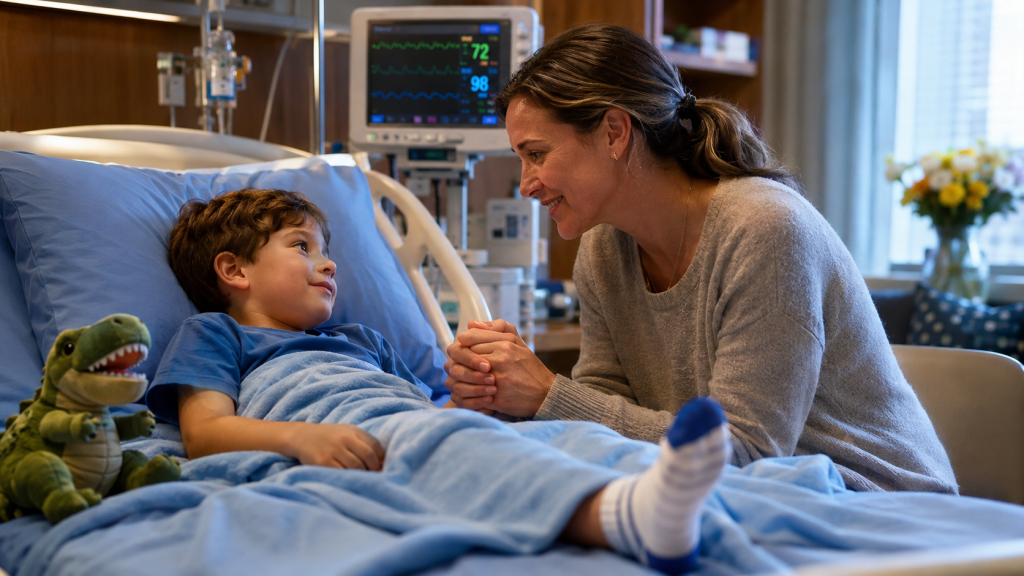
Nothing in this world prepares a mother for seeing her child in a hospital bed too large for his small body.
Noah lay surrounded by tubes and monitors.
His face looked pale beneath the soft hospital lights.
His favorite blue blanket was folded beside him, stained and torn at one corner.
There were wires on his chest.
A bandage around his wrist.
Machines breathing in rhythm around him.
For one terrible second, I thought of all the times I had complained about stepping on his dinosaurs in the hallway.
All the times I had rushed him through bedtime because I was tired.
All the times he asked for “one more story” and I said, “Tomorrow.”
Tomorrow suddenly felt like a luxury.
I walked to his bed and placed my hand gently over his.
His fingers were warm.
Small.
Real.
“Mommy’s here,” I whispered.
His eyelids fluttered.
For a moment, I thought he was only dreaming.
Then his lips moved.
“I tried to be good,” he breathed.
That sentence nearly killed me.
I bent over him, tears falling onto the hospital sheet.
“You are good, baby. You are so good. None of this was your fault.”
His eyes closed again.
A nurse touched my shoulder and let me cry.
I do not know how long I stood there.
Maybe minutes.
Maybe an entire life.
When I stepped back into the hallway, Detective Morales was waiting.
He held a folder.
“I know this is difficult,” he said. “But we need to document everything while memories are fresh.”
I wanted to collapse.
Instead, I nodded.
Because Noah could not speak for himself yet.
So I would.
The detective showed me photos from my mother’s house.
A broken childproof lock.
A hidden belt.
A laundry-room door with scratches near the bottom.
Noah’s dinosaur backpack in the corner.
His little blue shoes placed neatly beside the washing machine.
Madison’s phone videos had already been recovered.
The detective did not play them for me.
He only said they existed.
That was enough.
Then he handed me something else in a plastic evidence sleeve.
A folded note from Noah’s pajama pocket.
Written in crooked letters.
Mommy, Grandma is mad. I want to come home.
I pressed my hand against my mouth.
I had taught him to write those words.
Mommy.
Home.
Come.
Letters I once helped him trace in crayon were now evidence.
I asked for permission to hold the note.
The detective hesitated, then said they had already photographed it.
He let me touch the outside of the sleeve.
I pressed it to my heart and made a promise beside my son’s hospital room.
“You are coming home, baby. And they are never touching you again.”
By afternoon, my mother’s lawyer called.
Not my mother.
Her lawyer.
He spoke in a smooth, polished voice.
“Mrs. Carter, I understand emotions are high right now. Your mother is devastated. She believes there has been a misunderstanding.”
I stared through the ICU glass at my son fighting to breathe.
“A misunderstanding?”
“Children sometimes exaggerate. Family conflicts can be complicated. Diane is hoping we can avoid destroying the family further.”
I looked at Noah.
At the machines.
At the blue blanket.
At the tiny hand beneath the hospital sheet.
“The family was destroyed the moment you locked a six-year-old child behind a door,” I said.
Then I hung up.
My mother tried calling later from the detention center.
I did not answer.
Madison called too.
I blocked the number.
Then I called my ex-husband, Noah’s father.
James was stationed overseas.
We had divorced three years earlier, not because we hated each other, but because grief, distance, and financial pressure had made us terrible at loving each other gently.
He answered on the second ring.
“Emily?”
His voice was rough with sleep.
“I need you to sit down.”
There is no right way to tell a father his child is in intensive care.
I did my best.
James did not speak for several seconds after I finished.
Then I heard something break.
Maybe a cup.
Maybe him.
“I’m coming home,” he said.
“Can you?”
“I don’t care what forms I have to sign. I’m coming home.”
He arrived thirty-one hours later, still in uniform, face pale from travel and terror.
When he saw Noah, he stopped in the doorway.
His hand went to his mouth.
I had never seen James look helpless before.
War had not done it.
Divorce had not done it.
But our son in a hospital bed did.
He walked to Noah’s side and knelt.
“Hey, buddy,” he whispered. “Dad’s here.”
Noah was still mostly sedated, but his fingers twitched.
James broke.
I stood behind him and placed a hand on his shoulder.
For a moment, we were not divorced.
We were simply two parents whose world had narrowed to one small hospital bed.
“I should have been here,” he said.
“I should never have left him,” I replied.
James stood and turned to me.
“No. Don’t do that.”
I laughed bitterly.
“Don’t do what?”
“Put their crime on your back.”
I wanted to argue.
But I had no strength.
He pulled me into his arms, and I cried against his chest for the first time since the phone call.
Not because we were back together.
We were not.
But because he was Noah’s father, and he understood the shape of my fear without needing explanation.
The next few days blurred.
Doctors.
Nurses.
Police interviews.
Social workers.
Child protection advocates.
Family court emergency orders.
Noah slowly improved.
Every tiny change became a miracle.
His oxygen levels stabilized.
His fever lowered.
He opened his eyes for more than a few seconds.
He asked for water.
Then strawberry yogurt.
Then his dinosaur.
A nurse found a stuffed triceratops in the hospital gift shop, and when she placed it near his pillow, Noah whispered, “That one looks brave.”
“You are brave,” I told him.
He shook his head slightly.
“I cried.”
“Brave people cry.”
He thought about that.
“Even dads?”
James, sitting on the other side of the bed, wiped his face and said, “Especially dads.”
Noah’s mouth moved into the smallest smile.
It was the first smile since the call.
I wanted to bottle it and build a church around it.
The investigation widened quickly.
Detective Morales learned this was not the first report involving my mother.
Years earlier, a neighbor had called about shouting when Madison and I were children.
A teacher had once noticed bruises on Madison’s arm.
A church volunteer had reported that Diane sometimes spoke about children needing to be “broken early.”
Nothing had stuck.
My mother was charming when necessary.
She knew how to cry.
How to quote scripture.
How to make concern sound like persecution.
People like her do not always hide in shadows.
Sometimes they stand in kitchens wearing floral blouses, telling everyone they sacrificed everything for their family.
Madison’s role was harder for me to face.
My sister had been hurt by our mother too.
I knew that.
I had once tried to protect her.
When we were children, I used to hide Madison in my closet when Mom raged.
I used to take blame for things she broke.
I used to stand between them until I became the easier target.
But somewhere along the way, Madison stopped fearing our mother and started imitating her.
She learned that the safest place in a cruel house was beside the cruelest person.
That explained her.
It did not excuse her.
When Madison’s attorney asked through the prosecutor whether I would support treatment instead of prison time, I stared at the email until my vision blurred.
Then I wrote back one sentence.
My son can receive therapy for surviving them; they can receive consequences for hurting him.
I sent it before I could soften.
The case drew attention.
Not national.
Not dramatic.
But enough.
A local reporter called.
I refused to speak.
A few relatives texted me.
Some were horrified.
Some asked what Noah had “done” to upset my mother.
I deleted those messages.
One aunt wrote:
Your mother is old. Prison will kill her.
I wrote back:
Noah is six. Her house almost killed him.
Then I blocked her.
Family pressure came like a second assault.
People who had ignored my mother’s cruelty for decades suddenly cared about peace.
They wanted quiet.
They wanted forgiveness.
They wanted Thanksgiving to remain possible.
They wanted me to remember that Diane was my mother.
I remembered.
I remembered everything.
I remembered being eight years old and cleaning the kitchen at midnight because she said dust proved I was lazy.
I remembered Madison crying behind the bathroom door.
I remembered my mother smiling at church the next morning like we were a happy family.
I remembered promising myself that my child would never feel that kind of fear.
And then I remembered Noah whispering, “I tried to be good.”
No.
I would not protect the family lie anymore.
Three weeks after admission, Noah left the ICU.
The nurses clapped softly when he was moved to a regular room.
He wore dinosaur pajamas James had bought from the hospital gift shop.
One sock on.
One sock off.
Because even trauma could not defeat his opinion about angry feet.
Dr. Patel smiled when he saw it.
“Good to see some normal preferences returning.”
Noah looked at him seriously.
“Two socks is too many.”
“I’ll make a note in your chart,” Dr. Patel said.
I laughed.
A real laugh.
It startled me.
Noah looked pleased.
The first time he slept through the night without waking scared, James and I both cried in the hallway.
Recovery was not simple.
Children survive in strange ways.
Some mornings Noah wanted pancakes and cartoons and seemed almost like himself.
Other days, a closing door made him shake.
The washing machine made him cry.
He panicked when a nurse said she needed to “check something.”
He asked me over and over, “Am I going back to Grandma’s?”
Every time, I answered the same way.
“No. Never.”
“Promise?”
“Promise.”
“Even if she says sorry?”
“Even then.”
“Even if she cries?”
“Especially then.”
He held onto that.
So did I.
James extended his leave.
We attended meetings with doctors, therapists, and advocates.
We learned words I wish no parent had to learn.
Triggers.
Safety plan.
Trauma response.
Protective order.
Victim impact statement.
Noah’s therapist, Ms. Alvarez—no relation to the neighbor—helped him draw pictures when words felt too big.
In one picture, he drew a small blue dinosaur behind a door.
In another, he drew me as a giant with wings.
I cried when I saw that one.
He told the therapist, “Mommy flew from Denver.”
Yes.
I flew from Denver.
Too late to prevent everything.
But not too late to save what came after.
My mother’s trial did not happen immediately.
Legal time moves slowly, even when your pain is urgent.
There were hearings.
Continuances.
Evaluations.
Statements.
My mother appeared in court wearing soft sweaters and a small gold cross.
She looked frail.
Harmless.
Like a grandmother in a greeting card.
The first time I saw her across the courtroom, my body reacted before my mind did.
My hands went cold.
My breath shortened.
I was thirty-six years old, but some part of me became ten again.
James noticed and took Noah’s blue blanket from my bag, folding it into my hands.
“You’re here for him,” he whispered.
I held the blanket.
The fear passed.
My mother looked at me once.
Her eyes were not sorry.
They were offended.
As if I had embarrassed her.
As if my son’s injuries were less important than her reputation.
Madison cried during her hearing.
She said she had been under our mother’s influence.
She said she did not realize how serious it was.
She said Noah was difficult.
That word made me stand up so fast the prosecutor touched my arm.
Difficult.
A six-year-old child hungry, hurt, and afraid was difficult.
I wanted to scream.
Instead, I sat back down and wrote one word in my notebook.
Never.
Never again would I explain away cruelty because someone had also been hurt.
Never again would I confuse family with safety.
Never again would I ignore the twisting in my stomach when my child’s well-being was involved.
Noah came home six weeks after the call.
Not to my mother’s house.
Not to Dallas immediately.
To a small rental near the hospital where James and I could care for him while follow-up appointments continued.
The first night, Noah stood in the bedroom doorway and looked around.
“Does this door lock?”
My heart squeezed.
“No.”
“Can we keep it open?”
“Always.”
He slept with the light on.
James slept on the couch outside his room.
I slept on the floor beside Noah’s bed because he reached down every few minutes to make sure I was still there.
At 3:00 a.m., he whispered, “Mommy?”
“I’m here.”
“You came fast.”
Tears slid into my hair.
“As fast as I could.”
“Grandma said you wouldn’t.”
I closed my eyes.
“She lied.”
He thought for a moment.
“Is lying bad?”
“Yes.”
“Then she was bad?”
I breathed carefully.
Children ask questions adults like to complicate.
“She made very bad choices,” I said.
“Can I still love when I remember good things?”
That broke me.
Because there had been good things.
A birthday card.
A cookie baked once.
A song hummed in the car.
Children do not stop loving dangerous people just because adults finally tell the truth.
I touched his small hand.
“Yes, baby. You can feel anything. My job is to keep you safe.”
He nodded.
“Okay.”
Then he slept.
Months passed.
Noah grew stronger.
He gained weight.
His wrist healed.
His ribs healed.
The deeper wounds took longer.
Maybe they always will.
But slowly, he returned to himself.
He played with dinosaurs again.
He laughed when James used funny voices.
He asked for two bedtime stories instead of one.
He went back to school with a safety plan and a teacher who understood that loud sounds were hard for him.
One day, he wore two socks for almost an entire afternoon.
Then took one off and said, “I’m not ready for this kind of commitment.”
I laughed until I cried.
The trial ended before Christmas.
My mother accepted a plea after the videos, medical records, and neighbor testimony made denial impossible.
Madison accepted one too.
They both stood in court and said they were sorry.
My mother’s voice was flat.
Madison cried.
I did not know whether either apology was real.
It no longer mattered.
The judge spoke firmly about trust, vulnerability, and the particular cruelty of harming a child placed in one’s care.
My mother was sentenced.
Madison too.
Different terms.
Different conditions.
Both barred from contacting Noah.
When it was my turn to read a victim impact statement, I stood with Noah’s blue blanket folded in my hands.
I did not look at my mother.
I looked at the judge.
“My son is six,” I said. “He believed adults when they told him he had to be good to be safe. He still asks if crying makes him bad. He still wakes up checking whether doors are locked. This is what they did. Not in one moment of anger. Not by accident. They taught a child fear and called it discipline.”
My voice shook, but I kept going.
“I grew up in that house. I know what it means to survive Diane Whitaker. I failed my son by believing age had made her harmless. But I will not fail him again by asking him to forgive before he is safe.”
The courtroom was silent.
Then I finally looked at my mother.
She stared back.
Cold.
Small.
Unmoved.
For the first time in my life, that did not destroy me.
It freed me.
Because I understood then that I had spent decades waiting for remorse from someone who saw remorse as weakness.
I did not need her sorrow to validate my truth.
I had Noah.
I had the records.
I had the note from his pajama pocket.
I had survived her once.
Now my son would survive her too, but with help, protection, and love.
After court, James and I took Noah to a park.
It was cold, but he wanted to see ducks.
He wore his coat, dinosaur hat, and one sock under one boot.
We stood near the pond while he tossed little pieces of bread.
James stood beside me, hands in his pockets.
“We make a good team when everything is on fire,” he said.
I glanced at him.
“That’s a terrible foundation for romance.”
He smiled sadly.
“I know.”
We were not suddenly back together.
This was not that kind of story.
But we became better co-parents than we had ever been spouses.
He changed his assignment plans.
I changed jobs.
Not because fear won, but because priorities became brutally clear.
I found work in Dallas with less travel.
Less money.
More peace.
My promotion disappeared.
My son lived.
That trade required no mourning.
A year later, Noah asked if we could visit Mrs. Alvarez, the neighbor who called 911.
We brought her flowers.
She was a small woman in her seventies with silver hair and a voice like warm tea.
When she opened the door, Noah hid behind my leg.
I knelt.
“You don’t have to say anything.”
He held out the flowers.
“Thank you for hearing me,” he whispered.
Mrs. Alvarez covered her mouth.
Then she knelt too, slowly, with effort.
“Oh, sweetheart,” she said. “I am so glad I did.”
On the drive home, Noah asked, “Can strangers be family?”
I looked at him in the rearview mirror.
“Yes.”
“Can family be not safe?”
My throat tightened.
“Yes.”
He looked out the window.
“That’s confusing.”
“I know.”
He nodded.
Then said, “Mrs. Alvarez is safe family.”
“Yes,” I said. “She is.”
That became our language.
Safe family.
People who showed up.
People who listened.
People who did not laugh when a child cried.
People who did not demand silence to protect a name.
We built a new circle slowly.
James.
My friend Carla.
Mrs. Alvarez.
Noah’s therapist.
His teacher.
A neighbor with a golden retriever named Pancake.
People who proved safety through small, steady actions.
Noah turned seven with a dinosaur cake and a backyard full of children.
He blew out the candles and wished out loud.
“I wish everyone has one sock if they want.”
Everyone laughed.
I cried in the kitchen where no one could see.
Later that night, after the guests left, Noah climbed into my lap though he was getting too big.
“Was I dying?” he asked.
I froze.
“Who told you that word?”
“I heard nurses. Before.”
I wrapped my arms around him.
“You were very sick. But you lived.”
“Because you came?”
“Because doctors helped. Because Mrs. Alvarez called. Because you were strong. Because many people worked together.”
He leaned against me.
“Grandma said nobody would come.”
“She was wrong.”
He looked up.
“You always come?”
I kissed his forehead.
“Always.”
And I meant it in every possible way.
Not just physically.
I would come when he was scared.
When he was angry.
When he was grown and the old fear returned in ways neither of us expected.
I would come with therapy appointments, patience, boundaries, and truth.
I would come even when guilt told me I had failed.
I would come faster every time.
The hospital called me just before midnight and said my six-year-old son was dying.
But that is not the whole story.
The whole story is that he lived.
The whole story is that a neighbor listened.
A doctor fought.
A detective believed.
A father came home.
A mother stopped protecting the lie.
And a little boy with a blue blanket and one sock learned slowly, painfully, that being good was never supposed to be the price of being safe.
My mother laughed when I asked what had happened.
My sister said he got what he deserved.
They were wrong.
Noah deserved dinosaurs.
Strawberry yogurt.
Bedtime stories.
Thunderstorm cuddles.
Doors left open.
Adults who apologized when they were wrong.
A childhood without fear.
And a mother who would spend the rest of her life making sure he never again had to write, in crooked letters, Mommy, I want to come home.
Because he is home now.
Safe family.
Open doors.
One sock.
And finally, peace.
THE END! THANKS FOR READING!