 Reading Time: 13 minutes
My daughter married a Korean man when she was twenty-one. She has not come home in twelve years. But every year, she sends eighty thousand dollars. This Christmas, I chose to go to her without telling anyone.
When I opened the door to her house, I froze. I will never forget that morning when I held the plane ticket in my hands. My heart beat in a strange, racing rhythm. Twelve years. Exactly twelve years. Since Mary Lou married a Korean man, she had not returned even once.
But every year, exactly eighty thousand dollars arrived in my account.
Not seventy-nine thousand.
Not eighty-one.
Exactly eighty thousand.
Always with the same short message.
Mom, always take care of yourself. I’m doing well.
I hated those words.
I’m doing well.
A daughter who is truly doing well calls more than twice a year.
A daughter who is happy does not end every conversation quickly, as if someone is listening.
A daughter who built a good life does not send money like an apology.
People around me thought I was lucky.
“How blessed you are,” one neighbor said. “Your daughter married rich.”
Another told me, “At least she remembers you. Some children don’t send anything.”
I smiled because people prefer simple stories.
Rich husband.
Dutiful daughter.
Comfortable mother.
But only I knew what it felt like to eat dinner alone beside a phone that never rang.
Only I knew what it felt like to set an extra plate every Christmas and take it away untouched.
You can have money and still be starving for your child.
My name is Theresa Bennett.
I am sixty-three years old.
I was widowed young and raised my only daughter, Mary Lou, alone.
Her father died when she was eight, leaving behind a small house, a pickup truck that barely ran, and more love than savings.
Mary Lou became my reason to keep breathing.
She was intelligent, kind, and beautiful in a way that made people soften when she entered a room.
She studied hard.
Worked part-time.
Helped me clean houses on weekends without complaining.
Everyone said she would have a good life.
And yes, maybe she did.
According to what others believe.
At twenty-one, Mary Lou met Kang Jun.
He was Korean.
Nearly twenty years older than her.
Quiet.
Polite.
Well-dressed.
He owned an import business and traveled often.
I did not dislike him because he was Korean.
I disliked the gap between them.
The age.
The distance.
The way his eyes seemed to calculate everything before he smiled.
When Mary Lou told me she loved him, I argued.
“You are too young.”
She cried.
“You don’t trust me.”
“I trust you,” I said. “I don’t trust the world.”
She was stubborn.
She always had been.
“Mom, I know what I’m doing.”
In the end, I gave in because she looked so determined, and because mothers sometimes mistake determination for happiness.
Their wedding was simple.
Too simple.
A courthouse ceremony.
A small dinner.
No white dress.
No big family gathering.
Less than a month later, she left for South Korea with him.
At the airport, she hugged me so tightly I could barely breathe.
She wept against my shoulder.
I was crying too, but I tried to hide it.
“Mama,” she whispered, using the word she had not used since childhood.
“What is it?”
She shook her head.
“Just promise you’ll take care of yourself.”
“I will. You come home soon.”
She nodded.
But she did not come home.
One year passed.
Then two.
Then three.
By the fifth year, I no longer dared to ask.
Only the money kept arriving.
Each year.
Exactly eighty thousand dollars.
The first time, I called her in shock.
“Mary, why did you send so much?”
Her voice sounded distant.
“Kang Jun said it’s good for you. Fix the roof. Pay debts.”
“Is this from him?”
A pause.
“Yes.”
That pause never left me.
Over the years, my house improved.
The roof was replaced.
The kitchen repaired.
My medical bills paid.
Neighbors said I should be grateful.
But every improvement felt like another unanswered question.
Once, we had a video call.
Mary Lou was still beautiful.
But her eyes were different.
Always hurried.
Always distant.
She sat in a room with a blank white wall behind her.
No pictures.
No laughter.
No husband passing by.
I asked why she did not come home.
She froze for half a second.
Then she said, “I’m very busy with work, Mom.”
“What work?”
“Office work.”
“What office?”
She smiled too quickly.
“Mom, I have to go.”
I did not ask again.
Sometimes, a mother becomes a coward because she fears hearing the truth.
Time passed.
My hair grew gray.
My hands became stiff.
Every Christmas, I still cooked her favorite beef stew.
I set a place for her.
I told myself one day she would surprise me.
One day she would knock.
One day she would walk in and say, “Mama, I’m home.”
Twelve years is a long time to wait for a door to open.
Finally, that December, I stopped waiting.
I bought a plane ticket to Seoul.
I did not tell Mary Lou.
If I told her, she would stop me.
Or worse, someone else would.
For a sixty-three-year-old woman who had never been outside the country, the decision felt enormous.
A neighbor helped me with the ticket and documents.
The flight lasted forever.
I gripped the seat so tightly my fingers hurt.
At the airport, I was lost in crowds and words I could not understand.
Somehow, with shaking hands and a printed address, I found a taxi.
Mary Lou’s house was in a quiet neighborhood.
Two stories.
Clean lines.
A small garden.
The kind of house people look at and say, “She must be doing well.”
But when I stepped through the gate, a chill moved through me.
The garden was tidy, but cold.
No children’s toys.
No muddy shoes.
No wind chimes.
No signs of life beyond maintenance.
I rang the bell.
No answer.
The gate had not been locked, and neither was the front door.
That frightened me more than if it had been sealed shut.
I pushed it open.
And froze.
The living room was spacious and clean to the point of appearing lifeless.
Everything was in order, like a showroom.
No stray shoes.
No jacket on a chair.
No smell of food or coffee.
No mail.
No photographs.
No wedding picture.
No trace of a man named Kang Jun.
“Mary?” I called softly.
No answer.
The flowers on the table were plastic.
Cold to the touch.
I walked into the kitchen.
It was spotless.
Too spotless.
The refrigerator was almost empty.
A few bottles of water.
Two containers of rice.
Some withered fruit.
No leftovers.
No sauces.
No ordinary mess of living.
My chest tightened.
I went upstairs.
Three doors.
The first room had one bed.
The quilt was perfectly straightened.
The closet was full of women’s clothes.
Not a single item of men’s clothing.
The second room looked like an office, tidy but barely used.
No photos.
No personal objects.
No evidence Kang Jun had ever existed there.
Then I opened the last room.
My knees went weak.
It was full of boxes.
Some were open.
Inside were stacks of cash.
Dollars.
Neatly wrapped.
Bundled.
Hidden.
I touched one stack with trembling fingers.
Real.
“What is this?” I whispered.
I knew she sent eighty thousand dollars every year.
But this was far more than that.
Where did it come from?
Why was it hidden in a locked room?
At that moment, I heard the front door open downstairs.
I turned so fast my shoulder hit the doorframe.
Below, a woman’s voice called in Korean first.
Then in English, trembling.
“Who is there?”
I stepped into the hallway.
“Mary Lou?”
The footsteps stopped.
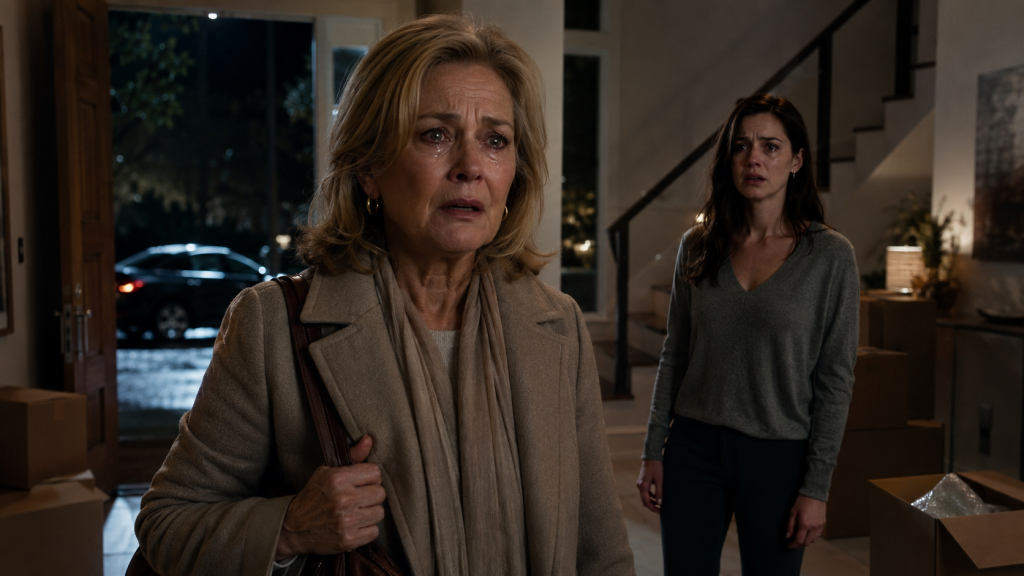
Then my daughter appeared at the bottom of the stairs.
She wore a plain gray coat.
Her hair was pinned tightly.
Her face was thinner than on the video calls.
For one second, she looked at me like I was a ghost.
Then her grocery bag fell from her hand.
“Mom?”
I tried to speak, but my throat closed.
Her eyes shot past me to the open room behind my back.
To the boxes of cash.
Her face changed from shock to fear.
“You shouldn’t have come,” she whispered.
I held the stair railing.
“Where is your husband? Where is Kang Jun?”
Mary Lou covered her mouth.
“Mom, please come downstairs.”
“No,” I said, my voice shaking. “Twelve years. Eighty thousand dollars every year. A house with no husband, no pictures, no life, and a room full of money. Tell me what is happening.”
Tears filled her eyes.
“Kang Jun died nine years ago.”
The words struck me so hard I nearly fell.
“Died?”
She nodded, crying now.
“Car accident. Nine years ago.”
I gripped the railing.
“Then who has been sending the money?”
She looked toward the front door, terrified.
“Not who, Mom. What.”
Before I could ask, a black car stopped outside the gate.
Mary Lou rushed up the stairs and grabbed my arm.
Her fingers dug into me.
“Listen to me. If they ask, you are not my mother. You are the cleaner.”
“What?”
“Please.”
The doorbell rang.
My daughter whispered the sentence that froze my blood.
“They own every dollar in this house, and they think they own me too.”
I wanted to scream.
I wanted to demand answers.
But Mary Lou’s fear was too real.
So I followed her downstairs.
She wiped her face quickly and opened the door.
Two men stood outside.
One older.
One younger.
Both in dark coats.
Their eyes moved over me once, then dismissed me.
The older man spoke Korean.
Mary Lou answered calmly, but her hands were shaking.
The younger man stepped inside without being invited.
He glanced at the staircase.
I lowered my head like a worker who did not understand.
The older man finally spoke in English.
“Who is this?”
Mary Lou did not look at me.
“Cleaner.”
He frowned.
“New?”
“Yes. Temporary.”
His eyes lingered on my face.
I kept my mouth shut.
For the first time in twelve years, I understood why my daughter never came home.
She had not forgotten me.
She was trapped.
The men walked into the office.
Mary Lou followed.
I stood in the hallway, heart pounding.
Their voices were low, but I heard enough.
Shipment.
Account.
Police.
Kang Jun.
Signature.
America.
The older man’s tone grew sharp.
Mary Lou answered softly.
Then came the sound of paper hitting a desk.
The younger man said in English, “You send next money before end of year. Same amount. Same message.”
Same amount.
Same message.
My stomach twisted.
Mom, always take care of yourself. I’m doing well.
It had never been only her message.
It had been a script.
When the men finally left, Mary Lou locked the door and collapsed against it.
I ran to her.
She sobbed once, then clapped a hand over her mouth as if crying itself was dangerous.
I held her face.
“Tell me everything.”
She shook her head.
“If I tell you, you’ll be in danger.”
“I crossed an ocean because not knowing was killing me. Tell me.”
We sat on the living room floor because neither of us could make it to the couch.
And my daughter finally told me the truth.
Kang Jun had not been the wealthy businessman he appeared to be.
He worked for a network that moved illegal money through small import companies.
At first, Mary Lou did not know.
She thought he was strict.
Secretive.
Controlling.
But not criminal.
After they moved to Korea, he took her passport “for safekeeping.”
He opened accounts in her name.
He used her American citizenship as a shield.
Money moved through her accounts, then out again.
Every year, eighty thousand dollars was sent to me.
Not as kindness.
As proof that Mary Lou looked like a dutiful daughter living a normal life.
“If anyone asked questions,” she whispered, “they could say I was supporting my mother. They made me write the same message every time.”
“What about Kang Jun?”
She looked down.
“Nine years ago, he tried to leave them.”
I went still.
“He wanted out?”
“Yes. He said we would disappear. He said he had hidden enough evidence to trade for protection. Then the accident happened.”
“You think it wasn’t an accident.”
“I know it wasn’t.”
She took a shaking breath.
“After he died, they kept me. They said the accounts were in my name. If I went to police, I would be blamed. If I returned to America, they would come for you.”
My mouth went dry.
“That’s why you never came home.”
Her face crumpled.
“I wanted to. Every Christmas. Every birthday. I bought tickets twice and canceled because they found out.”
I pulled her into my arms.
She felt too thin.
Too tired.
“I thought you chose this life,” I cried.
“I thought I was protecting you.”
For a long time, we held each other on that spotless floor in that lifeless house filled with money.
Then I asked, “Where is your passport?”
“They keep it.”
“Where?”
She hesitated.
“The office downtown.”
“And Kang Jun’s evidence?”
Her eyes changed.
“What?”
“You said he hid enough evidence to trade. Did you ever find it?”
Mary Lou wiped her tears.
“I think so.”
She led me upstairs to the room with the cash.
Behind one stack of boxes was a small vent panel.
She removed it with a screwdriver hidden under the carpet.
Inside was a sealed envelope, a flash drive, and a small notebook wrapped in plastic.
“Kang Jun put it there before he died,” she whispered. “I was too scared to use it.”
I looked at the flash drive.
Then at my daughter.
“Then we use it now.”
Mary Lou shook her head.
“They will know.”
“Not if we stop acting alone.”
I may have been a sixty-three-year-old widow from America, but I was not foolish.
Before leaving home, my neighbor had insisted I register my trip with the U.S. embassy information service.
She said, “Just in case.”
I had also written down the embassy address and emergency number on paper in my purse.
That scrap of paper now felt like a lifeline.
We packed quickly.
Not the money.
None of it.
Mary Lou wanted nothing from that room.
She took only the envelope, flash drive, notebook, one change of clothes, and a photograph hidden in her dresser.
It was of us at the airport twelve years earlier.
Her last free day.
We left through the back gate.
Mary Lou wore a hat and mask.
I held her hand like she was still my little girl crossing a busy street.
Every sound made her flinch.
Every black car made her stop breathing.
We took a taxi to a hotel near a crowded shopping district, then another taxi to an area closer to the embassy.
Maybe it was foolish.
Maybe it was desperate.
But desperate mothers can become very strategic.
At the embassy, Mary Lou finally spoke her own name without fear.
The process was not instant.
Stories make rescue sound like one dramatic door opening.
Real rescue is forms.
Interviews.
Waiting rooms.
Security officers.
Phone calls.
Tears.
More questions.
But the flash drive mattered.
Kang Jun’s notebook mattered.
Names.
Dates.
Account numbers.
Records of transfers.
Messages connecting the men to his so-called accident.
The embassy connected Mary Lou with legal assistance and local authorities.
Her passport issue was documented.
Her accounts were frozen pending investigation.
The cash house was searched days later.
The men in black coats did not disappear fast enough.
For the first time in years, they were the ones surprised.
Mary Lou and I were moved to a safe location while statements were taken.
The first night there, she slept for fourteen hours.
I sat beside her bed and watched her breathe.
Every few minutes, I touched her hand to convince myself she was real.
When she woke, she looked at me with swollen eyes.
“Mom?”
“I’m here.”
“I’m sorry.”
“No.”
“I sent you dirty money.”
“You sent me proof you were alive.”
She began crying again.
“I thought you would hate me.”
I held her.
“I could never hate you for surviving.”
It took weeks before we could return to America.
The investigation was bigger than either of us understood.
Kang Jun had been guilty of many things, but in the end, he had tried to save Mary Lou.
The notebook showed he had planned to expose the network and get her out.
His death had sealed her cage.
His evidence finally opened it.
When our plane landed in New York, Mary Lou gripped my hand so tightly my fingers hurt.
But this time, she was not leaving me at an airport.
She was coming home.
At my house, the first thing she did was stand in the kitchen and cry.
I had changed the cabinets with money she sent.
Bought new appliances.
Fixed the floors.
All of it suddenly felt heavy.
“I don’t want you to feel guilty,” I said.
She touched the countertop.
“I thought if your house was safe, maybe it meant something good came from it.”
“You are the good thing,” I told her.
“No money can replace that.”
We contacted lawyers.
Authorities reviewed the past transfers.
I turned over records of every annual payment.
The process was complicated, but because the payments were part of a coercive scheme and now under investigation, I was advised not to touch the remaining money in my accounts until everything was reviewed.
I did not care.
Let them take it.
Let them take every repaired roof tile, every remodeled cabinet, every dollar.
I had my daughter.
That Christmas, for the first time in twelve years, I set two plates.
This time, one did not stay empty.
Mary Lou sat across from me, wearing my old sweater, her hair loose around her shoulders.
She looked older than thirty-three.
Older than she should have.
But she was home.
The beef stew simmered on the stove.
The house smelled like onions, garlic, and memory.
She took one bite and covered her mouth.
“I dreamed about this,” she whispered.
I smiled through tears.
“I cooked it every Christmas.”
“I know.”
“How?”
She reached into her pocket and pulled out a small bundle of folded papers.
Copies of the messages she had never sent me.
Dozens of them.
Mom, I miss you.
Mom, I’m scared.
Mom, I want to come home.
Mom, please don’t forget my voice.
I could not read them all.
Not then.
Maybe not ever.
I held them to my chest and cried the way I should have cried years ago, if only I had known.
Mary Lou moved into her old room.
At first, she slept with the light on.
She hid food.
She panicked when unknown numbers called.
She apologized before asking for anything.
Healing was not quick.
But she began.
Therapy.
Legal meetings.
Long walks.
Quiet mornings drinking coffee beside me.
Sometimes she sat in the garden and simply listened to birds like they were a language she had forgotten.
Neighbors came by with casseroles.
Some asked too many questions.
I learned to say, “She was away. Now she’s home.”
That was enough.
One evening, a woman from church said, “At least she sent you all that money.”
I looked at her until she became uncomfortable.
Then I said, “I would have lived in a leaking house forever to have my daughter at my table.”
She never said it again.
Months later, Mary Lou received official confirmation that Kang Jun’s death investigation had been reopened.
She cried when she heard.
Not because she loved him the way she once thought she did.
Their marriage had been complicated by fear, control, and lies.
But because he had tried, at the end, to free her.
“He was wrong for bringing me into that world,” she said. “But he died trying to get me out.”
“Both can be true,” I told her.
That became something we repeated often.
Both can be true.
She had been trapped, and she had survived.
Kang Jun had deceived her, and he had tried to save her.
The money had helped me live, and it had come from pain.
I had been afraid to ask, and I had crossed the world when fear became smaller than love.
Both can be true.
A year later, Mary Lou started working at a community center helping immigrant women navigate legal forms and financial abuse resources.
She did not tell everyone her story.
Only pieces.
Enough to guide.
Enough to warn.
Enough to make another woman feel less alone.
The first time she came home after work smiling, truly smiling, I went into the bathroom and cried quietly.
Not from sadness.
From relief.
Her smile had returned slowly, like spring after a long winter.
The eighty thousand dollars no longer comes.
Thank God.
Some people still ask how I manage without it.
I tell them I manage just fine.
The roof is repaired.
The kitchen stands.
The bills are smaller now.
Mary Lou and I cook together.
We argue about salt.
We watch old movies.
She calls me Mama again when she is tired.
Every Christmas, I still set the table carefully.
But now, before we eat, Mary Lou lights one candle near the window.
“For the years we lost,” she says.
Then I light another.
“For the years we get back.”
Twelve years is a long time.
Long enough for a daughter’s face to change.
Long enough for a mother’s hair to turn gray.
Long enough for a lie to look like normal life.
But not long enough to break the invisible thread between a mother and her child.
I went to Korea looking for my daughter.
I found an empty house.
A room full of money.
A dead husband’s secret.
And a woman who had been surviving in silence so I could be safe.
When I opened the door, I froze.
But when my daughter whispered that they thought they owned her, something inside me thawed into fire.
They were wrong.
They owned the money.
They owned the fear for a while.
They owned the locks, the accounts, the threats, and the scripts.
But they never owned Mary Lou.
And they never owned the mother who crossed an ocean to bring her home.
THE END! THANKS FOR READING!