 Reading Time: 12 minutes
Two months ago, my wife drove to Knoxville to help our son and his wife unpack after moving into their new house. Maggie was supposed to stay for two weeks. After four days, she stopped answering my calls. By the fifth morning, I got into my truck and drove the three hours myself.
I had barely turned onto Kevin’s street when an elderly man from across the road rushed toward me and said, “Call an ambulance before you go inside that house.” Then my son opened the front door as if I were the problem. Maggie had always been the kind of woman who could turn chaos into home.
Give her a room full of boxes, loose screws, half-built shelves, and tangled cords, and she would somehow know exactly where everything belonged.
She folded towels like a hotel housekeeper.
She labeled pantry shelves.
She remembered where people would reach before they even knew what they were looking for.
So when Kevin said he and Brittany were overwhelmed after moving to West Knoxville, Maggie started packing almost immediately.
“They need help,” she told me in our Nashville kitchen, her reading glasses pushed onto her head. “It’s only two weeks, Frank. I’ll unpack the kitchen, organize the house, and help them breathe again.”
I did not like it.
Not because I did not love Kevin.
Because something about him had felt wrong for months.
He had been asking too many casual questions about our retirement accounts.
Making too many comments about how large our house was for just two people.
Laughing too often about how family should help family before outsiders got involved.
Maggie told me I was reading too much into it.
“He’s under stress,” she said. “Moving brings that out in people.”
So I kissed her goodbye in the driveway and watched her leave with a cooler in the back seat, a casserole wrapped in towels, and enough optimism to brighten the street.
For the first four days, she texted every morning.
Good morning.
Miss you.
Brittany still can’t find the silverware.
Kevin still doesn’t know how to hang curtains.
Then the messages stopped.
I called.
No answer.
I texted.
Nothing.
I called Kevin.
“She’s fine, Dad,” he said. “Just exhausted. We’ve been keeping her busy.”
The laugh he gave afterward felt wrong.
By the fifth day, I stopped waiting.
The drive to Knoxville felt endless.
Every mile gave me another excuse to calm myself.
Maybe Maggie forgot her charger.
Maybe she was asleep.
Maybe she was busy.
Maybe she was fine.
But after forty-one years of marriage, I knew the difference between silence and absence.
Kevin’s neighborhood looked perfect in that polished suburban way.
Wide lawns.
Brick mailboxes.
Old oak trees.
Porch lights glowing even in the afternoon shade.
His house sat near the end of the block, with white shutters, a broad porch, and curtains pulled tight.
Too quiet.
I parked at the curb.
Before I reached the walkway, an older man hurried over from the house across the street.
He looked nearly eighty, thin and tense, moving like someone who had spent days waiting for the right person to arrive.
“You related to the woman in that house?”
“She’s my wife,” I said. “Frank Callaway.”
“Earl Hutchins.”
He barely shook my hand before pointing toward Kevin’s house.
“You need to call an ambulance right now before you go in there.”
My hand went straight for my phone.
“What happened?”
His eyes flicked toward the upstairs windows.
“Three days ago, I saw your wife through the front window. She was sitting at the kitchen table and couldn’t keep her head up. Then she slid right out of the chair.”
The world seemed to narrow around me.
“I called over to your son,” Earl continued. “He told me she was fine. Said she had too much wine at dinner. But I watched for almost an hour. Nobody helped her off the floor.”
My throat tightened.
“What else?”
“I called for medical help anyway. Paramedics came. Your son met them at the door and said she had already spoken to a doctor. Said everything was handled. They left.”
The whole street seemed to go silent.
I gave the dispatcher the address and the facts in the clipped voice thirty years of police work had burned into me.
My wife had been seen unresponsive.
She had not answered calls in days.
I believed she needed immediate medical care.
Then I went to the front door.
Kevin opened before I knocked twice.
“Dad,” he said, blinking like I had interrupted something. “I didn’t know you were coming.”
“Where is your mother?”
“She’s upstairs resting. She’s been tired. Brittany has been making sure—”
I stepped past him.
“Dad, wait.”
I did not.
The house smelled of fresh paint, cardboard, and something sweet from the kitchen.
Boxes lined the hallway, but nothing looked chaotic enough to explain four days of silence.
Halfway up the stairs, Brittany appeared in a soft sweater, her hair neat, her expression calm.
“Frank,” she said carefully. “You scared us.”
“Where is Maggie?”
“She’s sleeping. She asked not to be disturbed.”
I stared at her.
“My wife hasn’t answered me in four days.”
Kevin came up behind me.
“Dad, you’re making this bigger than it is.”
That sentence changed something in me.
Because I had heard versions of it before.
When Kevin needed money.
When Kevin needed forgiveness.
When he wanted us to overlook one more problem.
You’re overthinking.
You’re being dramatic.
You don’t understand how hard things are right now.
I kept walking.
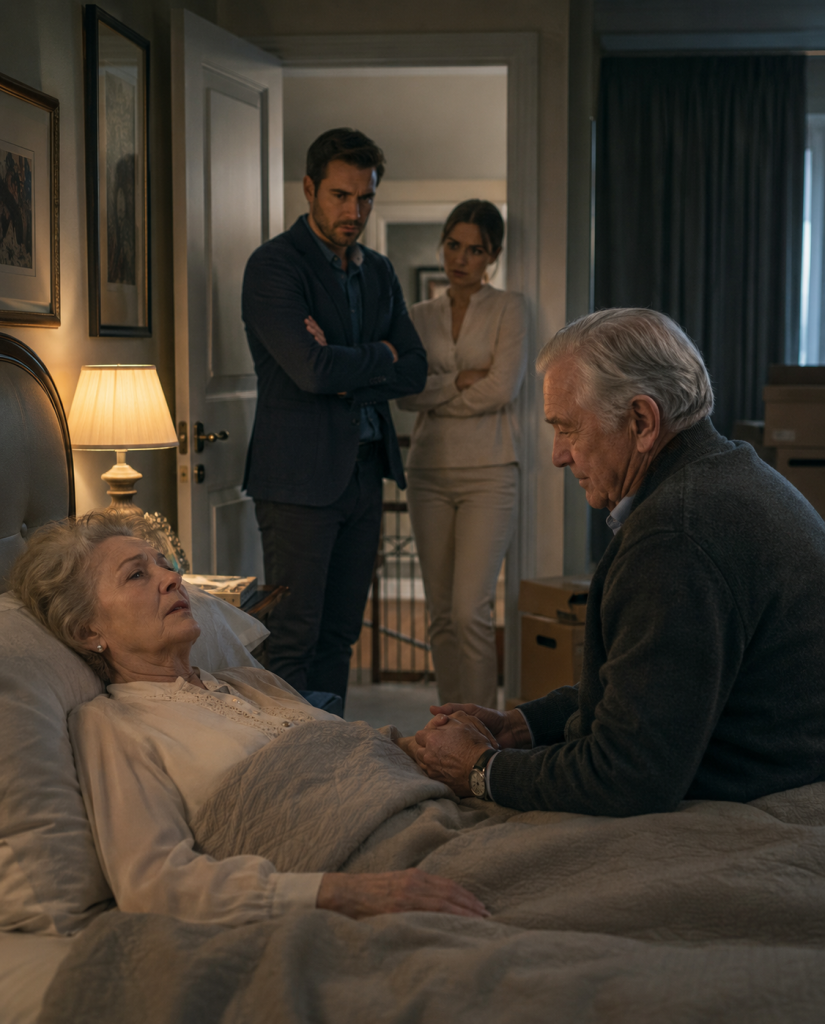
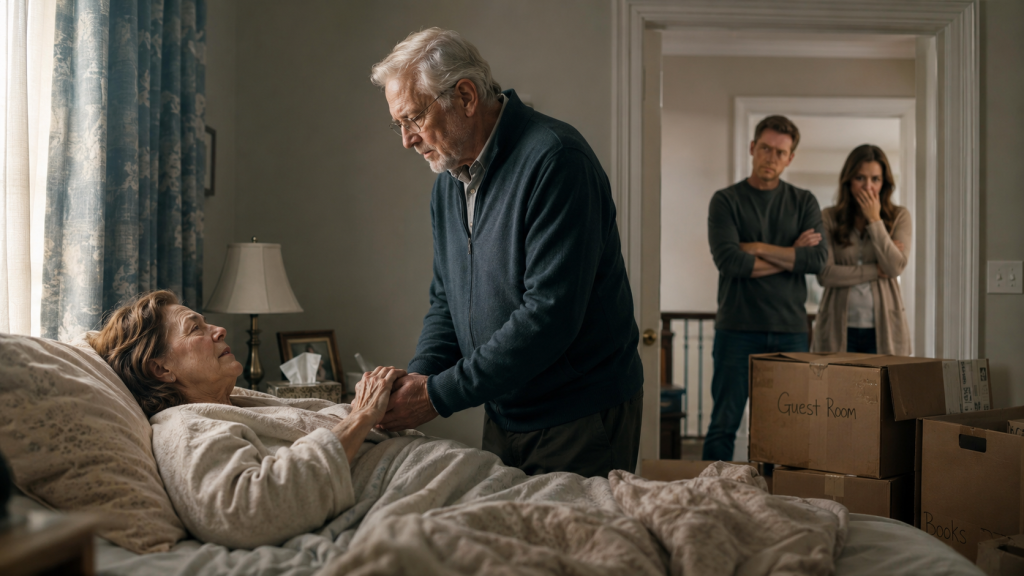
I found Maggie in the upstairs guest room.
The curtains were closed.
The air was stale.
She lay beneath the blankets with only her face visible, and the second I saw her, every excuse Kevin had given me disappeared.
She looked smaller.
Paler.
As if something had been slowly pulling her away from me while everyone downstairs practiced how to explain it.
Her eyes opened when I turned on the lamp.
They found mine.
“Frank,” she whispered.
The relief on her face was worse than fear.
It meant she had been waiting.
I sat beside her and took her hand.
“I’m here,” I said. “Help is coming.”
Behind me, Kevin spoke from the doorway.
“She had a reaction to something. We were handling it.”
I turned toward my son.
Not shouting.
Not shaking.
Just using the voice I had used for years when lies walked into a room pretending to be concern.
“Don’t say another word.”
The ambulance arrived minutes later.
Kevin and Brittany stayed on the porch.
They did not follow us to the hospital.
That was when I stopped thinking only like a terrified husband and started noticing like the man I used to be.
The closed curtains.
The missing phone.
The neighbor nobody wanted to believe.
The sweet tea Maggie said Brittany brought her every night.
And the way Kevin watched me from the front steps as the ambulance doors closed.
Not worried.
Caught.
At the hospital, the doctor asked me what medications Maggie took.
I listed them from memory.
Blood pressure.
Vitamin D.
Occasional allergy medicine.
Nothing strong.
Nothing that would make her nearly unconscious.
After the first round of tests, the doctor came back with a face I had seen too many times in my old career.
Careful.
Controlled.
Troubled.
“Mr. Callaway,” he said, “we found sedatives in your wife’s system.”
For one moment, I did not understand.
Then the word landed.
Sedatives.
“Did she take anything new?” the doctor asked.
I shook my head.
Maggie stirred on the bed.
Her lips were dry.
“She kept bringing me tea,” she whispered.
I leaned closer.
“Who?”
“Brittany,” Maggie said. “Every night. She said it would help me sleep. Kevin said I was anxious and needed rest.”
The room went cold.
I stepped into the hallway and called my old partner from the department.
Tom Alvarez had retired two years after I did, but men like us never truly stopped answering certain calls.
When he picked up, I said, “Tom, I need help, and I need it clean.”
By midnight, Knoxville police had been contacted, and Kevin’s house was being searched with probable cause supported by the hospital findings, Earl’s statement, and my emergency call.
Kevin arrived at the hospital furious before the search was even finished.
Not scared.
Furious.
“Dad, this is insane,” he snapped in the hallway. “You sent cops to my house?”
I stared at him.
“Your mother has sedatives in her system.”
“She probably mixed up pills.”
“Your mother does not mix up pills.”
“Brittany was helping her. You’re turning this into some crime show because you used to be a cop.”
“Where is her phone?”
He blinked.
“What?”
“Maggie’s phone. Where is it?”
“She probably misplaced it.”
Wrong answer.
Maggie never misplaced her phone.
She charged it every night beside her glasses and a glass of water.
Before I could respond, Tom called me back.
“They found the phone,” he said.
“Where?”
“In a kitchen drawer under dish towels.”
I closed my eyes.
“What else?”
Tom’s voice hardened.
“Her purse was locked in Brittany’s closet. They also found printed documents in the home office. Power of attorney forms. Property transfer papers. Beneficiary change requests for retirement accounts.”
My grip tightened around the phone.
“Signed?”
“No. But prepared.”
Kevin was watching me now.
He knew.
He knew something had shifted.
I lowered the phone and looked at him.
“You wanted your mother’s signature.”
His mouth opened.
Closed.
Then he said, “You don’t understand the pressure we’re under.”
There it was.
Not denial.
Justification.
I stepped closer.
“You drugged your mother for paperwork?”
“I didn’t drug anybody.”
“Then Brittany did it while you watched.”
Kevin’s face twisted.
“We were drowning, Dad. The house, the loans, the credit cards. You and Mom have more than you need. You always said family helps family.”
“Help is asked for,” I said. “Not extracted from a woman too weak to hold a pen.”
He looked away.
For the first time in his life, my son had nothing charming to say.
Then Earl Hutchins walked into the hospital with a small envelope in his hand.
He had followed the ambulance and waited in the lobby until someone let him know where to find me.
“I brought copies,” he said.
“Copies of what?”
“My security footage.”
Kevin’s face changed immediately.
Earl looked at him without fear.
“I record my front yard and the street. Three days’ worth. Thought someone might try to say I imagined things.”
Inside the envelope was a flash drive.
By the next morning, investigators had reviewed it.
The footage showed Kevin turning paramedics away.
It showed Brittany carrying trays upstairs twice a day.
It showed Maggie at the front window once, hand pressed weakly against the glass.
And it showed something that nearly broke me.
Maggie trying to reach the front porch.
She made it halfway down the walkway before collapsing near the shrubs.
Brittany came outside, looked up and down the street, then called Kevin.
Together they lifted Maggie and carried her back inside.
They did not call for help.
They hid her.
When I saw that footage, I walked into Maggie’s hospital room and closed the door.
She was awake now.
Weak, but clearer.
I sat beside her.
“I need to tell you something.”
Her eyes filled before I even spoke.
“She knew,” Maggie whispered.
“Who?”
“Brittany. She kept asking me where we kept the trust papers. She said Kevin deserved something now, not after we died.”
I took her hand.
“Why didn’t you tell me?”
Maggie looked ashamed.
“Because it was Kevin.”
That was the whole tragedy.
Because it was Kevin.
Our son.
The boy who once built forts out of couch cushions.
The teenager Maggie defended when he wrecked my truck.
The man she wanted so badly to believe was just stressed.
That kind of love can blind even good people.
Especially good people.
The police arrested Brittany first.
She broke quickly.
People like her often do.
She claimed Kevin planned it.
Kevin claimed Brittany pushed him.
Both of them claimed they never meant to hurt Maggie.
They only wanted her calm.
Cooperative.
Willing to sign.
That word stayed with me.
Cooperative.
As if my wife were a locked drawer.
As if her consent were an obstacle to be managed.
As if age made her easier to move around like furniture.
Maggie spent four days in the hospital.
The sedatives cleared slowly.
Her strength returned in pieces.
The first morning she could sit up by herself, she cried.
Not loud.
Just a steady, silent grief.
“I raised him,” she said.
I sat beside her.
“We both did.”
“Where did we fail?”
I wanted to say we did not.
But parenting does not come with clean answers.
So I told her the only truth I had.
“We loved him. He chose what to do with that love.”
Kevin called from jail twice.
I did not answer.
Maggie answered once.
I sat beside her while she listened.
His voice came through the speaker.
“Mom, I’m sorry. Brittany made everything worse. I was scared. We just needed help.”
Maggie closed her eyes.
“You could have asked.”
“You and Dad would have said no.”
“Yes,” she said softly. “We would have said no to stealing our lives.”
“Mom, please.”
“No, Kevin.”
Her voice trembled, but she did not break.
“You left me on the floor.”
Silence.
Then Maggie hung up.
After that, she blocked him.
The legal process moved slowly, but the evidence was overwhelming.
Hospital toxicology.
Earl’s footage.
The hidden phone.
The locked purse.
The prepared documents.
Text messages recovered from Brittany’s laptop.
Kevin: She’ll sign if she’s tired enough.
Brittany: Your dad is the problem.
Kevin: He won’t know until it’s done.
Reading those messages felt like being stabbed with a familiar knife.
Not by a stranger.
By blood.
Kevin and Brittany eventually accepted plea agreements.
Elder abuse.
Attempted financial exploitation.
Unlawful restraint.
Medication-related charges.
The words sounded official.
Cold.
But to me, the charge was simpler.
They tried to turn Maggie’s love into a signature.
When Maggie finally came home to Nashville, I changed the locks.
Then I changed our wills.
Then I contacted every bank, every retirement administrator, every insurance company, every attorney connected to our estate.
I placed alerts on everything.
No changes without in-person verification.
No authorization without both of us present.
No exceptions for family.
Especially family.
For weeks, Maggie moved through the house like a ghost.
She would open cabinets and forget why.
She would stand in the laundry room holding a towel, staring at nothing.
At night, she woke calling Kevin’s name.
Then she would remember and cry.
One afternoon, I found her in the kitchen with the old cooler she had taken to Knoxville.
The casserole dish was still inside, returned by police with her belongings.
She held it in both hands.
“I made this for them,” she whispered.
“I know.”
“I thought I was helping them breathe.”
I took the dish from her gently.
“You did help. They chose to suffocate themselves with greed.”
She looked at me then.
Her eyes were tired, but clear.
“I don’t want to hate him.”
“You don’t have to.”
“I don’t know how to love him now.”
I sat beside her.
“Then don’t decide today.”
That became our rule.
We did not decide forever on the worst day.
We decided only what kept Maggie safe that day.
No visits.
No calls.
No guilt.
No explanations to relatives who wanted to smooth things over because scandal made them uncomfortable.
Some people said, “But he’s your son.”
I learned to answer calmly.
“She is my wife.”
That usually ended the conversation.
Earl Hutchins called a month later.
He wanted to check on Maggie.
We drove to Knoxville to thank him in person.
He met us on his porch with coffee and a plate of store-bought cookies.
Maggie hugged him for a long time.
“You saved me,” she said.
Earl shook his head.
“No, ma’am. I just watched when other folks looked away.”
That sentence stayed with me.
Watching matters.
Listening matters.
Believing the quiet warning in your gut matters.
Before we left, Maggie stood on the sidewalk and looked across at Kevin’s house.
It had a FOR SALE sign in the yard.
Brittany’s parents had hired movers.
The curtains were open now.
The house looked ordinary.
That was the frightening thing.
Horror rarely announces itself.
Sometimes it has white shutters and a fresh welcome mat.
Sometimes it smells like sweet tea.
Sometimes it calls you Mom.
On the drive home, Maggie reached for my hand.
“I should have answered your calls.”
“You couldn’t.”
“I should have told you I was scared.”
“You survived.”
She looked out the window.
“I kept thinking he would come to his senses.”
I squeezed her hand.
“He may someday. But we won’t risk your life waiting for it.”
Two months later, Maggie began volunteering at a local community center teaching seniors how to protect themselves from financial abuse.
The first time she spoke, her voice shook.
But she stood at the front of the room with her reading glasses on her head and said, “Sometimes the person asking for your signature is someone you love. That does not mean you owe it to them.”
The room went silent.
Then people started taking notes.
I sat in the back row, watching the woman who could turn chaos into home turn pain into warning.
She was still Maggie.
Bruised in places no one could see.
But still Maggie.
Still folding towels like a hotel housekeeper.
Still labeling pantry shelves.
Still remembering where people would reach before they knew what they needed.
Only now, she also remembered one more thing.
Her kindness needed locks.
Her love needed boundaries.
Her signature belonged to her.
As for Kevin, I do not know what the future holds.
Maybe years from now, he will become the kind of man who understands what he did.
Maybe he will spend his life blaming everyone else.
That is no longer mine to manage.
My job is Maggie.
My job is morning coffee.
Doctor appointments.
Quiet evenings.
Security passwords.
Holding her hand when grief comes without warning.
And reminding her, as often as she needs to hear it, that being betrayed by your child does not mean you failed as a mother.
It means your love was real.
And his choices were his own.
Two months ago, my wife drove to Knoxville to help our son unpack.
She brought a casserole.
A cooler.
A heart full of trust.
By the time I found her, she had been hidden in a guest room with closed curtains, her phone buried in a drawer, and her name waiting on documents she never agreed to sign.
My son opened the front door as if I were the problem.
But Earl saw.
The doctors saw.
The cameras saw.
And finally, so did I.
Kevin once asked me why I kept my old police notebooks after retirement.
I told him habit.
That was only part of the truth.
I kept them because facts matter.
Dates matter.
Details matter.
And when someone you love lies to your face, the truth needs somewhere safe to stand.
Now the truth stands between Maggie and anyone who believes family is an excuse for harm.
Even our son.
Especially our son.
THE END! THANKS FOR READING!