 Reading Time: 9 minutes
My daughter never came home from prom. Eleven months later, what I found hidden inside my son’s beanbag chair made me scream. The last photo I have of my daughter was taken at 5:12 p.m. on our front porch eleven months ago.
She stood there in a pale blue dress, her hand linked through her twin brother’s arm, both of them laughing at something their father had just said. I remember adjusting a loose curl behind her ear before stepping back to take the picture.
“Stay together tonight,” I told them.
“We always do,” my son said.
“Mom, we are not eight,” my daughter added with a smile.
That was the last time I heard her voice.
At 11:47 p.m., the school principal called.
His voice was shaking.
“Your daughter disappeared. Please come here, now.”
She never came back.
The police searched the school, the woods behind it, and the river less than half a mile away.
They questioned everyone.
Kidnapping, they said.
Or maybe she wandered off and something happened near the water.
They kept asking my son, Caleb, the same question over and over.
“Where did Lila go?”
“I don’t know,” he kept saying. “She just stepped outside for air. I thought she’d be right back.”
After that night, Caleb changed.
He stopped laughing.
Stopped eating with us.
Stopped looking at his father.
And he locked his bedroom door every time he was inside.
If I knocked, he would say, “Please, Mom. Just don’t come in.”
I thought it was grief.
So I respected it.
For eleven months.
Until the afternoon I smelled smoke coming from under his door while he was away at college.
Panic took over.
I thought he had left something plugged in, or that the wiring had shorted.
I broke my own promise and forced the door open.
There was no fire.
Everything was perfectly still.
The room was dark, the curtains drawn, the air heavy with dust and stale laundry.
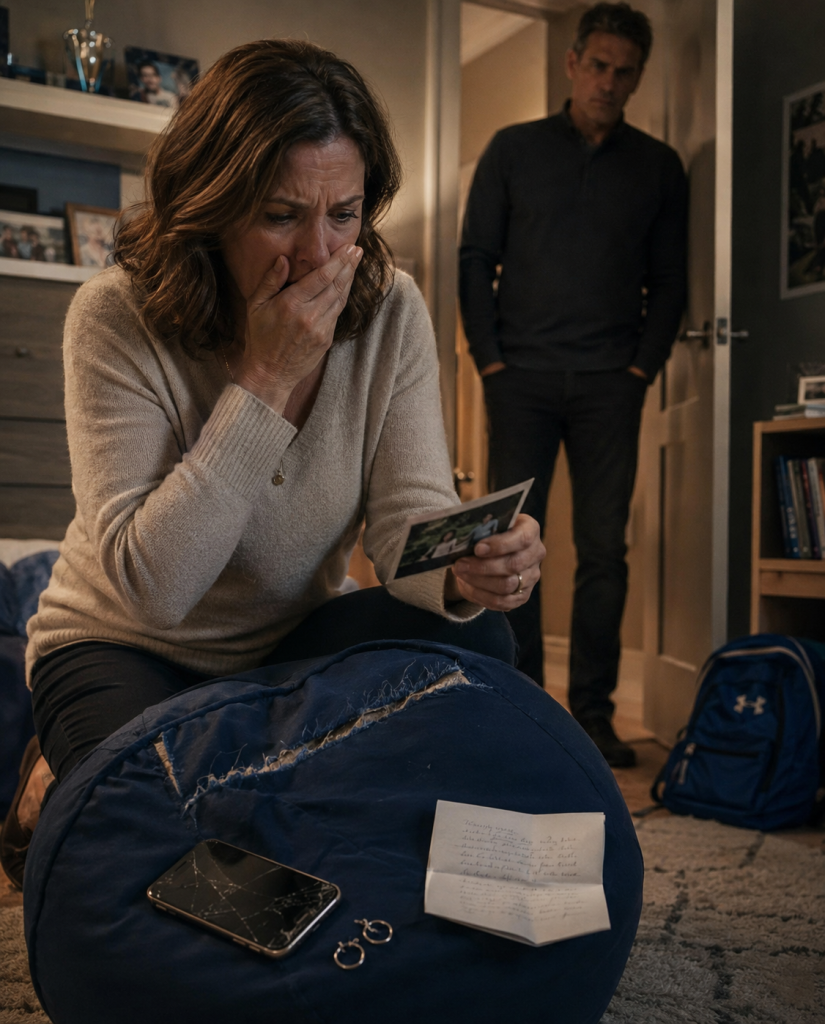
Then I saw the photo.
It was tucked halfway beneath his pillow.
At first, I thought it was the prom picture from our porch.
But when I picked it up, my hands went numb.
It was Lila.
Not on the porch.
Not smiling.
She was sitting on the floor of Caleb’s bedroom the night she vanished, still wearing the pale blue dress.
Her mascara was smeared.
One hand was pressed over her mouth as if someone had told her not to make a sound.
My knees nearly gave out.
I whispered her name.
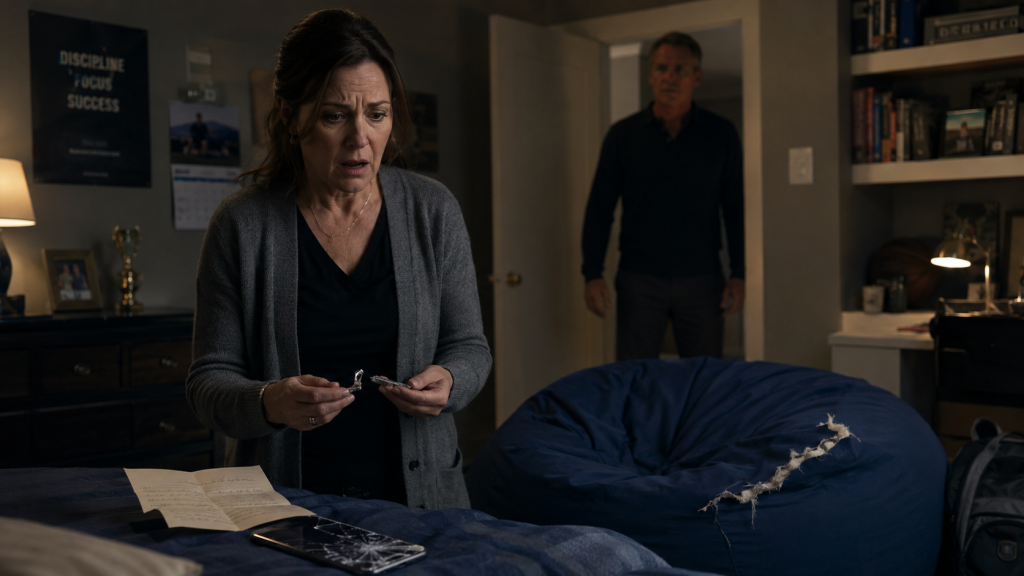
Then I saw the beanbag chair in the corner.
It had always bothered me.
That huge navy beanbag Caleb refused to let anyone touch.
He moved it himself every time we vacuumed.
He slept near it.
He guarded it like it contained his heart.
Now the seam was ripped open, and something inside reflected the light.
I walked toward it slowly, already afraid of what I would find.
With shaking hands, I pulled apart the fabric and reached inside.
My fingers touched plastic.
I pulled out a bag wrapped in duct tape.
Inside were Lila’s silver earrings.
Her cracked phone.
A torn piece of blue fabric from her dress.
And a folded note in Caleb’s handwriting.
I did not want to open it.
But I did.
I didn’t mean for this to happen.
Dad said if Mom knew, everything would be over.
I screamed so loudly the neighbor came running.
My first thought was that my son had hurt her.
My second thought was worse.
Dad.
My husband had stood beside me for eleven months.
He had held my hand during police interviews.
He had cried beside me at candlelight vigils.
He had comforted me while cameras recorded us.
And all that time, our son had locked himself in this room with the truth hidden inside a beanbag chair.
Then, from behind me, my husband’s voice came from the doorway.
“Put that down,” Nathan said softly. “You don’t understand what you found.”
I turned around.
Nathan stood in the hallway, still wearing his suit from work, his face pale but controlled.
Too controlled.
A father who had just seen his missing daughter’s belongings should have been breaking.
Nathan was calculating.
I backed away from him.
“What is this?”
He lifted both hands.
“Marianne, listen to me.”
“No. Tell me what this is.”
He glanced toward the open beanbag.
“Caleb was traumatized. He hid things. He didn’t know what he was doing.”
“Why does his note say Dad said if Mom knew, everything would be over?”
Nathan’s jaw tightened.
“He misunderstood.”
I held up Lila’s cracked phone.
“Where is my daughter?”
For one second, his expression changed.
Not grief.
Fear.
Then he said, “She’s gone.”
The way he said it made my blood turn cold.
Not missing.
Not lost.
Gone.
I ran.
I do not remember deciding to move.
I shoved past him, clutching the bag to my chest, and bolted down the stairs.
Nathan followed me, calling my name, but I was already at the front door.
Our neighbor, Mrs. Hale, was on the porch, startled.
“Marianne? Are you okay?”
“Call 911,” I said. “Tell them I found evidence in Lila’s case.”
Nathan reached the doorway.
“Marianne, you’re hysterical.”
Mrs. Hale stepped between us.
“No,” she said firmly. “She looks terrified.”
Nathan froze.
That pause saved me.
Within minutes, police cars filled our street.
Detective Ramirez arrived himself.
He had worked Lila’s case from the beginning.
When he saw the contents of the plastic bag, his face went still.
“Where did you find this?”
“In Caleb’s room. Inside the beanbag.”
His eyes moved to Nathan.
Nathan said nothing.
The detective asked, “Where is Caleb?”
“At college,” I said. “Two hours away.”
Ramirez nodded to another officer.
“Bring him in safely. Don’t let anyone contact him first.”
Nathan finally spoke.
“You have no right to interrogate my son without me.”
Detective Ramirez looked at him.
“Right now, Mr. Ellis, I’m more interested in why evidence from your missing daughter’s case was hidden in your house.”
Nathan looked at me then.
Not with love.
With warning.
For the first time, I saw what Caleb must have seen for eleven months.
That night, Caleb was brought home by two officers.
He looked thinner than I remembered.
His eyes were hollow.
When he saw me in the station interview room, he burst into tears.
“I’m sorry, Mom,” he sobbed. “I wanted to tell you.”
I reached for him.
Detective Ramirez allowed me one moment before the questions began.
Caleb clung to me like a little boy again.
Then he told the truth.
On prom night, Lila had never left the school to get air.
She had received a text from Nathan telling her to meet him near the side entrance.
“Dad said he needed to talk to her privately,” Caleb whispered. “She asked me to come, but when we got there, he told me to wait inside.”
But Caleb had followed.
He saw Nathan arguing with Lila near the parking lot.
Lila was crying.
She was holding her phone.
“She knew,” Caleb said.
“Knew what?” I asked.
His voice broke.
“Dad had another family.”
The room tilted.
Detective Ramirez leaned forward.
Caleb explained that Lila had found messages on Nathan’s old tablet two weeks before prom.
A woman.
A child.
An apartment across town.
Money transfers.
Lila planned to tell me after prom because she did not want to ruin the night.
But Nathan found out.
“He said she was destroying the family,” Caleb whispered. “She said the family was already a lie.”
“What happened then?” Ramirez asked gently.
Caleb covered his face.
“They argued. He grabbed her phone. She pulled away. She tripped near the service stairs.”
My hand flew to my mouth.
“She hit her head,” Caleb said, crying. “There was blood. She wasn’t moving.”
I stopped breathing.
Nathan had not planned to lose her.
But he had planned to silence her.
And when the accident happened, he chose himself.
Caleb continued.
“Dad told me if anyone knew, Mom would go to jail too because she owned the car he used. He said Emily—Lila—had run away and it would destroy everyone if I told. He said I had to help him bring her home first.”
“Bring her home?” I whispered.
Caleb nodded.
“He said we would call an ambulance from home and say she fell. But when we got her into the car, she woke up.”
My heart slammed.
“She was alive?”
Caleb sobbed harder.
“She was scared. She kept saying, ‘Mom. I want Mom.’ Dad panicked. He drove to the lake house.”
We had an old lake house forty minutes away.
It had belonged to Nathan’s parents.
Closed for years.
Barely used.
Caleb said Nathan took Lila inside and made him stay in the car.
“He came back alone,” Caleb whispered. “He said she ran. He said if I told anyone, they’d think I helped.”
For eleven months, my son had believed he helped make his sister disappear.
He hid the evidence because Nathan told him it proved his guilt.
The earrings.
The phone.
The torn fabric.
“He said if I kept quiet, he could fix it,” Caleb said. “But he never fixed anything.”
Detective Ramirez left the room immediately.
By dawn, police had a warrant for the lake house.
I was not allowed to go.
I sat in the station with Caleb’s hand in mine, feeling like time had cracked open.
At 8:32 a.m., Detective Ramirez returned.
His face told me before his words did.
They found Lila.
Not alive.
Hidden beneath the old boathouse floorboards, wrapped in a tarp Nathan had bought two days after prom.
I made a sound I did not recognize.
Caleb collapsed against me.
No mother should have to hear that.
No brother should have to carry it.
Nathan was arrested that morning.
At first, he denied everything.
Then detectives found security footage near the lake road.
Old toll records.
Hardware store receipts.
Messages from his other family.
And Lila’s cracked phone, once repaired enough to retrieve data, contained the draft message she never sent me:
Mom, I need to tell you something about Dad after prom. Don’t let him explain it away.
Those words broke me.
They also convicted him.
Months later, Nathan accepted a plea to avoid trial.
He admitted to covering up Lila’s death, tampering with evidence, coercing Caleb into silence, and concealing the body.
He still claimed the fall was an accident.
Maybe it was.
But the eleven months after were not.
Every lie was a choice.
Every false tear was a choice.
Every night he let me search for my daughter while he knew where she was, was a choice.
Caleb and I moved out of that house.
I could not sleep under the same roof where her earrings had been hidden.
We sold it after the case ended.
I kept only one thing.
The porch photo from 5:12 p.m.
Lila in her blue dress.
Caleb beside her.
Both laughing.
Before the world ended.
Caleb took a leave from college and moved in with me for a while.
He barely spoke some days.
Other days, he talked for hours.
Guilt poured out of him like poison leaving a wound.
“I should have saved her.”
“You were a child,” I told him again and again.
“I was seventeen.”
“You were still his child.”
“He made me lie.”
“He made you afraid.”
“But she was my twin.”
That sentence always broke him.
And all I could do was hold him.
Healing did not come quickly.
It came in small pieces.
The first time Caleb ate a full dinner.
The first time he slept without the lamp on.
The first time he said Lila’s name without choking.
The first time we visited her grave together.
He brought her a blue ribbon.
I brought her the photo.
We sat in the grass for an hour.
No speeches.
No prayers.
Just wind.
Just grief.
Just the terrible love that remains when someone is gone.
A year after we found her, Caleb asked if we could go to the lake house.
It had been torn down by then.
The new owners had cleared the land.
Only the water remained.
We stood on the shore in silence.
Then Caleb threw something into the lake.
A small piece of navy fabric.
The beanbag.
He had kept it.
Not all of it.
Just a scrap.
“I don’t want to carry it anymore,” he said.
I took his hand.
“Then don’t.”
He cried.
So did I.
I still dream of that prom night.
Sometimes in the dream, I stop her at the door.
Sometimes I take her phone and read everything.
Sometimes I follow them to the school.
Sometimes I save her.
Then I wake up and remember I cannot rewrite time.
All I can do is tell the truth now.
My daughter never came home from prom.
For eleven months, I thought mystery had taken her.
A stranger.
The woods.
The river.
A terrible unknown.
But the truth was closer.
It lived in my house.
It sat beside me at vigils.
It slept in my bed.
It called itself husband and father.
And the only reason I found it was because one day, smoke that was not smoke led me to a locked bedroom, a hidden photo, and a beanbag chair stuffed with the truth.
Lila is gone.
Nothing changes that.
But she is no longer missing.
Caleb is no longer silent.
And Nathan no longer gets to stand beside me pretending to grieve what he chose to bury.
The last photo I have of my daughter was taken at 5:12 p.m.
For a long time, I could not look at it.
Now I keep it beside my bed.
Not because it is the end.
Because it reminds me of the last promise she heard from me.
Stay together tonight.
We failed that night.
All of us, in different ways.
But Caleb and I are still here.
And every day, we choose to stay together now.
For her.
THE END! THANKS FOR READER!