 Reading Time: 11 minutes
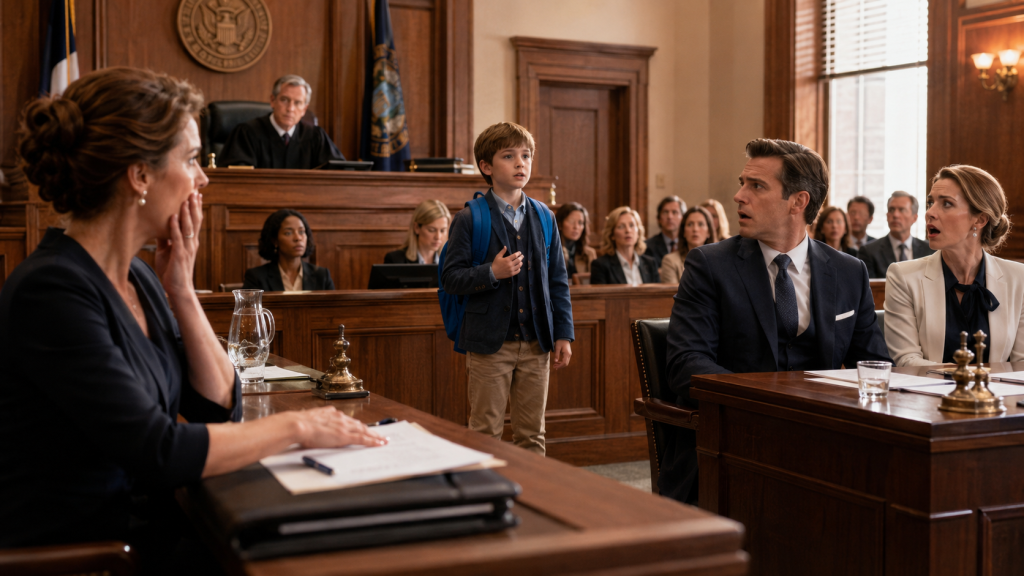
My nine-year-old son sat quietly in the back of the courtroom while my husband finished destroying my life. Then he stood up and said, “Your Honor, I know who framed my mom. They’re sitting in this room right now.”
For six years, my husband, Daniel, had convinced everyone that I was a thief. A liar. A criminal. A woman who had betrayed her own company. Our company. The company we had built together from nothing.
Vance & Keller Designs had started in our garage with one folding table, two borrowed laptops, and my savings account.
I handled the finances.
Daniel handled the clients.
We were supposed to be partners.
Husband and wife.
A team.
At least, that was what I believed.
By the time the final hearing arrived, Daniel had already taken almost everything from me.
My career.
My reputation.
My house.
Most of my friends.
And nearly my children.
Our daughter, Emily, was fifteen when the accusations first became public.
Old enough to read headlines.
Young enough to believe the parent who spoke louder.
Daniel told her I had stolen from the company.
He told her I had emptied accounts.
He told her I had planned to run away and leave them behind.
None of it was true.
But lies become powerful when they are repeated by someone wearing a good suit.
“I didn’t take anything,” I said over and over.
Nobody believed me.
Not the media.
Not our former friends.
Not the board members who had once toasted me at company dinners.
Not even Emily, who stopped answering my calls after Daniel told her I had ruined the family.
Only my son Noah still looked at me like I was his mother.
But after the divorce turned ugly, Daniel moved him out of state with Emily and his sister Vanessa.
He claimed it was for stability.
He claimed I was under investigation and not safe to be around.
The court allowed limited contact until the financial case was resolved.
Limited contact became missed calls.
Missed calls became blocked numbers.
Blocked numbers became birthdays without my children.
For six years, I lived with a silence where their voices should have been.
Then came the final hearing.
Daniel arrived early.
Of course he did.
He always liked to own the room before anyone else entered it.
He stood near the plaintiff’s table, surrounded by lawyers, looking calm and polished.
His navy suit was tailored.
His silver watch gleamed under the courtroom lights.
He smiled at the reporters near the back like a man who had already won.
When he testified, he looked the jury straight in the eye.
“She forged documents,” he said. “She emptied company accounts and tried to cover her tracks. I trusted my wife, and she used that trust to steal from all of us.”
His voice shook at exactly the right moments.
Daniel had always been good at performance.
My attorney, Rebecca Sloan, kept her face still.
But I could feel her tension beside me.
We had evidence that the accusations did not make sense.
Missing signatures.
Strange login times.
Transfers made from locations I had never visited.
But Daniel’s team had an answer for everything.
They said I had planned carefully.
They said I had used old credentials.
They said I was clever enough to make myself look innocent.
Every defense became another reason they claimed I was guilty.
By lunch, I felt hollow.
I had spent years fighting.
Years gathering bank statements, emails, old server logs, and fragments of proof.
But Daniel had money.
Daniel had influence.
Daniel had witnesses who owed him favors.
And I had exhaustion.
When Daniel finished his testimony, he walked past me on the way back to his seat.
He leaned close enough that only I could hear.
“You should have taken the settlement, Claire.”
My name sounded ugly in his mouth.
I stared ahead.
He smiled.
“You could have disappeared quietly. Now everyone gets to watch you lose.”
I did not answer.
I had learned that silence was sometimes the last dignity a person had left.
Then the courtroom doors opened.
At first, I did not turn.
Courtrooms are full of small interruptions.
A clerk entering.
An attorney stepping out.
A late observer slipping inside.
But then a whisper moved through the gallery.
Rebecca looked over my shoulder.
Her eyes widened.
“Claire,” she said softly.
I turned.
And my heart stopped.
Noah stood just inside the doorway.
Nine years old.
A little taller than the last time I had seen him in person.
His brown hair fell over his forehead.
His blue backpack hung from both shoulders.
The same backpack I had bought him years earlier, the one with the small rocket keychain still clipped to the zipper.
For a moment, the courtroom vanished.
All I saw was my little boy.
He scanned the room until he found me.
His face crumpled.
“Mom,” he whispered.
I stood before I realized I had moved.
“Noah.”
Daniel shot up from his chair.
“What is he doing here?”
Vanessa sat behind him, wearing a pale gray suit and gripping a designer handbag in her lap.
Her eyes sharpened immediately.
“Noah,” Daniel said, forcing a calm tone, “come here.”
But Noah did not move toward him.
He walked straight to me.
Slowly.
Carefully.
As if every step cost him courage.
When he reached my table, he looked up at me and said the words that changed everything.
“Mom, I know who framed you.”
I stared at him.
“What do you mean?”
His hands tightened around the backpack straps.
“I saw them.”
The room suddenly felt smaller.
Rebecca stood beside me.
“Saw who, Noah?”
“The person who went into Mom’s office.”
Daniel slammed his palm onto the table.
“Your Honor, this is absurd. He’s a child. He’s confused.”
The judge raised a hand.
“Mr. Keller, sit down.”
Daniel remained standing for one second too long.
Then he sat.
Noah swallowed hard.
“I wasn’t confused.”
Every eye in the courtroom turned toward him.
“I saw someone searching Mom’s office after everyone left. They opened her desk. They found the notebook where she kept her passwords.”
A ripple of whispers spread through the gallery.
Daniel’s face lost color.
Rebecca’s hand gently touched my arm.
“Your Honor,” she said, “we request permission for the child to be heard in chambers or under appropriate protection.”
The judge leaned forward.
“Noah, are you saying you personally witnessed this?”
“Yes, Your Honor.”
“Can you identify the individual?”
The courtroom fell completely silent.
Noah nodded.
Slowly, he raised his arm.
His finger moved across the room.
Past the jury.
Past the attorneys.
Past the spectators.
Then it stopped.
On Vanessa.
Daniel’s sister.
The woman who had stood beside him for six years, comforting my children, speaking to reporters, and calling me “tragic” in interviews.
Vanessa’s face went white.
“That’s impossible,” Daniel snapped.
But his voice cracked.
Noah looked at the judge.
“Aunt Vanessa came into Mom’s office after Dad told everyone to go home. She used a key from his coat pocket. I was hiding under the conference table because I didn’t want to go with Dad that night.”
My breath caught.
He had been there.
My baby had been there.
Noah continued, his voice trembling but clear.
“She opened Mom’s desk and took pictures of the password notebook.”
Vanessa stood so fast her purse fell from her lap.
A silver USB drive skidded across the courtroom floor.
Daniel lunged toward it.
The bailiff stepped between them.
“Don’t touch that,” the judge ordered.
Rebecca moved quickly.
With the judge’s permission, the bailiff collected the USB drive and placed it into an evidence envelope.
Vanessa pressed both hands to her mouth.
“I don’t know what that is.”
No one believed her.
Then Noah reached into his blue backpack.
He pulled out an old tablet with a cracked corner.
“I recorded part of it,” he whispered. “I was scared, so I didn’t tell anyone.”
Daniel stared at him.
“Noah.”
It was not a father’s voice.
It was a warning.
Noah flinched, but he did not stop.
Rebecca took the tablet carefully.
“Your Honor, we request immediate review.”
The judge ordered a recess.
But nobody moved.
Not really.
The courtroom seemed to hold its breath while the clerk connected the tablet to the courtroom screen.
The video flickered once.
Then my old office appeared.
My office.
The one I had not entered in six years without feeling sick.
The footage was shaky.
Low angle.
Taken from beneath the conference table.
But it was clear enough.
Vanessa entered the room.
She looked younger in the video.
More nervous.
She wore a black coat and carried a phone in one hand.
She went straight to my desk.
Opened the drawer.
Pulled out my small brown notebook.
The one Daniel had insisted I keep because “paper can’t be hacked.”
Then Vanessa whispered into her phone.
“Daniel, I found it. Once the transfers go through, she’ll never prove anything.”
The courtroom erupted.
The judge struck the gavel.
“Order.”
Daniel’s knees nearly gave out.
Emily, my daughter, was sitting two rows behind him.
I had not even seen her come in.
She covered her mouth with both hands, tears filling her eyes.
For six years, she had believed her father.
Now she had heard his name in Vanessa’s voice.
The judge ordered the jury removed temporarily and directed the bailiff to secure Vanessa.
Daniel’s attorney tried to object.
The judge silenced him with one look.
“Counsel, I strongly suggest you reconsider your next sentence.”
Vanessa began crying.
Not with remorse.
With panic.
“I only did what Daniel told me,” she blurted.
Daniel turned on her.
“Shut up.”
It was the wrong thing to say.
Everyone heard it.
Every reporter.
Every juror before removal.
Every officer.
Every person who had believed him.
Rebecca stood tall beside me.
“Your Honor, we request immediate preservation of all devices belonging to Mr. Keller and Ms. Vanessa Keller, review of the USB drive, and suspension of proceedings pending investigation into perjury, fraud, and evidence tampering.”
The judge’s expression was carved from stone.
“Granted.”
Daniel looked at me then.
For the first time in six years, he looked afraid.
Not angry.
Not superior.
Afraid.
Because the truth had walked into court wearing a blue backpack.
The hearing did not continue that day.
It transformed.
Police officers escorted Vanessa out for questioning.
Daniel’s phone was seized.
The USB drive was processed by forensic investigators.
And Noah was taken to a quiet room with a child advocate, Rebecca, and me.
The moment the door closed, he broke.
He ran into my arms and sobbed so hard his whole body shook.
“I’m sorry, Mom,” he cried. “I should have told sooner.”
I held him like I could hold together every broken year.
“No, baby. No. You were a child.”
“I thought Dad would hate me.”
“That was not your burden.”
“He said you left because you didn’t love us.”
I closed my eyes.
There are lies that hurt.
And then there are lies that steal years.
“I never stopped loving you,” I whispered.
Noah clung tighter.
“I kept the tablet hidden. Aunt Vanessa said if anyone knew, Dad would lose everything and it would be my fault.”
I pulled back enough to look at him.
“Noah, listen to me. Adults are responsible for what adults do. Not children.”
His lip trembled.
“I missed you.”
Those three words broke what was left of me.
“I missed you every day.”
Later that evening, Emily came to the courthouse hallway.
She stood ten feet away, pale and shaking.
She was twenty-one now.
A young woman.
But in that moment, I saw the fifteen-year-old who had stopped answering my calls.
“Mom,” she said.
I stood slowly.
She began crying before she reached me.
“I believed him.”
I wrapped my arms around her.
“I know.”
“I said terrible things.”
“I know.”
“I’m so sorry.”
I wanted to say it was okay.
But it was not okay.
None of it was okay.
So I told her the truth.
“We have time now.”
She cried harder.
That was all any of us had left.
Time.
The weeks that followed were brutal.
Daniel’s empire cracked quickly once investigators knew where to look.
The USB drive contained staged transfer logs, forged authorization files, and drafts of emails written to look like mine.
Vanessa confessed that Daniel had planned everything after learning I wanted to audit the company accounts.
He had already been siphoning money into private holdings.
When I got too close, he decided to frame me before I could expose him.
Vanessa helped because Daniel promised her a large share of the hidden funds and a board position after my removal.
The password notebook gave them access to my office computer.
The forged documents gave them the illusion of proof.
Daniel’s public grief over my “betrayal” gave him sympathy.
It had been a performance from the beginning.
The old server logs, which had once been dismissed as unreliable, were reviewed again.
This time, with Noah’s video, they told a different story.
The login times matched the night Vanessa entered my office.
The transfers matched Daniel’s private accounts.
The documents had been created from a device registered to Vanessa.
Every lie Daniel built had a timestamp.
The court vacated the findings against me.
The civil claims collapsed.
Then criminal charges followed.
Fraud.
Perjury.
Evidence tampering.
Conspiracy.
Daniel tried to claim Vanessa acted alone.
Vanessa turned over recordings proving otherwise.
People like them always trust each other until consequences arrive.
Then loyalty becomes a bargaining chip.
The company issued a public correction.
Former friends sent messages.
Some apologized.
Some acted like they had always had doubts.
I did not answer most of them.
Apologies given after the truth is safe are not the same as loyalty during the lie.
My daughter, Emily, struggled the most.
She had repeated Daniel’s stories for years.
She had defended him in interviews.
She had ignored my birthdays.
At first, she kept trying to punish herself.
“I should have known.”
I told her the same thing I told Noah.
“You were a child when this began.”
“But I kept believing him after I was older.”
“You loved your father. He used that.”
Healing did not happen in one dramatic hug.
It came slowly.
Awkward dinners.
Short walks.
Texts that began with “Are you awake?”
Therapy sessions.
Silences that no longer meant abandonment.
Noah stayed with me under temporary custody during the investigation.
The first night he slept in my house, he left his blue backpack beside the bedroom door like a guard dog.
In the morning, I found him sitting at the kitchen table, eating cereal quietly.
He looked up.
“Are you mad at me?”
I nearly dropped the coffee mug.
“No.”
“Because I waited.”
I sat beside him.
“Noah, you survived in a house full of adults telling you to be silent. I am proud of you for speaking at all.”
He stared at his cereal.
“Dad said truth ruins families.”
I reached across the table and touched his hand.
“No. Lies ruin families. Truth gives what’s left a chance to heal.”
Daniel’s trial came months later.
This time, I was not the accused.
I was the witness.
Walking into that courtroom felt like stepping back into a nightmare with the lights finally on.
Daniel looked thinner.
Older.
Still handsome, but sharpened by fear.
Vanessa sat at the prosecutor’s table under a plea agreement.
She did not look at me.
When the video of her in my office played again, the courtroom went silent just like before.
But this time, I did not shake.
Noah did not testify in open court.
His prior recorded statement was enough, and the judge protected him from further trauma.
For that, I was grateful.
Daniel was convicted on multiple counts.
When the sentence was read, he turned and looked toward Noah, who sat beside me.
For one terrible second, I feared he would try to speak to him.
But Noah reached for my hand.
Daniel looked away first.
That was the moment I knew my son had finally taken back something Daniel had stolen.
Not just truth.
Power.
A year after the truth came out, I returned to the old company building.
The board had offered me partial restoration and a settlement.
I accepted the settlement.
Not the position.
That life was gone.
I did not want to rebuild inside walls where I had been framed.
Instead, I started a smaller firm under my own name.
Claire Vance Consulting.
No Daniel.
No Keller.
No ghosts in the letterhead.
Emily helped design the logo.
Noah chose the color.
Blue.
“Like my backpack,” he said.
I laughed and cried at the same time.
The first framed photo in my new office was not a business award.
It was a picture of me and my children at the beach.
Emily on one side.
Noah on the other.
Both of them squinting in the sun.
All of us trying.
Not perfect.
Not fully healed.
But together.
Sometimes people still recognize me.
They whisper.
They remember the headlines.
The woman accused of stealing from her own company.
The wife framed by her husband.
The mother saved by her son.
I used to hate the whispers.
Now I let them pass.
Whispers do not define me anymore.
Neither do Daniel’s lies.
Neither does the courtroom where I nearly lost everything.
What defines me is the moment my little boy stood up while grown adults stayed silent.
He was nine years old.
Terrified.
Carrying six years of fear inside a blue backpack.
And still, he told the truth.
One evening, long after Daniel’s sentencing, Noah came into my office while I was reviewing paperwork.
“Mom?”
“Yes?”
“Do you ever wish I didn’t remember?”
I put down my pen.
I understood what he meant.
If he had not remembered, maybe he would not carry the fear.
Maybe he would not wake up some nights.
Maybe he would not feel responsible for saving me.
I reached for him.
“I wish you had never had anything painful to remember,” I said. “But I’m grateful you trusted yourself.”
He leaned into me.
“I was scared.”
“I know.”
“But you believed me.”
I kissed the top of his head.
“Always.”
The truth cost us years.
But it gave us back the future.
Daniel had spent six years building a cage out of lies.
He locked me inside it.
Then convinced my children I belonged there.
But he forgot something.
Children see more than adults think they do.
They remember the room.
The whispers.
The key taken from a coat pocket.
The aunt at the desk.
The phone call.
The fear.
And sometimes, even after years of silence, they find the courage to stand up in a courtroom and point directly at the truth.
My husband thought he had destroyed my life.
He thought he had buried me under forged documents and stolen accounts.
He thought no one would ever believe me.
Then my son walked into court.
And with one shaking hand, he showed everyone that the person Daniel should have feared most was never me.
It was the child he thought he had silenced.
THE END! THANKS FOR READING!