 Reading Time: 14 minutes
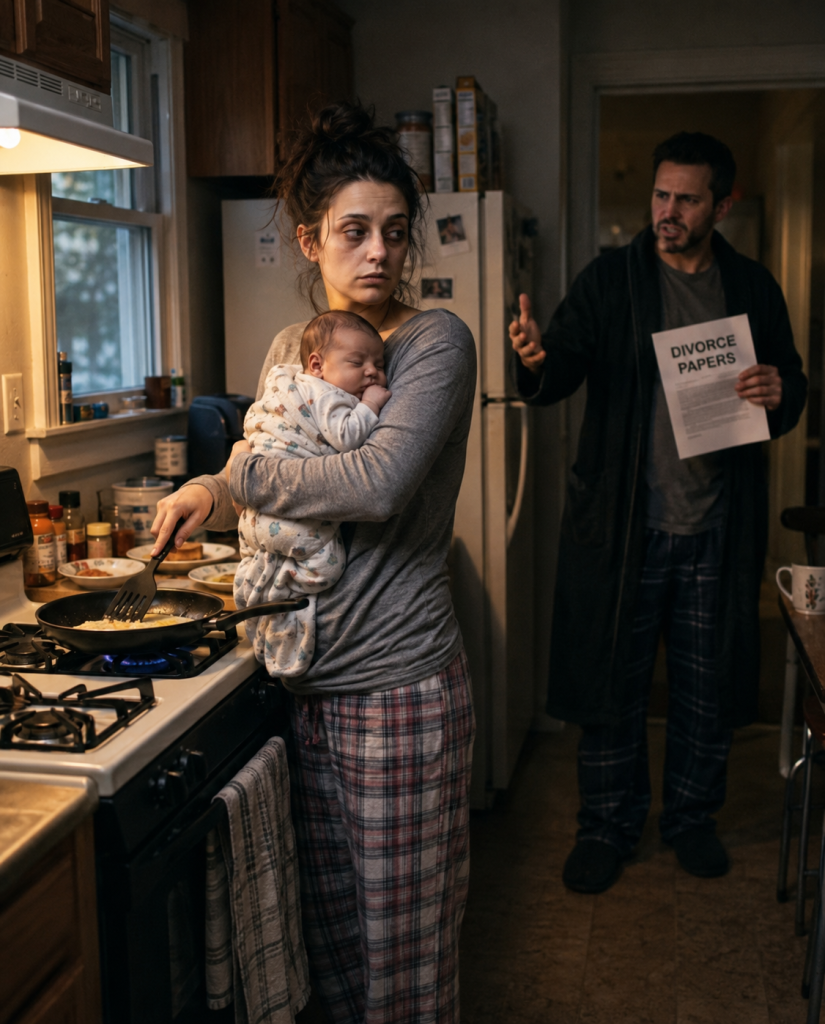
At 4:30 A.M., my husband came home, saw me holding our two-month-old baby while I cooked breakfast for his whole family, and said one word. “Divorce.” I didn’t cry. I didn’t beg. I turned off the stove, packed one suitcase, and left.
He thought I had nothing. He forgot what I did before I became his wife. The front door clicked open at exactly 4:30 a.m. The kitchen tile was cold under my bare feet. Bacon grease clung to the air, sharp and heavy, mixing with burnt coffee and the sour little smell of a baby bottle warming too long in a mug of water.
I had been awake since midnight with our two-month-old son tucked against my chest, his breath dampening the front of my T-shirt while I cooked breakfast for Mark’s whole family.
His parents were arriving at eight.
His sister had texted at 1:17 a.m. to remind me that his mother liked her eggs soft and her toast dry, as if I were staff she had forgotten to tip.
The refrigerator hummed.
The stove hissed.
My back ached from standing too long after barely sleeping.
Our son, Caleb, had finally stopped crying twenty minutes earlier.
He slept curled against me, one tiny fist tucked into my shirt, his little mouth soft and damp from milk.
Mark’s key scraped in the lock.
I tightened my arm around Caleb before I even turned around.
Some part of me already knew that whatever had walked into that kitchen was not my husband coming home.
It was the end wearing his navy suit.
Mark stepped inside with his tie loose and his hair damp from the fog.
He smelled like expensive cologne, cold air, and someone else’s perfume.
He looked at the table I had set.
The folded napkins.
The stack of clean plates.
The serving dishes warming in the oven.
The pan still hissing on the stove.
The bottle beside the coffee pot.
Then he looked at me like I was already furniture.
“Divorce,” he said.
No apology.
No explanation.
Just one word dropped into a kitchen where his wife was barefoot, exhausted, and holding his newborn son.
For one second, my heart hit my ribs so hard I thought Caleb would wake.
But he only sighed, warm and small, with milk on his breath and his cheek pressed against my collarbone.
I stared at Mark.
His expression did not change.
He looked almost bored.
As if he had rehearsed the word in his car and was disappointed I had not collapsed from it.
I did not ask who she was.
I did not ask how long.
I did not ask whether his parents knew.
Women are taught to believe details make betrayal bearable.
They do not.
Details only give betrayal a floor plan.
So I reached over, turned off the stove, and tightened my arm around my son.
Mark blinked.
My silence bothered him more than my pain.
“Did you hear me?”
“I heard you.”
“That’s all you have to say?”
I looked at the breakfast I had been cooking for people who treated me like a servant.
Bacon.
Eggs.
Biscuits.
Fruit sliced exactly the way his mother liked it.
A whole table prepared for a family that had never once asked whether I had eaten.
“Yes,” I said. “That’s all.”
Then I walked past him.
He moved slightly, as if he expected me to stop and plead.
I did not.
I went into the bedroom, laid Caleb gently in the portable bassinet, and pulled my old navy suitcase from the closet.
The same suitcase I had brought into this marriage four years earlier.
The one Mark once joked was “sadly practical.”
I packed like someone making an inventory.
Diapers.
Bottles.
Formula.
Two sleepers.
Baby wipes.
My laptop.
My wallet.
My birth certificate.
Caleb’s hospital discharge papers.
His social security card.
My old professional license documents.
Then the folder I had kept behind the loose back panel of my nightstand.
My hands did not shake.
That scared me more than crying would have.
Mark stood in the doorway watching me.
“You’re being dramatic.”
I placed Caleb’s tiny blue hat into the suitcase.
“You asked for divorce.”
“I said divorce. I didn’t say run away in the middle of the morning with my son.”
I looked at him then.
“Your son?”
His jaw tightened.
“Our son.”
“Interesting correction.”
He folded his arms.
“Where do you think you’re going?”
“Out.”
“To your mother?”
“My mother died two years ago. You remember because you complained the funeral ruined your golf weekend.”
His face flushed.
“That’s not fair.”
“No,” I said, closing the suitcase. “It wasn’t.”
By 4:52 a.m., I was standing in the driveway with Caleb strapped into his car seat, my suitcase beside my old SUV, and the porch flag tapping softly in the morning wind.
Mark leaned against the doorframe with his phone in his hand.
“Where are you going?” he asked again, like I was the problem.
“Out,” I repeated.
His mouth twitched.
He thought I meant a cheap motel.
He thought I meant a friend’s couch.
He thought I would be back before lunch because his family would arrive and somebody still had to serve breakfast.
Men like Mark do not fear quiet women.
They mistake restraint for permission.
I loaded Caleb into the car.
Mark called after me, “You’ll regret acting like this.”
I opened the driver’s door.
“No,” I said. “I think I’ve been regretting the opposite for years.”
Then I drove away.
The streets were almost empty.
The city slept beneath a layer of gray fog.
Caleb made soft noises in the back seat.
At the first red light, I looked at him in the mirror and finally let one tear fall.
Just one.
Not for Mark.
For the woman I had been at midnight, cooking eggs while holding a baby, still trying to earn kindness from people determined to deny it.
At 6:08 a.m., I was sitting at the kitchen table of Mrs. Henderson, the retired partner who had trained me ten years earlier.
Her house smelled like peppermint tea and lemon furniture polish.
A small American flag sat in a jar by the window beside a stack of old tax journals.
She had opened the door in a robe, taken one look at my face, and said, “Come in.”
She did not hug me right away.
That was why I trusted her.
Some people hug because they cannot bear silence.
Mrs. Henderson knew silence could be useful.
She poured tea.
She placed a folded blanket under Caleb’s car seat so it would not rock on the uneven kitchen floor.
Then she sat across from me.
“He said it while you were holding the baby?” she asked.
I nodded.
“And you left?”
“I packed one suitcase.”
Mrs. Henderson smiled without warmth.
“Good. Let him think that was all you had.”
I looked down at Caleb sleeping beside my foot.
“His family thinks I’m helpless.”
“No,” she said, sliding a yellow legal pad toward me. “They need you to be helpless. That’s different.”
Mrs. Henderson’s full name was Margaret Henderson, and ten years earlier she had been the most terrifying woman in corporate audit.
She trained me at Pierce & Rowland, where I started as a junior analyst and climbed faster than people expected.
She taught me how to follow money through shell companies, vendor accounts, inflated invoices, consulting agreements, and family businesses pretending to be legitimate.
“You don’t listen to what men say,” she told me once. “You listen to what their money does when they think no one is watching.”
Before I became Mark’s wife, before I learned which serving bowl his mother preferred and which shirts required dry cleaning, I was a senior corporate auditor.
A good one.
Maybe too good.
Mark loved that about me when we were dating.
He bragged that I could “spot fraud from a napkin.”
Then we married, and slowly, that skill became inconvenient.
When I questioned strange charges, he called me anxious.
When I asked why his family company paid repeated vendor advances to firms with no working websites, he told me I was embarrassing him.
When I became pregnant and left my job after a difficult first trimester, his mother said, “Maybe motherhood will soften that suspicious mind of yours.”
It did not.
It simply gave me more time to notice.
At 7:31 a.m., Mark’s mother called.
I let it ring.
Then his sister.
Then Mark again.
By 8:04, he texted.
My parents are here. Don’t embarrass me.
I read it twice while Caleb made tiny sleeping sounds beside my ankle.
Then I opened my laptop.
For eight months, I had documented everything.
Screenshots.
Account numbers.
Wire transfer ledgers.
A county clerk filing connected to a property Mark swore he never owned.
A folder labeled HOME EXPENSES that had nothing to do with our home.
Not suspicion.
Not jealousy.
Proof.
The first thing Mrs. Henderson did was call a forensic accountant she trusted.
The second thing she did was make me print every document twice.
“You’ll want digital copies, cloud copies, and paper copies,” she said. “Men who hide money often become clumsy when surprised.”
At 9:46 a.m., Mark texted again.
You’ll get nothing if you make this ugly.
I stared at those words.
He still thought the marriage was the only thing I could lose.
Mrs. Henderson placed the first printed report in front of me.
“Start with the account he opened three weeks before the baby was born.”
I turned the page.
There was Mark’s signature.
There was the transfer I had never authorized.
And beside it, in black ink, was a name that made Mrs. Henderson stop breathing for half a second.
Marlene Whitaker.
Mark’s mother.
The woman who treated me like unpaid help had been receiving money from the account Mark opened three weeks before Caleb was born.
Mrs. Henderson tapped the page once.
“That is not family support. That is asset hiding.”
My chest went cold.
Mark had moved marital money through his mother.
He had purchased a rental property through a shell company.
He had filed paperwork claiming I had no income, no contribution, and no interest in certain accounts because I was “voluntarily unemployed and financially dependent.”
Financially dependent.
That was how he saw me.
Not recovering from childbirth.
Not caring for his newborn.
Dependent.
Mrs. Henderson’s attorney arrived at 10:02.
His name was Samuel Price.
He wore a brown coat, carried an old leather briefcase, and looked far too calm for the chaos my life had become.
He read the documents in silence.
Then he looked at me.
“Did your husband know you had these?”
“No.”
“Good.”
At 10:12, I sent Mark one message.
Breakfast is over.
Then I turned off my phone.
Samuel filed emergency motions before noon.
Requests to freeze suspicious accounts.
Preserve financial records.
Prevent transfer of marital assets.
Establish temporary custody protections.
Demand financial discovery.
Notify the court of possible fraudulent conveyance.
The phrases were legal, clean, and powerful.
They sounded nothing like the kitchen where Mark had said divorce.
But they began there.
By noon, Mark’s smug texts stopped.
By three, he called from a different number.
I answered on speaker while Mrs. Henderson, Samuel, and the forensic accountant sat nearby.
“Come home,” Mark said.
His voice was different now.
Tighter.
“We can talk.”
I looked at Caleb asleep in a bassinet Mrs. Henderson had somehow produced from her attic.
“Talk to my lawyer.”
“Don’t be ridiculous.”
“You asked for divorce.”
“I was angry.”
“You were calm.”
He was quiet for two seconds.
Then he said, “My mother is devastated.”
I almost laughed.
“About the marriage?”
“About your accusations.”
“They’re not accusations. They’re documents.”
His breathing changed.
“What did you take?”
“My suitcase.”
“Don’t play games.”
“I’m not.”
His voice lowered.
“You have no idea what you’re doing.”
Mrs. Henderson raised one eyebrow.
I said, “Mark, I spent eight years finding hidden money for companies with better lawyers than yours. I know exactly what I’m doing.”
I hung up.
His mother called next.
I should have ignored it.
Instead, I answered once.
Marlene’s voice came through sharp and shaking.
“You are destroying this family.”
“No, Marlene,” I said. “I audited it.”
She gasped.
“You ungrateful little—”
I ended the call before she finished.
That evening, Mrs. Henderson insisted I sleep in her guest room.
I tried to protest.
She pointed toward the hallway.
“If you collapse from exhaustion, you will be useless to your son and entertaining to your enemies. Sleep.”
So I slept.
For four hours.
It was the longest I had slept since Caleb was born.
When I woke, he was fed, changed, and sleeping beside the bed in the bassinet.
Mrs. Henderson sat in the armchair reading audit notes like bedtime stories.
“You fed him?” I whispered.
“He and I reached an agreement.”
“He’s two months old.”
“He drives a hard bargain.”
For the first time in days, maybe months, I smiled.
The next week was war.
Quiet war.
Paper war.
Courtroom war.
Mark tried to control the story first.
He told his parents I had postpartum instability.
He told his sister I had kidnapped Caleb.
He told mutual friends I had taken financial documents I did not understand.
He told his lawyer I had never contributed to the marriage.
That last lie died quickly.
Samuel produced my old employment records, salary history, tax returns, mortgage contributions, audit work I had done unpaid for Mark’s startup during our first year of marriage, and proof that I had paid down joint debts before leaving work for pregnancy complications.
Then came the accounts.
The one opened before Caleb’s birth.
The transfers to Marlene.
The shell company.
The rental property.
The consulting firm registered to Mark’s college roommate.
The “vendor advances” that circled through family accounts and returned in smaller pieces.
Money moves like water, Mrs. Henderson used to say.
It always leaves a mark where it changes direction.
Mark had left marks everywhere.
At the first emergency hearing, he appeared in a charcoal suit and performed concern.
He looked tired, handsome, wounded.
The kind of man people wanted to believe.
I sat across the room in the only blazer that still fit after childbirth, holding Caleb’s diaper bag on my lap.
Mark’s lawyer tried to paint me as emotional.
“She left the marital home abruptly with an infant,” he said. “My client is deeply concerned.”
Samuel stood.
“My client left after Mr. Whitaker returned home at 4:30 a.m., demanded a divorce, and later threatened she would receive nothing if she challenged him.”
He placed printed messages on the table.
The judge read them.
Her expression did not change, but something in the room shifted.
Then Samuel presented the financial records.
Mark’s jaw tightened.
Marlene, sitting behind him in pearls and a cream blazer, went pale when her name appeared.
The judge ordered temporary support.
Temporary custody protections.
Preservation of marital assets.
Restrictions on account transfers.
Immediate production of financial documents.
Mark stopped looking wounded.
He looked furious.
When the hearing ended, he approached me in the hallway.
Samuel stepped between us.
Mark ignored him and looked at me.
“You’re enjoying this.”
I adjusted Caleb’s blanket.
“No.”
“You ruined me.”
I looked at him then.
Really looked.
At the man who had said divorce like a verdict while his newborn slept against my chest.
“You mistook service for surrender,” I said. “That was your mistake.”
He leaned closer.
“You think you’ll win?”
I did not answer.
Mrs. Henderson, who had come with me and dressed like a retired queen of tax law, stepped beside me.
“She already has,” she said. “You just don’t understand the category.”
Mark looked at her.
Recognition flickered.
He knew her name.
Most men in finance did.
His face changed.
Mrs. Henderson smiled.
It was not friendly.
That night, I moved into a short-term rental Samuel helped arrange through a client.
Small.
Clean.
Safe.
One bedroom, a kitchenette, and a window overlooking a parking lot.
It was not beautiful.
But it had a lock Mark could not open.
That mattered more.
I set Caleb’s bassinet beside the bed and unpacked the suitcase.
Diapers in the drawer.
Bottles on the counter.
Laptop on the tiny table.
Documents in a fireproof box Mrs. Henderson insisted I buy.
My whole life fit into one room.
But for the first time in years, no one was coming home at 4:30 a.m. to reduce me to a function.
Weeks passed.
Discovery widened.
Mark’s hidden property came out first.
Then the family transfers.
Then the false statement that I had waived rights to certain assets.
I had not.
The signature on that document was not mine.
The forensic handwriting expert Samuel hired confirmed it.
Mark claimed it was a clerical mistake.
Marlene claimed she knew nothing.
Then the bank records showed she had notarized the paperwork.
That was the day her screaming phone calls stopped.
Mark’s sister tried once.
She left a voicemail saying, “Mom is crying because of you.”
I saved it.
Then I listened again and realized something.
I had spent years being moved by their tears.
Their inconvenience.
Their discomfort.
Their disappointment.
But not once had any of them been moved by mine.
Not when I was pregnant and sick.
Not when I was bleeding through postpartum pads while cooking dinner.
Not when I held Caleb all night and still got up to make breakfast for them.
Their family had room for my labor, but not my pain.
That realization freed me more than the court orders did.
Mark tried apology next.
A carefully written email.
I was overwhelmed.
I said things badly.
I never meant divorce.
We should think about Caleb.
I read it while Caleb slept on my chest.
Then I forwarded it to Samuel.
No response.
Next came anger.
You are turning my son against me.
He was two months old.
Then bargaining.
We can sell the property and split something fair.
Then fear.
My lawyer says this could get ugly.
I stared at that message for a long time.
It had already been ugly.
It had been ugly at 1:17 a.m. when his sister texted egg instructions to a postpartum woman.
It had been ugly every time his mother walked past me holding a crying baby and said, “You’ll learn.”
It had been ugly when Mark moved money while I was learning how to breastfeed through tears.
Court simply gave ugliness a transcript.
Three months after I left, Mark was forced to disclose the rental property.
It was a small duplex across town.
Purchased under a limited liability company.
Funded partly through marital assets.
Managed by Marlene.
The judge did not appreciate the concealment.
Neither did the bank.
Neither did the tax attorney Samuel quietly suggested might want to review certain filings.
By then, Mark’s confidence had curdled into desperation.
At mediation, he sat across from me with dark circles under his eyes.
Marlene did not come.
Her lawyer advised against it.
Mark looked at Caleb, now five months old, sitting in his carrier beside me chewing on a soft toy.
“He’s bigger,” Mark said.
“Yes.”
“I’ve missed things.”
“Yes.”
For a second, grief passed through his face.
Maybe real.
Maybe another performance.
I no longer trusted myself to sort them.
“I want to be in his life,” he said.
“Then be safe in it.”
His eyes flicked up.
“You think I’d hurt him?”
“I think you hurt people when they become inconvenient.”
That landed.
He looked away.
The final settlement did not make me rich.
Real life rarely offers perfect victory.
But it gave me enough.
Enough support.
Enough access to marital funds.
Enough protection for Caleb.
Enough compensation for hidden assets.
Enough to rebuild.
Mark received structured visitation and mandatory financial compliance.
Marlene was removed from anything connected to Caleb.
The forged documents remained part of the record.
The rental property was sold.
The proceeds were divided under court supervision.
Mark hated every signature.
I signed mine calmly.
The morning after the divorce was finalized, I woke at 5:30 to Caleb babbling in his crib.
Sunlight filled the small apartment.
No bacon grease.
No burnt coffee.
No texts from his sister.
No one arriving at eight expecting service.
I picked Caleb up and held him against my shoulder.
He grabbed a fistful of my hair and laughed.
For months, I had been surviving.
That morning, I realized I was beginning to live.
Mrs. Henderson helped me find contract audit work I could do remotely.
At first, only a few hours during Caleb’s naps.
Then more.
My brain, which had spent months buried under bottles, court filings, and exhaustion, woke slowly.
Numbers still made sense.
Patterns still appeared.
Hidden things still revealed themselves when I looked long enough.
Six months after leaving Mark, I accepted a part-time forensic accounting position with a firm that specialized in divorce finance and small-business fraud.
My first client was a woman whose husband had hidden income through a landscaping company.
When I found the missing payments, she cried.
“Everyone said I was paranoid,” she whispered.
I knew that wound.
So I said what Mrs. Henderson once said to me.
“No. They needed you to be wrong. That’s different.”
A year after that morning in the kitchen, Caleb turned one.
I held his party in a park.
Blue balloons.
Cupcakes.
A picnic table covered in a plastic cloth.
Mrs. Henderson came wearing pearls and sneakers.
Samuel stopped by with a stuffed bear wearing a tiny tie.
Mark attended for one hour under the visitation agreement.
He brought a gift and kept his distance.
He looked at me once across the picnic table.
“You look different,” he said.
“I am.”
He nodded.
No apology came.
I did not wait for one.
Marlene sent no card.
His sister sent nothing.
That was fine.
Caleb had people around him who clapped when he smashed frosting into his hair.
That was enough.
Sometimes I think about that breakfast.
The eggs cooling.
The bacon grease in the air.
The folded napkins.
The wife I was at midnight.
The mother I became by dawn.
I do not hate her.
For a while, I did.
I wanted to shake her and say, Why are you cooking for people who would not bring you water if you were burning?
But now I understand.
She was tired.
She was postpartum.
She was trying to keep peace in a house that fed on her silence.
She had not yet learned that peace without dignity is just captivity with softer lighting.
Mark thought saying “divorce” would break me.
He thought I had nothing because he had slowly arranged my life to look that way.
No job.
No income.
A newborn.
A house filled with his family’s expectations.
He forgot I had a mind he never bothered to respect.
He forgot I had records.
He forgot I knew how money lied.
He forgot that before I became his wife, I was the woman companies hired when numbers did not add up.
So I left with one suitcase.
One baby.
One laptop.
One folder.
And enough proof to turn his threat into testimony.
People sometimes ask why I did not scream that morning.
Why I did not throw the pan, wake the neighbors, demand answers, make him explain.
The answer is simple.
I had a sleeping baby in my arms.
And I had already spent too many years giving Mark the satisfaction of my emotional labor.
That morning, silence was not weakness.
It was strategy.
I turned off the stove.
I packed.
I left.
And when he texted that I would get nothing if I made it ugly, I let the documents answer.
Now my mornings are different.
Caleb wakes early.
Always early.
He pats my face and says “Mama” like it is both a name and a command.
I make coffee.
Sometimes I burn toast.
Sometimes I make eggs exactly how I like them.
No one’s sister texts instructions.
No one’s mother critiques the plates.
No man walks in from another woman’s perfume and tells me my life is over.
My life did not end at 4:30 a.m.
It began again.
Not dramatically.
Not perfectly.
But honestly.
With cold tile under my feet, a baby against my chest, and one clear thought moving through the exhaustion.
I am done serving people who mistake my care for weakness.
And I was.
I still am.
THE END! THANKS FOR READING!