 Reading Time: 16 minutes
At my eighteenth birthday party, I quietly moved my $3 million inheritance into a trust, just in case my family ever tried to touch it. Everyone laughed and said I was being dramatic. But by the next morning, my parents said the words that proved I had just saved my entire future.
On the night I turned eighteen, my father raised a crystal glass in the ballroom of the Graystone Hotel and told two hundred guests I was “finally ready to become a woman.” Everyone clapped. The chandeliers glittered above us like frozen rain.
A string quartet played near the marble staircase. Waiters moved between guests carrying silver trays of champagne, sparkling water, and tiny desserts no one could pronounce.
My mother smiled beside me in a pale gold gown, one hand resting lightly on my shoulder as if she were proud.
My father stood on my other side, polished and powerful in his black tuxedo.
My older brother, Grant, leaned against the bar laughing with his friends, wearing an expensive watch my parents had bought him after his second failed business venture.
Everyone thought we looked perfect.
That was what Kingsleys did best.
We looked perfect in public.
My name is Evelyn Kingsley.
To most people in Chicago society, I was lucky.
I was the daughter of William and Cynthia Kingsley, a wealthy couple with a lakefront mansion, old family connections, and enough influence to make people lower their voices when they entered a room.
But being born into a beautiful family does not mean you are safe inside it.
Sometimes beautiful houses have the cruelest rooms.
Six months before my eighteenth birthday, my grandfather, Robert Hale, passed away.
He was my mother’s father, though he never acted much like her.
Grandfather was calm where my mother was sharp.
Careful where my father was greedy.
Quiet where my brother was loud.
He was the only person in my family who never treated me like decoration.
When I was little, he taught me chess on rainy afternoons and showed me how to read contracts before signing anything.
“Evie,” he used to say, tapping one finger on the page, “people hide knives inside pretty language.”
I did not fully understand him then.
I did by the time I turned eighteen.
Grandfather left me $3 million in my own name.
Not to my parents.
Not to the family company.
Not to a shared account.
To me.
The will said the money was mine when I became a legal adult.
My mother cried when the lawyer read that part, but they were not sad tears.
My father went still.
Grant cursed under his breath.
I noticed all of it.
At seventeen, people still think you do not understand adult faces.
That is not true.
Teenagers understand more than adults want to admit.
They only pretend not to because pretending keeps them safer.
After the will reading, my father began acting kinder than usual.
He asked about college.
He told me he was proud.
He said we should “handle the inheritance as a family.”
My mother started mentioning investment opportunities over dinner.
Grant began calling me “little millionaire” in a tone that sounded like a joke until it did not.
Then came the strange conversations.
My father said, “A young woman with too much money attracts the wrong people.”
My mother said, “You don’t want to seem selfish.”
Grant said, “It’s not like Grandpa expected you to hoard it.”
I said very little.
I had learned that silence made them underestimate me.
Two hours before my birthday party, I sat in a lawyer’s office in downtown Chicago, wearing a black dress and silver heels, with my hair already styled for the evening.
Across from me sat Nora Whitman, my grandfather’s attorney.
She was in her sixties, elegant, sharp-eyed, and completely unafraid of my parents.
Grandfather trusted her.
That was enough for me.
She slid a stack of papers across the polished table.
“You’re sure?” she asked.
I looked down at the trust documents.
My full legal name appeared at the top.
Evelyn Rose Kingsley.
Beneath it was the title:
The Hale Education and Independence Trust.
Nora folded her hands.
“Once this is executed, neither of your parents can access the principal. Only you and the independent trustee can authorize distributions under the terms we discussed.”
I nodded.
“The trust will cover tuition, housing, medical needs, professional training, and future investments?”
“Yes.”
“And emergency relocation if necessary?”
“Yes,” Nora said gently.
I looked up at her.
She did not pity me.
I appreciated that.
“I’m sure.”
She studied me for a moment.
“You know this may anger them.”
“They’re already angry.”
“They may hide it tonight.”
“That’s what I’m counting on.”
A faint smile touched Nora’s mouth.
“You are very much Robert Hale’s granddaughter.”
That almost made me cry.
Not because of the money.
Because someone had connected me to the only adult who had truly protected me.
I signed every page.
My hand did not shake.
By seven that evening, my inheritance was no longer sitting in an account my parents could pressure me to touch.
It was protected.
Locked.
Structured.
Mine.
At the party, my mother found out before dessert.
I do not know who told her.
Maybe the bank.
Maybe a social friend who knew Nora.
Maybe Grant had been checking accounts he thought he still had access to.
But I saw the exact moment she learned.
She was speaking with Senator Langley’s wife near the floral arch when her phone buzzed.
She glanced down.
Her smile froze.
Then her eyes lifted across the ballroom and found me.
If hatred could crack crystal, every chandelier in the Graystone Hotel would have fallen.
Ten minutes later, she pulled me into the hallway.
Her perfume smelled like roses and anger.
“What did you do?” she hissed.
I kept my voice calm.
“I protected what Grandpa left me.”
“You embarrassed us.”
“How?”
“You went to Nora behind our backs.”
“It was my inheritance.”
“You are eighteen,” she said, as if the number itself disgusted her. “You know nothing about money.”
“Then it’s good Nora does.”
My mother’s eyes narrowed.
“Do not get clever with me, Evelyn.”
Before I could answer, my father appeared behind her.
He wore his party smile, but his hand closed around my shoulder too tightly.
“What is this I hear about a trust?” he asked.
“A legal one.”
His smile sharpened.
“At eighteen? Sweetheart, you’ve been watching too many legal dramas.”
My mother tilted her champagne glass toward me.
“Nora should know better than to encourage childish paranoia.”
I looked between them.
“Grandfather wanted me to have control.”
My father laughed softly.
“Control? You are still living under our roof.”
“Not forever.”
Something flickered across his face.
A warning.
Then he leaned close enough that no one passing by could hear.
“Be careful, Evelyn. Money disappears quickly when little girls think they’re grown.”
I smiled.
“So I’ve heard.”
His grip tightened once.
Then he released me.
“Go smile for photographs.”
So I did.
I smiled beside the ice sculpture.
I smiled while my father gave a speech about family loyalty.
I smiled while my mother dabbed pretty tears from her eyes and told guests how proud she was of “our sweet Evie.”
Grant did not smile.
He stood near the bar watching me with a look I had never seen before.
Not irritation.
Not teasing.
Fear.
That frightened me more than my parents’ anger.
Grant was twenty-four and had never been told no in a way that mattered.
He had failed out of college twice.
He had burned through investors, loans, favors, and family money.
My parents called him ambitious.
Grandfather called him careless.
I called him dangerous.
Near midnight, I saw Grant’s girlfriend, Paige, laughing beneath the balcony.
She wore my grandmother’s diamond bracelet.
I recognized it immediately.
It had been locked in my mother’s jewelry room since the funeral.
Paige lifted her wrist toward the light, admiring the stones.
When she saw me looking, she smirked.
“Beautiful, isn’t it?”
“It was my grandmother’s.”
She looked at the bracelet again.
“Grant said it looks better on me.”
I said nothing.
Paige leaned closer.
“You’re not the only girl with expensive things now.”
I almost laughed.
She thought this was about jewelry.
It was about access.
And someone in my family was already giving away things that did not belong to them.
Grant disappeared before midnight with Paige.
My parents pretended not to notice.
The party ended after one.
Guests kissed my cheeks, wished me happiness, and told me how lucky I was.
I thanked them politely.
Then, at 1:10 a.m., I found my father in the hotel corridor near the service elevator, arguing into his phone.
His back was turned.
His voice was low but furious.
“She moved it,” he hissed. “All of it. No, I can’t reverse it. It’s locked.”
I stopped walking.
He listened.
Then snapped, “Because Nora Whitman got to her first.”
Another pause.
“No, Grant cannot wait. The payment is due Monday.”
My heart began beating harder.
Grant.
Payment.
Monday.
My father turned and saw me.
His face changed instantly.
Panic vanished.
Performance returned.
“Go to bed, Evelyn,” he said.
I looked at the phone in his hand.
“Who was that?”
“Business.”
“What payment is due Monday?”
His eyes went cold.
“Do not start imagining things.”
“I heard Grant’s name.”
“You heard nothing important.”
I took one step closer.
“Dad, what did Grant do?”
For a moment, I thought he might answer.
Then his expression hardened.
“You are a child who has been given too much confidence by a dead man’s money.”
I flinched.
Not visibly.
I had trained myself not to give him that satisfaction.
He stepped closer.
“You think moving that inheritance makes you powerful?”
“No.”
“Good. Because it does not.”
He leaned down, voice low.
“It makes you inconvenient.”
Then he walked away.
I did not sleep that night.
I sat in my hotel room still wearing my birthday dress, replaying everything.
The trust.
My mother’s face.
Grant’s fear.
The bracelet.
My father’s phone call.
At six in the morning, I texted Nora.
I think there is more going on.
She replied within three minutes.
There always is. Come to my office after breakfast if you can.
I almost smiled.
But I never made it to Nora’s office that morning.
At eight-thirty, a housekeeper knocked and told me my parents wanted me in the private breakfast room.
When I arrived, they were already waiting.
No coffee.
No smiles.
No servants.
My mother sat near the window, eyes red but not from sadness.
My father stood at the head of the table in yesterday’s shirt, sleeves rolled up, jaw tight.
Grant leaned near the doorway, arms crossed.
He looked like he had not slept either.
“Sit,” my father said.
I remained standing.
His nostrils flared.
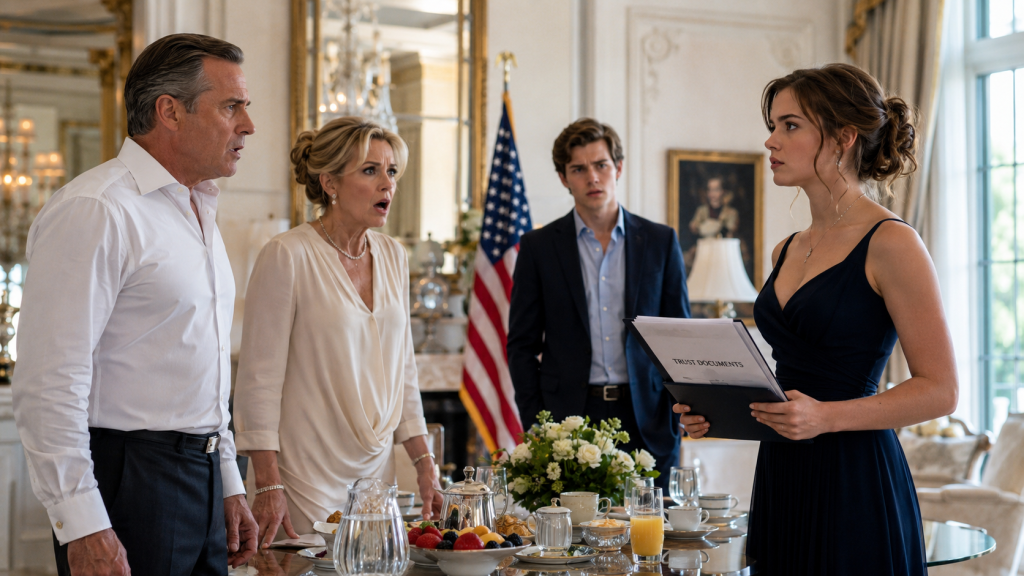
“Since you clearly don’t trust this family,” he said coldly, “you can pack your things and leave this house by noon.”
For one second, the room went silent around me.
Then my mother lifted her chin.
“And don’t expect a dollar from us.”
I looked at her.
Then at my father.
Then at Grant, whose rage was barely hidden behind his smile.
That was the moment I knew I had been right.
If they were throwing me out less than twelve hours after the trust was executed, then the money had never been a future concern.
It had been the plan.
I took a slow breath.
“Okay.”
My mother blinked.
That was not the reaction she expected.
“What did you say?”
“I said okay.”
My father’s face darkened.
“You think this is a game?”
“No.”
“You will leave the house. Your car is in my name. Your phone is on our plan. Your credit cards are linked to family accounts. Your college applications can be withdrawn.”
“Actually,” a calm voice said from behind me, “that would be a very poor decision.”
Everyone turned.
Nora Whitman walked into the breakfast room wearing a navy suit and carrying a leather folder.
My father’s face tightened.
“Nora.”
“William.”
My mother stood.
“You had no right coming here.”
Nora looked at me.
“Evelyn texted me this morning. Given the circumstances, I thought it best to come directly.”
“I did not invite you into a private family matter,” my father snapped.
Nora smiled faintly.
“Robert Hale did.”
She opened the folder.
“And since Evelyn is now legally an adult and a beneficiary of a trust for which I serve as independent trustee, this is not merely a family matter.”
Grant pushed away from the wall.
“This is ridiculous.”
Nora turned toward him.
“Grant, I would advise you to speak carefully.”
He went still.
That frightened him.
Good.
My father crossed his arms.
“What exactly do you think you’re going to do?”
Nora removed a document.
“First, Evelyn will not be leaving with nothing. The trust provides immediate access to housing, educational support, transportation, medical care, and legal protection.”
My mother laughed sharply.
“She can’t even rent an apartment alone.”
“She can,” Nora said. “And already has.”
I looked at her.
Nora gave me the smallest glance.
I understood.
She had prepared a place.
My father saw it too.
His jaw clenched.
“You planned this.”
“Robert planned for many possibilities.”
My mother’s voice trembled with rage.
“That old man poisoned her against us.”
Nora’s eyes sharpened.
“No, Cynthia. You did that yourselves.”
My father slammed one hand on the table.
“Enough.”
Nora did not flinch.
“Not quite.”
She removed another paper from the folder.
“Robert left a letter to be opened if Evelyn’s parents attempted to pressure her, remove her from the family home, or gain access to the inheritance.”
Grant’s face went pale.
My mother whispered, “What letter?”
Nora unfolded it.
I recognized my grandfather’s handwriting immediately.
My chest tightened.
Nora read aloud.
“If my granddaughter Evelyn is hearing this, then my fears were not imaginary. William and Cynthia have likely discovered they cannot use what I left her to repair the damage caused by Grant’s debts.”
The room went completely still.
Grant whispered, “No.”
Nora continued.
“I have watched this family reward irresponsibility and punish discipline for far too long. Evelyn owes none of you her future. If you are angry that she protected herself, ask yourselves why her protection harmed your plans.”
My throat burned.
My grandfather had seen it.
Before I had understood everything, he had seen it.
Nora lowered the letter.
My father’s face had gone gray beneath the anger.
My mother grabbed the back of a chair.
“That proves nothing,” she said.
Nora opened another section of the folder.
“No. But these do.”
She placed documents on the table one by one.
Bank statements.
Loan records.
A demand letter from a private lender.
Wire transfers.
Emails.
Jewelry invoices.
Credit card statements.
Everything I had suspected, made real in ink.
“Grant borrowed heavily using family business connections,” Nora said. “Several lenders expected repayment before the end of the month. William and Cynthia discussed using Evelyn’s inheritance to cover the most urgent obligations.”
My father’s eyes flashed.
“That is a lie.”
Nora lifted one page.
“This is an email you sent to your financial advisor two weeks ago.”
My father froze.
Nora read.
“Once Evelyn has access, we can convince her to move funds temporarily. She is young enough to pressure.”
My mother closed her eyes.
Grant turned away.
I stared at my father.
Young enough to pressure.
That was what he thought of me.
Not daughter.
Not person.
Opportunity.
My voice came out quieter than I expected.
“You were going to take it.”
My father looked at me.
“We were going to use it to protect this family.”
“No. You were going to use it to protect Grant.”
Grant spun around.
“You don’t understand anything.”
I faced him.
“Then explain it.”
His mouth opened.
No words came.
Nora answered for him.
“Grant personally guaranteed part of a failed development investment. There are also gambling-related debts concealed through business accounts.”
My mother snapped, “Nora!”
Grant’s face flushed deep red.
“You had no right digging into my life.”
Nora looked at him calmly.
“Your grandfather had every right to know whether his granddaughter’s inheritance was at risk.”
My father pointed at me.
“This is what money does. It turns children against their family.”
“No,” I said. “Lies do that.”
His eyes hardened.
“You think you can survive without us?”
I looked at Nora.
Then back at him.
“Yes.”
My mother laughed bitterly.
“You have no idea how cruel the world is.”
“I learned from experts.”
The words left my mouth before I could stop them.
My mother’s face changed.
For one second, hurt flickered there.
Then pride swallowed it.
“You will regret speaking to me like that.”
“No,” I said. “I think I’ll regret waiting so long.”
Nora closed the folder.
“Evelyn’s belongings will be collected today. If anything is missing, withheld, or damaged, I will file immediately.”
My father scoffed.
“You are threatening us in our own home?”
“I am informing you.”
Grant glared at me.
“You think this makes you better than us?”
“No,” I said. “It just makes me free from you.”
That was the sentence that finally broke the room.
My mother started crying then.
Soft, elegant tears.
The kind that had always worked on relatives, friends, neighbors, and my father.
“You’re cruel,” she whispered. “After everything we gave you.”
I looked at her carefully.
“What did you give me, Mom?”
She stared at me.
“A room in a house where I was reminded I was lucky to be tolerated? Parties where I had to smile while you lied? A brother who could take anything and still be defended? Parents who only wanted my inheritance when I became useful?”
Her lips parted.
I stepped back.
“Grandfather gave me a future. I protected it.”
By noon, I packed my life into three suitcases.
Nora came with a professional moving assistant and a security guard she said was “only precautionary.”
My mother stayed downstairs.
My father disappeared into his office.
Grant stood in the hallway watching me carry boxes from my room.
Paige’s bracelet flashed on his wrist now, wrapped in tissue paper.
I stopped.
“That belongs to Grandma.”
He looked down.
“She gave it to me.”
“No, she didn’t.”
His face twisted.
“What do you care? You have your precious millions.”
“I care because you keep taking things that don’t belong to you.”
For once, he did not argue.
He only looked tired.
“Do you know what it’s like?” he asked quietly.
“What?”
“To have everyone expect you to become something huge and know you can’t?”
The question surprised me.
For a moment, he sounded less like my arrogant brother and more like a frightened boy dressed in expensive failure.
“No,” I said honestly. “I know what it’s like to have everyone expect nothing and still be punished for becoming something.”
His eyes flickered.
I held out my hand.
“The bracelet.”
He hesitated.
Then placed it in my palm.
“Paige will be mad,” he muttered.
“Paige can survive disappointment.”
For a second, he almost smiled.
Then it vanished.
“I didn’t know Dad planned to take all of it.”
I looked at him.
“But you knew he planned to take some.”
He looked away.
That was answer enough.
I carried the bracelet downstairs and gave it to Nora.
“Keep this safe.”
She nodded.
At the front door, my father finally appeared.
He looked composed again.
That frightened me less now.
“You’ll come crawling back,” he said.
I paused on the threshold.
The house behind him was enormous.
Beautiful.
Cold.
For years, I had mistaken it for security.
But security is not marble floors or locked gates or a last name people recognize.
Security is having a choice.
I looked at him and smiled.
“No, Dad. I already escaped.”
Then I left.
Nora had arranged a furnished apartment near my future university campus.
It was small compared to the Kingsley mansion.
One bedroom.
Old brick walls.
A kitchen with a window over the sink.
A living room that echoed because I owned almost nothing.
But when I closed the door behind me, no one controlled the silence.
I sat on the floor and cried.
Not because I missed my parents.
Because I had spent eighteen years waiting for permission to breathe, and now breathing felt unfamiliar.
That first week was strange.
I learned how to buy groceries for one person.
How to set up my own phone plan.
How to choose towels without my mother saying the color was vulgar.
How to wake up without wondering what mood my father would be in.
Nora helped me enroll in financial literacy sessions, though she admitted I already knew more than most.
Grandfather had prepared me better than anyone realized.
College began that fall.
My parents sent one letter through their attorney, claiming I had been manipulated by Nora and requesting a “family mediation.”
I declined.
Grant texted twice.
The first message said, “Mom is losing it.”
I did not answer.
The second said, “Dad sold the lake boat.”
I stared at that one for a long time.
Then replied, “Debts have consequences.”
He did not respond for three months.
The family image began cracking publicly after that.
Word spread through the same social circles my mother once ruled.
Not all the truth.
Enough.
Grant’s failed investments.
My sudden departure.
Grandfather’s trust.
My father’s financial scrambling.
People whispered.
My mother hated whispers.
She had built her entire life around controlling what people saw.
Now she could not.
For years, I had been told that leaving family meant losing everything.
But leaving them taught me what I actually had.
I had a trust.
An education.
A safe apartment.
A lawyer who answered my calls.
A grandfather’s love, still protecting me from beyond the grave.
I also had myself.
That mattered most.
Two years later, I returned to the Graystone Hotel for a scholarship gala hosted by my university.
I almost did not go.
The ballroom held too many memories.
My father’s glass raised high.
My mother’s fake tears.
Grant staring like I had locked a door.
But I went anyway.
Not in a black birthday dress this time.
In a deep blue gown I chose myself.
Nora came as my guest.
When we entered, the chandeliers still glittered like frozen rain.
But I did not feel trapped beneath them anymore.
Halfway through the evening, I saw my parents across the room.
My mother looked older.
Still elegant.
Still polished.
But thinner around the eyes.
My father’s hair had gone grayer.
He saw me first.
For a moment, his face tightened.
Then my mother turned.
Our eyes met.
She did not approach.
Neither did I.
Nora touched my elbow.
“Are you all right?”
I looked at them.
Then around the ballroom.
Then at the scholarship students laughing near the stage.
“Yes,” I said. “I am.”
Later that night, Grant found me near the balcony.
He looked different.
Less shiny.
No designer watch.
No performance.
“I got a job,” he said.
I raised an eyebrow.
“A real one?”
He gave a tired laugh.
“Yes, Evelyn. A real one.”
“Congratulations.”
He leaned against the railing.
“I’m paying some of it back.”
“To who?”
“Lenders. Dad. Some to the estate account, though Nora says it doesn’t go to you directly.”
I studied him.
“Why tell me?”
He shrugged.
“I don’t know. Maybe because you were right.”
That sentence felt heavier than an apology.
“I usually am.”
He smiled faintly.
Then grew serious.
“I’m sorry.”
I looked out over the city.
“For what part?”
He exhaled.
“All of it. The money. The way I treated you. The bracelet. Letting them make you the problem because it was easier than admitting I was.”
I did not answer immediately.
Forgiveness is not a switch.
It is not something owed because someone finally says the correct words.
But honesty deserved honesty back.
“I’m not ready to forgive you,” I said.
He nodded.
“I know.”
“But I’m glad you’re trying.”
His eyes shone slightly.
“Me too.”
We stood there in silence for a while.
Not close.
Not healed.
But less false than before.
That was something.
My parents never apologized.
Not directly.
My mother sent birthday cards with stiff messages.
My father sent nothing.
I heard through relatives that he blamed Nora, Grandfather, modern culture, social media, and “bad influences.”
Never himself.
That was his choice.
I stopped waiting for different.
The trust became the foundation of my life.
Not because it made me rich.
Because it gave me room.
Room to study.
Room to choose.
Room to make mistakes that would not send me crawling back to people who would enjoy seeing me desperate.
I invested carefully.
I finished college.
I started a small foundation later, helping young adults protect inherited or scholarship funds from financial abuse.
Nora became one of the board members.
On the day we signed the foundation documents, she brought me Grandfather’s old fountain pen.
“He wanted you to have this when you were ready,” she said.
I held it carefully.
“He always seemed to know everything.”
“Not everything,” Nora said. “But enough.”
I used that pen to sign my name.
Evelyn Rose Kingsley.
For a while, I had considered changing it.
Dropping Kingsley.
Taking Hale.
But eventually, I decided to keep it.
Not because my parents deserved that.
Because I did.
They did not get to make me ashamed of my own name.
They did not get to define what a Kingsley daughter could become.
At eighteen, I moved my $3 million inheritance into a trust because I was afraid.
Afraid my family would pressure me.
Afraid they would call me selfish.
Afraid I would not be strong enough to say no if they cried, shouted, or threatened.
Everyone laughed.
They said I was dramatic.
Paranoid.
Childish.
But by the next morning, when my father told me to pack my things and leave because I had refused to give them access, the truth became clear.
I had not been dramatic.
I had been right.
That trust did more than protect money.
It revealed motives.
It separated love from control.
It turned threats into proof.
It gave me the strength to walk out of a mansion with three suitcases and still feel richer than everyone inside.
Grandfather once told me money does not make you safe.
Control does.
He was right.
But I would add something now.
Control is not only legal documents, bank accounts, or trustees.
Control is the moment you stop begging people to love you correctly.
It is the moment you understand that being cast out of a cruel home is not the same as losing a family.
Sometimes it is the beginning of finding yourself.
My father said I would come crawling back.
I never did.
I walked out by noon.
Head high.
Future intact.
And I have been walking forward ever since.
THE END! THANK YOU FOR READING!