 Reading Time: 15 minutes
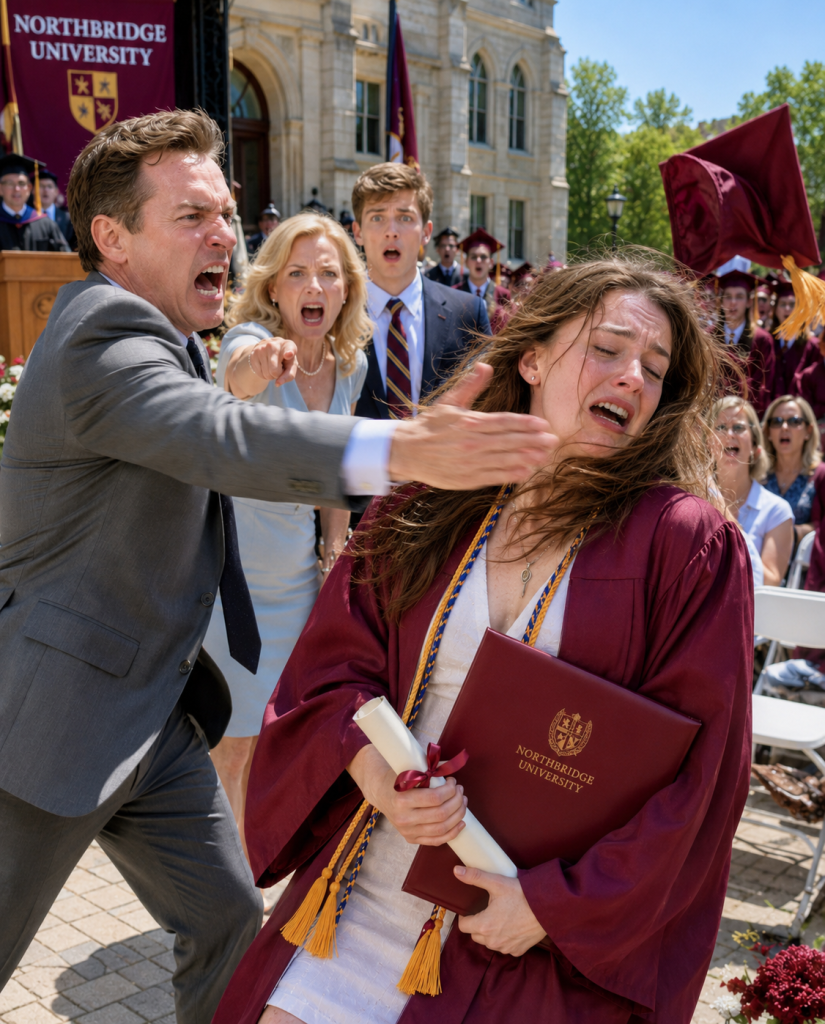
My father slapped me so hard during my college graduation that my cap crashed onto the pavement. My mother pointed at me and shouted, “You’re nothing but a loser in a graduation gown!” They expected me to break down in front of everyone.
Instead, I picked up my diploma, walked calmly to the microphone, and exposed the secret my family had spent four years desperately hiding. “You didn’t earn that diploma.” My father’s words came a heartbeat after his hand struck my face with enough force to send my graduation cap tumbling across the university courtyard.
The crack of the slap cut through the celebration. Conversations stopped. Applause faded into stunned silence. Hundreds of graduates, proud families, professors, and photographers turned toward us at once.
My cap rolled across the stone walkway until it came to rest beside the leather folder holding the diploma I had sacrificed four years to earn. My cheek burned. My hands trembled. But I never looked away from the man standing in front of me.
Arthur Vance, my father, glared at me as though my success were a personal betrayal.
“You’ve humiliated this family,” he growled, stepping closer. “Standing on that stage pretending you’ve accomplished something important.”
Before I could answer, my mother stormed forward.
Victoria Vance looked perfect, as always.
Pearl earrings.
Cream dress.
Hair pinned into a smooth twist.
A face polished for photographs and cruel enough to cut glass.
“A loser wearing a graduation gown is still a loser,” she shouted loud enough for everyone nearby to hear. “Stop embarrassing us!”
Gasps spread through the crowd.
Several parents exchanged horrified looks.
One professor raised a hand to his mouth.
A campus security officer immediately started walking toward us, his expression tense, but I quietly lifted one hand.
“Please,” I said evenly. “Let them finish.”
My best friend, Paige, rushed over, her face pale with concern.
“Audrey,” she whispered. “Are you okay?”
I did not answer.
Not because I could not.
Because I had imagined this moment for years.
I had imagined it during double shifts at the diner.
During nights in the library when my eyes burned so badly the words on the page blurred.
During winter mornings when I walked across campus before sunrise because I could not afford parking.
During every family gathering where my parents smiled at relatives and told them I had wasted my life.
I had not expected the slap.
But I had always known the day would come when my parents could no longer hide the truth.
For four years, they told relatives that I had dropped out of college.
They claimed I was lazy.
Irresponsible.
Ungrateful.
According to them, I had wasted every opportunity they had supposedly given me.
The real story could not have been more different.
I had earned a competitive scholarship.
I worked before sunrise at a neighborhood diner where my uniform smelled like coffee, bacon grease, and exhaustion.
I tutored students every afternoon in statistics and academic writing.
Most nights, I stayed in the library until it closed, surviving on vending machine coffee and cheap sandwiches because every extra dollar went toward tuition, books, housing, and fees.
There were weeks when I slept only a few hours each night.
There were nights I cried alone in empty study rooms before forcing myself back to work.
Still, I never quit.
Not once.
Not when my parents stopped answering my calls.
Not when my brother Julian posted photos from luxury vacations while I chose between groceries and lab fees.
Not when my mother told my aunt that I was “probably living off men somewhere.”
Not when my father called me a disgrace because I refused to come home and “act useful.”
Every insult became fuel.
Every lie became another reason to keep going.
That morning, when the dean announced my name with highest honors, the audience erupted into applause.
Audrey Vance.
Bachelor of Science in Accounting.
Summa cum laude.
Departmental honors.
Faculty award for academic excellence.
I walked across the stage feeling every sleepless night under my feet.
I shook the dean’s hand.
I accepted my diploma.
For one perfect second, I thought I had survived my family.
Then I saw them.
My parents stood near the front of the courtyard.
They had not told me they were coming.
My mother’s mouth was tight.
My father’s face was dark with anger.
And behind them stood my younger brother, Julian.
He wore a tailored designer suit and an expensive watch I recognized from his social media posts.
Julian had always been celebrated as the family’s greatest success, even after failing out of college twice and losing thousands of dollars on failed business ventures.
Money was always available for him.
Luxury vacations.
New cars.
Private coaching.
The latest electronics.
Rent for an apartment he barely used.
Investment money for ideas he abandoned after two months.
When it came to my education, however, my parents insisted there was never enough to help.
They said I needed to learn independence.
They said Julian needed support because “men carry the family name.”
They said I was selfish for expecting anything.
Watching me receive my diploma shattered the story they had spent four years telling everyone.
That was why my father crossed the courtyard.
That was why he slapped me.
Not because I failed.
Because I had succeeded without them.
Slowly, I bent down, picked up my graduation cap, and brushed dust from my diploma case.
The courtyard remained silent.
Even the photographers had stopped moving.
I stood and faced my parents.
My face still stung.
My voice did not shake.
“You’re right about one thing, Dad,” I said calmly. “Everyone here deserves to know the truth.”
A flash of panic crossed my mother’s face.
“Audrey,” she warned. “Don’t you dare make a scene.”
That almost made me laugh.
They had struck me in public.
Humiliated me in front of hundreds.
Called me a loser at my own graduation.
But I was the one making a scene.
Ignoring her, I turned and walked toward the ceremony podium.
Paige followed a few steps behind me.
“Audrey,” she whispered, “what are you doing?”
“What I should have done years ago.”
The university president stood near the microphone, speaking quietly with the dean.
When he saw me approaching, his expression shifted from concern to uncertainty.
“Miss Vance,” he said gently, “perhaps we should step aside and—”
“No,” I said. “This needs to be public.”
He glanced toward campus security, then toward the crowd.
Hundreds of people were still watching.
Phones were lifted now.
Recording.
Waiting.
I reached into the hidden pocket sewn inside my graduation gown.
Paige had helped me stitch it there the night before.
“Just in case,” she had said.
I had told her I probably would not need it.
I was wrong.
From the pocket, I removed a thick sealed envelope.
I had carried it all day.
Inside were copies of every document I had spent four years collecting.
Bank records.
Emails.
Legal letters.
Withdrawal forms.
Receipts.
Screenshots.
Proof.
I stepped up to the microphone.
The courtyard speakers gave a soft squeal.
Every head turned toward me.
My father’s voice cut through the silence.
“Audrey! Step away from there!”
I looked at him.
For the first time in my life, he looked afraid of me.
Not physically.
Not emotionally.
Afraid of what I knew.
I leaned toward the microphone.
“Before I leave this university,” I announced, my voice carrying across the entire courtyard, “I need to report the people who stole my tuition money, forged financial documents using my name, and spent years trying to erase me from my own family.”
The crowd erupted in shocked whispers.
Below the stage, my father shouted in panic.
“Audrey! Stop talking!”
But it was already too late.
The microphone was live.
And every person in the crowd was listening.
I opened the envelope and removed the first document.
A bank statement.
“This,” I said, holding it up, “is the education fund my grandfather, Charles Vance, created for me before he died.”
My grandfather had been the only person in my family who ever treated me like I mattered.
He was quiet, patient, and practical.
When I was little, he taught me how to balance a checkbook at his kitchen table.
He said numbers could tell stories if you learned how to listen.
He died when I was sixteen.
At the funeral, my father stood beside his casket and cried harder than anyone.
Later, I understood why.
Grandfather had left money for me.
Not to my parents.
To me.
“The account held eighty-four thousand dollars,” I continued. “Enough to pay for my undergraduate education.”
My mother’s face went white.
Julian shifted behind her.
I lifted the second page.
“Three months before my freshman year, nearly every dollar was transferred out of that account.”
My father jabbed a finger toward me.
“You have no idea what you’re talking about.”
I looked at him calmly.
“I do. I’m an accounting graduate, remember?”
A few people in the crowd murmured.
Some laughed softly, not with amusement, but disbelief.
I continued.
“The transfer forms show my signature authorizing the withdrawal.”
My mother lifted her chin.
“Because you agreed to help the family.”
“No,” I said. “I did not.”
I pulled out a third document.
“This is the handwriting analysis report comparing the signatures on those withdrawal forms to my actual signature. They do not match.”
The university president stepped closer, his expression suddenly serious.
A professor from the business department moved to the side of the stage, staring at the papers in my hands.
My father shouted again.
“This is private family business!”
I turned toward him.
“You made it public when you hit me.”
That silenced him for half a second.
I faced the crowd again.
“My parents forged my signature and transferred the money into an account linked to my brother, Julian Vance.”
Julian’s mouth fell open.
“That’s not true.”
I looked at him.
“Julian, please don’t lie today. We both know you’re bad at it.”
His face reddened.
I lifted more documents.
“Here are bank records showing deposits into his business account. Here are receipts from the clothing company he started and shut down in six months. Here are payments for his leased car. Here are invoices for a private marketing consultant. Here are travel expenses marked as business development.”
I paused.
“And here are vacation photos my mother posted from Cancun the same week she told my aunt I had dropped out because I was too lazy to work.”
People began turning toward my parents.
The shame they had tried to give me was changing direction.
My mother’s lips trembled with rage.
“You ungrateful little girl,” she hissed.
I heard her because the microphone caught it.
Everyone heard her.
I took out the final page.
It was the one that mattered most.
A letter from my grandfather’s attorney.
“This letter confirms the account was legally intended for my education only. My parents were temporary custodians until I turned eighteen. They were not authorized to use it for my brother, their vacations, or anything else.”
The university president took the paper from me carefully.
His eyes scanned the letter.
Then he looked at me.
“Miss Vance, do you have copies of all these documents?”
“Yes,” I said. “Multiple copies.”
Paige stepped forward and lifted a second envelope.
“So do I.”
My father looked like he might lunge toward the stage.
Campus security moved closer immediately.
My mother grabbed his arm.
“Arthur,” she whispered, but the microphone still picked up the edge of her panic.
Julian backed away from them, his face pale.
That almost hurt more than anything.
Julian had benefited from every stolen dollar, but in that moment, he looked like a child whose protection had suddenly disappeared.
I had spent years resenting him.
But watching him tremble, I wondered whether my parents had ruined him too, just differently.
He had been fed entitlement until he forgot how to stand on his own.
I had been starved of support until I learned to survive without them.
Both were forms of damage.
But only one of us had been blamed for it.
My mother pointed at me again.
“You’re destroying your own family.”
“No,” I said. “I’m telling the truth about who destroyed it.”
My father’s voice rose.
“We raised you.”
“You controlled me.”
“We fed you.”
“When it made you look good.”
“We gave you a roof.”
“And reminded me every day I should be grateful for the bare minimum.”
The crowd was silent now.
Not gossiping.
Listening.
That gave me courage.
I turned back to the microphone.
“For four years, my parents told everyone I dropped out. They said I was irresponsible. They said I refused to work. The truth is I was working before sunrise, tutoring after class, and taking full course loads while trying to recover money they stole.”
I swallowed hard.
My throat ached.
“I did not want to expose them today. I wanted one peaceful day. One day where my achievement was mine.”
My voice cracked for the first time.
“But my father struck me in front of all of you and told me I did not earn this diploma. So let me be clear.”
I lifted the diploma case.
“I earned this.”
Applause began somewhere near the back.
One person.
Then another.
Then dozens.
Soon the courtyard was filled with clapping.
Not celebration exactly.
Recognition.
The kind of applause that tells a person they are not crazy, not invisible, not alone.
My mother shouted over it.
“She’s lying! She’s always been dramatic!”
But no one moved toward her.
No one comforted her.
No one believed her.
The university president gently took the microphone.
“Miss Vance,” he said, loud enough for everyone to hear, “the university will assist you in filing this with the appropriate authorities. We will also provide witness statements regarding what occurred here today.”
My father’s face hardened.
“You’ll regret this,” he said.
Security stepped between us before he could move any closer.
The officer’s voice was firm.
“Sir, you need to step back.”
“I am her father.”
The officer looked at my reddened cheek.
“Then act like it.”
That sentence broke something open in the crowd.
More murmurs.
More cameras.
More people staring at my father with open disgust.
My mother began crying then.
Not from remorse.
From humiliation.
Victoria Vance had always cared most about appearances.
Today, she finally had the audience she had always wanted.
Only they were not admiring her.
They were seeing her.
Julian took a step toward me.
“Audrey,” he said quietly.
I looked at him.
His eyes were wet.
“I didn’t know it was your money.”
I wanted to believe him.
Maybe part of it was true.
Maybe he had not known at first.
But ignorance becomes choice when you benefit from a lie for years and never ask questions.
“You knew enough,” I said.
He flinched.
“You always knew they had money for you and never for me. You never wondered why.”
He looked down.
“I’m sorry.”
“I hope you mean that someday.”
He had no answer.
My parents were escorted away from the courtyard.
My mother screamed that I was unstable.
My father shouted threats about lawyers.
Security walked them past rows of horrified families.
No one followed them.
Not even Julian at first.
He stood in place, looking between me and them like he was finally seeing the split in our family clearly.
Then he turned and walked away alone.
After they were gone, the courtyard slowly began breathing again.
The university president asked if I needed medical attention.
I said no.
Paige said yes.
So I sat on a bench while a campus medic checked my cheek and asked whether I felt dizzy.
I did not.
I felt strangely awake.
As if I had spent years underwater and had finally reached the surface.
Paige sat beside me, holding my graduation cap in both hands.
“You did it,” she whispered.
I looked at the cap.
Dust still clung to one corner.
“I didn’t want to do it like this.”
“I know.”
“I wanted today to be happy.”
She squeezed my hand.
“It still can be.”
I looked around.
Students were hugging families.
Professors were taking photos.
Flowers were being handed out.
Life had resumed around the place where mine had cracked open.
Then my department chair, Professor Han, approached.
She had taught my forensic accounting seminar senior year.
She was small, elegant, and terrifyingly precise.
She stopped in front of me.
“Audrey,” she said.
I stood quickly.
“Professor Han, I’m sorry about—”
“Do not apologize.”
Her tone was so sharp I closed my mouth.
She held out her hand.
“I am very proud of you.”
That almost made me cry.
Not the slap.
Not my mother’s insult.
Those were familiar wounds.
But pride?
That was rarer.
I took her hand.
“Thank you.”
She leaned closer.
“For what it is worth, your grandfather was right to trust you with numbers.”
I smiled through tears.
“He used to say numbers tell stories.”
“They do,” she said. “And today, yours told the truth.”
Over the next few days, everything happened quickly.
The video spread online.
Not because I wanted it to, but because hundreds of people had recorded it.
My parents tried to claim it was edited.
Then more angles appeared.
They tried to say I had stolen from them.
Then the bank records were reviewed.
They tried to say the money had been used for family needs.
Then Julian’s business receipts surfaced.
My grandfather’s attorney filed a formal complaint.
The bank opened an investigation.
Forgery.
Misappropriation.
Financial abuse.
Identity fraud.
Words I had studied in textbooks were now attached to my own last name.
My parents hired an attorney who sent me a letter demanding I retract my statements.
I forwarded it to my own lawyer.
Then I did something that shocked even Paige.
I changed my name.
Not completely.
Just enough.
Audrey Vance became Audrey Charles.
My grandfather’s first name.
The man who had tried to protect my future even after death.
When my mother found out, she left me a voicemail.
“You think changing your name changes your blood?”
I deleted it.
Blood had been her favorite weapon for years.
Family.
Loyalty.
Gratitude.
Obedience.
She used those words like chains.
But blood did not pay my tuition.
Blood did not work breakfast shifts.
Blood did not sit beside me in the library at midnight.
Blood did not clap when I exposed the truth.
People did.
Paige did.
Professor Han did.
My friends did.
My scholarship advisor did.
The diner owner, Mr. Alvarez, did.
He had given me extra shifts when I needed money and free soup when he knew I had not eaten.
“You’re family,” he told me when he found out.
For the first time, that word felt warm.
Three months after graduation, my parents were charged.
Not dramatically.
Not in handcuffs outside a mansion.
Real life is rarely that cinematic.
They were summoned.
Questioned.
Their accounts reviewed.
Their lies taken apart one document at a time.
Julian cooperated eventually.
I think fear pushed him at first.
Maybe guilt came later.
He admitted that my parents had used the money to fund his business and personal expenses. He claimed he did not know the original source when it began, but acknowledged he learned later and said nothing.
That confession hurt.
But it also helped.
My parents reached out through relatives.
Aunt Marlene called me crying.
“Your mother is devastated,” she said.
“She should be.”
“She might go to prison.”
“She committed crimes.”
“But she’s your mother.”
I sat quietly for a moment.
Then I said, “And I was her daughter.”
Aunt Marlene had no answer.
People always expect abused children to remember the parent.
They rarely ask parents to remember the child.
In the end, my father accepted a plea deal.
My mother did too.
Restitution was ordered, though most of the money was gone.
Some assets were seized.
Julian sold his car.
My parents sold the vacation property they had told everyone was “an investment.”
I did not get everything back.
But I got enough.
Enough to pay off the loans I had taken.
Enough to begin graduate school without drowning.
Enough to prove, legally and publicly, that I had told the truth.
A year after graduation, I returned to the university as a guest speaker for incoming scholarship students.
Professor Han invited me.
At first, I said no.
The thought of standing near that podium again made my stomach twist.
But Paige said, “You should go back. Not for them. For you.”
So I did.
The courtyard looked different without caps and gowns, without cameras, without my parents standing like storm clouds at the edge of my life.
I stood at the same microphone.
This time, no one hit me.
No one shouted.
No one tried to stop me.
Rows of students sat in front of me, nervous and hopeful, many of them first-generation college students like me.
I told them the truth.
Not every detail.
Enough.
I told them that scholarship students often carry more than books.
They carry family pressure.
Debt.
Guilt.
Survival.
They carry people’s expectations and disappointments.
They carry secrets that are not theirs to hold.
Then I said, “Do not let anyone convince you that struggle means you do not belong here. Sometimes struggle is the proof that you fought harder than anyone knows.”
Afterward, a young woman approached me.
She was crying quietly.
“My parents took part of my refund check,” she whispered. “They said I owed them.”
I gave her the number for student legal services.
Then I walked to my car and cried.
Not because I was sad.
Because the truth had become useful.
That is what healing looks like sometimes.
Not forgetting.
Not forgiving everyone.
But turning pain into a map someone else can use to escape.
Julian and I speak occasionally now.
Not often.
He is trying, I think.
He got a regular job.
Sold the designer watches.
Started paying small amounts toward restitution even when the court did not require him to pay much.
One day, he called me and said, “I used to think they loved me more.”
I stayed quiet.
He continued, “Now I think they ruined me in a different way.”
That was the first honest thing he had ever said to me.
“What are you going to do about it?” I asked.
“I don’t know.”
“Figure it out.”
“I’m trying.”
“Good.”
That is the most I can offer him right now.
As for my parents, I have not visited them.
People judge me for that sometimes.
They say life is short.
They say forgiveness is healing.
They say I will regret it.
Maybe they are right.
Maybe not.
But I know this: forgiveness given under pressure is just another form of obedience.
If I ever forgive them, it will be because my heart is ready.
Not because relatives want holidays to feel less awkward.
Not because my mother cries.
Not because my father is ashamed.
Shame is not the same as remorse.
And consequences are not cruelty.
Today, my diploma hangs in my apartment above my desk.
Not hidden.
Not tucked away.
Framed in dark wood.
Beside it hangs a small photograph of my grandfather and me at his kitchen table, both of us bent over a checkbook while I held a pencil too big for my hand.
On the back of the photo, in his handwriting, are the words:
Audrey understands value.
For years, my parents tried to convince me I had none.
They called me ungrateful.
Lazy.
A loser.
A burden.
But value is not assigned by people who profit from your silence.
Value is not erased by cruelty.
Value is not measured by who claps for you when things are easy.
I earned that diploma.
I earned it with bruised pride, tired hands, unpaid sleep, and a heart that refused to quit.
My father’s slap was supposed to be the final humiliation.
My mother’s words were supposed to shrink me.
Instead, their cruelty opened the door for the truth.
I picked up my cap.
I picked up my diploma.
I walked to the microphone.
And with every document I pulled from that envelope, I gave the shame back to the people it belonged to.
That day did not end the way I dreamed.
There were no perfect family photos.
No proud parents wiping tears.
No dinner reservation with flowers and laughter.
But there was applause.
There was truth.
There was freedom.
And as I walked away from the podium, diploma in hand, cheek still burning, I understood something I wish I had known sooner.
You do not need the people who broke you to admit you survived.
Sometimes you only need one live microphone, one envelope full of proof, and the courage to say your own name without shame.
My name is Audrey Charles.
I am not a loser in a graduation gown.
I am the woman my family tried to bury under lies.
And I rose with honors.
THE END! THANK YOU FOR READING!