 Reading Time: 19 minutes
I adopted twins I found abandoned on a plane—their mother showed up eighteen years later and handed them a document. I’m seventy-three years old now, and for years I believed grief had taken everything from me.
But grief is strange. Sometimes it takes your breath. Sometimes it gives you a reason to breathe again. Eighteen years ago, I boarded a flight home with a heart so broken I could barely feel my own body. My name is Margaret Ellis.
At the time, I was fifty-five years old, recently retired from nursing, and traveling back to Ohio to bury my only daughter, Caroline, and my five-year-old grandson, Thomas.
They had died in a car accident two nights earlier. One phone call had emptied my life. I remember sitting in the airport with my boarding pass folded in my lap, watching people hurry past me with coffees, luggage, children, and ordinary complaints.
A woman beside me was irritated because her flight had been delayed.
A man across from me was laughing into his phone about a business deal.
A little boy near the window kept asking his mother whether clouds felt soft.
I wanted to scream at all of them.
How could the world still be moving?
How could planes still be boarding?
How could coffee still be served?
My daughter was gone.
My grandson was gone.
Everything I had loved most had vanished on a wet road under flashing ambulance lights.
When the boarding call came, I stood because the people around me stood.
I moved because my legs remembered how.
I found my seat because the ticket told me where to go.
I sat down by the window and stared at the gray sky without really seeing it.
Three rows ahead, a baby began crying.
At first, the sound passed through me like any other noise.
Then another baby started crying too.
A boy and a girl, though I did not know that yet.
Their cries rose together, sharp and terrified, filling the cabin before we had even taken off.
People began muttering almost immediately.
“Can’t someone do something?”
“Where is their mother?”
“This is ridiculous.”
I closed my eyes.
Once, that sound would have pulled me to my feet right away.
I had spent years as a nurse.
Years as a mother.
Years as a grandmother.
But that morning, I felt hollow.
There was no room in me for anyone else’s suffering.
Or so I thought.
The crying continued.
Not hungry crying.
Not sleepy crying.
Afraid crying.
I opened my eyes.
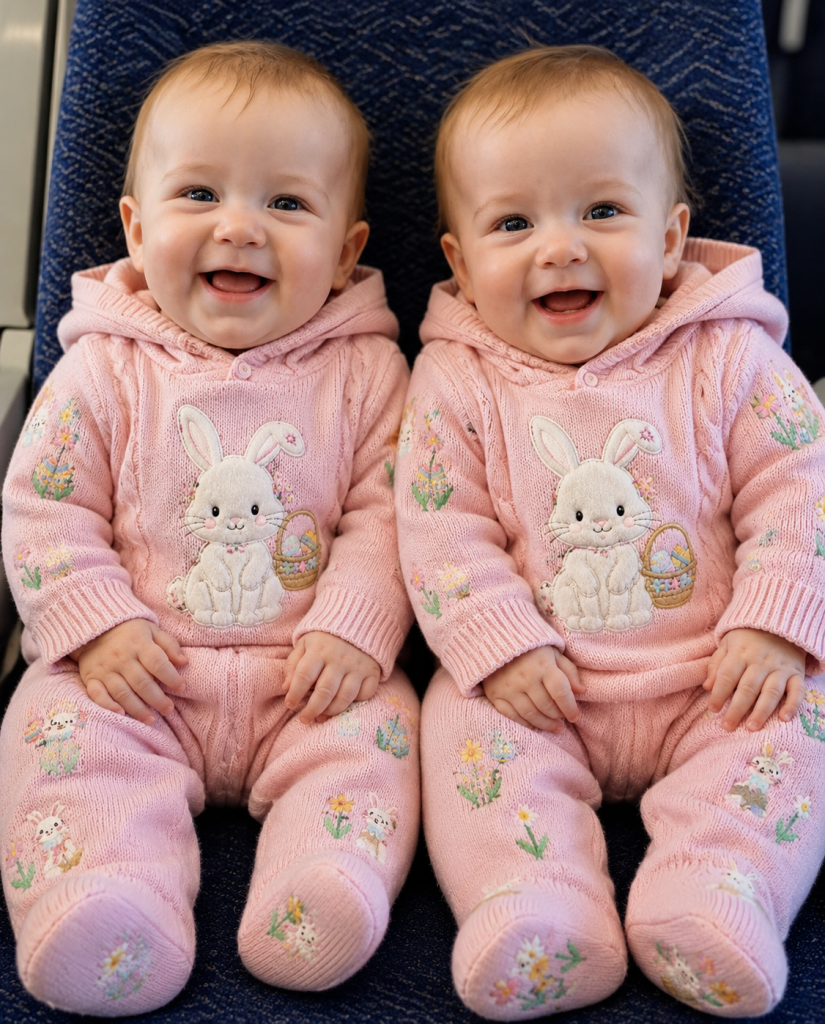
The babies were sitting in separate aisle seats, strapped awkwardly into infant carriers, their tiny faces flushed red. Their blankets had slipped down. One had lost a sock. The girl’s small hands trembled in the air, reaching for someone who did not come.
A flight attendant walked past, glanced down, and said, “We’re trying to locate the parent.”
Then she moved on.
Passengers leaned away from the babies as if sadness were contagious.
A man in a gray suit said, “This is disgusting.”
A woman behind him whispered, “Some people shouldn’t have children.”
Something inside me stirred.
Not strength.
Not yet.
Just recognition.
The world had turned away from them the same way it had turned away from me.
The young woman beside me touched my arm gently.
She was beautiful in a sharp, polished way, no older than her early twenties. Dark hair pulled into a sleek bun. Designer coat. Perfect nails. Expensive perfume.
Her name, I later learned, was Alicia.
At that moment, she only looked at me with sad eyes and whispered, “Someone needs to be the bigger person here. Those babies need someone.”
I turned back toward the twins.
The boy had stopped screaming and was making small, broken sounds.
The girl was hiccuping between sobs.
They sounded exhausted, as if they had already learned no one was coming.
Before I could second-guess myself, I unbuckled my seat belt and stood.
“Excuse me,” I said, moving into the aisle.
The man in the gray suit gave me an annoyed look.
I ignored him.
I reached the babies and bent down.
The boy looked up at me with wet brown eyes. The girl’s face crumpled again the moment she saw me.
“Oh, sweetheart,” I whispered.
I lifted the boy first.
He was warm and trembling.
The second I settled him against my shoulder, he buried his face into my coat and clutched the fabric with one tiny fist.
Then I picked up the girl with my other arm.
She pressed her cheek against mine, damp and soft, and grabbed my collar like she was afraid I might disappear.
Instantly, the crying stopped.
The cabin fell silent.
It was so sudden that even the engine noise seemed softer.
People stared at me.
I did not care.
I looked around the cabin and raised my voice.
“Is there a mother on this plane? A father? Anyone responsible for these children?”
No one moved.
I turned in a slow circle.
“These babies are alone. If they belong to anyone here, speak now.”
Still nothing.
The flight attendant hurried back, her face tight with concern.
“Ma’am, please return to your seat. We’re checking the manifest.”
“I will sit down,” I said, “but I am not putting them back like that.”
She looked at the babies resting quietly in my arms.
Then her expression softened.
“Can you hold them for takeoff?”
“Yes.”
The young woman from my row stood and helped gather the blankets and diaper bag from beneath the empty seats.
She smiled at me.
“You saved them,” she whispered.
I looked down at the babies.
Their breathing had slowed.
“I only picked them up.”
“Sometimes that’s everything.”
I carried them back to my row.
The flight attendant brought an infant seat extender and extra blankets. Somehow, we managed. The boy slept against my chest for most of the flight. The girl held my finger tightly even in sleep.
I should have been thinking about the funeral waiting for me.
Instead, I kept studying their faces.
Who leaves babies alone on a plane?
Who hears them cry and does not come?
When we landed, I refused to hand them over to anyone except airport security.
The moment we entered the terminal, the situation changed from uncomfortable to official.
Security officers came.
Then airport police.
Then social services.
The airline searched the plane.
They checked bathrooms, seats, boarding records.
They paged the supposed parents.
No one came.
No one even asked.
I stood in a small airport office holding both babies while strangers discussed procedures around me.
The boy woke and looked at me like he knew me.
The girl kept gripping my blouse.
A social worker named Patricia finally approached me.
“Ma’am,” she said gently, “you’ve done a good thing. We’ll take them from here.”
I nodded.
That was what was supposed to happen.
But when Patricia reached for the girl, she began to cry again.
The boy followed.
Both babies reached for me.
Patricia paused.
I closed my eyes.
I had buried my daughter in my mind a thousand times already, but the real funeral was tomorrow.
I had no room for this.
No room for two abandoned babies.
No room for new love when the old love had not even been laid in the ground.
And yet, I heard myself say, “Can I stay with them a little longer?”
Patricia studied my face.
“You have family waiting?”
“No,” I said.
That word hurt.
“No.”
So I stayed.
For three hours.
I changed them.
Fed them.
Rocked them.
I learned the boy liked being patted gently on the back. The girl liked humming.
When Patricia finally took them to emergency foster care, the girl cried until the hallway door closed.
The sound followed me home.
The next day, I buried my daughter and grandson.
I stood beside two graves under a black umbrella, wearing a dress Caroline had once said made me look “too serious.”
Rain tapped against the cemetery tent.
The pastor spoke.
Neighbors cried.
My sister held my elbow.
I heard almost none of it.
All I could think about were the babies.
Their flushed faces.
Their tiny hands.
The way they stopped crying when I held them.
At the repast afterward, people tried to feed me.
Casseroles.
Sandwiches.
Cake.
I could not swallow.
My sister finally sat beside me and said, “Margaret, where do you keep going?”
I looked at her.
“What?”
“You’re here, but you’re not.”
I folded my hands in my lap.
“There were babies on the plane.”
She frowned.
“What babies?”
I told her everything.
By the end, she was staring at me with an expression I could not read.
“Margaret,” she said carefully, “you just lost your daughter.”
“I know.”
“And Thomas.”
“I know.”
“You are grieving. You cannot replace them.”
Her words stung because they held a truth I was afraid of.
“I’m not trying to replace anyone.”
“Then what are you doing?”
I did not have an answer.
Not then.
But three days later, I called Patricia at social services.
I asked about the babies.
She could not tell me much, but she told me enough.
No one had come forward.
No missing persons report matched them.
The airline was cooperating.
The case was being treated as abandonment.
I asked if they were safe.
“They are safe,” Patricia said.
Then she paused.
“They still cry a lot.”
I gripped the phone.
“Do they?”
“Yes. Unless they’re being held.”
That night, I did not sleep.
By morning, I knew.
I went to social services in person wearing my best coat and carrying every document I could think of: proof of income, home ownership, medical records, identification, references from the hospital where I had worked.
Patricia looked surprised to see me.
“I want to foster them,” I said.
She blinked.
“Mrs. Ellis—”
“Margaret.”
“Margaret, this is not simple.”
“I know.”
“You’re grieving.”
“Yes.”
“You’re fifty-five.”
“Not dead.”
Her mouth twitched, almost a smile.
“There will be background checks, home studies, court hearings. They may still have family somewhere.”
“If they do, and they are safe, then they should be with family.”
“And if not?”
I looked her directly in the eyes.
“Then they have me.”
The process was long.
Painfully long.
But those babies had already been left once, and I refused to let bureaucracy be the second abandonment.
I became their emergency foster placement first.
The day Patricia brought them to my house, I had two cribs waiting in the spare bedroom.
One blue blanket.
One yellow.
Diapers stacked like a small mountain.
Bottles lined up on the counter.
I had not cared for infants in decades, but my hands remembered.
The boy smiled at me first.
A sleepy little half-smile while I fastened his pajamas.
I sat on the floor and cried.
Not because he looked like Thomas.
He did not.
Not because he filled Caroline’s place.
No one could.
I cried because for the first time since the accident, I felt something other than loss.
I named him Ethan.
The girl, I named Sophie.
Patricia warned me not to become too attached before the adoption was final.
That was sensible advice.
Impossible advice.
By the end of the first week, my house had changed.
Bottles in the sink.
Tiny socks in the laundry.
Baby toys scattered across the rug.
Exhaustion returned to my body like an old enemy.
But so did purpose.
Every morning, I had a reason to get up.
Two reasons.
Ethan and Sophie.
Three months later, after no biological family came forward and after the investigation led nowhere useful, I petitioned to adopt them.
Some people questioned me.
A widow raising twins alone at fifty-five?
Was it wise?
Was it fair?
Could I keep up?
I answered every question.
But inside, I knew the real answer was simple.
Love does not always arrive when life is convenient.
Sometimes it arrives when everything is broken.
And it asks whether you will open the door anyway.
I opened it.
The adoption became final on a cold December morning.
The judge smiled as he signed the papers.
“Congratulations, Mrs. Ellis. You are their mother now.”
Mother.
That word nearly dropped me to my knees.
I had been Caroline’s mother.
Then grief told me I would never mother anyone again.
But there I stood with Ethan sleeping against my shoulder and Sophie chewing on the sleeve of my coat.
A second chance.
Not a replacement.
A second chance.
The years that followed were the hardest and most beautiful years of my life.
Ethan walked first.
Sophie talked first.
Ethan climbed everything, including bookshelves, counters, and once the dining room table during Thanksgiving prayer.
Sophie watched before acting, always thinking, always studying the room.
When they were four, they asked why they did not have a father.
I told them families came in different shapes.
“Our family has Grandma-Mom,” Ethan said proudly.
That became my name for two years.
Grandma-Mom.
At six, they asked where babies came from.
I gave them the simple version.
At eight, Sophie asked why they had baby photos from the airport but no hospital pictures.
That was the day I told them the truth I believed they were old enough to understand.
I told them I found them on a plane.
I told them they had been alone.
I told them I held them, and they held on.
Ethan grew very quiet.
Sophie asked, “Did our first mom not want us?”
I had rehearsed many answers.
None felt good enough.
“I don’t know what was in her heart,” I said. “But I know what happened. She was not there when you needed her.”
Sophie looked down at her hands.
“Were you?”
I reached across the table.
“Yes.”
Ethan asked, “Did you choose us?”
I smiled through tears.
“Yes, sweetheart. Every day since.”
After that, the story became part of our family history.
Not a secret.
Not a wound we ignored.
A truth we handled carefully.
When they turned twelve, Ethan became obsessed with justice.
He hated unfairness in any form.
If a teacher punished the whole class for one student’s behavior, he wrote a respectful but furious letter.
If someone cut in line, he noticed.
If a classmate was bullied, Ethan stepped in even when it cost him.
“You’re going to be a lawyer,” I told him once.
He grinned.
“Maybe a judge.”
“Aim high.”
Sophie was different.
Soft-spoken but not weak.
She noticed pain before people spoke it.
At fifteen, she volunteered at the children’s hospital and came home with stories she held like fragile glass.
She wanted to become a pediatric surgeon.
“Babies should have someone who fights for them,” she told me.
I had to leave the room and cry quietly in the pantry.
By eighteen, they were extraordinary young adults.
Ethan had earned a scholarship to study political science and pre-law.
Sophie had been accepted into a competitive biology program with plans for medicine.
They were kind.
Smart.
Complicated.
Occasionally messy.
Fully human.
And mine.
My life felt whole again.
Not untouched by grief.
But whole.
Then, last week, everything changed.
It was a Thursday afternoon.
I was in the kitchen making peach tea when the doorbell rang.
Ethan was upstairs packing textbooks into boxes.
Sophie was sitting on the stair landing, sorting old photos for their graduation board.
I wiped my hands on a towel and opened the door.
A woman stood on my porch in designer clothes.
Dark sunglasses.
Cream coat.
High heels too expensive for my cracked walkway.
The scent of her perfume hit me before her voice did.
“Hello, Margaret,” she said calmly.
I froze.
She removed her sunglasses.
“I’m Alicia.”
The name stirred something old.
A plane.
A whisper.
Someone needs to be the bigger person here.
My stomach dropped.
“We met on the plane eighteen years ago,” she said.
I gripped the doorframe.
“You were sitting next to me.”
“I was.”
She stepped inside without waiting for an invitation.
Her eyes moved over my living room, scanning the family photos on the walls.
Ethan with missing front teeth.
Sophie covered in birthday cake frosting.
First day of kindergarten.
Middle school graduation.
High school awards.
Beach trips.
Christmas mornings.
A life.
Our life.
“What are you doing here?” I asked.
Her gaze paused on a framed photo of the twins in caps and gowns.
“They turned out beautifully.”
My skin went cold.
From the stairs, Sophie called, “Mom? Who is it?”
Alicia smiled slightly.
“Mom,” she repeated.
I did not like the way she said it.
Ethan appeared at the top of the stairs beside Sophie.
Alicia looked up at them, and for one second, something flickered across her face.
Not love.
Recognition.
Possession.
Then she dropped the truth like a bomb.
“I’m the mother of those twins you took from the plane.”
The house went silent.
Sophie’s hand flew to the banister.
Ethan’s face hardened.
I felt the room tilt around me.
“No,” I whispered.
Alicia turned back to me.
“Yes.”
“You abandoned them.”
“I was twenty-three.”
“You left them alone on a plane.”
“I was terrified.”
“You listened to them cry.”
Her expression tightened.
“I had a job opportunity that could change my life. I never planned for twins.”
Sophie made a small sound.
I turned toward her, but she was staring at Alicia.
Alicia continued, as if explaining a business decision.
“I saw you. Grieving. Broken. I thought you needed them as much as they needed someone.”
My chest tightened so sharply I could barely breathe.
“You set me up.”
“I gave them a better life than I could have.”
“You used my grief.”
“I gave you purpose.”
The words struck like a slap.
Ethan came down the stairs slowly.
His voice was calm in a way I recognized as dangerous.
“What do you want?”
Alicia’s eyes moved over him.
“My son.”
“I asked what you want.”
She pulled a thick envelope from her purse.
“I hear both of you are doing well. Good grades. Scholarships. Ambitious futures.”
Sophie stepped down behind Ethan.
“You’ve been watching us?”
Alicia smiled.
“From a distance.”
I felt sick.
“For how long?” I asked.
“A few years.”
Ethan’s jaw tightened.
“You knew where we were and never came?”
“I wanted to wait until the right time.”
Sophie’s voice shook.
“The right time for what?”
Alicia placed the envelope on my coffee table.
“For this.”
No one moved.
She tapped the envelope with one manicured finger.
“Your biological grandfather died recently. My father. He was very wealthy, but his will is complicated. A portion of the estate can only be accessed through direct blood heirs.”
Ethan stared at her.
“So you came for money.”
“I came because you have rights.”
Sophie laughed once, bitter and broken.
“Rights? You left us in airplane seats.”
Alicia’s face cooled.
“I was young.”
“You were an adult,” Ethan said.
“I made a painful choice.”
“You made a convenient one.”
Her eyes flashed.
“You have no idea what I sacrificed.”
Sophie stepped forward.
“No, we know exactly what you sacrificed.”
Alicia looked at her.
For the first time, her expression softened slightly.
“Sophie—”
“Don’t,” Sophie said. “You don’t get to say my name like you know me.”
Alicia inhaled slowly, regaining control.
“The document requires your signatures confirming biological relationship. Once processed, the estate will release funds.”
I picked up the envelope.
My nursing hands had held dying patients, frightened children, grieving spouses.
They had not shaken often.
They shook then.
I opened the envelope and removed the papers.
The first page looked official.
Consent.
Acknowledgment.
Estate representation.
Alicia watched me closely.
Too closely.
That was when my old instincts woke.
I had not worked in law.
I had not been a detective.
But I had lived long enough to know when someone was hiding the sharp edge of a knife behind polite words.
“Ethan,” I said quietly, “get my reading glasses.”
Alicia’s mouth tightened.
“There’s no need. It’s standard.”
“Then you won’t mind if we read it.”
Ethan brought my glasses.
Sophie sat beside me.
Together, we read.
The language was thick, dressed up in legal terms.
But meaning has a way of showing itself if you look long enough.
By the third page, my stomach turned.
By the fifth, Ethan had taken out his phone and was photographing every page.
By the seventh, Sophie whispered, “Mom.”
I looked where she pointed.
There it was.
In small print.
Signing would appoint Alicia as legal representative over any claim connected to their biological lineage.
Not just for the inheritance.
For all related assets.
Including funds assigned in their names.
Including decision-making authority.
Including retroactive management.
Ethan looked at Alicia.
“This gives you control over anything we might inherit.”
Alicia did not blink.
“It’s necessary for efficiency.”
“No,” he said. “It’s necessary so you can take it.”
“I am your mother.”
The room went cold.
Sophie stood.
“No. Margaret is our mother.”
Alicia’s mask cracked.
“She is the woman who picked you up.”
“She is the woman who stayed,” Sophie said.
Alicia’s face reddened.
“I gave birth to you.”
“And then gave us away to a grieving stranger like unwanted luggage,” Ethan said.
Alicia slapped him.
It happened fast.
A sharp crack across the room.
Ethan’s head turned slightly.
Sophie gasped.
I stood so quickly the papers fell from my lap.
“Get out of my house.”
Alicia looked startled, as if she had surprised herself.
Then she straightened.
“He needed to watch his mouth.”
I stepped between her and Ethan.
“No. You needed to remember you are standing in the home of the children you abandoned.”
“They are my children.”
“They are adults,” I said. “And they owe you nothing.”
Alicia’s breathing quickened.
“You think you’re noble? You think you saved them? I watched you take them. I watched you carry them off that plane like you had been waiting for a replacement family.”
That one hurt.
Because cruelty often knows exactly where to aim.
For a moment, I was back on that flight.
Broken.
Empty.
Holding babies while my daughter’s funeral waited.
Sophie saw my face.
Her own changed.
She moved beside me and took my hand.
“You didn’t replace anyone,” she said.
Ethan touched his cheek, then looked at Alicia.
“You don’t get to rewrite this.”
Alicia grabbed the documents from the floor.
“You’re making a mistake. That estate is worth millions.”
“Then keep chasing it,” Ethan said. “But do it without us.”
Her laugh was sharp.
“You’ll regret this when you’re drowning in student loans.”
Sophie stepped forward.
“I would rather owe money than owe you.”
Alicia looked at her daughter.
For one second, something like desperation appeared.
Then it vanished beneath pride.
“You think she loves you more than I do?”
Sophie’s eyes filled with tears, but her voice stayed steady.
“She loved us when we had nothing to offer her.”
That silence felt final.
Alicia shoved the documents back into the envelope.
“This is not over.”
Ethan opened the door.
“Yes,” he said. “It is.”
She walked out with her perfume, her heels, her envelope, and no children.
When the door closed, Sophie broke.
She collapsed onto the sofa, sobbing into her hands.
I went to her, but then stopped.
For the first time in their lives, I did not know whether my touch would help or hurt.
Sophie looked up at me through tears.
“Mom.”
That one word gave me permission.
I held her as she cried.
Ethan sat on the floor beside us, silent at first.
Then he leaned his head against my knee like he used to when he was little.
“She was there,” he whispered.
I stroked his hair.
“Yes.”
“She watched us cry.”
“Yes.”
“She told you to help us.”
My throat tightened.
“Yes.”
Sophie cried harder.
“That’s so cruel.”
“I know.”
Ethan looked up.
“Did you know? Even a little?”
“No,” I said. “Never.”
His eyes searched mine.
I understood what he was asking beneath the question.
Did you lie to us?
Did you keep her from us?
Did you choose our story for us?
“I told you everything I knew,” I said. “Always.”
He nodded slowly.
“I know.”
But pain is not logical.
For the next few days, our house changed.
Not loudly.
Quietly.
Ethan spent hours researching legal options.
Sophie stopped sorting graduation photos.
I found her once sitting on the floor of her room, looking at the airport picture I had kept from the day social services documented their case.
Two infants in my arms.
My face pale with grief.
Their faces finally peaceful.
“I used to think this picture was beautiful,” she said.
I sat beside her.
“It can still be beautiful.”
“How?”
“Because her cruelty is not the only thing happening in it.”
Sophie looked at me.
I touched the edge of the photo.
“Yes, she left you. But I found you. Both things are true. One is terrible. One is love.”
She leaned into me.
“I hate that I look like her.”
I kissed her hair.
“You look like yourself.”
The following week, Ethan contacted a legal aid clinic through one of his professors.
They reviewed the documents.
The attorney confirmed what we had suspected.
Alicia had not returned for reunion.
She had returned for control.
The estate existed, but the twins’ direct claim did not require Alicia to represent them. In fact, her document would have given her power to redirect almost everything.
The attorney recommended they file their own claim independently, not because they wanted money, but to prevent Alicia from exploiting their identities.
Ethan struggled with that.
“I don’t want anything connected to her,” he said.
Sophie agreed.
“I don’t either.”
The attorney nodded.
“That is your choice. But if you do nothing, she may continue trying to use your names.”
So they filed.
Not for greed.
For protection.
That decision forced more truth into the open.
Alicia’s father had known about the twins.
Not when they were born, but later.
He had tried to find them, but Alicia lied. She claimed they had died shortly after birth.
When he discovered the truth years later, he changed his will.
A portion of his estate was placed in trust for “any living biological children born to my daughter Alicia.”
Alicia had spent years trying to access it.
She could not without them.
That was why she had watched from a distance.
That was why she waited until they were adults.
That was why she came with a smile and a trap.
When Sophie learned her biological grandfather had tried, in some imperfect way, to leave something for them, she cried again.
“Someone in that family knew we mattered,” she whispered.
“Yes,” I said. “Someone did.”
Months passed.
The case moved slowly.
Alicia fought.
Then threatened.
Then claimed I had stolen her children.
That accusation enraged Ethan more than anything else.
In one legal statement, he wrote:
“Margaret Ellis did not take us. She answered when no one else did.”
I printed a copy and kept it in my Bible.
The court eventually rejected Alicia’s attempt to control the inheritance.
The twins were recognized as direct beneficiaries.
When the trust was released, Ethan and Sophie made a decision that stunned even me.
They kept enough for education.
Then they donated a large portion to an organization supporting abandoned infants and children entering foster care.
At the ceremony, Sophie spoke.
She stood at a small podium, nervous but radiant.
“I was once a baby no one claimed,” she said. “But I was never unwanted. There is a difference. One woman abandoned me. Another chose me. Today, we want more children to feel chosen.”
Ethan stood beside her, his hand on her shoulder.
I sat in the front row and cried openly.
I am too old to care who sees.
Alicia did not attend.
But a letter arrived from her attorney two weeks later.
No apology.
No remorse.
Only a request for “private reconciliation.”
Ethan threw it away.
Sophie did not stop him.
Life did not return to exactly what it had been.
It never does after a truth like that enters the room.
But it became honest in a deeper way.
Sometimes Ethan still asked questions about biology.
Medical history.
Family traits.
Whether his anger came from Alicia.
Whether Sophie’s cheekbones came from someone who loved them or someone who left.
We answered what we could.
We accepted what we could not.
One night, shortly before they left for college, I found both of them in the living room looking at old photo albums.
They had pulled out every album from the cabinet.
Baby pictures.
First steps.
School plays.
Lost teeth.
Halloween costumes.
Ethan dressed as a judge at age seven.
Sophie dressed as a doctor three years in a row.
I stood in the doorway, watching them.
Sophie noticed me first.
“Mom,” she said softly. “Come here.”
I sat between them on the floor.
Ethan held up a picture of me asleep in a rocking chair with both babies on my chest.
“You look exhausted,” he said.
“I was.”
Sophie smiled.
“You look happy too.”
“I was.”
Ethan stared at the photo.
“She gave birth to us,” he said.
I waited.
“But you became our mother.”
Sophie rested her head on my shoulder.
“Do you ever regret it?”
The question shocked me.
“Regret what?”
“Us,” she whispered.
I turned so I could see both of them.
“Never.”
“Even after everything?” Ethan asked.
“Especially after everything.”
My voice broke.
“You were not easy. Twins are chaos. You ruined rugs, broke lamps, got sick at the same time, cried at the same time, learned to run in opposite directions, and once painted the dog purple.”
Ethan laughed.
Sophie covered her face.
“But no,” I said. “I never regretted you. Not one day. Not one minute.”
Sophie cried quietly.
Ethan reached for my hand.
I squeezed it.
“You gave me back mornings,” I said. “After Caroline and Thomas died, I did not want mornings anymore. Then you two needed bottles at six a.m. and diapers and songs and someone to find tiny socks. You did not erase my grief. You gave me somewhere to put my love.”
That was the truth.
All of it.
A week later, we drove to the airport for their college flights.
The airport had always been complicated for us.
A beginning.
A wound.
A miracle.
We stood near security with suitcases and backpacks.
Ethan looked around.
“Hard to believe this is where it started.”
“Not this exact airport,” Sophie said.
“You know what I mean.”
I smiled.
“Yes.”
Sophie hugged me first.
She held on tightly.
When she pulled back, her eyes were wet.
“You saved us, Mom.”
I brushed her hair behind her ear.
“You saved me too.”
Ethan hugged me next.
He was tall now, taller than me by almost a foot, but when he held me, I still felt the baby who had buried his face in my shoulder.
“You didn’t find us,” he whispered. “You chose us.”
I closed my eyes.
“Every day.”
They walked through security together.
Brother and sister.
Twins.
My children.
Just before turning the corner, they looked back and waved.
I waved until they disappeared.
Then I sat down in the airport, right there near the security line, and let myself remember everything.
The crying.
The silence.
The young woman’s hand on my arm.
Someone needs to be the bigger person here.
For years, I thought Alicia had spoken those words out of kindness.
Now I knew she had spoken them as part of an escape.
But meaning does not always belong to the person who says the words.
Sometimes we take what was meant as manipulation and turn it into mercy.
She had wanted to use my grief.
Instead, love used me.
And love won.
I am seventy-three now.
My house is quieter again.
Ethan calls every Sunday.
Sophie sends photos from anatomy lab and tells me not to be alarmed by the medical skeleton in the background.
Their rooms are still there.
Their baby blankets are folded in a cedar chest.
The airport photo sits on my mantel.
People sometimes ask why I keep it there after everything we learned.
I tell them because that picture is not about Alicia.
It is about the moment my life began again.
Two babies abandoned in the sky.
One grieving woman with empty arms.
A choice made before thought could interfere.
A family formed not by blood, not by convenience, not by a document in an envelope, but by the simple act of staying.
Alicia came back eighteen years later with papers and perfume, believing motherhood was something she could reclaim with biology and signatures.
She was wrong.
Motherhood is not only birth.
It is midnight fevers.
Packed lunches.
Court dates.
First steps.
Hard talks.
Forgiveness.
Truth.
It is staying when staying costs you.
It is choosing the child again and again, long after the world stops applauding you for it.
I did not give Ethan and Sophie life.
But I gave them a home.
And they gave me one too.
So yes, I adopted twins I found abandoned on a plane.
And yes, their biological mother returned eighteen years later with a document.
But that document did not prove she was their mother.
It proved what she had never understood.
Children are not property to be claimed when they become useful.
They are souls to be loved when they are helpless.
And the day I lifted those crying babies into my arms, they stopped crying.
The cabin fell silent.
My broken heart started beating again.
And somewhere between the clouds and the ground, three lost lives became one family.
THE END! THANK YOU FOR READING!