 Reading Time: 13 minutes
My Husband Hit Me for Asking Where He Had Been All Night. The Next Morning, I Made His Favorite Southern Breakfast and Served It With a Smile. He Called Me a “Proper Wife.” Then the Kitchen Door Swung Open—and Every Bit of Color Left His Face.
Everything changed because of one simple question. “Where did you spend last night?” That was all I said. My husband, Ethan Blackwood, replied with the back of his hand. The blow pushed my lip into my teeth, and in an instant, I tasted blood.
For a few seconds, the kitchen went still except for the rain tapping the windows and the soft crackle of grease cooling on the stove. Ethan stood above me, completely calm. His white dress shirt remained flawless. His wedding ring shone beneath the kitchen lights.
“Do not question me in my own home,” he said in a cold voice.
I touched my mouth and stared at the blood on my fingers.
Then I looked up at him.
A smile slowly came back to his face when he understood I would not fight back.
That had always been the part he enjoyed most.
The quiet.
He confused it with fear.
With obedience.
With weakness.
In Ethan’s mind, I was only a well-mannered Southern wife who would never resist.
What he forgot was that I had been raised in the house of a respected judge.
What he never truly valued was that I had spent years examining financial wrongdoing long before I became Mrs. Blackwood.
And what he did not know was that every suspicious conversation, every missing dollar, and every lie he had told during the past six months had been carefully recorded.
Saved.
Copied.
Protected.
Ethan straightened his cufflinks as if nothing had happened.
“My mother is coming by this morning,” he said. “Make breakfast. And try not to shame me.”
I pressed a napkin to my bleeding lip.
“Of course.”
That response pleased him.
He thought the subject was finished.
He thought I had lowered my head because I had accepted my place.
He did not understand that silence can be a locked room.
And inside mine, everything was already waiting.
Ethan left the kitchen without looking back.
I stayed there for a long moment, listening to his footsteps climb the stairs.
Only when I heard the bedroom door close did I let my hand shake.
Not from fear.
Not anymore.
From the terrible calm that comes when a person finally stops hoping someone will change.
I rinsed my mouth at the sink.
The water turned pink, then clear.
I stared at my reflection in the dark kitchen window.
My name is Clara Blackwood.
Before Ethan, I was Clara Hale.
My father, Judge Robert Hale, raised me after my mother passed when I was nine. He taught me two things that stayed with me my entire life.
First, never speak when rage is speaking for you.
Second, never enter a fight without evidence.
At twenty-three, I became a forensic accounting analyst.
I followed missing money through shell companies, fake invoices, forged signatures, and carefully polished lies.
Men like Ethan always believed charm was camouflage.
They thought if they wore nice suits, donated to churches, kissed babies at charity events, and said “ma’am” to elderly women, no one would ever look too closely at the numbers.
But numbers do not care about charm.
Numbers remember.
Six years after marrying Ethan, I began noticing things.
Small things at first.
Late-night phone calls he ended when I entered the room.
Bank statements that no longer came to the house.
A new business account he said was “temporary.”
Investor dinners I was not invited to attend.
Receipts from places he claimed he had never been.
And then there was the night he came home smelling like expensive perfume and rain.
When I asked where he had been, he did not answer.
He hit me.
That was the first time.
The first time a man touches you with cruelty, something inside you searches desperately for an explanation.
Stress.
Alcohol.
A mistake.
A bad moment.
A line crossed but never again.
The second time, you realize the first was not an accident.
The third time, you understand you are living with someone who believes consequences are for other people.
But Ethan made one mistake.
He believed I was too ashamed to document anything.
I documented everything.
The first bruise.
The second lie.
The bank transfers.
The hidden accounts.
The forged signatures.
The emails he forgot were still synced to the old office tablet.
The recordings of phone calls he took in the garage, thinking the rain would cover his voice.
He was stealing from investors.
Not pennies.
Not mistakes.
Millions.
He had created fake consulting firms using his mother’s name, her maiden name, and even the name of a family trust Margaret Blackwood loved to brag about at luncheons.
At first, I thought Margaret might be unaware.
Then I found the messages.
She knew enough.
Maybe not everything, but enough to protect him.
Enough to advise him.
Enough to write, “Clara is too soft to understand business, but keep her out of the ledgers anyway.”
I almost laughed when I read that.
Too soft.
That was what they always thought.
By the time Ethan struck me in the kitchen, I had already sent three copies of the evidence to three separate places.
One to my father.
One to a federal investigator I had once worked with.
One to a secure legal archive with automatic release instructions if anything happened to me.
Ethan did not know that.
Ethan only knew that I made good biscuits.
So that morning, I made them.
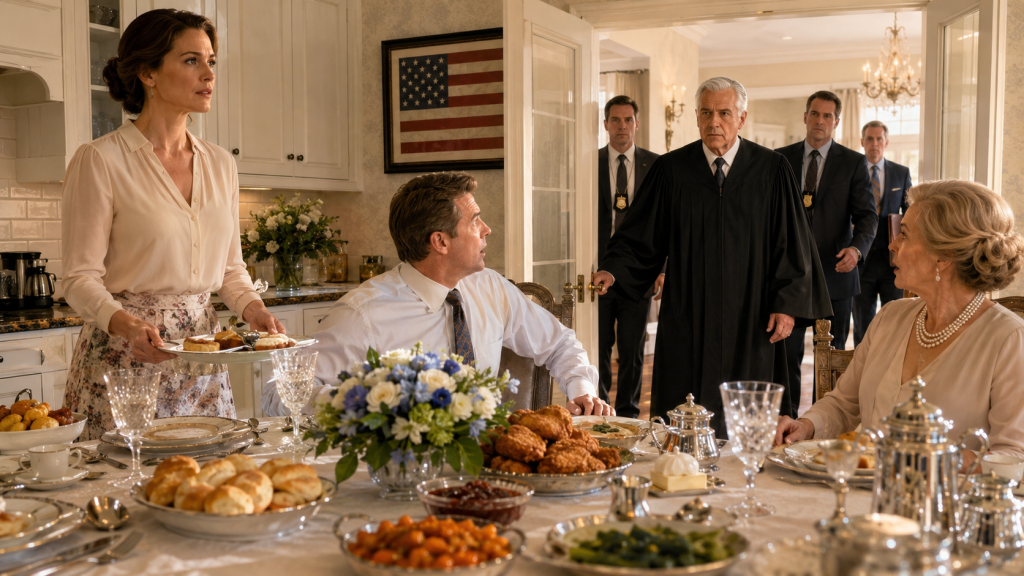
By morning light, the whole house smelled of comfort and old tradition.
Warm biscuits.
Peppered gravy.
Fried chicken.
Candied yams.
Buttered vegetables.
Sweet preserves.
Fresh coffee.
I moved through the kitchen with care.
I shined the family silver.
Placed the crystal glasses.
Set flowers in the middle of the table.
Everything appeared perfect.
Exactly how Ethan preferred it.
He came downstairs freshly showered, wearing a navy suit and the expression of a man who expected the world to rearrange itself around him.
His eyes flicked to my lip.
I had covered the swelling with makeup, but not completely.
He noticed.
His mouth tightened.
“You should have used more concealer.”
I poured coffee into the silver pot.
“I did my best.”
He stepped close enough for me to smell his cologne.
“See that you don’t embarrass me.”
I smiled gently.
“I won’t.”
He studied me for a moment, suspicious of nothing because obedience looked familiar to him.
Then he walked into the dining room.
His mother arrived at nine exactly.
Margaret Blackwood never arrived early or late. She arrived on time because she believed time itself should respect her.
She stepped through the front door in pearls, a cream blazer, and costly perfume.
Her silver hair was sculpted into place.
Her eyes moved over me the way they always did, searching for something to criticize.
They landed on my injured lip.
Instead of worry, she gave a smug little smile.
“A wife ought to know when to stop speaking,” she said.
Ethan laughed from the dining room.
I only took her coat.
“Good morning, Margaret.”
She handed me her gloves.
“Do not sound wounded, dear. It is unattractive.”
“I wouldn’t dream of it.”
Her eyes narrowed slightly.
Maybe she heard something beneath my tone.
Maybe not.
Women like Margaret are skilled at noticing silver that has not been polished, but terrible at noticing when a woman has stopped being afraid.
Before long, they sat at the dining table like honored guests.
Ethan at the head.
Margaret on his right.
Me moving quietly between kitchen and dining room.
They admired the food.
Praised the arrangement.
Commented on the biscuits.
Fully certain they were still in control.
“What a good wife,” Ethan said proudly from the head of the table.
Margaret lifted her coffee cup.
“She does keep a proper table.”
“A proper wife,” Ethan added, looking directly at me.
I set one last covered dish in front of him.
The silver lid reflected his face back at him.
Confident.
Polished.
Doomed.
I stepped backward.
At that exact second, the kitchen door opened.
The entire room went silent.
Ethan turned toward the doorway.
The certainty disappeared from his face.
The coffee cup shifted slightly in his hand.
And for the first time that morning, he looked frightened.
Because the person stepping through the kitchen door was not a guest.
It was my father, Judge Robert Hale.
Beside him stood two federal investigators in dark suits.
Behind them was Martin Ellis, Ethan’s own company accountant, pale and shaking so badly he could barely hold his briefcase.
Ethan rose so fast his chair scraped against the hardwood floor.
“What is this?” he demanded.
My father did not answer immediately.
His eyes moved to my swollen lip.
Everything in his face changed.
My father was not a loud man.
He had spent forty years in courtrooms, and that had taught him the power of stillness.
But when he looked at my mouth, something hard and dangerous entered his expression.
“This,” he said, “is the end of your pretending.”
Margaret stood.
“Robert, this is highly inappropriate.”
My father turned his gaze to her.
“Margaret, sit down.”
She opened her mouth.
Then closed it.
That was the kind of voice he used when defendants forgot they were not in charge.
One of the investigators stepped forward.
“Ethan Blackwood?”
Ethan’s face flushed.
“I don’t know what Clara has told you, but this is a domestic misunderstanding.”
I almost smiled.
Domestic misunderstanding.
That was what men like him called violence when witnesses entered the room.
The investigator did not react.
“We are here regarding financial fraud, investor misappropriation, falsified records, and conspiracy.”
Ethan looked at me then.
Really looked.
Not at the wife he thought he had trained.
At the woman he had underestimated.
“You did this?” he whispered.
I reached for the silver lid in front of him.
“No, Ethan.”
I lifted it.
Inside the serving dish was not food.
It was a flash drive.
Printed bank statements.
Copies of emails.
Hidden account records.
Wire transfers.
A ledger page marked with Ethan’s handwriting.
And a photograph of my bruised lip taken two hours after he hit me, time-stamped and printed clearly.
“You did this,” I said.
Margaret’s face drained.
“Ethan,” she whispered.
He turned on her.
“Don’t say anything.”
The second investigator moved closer.
“Mr. Blackwood, we advise you not to interfere with potential witness statements.”
“Witness?” Margaret said sharply. “I am his mother.”
Martin Ellis made a strangled sound from the doorway.
Everyone turned toward him.
He looked at Ethan with terrified apology.
“I told them,” Martin said.
Ethan’s jaw clenched.
“You coward.”
Martin flinched.
“You said it was temporary. You said the money would go back before anyone noticed.”
“Shut up.”
Martin shook his head.
“No. I’m done. I signed what they asked. I gave them the backup drives.”
For one second, Ethan looked like he might cross the room and grab him.
My father stepped forward.
That was enough.
Ethan froze.
The investigator removed a document from his folder.
“We have warrants for your office and home office records. We also have sufficient grounds to take you in for questioning.”
Ethan laughed, but it came out wrong.
Thin.
Ugly.
Desperate.
“This is insane. Clara is emotional. She has always been emotional. Ask my mother. She exaggerates.”
My father’s eyes went back to my lip.
“Careful,” he said quietly.
Ethan pointed at me.
“She attacked me. I defended myself.”
The room changed.
Even Margaret looked startled by that.
Because some lies are so shameless they expose the person telling them.
I stood very still.
Then I reached into the pocket of my dress and placed my phone on the table.
I tapped the screen.
Ethan’s voice filled the dining room.
“Do not question me in my own home.”
Then the sharp sound of the blow.
Then my breath catching.
Then Ethan again.
“My mother is coming by this morning. Make breakfast. And try not to shame me.”
The recording ended.
No one moved.
Margaret sat down slowly.
My father closed his eyes for one brief second.
When he opened them, he looked older.
Not weaker.
Just heartbroken.
Ethan stared at the phone.
“You recorded me?”
“Yes.”
“For how long?”
“Long enough.”
His face twisted.
“You snake.”
I tilted my head.
“No, Ethan. A snake strikes from hiding. I have been standing in front of you the whole time.”
The investigator stepped between us before Ethan could move.
“Mr. Blackwood, turn around.”
Ethan’s voice rose.
“You can’t arrest me in my own house.”
“You are not being arrested for owning a house.”
The second investigator took his arm.
Ethan pulled back.
“Mother, call the senator.”
Margaret looked up, stunned.
“What?”
“Call him!”
But Margaret had gone pale in a different way now.
Not with fear for Ethan.
Fear for herself.
Her eyes had fallen on one of the printed emails in the serving dish.
Her own words stared back at her.
“Use the trust account for now. Clara won’t understand the movement.”
My father saw her looking.
So did the investigator.
Margaret’s lips parted.
“I didn’t know what he meant.”
“Margaret,” I said softly, “yes, you did.”
Her gaze snapped to me.
“You ungrateful little—”
“Enough,” my father said.
His voice cracked through the room like a gavel.
For once, Margaret Blackwood obeyed.
Ethan tried everything.
First, outrage.
Then denial.
Then charm.
Then blame.
He said I was unstable.
He said Martin was incompetent.
He said his mother was old and confused.
That was when Margaret finally turned on him.
“Old?” she hissed.
He realized the mistake too late.
By the time the investigators led him toward the door, his perfect suit was wrinkled, his face was damp with sweat, and the confidence he had worn like armor had fallen away.
At the threshold, he looked back at me.
“You’ll regret this,” he said.
I smiled.
It was not the soft smile he knew.
It was my father’s courtroom smile.
“No,” I said. “I have been regretting you for years. This is something else.”
The door closed behind him.
For the first time in a long time, the house breathed.
Margaret remained seated at the table.
Her hands trembled around her coffee cup.
The woman who had once ruled every room she entered now looked small beneath the chandelier.
She turned to my father.
“Robert, surely we can handle this privately.”
My father looked at her with pure disgust.
“You should have handled your son privately when he first became cruel.”
Her mouth tightened.
“This will destroy the family name.”
I laughed once.
Quietly.
Margaret looked at me as if I had slapped her.
“The family name?” I said. “That is what you are worried about?”
She lifted her chin.
“You married into this family.”
“No,” I said. “I survived it.”
Her eyes flashed.
“You think people will respect you after this? A wife airing her home’s private matters?”
I leaned toward her.
“A wife ought to know when to stop speaking. Isn’t that what you told me?”
Her face went still.
I picked up the flash drive from the serving dish.
“Fortunately, I am finished speaking.”
The investigators returned later with more agents.
They searched Ethan’s home office for hours.
Boxes left the house.
Computers.
Files.
Hard drives.
The safe he thought I did not know about.
Martin Ellis gave a full statement.
Margaret gave a statement too, though only after her attorney arrived.
I gave mine with my father sitting beside me, silent except for one moment.
When the investigator asked if Ethan had ever been violent before, my father’s hand tightened around the armrest.
I answered truthfully.
“Yes.”
“How many times?”
I looked toward the dining room.
The breakfast still sat untouched.
The biscuits had gone cold.
“Enough times that I stopped pretending it was a mistake.”
My father lowered his head.
I knew he was blaming himself.
Later, after everyone left, he stood in the kitchen with me while I wrapped leftover food in foil.
“Clara,” he said softly.
I kept folding foil over the chicken.
“I’m okay.”
“No,” he said. “You are alive. That is not the same thing.”
My hands stopped.
The room blurred.
For the first time since the night before, my body remembered what had happened.
Not the plan.
Not the evidence.
Not the justice.
The fear.
The humiliation.
The pain.
My father crossed the kitchen and pulled me into his arms.
I was forty-one years old, but in that moment, I felt like a child again.
I cried against his jacket.
“I thought I could manage it,” I whispered.
He held me tighter.
“You should never have had to manage being hurt.”
“I was ashamed.”
“Shame belongs to the person who harmed you.”
I wanted to believe that.
Maybe someday I would completely.
The legal process took months.
Ethan’s story changed every week.
First, he denied everything.
Then he claimed Martin had acted alone.
Then he claimed Margaret had pressured him.
Then he claimed I had set him up because I wanted a divorce settlement.
But evidence is a patient thing.
It does not get tired.
It does not forget.
It does not panic under cross-examination.
The financial case widened.
More investors came forward.
Employees admitted they had been pressured to adjust records.
Accounts were frozen.
Assets were seized.
Margaret avoided prison by cooperating, but her reputation collapsed anyway.
The charity boards quietly removed her.
The luncheon invitations stopped.
The women who once admired her pearls began pretending not to see her in grocery stores.
She called me once after the indictment.
I answered because curiosity is a human weakness.
“You have ruined everything,” she said.
“No, Margaret. I simply stopped hiding it.”
“He was your husband.”
“And I was his wife. Not his shield.”
She was quiet for a long moment.
Then she said, “You could have saved him.”
I looked out the window at the garden I had planted myself.
“No,” I said. “But I saved me.”
I hung up.
Ethan eventually pleaded guilty to multiple financial crimes.
The domestic abuse charge moved separately, but by then the recording had traveled far enough through the legal system that denial became pointless.
The divorce was final before his sentencing.
I stood in court wearing a navy dress and my mother’s small gold necklace.
Ethan would not look at me.
That was fine.
I had spent years being watched by him.
Judged by him.
Measured by him.
Feared by him.
His refusal to look felt like freedom.
The judge asked if I wanted to make a statement.
I stood.
My hands shook at first.
Then they steadied.
“For years,” I said, “my husband believed that silence meant consent. He believed that because I did not shout, I accepted cruelty. He believed that because I cooked his meals and folded his shirts, I could not also understand his crimes.”
Ethan’s jaw tightened.
I continued.
“He was wrong. Silence can be survival. But it can also be preparation.”
I looked at him then.
“For anyone who thinks control is love, it is not. For anyone who thinks fear is respect, it is not. And for anyone sitting quietly in a house where they are being hurt, I want them to know quiet does not mean powerless.”
My voice broke only once.
At the end.
“I am not his proper wife anymore. I am myself.”
After the sentencing, my father walked me down the courthouse steps.
Reporters called questions.
I ignored them.
The sun was bright.
Too bright.
For a moment, I just stood there breathing air that did not belong to Ethan.
Weeks later, I returned to the Blackwood house one last time.
It had already been sold as part of the settlement.
Most of the furniture was gone.
The dining room was empty except for faint marks in the carpet where the table had stood.
I walked into the kitchen.
The room where he had hit me.
The room where I had bled.
The room where I had made breakfast with steady hands while the truth waited under a silver lid.
I expected to feel haunted.
Instead, I felt finished.
I opened the cabinet and took down the mug I had used every morning.
Then I left the key on the counter.
Outside, my father waited in the car.
“You ready?” he asked.
I looked back at the house one final time.
“Yes.”
I moved into a small cottage near Savannah six months later.
Nothing grand.
Nothing impressive.
A blue door.
A porch swing.
A kitchen with yellow curtains.
For the first time in years, I chose every object in my home without asking whether Ethan would approve.
I planted rosemary by the steps.
I bought mismatched plates.
I let the silver tarnish.
Some mornings, I made biscuits.
Not for Ethan.
Not for Margaret.
Not for performance.
For myself.
The first time I pulled a tray from the oven, I sat at the table and ate one with butter and peach preserves.
The biscuit was too salty.
I laughed until I cried.
Healing was not dramatic.
It did not arrive with music or applause.
It came in small ordinary pieces.
Sleeping through the night.
Answering the door without fear.
Wearing lipstick again.
Letting rain tap the windows without remembering the sound of that kitchen.
Sometimes I still touched my lip when I was nervous.
Sometimes I still woke expecting to hear Ethan’s footsteps.
But every month, the memories lost a little power.
One Sunday, my father came for breakfast.
He sat at my little table while sunlight filled the room.
I served biscuits, gravy, fried chicken, and coffee.
He looked at the spread and smiled.
“Looks like a proper Southern breakfast.”
I raised an eyebrow.
“Careful, Judge Hale.”
He laughed.
Then he lifted his coffee cup.
“To my daughter,” he said. “Who knows when to speak and when to strike with evidence.”
I smiled.
“To women who stop apologizing for surviving.”
We ate slowly.
Peacefully.
No one criticized the table.
No one inspected my face.
No one demanded silence.
And when the kitchen door swung open that morning, it was only the wind moving through the screen door.
I did not flinch.
That was how I knew I was free.
THE END! THANK YOU FOR READING!