 Reading Time: 12 minutes
My sister thought my Navy uniform would ruin her royal wedding. So she erased me from the guest list, smiled for the cameras, and pretended I did not exist. But three hours after she walked into that palace chapel, six royal guards appeared at my front door in Virginia. And the lie she had buried for years began to crack wide open.
Three hours after my sister’s royal wedding began, I opened my front door and stopped breathing. Six uniformed royal guards stood on my front lawn. Not local police. Not American military officers.Royal guards.
The kind most people only see standing stiffly outside palaces on television.
Behind them, three black vehicles lined the quiet street outside my townhouse in Norfolk, Virginia.
Curtains shifted in neighboring windows.
A man across the road froze halfway through watering his lawn.
Everyone was staring.
The tallest guard stepped forward, his polished boots stopping at the edge of my porch.
“Commander Emily Carter?”
My hand tightened around the doorknob.
“Yes?”
He straightened with immediate respect.
“His Majesty requests your presence at once.”
For a few seconds, I could only stare at him.
His Majesty.
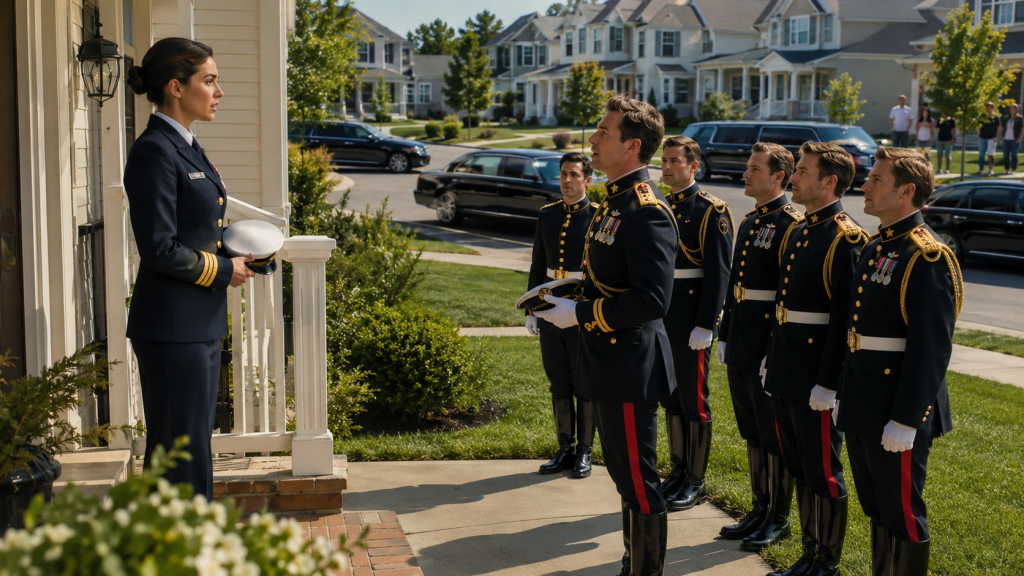
My sister Rachel was marrying a European prince that afternoon, but I was not supposed to be anywhere near that wedding.
I had not received an invitation.
I had not been asked to stand beside her.
I had not even been told where the ceremony would be broadcast.
Because according to Rachel, I did not belong in her new world.
At the time, I had no idea those guards had not come to escort me to a celebration.
They had come because the king had discovered something.
Something Rachel had hidden.
My name is Emily Carter.
I served in the United States Navy and was stationed near Norfolk.
Most people who knew me described me as disciplined, dependable, and calm under pressure.
I was never the glamorous one.
I did not chase attention, designer clothes, society headlines, or rooms full of people waiting to admire me.
That had always been Rachel’s world.
Rachel was three years older than me.
We grew up outside Columbus, Ohio, in a hardworking middle-class family.
Dad maintained school buildings for the county.
Mom worked long shifts as a nurse.
Money was tight, but love never was.
When we were little, Rachel and I were inseparable.
If other children mocked her, I defended her.
If she struggled with homework, I sat beside her until she understood.
When our parents worried about bills, we whispered on the back porch about the bright futures waiting for us somewhere beyond Ohio.
Back then, I believed sisters could survive anything.
I was wrong.
Rachel wanted luxury from the time she was old enough to understand what it meant.
Her bedroom walls were covered with magazine pages.
Mansions.
Gowns.
Private jets.
Celebrity parties.
Royal weddings.
I wanted something different.
Duty.
Purpose.
Service.
Rachel wanted to be admired.
I wanted to be useful.
Neither dream was wrong.
But they took us in opposite directions.
After graduation, Rachel moved to New York and built a career organizing elite charity events for wealthy clients.
She learned how to speak in polished rooms.
How to smile for cameras.
How to make powerful people feel important.
I joined the Navy.
The military became my second family.
Years passed through deployments, training exercises, overseas assignments, and long stretches away from home.
Rachel and I still spoke, but every year, the distance between us grew quieter and colder.
Then, two years before the wedding, Rachel called with impossible news.
She was dating a prince.
I laughed because I thought she was joking.
Girls from small-town Ohio did not usually call their sisters and casually announce they were involved with European royalty.
But it was true.
Prince Alexander belonged to a respected royal family overseas.
Not one constantly splashed across tabloids, but real royalty all the same.
The media adored Rachel.
A hardworking American woman falling in love with a prince?
It was the perfect modern fairy tale.
And honestly, I was happy for her.
At first.
Then Rachel began to change.
Every photo had to be flawless.
Every interview had to sound rehearsed.
Every public appearance had to support the elegant image she had built around herself.
She dressed differently.
Spoke differently.
Even her laugh became softer, measured, practiced.
It felt as though my real sister was slowly being replaced by a woman trained to survive behind palace glass.
Six months before the wedding, I flew to New York to visit her.
We had dinner at an expensive restaurant with tiny portions and white tablecloths.
For the first hour, Rachel smiled and talked about flowers, security, royal protocol, and media coverage.
Then she looked across the table and said quietly, “You probably shouldn’t wear your uniform around certain guests.”
I frowned.
“Why?”
She stirred her drink without meeting my eyes.
“It doesn’t really fit the image.”
“The image?” I repeated.
Rachel finally looked up.
In that moment, I saw something in her face I had never seen before.
Shame.
Not shame for what she was saying.
Shame for me.
“My wedding is going to be watched by very important people, Emily,” she said carefully. “Royal families. Diplomats. European society. They don’t need to see… all that.”
All that.
My years of service.
My sacrifices.
My uniform.
My life.
I sat there in silence as my own sister smiled politely and erased me piece by piece.
“What exactly are you asking me?” I said.
She exhaled like I was being difficult.
“I’m saying maybe you can wear something elegant. Something neutral. Maybe avoid talking about deployments or Navy things. It can make people uncomfortable.”
“Service makes people uncomfortable?”
“No,” she said quickly. “Don’t twist it.”
“I’m not twisting anything.”
Her voice lowered.
“I just need everything to be perfect.”
I looked at my sister, and for the first time, I understood.
Perfect did not include me.
Still, I thought I would be invited.
I was her sister.
I thought maybe she was nervous.
Maybe palace pressure had made her cruel for a moment.
Then weeks passed.
No invitation.
No call.
No mention of travel arrangements.
When I finally asked, Rachel sounded distracted.
“Oh, Emily, the guest list became impossible. Security limits. Protocol. You understand.”
I did not understand.
But I said, “Of course.”
That was what I had been trained to do.
Stay calm.
Control the wound.
Keep moving.
On the morning of the wedding, I put on my dress uniform anyway.
Not to attend.
Not to make a point.
For myself.
I stood in front of the mirror in my townhouse, medals aligned, collar straight, shoes polished.
Then I turned off the television before the ceremony could begin.
I told myself I did not care.
That was a lie.
I cared enough that my chest hurt.
I cared enough that I made coffee and forgot to drink it.
I cared enough that when a neighbor texted, “Isn’t your sister getting married today?” I did not answer.
Three hours later, the guards arrived.
The tallest one introduced himself as Captain Soren.
“Commander Carter,” he said, “His Majesty requests that you come immediately.”
I stared at him.
“I think there has been a mistake.”
“No, ma’am.”
“I wasn’t invited.”
His expression changed slightly.
“We are aware.”
The words landed heavily.
“We are aware.”
I swallowed.
“Why does the king want me?”
Captain Soren bowed his head.
“His Majesty asks that you attend not as a guest, but as the woman who saved his son’s life.”
My breath caught.
Saved his son?
Then memory struck me like cold water.
Five years earlier.
A classified rescue mission off a storm-darkened coast.
A diplomatic vessel in distress.
Bad weather.
Bad intelligence.
Worse timing.
We had pulled several people from wreckage before the sea swallowed what remained.
One of them had been a young diplomat with a head wound, barely conscious, speaking a language I did not understand.
I had kept pressure on his injury until evacuation.
I had never known his name.
The mission report had been sealed.
I had gone back to duty.
Now Captain Soren’s words echoed in my doorway.
The woman who saved his son’s life.
Prince Alexander.
Rachel’s prince.
My sister had known.
Somehow, she had known.
I stepped back from the door, suddenly cold.
“Give me ten minutes,” I said.
I went upstairs and looked in the mirror again.
The uniform Rachel thought would ruin her wedding stared back at me.
For one second, I considered changing.
Then I remembered her words.
All that.
No.
I would go as I was.
When I stepped outside in my Navy uniform, Captain Soren bowed his head.
“Commander,” he said, loud enough for every watching neighbor to hear, “it is an honor.”
The man across the street dropped his hose.
I got into the black vehicle with my spine straight and my hands folded over my knees.
During the drive, Captain Soren explained what he could.
The palace had asked Rachel for my contact information months earlier.
Prince Alexander had remembered my name from a classified commendation that was later declassified privately to the royal family.
He had wanted me present.
The king had wanted me honored.
Rachel told them I was deployed and unreachable.
Then she told them I disliked public attention.
Then she claimed I had chosen not to attend.
That morning, just before the ceremony, Prince Alexander asked again.
Where is Commander Emily Carter?
No one had an answer that satisfied the king.
So the palace security office began checking.
It took them less than an hour to discover I was in Virginia, not deployed, not unreachable, and very much unaware I had ever been requested.
By then, the ceremony had already begun.
The king stopped it.
My sister’s perfect wedding had frozen in front of royalty, diplomats, guests, cameras, and God.
By the time we reached the private airfield, my mind was strangely calm.
Maybe that is what training does.
It gives your body something to hold onto when your heart is breaking.
The flight felt unreal.
Royal guards.
A military aircraft.
Messages from unknown numbers lighting my phone.
By the time we reached the palace chapel, evening light was spilling across stone walls and polished cars.
People stood outside in clusters, whispering.
Inside, the chapel was silent.
Not peaceful silent.
Shocked silent.
The doors opened.
Every head turned.
Rachel stood near the altar in a gown so beautiful it almost hurt to look at.
White silk.
Long veil.
Diamonds at her throat.
Her face went pale the moment she saw me.
Prince Alexander stood beside her.
Tall, composed, but visibly shaken.
When his eyes met mine, something changed in him.
Recognition.
Not from photographs.
From memory.
He took one step forward.
“Commander Carter,” he said softly. “I looked for you for years.”
I did not know what to say.
The king stood near the front of the chapel.
He was older than I expected, broad-shouldered, with silver hair and a face carved by authority.
When he spoke, his voice carried through the room.
“This ceremony cannot continue until an insult against honor is corrected.”
Rachel whispered, “Emily, please.”
Please.
The first word she had spoken to me in months was not sister.
Not I’m sorry.
Please.
As if I had done this.
As if my existence was the scandal.
The king lifted a folder.
“In preparing for this union, this family requested the presence of Commander Emily Carter, whose courage saved my son’s life during a rescue operation five years ago. We were told she was deployed. We were told she wished to avoid attention. We were told she declined.”
He looked at Rachel.
“Those statements were false.”
A murmur moved through the chapel.
Rachel’s hands tightened around her bouquet.
“Your Majesty,” she said, voice trembling, “I was only trying to avoid complications.”
The king’s expression did not soften.
“Truth is not a complication.”
Prince Alexander turned to Rachel.
“You told me she didn’t want to come.”
Rachel’s lips parted.
“I thought it would be better.”
“For whom?” he asked.
She looked at me then.
Really looked.
For one second, beneath the veil and jewels and perfect makeup, I saw the girl from Ohio.
The sister who once held my hand on the back porch.
Then she looked away.
“For everyone,” she whispered.
And that was the answer.
Not for me.
Not for him.
For the image.
For the fairy tale.
For the version of herself that could not survive having a Navy officer sister in uniform standing beside her.
The king stepped down from the front and approached me.
I straightened automatically.
He stopped before me.
Then, in front of the chapel, he bowed his head.
Not deeply.
But enough.
The room seemed to stop breathing.
“Commander Carter,” he said, “my family owes you a debt beyond ceremony. My son stands here because you did your duty when no cameras were watching.”
My throat tightened.
“Your Majesty, I was part of a team.”
“Then your team has our gratitude as well. But today, you are here.”
He turned toward the guests.
“Let the record show that honor does not diminish a crown. It strengthens it.”
People began to applaud.
Softly at first.
Then louder.
I stood there in my uniform, the uniform Rachel had tried to hide, while a chapel full of royalty applauded the service she thought would shame her.
Rachel began crying.
Not loudly.
Not dramatically.
But enough for the cameras to capture it.
Prince Alexander did not comfort her.
He looked devastated.
The ceremony was postponed.
Not canceled immediately.
Postponed.
A royal word for disaster wrapped in velvet.
I was taken to a private room where palace staff brought tea I did not drink.
Twenty minutes later, Rachel entered alone.
For a moment, neither of us spoke.
She looked smaller without the crowd around her.
“Emily,” she said.
I waited.
“I panicked.”
“That’s your explanation?”
Her eyes filled.
“You don’t understand what it’s like. Everything is judged. Every detail. Every person connected to me becomes part of the story.”
“And I was the wrong detail.”
She wiped a tear.
“I thought if people saw you in uniform, they would ask questions. About deployments. About danger. About things that didn’t fit.”
“Fit what?”
“My life.”
The words were quiet, but they landed hard.
I nodded slowly.
“At least you finally said it.”
She stepped closer.
“I didn’t know Alexander would react this way.”
That almost made me laugh.
“You’re not sorry you lied. You’re sorry it mattered.”
Her face crumpled.
“That’s not fair.”
“No, Rachel. What wasn’t fair was telling a man I saved that I rejected his gratitude. What wasn’t fair was making me think my own sister had no room for me. What wasn’t fair was treating my service like dirt on your dress.”
She flinched.
“I was ashamed,” she whispered.
I looked at her.
“I know.”
That was the saddest part.
I had known for months.
Maybe years.
She covered her mouth and cried harder.
“I wanted to be someone else.”
“You became someone else.”
Silence stretched between us.
When she finally left, I did not feel victorious.
I felt tired.
Betrayal by a stranger cuts.
Betrayal by family hollows.
The next morning, the palace released a statement.
It praised the service of military personnel involved in the rescue operation.
It acknowledged an “unfortunate miscommunication” regarding my attendance.
That was the public version.
Privately, everyone knew.
Rachel’s wedding remained postponed while the royal family reconsidered the match.
Prince Alexander asked to speak with me once before I returned home.
We met in a garden behind the palace.
No cameras.
No guards close enough to hear.
He looked less like a prince there and more like the injured young man I half remembered from the storm.
“I never forgot your voice,” he said.
“My voice?”
“You kept telling me to stay awake.”
I smiled faintly.
“I do that a lot.”
“You told me I was not allowed to die because paperwork was annoying.”
Despite everything, I laughed.
“That sounds like me.”
His smile faded.
“I am sorry for what Rachel did.”
“That is not yours to apologize for.”
“I loved her,” he said quietly. “Or I loved who I thought she was.”
I understood that more than he knew.
“So did I.”
He looked toward the palace.
“I don’t know what happens next.”
“Neither do I.”
Before I left, he took my hand and bowed over it, not romantically, but with respect.
“Thank you, Commander.”
This time, I accepted it.
When I returned to Virginia, my neighbors had questions.
Lots of them.
I answered almost none.
The Navy did not make a spectacle of it, but my commanding officer called me in and said, with the smallest smile, “Interesting weekend, Carter.”
“Yes, sir.”
“Royal guards on your lawn?”
“Yes, sir.”
He nodded.
“Try to keep foreign monarchs off base property.”
“I’ll do my best, sir.”
Three months later, Rachel came to see me.
No cameras.
No palace car.
No diamonds.
Just jeans, a sweater, and red eyes.
The wedding had been canceled.
Officially, it was a mutual decision.
Unofficially, trust had broken beyond repair.
She stood on my porch holding a small box.
Inside was our mother’s bracelet.
The one Rachel had worn during every wedding interview.
“I should have asked you to stand beside me,” she said.
“Yes,” I replied.
“I should have been proud of you.”
“Yes.”
“I was jealous,” she admitted. “Not of your life. Of how sure you were about who you are.”
I looked at her for a long time.
“I wasn’t always sure.”
“But you never pretended.”
That was not entirely true.
I had pretended plenty.
Pretended I was fine.
Pretended it did not hurt.
Pretended being excluded was easier than confronting the person who excluded me.
But I understood what she meant.
Rachel wiped her face.
“I don’t expect you to forgive me.”
“Good,” I said. “Because I’m not ready.”
She nodded.
For once, she did not argue.
Before she left, she touched the sleeve of my uniform jacket hanging near the door.
“I used to think this made you look hard,” she said.
I looked at the medals, the pressed fabric, the life I had chosen.
“It made me honest.”
She left without asking for a hug.
That was the first respectful thing she had done in a long time.
Years later, people still sometimes ask about the royal wedding that stopped halfway through.
They remember the headlines.
The American bride.
The missing sister.
The Navy commander.
The king’s interruption.
They ask if I regret going.
I do not.
I regret that my sister could not love me without editing me.
I regret that she saw my uniform as a stain instead of a story.
I regret that it took a king asking one simple question for the truth to matter.
Where is Commander Emily Carter?
But I do not regret walking into that chapel.
I do not regret standing there in the uniform I earned.
I do not regret watching every polished lie crack under the weight of honor.
Rachel thought my uniform would ruin her royal wedding.
She was wrong.
The uniform did not ruin anything.
The lie did.
And when six royal guards came to my door in Virginia, they did not bring me into her fairy tale.
They brought me back into my own story.
THE END! THANKS FOR READING!