 Reading Time: 8 minutes
My eight-year-old daughter sent me a text saying, “Dad, come to my room. Just you.” Then she turned around and showed me the handprints covering her back. I thought I was taking her to a piano recital that day. Instead, one terrifying secret exposed the people she had been afraid of all along.
My name is Harrison Vance, and the worst day of my life began with a text message from my daughter. I was standing in my bedroom, trying to button my cufflinks for Chloe’s spring piano recital, when my phone buzzed on the dresser. The message was short.
Dad, can you help me with my dress zipper? Come to my room. Just you. Close the door.
At first, I stared at it, confused.
Chloe normally filled her messages with emojis, missing letters, and dramatic little statements like, “Dad, emergency, my hair hates me.”
But this message sounded careful.
Too careful.
Almost rehearsed.
Something cold moved through my chest.
From downstairs, my wife Meredith called, “Everything on schedule up there, Harrison?”
“Just finishing up,” I answered.
Even to me, my voice sounded strange.
I walked down the hallway slowly.
Chloe’s bedroom door was half closed.
The recital dress I had helped her choose was lying untouched across the chair. Pale blue. Tiny pearls around the waist. She had loved it in the store and spun in front of the mirror until I nearly cried.
But now she was not wearing it.
She stood by the window in leggings and a T-shirt, clutching her phone with both hands.
Her face was pale.
Terrified.
“Hey, kiddo,” I said softly. “Need help with the zipper?”
She shook her head.
“I lied about the zipper.”
The fear in her voice erased every other thought from my mind.
I stepped inside and closed the door behind me.
“What is it, sweetheart?”
She looked toward the door.
Then back at me.
“Dad, I need you to look at something,” she whispered. “But you have to promise you won’t freak out.”
My heart began pounding so hard I could hear it.
“I promise I’ll stay calm.”
Her lips trembled.
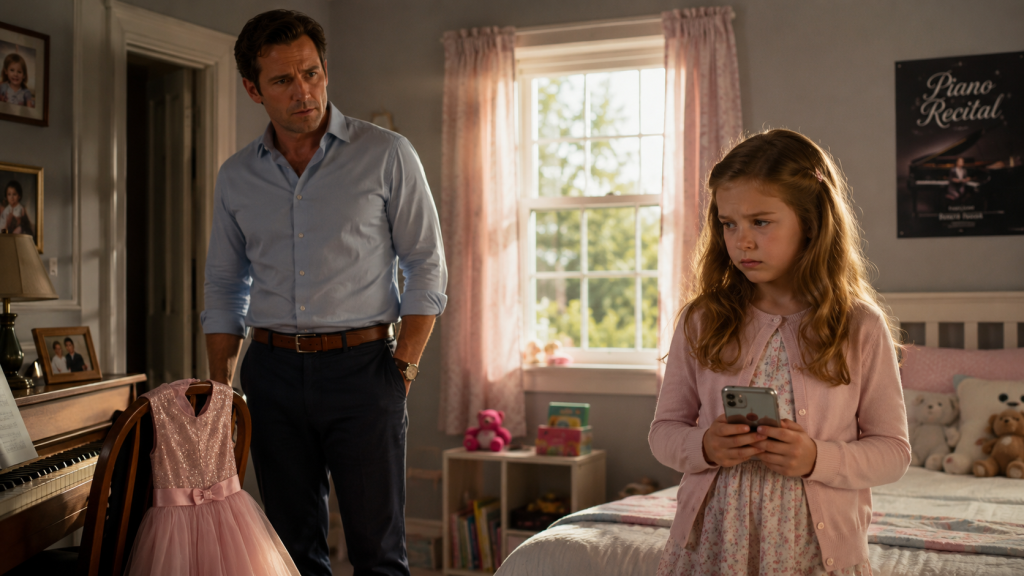
“You have to really promise.”
I knelt so my eyes were level with hers.
“I promise.”
For a moment, she just stared at me, searching my face like she needed to decide if I was still safe.
Then she slowly turned around.
With shaking hands, Chloe lifted the back of her shirt.
My entire world stopped.
Dark bruises covered her ribs and lower back.
Some were old and yellow at the edges.
Others were fresh, swollen, and deep purple.
They were not random playground marks.
They were not from falling off a bike.
They were handprints.
Someone had grabbed my daughter hard enough to leave fingers in her skin.
For one second, pure rage exploded inside me.
I wanted to smash the room apart.
I wanted to run downstairs and destroy whoever had done this.
But then Chloe turned her head and looked at me.
She was not watching for anger.
She was watching to see if I believed her.
So I forced every bit of rage down into the floor.
I breathed once.
Then I gently lowered her shirt.
“How long has this been happening?” I asked.
A tear slid down her cheek.
“Since February.”
February.
It was April.
Two months.
Two months of my little girl carrying this while I drove to work, paid bills, kissed her forehead, asked if school was good, and believed her when she said, “I’m fine.”
“Who did this?” I asked.
She swallowed.
Then she whispered the name.
“Grandpa Richard.”
For a moment, I could not understand the words.
Richard.
Meredith’s father.
The retired principal.
The church volunteer.
The man everyone called strict but respectable.
The man who gave speeches about family values and discipline.
The man who had been staying with us twice a week to “help with Chloe” while Meredith recovered from migraines and I worked late.
My stomach turned.
“Did he do this today?”
Chloe nodded.
“He said I played the wrong song too many times.”
My hands tightened, but I kept my voice steady.
“Does your mom know?”
Chloe stared at the carpet.
That was answer enough.
Downstairs, Meredith called again.
“Harrison, we’re going to be late!”
Chloe flinched.
I noticed that too.
Every small movement suddenly became evidence.
Every silence became a warning I had missed.
“Chloe,” I said quietly, “has anyone told you not to tell me?”
She nodded.
“Grandpa said you’d get mad and leave Mom. Mom said I needed to stop making things bigger than they are.”
My throat closed.
“Bigger than they are?”
“She said Grandpa comes from a different generation and I’m sensitive.”
I stood slowly.
Not because I wanted to leave her.
Because if I stayed kneeling, I might collapse.
“Sweetheart, listen to me. None of this is your fault.”
“But Mom said—”
“I don’t care what Mom said. I’m your father. I believe you.”
Her face crumpled.
She stepped into my arms and finally started crying.
Not loudly.
Not the way children cry when they want attention.
She cried like someone who had been holding her breath for months.
I held her carefully.
Then I pulled back.
“I’m taking you to the hospital.”
Her eyes widened.
“No, Dad, the recital—”
“No recital.”
“Mom will be mad.”
“Let her be.”
“Grandpa’s downstairs.”
That sentence froze the air.
Richard was downstairs.
In my house.
Waiting with flowers, probably smiling for pictures.
I looked at Chloe’s tablet on the bed.
“You mentioned pictures?”
She hesitated.
Then she nodded.
“I took them. Of my back. And the dates. And I recorded him once when he said nobody would believe me.”
My eight-year-old daughter had been collecting proof because the adults around her had failed her.
I wanted to weep.
Instead, I said, “Bring it.”
She slid the tablet into her little recital bag.
I took her sweater from the chair and wrapped it around her shoulders.
When we walked downstairs, Meredith was standing near the door in a cream dress, holding her purse.
Richard stood beside her with a bouquet of pink roses.
He smiled when he saw Chloe.
“There’s our little pianist.”
The word our made my skin crawl.
I stepped slightly in front of my daughter.
Meredith frowned.
“Why isn’t she in her dress?”
“We’re not going to the recital.”
“What?”
“We’re going to the hospital.”
Meredith went very still.
Richard’s smile twitched.
“The hospital?” he asked lightly. “For what?”
I looked at Meredith.
“You know for what.”
Her face drained of color.
“Harrison, not here.”
That was the second time my heart broke that day.
Not here.
Not what happened?
Not is Chloe okay?
Not who hurt her?
Not here.
Richard’s voice hardened.
“Careful, Harrison.”
I turned to him.
“You do not speak to me.”
His face changed.
For the first time, the respectable mask slipped.
I saw something cold underneath.
Meredith stepped closer.
“Chloe gets dramatic when she feels pressure.”
My daughter’s hand tightened around mine.
I looked at my wife, the woman I had loved for twelve years, and saw a stranger.
“She has handprints on her back.”
Meredith whispered, “My father didn’t mean—”
I cut her off.
“You knew.”
Tears filled her eyes.
“He said she needed discipline. He said you were making her soft.”
“She is eight years old.”
“She can be difficult.”
Chloe made a small sound behind me.
That was when the last piece of love I had for Meredith cracked.
I pulled out my phone.
Meredith’s eyes widened.
“What are you doing?”
“Calling 911.”
Richard stepped forward.
“You are making a terrible mistake.”
“No,” I said. “I made the mistake months ago when I trusted you near my child.”
I dialed.
Meredith began crying, begging me to hang up before I ruined the family.
But the family was already ruined.
It had been ruined every time Chloe cried alone in her room.
It had been ruined every time Meredith chose silence over protection.
It had been ruined every time Richard walked into my house pretending to be a grandfather.
The operator answered.
I said clearly, “I need police and medical assistance. My eight-year-old daughter has injuries, and the person responsible is in the house.”
Richard tried to leave.
I moved between him and the door.
He laughed once.
“You think you can hold me here?”
“No,” I said. “But the camera can show you leaving.”
His eyes flicked to the doorbell camera.
For the first time, fear crossed his face.
The police arrived within minutes.
I kept Chloe behind me until the officers entered.
A female officer knelt near her and spoke gently.
Chloe did not want to show anyone at first.
Then she looked at me.
I nodded.
“You’re safe.”
At the hospital, doctors examined her carefully.
They photographed the injuries.
A child advocate was called.
Chloe’s tablet was taken as evidence.
When the nurse saw the bruises, her mouth tightened in a way I will never forget.
She did not say much.
She only touched Chloe’s shoulder and whispered, “You were very brave.”
Meredith arrived an hour later with a lawyer.
Not alone.
Not with concern.
With a lawyer.
That told me everything I needed to know.
She tried to speak to Chloe.
The officer stopped her.
“You can wait outside.”
Meredith looked at me.
“Harrison, please.”
I wanted to ask her how many times Chloe had said that word to her.
Please.
Please believe me.
Please don’t make me go with Grandpa.
Please don’t tell him I cried.
But I was too tired to give Meredith the comfort of my anger.
I only said, “You chose.”
Child Protective Services opened a case that night.
Richard was arrested after Chloe’s recordings confirmed his threats.
In one video, his voice was clear.
“Your father won’t believe you. Your mother already knows you exaggerate.”
Hearing it nearly destroyed me.
But it also saved my daughter.
The evidence proved she had not lied.
The doctors proved the injuries were real.
And Meredith’s own text messages, recovered later, proved she had known something was wrong and chosen to protect her father’s image.
The next weeks were a blur.
Police interviews.
Court hearings.
Therapy appointments.
Sleepless nights.
Chloe moved into my room for a while because she was afraid to sleep alone.
I put a mattress on the floor beside my bed and let her keep the lamp on.
Some nights she woke crying.
Some nights she said nothing, just reached for my hand in the dark.
I held it every time.
Meredith tried to claim she had been manipulated by her father.
Maybe she had.
But she had also been a mother.
And being afraid of an adult does not excuse abandoning a child.
The court granted me emergency custody.
Meredith was allowed supervised visits only after completing counseling.
Richard was not allowed near Chloe.
Later, he pled guilty to avoid a longer trial.
People in town were shocked.
They always are when monsters wear nice jackets and smile at church.
Chloe stopped playing piano for almost six months.
The recital dress stayed in the closet.
I never pushed her.
Then one evening, I heard a soft melody coming from the living room.
I found her sitting at the piano, playing slowly.
Not perfectly.
Not confidently.
But playing.
She saw me and stopped.
“Is it okay?” she asked.
I sat beside her.
“Everything you feel is okay.”
She looked down at the keys.
“I still like music.”
“Then music still belongs to you.”
A year later, Chloe played in another recital.
A smaller one.
No Meredith.
No Richard.
Just me in the front row, holding flowers.
Before she walked onstage, she texted me from backstage.
Dad, are you there?
I replied immediately.
Always.
She played with shaking hands at first.
Then stronger.
By the final note, I was crying so hard I could barely see.
Afterward, she ran into my arms.
“Did I do good?”
I kissed her hair.
“You did more than good. You came back.”
Chloe still heals in pieces.
So do I.
I carry guilt for what I missed.
For every late night at work.
Every time she said she was tired and I believed it was school.
Every time I let Richard pick her up because he seemed trustworthy.
But guilt cannot become the center of her recovery.
She needs a father who watches better now.
Who listens.
Who believes.
Who never asks a child to prove pain before offering protection.
Sometimes people ask what happened to Meredith.
She lives across town now.
She is allowed supervised contact, but Chloe chooses when.
Sometimes she goes.
Sometimes she does not.
The first time Chloe said, “I don’t want to see Mom this week,” and I answered, “Okay,” she stared at me like I had given her the moon.
Children should not be shocked by choice.
But some are.
We are fixing that slowly.
One safe yes.
One honored no.
One believed truth at a time.
That morning, I thought I was taking my daughter to a piano recital.
I thought the worst thing that could happen was a missed note.
Instead, I learned that the most dangerous secrets can live inside the people invited to family dinners.
Inside respected men.
Inside silent mothers.
Inside homes that look perfect from the sidewalk.
But I also learned something else.
My daughter was not weak.
She was not dramatic.
She was not difficult.
She was brave enough to send one careful text.
Dad, come to my room. Just you.
And I thank God every day that I listened before the music started.
THE END! THANKS FOR READING!