 Reading Time: 8 minutes
My stepfather hurt me almost every day for his own amusement. One afternoon, he knocked me unconscious, and when he brought me to the hospital, my mother claimed, “She slipped while taking a bath.”
The moment the doctor examined me, he grabbed the phone and dialed 911.The final sound I heard before everything faded into darkness was my stepfather’s laughter. He laughed as if hurting me was entertainment. As if my suffering was the highlight of his day.His name was Victor Payne, though inside our home, everyone called him “sir.”
Especially my mother.
I used to think she called him that because she loved him.
Later, I understood it was because she feared him.
But fear did not excuse what she allowed.
Every evening, Victor found some reason to punish me.
A dish set down too hard.
A shirt folded the wrong way.
A glance he decided was disrespectful.
Sometimes, he did not even bother inventing a reason.
He would sink into his recliner with a beer in his hand, turn the television volume down, and say, “Violet, come here. I’m bored.”
My mother would immediately lower her gaze.
“Just do what he says,” she once murmured. “Don’t make things worse.”
But every time she stayed silent, she made things worse herself.
I was twenty-two, old enough to leave in theory, but trapped in all the ways people do not understand unless they have lived it.
Victor controlled the money.
He had taken my bank card after saying I was “irresponsible.”
He kept my car keys locked in his desk.
He had convinced neighbors that I was unstable, dramatic, and difficult.
When I once tried to tell my aunt what was happening, Victor smiled across the dinner table and said, “Violet has always had a wild imagination.”
My mother nodded.
That nod broke something in me more deeply than his cruelty ever could.
After that, I stopped begging her to save me.
I started saving myself.
Not loudly.
Not bravely in the way people imagine.
There were no dramatic speeches.
No packed bags at midnight.
No running through the rain.
Survival, for me, looked like silence.
It looked like memorizing his moods.
It looked like learning which floorboards creaked.
It looked like hiding a second phone inside the lining of an old winter coat.
It looked like taking pictures of bruises when everyone was asleep.
It looked like recording him from beneath a laundry basket while he threatened me in the kitchen.
It looked like writing dates inside an old Bible because I knew Victor would never open one.
The Bible had belonged to my grandmother.
She used to say, “Truth can be buried, Violet, but it does not die.”
For a long time, I did not believe her.
Then I started writing.
May 3. He broke the blue plate and blamed me.
May 9. Mother said I fell.
May 17. He threatened to lock me in the basement.
June 2. He said no one would believe me.
Over three years, the pages filled.
Not with prayers.
With evidence.
Victor loved having an audience.
He enjoyed forcing me to stand in the center of the living room while he humiliated me.
“Look at her,” he would tell my mother. “Twenty-two years old and still completely useless.”
My mother would sit on the edge of the couch, hands folded, eyes lowered.
Sometimes I hated her more than him.
That is an ugly truth, but it is the truth.
He was a monster.
She was the door he walked through every day.
By then, I no longer cried in front of him.
That bothered him more than anything.
Tears made him feel powerful.
Silence made him suspicious.
One evening, he stepped close enough that I could smell alcohol on his breath.
“You think you’re brave?” he asked.
I looked at him evenly.
“No,” I said. “I think you’re predictable.”
The smile disappeared from his face.
My mother whispered, “Violet, stop.”
But I was tired.
Tired in my bones.
Tired of folding myself small enough to survive another night.
The first strike sent me crashing into the kitchen counter.
Pain flashed through my side.
The second knocked the breath from my chest.
My mother stood frozen by the sink, twisting her wedding ring as though that small circle of gold could spare her from choosing a side.
Victor pointed at me.
“Tell her.”
My mother swallowed hard.
“Apologize, Violet.”
I stared at her.
“For what?”
Victor moved so quickly I barely registered it.
My head hit the tile floor.
The world went bright, then black.
When I regained consciousness, harsh hospital lights glared above me.
My mouth tasted like metal.
My body felt far away, heavy and broken.
Victor stood beside the bed wearing an expression of counterfeit concern.
My mother held my hand, but not out of affection.
She was keeping it pinned in place.
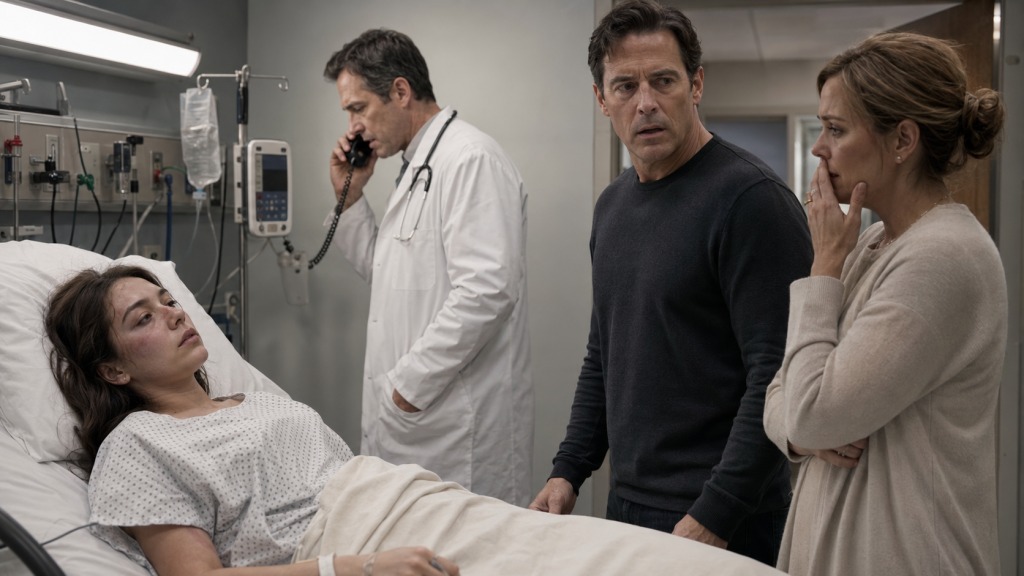
A doctor in a white coat walked into the room.
He had kind eyes, but tired ones.
“What happened?” he asked.
My mother answered before I could speak.
“She accidentally slipped while taking a bath.”
Victor nodded sadly.
“She’s always been clumsy.”
The doctor looked at me.
Then at my arms.
Then at the older marks Victor believed had faded enough to stay hidden.
His expression changed.
Not dramatically.
Not like in movies.
Something in his face simply closed.
He turned to the nurse and said, “Please step outside and call security.”
Victor’s posture stiffened.
“Is there a problem?”
The doctor did not answer him.
He picked up the phone mounted on the wall.
“I need police in Emergency Room Three,” he said. “Now.”
For the first time that night, Victor stopped smiling.
And in that moment, even through the pain, I knew the trap I had spent years preparing had finally sprung shut.
Victor tried to leave.
The nurse blocked the door with a calmness that made me want to cry.
“Sir, please remain where you are.”
He laughed sharply.
“This is ridiculous. My stepdaughter fell.”
The doctor stepped between him and my bed.
“These injuries are not consistent with a fall.”
My mother began crying.
Not for me.
For him.
“Victor,” she whispered, “tell them. Tell them it was an accident.”
He shot her a look so cold she went silent.
Then two officers entered.
A man and a woman.
The female officer came to my bedside.
“Violet, can you tell me what happened?”
Victor immediately spoke.
“She’s unstable. She makes things up when she wants attention.”
I turned my head slowly toward the officer.
My voice was weak, but clear.
“Check my phone.”
Victor’s eyes narrowed.
“What phone?”
The female officer leaned closer.
“Where is it?”
“In my coat,” I whispered. “Old green coat. Hall closet at home. Inside the lining.”
Victor’s face changed.
Just slightly.
Enough.
“And the folder,” I continued. “Cloud account. Folder name: Chemistry Notes.”
The officer looked at me carefully.
“What’s inside?”
“Photos. Recordings. Dates. Three years.”
Victor took one step back.
Because he finally understood.
I had not survived by being silent.
I had survived by recording everything.
My mother stared at me as if I had betrayed her.
That look hurt, but only for a second.
Then the doctor gently lifted my sleeve to examine another bruise, and I remembered who had truly betrayed whom.
The officers separated us.
One stayed with me.
The other escorted Victor and my mother to another room.
I heard Victor shouting through the walls.
“She’s lying!”
“She’s sick!”
“She wants money!”
Every accusation sounded smaller from a distance.
For years, inside our house, his voice had filled every room.
In the hospital, behind a closed door, he was just a man running out of lies.
Detective Morales arrived an hour later.
She was quiet, serious, and careful with every question.
She asked if I felt safe giving a statement.
I said yes.
She asked if I wanted my mother in the room.
I said no.
That one word felt like breaking a chain.
No.
I told Detective Morales about the phone.
The Bible.
The recordings.
The neighbors who had heard but never asked.
The broken dishes.
The threats.
The nights I slept with a chair under my bedroom door.
She wrote everything down.
When she asked why I had not reported sooner, shame rose in my throat.
Before I could answer, the doctor spoke from the doorway.
“Fear keeps people trapped. Evidence helps them leave.”
I looked at him then.
Really looked.
His name tag read Dr. Samuel Reed.
I will never forget that name.
The next day, police searched the house.
They found the green coat.
They found the phone.
They found the old Bible.
They found a dent in the kitchen counter where my body had struck it.
They found a cracked tile with my blood still visible in the grout.
They found the locked drawer where Victor kept my bank card, my birth certificate, and my car keys.
Most importantly, they found themselves listening to Victor’s own voice.
His threats.
His laughter.
His exact words.
“No one will believe you.”
But someone did.
The recordings changed everything.
Victor was arrested.
My mother was not arrested that day, but she was questioned for hours.
Later, I learned she admitted she had lied to doctors before.
Not once.
Many times.
She said she was afraid.
She said Victor would hurt her too.
I wanted to feel sorry for her.
Part of me did.
But another part remembered her hand pinning mine to the hospital bed.
Another part remembered her saying, “Apologize, Violet.”
Fear may explain silence.
It does not erase it.
After I was discharged, I did not go home.
A victim advocate helped place me in a safe apartment.
Small.
Plain.
Mine.
For the first time in years, I locked a door and knew no one inside would hurt me.
The first night, I sat on the floor because I did not yet own a couch.
I ate crackers for dinner.
Then I cried until sunrise.
Not because I wanted to go back.
Because freedom, when it first arrives, feels too quiet.
I had spent years listening for footsteps, for bottles opening, for Victor clearing his throat.
Silence felt unsafe at first.
Then, slowly, it became peace.
The case took months.
Victor’s lawyer tried to say I was vindictive.
Confused.
Mentally unstable.
Then the prosecutor played the recordings.
Victor’s voice filled the courtroom.
“Violet, come here. I’m bored.”
My mother sat two rows behind him, pale and shaking.
She would not look at me.
I did not look away from him.
For years, he had forced me to stand in the middle of the living room while he humiliated me.
Now he sat in a courtroom while his own words did it to him.
The jury did not take long.
Guilty.
When the verdict was read, Victor turned around and looked at me.
For a moment, I saw the old threat in his eyes.
Then two officers moved toward him, and the threat disappeared into fear.
I thought I would feel joy.
I did not.
I felt tired.
Deeply, completely tired.
But beneath that exhaustion was something stronger.
Relief.
My mother tried to speak to me outside the courtroom.
“Violet,” she said, voice cracking.
I stopped walking, but I did not turn fully toward her.
“I was scared,” she whispered.
“So was I.”
“I didn’t know what to do.”
“Yes, you did,” I said. “You just chose him.”
She began to cry.
I had dreamed of that moment for years.
In my dreams, I screamed at her.
I told her every wound she ignored.
Every lie she told.
Every time I looked at her and waited for love to beat fear.
But in real life, I had no energy left for screaming.
I only said, “I hope someday you become someone who would protect her child. But you are not my safe place anymore.”
Then I walked away.
A year has passed.
I have a small apartment with yellow curtains.
A job at a library.
A bank account in my own name.
My birth certificate is in a locked drawer only I can open.
The old Bible sits on my shelf.
Not hidden anymore.
Sometimes I still wake up at night convinced I heard Victor’s recliner creak.
Sometimes loud laughter makes my hands shake.
Sometimes I smell beer on a stranger’s breath and feel twenty-two and trapped again.
Healing is not a clean road.
It is uneven.
Some days I feel strong.
Some days I still feel like the girl on the tile floor.
But every morning, I wake up in a place where no one calls me useless.
No one orders me to apologize for bleeding.
No one laughs when I flinch.
Dr. Reed sent me one letter after the trial.
It was short.
Violet, you were believed because you told the truth. But I hope you know this: you deserved help even before you had proof.
I keep that letter inside the Bible.
Beside the dates.
Beside the evidence.
Beside the story of the girl who thought silence was the only way to survive.
Victor believed fear would protect him.
My mother believed lying would keep the house standing.
But houses built on terror always collapse eventually.
Mine collapsed under fluorescent hospital lights, when a doctor looked closely enough to see what everyone else had chosen to ignore.
He picked up the phone.
He dialed 911.
And for the first time in my life, the sound that followed was not Victor’s laughter.
It was the beginning of my freedom.
THE END! THANKS FOR READING!