
The moment my granddaughter pulled that envelope from her backpack, I felt something change in the courtroom. I didn’t know what was inside it.
I didn’t know why Brandon suddenly looked as though someone had knocked the breath out of him. But I knew my granddaughter. And I knew the expression on her little face.
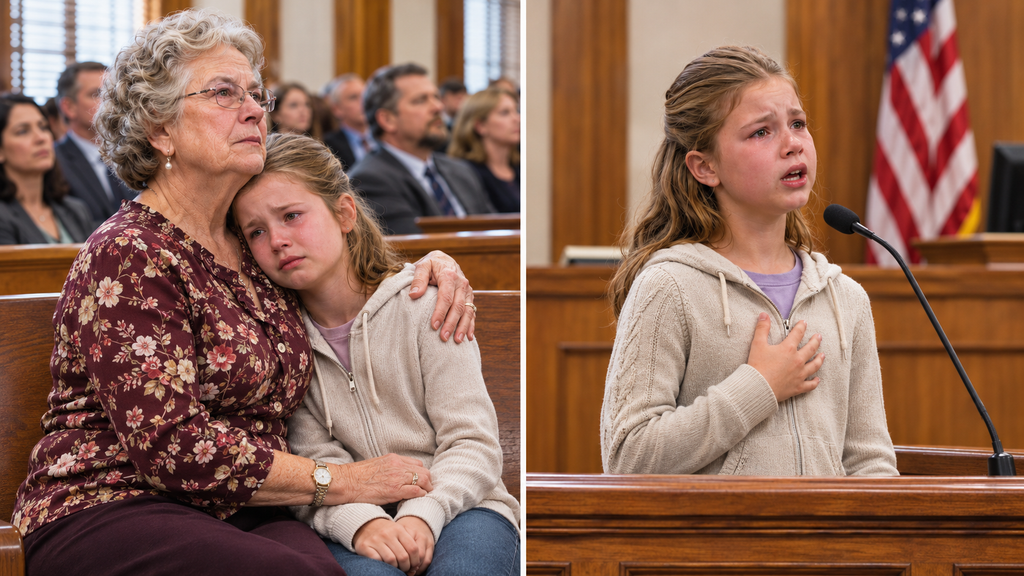
It was the same expression she had worn when she was seven years old and confessed that she had accidentally broken my favorite vase.
Only this time, there was something different in her eyes.
Fear.
Not fear of punishment.
Fear of what might happen when the truth finally came out.
“Sweetheart,” the judge said gently, “what have you brought with you?”
Hazel swallowed.
“It’s something my father doesn’t want anybody to see.”
Brandon immediately rose from his chair.
“Your Honor, this is ridiculous. She’s eleven years old. She doesn’t understand what she’s talking about.”
“Mr. Ward,” the judge replied sharply, “sit down.”
His attorney placed a hand on his arm.
But Brandon wasn’t looking at the judge anymore.
He was staring at the envelope.
And for the first time since he had walked back into our lives, I saw genuine terror on his face.
Hazel carefully removed three folded sheets of paper.
The first was covered in numbers.
The second contained several signatures.
And the third had a photograph attached to it.
She placed them in front of the judge.
“Grandma doesn’t know about this,” she whispered. “I didn’t know how to tell her.”
Judge Miriam Reed adjusted her glasses.
She read the first page.
Then the second.
When she reached the third, she stopped.
Her eyes widened.
She raised one hand to her mouth.
And for several seconds, the courtroom was completely silent.
Finally, she looked directly at Brandon.
“Mr. Ward,” she said slowly, “would you care to explain why your daughter appears to be the beneficiary of a trust worth approximately four million, six hundred thousand dollars?”
I stopped breathing.
Four million?
Six hundred thousand?
I couldn’t even imagine such an amount.
Brandon’s attorney straightened in her seat.
“Your Honor, that information concerns a private family estate. It has no bearing on the custody petition.”
The judge looked at the remaining papers.
“I believe,” she replied, “that we may have a serious disagreement about that.”
Hazel gripped the sides of her backpack.
Then she said something I will remember until the day I die.
“He doesn’t want me because I’m his daughter.”
She turned and looked at Brandon.
“He wants me because I’m worth money.”
A cold silence settled over the room.
And in that moment, I realized that the man who had abandoned my granddaughter eleven years earlier had returned for something far more valuable to him than her love.
He had returned for her inheritance.
But even then, I had no idea how far he had already gone to get it.
Or how much worse the truth was about to become.
The Conversation Hazel Was Never Supposed to Hear
“Tell me everything,” Judge Reed said.
Her voice was gentle now.
Hazel looked toward me.
I wanted to run to her.
To wrap my arms around her shoulders and take her away from that frightening room.
But the judge gave me a small, reassuring nod.
So I stayed where I was.
Hazel took a breath.
“Last Sunday, my dad picked me up for lunch.”
I remembered that afternoon.
Brandon had insisted that Hazel spend time with him before the hearing.
He called it an opportunity for them to bond.
I had been reluctant.
Hazel had begged me not to make her go.
But I was afraid that refusing contact would be used against me in court.
So I had encouraged her to give him a chance.
I had even packed her favorite strawberry cookies in a small container.
“Maybe he’ll surprise you,” I had told her.
Oh, how desperately I wished I could take those words back.
Hazel continued.
“He took me to his house. It’s really big. There’s a swimming pool and a movie room and a staircase that looks like the one in Cinderella.”
A few people smiled faintly.
“But I didn’t like it.”
“Why not?” the judge asked.
“Because he kept telling me everything I would get if I agreed to live there. He never asked me what I wanted.”
My heart tightened.
“He showed me a bedroom with a white carpet and a huge television. He said I could have a new phone and a horse and go shopping whenever I wanted.”
Brandon shifted uncomfortably.
“That’s called providing for my daughter,” he muttered.
The judge gave him a warning glance.
Hazel looked down.
“Then his wife went out to meet somebody, and my dad got a phone call.”
“Where were you?”
“In the room beside his office. He told me to wait there and watch television.”
She hesitated.
“The door was open a little. He was talking really loudly.”
The judge leaned forward.
“What did you hear?”
Hazel’s lower lip trembled.
“He said, ‘I don’t care what the girl wants. I need legal control before the bank comes after everything.'”
The attorney beside Brandon went very still.
Hazel continued.
“He said, ‘Once she’s living here, we’ll get somebody to put me in charge of her money. Four and a half million is more than enough to save the company.'”
Brandon suddenly spoke.
“That is completely out of context!”
“Mr. Ward!”
The judge’s voice echoed through the courtroom.
Hazel flinched.
I rose halfway from my seat.
“Please don’t frighten her,” I said.
The judge nodded.
“Nobody is going to hurt you here, Hazel. Take your time.”
My granddaughter wiped her cheek with the back of her hand.
“Then my dad said something about Grandma.”
I felt a strange pressure in my chest.
“He said she was old and poor and wouldn’t be difficult to get rid of.”
My hands went numb.
“He said the lawyer had someone who could make it look like Grandma couldn’t remember things properly anymore.”
I stared at Brandon.
The man I had once welcomed into my kitchen.
The man whose child my daughter had carried.
The man who had walked out of our home with a suitcase while I held his crying baby.
Eleven years later, he had not returned to thank me.
He had returned to destroy me.
Hazel continued speaking.
“When he finished talking, he went outside. The printer in his office had papers in it. I saw my name on them.”
She pointed to the envelope.
“I know I shouldn’t take things that don’t belong to me. But I saw Grandma’s name too.”
The judge glanced down at the pages.
“And these are the papers you found?”
Hazel nodded.
“One says how much money I have. One says my dad should be in charge of it.”
She paused.
“And the other one says Grandma agreed that he could take me.”
My stomach dropped.
“What?” I whispered.
Hazel turned toward me.
“Grandma, it has your signature.”
I stared at the judge.
“I never signed anything.”
Judge Reed’s expression hardened.
“I understand, Mrs. Ellis.”
My name is Nora Ellis.
I had lived sixty-four years before my granddaughter came into the world.
And I had spent the next eleven years learning how to be a mother all over again.
I had signed school permission slips.
Medical forms.
Library cards.
Dentist paperwork.
I had signed a hundred things for Hazel.
But I had never signed away my little girl.
Never.
Not for a mansion.
Not for a million dollars.
Not for anything in this world.
The judge studied the document again.
“Mrs. Ellis, we will arrange for this matter to be reviewed properly. At this stage, these papers raise serious questions, but the court will need to verify their authenticity.”
Then she turned to Brandon’s attorney.
“Counsel, I want copies preserved and an explanation of the proposed financial arrangement.”
Brandon’s attorney looked as though she had aged ten years.
“Your Honor, I was not aware of any document bearing Mrs. Ellis’s alleged consent.”
Brandon snapped his head toward her.
“Fletcher!”
She ignored him.
That frightened him even more.
The judge called a recess.
She ordered that Hazel remain in my care while the court arranged further review of the allegations.
She also requested an independent representative for Hazel’s interests.
The custody question would not be decided that morning.
But something had changed forever.
For eleven years, Brandon had been able to walk away from responsibility.
That day, for the first time, he was being asked to explain himself.
And he had no good answer.
“You Should Have Kept Your Mouth Shut”
Outside the courtroom, I knelt in front of Hazel.
She was trembling so badly that her backpack straps shook against her shoulders.
“Grandma,” she whispered, “are you mad at me?”
The question nearly broke me.
“Mad at you?”
I pulled her into my arms.
“Oh, sweetheart. No. Never.”
“I took those papers.”
“You were scared.”
“I thought if he knew, he’d be really angry.”
I kissed her forehead.
“You did the right thing by telling the truth.”
She began crying.
Not the quiet tears she had shed in court.
These were deep, exhausted sobs.
The kind that came from holding fear inside for far too long.
“I don’t want his money,” she cried. “I don’t want the big house. I just want to stay with you.”
I held her tighter.
“You are not going anywhere without us fighting for you, Hazel. Do you understand?”
She nodded against my shoulder.
Then a voice came from behind us.
“That was quite a performance.”
I turned.
Brandon stood a few feet away.
His expensive jacket was unbuttoned.
His face was red.
And the confident smile he had worn when he arrived at the courthouse had completely disappeared.
“Brandon,” I said quietly, “leave us alone.”
He ignored me.
His eyes remained fixed on Hazel.
“Do you understand what you’ve done?”
Hazel shrank behind me.
I stood.
“Do not speak to her like that.”
“She went through my private papers!”
“She’s eleven!”
“She’s old enough to understand consequences.”
I could hardly believe what I was hearing.
“Consequences?” I repeated. “You abandoned her for eleven years. Now you’re threatening her because she discovered what you’ve been doing?”
His jaw tightened.
“You’ve poisoned her against me.”
“No, Brandon. You did that yourself.”
He stepped closer.
“You think you’re going to win because she cried in front of a judge?”
I put myself between him and Hazel.
“I think you should remember where you are.”
For a moment, I saw something dangerous in his expression.
Not physical violence.
Something colder.
The fury of a man who believed that everyone around him existed to obey him.
Then his attorney appeared.
“Brandon. Stop talking. Now.”
He looked at her.
She spoke in a low voice.
“Do not make this worse.”
For the first time, he seemed to realize that other people were watching.
He stepped backward.
But before leaving, he looked at Hazel and said one final thing.
“You have no idea what you’ve just cost me.”
Hazel gripped my hand.
And in a voice barely louder than a whisper, she answered:
“You already cost me eleven birthdays.”
Brandon froze.
I felt tears filling my eyes.
Because there was nothing he could say to that.
Not a single thing.
The Man Who Left Hazel Four Million Dollars
Two days later, I received a phone call.
The woman introduced herself as Dana Ortiz.
She worked with a legal aid organization and had been asked to speak with me about Hazel’s case.
She explained that the court had arranged for someone independent to represent Hazel’s interests and that I might qualify for assistance with my own legal defense.
For the first time since Brandon had returned, I felt that I wasn’t standing completely alone.
Dana came to our home that Thursday.
She was a small woman with serious brown eyes and a voice that made complicated things sound understandable.
She sat at my kitchen table.
The same table where Hazel had learned to write her name.
The same table where I had cried over unpaid electricity bills after my daughter died.
Dana opened a folder.
“Mrs. Ellis, there’s something important you need to know about Hazel’s paternal family.”
I poured her a cup of tea.
My hands were shaking.
“All right.”
“Do you recognize the name Arthur Ward?”
I frowned.
“Brandon’s father?”
“Yes.”
I remembered Arthur vaguely.
He had owned a manufacturing company in another state.
Brandon seldom spoke about him.
When he did, it was usually with bitterness.
He claimed his father had never supported him.
That he cared more about business than family.
I had never met the man.
“Arthur passed away six months ago,” Dana explained.
“I’m sorry to hear that.”
She looked down at the papers.
“He left a substantial portion of his estate in trust for Hazel.”
I sat slowly.
“Why?”
“According to the estate documents, Hazel was his only grandchild.”
“But he never met her.”
Dana hesitated.
“That’s something we’re still trying to understand.”
She continued.
“The trust is valued at approximately four million, six hundred thousand dollars. It’s managed by an independent trustee. Hazel is the beneficiary, and the money is intended to provide long-term security, education, and support.”
I stared at her.
Four million dollars.
For a little girl who counted the coins in her piggy bank before the school book fair.
A little girl who had once cried because I couldn’t afford the pink bicycle in the shop window.
A little girl who didn’t know that I sometimes skipped dinner so she could have seconds.
“Why didn’t anyone tell me?” I asked.
“We’re looking into that.”
Dana closed the folder halfway.
“Brandon was contacted during the estate administration because he is Hazel’s biological father. He knew about the inheritance before he filed for custody.”
I felt my face grow hot.
“So that’s why he came.”
“Based on the records we’re reviewing, the timing raises a serious concern.”
I looked toward the living room.
Hazel was sitting on the carpet, drawing a picture of our old house.
The roof was crooked.
The front steps leaned to one side.
But above it she had drawn a big yellow sun.
And underneath the picture, in purple letters, she had written:
HOME IS WHERE GRANDMA IS.
I turned away before Dana could see my tears.
“Can he take her money?”
“Not simply by becoming her custodial parent,” Dana answered. “The trustee has separate duties, and there are safeguards. But he appears to have been pursuing legal control over her property as well as custody.”
She paused.
“That document Hazel found with your supposed signature could be particularly serious if someone intended to use it as genuine consent.”
I gripped the edge of the table.
“He knows my signature,” I whispered.
Dana looked at me.
“What do you mean?”
“Eleven years ago, when Elena died, Brandon signed some of the hospital and funeral paperwork. I had to sign documents too. He watched me fill out everything.”
Then I remembered something else.
Something so small I had never given it a second thought.
The day Brandon came to our house demanding Hazel, he had asked whether I still kept Elena’s old documents.
He said he wanted a copy of her death certificate for his records.
I had gone into my bedroom.
Taken out the old metal filing box.
And allowed him to look through it.
He had been alone with those papers for almost fifteen minutes while I comforted Hazel in the kitchen.
I looked at Dana.
“He had access to copies of my signature.”
She took out her notebook.
“Tell me exactly what happened.”
And I did.
Every detail.
Every word.
By the time I finished, Dana’s expression had become very serious.
“Mrs. Ellis,” she said, “I think we need to preserve everything in that filing box.”
I nodded.
But what frightened me most was not the possibility that Brandon had forged my name.
It was the realization that he had begun preparing his betrayal long before I understood what was happening.
He had come into my home smiling.
He had admired Hazel’s drawings.
He had asked about her school.
And while I was hoping he might finally have developed a heart, he had apparently been searching for a way to take everything from us.
Including the one person I loved more than life itself.
The Papers That Almost Destroyed Us
For the next three weeks, I barely slept.
Every time the telephone rang, my stomach tightened.
Every car that slowed outside our house made me look through the curtains.
I had spent eleven years building a peaceful little world for Hazel.
Now it felt as though someone had opened the door and let a storm inside.
Brandon did not call to apologize.
He did not ask whether Hazel was frightened.
He did not ask if she had eaten properly or whether she was sleeping.
Instead, his new attorney filed additional papers.
He claimed that my age and financial circumstances made me incapable of providing proper care.
He alleged that I had become forgetful.
That Hazel had missed important educational opportunities.
That our home needed repairs.
Some of those things were technically true.
Our house did need repairs.
I was older than most mothers at Hazel’s school.
And I certainly didn’t have enough money to send her to expensive summer camps.
But there was one thing Brandon could never truthfully say.
He could never say that Hazel had been neglected.
I had never allowed my circumstances to become an excuse for failing her.
When she was sick, I sat beside her bed.
When she struggled with reading, I borrowed books from the library.
When she wanted to learn piano, I arranged for her to practice on the old keyboard at our church.
I made birthday cakes from scratch.
I learned to braid hair from videos.
I sat through school concerts with my knees aching and my eyes full of tears.
I had given Hazel everything I possessed.
And now I was being told that everything wasn’t enough.
One afternoon, a woman named Ms. Keene came to inspect our home.
She was polite.
But I was so nervous that I nearly dropped the coffee mug I offered her.
She examined the kitchen.
Checked the bathroom.
Looked at Hazel’s bedroom.
Our roof had developed a leak during the spring rains, and there was a small patch of discoloration near the hallway ceiling.
She made a note.
I watched her pen move.
My heart sank.
“Mrs. Ellis,” she asked, “have you been able to arrange repairs?”
“I’m saving for them.”
“How long has the leak been there?”
“A few months.”
She nodded.
I could feel my eyes burning.
“I know it doesn’t look like much,” I said quietly. “But I keep it clean. And Hazel has everything she needs.”
Ms. Keene put down her pen.
“Mrs. Ellis, I’m not here to judge whether you have expensive furniture.”
Then she looked at the photographs covering the refrigerator.
Hazel on her first bicycle.
Hazel holding her kindergarten certificate.
Hazel missing her two front teeth.
Hazel dressed as a sunflower for the school play.
“Tell me about these,” she said.
I smiled despite myself.
And for the next twenty minutes, I told her about my granddaughter.
About the time she rescued a baby bird.
About how she wanted to become a veterinarian.
About the little notebook she kept beside her bed because she loved writing stories.
About the Christmas she insisted that we give our extra blanket to a homeless woman outside the grocery store.
Ms. Keene listened.
Then she went into Hazel’s bedroom.
On the wall above her bed, Hazel had taped a drawing.
It showed two figures standing beneath a rainbow.
One was tall with silver hair.
The other was small with brown pigtails.
Underneath she had written:
SOME PEOPLE HAVE A MOM AND DAD. I HAVE A GRANDMA WHO IS BOTH.
Ms. Keene stood very still.
When she finally turned around, her eyes were shining.
She did not tell me what she would recommend.
But as she left, she squeezed my hand.
“Mrs. Ellis,” she said, “love isn’t measured by square footage.”
It was the first kind thing a stranger had said to me in weeks.
I closed the door.
Then I sat on the bottom stair and cried.
Not because I was giving up.
But because I was so tired of proving that my granddaughter belonged in the only home she had ever known.
The Woman Brandon Had Married
The next unexpected visitor arrived on a rainy Tuesday evening.
Hazel was upstairs finishing her homework.
I had just put a pot of vegetable soup on the stove when the doorbell rang.
A tall woman stood on the porch.
She wore a cream-colored coat and carried a black umbrella.
Her hair was perfectly styled.
Her shoes probably cost more than my monthly grocery bill.
“Mrs. Ellis?”
“Yes?”
“My name is Vanessa Ward.”
I stared at her.
Brandon’s wife.
The wealthy woman whose money had supposedly transformed him into a successful businessman.
My first instinct was to close the door.
But something in her expression stopped me.
She looked exhausted.
And frightened.
“May I come in?” she asked.
I hesitated.
“Why?”
“Because I think my husband has lied to both of us.”
I let her inside.
She sat at my kitchen table, looking uncomfortable in a room so different from the enormous house where she lived.
I poured tea.
She wrapped both hands around the cup.
For several moments, neither of us spoke.
Then Vanessa looked at the photograph of Elena on the sideboard.
“Is that Hazel’s mother?”
I nodded.
“She was twenty-six when she died.”
Vanessa studied the picture.
“She was beautiful.”
“She was.”
My voice caught.
Elena had been my only child.
Losing her had taken a part of me that never grew back.
Vanessa lowered her eyes.
“Brandon told me something very different about his past.”
I waited.
“He said Hazel’s mother had died, but that you refused to let him raise his daughter.”
I felt my hands go cold.
“He told me he tried for years to be involved, but that you threatened him and kept moving so he couldn’t find you.”
“That’s a lie.”
“I know that now.”
Vanessa opened her handbag.
She removed a folder.
“Do you know what he told me when we got married?”
I shook my head.
“He said he sent money every month for Hazel.”
I stared at her.
“Money?”
“Eight hundred and fifty dollars. Sometimes more.”
A bitter laugh escaped me.
“Vanessa, that man hasn’t given her eight dollars in eleven years.”
She shut her eyes.
“I was afraid you’d say that.”
Then she showed me several bank statements.
For years, Brandon had claimed that certain withdrawals from his accounts represented financial support for his daughter.
But when Vanessa began investigating, she discovered the money had been transferred into accounts belonging to one of his own businesses.
There was no evidence that any of it had reached me.
I remembered those desperate years.
The winter the furnace failed.
The summer I worked three cleaning jobs a day.
The birthday when Hazel asked for a dollhouse and I stayed awake until two in the morning making one from cardboard boxes.
I had been so frightened of failing her.
And somewhere, Brandon had apparently been using her name to make himself look generous.
“Why are you telling me this?” I asked.
Vanessa stared at her wedding ring.
“Because he told me that after the custody hearing, Hazel would finally come home to us.”
She hesitated.
“Then I found something in his desk.”
She opened another envelope.
Inside was a printed application.
A residential school.
Cresthaven Academy.
Located hundreds of miles away.
There was a photograph of a beautiful stone building surrounded by gardens.