 Reading Time: 12 minutes
My eight-year-old adopted granddaughter called me at 1:58 a.m. and whispered, “Grandpa, I feel so hot.” Her parents had taken her brother to Florida for his birthday. But one note left on the kitchen counter proved this was not an accident. At 1:58 in the morning, my bedroom was so still I could hear the refrigerator humming through the floor vents and the air conditioner clicking somewhere in the hall.
Then my phone lit up on the nightstand. Sadie. Not my son, Wesley. Not his wife, Maren. Sadie. My eight-year-old adopted granddaughter. The little girl who still thanked people for passing the salt and slept beneath a yellow blanket covered in tiny moons. I answered before the second buzz.
“Sadie, sweetheart? What happened?”
For a moment, I heard only her breathing.
Small.
Uneven.
Then she whispered, “Grandpa Harlan?”
Her voice sounded weak and dry, and my chest tightened before she said another word.
“I feel really hot,” she said. “And when I close my eyes, the room moves.”
I sat up so quickly my knees cracked.
“Where’s your dad? Where’s Maren? Did you wake them?”
The silence that followed was too careful.
Children should not have careful silences.
They should answer without measuring the danger of each word.
“They went to Florida,” she finally said.
I froze.
“What do you mean they went to Florida?”
“For Carter’s birthday weekend,” she whispered. “Mom said I had to stay because I turn sick days into problems, and Carter deserved one trip where nobody ruined it.”
I had spent nearly thirty years working as a court-appointed family advocate in Oregon.
I had heard children say terrifying things in quiet voices before.
I had sat across from children who learned to lie about hunger.
Children who called neglect “being independent.”
Children who thought love meant not needing too much.
But nothing prepares you for hearing it from your own granddaughter.
“Sadie,” I said carefully, already reaching for my clothes, “are you alone in the house?”
“They left medicine on the counter,” she whispered. “And a note.”
A note.
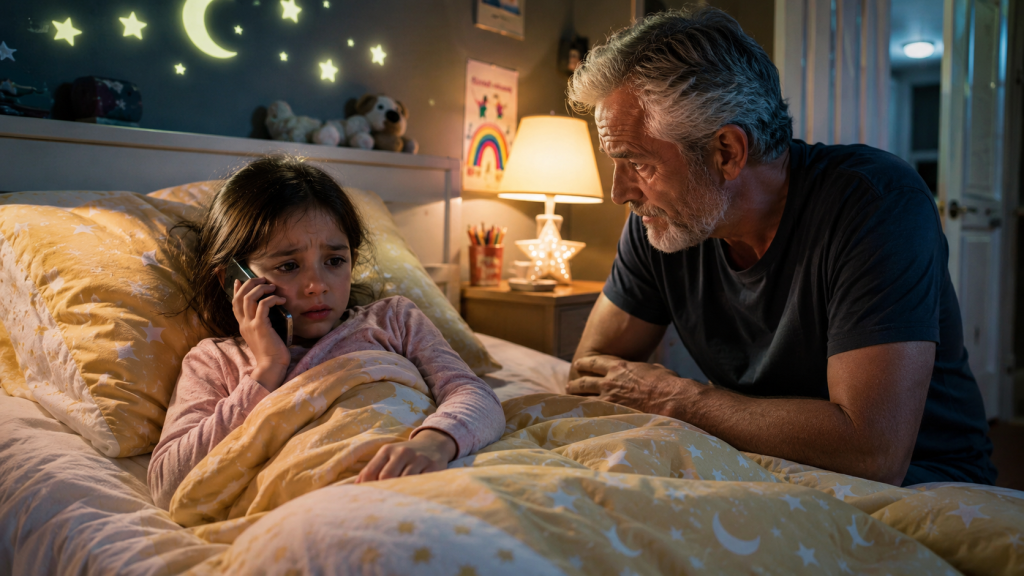
Some people do not fail a child in one sudden moment.
They train that child slowly not to ask.
Not to interrupt.
Not to need too much.
Then one night, the cruelty stops pretending to be a mistake.
I pulled on jeans, grabbed my keys, and tucked my phone between my shoulder and ear.
“Listen to me. Don’t get up again. Don’t try to get water. Keep the phone close and stay with me.”
“I’ll be quiet,” she said quickly. “Please don’t tell Mom I bothered you.”
For one second, I wanted to call Wesley and force him to hear his daughter’s voice at nearly two in the morning.
But Sadie needed help, not anger.
So I drove.
Wesley’s neighborhood near Lake Oswego looked perfect, as always.
Trimmed lawns.
Clean driveways.
Porch lights glowing over flowerpots.
A little flag by the mailbox making the whole street look safe and decent.
I kept Sadie on speaker the entire way, asking small questions whenever her breathing sounded too soft.
“What blanket do you have tonight?”
“Yellow,” she murmured. “The moon one.”
“The one from the craft fair?”
“Because it looked like space.”
For half a second, there she was.
My Sadie.
The little girl who loved planets and could explain Saturn’s rings with complete seriousness.
Then she coughed again, and I pressed harder on the gas.
The drive took sixteen minutes.
It felt like an hour.
I used the spare key Wesley had given me years earlier.
The house was warm and still.
Too warm.
The thermostat glowed in vacation mode, set for an empty house.
Not for a sick child upstairs.
In the kitchen, the under-cabinet lights were on.
Everything looked clean and carefully arranged.
Maren had always been that way.
The sort of woman who wiped fingerprints from stainless steel but somehow never noticed when a child’s face fell at the dinner table.
On the counter sat children’s fever medicine, a plastic measuring cup, crackers, and a folded pastel note from Maren’s planning pad.
Her handwriting was neat.
Sadie, take one dose before bed and stop turning every illness into a scene. We are taking Carter to Orlando because he earned a happy birthday weekend, and you need to rest instead of stealing everyone’s attention. Do not call the neighbors unless it is a real emergency, and do not make your brother feel guilty.
I read it once.
Then again.
This was not panic.
Not confusion.
Not a rushed accident.
This was planned.
Beside the note was a digital thermometer.
I pressed the memory button.
The screen flashed.
103.7.
They had checked.
They had known.
And they left anyway.
I folded the note and put it in my pocket.
Then I slipped the thermometer in beside it.
Anger can blur details.
Evidence does not.
Upstairs, family photos lined the hallway.
Carter at a theme park.
Carter in soccer gear.
Carter holding trophies.
Wesley and Maren on vacations.
Sadie appeared only a few times.
Usually near the edge of the picture.
Never centered.
Never alone.
At her bedroom door, I heard a small cough.
I opened it gently.
Sadie was curled beneath her yellow moon blanket.
Her hair was damp against her forehead.
Her cheeks were flushed.
Her lips were dry.
When she saw me, she tried to sit up.
“No,” I said softly. “Stay still.”
“I’m sorry,” she whispered.
That was the first thing she said to me.
Not help me.
Not I’m scared.
I’m sorry.
I sat beside her and touched her forehead.
She was burning.
Across the room, a cup of water sat on the dresser.
Full.
Untouched.
Too far for her to reach.
“I tried to get it,” she said. “But when I stood up, the floor moved.”
That was the truth of the room.
Medicine downstairs.
Water out of reach.
A thermostat set for no one.
A note telling her not to ask for help.
Then Sadie looked at me with tired eyes.
“Did I ruin Carter’s trip?”
My throat tightened.
“No, sweetheart,” I said. “You didn’t ruin anything.”
I helped her take a small sip of water.
Then I wrapped her carefully in the yellow blanket.
“We’re getting you help.”
“Will Mom be mad?”
“I’ll handle your mom.”
Her eyes closed for a moment.
“Dad said Mom handled it.”
And there it was.
Wesley had not written the note.
But Wesley had left too.
I lifted Sadie carefully.
She felt far too hot and far too light in my arms.
Before carrying her downstairs, I took one photo of the room.
Not for memory.
For proof.
The cup out of reach.
The crumpled tissue beside the bed.
The little phone lying near her hand.
Then I carried my granddaughter past the glowing thermostat, past the spotless kitchen, and past the note that explained everything.
Outside, the porch lights still shone warmly.
The neighborhood still looked perfect.
But now I knew the truth.
A house can look beautiful from the street and still fail the child inside.
At the emergency room, Sadie’s fever was still dangerously high.
The nurse’s smile disappeared when I explained she had been left alone.
“How long?” she asked.
“I don’t know exactly.”
“Who was with her?”
“No one.”
The nurse’s eyes lifted to mine.
“No adult?”
I handed her Maren’s note and the thermometer.
“Long enough for this to stop being a mistake.”
Within minutes, Sadie was in a bed.
A doctor examined her.
A nurse started an IV.
They checked her oxygen, blood pressure, temperature, hydration.
Sadie barely protested.
That broke my heart too.
Children who are cared for complain when needles hurt.
Children who are trained not to be trouble apologize to the needle.
“I’m sorry,” she whispered as the nurse inserted the IV.
The nurse looked at me.
I looked away.
Because if I did not, I would have cried in front of everyone.
The diagnosis came slowly.
Severe dehydration.
High fever.
Possible infection that had been worsening for days.
The doctor said she needed fluids, monitoring, and treatment immediately.
Then he asked the question I knew was coming.
“Mr. Harlan, are the parents aware she is here?”
“No,” I said. “Not yet.”
The doctor glanced at the note in the plastic evidence bag the nurse had prepared.
“We are required to involve a social worker.”
“I know.”
His expression changed.
“You understand?”
“I spent thirty years as a family advocate.”
He nodded.
“Then you know this is serious.”
I looked through the glass at Sadie, asleep under her moon blanket with an IV in her arm.
“Yes,” I said. “I know exactly how serious it is.”
A hospital social worker arrived just after dawn.
Her name was Elaine.
She spoke gently, but her eyes were sharp.
She asked questions.
When did they leave?
Who knew Sadie was ill?
Was there any adult checking on her?
Did she have access to food and water?
Had this happened before?
I answered what I knew.
Then I answered what I suspected.
“She is treated as an inconvenience,” I said. “Not always loudly. Not always obviously. But consistently.”
Elaine wrote that down.
At 7:12 a.m., Wesley finally called.
His voice was irritated, not scared.
“Dad, why is Maren saying you took Sadie?”
I stared at the phone for a moment.
Not, Is she okay?
Not, What happened?
Why did you take her?
I stepped into the hallway.
“Because she called me at 1:58 a.m. with a fever of 103.7 while you were in Florida.”
Silence.
Then he said, “Maren said she was exaggerating.”
I closed my eyes.
That sentence broke whatever faith I still had in my son.
“And you believed your wife over your sick child?”
“Dad, it’s not like that.”
“It is exactly like that.”
“She gets dramatic when Carter gets attention.”
“She is eight years old.”
“She had medicine.”
“She had a fever of 103.7.”
“Maren checked on her before we left.”
“Yes,” I said. “That is what makes it worse.”
He went quiet.
I continued.
“The hospital has the note. The thermometer. Photos. And now Child Protective Services is involved.”
That woke him up.
“What? Dad, no. You didn’t.”
“I did not do this, Wesley. You did.”
His voice lowered.
“Don’t make this official.”
I almost laughed.
That was a phrase I had heard too many times from parents who wanted private cruelty to stay private.
Don’t make this official.
Don’t ruin our family.
Don’t involve strangers.
But they had left Sadie alone with a high fever and a note blaming her for being sick.
Official was exactly what it needed to become.
Then Maren grabbed the phone.
Her voice was sharp and breathless.
“You had no right.”
I looked at Sadie’s yellow moon blanket folded beside her hospital bed.
“No, Maren. You had no right to leave her to die quietly so Carter could smile in Orlando.”
She hissed, “That is a disgusting thing to say.”
“It is a disgusting thing to do.”
“She had medicine.”
“She was eight. Feverish. Alone. Too dizzy to reach water.”
“She always does this.”
“Gets sick?”
“Steals attention.”
There it was.
Not hidden.
Not softened.
The truth.
I felt my hand tighten around the phone.
“You are being recorded by the hospital line nearby,” I lied.
Maren went silent.
Sometimes guilt is slow.
Fear is faster.
Wesley came back on the phone.
“Dad, we’re flying back.”
“Good.”
“What happens now?”
I looked through the glass.
Sadie was asleep.
Small.
Pale.
Alive.
“Now,” I said, “you explain to people with authority why your daughter had to call her grandfather in the middle of the night because her parents went to Disney World.”
“It was Carter’s birthday.”
“And it almost became Sadie’s last night.”
He said nothing.
By afternoon, CPS had opened an emergency review.
I gave a statement.
Elaine gave a statement.
The doctor documented the fever, dehydration, infection, and the risk created by delayed treatment.
The note was copied.
The thermometer reading was photographed.
The thermostat setting was recorded from the photo I had taken.
Wesley and Maren arrived at the hospital still dressed like vacationers.
Maren had sunglasses on her head.
Wesley looked pale.
Carter was with them, clutching a stuffed dinosaur from the airport gift shop.
He looked confused.
He was ten.
None of this was his fault either.
When Carter saw me, he asked, “Is Sadie okay?”
Before I could answer, Maren snapped, “She’s fine. Everyone overreacted.”
A nurse at the station looked up.
I saw Wesley notice.
For the first time, he looked ashamed.
A CPS worker met them before they could enter Sadie’s room.
There was a conversation in a private room.
I did not hear all of it.
But I heard Maren raise her voice once.
“I am her mother.”
Then the worker said something I will never forget.
“Being a mother is not a title you use after abandoning the duties.”
Maren came out red-faced.
Wesley did not look at me.
CPS placed Sadie temporarily with me while the investigation continued.
Carter stayed with Wesley under supervision requirements, because the agency needed to understand the whole household dynamic before making broader decisions.
Maren was not allowed unsupervised contact with Sadie.
When I told Sadie she would come home with me after the hospital, she stared at me.
“Just for a little while?” she asked.
“As long as you need.”
“Will I be in trouble?”
“No.”
“Will Carter hate me?”
“No, sweetheart.”
She looked down at her blanket.
“Mom says families break when one person always needs too much.”
I sat beside her and took her small hand.
“Families break when the people responsible for care decide love has conditions.”
She did not understand all of that.
Not yet.
But she squeezed my hand.
That was enough.
The next weeks were hard.
Sadie recovered physically faster than emotionally.
The fever went down.
The infection cleared.
Her appetite returned slowly.
But she apologized for everything.
For asking for water.
For dropping a spoon.
For taking too long in the bathroom.
For crying when she missed Carter.
At my house, I made one rule.
No one apologized for needing help.
The first time she forgot and said sorry because she spilled juice, I handed her a towel and said, “What do we say instead?”
She looked nervous.
“I need a towel?”
“Good.”
She wiped the floor, then looked at me carefully.
“You’re not mad?”
“No.”
“What if it stains?”
“Then the floor will survive.”
A tiny smile touched her mouth.
That smile became my reward for every sleepless night.
Carter called her after a week.
He was crying.
“I didn’t know they left you alone,” he said.
Sadie cried too.
“I didn’t want to ruin your birthday.”
“You didn’t.”
“I got sick.”
“That’s not ruining it.”
They talked for twenty minutes about his dinosaur toy and her moon blanket.
After the call, Sadie slept better.
Wesley asked to visit after three weeks.
CPS approved a supervised meeting at my house.
He arrived with no Maren.
Good.
He stood in my living room looking like a boy caught stealing cookies, except the stakes were far higher.
Sadie sat on the couch holding her blanket.
Wesley knelt in front of her.
“I’m sorry,” he said.
She looked at him.
“For what?”
His eyes filled with tears.
“For leaving. For not checking. For believing you were exaggerating. For making you feel like being sick was your fault.”
Sadie’s lips trembled.
“Mom said I ruin things.”
Wesley covered his face for a moment.
When he lowered his hands, he looked wrecked.
“You don’t ruin anything. I did.”
I watched him carefully.
Words are easy.
Patterns are harder.
But it was the first time I had heard my son take blame without hiding behind Maren.
That mattered.
A month later, Wesley separated from Maren.
Not because I demanded it.
Because CPS interviews revealed what he had refused to see.
Sadie had been treated like a burden for years.
Carter had been taught, quietly and constantly, that Sadie’s needs stole from him.
Maren did not adopt Sadie in her heart.
Only on paper.
That truth hurt Wesley.
It should have.
Sadie stayed with me while the court process unfolded.
Eventually, Wesley was allowed more visitation.
Then overnight visits, after parenting classes, therapy, and home monitoring.
Maren fought hard.
Not for Sadie.
For her image.
People like Maren do not fear losing a child as much as they fear people knowing why.
The note did what Sadie’s tears had never done.
It made the cruelty visible.
By the end of the year, Wesley had primary custody of Carter and began rebuilding his relationship with Sadie carefully, under guidance.
Maren received supervised visitation only, which Sadie could decline.
The first time Sadie said, “I don’t want to go,” and an adult answered, “Okay,” she looked stunned.
Then she cried for an hour.
Not because she was sad.
Because choice felt unfamiliar.
Sadie is ten now.
She still loves space.
Her room at my house has glow-in-the-dark stars on the ceiling.
The yellow moon blanket is folded at the foot of her bed, worn soft from washing.
Some nights, she wakes up and calls, “Grandpa?”
I answer every time.
Even if I am in the next room.
Even if I am half asleep.
“I’m here,” I say.
And she says, “Just checking.”
That is what neglect takes from children.
The certainty that someone will come.
We are giving it back to her slowly.
One answered call at a time.
I still keep Maren’s note in a folder with the hospital records.
Not because I enjoy looking at it.
I hate looking at it.
But I keep it because truth matters.
The world is full of beautiful houses with warm porch lights and little flags by the mailbox.
The world is full of smiling family photos where one child stands too close to the edge.
And sometimes the only thing between a child and being forgotten is one phone call answered at 1:58 in the morning.
Sadie once asked me if I was angry at her dad forever.
I told her the truth.
“I am angry at what he allowed. But people who face the truth can change.”
Then she asked about Maren.
I paused longer.
“Some people love their image more than they love a child.”
Sadie thought about that.
Then she whispered, “I don’t want to be someone’s image.”
I pulled her close.
“You never were. You are a person. A whole person.”
She nodded against my chest.
Outside, rain tapped against the windows.
Inside, my granddaughter was warm for the right reasons.
Safe.
Fed.
Heard.
Loved.
That night, I looked at the clock after she fell asleep.
1:58 a.m.
The same minute my phone had lit up months before.
I walked to her bedroom door and listened.
Her breathing was steady.
Peaceful.
I thought about the note on the kitchen counter.
The thermometer.
The water she could not reach.
The family trip to Florida.
The little girl who whispered, “Please don’t tell Mom I bothered you.”
Then I thought about the woman I used to tell families in court that children do not need perfect parents.
They need safe ones.
That night, my son and his wife failed the most basic test.
But Sadie did not fail.
She called.
And I answered.
That is why she is still here.
That is why every phone I own stays charged beside my bed.
Because when a child finally finds the courage to ask for help, someone better be awake enough to hear her.
THE END! THANKS FOR WATCHING!