 Reading Time: 34 minutes
The silence that followed Marcus’s announcement was unlike anything I had ever experienced. For ten years, I had imagined what might happen if my family discovered the truth about me.
Sometimes, during the lonely nights when I was still cleaning hotel bathrooms for minimum wage, I imagined walking into our old family mansion wearing an expensive dress and telling my mother that she had been wrong.
Other times, I dreamed of my father opening his arms and saying he was proud of me.
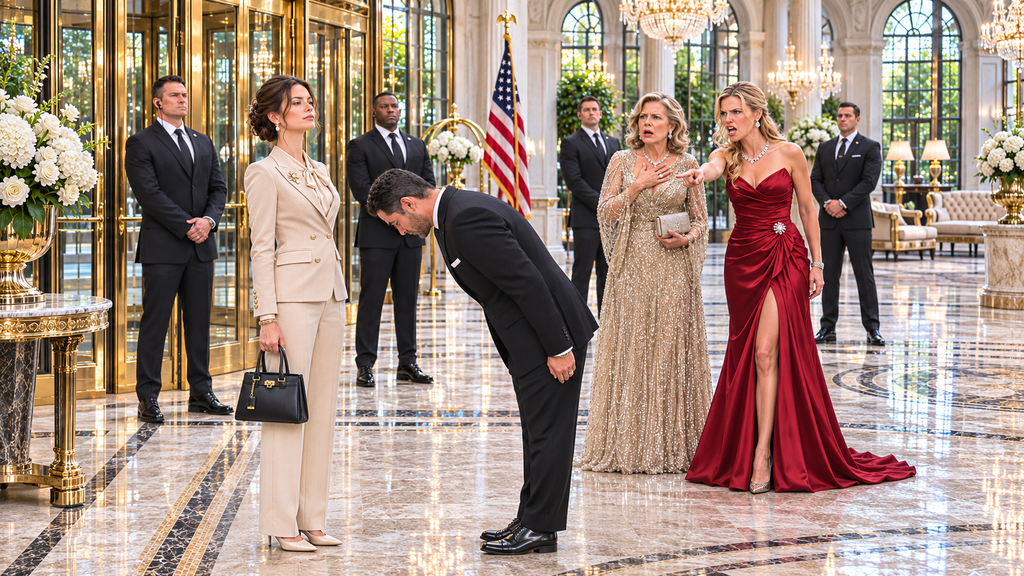
But standing in the magnificent lobby of The Opeline, surrounded by marble columns, crystal chandeliers, and guests who had spent thousands of dollars simply to sleep beneath my roof, I felt neither triumph nor satisfaction.
I felt something much more complicated.
Grief.
Because the two women staring at me in disbelief were the same women whose approval I had once desperately wanted.
Harper was the first to recover.
She gave a sharp, nervous laugh.
“Madam Chairman?”
She looked from Marcus to me, then back again.
“Oh, this is ridiculous.”
Marcus remained perfectly still.
“Is there a problem, ma’am?”
“Of course there’s a problem!” Harper snapped. “You’ve mistaken this woman for someone important!”
A few nearby guests turned to look.
My mother immediately stepped forward.
“Young man, I don’t know what kind of misunderstanding is happening here, but this woman is my daughter. She’s unemployed, has no respectable social standing, and has spent most of her adult life doing domestic work.”
Marcus’s expression hardened.
“Mrs. Sterling, I am fully aware of Madam Chairman’s identity.”
Harper pointed at me.
“Then you’re incompetent!”
“Harper,” I said quietly.
“Don’t you dare say my name like we’re equals!”
Something inside me went very still.
I looked at her crimson gown, her flawless makeup, and the diamond necklace she had inherited from our grandmother.
Then I remembered being nineteen years old, standing outside our family home in the rain, watching Harper laugh from behind the upstairs window.
She had watched me leave with forty-eight dollars.
She had never once called to ask whether I had somewhere to sleep.
“You’re right,” I replied softly. “We aren’t equals tonight.”
Her lips curled.
“At least you finally understand.”
I turned toward Marcus.
“Would you please explain my position to these ladies?”
“Certainly, Madam Chairman.”
He straightened his shoulders.
“Ms. Blair Sterling is the founder, chairwoman, and controlling owner of Opeline Hospitality Holdings. The company owns this property, its operating businesses, and the associated hospitality assets.”
My mother’s face went completely white.
Marcus continued.
“The Opeline is currently valued at approximately fifty million dollars. Every executive department in this building ultimately reports to Ms. Sterling.”
Harper opened her mouth.
Nothing came out.
“The sixty-fifth-floor Skyline Level,” Marcus added, “where your private celebration is taking place, is also under her direct authority.”
I watched my mother’s fingers tighten around her handbag.
For the first time in my life, Eleanor Sterling appeared genuinely speechless.
Then Harper began shaking her head.
“No.”
She laughed again, but this time the sound was brittle.
“No, that’s impossible. Blair couldn’t even afford university after she left home!”
“That is correct,” I said.
Her eyes darted toward me.
“I couldn’t.”
I took one step closer.
“I also couldn’t afford a proper winter coat. I couldn’t afford a security deposit on an apartment. For my first three weeks after leaving home, I slept on a folding cot in the laundry room of a roadside motel.”
My mother swallowed.
“Blair, there’s no need to exaggerate.”
I looked directly into her eyes.
“Do you remember what you told me when I refused to marry that shipping magnate?”
She stared at me.
I repeated the words slowly.
“‘Without this family, you’ll spend the rest of your life scrubbing other people’s toilets.'”
Eleanor’s mouth tightened.
“That was a difficult time for everyone.”
“No, Mother. It was a difficult time for me.”
I gestured toward the enormous chandelier above us.
“You were disappointed that your financial arrangement had failed. I was wondering whether I would survive the winter.”
Her expression shifted.
For one brief moment, I thought I saw shame.
Then she lifted her chin.
“Whatever happened ten years ago doesn’t give you the right to embarrass us publicly.”
I almost smiled.
She had insulted me in front of strangers without hesitation.
But being answered in front of those same strangers was suddenly an unbearable humiliation.
Before I could respond, the private elevator opened.
Tasha stepped out wearing an elegant charcoal suit.
She crossed the lobby with the calm efficiency that had made her indispensable to me.
“Madam Chairman,” she said, “Mr. Keating is requesting an update.”
My mother spun toward her.
“Arthur Keating?”
“Yes, ma’am.”
Eleanor hurried forward.
“Then please tell him Eleanor Sterling is on her way. There’s been an unfortunate misunderstanding involving my daughter.”
Tasha glanced at me.
“Would you prefer that I explain the situation, Madam Chairman?”
I shook my head.
“No. I think it’s time everyone heard the truth together.”
Harper’s face hardened.
“Don’t even think about going upstairs.”
I looked at her.
“Harper, you’re standing inside my hotel, attending an event paid for through a company that belongs to you, and attempting to impress an investor using assets you don’t own.”
Her breathing changed.
“What are you talking about?”
I lowered my voice.
“I’m talking about the fifty-million-dollar loan.”
My mother’s handbag slipped from her fingers.
It hit the marble floor with a sharp crack.
For several seconds, nobody moved.
Then Eleanor whispered, “How do you know about that?”
I didn’t answer immediately.
Instead, I looked toward Tasha.
“Is the conference room ready?”
“Yes, Madam Chairman. And the documents have been secured.”
“Good.”
Harper stepped backward.
“What documents?”
Tasha’s expression remained unreadable.
“The documents your fiancé attempted to remove from our corporate archives.”
Harper’s eyes widened.
“Preston?”
“Yes.”
My mother suddenly reached for my wrist.
“Blair, sweetheart, perhaps we should discuss this privately.”
Sweetheart.
The word struck me harder than any insult she’d delivered that evening.
Ten years.
Ten years without a birthday call.
Ten years without a Christmas invitation.
Ten years of silence.
And now, with the threat of losing everything hanging above her head, she remembered how to call me sweetheart.
I gently removed her hand.
“We will discuss everything upstairs.”
Then I turned toward Marcus.
“Please escort my mother and sister to the Skyline Level.”
Harper crossed her arms.
“And if we refuse?”
Marcus spoke before I could.
“You’re free to leave the property, ma’am. But the investigators reviewing the attempted unauthorized access will still need to speak with the people involved.”
Harper looked at my mother.
For the first time that evening, neither woman had an answer.
And as we entered the private elevator, I realized something extraordinary.
I was no longer the daughter standing outside a locked door.
I was the woman holding the key.
The elevator climbed in almost complete silence.
Soft instrumental music played from hidden speakers.
Through the glass wall, the city’s illuminated skyline gradually spread beneath us.
My mother stood in the far corner, clutching her handbag against her chest.
Harper studied me through the mirrored wall.
Finally, she spoke.
“Where did you get the money?”
I watched the numbers above the elevator door.
Fifty-two.
Fifty-three.
Fifty-four.
“Which money?”
“The money to buy this hotel!”
“I earned it.”
She scoffed.
“Don’t insult my intelligence.”
I turned toward her.
“That’s a rather ambitious request, Harper.”
Tasha lowered her eyes, hiding the smallest smile.
Harper’s cheeks flushed.
“You expect us to believe you went from cleaning bathrooms to owning a fifty-million-dollar property?”
“No,” I said. “I expect you to understand that you missed ten years of my life.”
My mother finally spoke.
“People don’t become multimillionaires by being maids.”
“You’re correct.”
She seemed relieved.
Then I continued.
“They become successful by learning, working, taking risks, making mistakes, and refusing to surrender when everything falls apart.”
I looked at my reflection.
“I started as a maid. I’m not ashamed of that.”
And suddenly, as the elevator continued upward, I was twenty years old again.
Standing in a cramped motel laundry room.
My fingers burned from industrial cleaning chemicals.
My feet ached so badly that I sometimes cried while pulling off my shoes.
The first hotel manager who hired me was a woman named Rosa Martinez.
She had been in hospitality for thirty-seven years.
She was sixty-three, widowed, and had hands covered in small scars from decades of work.
On my third night, she discovered me sleeping between two enormous stacks of clean towels.
I woke expecting to be fired.
Instead, she sat beside me.
“Child,” she whispered, “when did you last eat?”
I lied.
“This morning.”
She didn’t argue.
She simply handed me half of her sandwich.
For months, Rosa taught me everything.
How to inspect guest rooms.
How to calculate occupancy costs.
How to recognize wasteful purchasing.
How to handle angry customers.
How to understand that luxury wasn’t about expensive furniture.
It was about making people feel seen.
One evening, after a guest screamed at me because his bathroom mirror had a small streak, I ran into the supply closet and cried.
Rosa followed me.
“Look at me, Blair.”
I wiped my face.
“I’m trying.”
“I know you are.”
“I’m just tired of being treated like I’m nothing.”
She took my hands.
“Then promise me something.”
“What?”
“Never become the kind of person who thinks a uniform determines someone’s worth.”
That sentence changed my life.
I worked during the day and studied hotel management online at night.
I saved every dollar I could.
Eventually, Rosa helped me approach the owner of a failing twelve-room inn.
The building was nearly empty.
The roof leaked.
The furniture was outdated.
But the location was excellent, and the owner was desperate to retire.
I persuaded him to let me manage it under a profit-sharing agreement.
Within eighteen months, occupancy had doubled.
Three years later, I became a minority partner in the property.
Then I helped turn around another struggling hotel.
And another.
My first major investment came after I presented a redevelopment proposal to a room full of businessmen who initially assumed I was there to serve coffee.
One of those men was Arthur Keating.
He was the only person who asked me about my financial projections instead of my background.
He became my first major financing partner.
Not my rescuer.
Not my benefactor.
My business partner.
Over the following years, I built a hospitality company, refinanced successful properties, brought in investors, and gradually purchased back their ownership stakes.
The Opeline was my greatest achievement.
A neglected waterfront commercial tower transformed into a luxury hotel through years of planning, financing, and reconstruction.
Every chandelier.
Every marble staircase.
Every suite.
Every employee training program.
Each represented another piece of the life I had built after my family told me I was worthless.
The elevator chimed.
Sixty-five.
The doors opened.
I looked at my sister.
“No, Harper. I didn’t become wealthy by cleaning bathrooms.”
I stepped into the corridor.
“But cleaning bathrooms taught me lessons that people like you have never bothered to learn.”
The Skyline Level was breathtaking.
Floor-to-ceiling windows framed the dark harbor.
Crystal chandeliers glittered above an enormous dining table dressed in ivory linen.
White orchids lined the center.
A pianist played near the panoramic windows.
Beyond them, the city’s lights shimmered like fallen stars.
Twenty-four guests were seated around the table.
Business executives.
Private investors.
Family acquaintances.
And at the head sat my father.
Richard Sterling.
He looked older than I remembered.
His once-dark hair had turned almost entirely silver.
His shoulders were slightly stooped.
And when he saw me entering behind Eleanor and Harper, he rose so abruptly that his chair scraped against the floor.
“Blair?”
His voice was barely audible.
Something tightened in my chest.
“Dad.”
He stared at me.
Then his eyes filled with tears.
“My God.”
For a moment, the room seemed to disappear.
All I could see was the man who had taught me to ride a bicycle.
The man who used to carry me upstairs when I fell asleep on the couch.
The man who took me fishing when I was eight and patiently showed me how to untangle a fishing line.
And the same man who had watched silently as my mother threw me out of our home.
He stepped forward.
“Blair, I—”
“Not yet,” I whispered.
He stopped.
Across the table, a distinguished man in his late sixties stood up.
Arthur Keating.
He wore a midnight-blue suit and the expression of someone who had been expecting trouble.
When our eyes met, a faint smile appeared.
“Good evening, Blair.”
“Good evening, Arthur.”
He walked toward me and extended his hand.
Then, to the astonishment of everyone watching, he leaned forward and kissed my cheek.
“Congratulations on the latest quarterly figures,” he said. “Your management team has exceeded projections again.”
My mother looked as though she might collapse.
“Arthur?”
He turned toward her.
“Eleanor.”
“You know my daughter?”
Arthur raised an eyebrow.
“Know her? Eleanor, I’ve worked with Blair for years.”
Harper stepped forward.
“That’s impossible. You told us you were interested in investing in our hospitality expansion.”
“I said I was willing to review your proposal.”
He glanced toward me.
“I was rather curious why you claimed to control a property whose ownership I knew extremely well.”
The guests began exchanging puzzled looks.
My mother laughed nervously.
“There must be some confusion about the company structure.”
Arthur’s expression became cold.
“Then perhaps you’d like to explain why your presentation identifies Sterling Capital as the majority owner of The Opeline.”
Harper’s eyes darted toward the enormous television screen behind the dining table.
I followed her gaze.
Displayed across it was a beautiful corporate presentation.
THE OPELINE.
A STERLING CAPITAL PREMIER PROPERTY.
I studied the words for a moment.
Then I looked at Harper.
“Beautiful design.”
She swallowed.
“Blair—”
“Who created it?”
“Preston handled the presentation.”
“Of course he did.”
I turned toward Tasha.
“Let’s begin.”
She touched her tablet.
The screen went black.
Then a new image appeared.
The official Opeline Hospitality Holdings corporate ownership chart.
My name stood at the top.
Below it were the legal entities controlling the hotel, its operations, and the associated properties.
Arthur returned to his chair.
My father remained standing.
And my mother whispered something that chilled me.
“We didn’t know you were the owner.”
I turned toward her.
“Would it have made a difference?”
She stared at me.
“Would you have invited me tonight if you’d known I was wealthy?”
No answer.
“Would you have called me on my birthday?”
Silence.
“Would you have apologized for what happened ten years ago?”
Eleanor lowered her eyes.
I felt tears pressing behind my own.
But I refused to let them fall.
“That’s what I thought.”
Tasha displayed the next document.
A proposed loan agreement.
Fifty million dollars.
Sterling Capital as the borrower.
The Opeline as the supposed principal collateral asset.
Arthur leaned forward.
“My legal team received this draft yesterday.”
Harper shook her head frantically.
“It’s just a preliminary proposal!”
“That isn’t the issue,” Arthur replied.
He pointed toward the signature page.
“The issue is that this document represents your family as having authority over a property it doesn’t own.”
My mother clenched her jaw.
“Preston assured us everything was legal.”
I looked at her.
“You were willing to sign a fifty-million-dollar agreement without understanding what you were pledging?”
She refused to meet my eyes.
Tasha changed the screen again.
Now it showed still images from the fifty-ninth-floor security cameras.
Preston entering a restricted corridor.
Preston holding a cloned access card.
Preston opening a corporate records room.
Harper gasped.
“Where is he?”
Marcus stepped toward the table.
“Mr. Preston Vale was intercepted after entering a restricted records area. He is currently in a secured meeting room with hotel security while we await the appropriate authorities.”
My mother gripped the back of a chair.
“Authorities?”
“Yes, Mrs. Sterling.”
Harper’s voice rose.
“You can’t arrest him! This is a private hotel!”
Marcus answered calmly.
“We haven’t arrested him. We prevented him from continuing unauthorized access, recovered the materials he attempted to remove, and contacted law enforcement. He has been informed that he may leave the meeting room, but he cannot reenter restricted areas.”
I watched my sister’s confidence crumble.
For years, Preston had played the role of the perfect future son-in-law.
Handsome.
Charming.
Ambitious.
Always ready with an expensive bottle of wine or a convincing business proposal.
But I had learned long ago that confidence was not the same as competence.
And charm was often the cheapest thing a dishonest man could offer.
Tasha continued.
“Investigators also have copies of the documents sent from Mr. Vale’s business email account.”
The screen changed.
A series of messages appeared.
Harper’s name.
Preston’s name.
And Eleanor’s.
My sister suddenly reached toward the tablet.
“Turn that off!”
I raised one hand.
“Don’t.”
She froze.
I looked at the documents.
Then at the people around the table.
“These messages discuss creating a false ownership structure, obtaining the hotel’s corporate seals, and presenting forged security documents to Mr. Keating’s lending team.”
Arthur’s face darkened.
“Had I transferred those funds based on these representations, my institution could have been exposed to an enormous fraudulent transaction.”
My mother began crying.
Not quietly.
Not with the restrained grief of someone genuinely overcome by remorse.
She cried loudly enough to make several guests look away.
“This is all a terrible misunderstanding!”
I waited.
She continued.
“Preston handled the paperwork! Harper was simply trying to help our family!”
“Help your family?” I repeated.
Her tears paused.
“Eleanor,” Arthur said firmly, “your signature appears on the proposed authorization.”
My mother gripped the table.
“That doesn’t mean I understood every detail!”
I studied her face.
Then I spoke the words I had spent ten years preparing myself to say.
“Mother, when you threw me out, you told me that family loyalty meant doing whatever was necessary to protect the Sterling name.”
She stared at me.
“Tonight, you’ve shown me exactly what that means to you.”
Her eyes flashed.
“Don’t you lecture me about loyalty!”
She struck the table with her palm.
“You abandoned us when we needed you!”
The room went silent.
I felt something inside me fracture.
Then I looked directly at her.
“No, Mother.”
My voice was steady.
“You tried to sell my future to an elderly man with enough money to save your lifestyle.”
I glanced at my father.
“And when I refused, you made sure I had nowhere to go.”
My mother’s expression shifted from anger to fear.
Because there was something she didn’t know.
Something I had discovered only three weeks earlier.
Something that would change the entire meaning of that terrible night.
And it involved the man sitting at the head of the table.
My father.
Three weeks earlier, after my attorneys acquired the debt secured against the Sterling family mansion, they began reviewing its ownership history.
The mansion had belonged to my grandmother before she died.
I remembered her sitting beside the fireplace, knitting wool scarves and telling me stories about the women in our family.
She had been the only person who consistently defended me when my mother criticized my appearance, my grades, or my ambitions.
“Blair,” she used to say, “never confuse a polished shoe with an honorable person.”
I hadn’t understood the wisdom of those words until much later.
During the legal review, my attorneys discovered a document connected to my grandmother’s estate.
A trust distribution agreement.
And beneath the signature line, dated ten years earlier, was my name.
Blair Elizabeth Sterling.
I had supposedly signed away my inheritance.
A substantial sum my grandmother had reserved for my education and future independence.
There was only one problem.
I had never seen that document.
I had never signed it.
And the signature was not mine.
At first, I assumed my mother had forged it herself.
Then I looked at the witness section.
My father’s signature was there.
Richard Sterling.
The man who had kissed my scraped knees when I was little.
The man who used to tell me that honesty was the foundation of a good life.
The man who had allowed me to leave home with forty-eight dollars while an inheritance intended to protect me disappeared into the family’s failing business accounts.
I had sat alone in my office for nearly an hour, staring at that signature.
Not because I needed the money.
I had long since earned far more than the trust was worth.
But because that document proved something far more painful.
My family hadn’t simply abandoned me.
They had taken the one thing my grandmother had left to help me survive.
And my father had helped them do it.
Now, standing in the Skyline Level before two dozen witnesses, I finally looked directly at him.
“Dad,” I said, “do you remember Grandma’s education trust?”
His face changed.
It was subtle.
A quick movement of his eyes.
A tightening of his jaw.
But I saw it.
My mother saw it, too.
“Blair,” she said sharply, “this is neither the time nor the place.”
I ignored her.
“Dad, I’m asking you a question.”
He slowly lowered himself into his chair.
“Yes,” he whispered.
“Do you remember signing a document stating that I voluntarily surrendered my inheritance?”
His hands began trembling.
Harper looked between us.
“What inheritance?”
My mother stepped forward.
“Richard, don’t say another word.”
I turned toward her.
“Why?”
“Because these are private family matters!”
I looked around the magnificent room.
“Private family matters didn’t seem to concern you when you announced to everyone downstairs that I was nothing but a former maid.”
Eleanor’s lips pressed into a thin line.
I turned back toward my father.
“Did you witness me signing that document?”
He closed his eyes.
For several terrible seconds, he said nothing.
Then he whispered, “No.”
My chest tightened.
The room was completely silent.
I swallowed.
“Did you know the signature wasn’t mine?”
He lowered his head.
“Yes.”
My mother made a strangled sound.
“Richard!”
He raised one shaking hand.
“Enough, Eleanor.”
She stared at him.
“I said enough.”
His voice was no longer strong, but there was something different about it.
For the first time in my life, my father was refusing to let my mother speak for him.
He looked at me.
“I’m sorry, Blair.”
Two small words.
Ten years too late.
I held his gaze.
“Tell me what happened.”
He took a long breath.
“Your grandmother left money for you. She wanted you to finish university without depending on us.”
“I know that now.”
“After she died, our business began losing money. The company had outstanding loans. We were behind on payments. Your mother thought the money could keep the business alive long enough for us to recover.”
I glanced at Eleanor.
She looked furious.
“How much?”
My father swallowed.
“Two hundred and eighty thousand dollars.”
The figure landed heavily between us.
I remembered counting coins to buy instant noodles.
Sleeping in a laundry room.
Wearing shoes with holes in the soles.
Working through fevers because I couldn’t afford to lose a shift.
All while my parents had quietly taken the money my grandmother intended for me.
My eyes burned.
“And the marriage?”
My father’s expression collapsed.
“The shipping investor offered to inject capital into Sterling Capital if the families established a permanent personal connection.”
“A permanent personal connection,” I repeated.
He nodded miserably.
“He wanted to marry you.”
I laughed once.
The sound was hollow.
“Of course he did.”
My mother snapped.
“We were going to lose everything!”
I looked at her.
“So you decided I should lose my future instead?”
“You were young! You didn’t understand the responsibilities of maintaining a family legacy!”
I took a step toward her.
“I was nineteen.”
Her mouth remained open.
“Nineteen, Mother. I wanted to go to university. I wanted to build a career. I wanted to marry someone I loved someday.”
My voice began trembling.
“And you told me that my choices didn’t matter because the family needed money.”
Eleanor looked away.
I turned toward my father.
“You knew she was using my inheritance?”
He nodded.
“You knew she was trying to force me into that marriage?”
Another nod.
“And you watched her throw me out?”
Tears rolled down his cheeks.
“Yes.”
I felt the old wound open.
A wound I thought wealth, achievement, and time had finally closed.
“Why didn’t you stop her?”
He covered his face.
“Because I was a coward.”
For the first time that evening, my mother had nothing to say.
Nobody moved for several moments.
Then my father stood.
He looked suddenly smaller.
Almost fragile.
“I told myself I was protecting the family,” he said. “Every time Eleanor made a decision I knew was wrong, I convinced myself that keeping quiet was better than confronting her.”
His voice broke.
“But when you walked out that night, I knew.”
He looked at me.
“I knew I’d failed you.”
I could barely breathe.
“Then why didn’t you come after me?”
He swallowed.
“At first, I thought you would return.”
I shook my head.
“Why would I?”
“Because you were my daughter. Because I thought you would need us.”
The words hurt more than he probably intended.
“And when I didn’t return?”
He wiped his face.
“I was ashamed. Every month that passed made it harder to admit what I had done.”
I studied him.
There was no way to reclaim those years.
No apology could erase the nights when I needed someone to tell me everything would be all right.
No amount of money could replace the father I had waited for beside the motel’s cracked window.
“I needed you, Dad,” I whispered.
His shoulders shook.
“I know.”
“No,” I said. “You don’t.”
I took a breath.
“When I first started working at the motel, I got sick. Really sick. I had a fever for four days. I couldn’t afford to see a doctor, and I was terrified that if I missed work, I’d lose the only roof over my head.”
My father stared at me.
“I lay on that folding cot thinking about our house. I remembered the warm blankets in my old bedroom. I remembered the soup you used to make when I was sick.”
A tear slid down my cheek.
“And I wondered whether you ever thought about me.”
He pressed a hand against his mouth.
“I did. Every day.”
“Then why wasn’t I worth finding?”
He couldn’t answer.
That silence told me more than any explanation.
Finally, I whispered, “You were my father. You were supposed to protect me.”
He began to cry.
And for a moment, I hated how much I still wanted to comfort him.
That was the cruelest thing about loving people who had hurt you.
Some part of your heart continued reaching toward them, even when you knew they were the reason you had learned to live without being held.
My mother suddenly interrupted.
“Well, this is quite enough.”
We all turned.
She stood rigidly beside the dining table, her face flushed with anger.
“Richard, you’re making a spectacle of yourself. Blair, you’ve made your point. You’re wealthy. Congratulations. Now perhaps we can behave like civilized adults and salvage your father’s birthday.”
I stared at her.
It was almost unbelievable.
We had just uncovered a decade-old betrayal.
A fraudulent inheritance waiver.
An attempted fifty-million-dollar loan deception.
And my mother was worried about the birthday dinner.
“Mother,” I said quietly, “there is nothing left to salvage.”
She narrowed her eyes.
“Don’t be so dramatic.”
I turned to Tasha.
“Show them the final document.”
My mother frowned.
“What final document?”
Tasha touched the tablet.
The screen changed.
An old photograph of the Sterling mansion appeared.
The ivy-covered exterior.
The enormous wooden front doors.
The circular driveway where I had learned to ride my bicycle.
Harper looked confused.
“Why are you showing our house?”
I didn’t answer.
Beneath the photograph, a legal document appeared.
A deed of trust assignment.
Followed by a notice identifying the current holder of the secured debt.
My company.
Sterling Legacy Holdings, an entity controlled by Opeline Hospitality.
My mother stared.
Then she laughed.
“No.”
I looked at her.
“Yes.”
She stepped closer to the screen.
“That’s impossible.”
“The debt secured against the mansion was sold by your lender six weeks ago. My attorneys completed the acquisition three weeks ago.”
Harper frowned.
“What does that mean?”
“It means,” I explained, “the family lender no longer controls the debt.”
My mother gripped the table.
“Who does?”
I met her eyes.
“I do.”
Harper let out a sharp gasp.
My mother looked as though someone had struck her.
“You bought our mortgage?”
“I acquired the outstanding secured loan and the associated creditor rights.”
Eleanor shook her head.
“No. No, you couldn’t have.”
“Mother, your company has been missing payments for nearly two years. You used the mansion as collateral for additional borrowing. The lender eventually decided to sell the troubled debt.”
I paused.
“My company purchased it.”
Harper slammed her hand onto the table.
“You planned this!”
I turned toward her.
“Yes.”
The simple answer seemed to shock her more than a denial would have.
“You wanted to destroy us!”
“No, Harper. I wanted to understand the financial situation before deciding what to do.”
“That’s a lie!”
I took a slow breath.
“If I wanted to humiliate you, I could have announced your debts to every newspaper in the city.”
My mother stared at the screen.
“You can’t take our home.”
“Not tonight,” I replied. “And not without following the law.”
She looked toward me with sudden hope.
I continued.
“But you cannot keep using it as collateral for debts you cannot repay, either. Your loan is in default. The obligations are real.”
Her expression hardened again.
“You would actually throw your own mother out onto the street?”
The accusation was so familiar that I almost laughed.
There it was.
The old weapon.
Family.
Duty.
Guilt.
The same words she had used when she tried to force me into marriage.
I stepped closer.
“Do you remember what you told me when you locked the door ten years ago?”
She said nothing.
“‘If you can’t survive on your own, then you don’t deserve to survive at all.'”
Her eyes widened.
I leaned forward.
“I remember every word.”
For a moment, I allowed the silence to settle.
Then I said something she clearly hadn’t expected.
“I’m not going to do to you what you did to me.”
She blinked.
“What?”
“I’m not ordering anyone to throw your belongings onto the pavement. Any decision involving the house will go through the proper legal process.”
My mother looked stunned.
I continued.
“You will receive the same documented opportunities to address the debt that any borrower would receive. There will be no secret arrangement. No special favors. No humiliation for entertainment.”
Harper crossed her arms.
“Then what’s your point?”
“My point,” I replied, “is that your wealth was never proof that you were better than anyone. And losing it doesn’t make you less human.”
The words seemed to unsettle my mother more than any threat.
Because she had spent her life measuring people by what they owned.
And now the person she considered worthless had the power to decide whether her financial collapse would become even more painful.
I looked toward my father.
“You should speak to an independent attorney about your rights and obligations. Not Mother’s attorney. Not Harper’s fiancé. Someone who will tell you the truth.”
He nodded slowly.
“All right.”
Then I turned back toward Eleanor.
“And as for Grandma’s trust, my legal team will be seeking a proper accounting.”
Her face tightened.
“We used that money for the family!”
“You used money that wasn’t yours.”
“Your grandmother would have understood!”
My voice rose for the first time.
“Don’t you dare speak for Grandma!”
Everyone froze.
I could feel my heartbeat pounding in my ears.
“She was the only person in that house who never made me feel ashamed of being myself.”
My mother flinched.
“She told me that I could become anything I wanted. She saved that money because she believed in me.”
Tears blurred my vision.
“And you took it.”
I wiped my face.
“Not because you were starving. Not because you had no other choice. You took it because keeping up appearances mattered more to you than your daughter’s future.”
My mother opened her mouth.
Nothing came out.
I stepped back.
“For once, Mother, you will have to answer for a choice you made.”
Then the elevator doors opened.
Marcus touched his earpiece.
His expression changed.
He approached me.
“Madam Chairman, there’s another development.”
I turned.
“What happened?”
“Mr. Vale has requested to speak with you. He claims there are additional parties involved in the loan arrangement.”
Harper immediately stepped forward.
“Preston wants to see me?”
Marcus hesitated.
“He specifically requested Madam Chairman.”
My sister’s face darkened.
“Why?”
Tasha looked at me.
“We’ve also received preliminary findings from our forensic accounting team.”
Something in her voice made me pay attention.
“What did they find?”
She leaned closer.
“The account designated to receive the loan proceeds isn’t controlled by Sterling Capital.”
I frowned.
“Who controls it?”
“An offshore holding company connected to Preston.”
For a moment, I simply stared at her.
Then I looked at Harper.
The color had drained from her face.
“What are you talking about?” she whispered.
Tasha answered carefully.
“The payment instructions in the draft loan agreement directed the funds to a company controlled by your fiancé. It appears he intended to divert a significant portion of the proposed financing away from Sterling Capital.”
Harper shook her head.
“No.”
My mother looked between us.
“What does that mean?”
“It means,” I said slowly, “Preston may have been planning to use you to secure the money, take control of the proceeds, and leave your company facing the consequences.”
Harper backed into a chair.
“No. Preston loves me.”
No one spoke.
“He proposed to me,” she whispered. “We’re getting married in six months.”
For the first time that evening, I saw something other than arrogance on my sister’s face.
Fear.
Not fear of embarrassment.
Not fear of losing money.
The terrible fear of discovering that someone you trusted had been using you.
It was a feeling I knew intimately.
I looked toward Marcus.
“Has he made a formal statement?”
“Not yet. The authorities are being briefed. He says he’ll cooperate.”
“Good. Preserve everything and let the investigators handle it.”
Harper suddenly grabbed my arm.
“Blair, please.”
I looked at her hand.
She released me immediately.
“Please tell me this isn’t true.”
Her voice was small.
Almost childlike.
For one brief moment, I saw the sister who used to crawl into my bed during thunderstorms.
The sister who held my hand when we walked to school.
The sister who once promised that when we grew up, we would live in houses next door to each other.
Then I remembered the woman who had laughed as I stood in the rain.
“I don’t know everything yet,” I answered honestly.
Her lips trembled.
“But the evidence is serious, Harper. You need your own lawyer. And you need to stop protecting someone simply because you wanted to believe he loved you.”
She started crying.
My mother moved toward her.
“Don’t listen to her! Blair is trying to turn us against each other!”
I stared at Eleanor.
Even now.
Even after everything.
She was searching for someone else to blame.
“Mother, Preston’s financial records are not something I invented.”
“You’re enjoying this!”
I looked at my sister’s tear-streaked face.
“No,” I said quietly. “I’m not.”
And I meant it.
I had imagined this moment for years.
I had imagined my mother begging.
Harper apologizing.
My father finally recognizing my worth.
But now that it was happening, the truth was painfully different.
Their suffering did not undo mine.
Their humiliation did not restore my lost childhood.
Their tears did not return the ten years we had wasted.
Revenge, I realized, could expose the truth.
But it could not give me back the family I had wanted.
The authorities arrived shortly afterward.
The guests were discreetly escorted to a separate lounge while investigators reviewed the reported unauthorized access and documents.
Arthur remained behind.
So did my father.
My mother and Harper were asked to provide information about the proposed loan arrangements.
Preston was interviewed separately.
No dramatic arrests took place in front of the birthday guests.
There were no handcuffs displayed for entertainment.
There were simply questions.
Documents.
Evidence.
And the slow, uncomfortable realization that actions had consequences beyond a luxury dining room.
I stood near the windows, staring at the harbor.
Arthur approached quietly.
“You handled that better than I expected.”
I gave a tired laugh.
“That doesn’t feel like much of a compliment.”
He stood beside me.
“For what it’s worth, Blair, I never doubted your ability to run this hotel.”
I looked at him.
“You doubted my ability to deal with my family?”
“I worried that confronting them might cost you something you’ve worked very hard to build.”
I watched the distant lights flicker across the water.
“It already did.”
He waited.
“I thought proving them wrong would make me feel free.”
“And?”
I swallowed.
“I just feel sad.”
Arthur nodded.
“That’s because you weren’t really looking for revenge.”
I turned toward him.
“What was I looking for?”
He considered the question.
“Perhaps you wanted them to finally see you.”
My throat tightened.
He was right.
For ten years, every success had carried a small, secret hope.
When I signed my first management contract, I imagined telling my father.
When I purchased my first hotel interest, I imagined my mother smiling with pride.
When I stood at the grand opening of The Opeline, surrounded by hundreds of guests, a part of me still wished my sister had been there.
Not to envy me.
Not to apologize.
Just to share the moment.
Arthur rested a hand briefly on my shoulder.
“Blair, they should have seen your worth long before you had money.”
I wiped my cheek.
“I know.”
“Knowing it and believing it are two different things.”
He gave me a gentle smile.
“You’ve spent ten years building an extraordinary life. Don’t spend the next ten trying to convince people who refused to see you when you had nothing.”
I looked out over the city.
And for the first time that night, I felt something loosen inside me.
About twenty minutes later, my father approached.
He had removed his jacket.
His shirt sleeves were rolled to his elbows.
Without the expensive suit, he looked less like the head of a wealthy family and more like an exhausted old man.
“Blair?”
I turned.
“Yes, Dad?”
“May I speak to you?”
I hesitated.
Then nodded.
We moved into a small adjoining sitting room.
There was a fireplace, a pair of leather chairs, and a bookshelf filled with carefully selected first editions.
My father stood awkwardly near the doorway.
“I don’t expect you to forgive me,” he began.
I remained silent.
“I don’t expect you to forget what I did.”
He looked down.
“But I want you to know that tonight, when you asked me why I didn’t protect you, I finally understood how much damage my silence caused.”
I watched him carefully.
“For ten years,” he continued, “I told myself that Eleanor was simply stronger than I was. That disagreeing with her would only create more conflict. That keeping the peace was the responsible thing.”
He shook his head.
“But peace for me meant suffering for you.”
My eyes filled again.
He reached into his pocket.
For a moment, I wondered whether he was going to offer me money.
Instead, he removed an old photograph.
The edges were worn.
It showed a little girl with dark pigtails sitting on her father’s shoulders.
Me.
At six years old.
We were standing in front of the Sterling mansion.
I remembered that day.
My grandmother had taken the picture after I won a school art competition.
Dad had promised to display my painting in his office.
“I kept this in my desk,” he said.
I stared at it.
“Why?”
“Because it’s the last photograph I have of you looking at me as though I could never disappoint you.”
My breath caught.
He handed it to me.
I took it carefully.
The little girl in the picture was laughing.
Her father’s hands held her ankles securely.
She looked fearless.
Because she believed he would never let her fall.
My father began crying again.
“I’m sorry I let go.”
I closed my eyes.
For a long moment, I couldn’t speak.
Then I whispered, “I needed you to be brave just once.”
He nodded.
“I know.”
“And you weren’t.”
“No.”
I opened my eyes.
“I don’t know if I can forgive you.”
His face crumpled.
“That’s fair.”
“I don’t know if I ever want you in my life again.”
He swallowed.
“I understand.”
I looked down at the photograph.
“But I’m glad you finally told the truth.”
He nodded slowly.
“Whatever the investigation uncovers, I’ll cooperate. I’ll tell them what I signed. I won’t ask you to hide anything.”
I studied him.
For the first time, he wasn’t asking me to rescue the family’s reputation.
He wasn’t asking me to make things easier.
He was finally accepting responsibility.
I couldn’t give him forgiveness.
Not that night.
But I could acknowledge the difference.
“Thank you,” I whispered.
He moved toward the door.
Then stopped.
“Blair?”
“Yes?”
“Your grandmother would have been proud of you.”
I looked at the photograph again.
And this time, I let myself cry.
By midnight, the birthday celebration was over.
Most guests had left.
The enormous dining table remained covered in untouched food.
The white orchids still stood in their glass vases.
A three-tiered birthday cake sat beneath a silver serving dome.
Nobody had cut it.
Nobody had sung.
Nobody had raised a glass.
It was the most expensive birthday party my father had ever hosted.
And perhaps the loneliest.
I returned to my office on the sixty-fifth floor.
Tasha was waiting.
She had removed her blazer and was sitting with a cup of tea.
“Long night?” she asked.
I laughed weakly.
“Is that your professional assessment?”
“Among other things.”
She handed me a second cup.
I sat opposite her.
For several minutes, we said nothing.
Then she asked a question.
“Do you regret telling them?”
I thought carefully.
“No.”
“Do you regret how it happened?”
I looked down.
“Parts of it.”
Tasha nodded.
“That’s understandable.”
I leaned back.
“You know what’s strange?”
“What?”
“When my mother called me a maid downstairs, I thought I was prepared for it.”
I stared at the ceiling.
“I’ve heard insults like that a thousand times. From hotel guests. From investors. From people who thought that because I once cleaned rooms, I could never understand how to run a business.”
Tasha listened quietly.
“But hearing it from her again…”
My voice broke.
“It made me feel nineteen.”
She reached across the desk and squeezed my hand.
“Blair, the woman who entered that lobby tonight wasn’t the girl who left home ten years ago.”
I wiped my eyes.
“I know.”
“And being hurt doesn’t mean you’ve become that girl again.”
I looked at her.
She smiled gently.
“It means she still matters.”
Something in my chest softened.
For years, I had tried to bury the young woman who slept in a laundry room.
I had treated her as a painful memory.
A weakness.
A version of myself I needed to outgrow.
But she wasn’t weak.
She had survived.
She had learned.
She had gotten up every morning when getting up felt impossible.
Without her, there would be no Opeline.
No company.
No fifty-million-dollar hotel.
No Blair Sterling sitting in the chairman’s office.
I looked at Tasha.
“Tomorrow morning, I’d like to make a change.”
She reached for her notebook.
“What kind?”
“Something we should have done years ago.”
The next morning, at eight o’clock, I called a meeting with our executive leadership team.
The hotel had returned to its usual rhythm.
Guests rolled expensive luggage across the marble floors.
Staff members arranged fresh flowers.
The kitchen prepared breakfast for hundreds of visitors who knew nothing about the extraordinary confrontation that had unfolded upstairs.
Outside, sunlight glittered across the harbor.
The world had not stopped.
And neither had my responsibilities.
I stood at the head of the conference table.
“Yesterday,” I began, “someone reminded me that I used to clean hotel rooms.”
Several executives exchanged uncertain glances.
I smiled.
“They intended it as an insult.”
My housekeeping director lowered her eyes.
I noticed.
And I remembered exactly how that felt.
“I want everyone in this room to understand something. I am proud that I started in housekeeping.”
I looked around the table.
“I’m proud of the people who taught me this industry. I’m proud of every person who makes this building function, whether they work in a corner office, a kitchen, a laundry room, or a guest suite.”
I paused.
“And I want that pride reflected in our policies.”
Tasha distributed a proposal.
The Opeline Opportunity Fund.
An employee advancement and education program.
It would provide scholarships, professional training, emergency support, and career development opportunities for employees who wanted to move into management or other hospitality careers.
We would fund the program from a dedicated company allocation, subject to proper approval and oversight.
My chief financial officer scanned the document.
“Madam Chairman, this is a substantial commitment.”
“I know.”
“Are you certain?”
I looked toward the windows.
“More certain than I’ve been about anything in a long time.”
Then I smiled.
“And we’re naming the first scholarship after someone very special.”
Three weeks later, the hotel hosted a small ceremony.
Not for wealthy investors.
Not for politicians.
Not for people whose surnames appeared on buildings.
For our employees.
Housekeepers.
Bell attendants.
Chefs.
Maintenance technicians.
Front-desk associates.
Laundry workers.
And their families.
The grand ballroom was filled with laughter.
Children ran between tables.
Employees who usually spent their days serving other people were finally being served themselves.
I stood backstage, holding a small silver plaque.
Tasha approached.
“She’s here.”
My heart jumped.
“Really?”
She nodded.
“Rosa is waiting near the front.”
I smiled so widely that my cheeks hurt.
Then I stepped onto the stage.
The applause began immediately.
I waited for it to settle.
“Good evening, everyone.”
Faces turned toward me.
“Ten years ago, I arrived at a small roadside motel with forty-eight dollars and nowhere to sleep.”
The room grew quiet.
“I had no degree. No family support. No connections. And very little confidence.”
I took a breath.
“But I had one thing that changed my life.”
I looked toward the first row.
“Someone believed I was worth helping.”
A small elderly woman sat beside the aisle.
Her silver hair was neatly arranged.
She wore a simple navy dress and comfortable shoes.
Rosa Martinez.
The woman who had given me half her sandwich when I was hungry.
The woman who had taught me how to make a bed so neatly that guests felt welcomed before they even sat down.
The woman who had reminded me that dignity did not come from expensive clothing.
“Rosa,” I said, “would you please come up here?”
She covered her mouth.
People began clapping.
Tasha walked down the aisle to help her toward the stage.
When Rosa reached me, I immediately wrapped my arms around her.
She smelled faintly of lavender soap.
The same scent I remembered from the motel laundry room.
“My girl,” she whispered.
That was all it took.
I began crying.
Not from pain this time.
From gratitude.
I stepped back and turned toward the audience.
“This woman gave me my first real chance.”
Rosa shook her head.
“Oh, honey, you did the hard part.”
I laughed through my tears.
“And she still refuses to take credit.”
The audience laughed.
I lifted the plaque.
“Starting today, our employee scholarship program will include the Rosa Martinez Hospitality Scholarship, honoring the woman who taught me that true luxury begins with kindness.”
Rosa stared at the plaque.
Her hands trembled.
“Blair…”
I placed it in her hands.
“Thank you for seeing me when nobody else did.”
She pulled me into another embrace.
And as the room erupted in applause, something inside me finally began to heal.
Because I understood something I hadn’t understood during all those years of chasing success.
My family had taught me what abandonment felt like.
But Rosa had taught me what family was supposed to feel like.
In the months that followed, the consequences of that birthday night slowly unfolded.
The investigation into Preston’s conduct expanded.
Financial records raised serious questions about forged documents, unauthorized access, and his proposed handling of the loan proceeds.
His lawyers began negotiating with investigators.
Harper’s engagement ended.
The expensive wedding invitations were never mailed.
Sterling Capital’s creditors increased pressure on the company, and my sister faced the difficult reality of answering for business decisions she had previously dismissed as minor paperwork.
My mother hired several attorneys.
At first, she threatened to sue me.
Then she insisted I had manipulated my father.
Then she accused Arthur Keating of conspiring against her.
But threats could not change the ownership records.
And anger could not make the debts disappear.
Eventually, my attorneys received a formal request for debt restructuring discussions.
I authorized them to review it on ordinary commercial terms.
No revenge.
No secret favors.
No special punishment.
Just the same standards I expected from everyone else.
My father’s involvement in the inheritance waiver also became part of the legal review.
He cooperated.
He provided old financial records.
He admitted that he had witnessed a signature he knew I hadn’t written.
The process was painful.
And it was far from finished.
But for once, he stopped hiding behind my mother.
As for Eleanor, she sent me a letter.
It arrived on a rainy Thursday afternoon.
The envelope was thick.
Cream-colored.
Expensive.
Exactly the kind of stationery she had always preferred.
I opened it in my office.
The first paragraph was an apology.
The second explained how desperate the family had been.
The third described the financial burden she was now facing.
And the fourth asked whether I would consider helping preserve the mansion.
I read the letter twice.
Then placed it inside a drawer.
I didn’t answer immediately.
Because I had spent too many years responding to people who only contacted me when they needed something.
And I was finally learning that silence could be a boundary rather than a punishment.
Six months after the birthday dinner, I received a different letter.
This one wasn’t expensive.
It arrived in an ordinary white envelope.
The handwriting was unmistakable.
Harper.
I almost set it aside.
But something made me open it.
Inside were three handwritten pages.
For the first time in my life, my sister hadn’t written to demand anything.
She hadn’t asked for money.
She hadn’t mentioned the mansion.
She hadn’t tried to explain why Preston’s actions were someone else’s responsibility.
Instead, she wrote about a memory.
We were children.
I was nine.
She was thirteen.
Our mother had taken us shopping for school clothes.
I had fallen in love with a blue winter coat.
It wasn’t expensive, but Mother refused to buy it because she believed the color made me look pale.
Harper remembered how I cried quietly in the back seat.
That evening, she secretly took money from her birthday savings and bought me the coat herself.
I remembered it immediately.
I had worn that coat for three winters.
Until I outgrew it.
Until the sleeves stopped reaching my wrists.
Until my mother donated it without asking.
Harper wrote:
I don’t know when I stopped being the sister who bought you that coat and became the woman who laughed when you had nowhere to sleep.
I pressed my hand over my mouth.
The next sentence made me cry.
I think I became so desperate to be Mother’s favorite that I learned to treat you the way she did.
I stopped reading.
For a long time, I sat in silence.
Then I continued.
That doesn’t excuse what I did. I was old enough to know better. I watched you leave. I knew you had no money. I could have helped you, and I didn’t.
My tears fell onto the paper.
I’m not asking you to forgive me. I just want you to know that I’m ashamed of the person I became.
At the bottom of the final page was one last sentence.
I hope someday I can become someone you wouldn’t be afraid to trust again.
I folded the letter carefully.
And for the first time in ten years, I allowed myself to remember the sister I had once loved without immediately pushing the memory away.
I didn’t call Harper that day.
Or the next.
But a week later, I sent her a short message.
I received your letter. Thank you for telling the truth.
She replied almost immediately.
I meant every word.
I stared at the screen.
Then typed:
I don’t know what happens next.
A minute passed.
Then her answer appeared.
Neither do I. But I won’t ask you to pretend nothing happened.
For the first time, that felt like enough.
Not forgiveness.
Not reconciliation.
Just honesty.
A beginning that didn’t require me to deny the past.
One year after my father’s disastrous birthday dinner, I stood in the lobby of The Opeline again.
The marble floors gleamed.
The chandeliers shone.
The enormous floral arrangement beside the reception desk had been changed from white orchids to deep purple roses.
I was meeting Rosa for lunch.
She had insisted on visiting once a month, mostly because she believed I worked too hard and didn’t eat enough.
I was checking the time when I noticed a young woman standing near the entrance.
She wore a faded coat.
Her shoes were worn.
And she was clutching a small suitcase.
One of the junior receptionists approached her politely.
“Good afternoon. May I help you?”
The young woman looked embarrassed.
“I was wondering if you’re hiring.”
The receptionist smiled.
“Our current vacancies are listed online. I can show you where to apply.”
The woman glanced around the luxurious lobby.
“I don’t have much experience.”
I stopped walking.
Something in her voice caught my attention.
“I’ve cleaned rooms before,” she continued. “And I’ve worked in a restaurant kitchen. I just…”
She swallowed.
“I really need a job.”
I remembered another young woman.
Ten years earlier.
Cold.
Hungry.
Terrified.
Holding forty-eight dollars.
Wondering whether the world had room for someone like her.
I approached.
“Good afternoon.”
The young woman turned.
“Hello, ma’am.”
“What’s your name?”
“Emily.”
I smiled.
“Emily, I’m Blair.”
She looked nervous.
“I’m sorry if I’m not supposed to be here.”
“You’re welcome to ask about work.”
Her eyes filled with cautious hope.
I turned toward the receptionist.
“Would you please connect Emily with our recruitment team and let her know about the training opportunities?”
“Of course, Madam Chairman.”
Emily blinked.
“Madam Chairman?”
I smiled gently.
“Yes.”
She looked horrified.
“Oh, I’m so sorry! I didn’t realize you were the owner.”
“There’s nothing to apologize for.”
She stared at me.
Then whispered, “I just didn’t think someone like me would fit in somewhere like this.”
My throat tightened.
I looked around the lobby.
At the polished marble.
The crystal chandeliers.
The uniformed employees moving gracefully through the enormous building.
Then I looked back at her.
“Emily, can I tell you something?”
She nodded.
“I started my career cleaning hotel rooms.”
Her eyes widened.
“Really?”
“Really.”
I smiled.
“And I still believe that some of the most important people in any hotel are the ones guests rarely notice.”
Her shoulders relaxed.
I continued.
“What matters is whether you’re willing to learn, work hard, and treat people well.”
She nodded quickly.
“I am.”
“Then you deserve a fair chance.”
Her eyes filled with tears.
“Thank you.”
I nodded toward the receptionist.
“She’ll help you get started with the application.”
As Emily walked away, I stood quietly beneath the chandelier.
And suddenly, I heard my mother’s voice in my memory.
A former maid like you just smells like bleach. Go back to scrubbing toilets.
For ten years, those words had followed me.
They had echoed through sleepless nights and lonely mornings.
They had pushed me to work harder.
To prove more.
To become someone nobody could dismiss.
But standing there now, I realized those words had finally lost their power.
Because I no longer needed to prove that I was better than a maid.
I had never been less valuable when I was one.
Rosa arrived a few minutes later.
She took one look at my face and frowned.
“Blair, you’ve been crying again.”
I laughed.
“Only a little.”
She linked her arm through mine.
“Well, come on, then. You can tell me everything over lunch.”
We walked toward the restaurant.
Halfway there, she stopped and looked around.
“You know,” she said, “I still can’t believe all this belongs to you.”
I smiled.
“Sometimes I can’t either.”
She gave my arm a gentle squeeze.
“Your grandmother would have been proud.”
My eyes softened.
“I think so.”
“And I hope you’re proud of yourself.”
I looked toward the enormous windows.
Beyond them, the harbor sparkled beneath the afternoon sun.
I thought about my family.
My father’s confession.
My mother’s bitterness.
Harper’s letter.
The uncertain possibility of forgiveness.
I thought about the girl who had slept in a laundry room.
The woman who had signed her first business contract.
The frightened young entrepreneur who had stood before investors, terrified they would discover how little she knew.
And the person I had become.
Not perfect.
Not untouched by pain.
But capable.
Independent.
And no longer ashamed of where I began.
“I am,” I whispered.
Rosa smiled.
“Good. Because you should be.”
We continued toward lunch.
And just before entering the restaurant, I glanced back toward the front doors.
Those same doors where my family had tried to humiliate me.
Where my sister had laughed and told me I couldn’t afford a glass of water.
Where my mother had called me worthless.
I remembered standing there, silently listening.
Waiting for them to understand who I had become.
But now, one year later, I understood the greatest truth of all.
The most important thing I owned was never the fifty-million-dollar hotel.
It wasn’t the mansion’s debt.
It wasn’t the company, the investments, or the luxury suites overlooking the harbor.
It was my freedom.
The freedom to decide who belonged in my life.
The freedom to help others without begging anyone’s permission.
The freedom to walk away from cruelty without believing I deserved it.
And, most importantly, the freedom to look at the young maid I used to be and feel nothing but love and respect.
My mother had spent ten years telling people that I had disgraced the Sterling name.
But I had finally learned something she never understood.
A family name could be inherited.
A fortune could be lost.
A mansion could be sold.
And a diamond necklace could be taken away.
But kindness, courage, integrity, and dignity were things no one could steal unless you surrendered them yourself.
I had entered The Opeline that evening hoping my family would finally recognize my worth.
Instead, I discovered that I had known my worth all along.
I had simply spent too many years waiting for them to agree.
And as Rosa and I sat down to lunch, surrounded by the warmth and laughter of the people who had become my chosen family, I realized I no longer needed that agreement.
I hadn’t built a fifty-million-dollar hotel to prove that I was better than the people who rejected me.
I had built a life in which their rejection no longer defined me.
And that was worth more than every dollar in the world.
THE END! THANK YOU FOR READING!❤️