 Reading Time: 11 minutes
The second my divorce became final, I canceled my ex-mother-in-law’s card. My ex called me screaming. “Her card declined on a fifty-thousand-dollar Cartier necklace! You humiliated her!” I hung up.
At 6:42 the next morning, I woke to the sound of a drill eating through my deadbolt. “My wife is having a mental breakdown,” my ex lied to a locksmith. “Drill it!” And what he did after that was even worse than I expected.
The ink on my divorce papers had barely dried when my phone began ringing. It was my ex-husband, Brandon Hawthorne.
He wasn’t calling because he felt sorry.
He wasn’t calling because five years of marriage had ended in a courthouse with two signatures and a judge’s tired voice.
He was calling to scream.
“What the hell did you do, Olivia?” His voice blasted through the speaker. “My mother was just humiliated in front of two hundred people!”
I stood in my kitchen, calmly drinking espresso, surrounded by the perfect silence of my newly empty penthouse.
For the first time in years, there was no Margaret Hawthorne criticizing my flowers.
No Brandon leaving his cufflinks on the counter.
No staff schedule his mother had changed without asking me.
No family group chat buzzing with demands disguised as emergencies.
Just quiet.
Beautiful, expensive, earned quiet.
“What happened?” I asked, though I already knew.
“She won a fifty-thousand-dollar Cartier necklace at a charity auction,” Brandon roared, “and her card declined red in front of everyone!”
I looked toward the city skyline glowing beyond my windows.
Morning light spilled across the marble floor like a blessing.
For five exhausting years, I had funded Margaret Hawthorne’s luxury life.
Designer dinners.
Private drivers.
Spa weekends.
Hotel suites.
Handbags.
Jewelry.
Charity tables where she smiled for photographers while using my money to look generous.
In return, she treated me like an ugly stain on the family name.
To them, I had never been a daughter-in-law.
I was a credit card with a pulse.
When Brandon and I married, he had insisted his mother was “old-fashioned.”
“She’s protective,” he said. “She’ll warm up.”
Margaret never warmed up.
She sharpened.
She commented on my clothes, my hair, my accent, my career, my family, my friends, my body, my schedule, and eventually my spending.
Not Brandon’s spending.
Mine.
The irony would have been funny if it had not cost me nearly half a decade of peace.
Brandon came from a well-known Manhattan family with old photographs, old stories, and very little actual liquidity.
I came from nothing glamorous.
My father drove buses.
My mother cleaned offices.
I built my wealth the slow, brutal way—scholarships, sleepless nights, finance internships, ruthless discipline, and finally Sterling Point Capital, the venture firm where I became the youngest managing partner in company history.
Margaret never forgave me for being richer than her son.
So she punished me by spending.
And Brandon let her.
“If your name isn’t on the account, Brandon, you don’t get to use the plastic,” I said calmly. “The card is dead. And so is this conversation.”
“Olivia, don’t you dare—”
I hung up.
Then I blocked his number.
I thought cutting off the money would finally cut them out of my life.
I was dangerously wrong.
The divorce itself had been ugly, but efficient.
No children.
Prenup intact.
Assets separated.
Penthouse mine.
Brandon had tried to argue that Margaret had become “financially accustomed” to my support.
My attorney laughed so hard she had to cover her mouth with a file.
The judge did not find it charming either.
By 3:18 p.m. on a Thursday, I was legally free.
By 4:05, I had canceled every authorized user card tied to my accounts.
By 6:30, Margaret’s Cartier fantasy collapsed in front of half of Manhattan society.
By 6:42 the next morning, I learned that humiliation had made them desperate.
I did not wake to knocking.
I woke to the shrill, metallic grinding of a heavy-duty power drill chewing through my deadbolt.
For one frozen second, I lay completely still.
The sound came again.
A violent bite of metal.
Then a man’s voice in the hallway.
“Sir, I need confirmation. You’re sure she’s inside and in danger?”
Then Brandon.
Urgent.
Breathless.
Performing panic.
“My wife is having a severe psychotic break because of the divorce. She’s been unstable for weeks. We have to get inside before she does something stupid. Drill it.”
My blood turned to ice.
He was inventing a psychiatric emergency to force an illegal entry into my home.
He thought I was hiding under the blankets, weak and defenseless.
He had no idea I wasn’t even in bed.
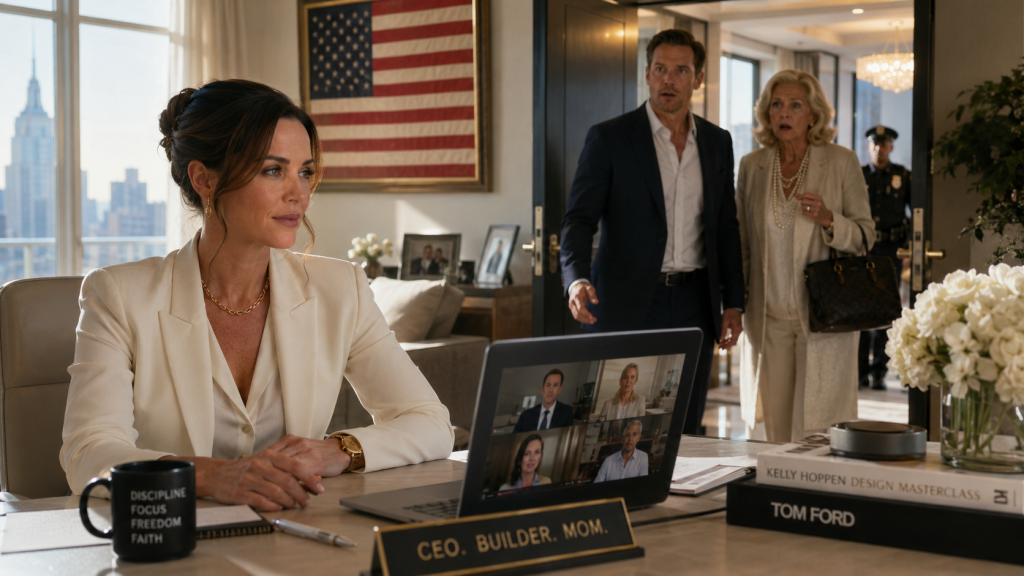
I was fully dressed, seated at my home office desk.
My laptop was open.
And I was ten minutes into a live, high-stakes video board meeting with eight senior partners from Sterling Point Capital.
The meeting had started at 6:30 because our Singapore deal team needed urgent approval on a biotech acquisition.
I had coffee beside me.
Slides open.
Hair pulled back.
Divorce papers in a folder at the edge of my desk like a closed chapter.
Then Brandon’s drill started writing the next one.
“Olivia?” asked Margaret Chen, our senior partner in Asia. “Is everything all right?”
I muted myself for half a second and opened the security camera feed.
There stood Margaret Hawthorne outside my penthouse door, wearing cream silk at dawn, her face twisted with poisonous rage.
Beside her, Brandon hovered over the locksmith, one hand pressed dramatically to his forehead.
Behind them stood a building security guard looking uneasy.
The locksmith looked uncomfortable, but the drill was already in his hands.
Margaret snapped, “For God’s sake, hurry. She’s dangerous when she’s emotional.”
I almost laughed.
Dangerous.
Not when I was funding their lives.
Not when I was saving Brandon from bad investments.
Not when I was making Margaret look philanthropic.
Only now, when I controlled the locks, the cards, and the narrative.
I unmuted myself.
“Everyone, I need you to stay on this call,” I said.
Eight faces stared back at me.
I picked up my laptop and turned the webcam toward the entryway.
The drill screamed.
The deadbolt gave way with a violent crack.
My front door opened.
Brandon stepped in first, sweating through his expensive shirt.
Margaret followed, clutching a large structured tote bag.
The locksmith stood just inside the threshold, suddenly aware that whatever story he had been told did not match the woman calmly filming him from across the room.
Brandon froze.
“Olivia?”
I held the laptop steady.
“Good morning, Brandon.”
His eyes flicked to the screen.
To the faces.
To the board meeting.
To the recording symbol glowing red in the corner.
Every bit of color left his face.
“What is this?”
“A board meeting,” I said. “And now, evidence.”
Margaret recovered faster.
She always did when there was an audience to manipulate.
“Oh, darling,” she cried, pressing a hand to her chest. “We were so worried. Brandon said you were having an episode.”
One of my senior partners, Henry Vale, leaned toward his webcam.
“For the record, Mrs. Hawthorne, this meeting has been recorded since 6:30 a.m.”
Margaret stopped speaking.
Brandon tried to laugh.
“This is a private family dispute.”
I looked at him.
“We are not family. We are divorced.”
He pointed at me.
“She’s unstable. You’re seeing it right now.”
I turned the laptop slightly, showing my desk.
Organized papers.
Coffee.
Contract review.
No broken glass.
No chaos.
No crisis.
Just a woman who had expected a biotech vote and received a home invasion instead.
“Brandon,” I said, “you lied to a locksmith and building security to drill through my door.”
The locksmith lifted both hands.
“He told me it was an emergency. He said you were married.”
“My divorce was finalized yesterday at 3:18 p.m.”
My attorney’s voice suddenly came through my phone on speaker.
I had texted her one word while the drill was still running.
Emergency.
She had called immediately.
“Olivia,” she said, calm as winter, “do not say another word to them. The board recording is already preserved.”
Brandon’s mouth fell open.
Margaret’s eyes darted toward the hallway.
The police arrived six minutes later.
Building security had called them after hearing the words mental breakdown and forced entry.
By then, Brandon had shifted from panicked husband to offended victim.
He waved his hands and spoke over everyone.
“I was concerned. She blocked me. She canceled my mother’s card. She’s acting irrationally.”
The officer looked at me.
“Ma’am, are you Olivia Sterling?”
“Yes.”
“Do you need medical assistance?”
“No. I need them removed from my home.”
Margaret gasped.
“Your home? This was Brandon’s marital residence.”
“It was never his property,” my attorney said through the laptop speakers. “And the divorce decree confirms exclusive ownership and occupancy to Ms. Sterling.”
The officer turned to Brandon.
“Sir, did you authorize the locksmith to drill the lock?”
Brandon hesitated.
“I believed my wife was in danger.”
“Ex-wife,” Henry Vale said from the board call.
A second partner, Angela Brooks, added, “For the record, Sterling Point Capital witnessed the forced entry and the false mental-health claim in real time.”
Brandon looked like he wanted to smash the laptop.
Marcus, our general counsel, appeared in another video window and said, “Any attempt to interfere with that device will be considered destruction of evidence.”
The officer’s expression changed.
“What exactly is in the bag, ma’am?” he asked Margaret.
Margaret stiffened.
“My personal things.”
“In my home?” I asked.
She clutched the tote strap.
“I was going to retrieve family items before she threw them away.”
I laughed once.
“Search it.”
Margaret recoiled.
“You have no right.”
The officer said, “Given the circumstances, we do need to inspect what was brought into the residence.”
Margaret tried to look at Brandon.
But Brandon was already staring at the floor.
The officer opened the tote bag.
Inside were three empty jewelry boxes.
My passport.
A folder of blank checks from an old household account.
A photocopy of my building access card.
And a typed letter addressed to my building manager.
The officer unfolded it.
His face hardened as he read.
To whom it may concern,
Due to my wife Olivia Hawthorne’s severe mental instability following marital separation, I, Brandon Hawthorne, request emergency administrative access to the penthouse residence and authority to remove dangerous personal effects, financial documents, and travel identification for her protection.
The room went silent.
My blood went cold.
They had not come to check on me.
They had come to steal my life before I could lock them out permanently.
My passport.
My checks.
My access.
My legal identity.
All wrapped in the language of concern.
Margaret whispered, “That is not what it looks like.”
The officer looked at her.
“It looks very specific.”
Brandon snapped, “My mother didn’t write that.”
My attorney answered, “Wonderful. Then your fingerprints and metadata will help clarify who did.”
Brandon’s face twisted.
“Olivia, don’t do this.”
I looked at him across the room that had once held our marriage.
“I’m not doing anything. You drilled through my lock.”
His voice dropped.
“You humiliated my mother.”
“She humiliated herself with a canceled card she had no right to use.”
Margaret suddenly burst into tears.
Real tears, maybe.
Or theater.
With Margaret, it was always hard to tell until the audience changed.
“I gave you five years of my life,” she cried.
I stared at her.
“No. You charged five years of your life to my account.”
The locksmith sat in the hallway, pale and shaking, giving his statement.
The police photographed the lock, the door, the tote bag, the letter, and the security footage.
My board remained on the call the entire time.
At one point, Angela asked softly, “Olivia, do you want us to adjourn?”
I shook my head.
“No. Let’s finish the vote.”
Brandon stared at me as if I had become someone else.
Maybe I had.
Or maybe I had finally stopped being the woman who made his life easy.
“Motion carries,” Henry said twenty minutes later. “Acquisition approved.”
“Thank you,” I said. “Now I’ll deal with the burglary.”
That sentence made Brandon flinch.
By noon, I had filed a police report, restraining order requests, emergency fraud alerts, passport security notices, and account lockdowns.
My building replaced every lock, reset every biometric access point, and permanently banned Brandon and Margaret from the property.
The locksmith company suspended the technician pending review, though I later declined to pursue him personally once it became clear Brandon had lied in writing and on camera.
By evening, Brandon’s law firm had placed him on administrative leave.
The board recording had reached their ethics committee.
He had used false mental-health claims, attempted forced entry, and brought documents seeking control of my residence and personal effects.
For a man who built his career on corporate reputation, he had destroyed his own in less than ten minutes.
Margaret’s charity circle learned the rest faster than I expected.
The same women who had watched her Cartier card decline now heard why she had been escorted from my building by police.
Her friends did what society friends do best.
They expressed concern publicly and vanished privately.
The Cartier necklace was returned to the auction table.
Margaret did not receive it.
She did, however, receive a legal notice warning her never to contact me again.
Two weeks later, we returned to court.
Brandon wore a navy suit and the wounded expression of a man hoping the judge would mistake embarrassment for remorse.
Margaret wore black, as if attending the funeral of her reputation.
My attorney played the board recording.
The drill.
Brandon’s lie.
Margaret’s comments.
My calm voice.
The partners identifying themselves as witnesses.
Then the police body camera footage.
Then the tote bag inventory.
Then the typed letter.
The judge watched without interruption.
When it ended, he removed his glasses.
“This was not concern,” he said. “This was a coordinated invasion.”
Brandon’s attorney tried to argue emotional distress.
The judge cut him off.
“Emotional distress does not permit a man to fabricate a psychiatric emergency to enter his ex-wife’s home.”
Margaret tried to speak.
“Your Honor, I am an elderly woman who was humiliated.”
The judge looked at her.
“By a declined credit card or by your own conduct?”
Her mouth closed.
The restraining orders were granted.
Brandon was ordered to pay for the damage to my door, my legal costs related to the emergency hearing, and additional security expenses.
Separate criminal and civil investigations continued.
But that day, walking out of court, I felt something I had not expected.
Not victory.
Relief.
Victory still gave Brandon too much importance.
Relief belonged entirely to me.
That night, I returned to the penthouse.
The new lock made a clean, solid click behind me.
No Brandon.
No Margaret.
No emergency calls.
No accusations.
No one demanding I rescue their pride.
I stood in the entryway for a long moment, listening.
The city hummed below.
My coffee machine beeped softly.
Somewhere in the distance, a siren passed and faded.
For five years, I had mistaken peacekeeping for love.
I paid Margaret’s bills because Brandon said family helped family.
I swallowed insults because he said she was from another generation.
I let her use my card because he said refusing would embarrass him.
I stayed quiet because he said I was too sensitive.
But the morning they drilled through my door, I finally understood.
People who benefit from your boundaries being weak will always call you cruel when you make them strong.
Brandon had never wanted a wife.
He wanted insulation.
Between him and his mother’s demands.
Between his family’s image and their financial reality.
Between his failures and the consequences.
Margaret had never wanted a daughter-in-law.
She wanted access.
To money.
To status.
To my home.
To the story.
To the version of herself where she was always the victim and every woman who refused her was unstable.
But I had given them both enough.
The next morning, I unblocked Brandon long enough to send one message through my attorney.
All future communication must go through counsel.
Then I blocked him again.
My partners never treated me differently after the recording.
If anything, they respected me more.
At the next board meeting, Henry said, “I appreciate your composure under pressure.”
I smiled.
“I had excellent motivation.”
Angela sent me a small gift the following week.
A silver key on a chain.
The note said:
For doors only you control.
I keep it in my desk drawer.
Not because I need a reminder of Brandon.
Because I need a reminder of myself.
The woman who did not panic.
The woman who turned the camera.
The woman who let billionaires watch because the truth deserved witnesses.
Months later, I moved out of the penthouse.
Not because I was afraid.
Because the space had held too many echoes.
I bought a brownstone with tall windows, a private garden, and a front door painted deep blue.
The first night I slept there, I woke before dawn.
No drill.
No shouting.
No emergency.
Just birds in the garden and sunlight touching the floor.
I walked downstairs, made coffee, and stood by the new door.
I unlocked it.
Locked it.
Unlocked it again.
Then I laughed.
A quiet, disbelieving laugh.
Freedom can sound like many things.
A judge’s signature.
A blocked phone number.
A card declined at Cartier.
A board recording preserved on a corporate server.
But for me, the sweetest sound after divorce was the clean click of a new lock that only I controlled.
Brandon lost access to me.
Margaret lost access to my money.
And I lost the last illusion that they had ever loved me as anything more than a resource.
People later asked if I regretted canceling the card so quickly.
Never.
That canceled card did not create their cruelty.
It revealed it.
The declined necklace showed me Margaret’s entitlement.
The phone call showed me Brandon’s rage.
The drilled lock showed me their plan.
And the tote bag showed me how far they were willing to go when their access disappeared.
I used to think divorce was the ending.
I was wrong.
Divorce was the door.
What happened after was the test of whether I would keep it closed.
The second my divorce became final, I canceled my ex-mother-in-law’s card.
She was humiliated in front of two hundred people.
My ex called me screaming.
By sunrise, he was outside my home with a locksmith, lying that I was having a mental breakdown.
He thought he would find a frightened woman alone.
Instead, he found a board meeting, eight witnesses, a recording, an attorney on speaker, and a woman who had finally learned that calm is not weakness.
It is aim.
He broke my deadbolt.
He did not break my life.
And when the new lock clicked shut behind me, I understood something my marriage had almost made me forget.
A home is not safe because someone says they love you.
A home is safe when no one can enter it without your permission.
THE END! THANKS FOR READING!