 Reading Time: 13 minutes
When I was close to giving birth, my husband locked me inside our house, yelled at me to “quit acting dramatic,” and went to his mother’s birthday celebration. Two days later, he walked back to the house smiling with leftover cake.
Then the sight waiting for him made him drop it in terror. When the first contraction struck, I was in the kitchen, clutching a glass of water that slid from my fingers and shattered across the floor.
“Ethan,” I breathed, pressing a hand to my belly. “Something isn’t right.” My husband glanced up from his phone with the annoyance of a man whose important moment had been interrupted.
He was already wearing a charcoal suit.
His hair was neatly combed back.
His watch gleamed beneath the kitchen lights.
His mother, Patricia Walker, had turned sixty-five that evening, and the party was not just a party.
In Ethan’s family, Patricia’s celebrations were royal events.
People did not arrive late.
People did not leave early.
And nobody, not even a heavily pregnant wife, was supposed to take attention away from her.
Suddenly, Ethan’s phone rang.
He put it on speaker.
“Don’t tell me Madison is pulling one of her stunts again,” Patricia sighed through the line. “If you miss my champagne toast, Ethan, I will be humiliated.”
Another contraction hit, stronger this time.
I folded over the counter, struggling for air.
“Ethan, please. I think the baby is coming.”
He rolled his eyes.
“Madison, stop making this so dramatic.”
The words landed colder than panic.
I was thirty-eight weeks pregnant.
My doctor had warned both of us that my blood pressure had been unstable.
She had told Ethan plainly that if I felt serious pain, dizziness, or bleeding, I had to go to the hospital at once.
Now sweat was soaking through my dress.
My knees were shaking.
Every part of my body was screaming that something was terribly wrong.
Ethan covered the phone and glared at me.
“You always do this.”
“I’m not doing anything. I need help.”
“You turn everything into an emergency the moment my family needs me.”
My fingers gripped the edge of the counter.
“Your child needs you.”
His jaw hardened.
He hated that phrase.
Your child.
As if responsibility was an accusation.
Through the speaker, Patricia gave a little laugh.
“Ethan, darling, leave her to rest. First babies take forever. She’s just nervous.”
I looked at the phone.
I wanted to scream at Patricia, to tell her that this was not nervousness, not drama, not a woman seeking attention.
But another wave of pain stole my voice.
Ethan snatched up his car keys.
“You can wait a couple of hours.”
“No,” I whispered. “Please don’t go.”
He walked toward the door.
I followed as far as my body allowed.
“Ethan, I’m serious. I need the hospital.”
He turned back, his face dark with irritation.
“You need to stop embarrassing me.”
Then he stepped outside.
A second later, I heard an electronic beep.
At first, I did not understand it.
Then I looked at the smart lock panel beside the door.
Red.
Locked.
From the outside.
Ethan had used his phone app to lock the steel-core front door so I could not follow him, could not make a scene, could not ruin Patricia Walker’s perfect toast.
I grabbed the handle.
It would not move.
“Ethan!”
His car engine started.
I pounded weakly on the door.
“Ethan, open it!”
The car pulled away.
The house went silent.
For a few seconds, I stood there, one hand against the door, the other under my belly, unable to believe that the man who had promised to protect me had just trapped me inside the house like an inconvenience.
Then I saw the blood on the white kitchen tile.
A dark stain spreading near the broken glass.
The room tilted.
My doctor’s warnings flashed through my mind.
Do not wait.
Do not drive yourself.
Call emergency services.
I moved toward the counter where my phone had fallen.
Every step felt impossible.
The house was too quiet.
The nursery upstairs was painted pale yellow, waiting for a baby girl Ethan had wanted to name Olivia after his grandmother.
Her tiny clothes were folded in drawers.
Her bassinet was ready beside our bed.
Her stuffed rabbit sat in the corner with a pink bow around its neck.
All that softness existed upstairs while I crawled across the kitchen floor, locked inside my own home, begging my body not to give up.
I reached for my phone with shaking fingers.
The screen blurred.
I dialed 911.
The dispatcher answered, calm and clear.
“911, what is your emergency?”
“My husband locked me in,” I cried, barely able to keep my eyes open. “I’m thirty-eight weeks pregnant. I’m bleeding. I’m alone. Please…”
“Ma’am, what is your address?”
I gave it.
Or I tried to.
Halfway through, my voice failed.
The dispatcher kept speaking.
“Madison, stay with me. Help is on the way. Are you able to unlock the door?”
“No. Smart lock. He locked it from outside.”
“Is there another exit?”
I looked toward the back door.
The kitchen seemed impossibly far away.
“I can’t walk.”
“Okay. Stay where you are. Keep the line open.”
I tried.
I truly tried.
But the phone slipped from my hand.
The last thing I heard before darkness pulled me under was the dispatcher saying, “Madison, help is coming.”
Two days later, Ethan and Patricia finally came home.
They were smiling.
Laughing.
Carrying leftover fondant cake from the birthday celebration.
Ethan expected to find an exhausted, angry wife waiting to apologize for ruining his mood.
Patricia expected to find me dramatic, sulking, and ready to be corrected.
Instead, when Ethan pushed open the front door, the cake slipped from his hands.
The box hit the floor.
White frosting spread across his polished shoes.
The kitchen had been sealed with yellow evidence tape.
Police markers stood near the broken glass.
Near the hallway.
Near the locked front door.
A printed notice was taped to the wall.
SCENE UNDER INVESTIGATION.
Ethan screamed my name.
“Madison?”
No answer came from the empty house.
Patricia gripped his arm.
“What is this?”
A police officer stepped from the living room, followed by my older sister Rebecca, my doctor, and a woman from child protective services.
Ethan’s face drained.
“Where is my wife?”
Rebecca’s eyes were swollen from crying, but her voice was hard as stone.
“Alive. No thanks to you.”
He stumbled back.
“The baby?”
The officer looked at him coldly.
“Also alive. Because your wife managed to call 911 before she lost consciousness.”
Patricia lifted her chin.
“This is a family misunderstanding.”
My doctor turned on her.
“A high-risk pregnant woman was locked inside a house during a medical emergency.”
Ethan shook his head.
“I didn’t know it was serious.”
The officer held up a tablet.
“The dispatcher recording says otherwise. So do your smart-lock logs. You locked the door remotely at 7:42 p.m. and ignored eight emergency calls.”
Patricia whispered, “Ethan…”
For once, she had no script.
No polished insult.
No motherly excuse.
No way to twist what the records already proved.
The officer continued.
“Your wife called emergency services at 7:49. Fire rescue forced entry at 8:03. She was transported unconscious at 8:11.”
Ethan’s mouth opened.
Closed.
Opened again.
“I was at my mother’s birthday.”
Rebecca stepped forward.
“You chose cake over your wife and child.”
Patricia snapped, “Don’t you speak to my son like that.”
Rebecca turned slowly toward her.
“Your son locked my sister in a house while she was in labor.”
Patricia looked toward the kitchen floor, then away.
“This is not what it looks like.”
The officer’s voice cut through the room.
“It looks like evidence.”
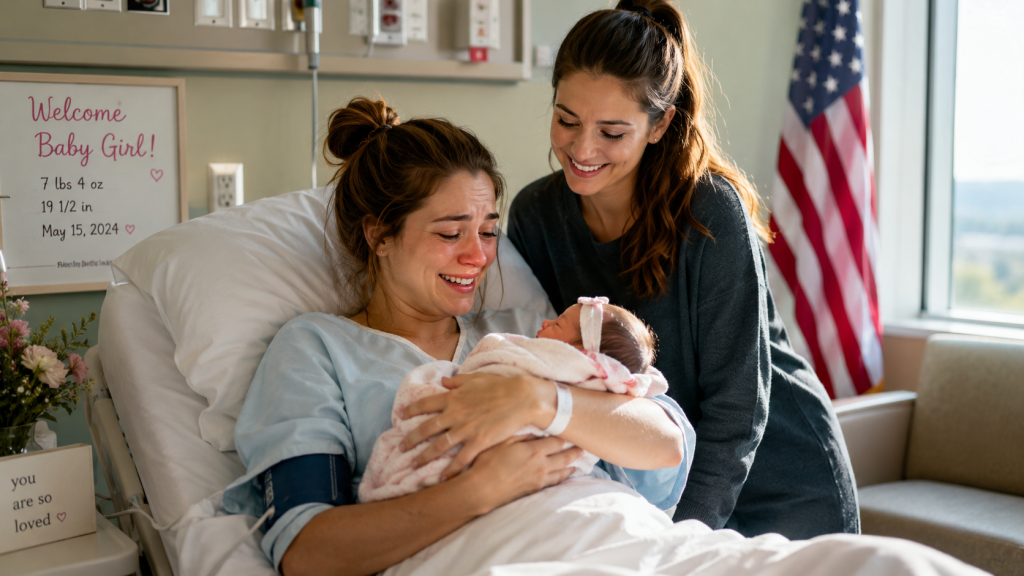
At the hospital, I woke to the sound of my daughter crying softly in a bassinet beside me.
At first, I did not understand where I was.
The room smelled like antiseptic and clean sheets.
Machines beeped quietly.
There was a dull ache through my body.
My throat was dry.
My hand felt heavy.
Then I turned my head and saw Rebecca sitting beside the bed, holding my fingers between both of hers.
Her face crumpled when my eyes opened.
“Madison.”
“The baby,” I whispered.
Rebecca stood quickly.
“She’s here. She’s safe.”
Safe.
The word broke something loose inside me.
A nurse gently lifted the tiny bundle from the bassinet and placed her against my chest.
My daughter was so small.
So warm.
Her face was pink and wrinkled, her dark hair soft against my chin.
She made a tiny sound and pressed her cheek against me.
I started crying without sound.
Not from pain.
From relief so deep it felt like grief leaving my body.
“She’s perfect,” Rebecca whispered.
I touched my daughter’s hand.
Her fingers curled around mine.
“What happened?”
Rebecca’s face changed.
“You called 911. They broke the door. You were taken into emergency surgery.”
I closed my eyes.
Ethan.
The lock.
The kitchen floor.
Patricia’s voice.
I remembered enough.
“Did he come?”
Rebecca’s mouth tightened.
“Not until today.”
“Today?”
“You’ve been here two days.”
The room went silent except for my daughter’s small breaths.
Two days.
My husband had left me locked inside our house during a medical emergency and had not even come home for two days.
“He came back,” Rebecca said quietly. “With cake.”
I closed my eyes.
No tears came then.
I think my body had finally understood that Ethan’s absence was not a mistake.
It was a choice.
The police came to take my statement later that afternoon.
They were careful.
They spoke gently.
They asked only what I could handle.
The dispatcher recording had captured more than I remembered.
My voice begging.
My words about the lock.
The silence after I dropped the phone.
The smart home company had provided access records showing exactly when the door was locked, from whose phone, and when Ethan ignored the emergency notifications that followed.
My doctor had documented the risks Ethan knew about.
Rebecca had copies of the texts I had sent her weeks earlier, telling her I was scared Ethan would refuse to take me seriously when labor started.
Every little warning I had minimized had become part of the truth.
That was the strange cruelty of it.
I had spent months telling myself Ethan was stressed.
Patricia was overbearing.
Marriage was complicated.
Family pressure was normal.
But evidence did not care about excuses.
Evidence arranged itself plainly.
A woman asked for help.
A husband mocked her.
A mother-in-law encouraged him.
A door was locked.
A call was ignored.
A life nearly ended.
Two weeks later, Ethan stood in court wearing the same charcoal suit from Patricia’s party.
It looked different now.
Less elegant.
More like a costume.
I watched him from behind my attorney, holding my daughter’s blanket in my lap.
I had named her Grace.
Not Olivia.
Grace because she arrived when everything else was breaking.
Grace because she survived a night she should never have had to survive.
Grace because I needed to believe the rest of our lives could still hold gentleness.
Ethan looked at me across the courtroom.
For a second, I saw the man I once thought he was.
The man who cried during our wedding vows.
The man who painted the nursery while humming old songs.
The man who placed his hand on my belly the first time Grace kicked.
Then he lowered his eyes, and that memory dissolved.
Emergency custody was granted to me.
A protective order followed.
Ethan’s attorney tried to argue that he had misunderstood the severity of the situation.
My doctor stood and testified.
She explained that Ethan had attended appointments.
He had been told the risks.
He had received written emergency instructions.
He had signed hospital forms acknowledging them.
The judge asked Ethan one question.
“Why did you lock the door?”
Ethan swallowed.
“I didn’t want her following me while upset.”
The courtroom went still.
The judge’s expression hardened.
“You locked a pregnant woman inside a house during a medical emergency because you did not want her to inconvenience you.”
Ethan said nothing.
Patricia tried to speak from the gallery.
“Your Honor, my son was under pressure. It was an important family event, and Madison has always been emotional.”
The judge turned toward her.
“A celebration is not an excuse to abandon a woman in labor.”
Patricia sat down.
For the first time since I had met her, she looked small.
Not ashamed.
Just defeated by the fact that nobody important was accepting her version.
The months after that were both gentle and brutal.
I did not go back to the house.
Rebecca helped me move into a small apartment near the hospital.
It had sunlight in the mornings, clean white curtains, and a front door with a simple lock I could turn with my own hand.
The first night there, I stood in front of that door for almost ten minutes.
Lock.
Unlock.
Lock.
Unlock.
A simple sound.
A simple movement.
Freedom.
Grace slept in her bassinet beside the couch, one tiny fist curled near her face.
Rebecca brought soup.
My father installed shelves.
My friends filled the refrigerator.
For years, I had believed I did not have enough people.
The truth was, Ethan and Patricia had trained me to stop calling them.
Now they came.
One by one.
Quietly.
Angrily.
Lovingly.
My phone filled with messages.
We are here.
Tell us what you need.
You are not alone.
Ethan sent messages too.
At first, angry ones.
You’re destroying my life.
You’re keeping my child from me.
My mother is sick over this.
Then sad ones.
I panicked.
I made one mistake.
I love you.
Please let me see Grace.
Then blaming ones.
If you had stayed calm, none of this would have happened.
That was the message that finally freed me.
Because when I read it, I did not feel guilt.
I felt clarity.
Ethan did not regret what he had done.
He regretted that people could prove it.
Patricia wrote a long email to my attorney claiming she had been misled, that she had never known I was truly in danger, that she would have told Ethan to stay if she understood.
My attorney forwarded it to the police.
Attached to it was the speakerphone recording from our smart kitchen assistant.
Patricia’s voice was clear.
Don’t tell me Madison is pulling one of her stunts again.
If you miss my champagne toast, Ethan, I will be humiliated.
She stopped writing after that.
The criminal case took longer than I wanted.
Everything legal does.
There were interviews, hearings, delays, motions, arguments over wording, attempts to lower charges, attempts to blame technology, attempts to make Ethan sound confused instead of cruel.
But the smart-lock logs remained.
The 911 call remained.
The medical records remained.
My doctor’s warnings remained.
The missed calls remained.
The evidence tape remained in photographs.
And Grace remained, breathing softly in my arms, proof that survival was not the same as forgiveness.
Ethan eventually accepted a plea agreement tied to unlawful restraint, reckless endangerment, and domestic abuse-related charges.
He was ordered into supervised visitation only after evaluation, counseling, and court approval.
Patricia was barred from contact with me and Grace.
When the order was read, she gasped as if I had personally stolen something from her.
Rebecca leaned toward me and whispered, “She still thinks this is about her.”
I almost laughed.
Because she was right.
Patricia had made everything about herself for so long that even my emergency became an insult to her party.
The first time Ethan saw Grace was through supervised visitation.
I did not attend.
I sat in a waiting room with Rebecca while a trained supervisor stayed in the room with him.
When it was over, the supervisor told me Ethan had cried.
“He asked if you would ever forgive him,” she said.
I looked down at Grace’s blanket.
“That is not the question that matters.”
“What question does?”
“Whether my daughter will ever be safe around him.”
The supervisor nodded slowly.
“That is the right question.”
Healing did not arrive as one big moment.
It came in small ones.
The first time I slept three hours without waking from a nightmare.
The first time I cooked in my own kitchen without seeing broken glass.
The first time Grace smiled.
The first time I took her outside in the stroller and felt the sun on my face without checking whether Ethan’s car was nearby.
The first time I told a nurse my story without apologizing for it.
The first time I said, “My ex-husband,” and did not feel the words tear through me.
I learned that survival after betrayal is not just leaving.
It is relearning ordinary things.
Doors.
Phones.
Dinner.
Sleep.
Trust.
I joined a support group for women who had been controlled in ways that did not always leave visible marks.
One woman’s husband hid her car keys.
Another’s emptied her bank account.
Another’s used her children to monitor her.
When I told them about the smart lock, no one looked shocked.
That comforted and horrified me.
After the meeting, an older woman named Nadine took my hand.
“He wanted you to believe the locked door was the worst part,” she said.
I looked at her.
“It wasn’t?”
She shook her head.
“The worst part was that he thought he had the right to decide whether your emergency was real.”
I carried that sentence with me for months.
Because that was what Ethan had done long before the night Grace was born.
He had made himself the judge of my pain.
Too tired.
Too sensitive.
Too dramatic.
Too emotional.
Too needy.
Too inconvenient.
That night, when he locked the door, he had only made physical what he had been doing emotionally for years.
But doors can be opened.
Records can be pulled.
Truth can be spoken in court.
And a woman who survives can stop asking permission to be believed.
A year later, Grace turned one.
We held a small birthday party in Rebecca’s backyard.
No champagne.
No grand speeches.
No Patricia.
Just cupcakes, balloons, sunlight, and people who loved my daughter without needing control over her.
Grace wore a yellow dress and smashed frosting across her cheeks with both hands.
Everyone laughed.
Real laughter.
Safe laughter.
I stood under the oak tree watching her, my heart full and aching.
Rebecca came beside me.
“What are you thinking?”
I smiled.
“That I almost named her Olivia.”
Rebecca squeezed my hand.
“Grace suits her.”
“Yes,” I whispered. “It does.”
Later that afternoon, my attorney called.
The divorce was final.
The house had been sold.
Part of the proceeds went into a trust for Grace.
Part came to me.
Ethan had signed without fighting at the end.
Maybe he was tired.
Maybe his lawyer told him the evidence made him look worse every time he argued.
Maybe some part of him finally understood that I was not coming back.
I did not ask why.
I simply thanked my attorney, hung up, and walked back to the party.
Grace reached for me with frosting-covered hands.
I picked her up and let her ruin my dress.
There are stains that feel like blessings.
That night, after everyone left, I sat on the floor of the nursery in our apartment.
Grace slept in her crib, one hand curled around the ear of her stuffed rabbit.
The room was small.
The furniture was secondhand.
The curtains did not match the rug.
But the door was open.
The window was open.
The whole apartment felt like air.
I thought about the woman I had been that night in the kitchen, crawling toward a phone, begging not to be dismissed.
I wanted to go back and hold her.
Tell her help was coming.
Tell her the baby would cry.
Tell her the door would open.
Tell her the man who locked her in would not get to define the rest of her life.
Tell her that two days later, when Ethan returned with cake and confidence, the house would not be waiting with an apology.
It would be waiting with evidence.
People sometimes ask how I moved on.
The truth is, I did not move on.
I moved forward.
There is a difference.
Moving on sounds like forgetting.
Moving forward means carrying the truth without letting it chain your feet.
I remember everything.
The glass breaking.
The beep of the lock.
The dispatcher’s voice.
The hospital ceiling.
Grace’s first cry.
The judge’s words.
The first night in my new apartment.
I remember because those memories are not only pain.
They are proof.
Proof that I survived.
Proof that Grace survived.
Proof that being called dramatic does not make your emergency false.
Proof that a locked door can become the beginning of freedom.
When I was close to giving birth, my husband locked me inside our house and went to his mother’s birthday celebration.
Two days later, he came home smiling with leftover cake.
He expected a wife ready to apologize.
Instead, he found evidence tape, police officers, medical records, and the truth waiting in every silent room.
He dropped the cake because he finally understood what I had learned that night.
Some choices cannot be explained away.
Some doors, once opened by rescue, never close again.
Ethan lost his wife the night he chose a birthday toast over our lives.
Patricia lost the power to call cruelty tradition.
And I gained something stronger than marriage.
A daughter.
A future.
A home with unlocked doors.
And the courage to never again beg anyone to care whether I survived.
THE END! THANKS FOR READING!