 Reading Time: 9 minutes
I finally surrendered my brother’s old golden retriever to the shelter on a rainy Tuesday morning. I told myself I had no choice. Between my new job, the apartment rules, and the fact that my life had become one long list of things I could barely afford, keeping Max felt impossible.
He was twelve years old. Slow. Gray around the muzzle. Half deaf. And still carrying that same ratty blue chew toy everywhere like it was the crown jewel of England. My brother, Aaron, had died eight months earlier.
Max was the last living thing that still looked for him at the door.
Every evening, around six, Max would drag himself to the hallway, sit facing the entrance, and wait.
That was when Aaron used to come home from work.
Even after the funeral.
Even after I cleaned out Aaron’s apartment.
Even after the landlord changed the locks.
Max kept waiting.
At first, I thought it was sweet.
Then it became unbearable. Because every night, that dog looked at the door with more faith than I had left in anything. Aaron had been my older brother by six years.The good one, everyone said.
The responsible one.
The one who remembered birthdays, fixed broken shelves, sent money when I was short, and never once made me feel small for needing help.
When he died, people called it an accident.
A late-night fall near the old storage units outside town.
No witnesses.
No real investigation.
Just a police report, a funeral, and a box of his belongings handed to me like a receipt.
I cried, of course.
But not the way people expected.
My grief came mixed with resentment.
Aaron had left me with bills, memories, and a dog I was not allowed to keep.
My apartment had a strict no-pets rule.
I hid Max for months.
Every time he barked, I panicked.
Every time maintenance knocked, I shoved him into the bedroom with treats and prayed.
My new job started at 7 a.m. across town, and I was gone ten hours a day.
Max needed medicine.
Max needed walks.
Max needed patience.
I had rent.
I had debt.
I had a life that felt too small for even my own breathing.
So one morning, after another warning letter from the landlord, I put Max’s leash on.
He wagged his tail.
That nearly broke me.
He thought we were going somewhere good.
The shelter smelled like bleach, wet fur, and old fear.
A young woman at the desk looked at Max, then at me.
“Owner surrender?”
I nodded.
“He belonged to my brother.”
She typed something into the computer.
“Reason?”
I swallowed.
“Apartment rules. Work schedule.”
She kept typing.
Max sat beside me with his chew toy in his mouth.
The toy had once been shaped like a blue dinosaur, maybe.
Now it was just fabric, slobber, and stubborn loyalty.
When the shelter worker reached for his leash, Max did not resist.
He only turned his head and pressed his wet nose into my palm one last time.
Then he dropped the chew toy at my feet.
It landed softly between my shoes.
I stared at it.
Something inside me said, Pick it up.
But the shelter worker slid a form toward me.
“Just standard intake,” she said. “Fifty-dollar surrender fee.”
So I paid.
I left the toy in my purse because I could not bear to leave it there.
Then I walked out before guilt could make me turn around.
For two weeks, I tried not to think about him.
That is the ugliest truth.
I told myself Max was safe.
Shelters had volunteers.
Maybe someone kind would adopt an old golden retriever with cloudy eyes and a limp.
Maybe he would have a yard.
Maybe he would stop waiting for Aaron.
Then the call came.
It was a Thursday evening.
I had just microwaved soup and kicked off my shoes when my phone rang.
The shelter number flashed on the screen.
“Ms. Turner?” the woman asked.
“Yes.”
“I’m sorry to tell you this. Max passed away overnight.”
Passed away.
Such clean words.
“He didn’t wake up from his sleep,” she continued gently. “It was peaceful.”
I sat down on the floor.
Not the couch.
The floor.
My soup rotated inside the microwave, humming.
“Was anyone with him?” I asked.
There was a pause.
“One of the overnight staff checked on him earlier. He was resting.”
That meant no.
He died alone.
In a kennel.
Waiting for a man who was already gone and a woman who had given him away.
The guilt came then.
Not a twinge.
A wave.
But guilt is easier to manage when you are busy, so I cleaned.
I scrubbed the counters.
Folded laundry.
Emptied trash.
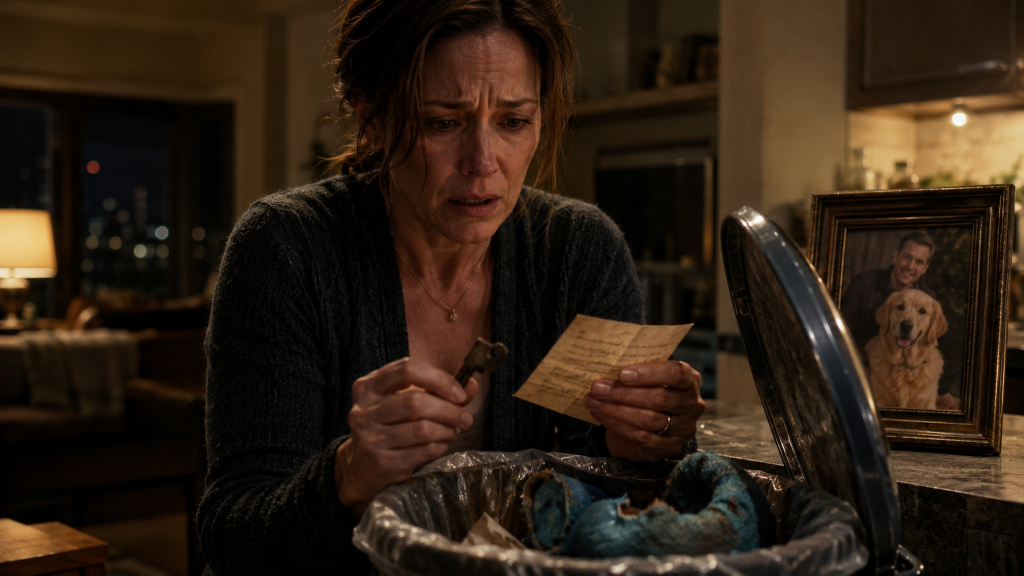
I took Max’s chew toy from the hook by the door, where it had hung inside a plastic grocery bag since the day I surrendered him.
It was ridiculous to keep it.
It smelled faintly of dog and rain.
I told myself throwing it away was closure.
I dropped it into the trash.
It caught on the sharp edge of an open soup can and ripped.
Something metallic fell out.
Clink.
I froze.
A small rusted key lay at the bottom of the trash can, wrapped in folded paper.
My hands went cold.
I reached in and pulled it out.
The paper was soft from years of being hidden inside fabric, but the handwriting was clear.
Aaron’s handwriting.
If he gave you this, it means they found me.
I stopped breathing.
They.
Not it.
Not the police.
They.
My brother had written the note before he died.
My knees weakened, and I grabbed the counter.
I unfolded the paper fully.
There was more.
The key opens unit 14B at Ridgeway Storage. Don’t trust Paul. Don’t call the police until you see what’s inside. Max knows who came that night. I’m sorry, Lila.
I read it three times.
Paul.
Paul Mercer had been Aaron’s business partner.
He had given a speech at the funeral.
He had stood beside my mother’s grave afterward and told me Aaron was “like a brother.”
He had even offered to take Max.
I had almost said yes.
But Max had growled at him.
That was the only time I had ever heard Max growl at a person.
At the funeral, Paul reached down to pet him, and Max bared his teeth so suddenly people gasped.
Paul laughed it off.
“Poor thing is confused,” he said.
At the time, I believed him.
Now I remembered Aaron’s words.
Max knows who came that night.
I stood in my kitchen with the rusted key in my palm, feeling my grief turn into something sharper.
Fear.
Rage.
Purpose.
Ridgeway Storage was twenty minutes outside town, past the old rail bridge.
I almost went that night.
Then I looked at the note again.
Don’t call the police until you see what’s inside.
I did not sleep.
I sat at the kitchen table until dawn, the key in front of me, the torn chew toy beside it.
For the first time since Aaron died, I stopped thinking of his death as something that happened.
I began thinking of it as something someone had done.
At 9 a.m., I called in sick.
My voice sounded normal.
That surprised me.
Then I drove to Ridgeway Storage with my stomach twisting.
The place was almost empty.
Rows of orange metal doors.
Security cameras.
A bored man at the front desk.
“Unit number?” he asked.
“14B.”
He looked at me strangely.
“Name?”
“Aaron Turner.”
His fingers paused over the keyboard.
“That unit’s paid through the year.”
“My brother died.”
The man’s face softened.
“Sorry.”
He handed me a map.
Unit 14B sat near the back, where weeds pushed through cracks in the pavement.
The key fit.
The lock turned with a dry scrape.
Inside, the unit smelled of dust, cardboard, and something old.
At first, it looked ordinary.
Boxes.
A metal filing cabinet.
A covered workbench.
A bicycle.
Then I saw the wall.
Photos were taped across it.
Not family photos.
Surveillance stills.
Documents.
Maps.
Bank records.
And in the center, one large picture of Paul Mercer shaking hands with a man I recognized from the news.
Victor Haines.
A city contractor who had recently been indicted for bribery.
My brother had been an accountant.
Quiet.
Careful.
The kind of man who noticed numbers others missed.
On the workbench sat a laptop, three flash drives, and a folder labeled:
IF I DISAPPEAR.
My hands trembled as I opened it.
Inside were copies of invoices, emails, payment trails, and handwritten notes.
Aaron had discovered that Paul and several others were using their construction company to move stolen money through fake repair contracts.
He had planned to turn the evidence over.
But someone found out.
The last page in the folder was a timeline.
Paul coming to Aaron’s apartment.
Paul arguing with him.
Aaron moving evidence to the storage unit.
Max biting Paul’s sleeve.
Then one final note:
If anything happens to me, check Max’s toy. I put the key where only loyalty would keep it safe.
I covered my mouth.
Max.
Sweet, old Max.
Carrying that toy from room to room.
Sleeping beside it.
Dropping it at my feet before I abandoned him.
He had been trying to give me the truth.
And I had not listened.
I sat on the floor of the storage unit and cried harder than I had cried at Aaron’s funeral.
For my brother.
For the dog.
For every night Max waited at the door with a secret in his mouth.
Then I wiped my face and called Detective Ramirez.
His number was on Aaron’s original report.
When he answered, I said, “My brother’s death wasn’t an accident.”
He was quiet for a moment.
Then he said, “Where are you?”
I gave him the address.
Within an hour, police cars filled the storage lot.
Detective Ramirez walked through the unit slowly, his face growing darker with every file.
“Why didn’t we know about this?” he muttered.
I wanted to say, Because you didn’t look hard enough.
Instead, I said, “My brother hid the key inside his dog’s toy.”
The detective looked at me.
“And the dog kept it?”
“Until the end.”
They took everything.
The laptop.
The flash drives.
The folders.
The photographs.
They told me not to contact Paul.
I almost laughed.
Paul contacted me first.
That evening, my phone buzzed.
Lila, I heard you went to Ridgeway today. We should talk.
I stared at the message until my skin prickled.
Then another came.
Aaron was stressed before he died. Don’t let old papers confuse you.
Then another.
You don’t know what you’re getting into.
I forwarded all of them to Detective Ramirez.
Two days later, Paul was arrested.
Not only for fraud.
For obstruction.
Then, after forensic evidence connected him to Aaron’s storage unit and to the scene where Aaron died, the charges grew heavier.
The case took months.
During that time, the shelter mailed me Max’s collar.
They included a paw print pressed into clay.
I opened the package at my kitchen table and broke down.
The shelter worker had written a note.
Max was gentle. One volunteer sat with him often. He loved his blue toy.
I pressed the clay paw print to my chest.
“I’m sorry,” I whispered.
But sorry felt too small.
After Paul’s arrest, more truth came out.
Aaron had not fallen.
He had been followed to the storage units.
He tried to run.
There had been a struggle near the loading dock.
Max had been with him that night and had bitten Paul, tearing his sleeve.
A neighbor heard barking but never came outside.
By the time police arrived, Aaron was gone and Max was found wandering nearby.
That was why Max never stopped waiting at the door.
He had seen who took his person away.
And nobody understood him.
At the trial, I testified.
I told the court about the chew toy.
The key.
The note.
I told them Max had carried the truth longer than any human had.
Paul would not look at me.
When the verdict came, guilty on the major counts, I did not feel happy.
I felt hollow.
Justice is not the same as restoration.
It did not bring Aaron back.
It did not give Max his last weeks in a warm bed.
But it gave the truth a place to stand.
And sometimes that is all the dead can ask from us.
After the trial, I changed my life.
Not in a dramatic movie way.
In small, necessary ways.
I left the apartment.
I found a small rental with a yard.
I started volunteering at the shelter every Saturday morning.
At first, I could barely walk past the senior dog kennels.
Then one old beagle with cloudy eyes pressed his nose through the bars, and I understood something.
Love is not convenient.
It never has been.
Love interrupts your schedule.
Love breaks apartment rules.
Love costs money.
Love asks more of you when you think you have nothing left.
But sometimes love is also the only thing standing between the truth and a trash can.
Six months after the trial, I adopted a thirteen-year-old golden retriever mix named Daisy.
She was slow.
Gray around the muzzle.
Half deaf.
When I brought her home, she sniffed every corner of the yard, then settled by the front door.
I sat beside her.
“You waiting for someone?” I asked.
She put her head on my knee.
I cried then, but softly.
Not the guilty kind of crying.
The kind that comes when grief finally finds somewhere gentle to rest.
I still keep Max’s torn blue chew toy.
Not in the trash.
Never again.
It sits in a shadow box beside Aaron’s photo and Max’s clay paw print.
The rusted key is there too.
People who visit sometimes ask about it.
I tell them the truth.
“That dog saved my brother’s story.”
And when they look confused, I add, “He tried to save me too. It just took me too long to listen.”
I have forgiven many things since then.
I have forgiven myself for being overwhelmed.
For being tired.
For being afraid of losing my apartment.
But I have not forgotten.
I have not forgotten Max pressing his nose into my palm that last morning.
I have not forgotten the toy dropping at my feet.
I have not forgotten how easily I walked away from loyalty because it arrived wrapped in inconvenience.
Now, every time I see an old dog at the shelter, I kneel down.
I let them smell my hand.
I look into their cloudy eyes.
And I remember the golden retriever who carried a dead man’s secret inside a ratty blue toy until his last breath.
Max did not resist when I surrendered him.
He did not bark.
He did not blame me.
He simply gave me the key.
And in the end, that was the worst part.
He trusted me with the truth before I had earned it.
THE END! THANKS FOR READING!
“The shelter worker had written a note.
Max was gentle. One volunteer sat with him often. He loved his blue toy.”??
Would that be the toy that ‘Max’ gave ‘her’ when he was surrendered at the Shelter, and in which ‘she’ found the note and key?
Yes, you’re right — that line creates a small continuity problem.
In the story, Max dropped the blue chew toy at her feet when she surrendered him, and she took it home. Later, she ripped it open and found the key and note inside. So the shelter worker should not say Max loved his blue toy after he was surrendered, because Max no longer had it at the shelter.
Better corrected version:
Original problem line:
“The shelter worker had written a note. Max was gentle. One volunteer sat with him often. He loved his blue toy.”
Corrected version:
“The shelter worker had written a note. Max was gentle. One volunteer sat with him often. He kept looking toward the door whenever someone passed, as if he was still waiting for someone he loved.”
Or more emotional:
“The shelter worker had written a note. Max was gentle. One volunteer sat with him often. Every evening, he lifted his head whenever the door opened, as if he still believed someone was coming back for him.”
That keeps the toy clue consistent because the toy stayed with her, not with Max at the shelter.