 Reading Time: 12 minutes
My parents announced they were bringing twenty guests to my lake house and ordered me to fill the fridge. When I said no, Mom laughed and asked if I really thought I could stop them.
By Friday morning, Dad was screaming, “What did you do to the house?” I had worked twelve hours at St. Mercy Medical Center, most of it on my feet, most of it watching people beg for one more breath under fluorescent lights.
By the time I parked outside my apartment in Portland, Oregon, my scrubs smelled like antiseptic and coffee, and my phone had been buzzing for twenty minutes.
Family group chat.
Dad had tagged me three times. Dad: We’re using your lake house this weekend — 20 guests.
Mom: Fill the fridge and behave.
My younger brother, Kyle, added a row of laughing faces.
I stared at the messages until the letters blurred.
My lake house was not “family property.”
It was mine.
I bought it after six years of double shifts, overtime, and living with roommates who stole my groceries.
A quiet place near Devils Lake where I could sleep, breathe, and not hear my mother criticize my life.
The house was small but beautiful.
Blue-gray siding.
A wraparound porch.
Big windows facing the water.
One bedroom downstairs.
A loft upstairs.
A kitchen I painted sage green myself on three hours of sleep and two gas station coffees.
I bought the place after my divorce because I needed proof that something in my life could belong only to me.
Not my ex-husband.
Not my parents.
Not my brother.
Me.
But my family never understood the word mine unless it belonged to them.
When I was a child, my mother called sharing “being loving.”
What she meant was surrender.
If I got birthday money, Kyle needed new sneakers.
If I saved for a school trip, Dad’s truck needed repairs.
If I bought myself a winter coat, Mom said it was selfish not to buy her one too, since she had “given birth to me.”
When I graduated nursing school, they threw a party at my aunt’s house and spent the whole evening telling everyone how proud they were.
Then, at the end of the night, my father handed me a list of bills he expected me to help with now that I had “a real career.”
I thought adulthood would make it stop.
It did not.
It only made their demands more expensive.
When I bought the lake house, I made the mistake of inviting them once.
Just once.
A Labor Day weekend.
I thought maybe they would see it as my sanctuary.
Instead, they saw it as inventory.
Mom opened every cabinet and said, “You need more serving platters if we’re going to host here.”
Dad stood on the deck and said, “We could fit a grill station over there.”
Kyle brought four friends without asking.
By Sunday, the hot tub had beer cans floating in it, the guest towels were stained with mud, and someone had scratched the hardwood near the fireplace dragging a cooler across the room.
When I said they could not use it again without my permission, Mom laughed.
“Oh, Claire,” she said. “Don’t be dramatic. Family doesn’t need permission.”
That sentence stayed with me.
Family doesn’t need permission.
It sounded loving if you did not know my family.
To me, it sounded like a warning.
So that Thursday night, sitting in my car after a hospital shift that had already emptied me, I typed one word into the family group chat.
Me: No.
Mom replied immediately.
Mom: 😂😂😂 You really think you can stop us?
Dad sent a voice message, but I did not play it.
I already knew the tone.
Command disguised as family love.
Kyle added another message.
Kyle: Come on, Claire. Don’t be weird. We already invited people.
I stared at the screen.
They already invited people.
To my house.
Without asking me.
After I said no.
Something inside me went very still.
For years, I had tried explaining.
Please don’t use my credit card.
Please don’t tell people I’ll pay.
Please don’t show up without calling.
Please don’t offer my time, my money, my home, my body, my labor as if I were a spare room attached to your lives.
Explaining had never worked.
So I did not argue.
I got out of my car, walked upstairs, took a shower, changed clothes, and made one call to my neighbor at the lake.
Mrs. Harper lived across the gravel road from the lake house.
She was seventy-one, widowed, sharp as broken glass, and had once chased a raccoon off her porch with a broom while wearing pearls.
“Margaret,” I said, “if any cars show up this weekend, they do not have permission to enter.”
She paused.
“Your parents again?”
“Yes.”
“Good,” she said. “I’ll keep an eye out.”
Then I opened my laptop and logged into the smart security system.
I changed every door code.
I disabled the old garage keypad.
I turned off the guest Wi-Fi.
I activated the cameras.
Then I called the local locksmith, who had helped me after my father “borrowed” the place last summer and left beer cans in the hot tub.
“Emergency?” the locksmith asked.
“Family.”
He sighed.
“That’s worse.”
By noon the next day, the locks were changed.
By three, I had emailed the sheriff’s office non-emergency line with a written statement.
No one had permission to enter the property.
No family members.
No guests.
No exceptions.
I attached proof of ownership.
Then I slept.
For once, I did not stay awake waiting for the next message.
Friday morning, my phone exploded.
Forty missed calls.
Dad’s name filled the screen again and again.
Mom.
Kyle.
Dad.
Mom.
Kyle.
Then the family group chat.
Dad: OPEN THE DOOR.
Mom: This is embarrassing.
Kyle: You’re seriously doing this?
Dad: ANSWER ME.
I let it ring until the forty-first call.
Then I answered.
“What did you do to the house?” Dad screamed.
His voice echoed, windy and furious.
I heard Mom in the background yelling, “Tell her to stop acting crazy!”
I sat up slowly.
“Good morning.”
“Don’t you good morning me! The front door code doesn’t work. The garage is locked. There are cameras everywhere. Your mother is standing outside with groceries melting, and everyone is staring at us!”
“Then everyone should leave.”
“This is a family weekend!”
“No,” I said. “It was a break-in attempt with witnesses.”
For once, there was silence.
Then Dad lowered his voice.
“Open the door, Claire.”
I looked at the live camera feed.
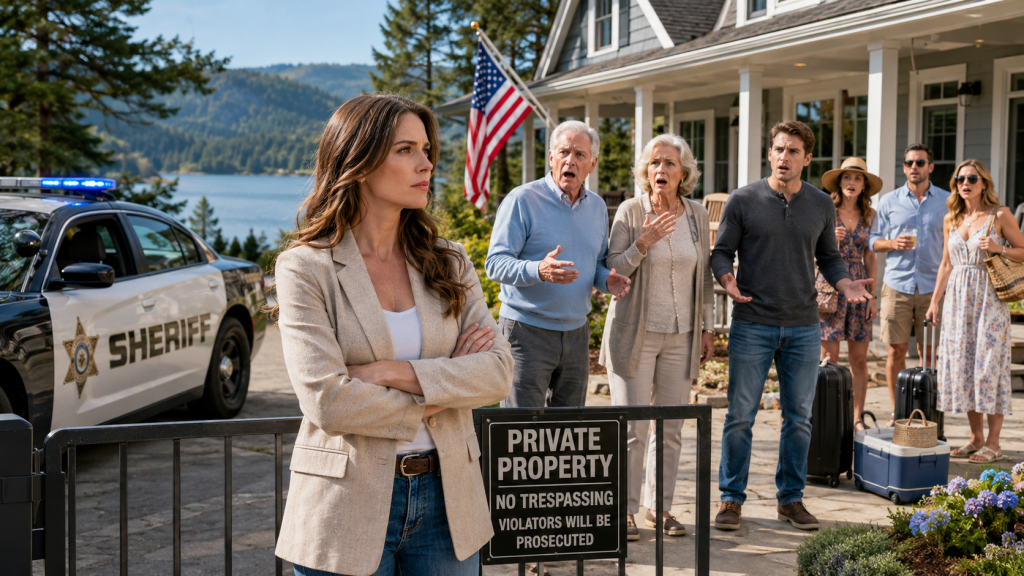
Twenty people stood on my porch.
Coolers.
Suitcases.
Beach bags.
A folding table.
Two men I did not even recognize were leaning against my porch railing like they owned the place.
Kyle was laughing near the steps, holding a case of beer.
Mom stood at the front door, punching numbers into the keypad again and again.
And behind them, a sheriff’s cruiser was turning into the driveway.
My father saw it at the same time I did.
His tone changed instantly.
“Claire,” he said, “don’t make this ugly.”
I almost laughed.
“Dad, you brought twenty people to a house you don’t own after I said no. You made it ugly.”
The deputy stepped out of the cruiser.
He spoke to Mrs. Harper first, then looked straight at the camera mounted above the porch.
“Are you Claire Miller?” he asked.
I opened the security app speaker.
“Yes, Deputy. I’m the owner. No one there has permission to enter.”
My mother gasped like I had slapped her.
“She’s our daughter!”
The deputy turned to her.
“Ma’am, that does not grant property rights.”
Kyle muttered, “This is insane.”
I tapped another file on my phone and said, “Deputy, I emailed proof of ownership and my written no-entry notice yesterday.”
Dad’s face went red.
“You planned this?”
“No,” I said. “I prepared for you.”
That hit him harder than anger.
Because my father understood preparation.
He had taught me to keep jumper cables in my trunk, spare cash in my wallet, and receipts for every major purchase.
He just never expected me to prepare against him.
The deputy asked everyone to leave the porch.
My father refused at first, pointing at the house like anger could unlock it.
“This is a misunderstanding,” he said. “We are family.”
The deputy remained calm.
“The homeowner has stated you do not have permission to enter.”
“My daughter is emotional.”
“Sir, the homeowner has provided written notice.”
“She’s a nurse. She’s tired. She doesn’t mean it.”
I leaned toward my phone.
“I mean it.”
Mom snapped toward the camera.
“Claire, stop humiliating us.”
I looked at the screen and saw my entire childhood in her face.
Not concern.
Not apology.
Embarrassment.
That was always the crime in our family.
Not crossing boundaries.
Not taking from me.
Not lying.
Not demanding.
The crime was making them look bad while they did it.
The deputy said, “Sir, forcing entry after this warning may result in trespassing charges.”
A few guests suddenly looked uncomfortable.
One woman holding a casserole whispered, “Wait, you said she knew we were coming.”
Kyle avoided her eyes.
Another man picked up his cooler.
My father turned on them.
“Nobody is leaving.”
But people do leave when legal consequences arrive.
Especially when the free lake weekend starts looking like a police report.
One by one, guests stepped off the porch.
Bags were dragged back toward cars.
Coolers lifted.
Children complained.
Someone said, “This is not what you told us.”
Mrs. Harper stood near the edge of her yard, arms crossed, enjoying every second.
Mom looked into the camera, furious.
“You chose a house over family.”
I stared at the screen, exhausted from years of being treated like a spare key.
“No, Mom. I chose peace over being used.”
Then I ended the call.
For a few minutes, I did nothing.
I sat in bed, phone in hand, heart pounding so hard it hurt.
I expected guilt to flood me.
It always had before.
But what came instead was silence.
Clean, strange silence.
The kind I had bought the lake house to find.
Then my phone buzzed again.
A message from Mrs. Harper.
Margaret: They’re leaving. Your father looks like a tomato in a windbreaker.
I laughed so suddenly I scared myself.
Then I turned off my phone and slept better than I had in years.
When I woke up that afternoon, the family group chat had become a battlefield.
Mom: You humiliated us.
Dad: We need to talk.
Kyle: You made me look like an idiot in front of my friends.
Aunt Linda: Claire, I know you work hard, but family should share blessings.
Cousin Beth: Is it true the sheriff came?
Uncle Rob: This could have been handled privately.
I read the messages while eating cereal from a mug because I was too tired to wash a bowl.
Handled privately.
That phrase made me snort.
They had publicly announced a twenty-person weekend at my house, publicly told me to fill the fridge, publicly laughed when I said no, publicly arrived with guests and groceries, but the moment I enforced a boundary, suddenly privacy mattered.
I typed one message.
Me: Nobody has permission to use my lake house without my written approval. Anyone attempting to enter will be treated as trespassing. This is not a discussion.
I left the group chat.
Within ten seconds, Mom called.
I did not answer.
Dad called.
I did not answer.
Kyle texted privately.
Kyle: You’re selfish.
I stared at the word.
Selfish.
That old hook.
It had dragged me through birthday dinners I paid for, vacations I did not want, emergency loans never repaid, family obligations invented five minutes before they needed my wallet.
This time, the hook did not catch.
I typed back.
Me: Then stop asking selfish people for free houses.
He did not reply.
The next week at work was brutal.
Three twelve-hour shifts.
Two emergency admissions.
One elderly patient who held my hand and told me she did not want to die alone.
I went home each night with sore feet and a heaviness behind my eyes.
But underneath the exhaustion was something new.
A thin line of pride.
I had said no.
They had tested it.
The world had not ended.
The following Saturday, I drove to the lake house.
The road curved through wet pines and low fog. Devils Lake appeared between the trees, silver and calm under a pale sky.
When I turned into the driveway, I stopped.
For one second, fear went through me.
What if they had come back?
What if Dad had broken something?
What if Mom had left flowers on the porch like a guilt offering?
But the house was quiet.
Untouched.
Mine.
I walked slowly to the front door.
The new lock clicked open under my code.
Inside, everything smelled faintly of cedar and lemon cleaner.
The couch faced the lake.
The books I had left on the coffee table were still stacked crookedly.
The kitchen was empty except for the tea I liked and the oat milk no one else in my family would drink without making a joke.
I stood in the middle of the living room and cried.
Not because I was sad.
Because the room had waited for me.
Because nothing had been taken.
Because for once, I had protected something before it was ruined.
A knock came at the door.
I wiped my face and opened it.
Mrs. Harper stood there holding a foil-covered plate.
“Blueberry muffins,” she said. “Boundary enforcement requires carbohydrates.”
I laughed and invited her in.
We sat on the porch with coffee, wrapped in blankets, watching the water move.
“Your father came back yesterday,” she said casually.
I stiffened.
“What?”
“Just him. Parked at the end of the drive for ten minutes. Didn’t get out. Probably wanted to see if cameras were real.”
“They are.”
“I waved at him with my phone in my hand. He left.”
I exhaled.
“Thank you.”
She shrugged.
“People think kindness means unlocking every door. It doesn’t.”
I looked at her.
“My family thinks I’m cruel.”
“No,” she said. “They think you’re useful. There’s a difference.”
That sentence stayed with me longer than the muffins.
Two weeks later, my father showed up at my apartment.
I saw him through the peephole, standing in the hallway with his hands on his hips.
I opened the door but kept the chain on.
His face darkened.
“You’re really doing that?”
“Yes.”
“I’m your father.”
“You’re also angry.”
He looked away.
For the first time, I noticed how old he looked.
Not weak.
Just older than the version of him that lived in my head, the booming father who could fill a room with one command.
“You embarrassed me,” he said.
“No. You embarrassed yourself by lying to twenty people.”
His jaw tightened.
“You always have to make a point.”
“I said no. You turned it into a point.”
He leaned closer.
“Your mother cried all weekend.”
I felt the old guilt rise.
Then I remembered her on the camera, stabbing numbers into my keypad after I had said no.
“I’m sorry she was upset.”
His eyes sharpened.
“That’s it?”
“Yes.”
“She feels like she lost her daughter.”
I touched the doorframe.
“Dad, she did not lose me. She lost unlimited access to me.”
He stared like he did not understand the language.
Then he said the sentence I had been waiting for my whole life.
“After everything we did for you.”
I nodded slowly.
“There it is.”
“What?”
“The bill.”
He stepped back.
I continued.
“You and Mom raised me. You fed me. You clothed me. You took me to school. You also made sure I paid for it emotionally every day after I became old enough to be useful.”
“That is not fair.”
“Neither was showing up at my house with twenty guests.”
“It’s just a house.”
“No,” I said. “It is the first place in my life where nobody gets to raise their voice and call it love.”
Something in his expression flickered.
Maybe shame.
Maybe anger.
Maybe both.
He turned to leave, then stopped.
“Kyle says you’re tearing the family apart.”
I smiled tiredly.
“Kyle says that because the family is built around taking from whoever says yes.”
Dad did not answer.
He left without apologizing.
But he also left without yelling.
That was new.
My mother held out longer.
She sent dramatic messages through relatives.
She posted vague quotes online about ungrateful children.
She told Aunt Linda that I had “changed since buying property.”
That one made me laugh.
She was right.
I had changed.
Property did not make me selfish.
Ownership made me awake.
Three months passed before Mom called and left a voicemail that did not begin with an accusation.
“Claire,” she said, voice stiff, “your father says I should apologize for the lake weekend. I still think you overreacted. But perhaps we should have asked.”
Perhaps.
The smallest word a proud woman could offer.
I did not call back immediately.
I listened to it three times.
Then I sent a text.
Me: Thank you for acknowledging that you should have asked. Going forward, visits to the lake house are by invitation only. I’m available for dinner next month if you want to talk respectfully.
She replied six hours later.
Mom: Dinner is fine.
It was not a miracle.
It was not healing.
It was a crack in the old wall.
Sometimes that is enough.
Kyle did not speak to me for nearly a year.
That was peaceful.
Then he texted me one afternoon.
Kyle: Can I rent the lake house for a weekend? I’ll pay. Just me and Jenna.
I stared at the message for a long time.
Rent.
Pay.
Ask.
Growth looked suspiciously like a full sentence.
I replied.
Me: Send me the dates. I’ll let you know.
He sent the dates.
I checked my calendar.
Then I said no because I wanted to use it that weekend.
He replied with a thumbs-up.
No insults.
No guilt.
No laughing faces.
I sat at my kitchen table and smiled.
The lake house became what I had always wanted it to be.
A place of rest.
Sometimes I went alone.
Sometimes I invited friends from the hospital.
Once, I let my parents come for lunch.
Just lunch.
My mother brought flowers and did not rearrange the kitchen.
My father fixed a loose porch step and asked before opening the shed.
It felt awkward.
It felt fragile.
But it was better than before.
When they left, Mom stood on the porch and looked at the lake.
“I understand why you like it here,” she said.
I waited for the criticism.
It did not come.
Instead, she added, “It’s quiet.”
“Yes,” I said. “That’s the point.”
She looked at me then, really looked.
Maybe for the first time in years.
“You were very tired, weren’t you?”
The question surprised me.
Not because the answer was complicated.
Because nobody in my family had ever asked.
“Yes,” I said. “I was.”
She nodded.
“I didn’t see that.”
“No,” I said gently. “You didn’t.”
She did not apologize.
Not fully.
But she touched my arm before leaving.
For my mother, that was a paragraph.
The next summer, I hosted a small dinner at the lake house.
People I chose.
Food I wanted.
Music low.
No one yelled.
No one mocked the oat milk.
No one opened cabinets like inspectors.
Mrs. Harper came over with blueberry pie.
A nurse from work fell asleep on the porch swing after three night shifts, and everyone let her rest.
As the sun went down over Devils Lake, the water turned gold.
I stood barefoot on the deck, holding a glass of iced tea, and thought about the Friday morning my father screamed, “What did you do to the house?”
At the time, he thought I had ruined the weekend.
But I had not done anything to the house.
I had protected it.
And in protecting it, I had protected the version of myself that was always told peace was selfish.
My parents announced they were bringing twenty guests to my lake house and ordered me to fill the fridge.
When I said no, they laughed.
They really thought I could not stop them.
Because for years, I had not.
I had opened the door.
Paid the bill.
Smiled through the insult.
Cleaned up the mess.
Explained my hurt in words they rearranged into drama.
But that week, after twelve hours on my feet at the hospital, after one more command disguised as family love, I finally understood something simple.
A locked door is not an act of hate.
Sometimes it is the first honest sentence you ever speak.
By Friday morning, Dad was screaming, “What did you do to the house?”
The answer was nothing.
The house was fine.
The locks were new.
The cameras were on.
The sheriff had the paperwork.
The guests were leaving.
The groceries were melting.
And for the first time in my life, my family was learning that my no did not need their permission to be real.
THE END! THANKS FOR READING!