 Reading Time: 84 minutes
An emotional story of betrayal, hidden corruption, a mother’s courage, and the truth that finally brought an entire empire to its knees
Robert Haines looked at me as though I were a stain on his beautiful marble floor. I recognized that expression immediately. It was the same look Patrick had given me the night before.
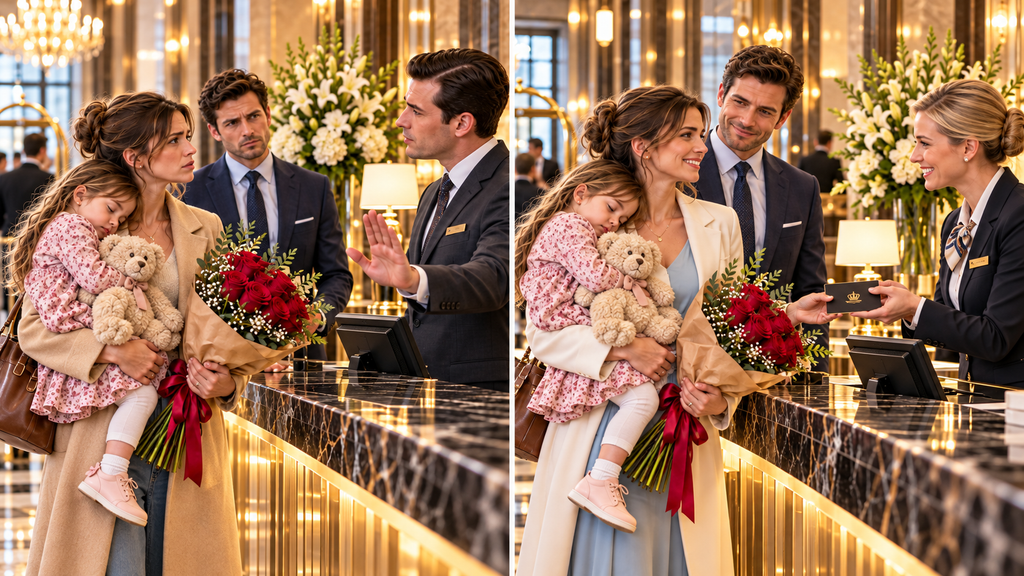
The same silent judgment.
The same assumption that a woman wearing an old leather jacket, carrying a worn backpack, and traveling with a small child could not possibly belong in a hotel like this.
Only this time, the man looking down on me was not a receptionist.
He was the general manager.
The man responsible for enforcing every value my late husband and I had spent eleven years building into this company.
And judging by the expression on his face, he had forgotten every single one of them.
“Good morning,” I said.
Robert didn’t return the greeting.
Instead, he turned toward Patrick.
“Is this the woman from last night?”
Patrick shifted uncomfortably.
“Yes, sir.”
Robert sighed.
Not the sigh of someone concerned about a guest’s experience.
The sigh of someone annoyed that a problem had survived until morning.
“I thought we handled this.”
Patrick glanced at me.
“We found her reservation, Mr. Haines.”
“Then what’s the issue?”
“There’s no issue,” I answered.
Robert turned toward me.
“Then how can I help you, ma’am?”
I looked at his name badge.
ROBERT HAINES.
GENERAL MANAGER.
Underneath the title was the small silver emblem of Vance Hospitality.
A pair of overlapping branches forming the outline of an open door.
Daniel had designed that emblem himself.
He used to say that a hotel was not simply a building with expensive furniture.
It was a promise.
A promise that whoever walked through its doors would be treated like a human being.
Standing before Robert, I wondered how long ago that promise had been forgotten.
“I’d like to discuss what happened last night,” I said.
Robert’s polite expression tightened.
“Ms…?”
“Vance.”
His eyes flickered.
But only briefly.
There were plenty of people named Vance.
And apparently, he hadn’t bothered to connect my name to the company printed on his own badge.
“Ms. Vance,” he repeated. “I understand there was a minor reservation misunderstanding.”
“Is that what Patrick told you?”
Robert glanced sharply at the receptionist.
“That’s what the overnight report indicates.”
“Would you mind telling me what else the report says?”
He crossed his arms.
“I’m afraid internal operational reports aren’t available to guests.”
“I see.”
“However, I can assure you that our staff handled the situation appropriately.”
I let the silence stretch.
Then I asked one simple question.
“Did you watch the security footage?”
Robert blinked.
“Excuse me?”
“The footage from the front desk. Did you review it before deciding your employees handled the situation appropriately?”
His expression became colder.
“Ma’am, I’m not required to explain our internal procedures.”
“Of course not.”
I nodded.
“Then perhaps you can explain why your staff suggested I take my sleeping six-year-old daughter to a cheap motel when I already had a confirmed executive reservation.”
Patrick looked down.
Karl suddenly became interested in arranging brochures.
Robert, however, barely hesitated.
“With respect, our employees have to maintain certain standards.”
I felt something turn over inside my chest.
“Standards?”
“Yes.”
“What kind?”
“Guest experience. Safety. Property reputation.”
I looked around the magnificent lobby.
The chandeliers.
The spotless marble.
The enormous floral arrangements.
The smiling photographs of executives displayed beside the ballroom entrance.
Then I looked back at him.
“And what did my appearance have to do with any of those things?”
Robert’s jaw tightened.
“You’re twisting my words.”
“I’m asking you to explain them.”
He leaned slightly closer.
“Ms. Vance, this is a premium property. Sometimes guests misunderstand the atmosphere we’re trying to maintain.”
There it was.
Not a mistake.
Not a misunderstanding.
A philosophy.
A quiet, ugly philosophy dressed in the language of luxury.
I thought of Daniel.
And suddenly I could hear his voice as clearly as if he were standing beside me.
If somebody needs to feel small so your business can look important, Clara, you’ve built the wrong business.
I touched the folded badge inside my jacket pocket.
But I didn’t take it out.
Not yet.
Because Robert had just handed me something far more valuable than an apology.
He had shown me exactly what he believed.
And I needed to know how far that belief had spread.
“Thank you for explaining,” I said.
Robert appeared relieved.
“I’m glad we understand each other.”
“We certainly do.”
I turned toward the elevators.
Behind me, I heard Karl mutter something.
Then Robert’s voice followed.
“Next time, Patrick, use better judgment about who you allow to create a scene in this lobby.”
I stopped walking.
Not because of the insult.
Because of the word allow.
As though a guest’s dignity were something granted at the discretion of the front desk.
As though kindness were a privilege.
As though the hotel belonged to people like Robert.
I turned back.
“Mr. Haines?”
He looked up impatiently.
“Yes?”
“Who taught you that guests should be judged by how much money they appear to have?”
His smile disappeared.
“Have a pleasant stay, ma’am.”
I nodded.
“You too.”
Then I stepped into the elevator.
And as the doors slid shut, I knew one thing with absolute certainty.
By the time this day ended, Robert Haines would no longer recognize the world he thought he controlled.
But I still had no idea how dangerous the truth was going to become.
Because what I found inside my hotel wasn’t merely prejudice.
It was theft.
It was intimidation.
It was a carefully constructed system that had been hurting employees and guests for years.
And at the center of it was a secret involving my husband’s legacy.
A secret someone had worked very hard to keep buried.
The first thing I did when I returned to Suite 904 was call David Mercer.
He answered on the second ring.
“Clara?”
“Good morning.”
There was a pause.
“That tone tells me something happened.”
David had worked beside Daniel and me since the earliest days of Vance Hospitality.
He knew me well enough to distinguish between ordinary irritation and the kind of quiet anger that came just before I made an irreversible decision.
“I need a few things,” I said.
“Name them.”
“First, don’t contact Robert Haines.”
“All right.”
“Don’t tell him I’m here. Don’t tell anyone at the property that I’m the owner.”
“Understood.”
“Second, pull the last eighteen months of guest complaints, employee resignations, disciplinary actions, and financial adjustments for this location.”
David became silent.
Then he asked, “How bad?”
“I don’t know yet.”
That was the truth.
And it frightened me more than I wanted to admit.
“Third,” I continued, “I want the original security footage from the lobby last night preserved. Not a summary. Not a clip. Every camera angle from six in the evening until midnight.”
“Consider it done.”
“And David?”
“Yes?”
“Who approved Robert Haines as general manager?”
Another pause.
“Regional Vice President Thomas Ellison recommended him. The promotion went through the standard approval process.”
“Did Daniel know him?”
“Not personally. Robert joined after Daniel died.”
I stared through the suite window.
Below me, the city was waking beneath a pale October sky.
Cars moved through the streets.
People hurried toward office buildings carrying coffee cups and briefcases.
Ordinary life continued.
Meanwhile, I felt as though I had opened a door in my own house and discovered a room I had never known existed.
“Find out everything you can about Thomas Ellison,” I said.
David’s voice changed.
“Clara, Thomas has been with us for nine years.”
“I know.”
“He’s one of our most senior executives.”
“I know that too.”
“Are you suggesting—”
“I’m suggesting we look at evidence before deciding what it means.”
Those were Daniel’s words.
I had used them so often since his death that sometimes I wondered whether I was preserving his wisdom or simply borrowing his voice because I missed hearing it.
David exhaled.
“All right.”
“And one more thing.”
“Go ahead.”
“Do we still have access to the original guest promise training materials from eleven years ago?”
A softer silence settled between us.
“Of course,” he said.
“Send them to me.”
“Clara…”
“Yes?”
“Daniel would have hated what happened last night.”
I closed my eyes.
“I know.”
“He would also have been proud of how you’re handling it.”
That was the sentence that nearly broke me.
Not because I disagreed.
But because three years after burying my husband, I still hadn’t learned how to hear his name unexpectedly without feeling the floor shift beneath my feet.
I swallowed.
“Send me the files, David.”
“I will.”
I ended the call.
Then I stood motionless beside the window for a long time.
Until a small voice came from the bedroom.
“Mommy?”
I turned.
Lily stood in the doorway wearing pink pajamas, her stuffed rabbit tucked beneath one arm.
Her hair was tangled.
There was a blueberry stain on her sleeve.
She looked exactly like Daniel did when he had just woken up.
The same sleepy eyes.
The same furrowed brow.
The same habit of tilting her head when she sensed that someone was upset.
“Are you working?” she asked.
“A little.”
“Are you still sad about Daddy?”
My throat tightened.
I crouched in front of her.
“Sometimes.”
She touched my cheek with her small hand.
“Me too.”
I pulled her close.
For a few moments, there was no hotel.
No executives.
No investigation.
No anger.
Only a mother holding her daughter.
Then Lily whispered something into my shoulder.
“Daddy always said people should be nice to the cleaners.”
I pulled back.
“What?”
She nodded seriously.
“He said they’re the people who make everybody’s beds nice, and nobody says thank you enough.”
I stared at her.
Daniel had said that.
Not once.
Hundreds of times.
And somehow our six-year-old daughter had carried the lesson into a morning when I desperately needed to remember why I was fighting.
“Yes, sweetheart,” I whispered.
“He was right.”
Lily smiled.
“Can we give Lupita something nice?”
I kissed her forehead.
“I think we can do better than that.”
At nine-thirty, I left Lily with Marisol and took the service elevator down to the employee cafeteria.
I had changed into jeans and kept the same jacket.
No expensive watch.
No jewelry beyond my wedding ring.
I wanted to understand the hotel the way its least powerful employees experienced it.
The employee cafeteria was located on the basement level, behind a narrow corridor lined with storage rooms.
The contrast was immediate.
Upstairs, soft piano music played beneath crystal chandeliers.
Down here, fluorescent lights buzzed over cracked tiles.
The air smelled of reheated coffee and industrial cleaner.
A vending machine blinked with an OUT OF ORDER message.
Three employees sat at a table eating from plastic containers.
They looked up when I entered.
Then immediately looked away.
I approached the counter.
A woman in a kitchen uniform was refilling a tray of rice.
“Excuse me,” I said.
“Yes?”
“Is Lupita working today?”
The woman’s hands stopped.
“Why?”
There was fear in that single word.
Not curiosity.
Fear.
“I’m staying upstairs,” I explained. “She helped me last night. I wanted to thank her.”
The woman studied me.
Then she lowered her voice.
“She’s on the tenth floor.”
“Thank you.”
I started to leave.
Then something on the wall caught my attention.
A printed notice.
STAFF MUST REPORT ALL GUEST INTERACTIONS TO MANAGEMENT.
UNAUTHORIZED CONVERSATIONS MAY RESULT IN DISCIPLINARY ACTION.
I walked closer.
Beneath that warning was another.
EMPLOYEES ARE REMINDED THAT NEGATIVE COMMENTS REGARDING PROPERTY OPERATIONS CONSTITUTE A VIOLATION OF THE PROFESSIONAL CONDUCT POLICY.
I read both notices twice.
Neither matched our corporate employee handbook.
Neither had been approved by our legal department.
I knew because I had helped write the policy that protected employees who reported misconduct.
A policy Daniel had insisted upon after a housekeeper at our first property told him she had been afraid to report a supervisor.
We had promised ourselves that nobody working for our company would ever have to choose between telling the truth and keeping their job.
Yet here was a notice implying exactly that.
“Are those new?” I asked the woman.
Her face changed.
She followed my gaze.
Then she lowered her eyes.
“Please don’t ask me.”
“Why?”
“Because I need this job.”
She turned away before I could say another word.
I stood looking at the notice.
Then I took a photograph.
A quiet voice spoke behind me.
“You shouldn’t do that.”
I turned.
A young man wearing a maintenance uniform stood in the doorway.
He couldn’t have been older than twenty-three.
His name badge read ELI.
“Why not?” I asked.
“Management doesn’t like people photographing staff notices.”
“Why?”
He hesitated.
Then glanced toward the security camera above the door.
“Because they say things disappear when people start asking questions.”
I felt a chill.
“What things?”
He looked over his shoulder.
Then whispered, “People.”
Before I could respond, he walked away.
I watched him disappear around the corner.
And for the first time that morning, the anger inside me made room for something else.
Concern.
Not for myself.
For the people who had been living under whatever system Robert Haines had created.
I found Lupita on the tenth floor.
She was kneeling beside a housekeeping cart, searching for a replacement pillowcase.
When she saw me, her expression brightened.
“Ms. Vance.”
“Good morning.”
“How was breakfast? Did your little girl like the pancakes?”
“She loved them.”
Lupita smiled.
“Good. The chef always saves the best blueberries for children.”
Then she looked around nervously.
“Did you need something from housekeeping?”
“Actually, I wanted to speak with you.”
Her smile faded.
“Did I do something wrong?”
The question struck me.
Not How can I help?
Not What would you like to know?
Did I do something wrong?
I shook my head.
“Quite the opposite.”
She relaxed slightly.
“Would you be comfortable talking somewhere private?”
Lupita glanced toward the hallway.
Then toward the elevator.
“About what?”
“About this hotel.”
Her expression closed.
I recognized it immediately.
The same fear I had seen in the cafeteria.
“Lupita,” I said softly, “you don’t have to tell me anything. And I don’t want to put your job at risk.”
She gave a small, humorless laugh.
“That is a kind thing to say, Ms. Vance.”
“But?”
“But people who say that don’t always mean it.”
I felt the truth of those words.
“I understand.”
She looked down at the pillowcase in her hands.
Then asked, “Can I ask you something?”
“Of course.”
“Are you really Clara Vance?”
“Yes.”
“The woman who founded the company with her husband?”
“Yes.”
Her eyes filled unexpectedly.
She looked away.
For a moment, I thought she might cry.
Instead, she said, “Then maybe you should see something.”
She reached into the pocket of her housekeeping apron.
And pulled out a folded piece of paper.
The edges were worn.
The creases had been opened and closed so many times that the paper looked almost transparent.
“This was given to me four months ago,” she said.
I unfolded it.
It was a disciplinary notice.
Employee: Lupita Morales.
Violation: Unauthorized Guest Assistance.
Penalty: Written Warning.
A second violation would result in suspension.
A third would result in termination.
I looked up.
“What did you do?”
Lupita swallowed.
“I gave bottled water to a family whose room wasn’t ready.”
I stared at her.
“Water?”
She nodded.
“A grandmother had been waiting with two little boys. They had traveled all night. The boys were thirsty.”
“And you were disciplined?”
“Management said I was encouraging guests to complain about delays.”
I looked at the signature.
Robert Haines.
Beneath it was a second name.
Thomas Ellison.
Regional Vice President.
The same man David had mentioned.
“Did Thomas personally review this?”
Lupita nodded.
“He was here that week.”
I studied the notice again.
Something about the wording seemed deliberate.
As though kindness itself had been reclassified as misconduct.
“Lupita, has anything else happened?”
She was silent.
Then she reached into her apron again.
This time, she pulled out a small envelope.
Inside were three pay statements.
She placed them in my hand.
“Please don’t misunderstand me,” she whispered. “I work hard. I have never asked for special treatment.”
“I know.”
“But my hours…”
Her voice cracked.
“My hours keep disappearing.”
I examined the statements.
Each showed deductions labeled SERVICE RECOVERY ADJUSTMENT.
“What’s this?” I asked.
Lupita shook her head.
“They say it’s for guest complaints.”
“Guest complaints against you?”
“Sometimes there aren’t any complaints.”
I looked closer.
The deductions were not ordinary payroll withholdings.
They appeared to reduce the paid hours that should have been recorded.
In one pay period, Lupita had worked forty-six hours.
She had been paid for thirty-four.
“Did you speak with payroll?”
“Yes.”
“What did they say?”
“They told me the system was correct.”
“Did you speak with human resources?”
Her face changed.
“Ms. Vance…”
“What?”
“Human resources is Mr. Haines’s sister-in-law.”
My stomach tightened.
“What’s her name?”
“Rebecca Sloan.”
I knew that name.
Rebecca Sloan had been hired eighteen months earlier to oversee employee relations at the property.
Her application had been approved through regional management.
I had seen her name in staffing reports.
I had never known she was related to Robert.
“Is anyone else having hours removed?” I asked.
Lupita gave me a look so full of exhaustion that I knew the answer before she spoke.
“Almost everyone.”
I folded the pay statements carefully.
“Why hasn’t anyone contacted corporate?”
She laughed again.
Only this time there was no humor at all.
“We tried.”
The corridor seemed to grow colder.
“What happened?”
“Complaints go to a special employee hotline. We were told it goes directly to headquarters.”
“Yes,” I said. “It should.”
She shook her head.
“Mr. Haines gets them first.”
I stopped breathing for a second.
“How do you know?”
“Because when I called, he repeated my exact words to me the next morning.”
I stared at her.
“What did he say?”
Lupita’s eyes dropped.
“He said I should remember that my daughter was depending on me.”
My fingers tightened around the statements.
“Your daughter?”
“Isabella. She’s seventeen. She’s applying for college.”
She smiled sadly.
“I’ve saved for her since she was born.”
“And Robert knew that?”
“He knows everything about us.”
I looked toward the hallway.
For the first time, I understood the scale of what might be happening.
This wasn’t a rude manager protecting rude employees.
This was a system of control.
One that apparently used fear, money, and personal information to keep people obedient.
“Lupita,” I said, “I need you to do something for me.”
She looked frightened.
“What?”
“Nothing dangerous. Nothing that puts you in conflict with your supervisor. I want you to finish your shift normally.”
She nodded slowly.
“And tonight, if you’re willing, I’d like to hear everything.”
“Everything?”
“Everything you’re comfortable telling me.”
She searched my face.
Then whispered, “What if they find out?”
I took her hand.
“Then they will answer to me.”
Her eyes filled.
“But people like Mr. Haines always win.”
I held her gaze.
“Not this time.”
At eleven-seventeen, David called.
I was back in Suite 904, sitting at the desk while Lily built a tower of pillows on the carpet.
Marisol was helping her decide whether the stuffed rabbit should be the king or the dragon.
“Clara,” David said, “we found something.”
His voice was different.
Controlled.
Careful.
The voice of a man choosing every word because he understood the consequences.
“What?”
“The employee hotline.”
I looked toward Lily.
Then stepped onto the balcony.
“Go on.”
“Sixteen months ago, the property requested permission to pilot a localized incident-reporting platform.”
“Why?”
“They said corporate response times were too slow.”
“Who approved it?”
“Thomas Ellison.”
I closed my eyes.
Of course.
“And?”
“The local system routes complaints through a third-party vendor before they reach headquarters.”
“What vendor?”
David paused.
“Westbridge Compliance Solutions.”
I didn’t recognize the name.
“Who owns it?”
“That’s where things get interesting.”
I gripped the railing.
“David.”
“Westbridge was formed twenty months ago. Its registered agent is a corporate services firm, but we traced the beneficial ownership through state filings.”
“And?”
“Forty percent belongs to Rebecca Sloan.”
My stomach dropped.
“Robert’s sister-in-law.”
“Yes.”
“And the rest?”
David was silent for a moment.
“Sixty percent belongs to Thomas Ellison’s wife.”
For several seconds, I heard nothing except the distant noise of traffic.
A truck horn.
The low rumble of a bus.
A dog barking somewhere below.
Ordinary sounds from an ordinary city.
But the world inside my head had gone completely still.
“So Thomas approved a vendor partly owned by his wife,” I said.
“Yes.”
“And the vendor was supposed to process employee complaints.”
“Correct.”
“Complaints that could implicate Thomas himself.”
“Exactly.”
I stared at my reflection in the balcony glass.
It looked like a stranger’s face.
Pale.
Tired.
Older than it had that morning.
“How much have we paid Westbridge?”
David hesitated.
“Clara…”
“How much?”
“In the last sixteen months? Just over eight hundred and forty thousand dollars.”
I felt sick.
“Eight hundred and forty thousand.”
“Yes.”
“For handling employee complaints?”
“Officially, compliance administration, audit support, and labor dispute prevention.”
I covered my mouth with one hand.
Daniel and I had built our first hotel with borrowed money and secondhand furniture.
There had been nights when we counted cash at the kitchen table to make sure we could pay the housekeepers before paying ourselves.
Eight hundred and forty thousand dollars.
Money that could have supported employees.
Improved training.
Paid wages.
Provided scholarships.
Instead, it appeared to have been routed into a company controlled by the families of two people overseeing the operation.
“Is it only this property?” I asked.
“We don’t know yet.”
“Find out.”
“We’re expanding the review.”
“And David?”
“Yes?”
“Preserve everything.”
“Already underway.”
“Emails, invoices, authorization logs, vendor contracts, access records. All of it.”
“Understood.”
I took a breath.
“What about the financial adjustments?”
Another pause.
“That’s worse.”
I pressed my palm against the balcony door.
“Tell me.”
“We found an unusual pattern in labor-cost reporting. The property has been reporting staffing expenses substantially below approved budgets, despite consistently high occupancy.”
“How much below?”
“Enough to trigger an audit. But somehow, the variance explanations kept receiving regional approval.”
“Thomas?”
“Yes.”
I closed my eyes.
I had known Thomas Ellison for nine years.
He had attended Daniel’s funeral.
He had stood beside me in the church courtyard and promised that he would protect everything Daniel and I had built.
He had sent flowers every anniversary.
Every year.
White lilies.
Daniel’s favorite.
And now I was beginning to wonder whether those flowers had been gifts.
Or camouflage.
“David,” I whispered, “I want an outside forensic accounting team.”
“I’ve already contacted one.”
“Employment counsel too.”
“Yes.”
“And independent investigators. Nobody who reports to Thomas.”
“Done.”
I leaned against the wall.
For a long moment, I couldn’t speak.
Then David said quietly, “Clara, there’s something else.”
I opened my eyes.
“What?”
“We reviewed the last twenty-four months of turnover.”
“And?”
“Forty-three employees have left the property.”
That number alone didn’t tell me enough.
Hotels had turnover.
Hospitality was demanding.
People moved, changed jobs, returned to school.
But David continued.
“Twenty-nine of them left within ninety days of filing some kind of complaint.”
My chest tightened.
“Twenty-nine?”
“Yes.”
“Did corporate see those complaints?”
“No.”
I looked down at the roses on the table.
Their heads had begun to lift after Lupita placed them in fresh water.
One was still bent.
But it hadn’t died.
“David,” I said, “we are not going to handle this with a quiet management reshuffle.”
“I know.”
“We are going to find out what happened to those people.”
“Every one of them.”
“And if money was taken from their wages, we repay it.”
“With interest, subject to the audit.”
“And if they lost their jobs for speaking up?”
“We make that right too.”
I heard him breathe out.
Then he said something I would remember for the rest of my life.
“Clara, I think Daniel’s company has been calling for help.”
I pressed my lips together.
Because that was exactly how it felt.
As though the place we had built with love had been speaking through every frightened employee.
Every missing paycheck.
Every unanswered complaint.
Every guest who had been judged and dismissed.
And I had not been listening.
Not closely enough.
Not until I became one of them.
At noon, a message arrived on my phone.
It came from an unknown number.
There were only seven words.
STOP ASKING QUESTIONS ABOUT THE EMPLOYEE PAYROLL.
Beneath the message was a photograph.
My daughter.
Lily was sitting near the suite window in her yellow sweater, holding her stuffed rabbit.
The photograph had been taken that morning.
Inside my room.
My blood turned cold.
For one horrifying moment, I couldn’t move.
Then I opened the balcony door.
“Marisol!”
She looked up immediately.
“Clara?”
“Where’s Lily?”
Marisol pointed toward the bedroom.
“She’s washing her hands.”
I crossed the room so quickly that I nearly knocked over a chair.
“Lily!”
She appeared in the bathroom doorway.
“Mommy?”
I dropped to my knees and wrapped both arms around her.
“Are you okay?”
She looked startled.
“Yes.”
“Did anyone come into the room?”
She shook her head.
“Only the lady.”
My heart stopped.
“What lady?”
“The one with the purple scarf.”
I looked at Marisol.
Her face had gone pale.
“I didn’t see anyone,” she said.
Lily frowned.
“She came when you were getting my crayons.”
I forced myself to remain calm.
“Sweetheart, what did the lady say?”
“She said she was checking the room.”
“Did she touch anything?”
Lily nodded.
“My rabbit.”
A cold wave passed through me.
“Why?”
“She said he was very pretty.”
I kissed Lily’s forehead.
“Thank you for telling me.”
Then I stood.
My hands were shaking.
I called David.
He answered immediately.
“Clara?”
“Someone entered my suite.”
“What?”
“Someone entered while my daughter was here. I just received a photograph of her inside the room.”
His voice sharpened.
“Are you safe?”
“Yes. Lily is with me.”
“Call hotel security.”
“No.”
“Clara—”
“Not hotel security. I don’t know who is involved.”
He understood instantly.
“I’m contacting the independent security team.”
“Have them come directly to my floor. Plainclothes. No property management notification.”
“Done.”
“And David?”
“Yes?”
“I want every electronic key entry for Suite 904 from seven this morning onward.”
“Immediately.”
I ended the call.
Then I turned toward Marisol.
“I’m sorry,” she whispered.
“You didn’t do anything wrong.”
“I stepped into the hallway for less than two minutes because the art supplies—”
“Marisol.”
She stopped.
“Someone deliberately took advantage of that moment. This isn’t on you.”
Her eyes filled.
“I should have been more careful.”
“We’re going to be careful now.”
I looked at Lily.
She was sitting on the edge of the bed, hugging her rabbit.
“Mommy?”
“Yes, sweetheart?”
“Is the purple lady bad?”
I crouched before her.
“I don’t know yet.”
Lily looked worried.
“She said you should stop being nosy.”
A terrible stillness settled over me.
“She said that?”
Lily nodded.
“She said grown-ups get into trouble when they ask too many questions.”
I closed my eyes.
For one second, all I could see was Daniel.
Standing in our kitchen three years earlier.
Laughing as Lily tried to put pancake batter on his nose.
The last ordinary morning before the car accident.
The last morning I had believed that the world was predictable.
I opened my eyes.
“Listen to me, sweetheart.”
Lily looked up.
“You did nothing wrong. And nobody is allowed to frighten you because your mommy is asking questions.”
She thought about that.
Then nodded.
“Okay.”
I hugged her again.
But this time, I understood something that changed the entire investigation.
Whoever was behind this wasn’t merely afraid of losing a job.
They were afraid of what I might uncover.
Afraid enough to threaten a six-year-old child.
And I was done giving them the benefit of the doubt.
The independent security team arrived twenty-three minutes later.
Their leader was a former federal investigator named Rachel Bennett.
She was in her early forties, with close-cropped dark hair and the calm, focused manner of someone who had spent years dealing with frightened people.
David had retained her firm for corporate security assessments in the past.
I trusted her.
Rachel entered the suite with two colleagues and immediately checked the doors, windows, adjoining access points, and electronic locks.
Then she sat across from me.
“Show me the message.”
I handed her my phone.
She studied it carefully.
“Don’t delete anything.”
“I won’t.”
“Has anyone else received threats?”
“Not that I know of.”
“Does hotel management know you’re the owner?”
“Not officially.”
She looked at me.
“Someone does.”
I nodded.
“Apparently.”
Rachel examined the photograph.
Then enlarged it.
“Look at the angle.”
I leaned closer.
The image showed Lily seated beside the window.
The photographer had been standing near the entrance to the suite.
“Whoever took this entered through the main door,” Rachel said.
“Can you identify the person?”
“Not from the photograph. But access logs may help.”
As if on cue, her phone buzzed.
She read the message.
Then looked up.
“Clara, your suite was accessed at eleven fifty-two this morning using a housekeeping master credential.”
“Whose?”
“The credential is assigned to Rebecca Sloan.”
I stared.
“Human resources?”
Rachel nodded.
“Yes.”
“Why would HR have a housekeeping master credential?”
“That’s an excellent question.”
She showed me the log.
At 11:52 a.m., Rebecca’s credential had opened Suite 904.
At 11:55, it had been used again at the service corridor.
The timing matched the photograph.
“Can we prove Rebecca herself used it?” I asked.
“Not yet. Credentials can be shared or stolen. We’ll need camera footage and access-control records.”
I nodded.
“Preserve them.”
“We are.”
Rachel leaned forward.
“Clara, I need to be very clear. This is no longer simply an employment investigation. Someone has used unauthorized access to approach your child and send an intimidating message.”
“I understand.”
“I recommend relocating Lily immediately.”
I looked toward the bedroom.
My daughter was drawing a picture with Marisol.
A pink house.
A yellow sun.
Three stick figures.
One of them had wings.
She always drew Daniel with wings.
Even when I asked her not to.
Because she said Daddy was still part of our family, and families belonged in pictures.
“Where?” I asked.
“We have a secure residence available through corporate. Private entrance, vetted staff, no hotel personnel access.”
I hesitated.
I had promised Lily we would spend the anniversary together.
I had promised we would visit the little garden Daniel had loved beside the river.
I had promised that this trip would be about remembering him.
Not about danger.
Not about another goodbye.
Rachel seemed to understand.
“She won’t be alone,” she said. “Marisol can go with her. You can join them whenever you choose.”
I swallowed.
“All right.”
I walked into the bedroom.
Lily looked up.
“Mommy, look!”
She held out her drawing.
Three figures stood beneath a bright yellow sun.
One wore a red dress.
One was very small.
The third floated above the house with enormous blue wings.
“That’s us,” she said proudly.
I sat beside her.
“It’s beautiful.”
She smiled.
“Are we going somewhere?”
I forced my voice to remain steady.
“Yes, sweetheart. We’re going to stay in a different place for a little while.”
“Why?”
“Because I need to finish some work, and I want you somewhere quiet and safe.”
She studied my face.
Then asked the question I had been dreading.
“Are you scared?”
I could have lied.
I could have told her everything was fine.
I could have pretended that adults never felt afraid.
Instead, I brushed a curl away from her forehead.
“A little.”
Her expression softened.
“That’s okay, Mommy.”
I almost smiled.
“Is it?”
She nodded.
“Daddy told me brave people get scared too.”
My eyes filled.
“He did.”
“He said brave people just don’t let the scared part make all their choices.”
I pulled her into my arms.
And for a few seconds, I allowed myself to cry.
Not loudly.
Not dramatically.
Just enough to release the fear that had been tightening around my heart.
Because my husband had been dead for three years.
And somehow, on the morning I needed courage most, his voice was still reaching me through our daughter.
By two in the afternoon, Lily was safely away from the hotel.
Rachel remained with me.
David had arrived on a corporate flight and was working with outside counsel and forensic accountants in a temporary office across the street.
The investigation was expanding faster than any of us expected.
The first major discovery came from an employee named Eli.
The young maintenance worker who had warned me about photographing the notices.
Rachel arranged a private conversation with him after he approached Lupita and asked whether the “woman in the leather jacket” could be trusted.
We met in a conference room outside the hotel’s management offices.
Eli entered carrying a battered backpack.
He looked terrified.
“Are you really the owner?” he asked.
“Yes.”
He stared at me.
Then gave a shaky laugh.
“I thought Lupita was joking.”
“She wasn’t.”
He glanced toward Rachel.
“Am I in trouble?”
“No,” I said. “Why would you be?”
He unzipped his backpack.
“Because I copied something.”
Rachel leaned forward.
“What did you copy?”
Eli placed a small external drive on the table.
“My supervisor told me to erase the old maintenance server last week. Said we were replacing the system.”
“Okay,” I said.
“But before I did, I saw folders I wasn’t supposed to see.”
My pulse quickened.
“What folders?”
“Old surveillance backups. Access logs. Service records. Some files had dates from before Mr. Haines became general manager.”
Rachel exchanged a glance with me.
“Why did you copy them?”
Eli looked down.
“Because my friend Marcus got fired.”
“Who is Marcus?”
“He worked in security.”
“What happened?”
Eli’s voice tightened.
“He reported that Mr. Haines was letting people into executive rooms without authorization.”
My stomach dropped.
“When?”
“About six months ago.”
“And he was fired?”
“Three days later. They said he stole a guest’s watch.”
“Did he?”
Eli shook his head fiercely.
“No. Marcus wouldn’t steal.”
“How do you know?”
“Because he’s my brother.”
His voice broke.
“He lost his job. Then his apartment. His girlfriend left because they couldn’t afford rent. He’s sleeping on our mother’s couch now.”
I felt the familiar ache of guilt.
Another person.
Another life damaged.
Another warning that had never reached me.
“Did Marcus file a complaint?” I asked.
“Yes.”
“What happened?”
“Nothing.”
Eli looked at the drive.
“After they fired him, someone told me to wipe the surveillance backups from the week he reported the access issue. I didn’t understand why.”
Rachel’s expression sharpened.
“Did you preserve the original files?”
Eli nodded.
“I copied them before the drive was erased.”
“Has anyone else seen this?”
“No.”
“Does management know?”
He shook his head.
“Not unless they checked my locker.”
I leaned forward.
“Eli, why did you decide to come forward now?”
He looked at me for a long moment.
Then said quietly, “Because last night I saw what they did to you.”
I blinked.
“I was fixing the lobby light above the entrance,” he explained. “I heard the whole thing.”
“And?”
He swallowed.
“You were holding a little girl. You looked tired. You were being polite. And they treated you like dirt.”
His eyes filled.
“I kept thinking about my mom.”
I waited.
“She cleans offices at night. Sometimes people act like she isn’t there. Like she’s furniture.”
He wiped his face quickly.
“I hate that.”
I reached across the table.
“Your mother should never be treated that way.”
He nodded.
“Neither should you.”
I looked at the drive.
Then back at him.
“Thank you for trusting us.”
His voice dropped.
“Are you going to fire Mr. Haines?”
I could have said yes.
At that moment, every part of me wanted to.
But Daniel’s words held me steady.
Evidence before action.
“We’re going to establish exactly what happened,” I said. “And then there will be consequences.”
Eli looked disappointed.
I understood.
He wanted certainty.
He wanted someone powerful to finally promise that the person who had hurt his family would not escape.
So I added something.
“I can promise you this: Marcus’s case will be independently reviewed. Your evidence will be protected. And nobody will be permitted to retaliate against you for coming forward.”
Eli’s shoulders dropped slightly.
For the first time, he looked as though he might believe me.
At three-forty, Rachel’s forensic specialist called.
He had examined the recovered server files.
What he found made the room go silent.
There were recordings of Robert Haines and Thomas Ellison entering occupied suites when guests were absent.
Sometimes they entered with members of the sales team.
Sometimes with outside contractors.
Sometimes with people whose identities had not yet been established.
At first, I assumed they were conducting unauthorized inspections.
That would have been serious enough.
But the next discovery was worse.
Several of those suites belonged to guests who had later filed complaints about missing valuables.
Jewelry.
Cash.
Expensive watches.
A designer handbag.
A laptop.
In every case, the property had denied responsibility.
In several cases, the guests had been offered small settlements in exchange for confidentiality agreements.
I stared at the list.
“How many?”
Rachel consulted the preliminary findings.
“At least fourteen incidents need review.”
“Fourteen?”
“Possibly more.”
I looked at David.
He looked as stunned as I felt.
“Who approved the settlements?” I asked.
“Thomas,” David answered.
“And were they reported to corporate risk management?”
“No.”
I pressed my fingertips to my temples.
Then Rachel spoke again.
“There’s something else.”
I looked up.
“One of the guests was particularly persistent.”
“Who?”
“An elderly man named Arthur Bell.”
The name sounded familiar.
Rachel continued.
“He stayed here nine months ago. He reported that a gold pocket watch disappeared from his room.”
“Was it valuable?”
“Financially, perhaps. But apparently, it was primarily sentimental. It had belonged to his father.”
I felt a pang.
“What happened?”
“He filed a formal complaint. When the property rejected it, he contacted the regional office.”
“Thomas?”
“Yes.”
“And?”
“Thomas sent him a letter stating that there was no evidence of unauthorized room access.”
Rachel paused.
“Then the hotel banned him from the property.”
I stared at her.
“For reporting a missing watch?”
“Officially, for abusive behavior toward staff.”
“Was he abusive?”
“We don’t know yet.”
David looked at the screen.
“Clara, Arthur Bell died three months ago.”
My heart sank.
“Does he have family?”
“A granddaughter. Her name is Naomi.”
I stared at the evidence.
Another family.
Another loss.
Another person who had been told that the truth didn’t matter because someone with a title had decided otherwise.
Then David said something that made me look up sharply.
“Clara, Arthur Bell was a retired hotel employee.”
“From where?”
David swallowed.
“From our first property.”
I froze.
“What?”
“He worked at the original Vance House for eleven years.”
I felt the room tilt.
“No…”
David nodded slowly.
“Arthur Bell was our first night manager.”
And suddenly I remembered.
An elderly man with gentle eyes.
Silver hair.
A bow tie he wore every Christmas.
A man who used to bring homemade cookies for Daniel because he knew Daniel skipped lunch when he was working.
Arthur Bell.
Of course.
I hadn’t recognized his name because I hadn’t seen him in years.
After retirement, we had exchanged occasional holiday cards.
Then the cards stopped.
I had assumed he was enjoying a peaceful retirement.
Instead, he had come to one of our hotels.
He had been mistreated.
He had asked for help.
And the company he helped build had turned him away.
I covered my mouth.
“Oh, Arthur.”
The room blurred.
Daniel had loved Arthur.
He used to call him the conscience of the front desk.
And now I was learning that Arthur’s final experience with our company had been one of humiliation and dismissal.
“Find Naomi,” I whispered.
David nodded.
“Of course.”
“And David?”
“Yes?”
“Find out whether Arthur ever tried to contact me.”
David hesitated.
Then nodded.
“I will.”
I looked down at my hands.
My wedding ring caught the light.
For the first time in three years, I wished Daniel were standing beside me not merely because I missed him.
But because I didn’t know how to carry what we were discovering.
At four-twenty, David brought me an envelope.
He didn’t sit down.
He simply placed it on the conference table.
“Clara,” he said quietly, “you need to read this.”
I looked at the envelope.
My name was written across the front.
Not typed.
Handwritten.
In shaky blue ink.
CLARA VANCE.
I recognized the handwriting.
Not immediately.
But somewhere deep inside my memory, a door opened.
Arthur Bell.
I remembered the Christmas cards.
The little handwritten notes.
The careful looping letters.
My hands began to tremble.
“Where did you get this?”
David swallowed.
“Arthur mailed it to corporate seven months ago.”
I stared at him.
“What?”
“It was logged as personal correspondence and forwarded to the regional office because it concerned this property.”
My stomach dropped.
“Thomas.”
David nodded.
“Someone in records located a scanned copy attached to a closed complaint file.”
I opened the envelope.
Inside was a three-page letter.
The first line made my eyes fill.
Dear Clara,
I hope you and little Lily are finding some peace. Daniel was a good man, and I still think about him often.
I stopped reading.
The words blurred.
David waited silently.
I wiped my eyes and continued.
I am writing because I believe something is badly wrong at the Grand Meridian.
I stayed there for my granddaughter’s graduation, and a pocket watch that belonged to my father disappeared from my room.
That watch was not especially valuable, but I carried it every day for sixty-two years.
I know accidents happen. I know mistakes happen. But I also know what it feels like when someone is telling you something that isn’t true.
My throat tightened.
The manager treated me like a confused old man. He said I had probably misplaced it and suggested that perhaps my memory was failing.
Clara, I am old, but I am not foolish.
I pressed the paper against the table.
Then forced myself to continue.
I watched you and Daniel build a company that treated ordinary people with dignity.
I remember when Daniel repaired the elevator himself because we couldn’t afford a contractor.
I remember you sleeping on the office couch because the roof leaked over your apartment and you wanted to make sure the guests were comfortable first.
I remember the night a homeless veteran came into the lobby during a snowstorm, and Daniel gave him Room 12 because he said no one should freeze beneath a roof full of empty beds.
Tears slid down my face.
I remembered that night.
The veteran’s name had been Samuel.
Daniel had bought him breakfast.
Arthur had given him a clean shirt.
And I had spent the morning arguing with our insurance agent because we hadn’t followed the usual check-in procedure.
We had laughed about it for years.
Then I reached the final paragraph.
I do not know whether this letter will reach you.
But if it does, please remember something Daniel used to say: a hotel reveals its character most clearly when the person at the desk believes the guest has no power.
Please look into what is happening.
Not for me.
For the people who cannot afford to be ignored.
With affection and respect,
Arthur Bell.
I sat motionless.
The room was silent.
Then I turned the page.
There was a handwritten note beneath his signature.
One final sentence.
P.S. I think someone inside your company is stealing more than watches.
I looked up slowly.
“David.”
He nodded.
“I saw it.”
“Arthur knew.”
“He suspected.”
“Seven months ago.”
“Yes.”
I stared at the letter.
Seven months.
For seven months, the warning had existed.
For seven months, someone had buried it.
And three months ago, Arthur had died without knowing whether anyone had listened.
I pressed the letter against my chest.
“I’m sorry,” I whispered.
Not to David.
Not to Rachel.
To Arthur.
To Daniel.
To every employee who had spoken and been ignored.
Then I stood.
And something inside me changed.
The uncertainty disappeared.
The hesitation.
The fear of creating a public scandal.
I was still determined to establish the facts carefully.
But I was no longer uncertain about the urgency.
“We’re going to expose every part of this,” I said.
David looked at me.
“Clara—”
“Every missing paycheck. Every buried complaint. Every unauthorized room entry. Every dollar.”
I placed Arthur’s letter carefully on the table.
“And we’re going to do it without letting them hurt anyone else.”
Rachel nodded.
“We’ll need a plan.”
“I have one.”
David raised an eyebrow.
I looked toward the ballroom doors visible through the glass wall.
The corporate gala was scheduled to begin at seven.
Three hundred guests.
Investors.
Executives.
Regional managers.
Community partners.
Several members of our board.
Robert Haines was supposed to deliver the opening remarks.
Thomas Ellison was scheduled to receive an award for operational excellence.
I had approved that award based on the financial reports he submitted.
Now those reports were under investigation.
I looked at David.
“Do we still have the final presentation?”
“Yes.”
“Good.”
“Clara, what are you thinking?”
I picked up my phone.
“Tonight, they’re going to hear the real story of this hotel.”
By five-thirty, the Grand Meridian was transforming into a glittering stage.
Florists carried towering arrangements of white orchids into the ballroom.
Servers polished silver trays.
A string quartet rehearsed beside the grand staircase.
A photographer arranged a backdrop beneath a golden sign.
VANCE HOSPITALITY.
ELEVEN YEARS OF EXCELLENCE.
I stood on the upper mezzanine watching the preparations.
Eleven years.
I remembered the beginning so clearly.
Daniel and I had been twenty-nine when we bought our first small property.
A tired, thirty-room hotel on the edge of a highway.
The carpet smelled of old cigarettes.
Half the air conditioners were broken.
The swimming pool was empty.
The previous owner had told us we were making a terrible mistake.
Maybe we were.
But Daniel had walked through those neglected rooms with a smile.
“Can you see it?” he asked.
“See what?”
“What it could become.”
I had laughed.
“Something that doesn’t smell like wet carpet?”
He grinned.
“That would be a start.”
We had painted the walls ourselves.
We had scrubbed bathrooms.
We had taken turns covering the front desk.
When a guest complained that the coffee was terrible, Daniel went out and bought a better machine with money we had intended to use for new office chairs.
I was furious.
He told me good coffee mattered more than comfortable chairs.
He was probably right.
We hired Arthur Bell that first winter.
Then Lupita’s cousin at another property.
Then dozens more.
Some employees stayed for years.
Some left to build their own lives.
But Daniel knew their names.
Their children.
Their birthdays.
Their struggles.
He believed people worked better when they knew they mattered.
And I believed him.
That was how Vance Hospitality grew.
Not because we had the grandest buildings.
Not because our advertisements were clever.
But because people trusted us.
Somewhere along the way, growth had changed the company.
Or perhaps I had changed.
After Daniel died, I had withdrawn from day-to-day operations.
I told myself I needed time to grieve.
And I did.
But I had also trusted executives to preserve a culture they might never have understood.
I had mistaken reports for reality.
Profits for health.
Awards for integrity.
Now I stood above a ballroom full of people preparing to celebrate a company whose foundations had been quietly damaged.
And I wondered how many of them knew.
How many had suspected.
How many had looked away.
A voice interrupted my thoughts.
“Mrs. Vance?”
I turned.
Lupita stood a few feet away.
She was wearing her housekeeping uniform.
Her hands were clasped nervously.
“Are you all right?” she asked.
I smiled faintly.
“Not entirely.”
She nodded.
“I understand.”
I looked at her.
“Do you?”
She gazed toward the ballroom.
“My husband used to work in a restaurant,” she said. “He was the kindest man I ever knew.”
I waited.
“When the owner died, the new manager changed everything. He stopped feeding the staff. He took away their breaks. He told them kindness wasn’t profitable.”
Her eyes grew distant.
“My husband stayed because we needed the money.”
“What happened?”
“He became sick.”
She swallowed.
“He worked through it because he was afraid to lose his job.”
I felt a pang.
“I’m sorry.”
Lupita nodded.
“After he died, I promised myself I would never let anyone convince me that treating people badly was just business.”
I looked toward the ballroom.
“And yet you’ve been working under Robert for eighteen months.”
“Yes.”
“Why?”
She smiled sadly.
“Because courage is easier when you don’t have rent due.”
I felt those words settle inside me.
Courage is easier when you don’t have rent due.
I had been able to walk away from the front desk last night knowing I owned the building.
Lupita had stood up for me knowing she might lose her livelihood.
Her courage had cost far more than mine.
“Lupita,” I said, “I owe you an apology.”
She looked startled.
“Why?”
“Because this happened in my company.”
“Mrs. Vance—”
“Because I should have known.”
She shook her head gently.
“You cannot see every room in every building.”
“No.”
I looked at her.
“But I can make sure people are safe enough to tell me what’s happening inside them.”
Her eyes filled.
For a moment, neither of us spoke.
Then she reached into her pocket.
“I brought you something.”
She held out a small photograph.
It showed a young Daniel standing in front of our first hotel.
Beside him stood Arthur Bell.
And a much younger Lupita.
I stared.
“Where did you get this?”
She smiled through tears.
“My cousin worked there. She gave me the photograph years ago.”
I looked closer.
Daniel was holding a paintbrush.
There was white paint on his cheek.
Arthur wore his Christmas bow tie even though the photograph appeared to have been taken in summer.
And Lupita stood beside them, smiling shyly.
“I didn’t know you met Daniel,” I whispered.
“Only once.”
She nodded.
“I was visiting my cousin. Your husband was painting a hallway.”
I laughed through my tears.
“That sounds like him.”
“He asked if I wanted coffee. I said no. Then he brought me some anyway.”
I smiled.
“That sounds exactly like him.”
Lupita touched the edge of the photograph.
“He told me that if I ever needed a job, I should apply to your company because it was a place where people mattered.”
My throat tightened.
“I remembered that when I applied eight years ago.”
She looked at me.
“And for a long time, he was right.”
I stared at the photograph.
Then whispered, “He still has to be right.”
Lupita nodded.
“Then make him right again.”
At six-oh-five, the first gala guests began arriving.
I returned to my suite to change.
For a long moment, I stood before the closet looking at the black evening dress corporate had arranged for me.
It was beautiful.
Elegant.
Perfectly tailored.
Exactly what a founder should wear to an anniversary gala.
Then I looked at my old leather jacket hanging over the chair.
Daniel had bought it for me fifteen years earlier.
We were standing in a tiny shop during a trip to Denver.
I had admired the jacket but refused to buy it.
We were saving money.
Every dollar mattered.
Daniel had returned to the shop without telling me.
On our anniversary, he gave me the jacket wrapped in brown paper.
Inside the pocket was a note.
For the woman who never needed expensive clothes to be extraordinary.
I had laughed when I read it.
Then cried.
Then worn the jacket almost every winter since.
After Daniel died, I wore it whenever I missed him so badly that I couldn’t breathe.
I had worn it to the cemetery.
To Lily’s first day of kindergarten.
To the airport yesterday.
And to the front desk where Patrick told me I belonged in a cheap motel.
I touched the worn leather.
Then made my decision.
I put on the evening dress.
I fastened my wedding ring.
I brushed my hair.
And then, over the dress, I wore the jacket.
The same jacket they had judged.
The same jacket they had dismissed.
The same jacket Daniel had loved.
I looked in the mirror.
For the first time all day, I recognized myself.
Not merely the founder of Vance Hospitality.
Not the widow.
Not the grieving mother.
Not the woman who had been humiliated in her own lobby.
I saw Clara.
The woman Daniel had believed in.
The woman who had built something from almost nothing.
The woman who had forgotten, for a while, that her voice still mattered.
I picked up my phone.
There was a message from Marisol.
A photograph of Lily wearing her pajamas and eating soup.
Beneath it were three words.
SHE’S SAFE. ❤️
I let out a breath.
Then another message arrived.
From David.
The board is assembled. Independent counsel is present. Evidence preservation is complete. We’re ready.
I looked at the time.
6:42 p.m.
Eighteen minutes until the gala.
Eighteen minutes until Robert Haines stood before hundreds of people and celebrated excellence.
Eighteen minutes until Thomas Ellison accepted an award he did not deserve.
I reached for the roses.
Three damaged stems.
One missing petal.
I had brought them for Daniel.
They had been crushed during the flight.
Bent.
Bruised.
Imperfect.
But Lupita had helped me save them.
I lifted the small vase.
And carried the roses toward the elevator.
At precisely seven, the ballroom lights dimmed.
The string quartet finished its final piece.
Conversations softened.
Crystal glasses glimmered beneath warm golden light.
The room was filled with expensive suits, silk dresses, and polished smiles.
At the front stood a stage decorated with white orchids.
Behind the podium, an enormous screen displayed the company logo.
VANCE HOSPITALITY.
ELEVEN YEARS OF EXCELLENCE.
Robert Haines stepped toward the microphone.
He looked confident.
Immaculate.
Untouchable.
“Good evening, distinguished guests, colleagues, investors, and friends.”
Applause filled the room.
I stood near the back beside Rachel.
David was positioned near the stage with our general counsel and two board members.
Robert continued.
“Tonight, we celebrate more than a hotel. We celebrate the values that have made Vance Hospitality a symbol of luxury, integrity, and exceptional service.”
I almost laughed.
Integrity.
The word sounded strange in his mouth.
“At the Grand Meridian,” he continued, “we believe every guest deserves to feel seen, valued, and respected.”
I felt my fingers tighten around the vase.
Behind me, someone whispered, “Beautiful speech.”
Yes.
It was beautiful.
Beautifully false.
Robert continued describing record occupancy, strong employee satisfaction, and impressive financial performance.
Every statistic had been supplied by his own management team.
Several were now under investigation.
Then he smiled.
“And now, it is my great honor to welcome the man whose leadership has guided this property to unprecedented success, our Regional Vice President, Mr. Thomas Ellison.”
Thunderous applause.
Thomas rose from a table near the stage.
He was tall, silver-haired, and handsome in the polished way that made people trust him before he spoke.
He wore a dark tuxedo.
A gold watch.
A smile practiced in mirrors.
I remembered him standing beside Daniel’s coffin.
His hand on my shoulder.
His voice solemn.
You can count on me, Clara.
Now I watched him walk toward the stage.
And wondered how many times he had used that same reassuring tone while lying to me.
Thomas embraced Robert.
Then stepped to the microphone.
“Thank you, Robert.”
He smiled toward the audience.
“Tonight is particularly meaningful because this company began with a dream shared by two extraordinary people.”
My heart contracted.
No.
Don’t.
But he continued.
“Daniel and Clara Vance believed hospitality was about more than profit.”
I closed my eyes briefly.
Thomas was speaking my husband’s name.
Using his memory.
Wrapping himself in values he had apparently betrayed.
“Daniel was a visionary,” Thomas continued. “And while we lost him far too soon, his legacy lives in every member of this organization.”
I felt sick.
Then he said the sentence that ended my patience.
“Daniel always believed excellence meant never compromising our standards.”
I handed the roses to Rachel.
“Hold these.”
She nodded.
Then I began walking.
At first, nobody noticed.
The ballroom was dim.
Most eyes were fixed on the stage.
I passed tables of investors.
Executives.
Managers.
People who had spent thousands of dollars on their clothing and hundreds on the wine in their glasses.
A few guests glanced at my leather jacket.
One woman frowned.
A man near the aisle whispered, “Is she staff?”
I kept walking.
Thomas continued.
“And tonight, I am humbled to accept this award on behalf of the entire Grand Meridian team.”
He lifted the crystal plaque.
Applause erupted.
I reached the front of the ballroom.
Then stepped onto the stage.
Robert turned.
His smile vanished.
Thomas stopped speaking.
The room fell into confused silence.
I approached the microphone.
Robert moved toward me.
“Ma’am,” he whispered angrily, “this is a private event.”
I looked at him.
“Yes.”
“You’re not authorized to be onstage.”
I held his gaze.
“Actually, Robert, I am.”
His face tightened.
“Security—”
“That won’t be necessary,” David said from the side of the stage.
Robert turned sharply.
David stepped into the light.
“Mr. Haines, please step back.”
Thomas stared at him.
“David? What is this?”
I reached into my jacket pocket.
And removed my corporate badge.
I placed it on the podium.
Then leaned toward the microphone.
“Good evening.”
The sound of my voice filled the ballroom.
Three hundred faces turned toward me.
“My name is Clara Vance.”
A murmur moved through the crowd.
Some guests recognized the name immediately.
Others looked toward the logo behind me.
Thomas went pale.
Robert’s mouth opened.
Then closed.
I let the silence settle.
“I am the cofounder and controlling owner of Vance Hospitality.”
Someone gasped.
A glass clinked against a plate.
Robert took a half step backward.
Thomas gripped the edge of the podium.
And Patrick, standing near the ballroom entrance, looked as though the floor had disappeared beneath him.
I continued.
“Eleven years ago, my husband Daniel and I started this company with one hotel, thirty rooms, and very little money.”
A few people smiled uncertainly.
“We believed luxury was not defined by chandeliers, expensive carpets, or the kind of car a guest drove.”
I glanced toward Robert.
“We believed luxury began when a person walked through our doors and felt safe, welcome, and respected.”
The room was silent.
“Last night, I arrived at this property carrying my sleeping six-year-old daughter and three damaged roses.”
I paused.
“Those roses were for the anniversary of my husband’s death.”
A ripple of sympathy moved through the room.
“I had a confirmed reservation in Suite 904. But when I approached the front desk, two employees told me I should take my daughter to a cheaper motel.”
Robert closed his eyes.
Thomas stared at the floor.
I continued.
“They made that judgment before properly checking the reservation. They looked at my jacket, my boots, my backpack, and my sleeping child, and decided I did not belong.”
A woman near the front shook her head.
Someone whispered, “Oh my God.”
“But that was not the worst part.”
I looked toward Robert.
“This morning, when I asked the general manager to explain what happened, he told me that premium properties must maintain certain standards.”
Robert’s face turned crimson.
I waited.
Then said quietly, “Apparently, those standards did not include kindness.”
The room remained completely silent.
I could hear the faint hum of the projector.
The soft movement of someone shifting in a chair.
The sound of Robert breathing too quickly beside me.
Then I turned toward Thomas.
“Unfortunately, my experience was only the beginning.”
Thomas stepped forward.
“Clara, perhaps we should discuss this privately.”
I looked at him.
“That would have been appropriate seven months ago, Thomas.”
His face changed.
“What?”
“When Arthur Bell wrote to me.”
For the first time, Thomas appeared genuinely frightened.
He stared.
I watched recognition flicker across his face.
Then panic.
I knew.
At that moment, I knew Arthur’s letter had reached him.
I knew because his expression betrayed what his mouth refused to say.
“Arthur Bell,” I repeated.
“Do you remember him?”
Thomas swallowed.
“I receive hundreds of letters, Clara.”
I nodded.
“Yes. And according to our records, his letter was routed through your regional office.”
“That doesn’t mean—”
“He was our first night manager.”
Thomas fell silent.
“He helped build this company. He stayed at this hotel nine months ago. A family heirloom disappeared from his room. When he complained, management dismissed him.”
The audience began murmuring.
“Then he wrote directly to me.”
I lifted the letter.
“And someone buried his warning.”
Thomas stepped closer.
“Clara, you’re making very serious accusations.”
I met his eyes.
“Yes.”
“Without understanding the facts.”
I looked toward David.
He gave a small nod.
I turned back to the microphone.
“Which is why independent investigators, forensic accountants, and outside employment counsel have been reviewing the records.”
Thomas froze.
I continued carefully.
“They have identified serious irregularities requiring formal investigation, including possible wage underpayments, undisclosed vendor conflicts, unauthorized room access, suppressed employee complaints, and financial reporting discrepancies.”
The ballroom erupted into whispers.
Robert shook his head rapidly.
“This is ridiculous.”
I looked at him.
“Then you should welcome an independent review.”
He opened his mouth.
Nothing came out.
Thomas leaned toward the microphone.
“Clara, I strongly advise you to stop.”
I looked at him.
“Why?”
“Because you’re damaging the company.”
I felt something inside me harden.
“No, Thomas.”
I took one step closer.
“What’s damaging this company is that employees were apparently afraid to report missing wages.”
His jaw clenched.
“What’s damaging this company is that guests reported missing belongings and their complaints were not properly investigated.”
“Clara—”
“What’s damaging this company is that an elderly man who helped build it was treated like a liar.”
His face went white.
“And what’s damaging this company,” I continued, my voice shaking now, “is that someone entered my suite today, approached my six-year-old daughter, photographed her, and sent me a threatening message.”
A collective gasp filled the ballroom.
Thomas stared at me.
Robert looked toward the exit.
The room had changed.
This was no longer an awkward interruption.
It was a crisis.
And everyone knew it.
Robert recovered first.
“This is an outrageous attempt to embarrass hardworking employees,” he declared.
I turned toward him.
“Robert, I haven’t accused every employee of wrongdoing.”
He pointed toward me.
“You came here under false pretenses.”
“I came here as a guest.”
“You deliberately concealed your identity.”
“Yes.”
“That’s entrapment.”
I shook my head.
“No. I asked for the room I had reserved. I asked for help. Your employees chose how to respond.”
He opened his mouth.
Then closed it.
I continued.
“Would you have treated me differently if you’d known who I was?”
He hesitated.
The entire room waited.
“Of course,” he said finally.
And there it was.
The confession he didn’t realize he had made.
I looked at him sadly.
“That’s exactly the problem.”
A murmur rolled through the ballroom.
Robert’s face changed as he realized what he had said.
He tried to recover.
“I meant I would have personally assisted you because of your position—”
“Every guest deserves competent, respectful assistance, Robert.”
I looked toward the audience.
“And every employee deserves to be treated with dignity, too.”
Then I turned back to him.
“Did you authorize disciplinary action against a housekeeper for giving water to a family?”
Robert blinked.
“What?”
“Did you?”
He looked toward Thomas.
Thomas said nothing.
Robert swallowed.
“That employee violated service procedures.”
“For giving children water?”
“It was more complicated than that.”
“Then an independent reviewer will have the opportunity to hear your explanation.”
I looked toward the ballroom entrance.
Lupita stood there.
Still wearing her housekeeping uniform.
Her hands clasped tightly.
Her face pale.
She had not been invited to the gala.
Most of the housekeepers hadn’t.
They were downstairs preparing rooms while executives celebrated their performance.
I raised my hand toward her.
“Lupita, would you come forward, please?”
She froze.
Then shook her head slightly.
I understood.
She was terrified.
I gave her a reassuring smile.
“You don’t have to.”
For several seconds, she remained still.
Then Eli stepped beside her.
He said something I couldn’t hear.
Lupita looked at him.
Then at me.
And slowly, she walked forward.
The room watched as a woman in a plain gray housekeeping uniform crossed the ballroom beneath chandeliers worth more than her annual salary.
A few executives shifted uncomfortably.
Robert looked furious.
Thomas stared at the floor.
Lupita climbed the steps.
I moved aside.
“This is Lupita Morales,” I said.
“She has worked at this property for eight years.”
A few scattered claps sounded.
Then silence.
“Last night, while others judged me by my appearance, Lupita was the only employee who stopped to ask whether my daughter and I needed help.”
I turned toward her.
“She didn’t know who I was.”
Lupita’s eyes filled.
“She didn’t know I owned the company.”
I paused.
“She simply saw a tired mother carrying a sleeping child.”
A woman near the front began crying.
“That is what hospitality looks like.”
Applause rose.
Slowly at first.
Then stronger.
Lupita covered her mouth.
She shook her head, overwhelmed.
I reached for her hand.
“Thank you,” I whispered.
She squeezed my fingers.
Then leaned toward the microphone.
“I didn’t do anything special.”
Her voice was barely audible.
I adjusted the microphone for her.
She looked out at the room.
“I just thought…” She swallowed. “I thought about how I would want someone to treat my own daughter if she were tired and far from home.”
The applause became louder.
And in that moment, standing beside Lupita beneath the bright ballroom lights, I understood something I had forgotten.
Our company was not broken because kindness had disappeared.
It was broken because kindness had been punished.
And the people who still practiced it had been made afraid.
Thomas moved toward David.
I could see them arguing quietly at the edge of the stage.
Thomas’s expression was furious.
David remained calm.
Then Thomas took out his phone.
He typed something rapidly.
Rachel watched him.
Her own phone buzzed.
She read the message and stepped toward me.
“Clara,” she whispered, “we have a problem.”
My stomach tightened.
“What?”
“Thomas just instructed someone to delete archived regional records.”
I stared at her.
“How do you know?”
“His corporate account is being monitored under the preservation protocol. The instruction went to the regional IT administrator.”
“Can they delete anything?”
“No. Access has already been restricted and backups secured.”
I let out a breath.
Rachel continued.
“But it may be evidence of attempted destruction.”
I nodded.
“Preserve the communication.”
“We are.”
Then Thomas returned to the microphone.
“Clara, I need to address this.”
I stepped aside.
He smiled at the audience.
It was a remarkable smile.
Practiced.
Warm.
Almost convincing.
“Ladies and gentlemen, I understand this is a distressing moment.”
His voice was smooth.
“Our founder has clearly been through a difficult time.”
My spine stiffened.
He continued.
“The loss of her husband was devastating, and naturally, emotions can run high around anniversaries.”
The room grew quiet.
I stared at him.
He was doing it.
He was using Daniel’s death to undermine me.
“My colleagues and I have the utmost respect for Mrs. Vance,” Thomas said. “But as everyone knows, she has taken a step back from daily operations in recent years.”
I felt my hands go cold.
“Sometimes,” he continued, “when someone has been away from complex business decisions, isolated incidents can be misunderstood.”
A few people shifted uncomfortably.
His words were carefully chosen.
He wasn’t calling me unstable.
Not directly.
He was suggesting it.
A grieving widow.
Emotional.
Absent.
Confused.
A woman who couldn’t understand the company she owned.
I looked at David.
He was furious.
But I raised one hand.
Not yet.
Thomas continued.
“I believe the responsible approach is to move these concerns into a private review rather than publicly damage the reputation of hundreds of dedicated employees.”
I waited until he finished.
Then I stepped forward.
“Thomas?”
He turned.
“Yes, Clara?”
“Did you approve the Westbridge Compliance Solutions contract?”
His smile faltered.
“What?”
“Westbridge Compliance Solutions.”
I repeated the name slowly.
“The third-party vendor receiving payments for employee complaint administration.”
The room became very still.
Thomas looked at me.
Then at David.
“That’s a confidential vendor relationship.”
“Did you approve it?”
“It went through procurement.”
“Did you disclose that your wife owns sixty percent of the company?”
A gasp moved through the ballroom.
Thomas’s face drained.
For a moment, he looked unable to breathe.
I continued.
“Did you disclose that the other forty percent is owned by Rebecca Sloan, who works in human resources here and is related to Robert Haines?”
Robert took a step backward.
Thomas gripped the podium.
“Clara, this is inappropriate.”
“Is the ownership information incorrect?”
He stared.
“Is it?” I repeated.
He said nothing.
I looked toward the audience.
“An independent audit will determine whether those relationships violated company policy or law, and whether the services billed were actually delivered.”
Thomas leaned toward me.
His voice was low and vicious.
“You have no idea what you’re doing.”
I looked into his eyes.
“Then explain it to the investigators.”
He stepped back.
And for the first time in nine years, I saw the man beneath the polished image.
Not a mentor.
Not a trusted executive.
Not Daniel’s loyal colleague.
A frightened man whose confidence depended on nobody examining the foundation beneath him.
The ballroom doors opened.
Two members of the independent security team entered.
They approached Rachel.
One handed her a tablet.
She read the screen.
Then her expression changed.
She looked at me.
“Clara, we need to speak.”
I stepped away from the microphone.
“What happened?”
Rachel lowered her voice.
“We identified the woman who entered your suite.”
My heart raced.
“Rebecca?”
“No.”
I stared at her.
“The credential was Rebecca’s, but the footage shows someone else.”
“Who?”
Rachel turned the tablet toward me.
A hallway camera showed a woman wearing a purple scarf stepping out of the service elevator.
She carried a small cleaning bag.
Her face was partially turned away.
But I recognized her.
Not because I knew her well.
Because I had seen her photograph in a corporate holiday newsletter.
“That’s Emily Carter,” I whispered.
Rachel nodded.
“Executive assistant to Thomas Ellison.”
I felt the blood drain from my face.
Emily Carter.
Thomas’s longtime assistant.
The woman who arranged his travel.
Handled his schedules.
Managed his correspondence.
She had attended Daniel’s memorial service.
She had sent flowers after my mother died.
And today she had entered my daughter’s room.
“Where is she?” I asked.
“She left the property twenty minutes ago.”
“Can you locate her?”
“We’re working with authorities.”
I stared at the photograph.
Then Rachel said quietly, “Clara, there’s more.”
I looked up.
“The message to your phone was sent through an encrypted messaging service, but the device metadata and network records available to investigators may help establish the sender.”
“Do we know who sent it?”
“Not conclusively.”
She hesitated.
“However, we’ve preserved a communication from Thomas to Emily shortly before the suite entry. It references a ‘personal reminder’ for you.”
My stomach turned.
I looked toward the stage.
Thomas was speaking urgently with Robert.
I watched the two men.
The same men who had stood beneath our company logo.
Celebrated themselves.
Talked about standards.
Spoken of legacy.
And now one of them was connected to the woman who had frightened my daughter.
I felt anger so intense that it became almost physical.
My hands shook.
My vision narrowed.
For one terrible second, I wanted to cross the stage and scream.
But then I remembered Lily.
Brave people get scared too.
I took a breath.
Then another.
I looked at Rachel.
“Turn everything over to the proper authorities.”
“We are.”
“Don’t confront Emily without a lawful basis.”
“Understood.”
“And make sure Lily remains protected.”
“Already done.”
I turned back toward the microphone.
Thomas watched me approach.
Something in my face must have frightened him.
Because his expression changed immediately.
“Clara,” he said.
I didn’t answer.
I looked out at the audience.
“Ladies and gentlemen, I am going to make several announcements.”
The room fell silent.
“Effective immediately, Thomas Ellison is relieved of all operational authority pending the outcome of an independent investigation.”
Thomas jerked forward.
“You can’t—”
“I can.”
I looked toward David.
“Our board has been informed, and the necessary interim controls are being implemented.”
Thomas turned toward two board members.
They remained seated.
Neither offered him support.
I continued.
“Robert Haines is also being removed from management duties pending investigation.”
Robert’s face collapsed.
“No.”
I looked at him.
“Your access to employee records, financial systems, and guest information is being suspended.”
He shook his head.
“This is insane.”
“Independent management will assume control of this property tonight.”
The audience began murmuring.
I raised my hand.
“And I want to make something absolutely clear.”
Silence returned.
“These actions are not a judgment against the hundreds of honest employees who work here.”
I looked toward Lupita.
“Most of them have been doing their best under circumstances we are only beginning to understand.”
Then I turned toward the room.
“Any employee who has experienced wage discrepancies, retaliation, harassment, or pressure to conceal misconduct will have access to an independent reporting channel that does not answer to local or regional management.”
David nodded.
“We will also conduct a full payroll review and correct verified underpayments.”
Applause began.
I raised my hand again.
“Not because it’s generous.”
The room quieted.
“Because paying people what they earned is the bare minimum.”
The applause grew louder.
I continued.
“We will review previous guest complaints, including those involving missing property or improper access.”
I looked toward Thomas.
“And every person involved will have an opportunity to respond to documented findings. We will not replace one unfair process with another.”
Thomas said nothing.
His face was gray.
I turned toward the audience.
“The gala will not continue as originally planned.”
A murmur passed through the room.
“Instead, our leadership team will be available to answer questions, and we will provide appropriate updates as facts are verified.”
I paused.
Then looked toward the enormous company logo.
“And tonight, I want to apologize.”
My voice trembled.
“Not because I personally knew about every incident.”
I swallowed.
“But because I am responsible for the values this company claims to represent.”
The room was completely silent.
“I let myself believe that financial reports and polished presentations told me what was happening inside our hotels.”
I looked toward the employees standing along the walls.
“I should have listened more carefully to the people doing the work.”
Lupita was crying openly now.
So was Eli.
I continued.
“I cannot change what happened yesterday.”
I looked toward Patrick and Karl.
“Or what happened to the people who came before me.”
My eyes filled.
“But I can promise that what happened here will not be hidden behind another beautiful speech.”
Then I said the words Daniel had once written on a napkin, long before we carved them into marble.
“Every guest deserves to feel seen.”
I paused.
“And so does every employee.”
Thomas tried to leave through the side entrance.
Rachel’s team did not physically stop him without lawful grounds.
Instead, they documented his departure, preserved the relevant records, and notified the investigators handling the allegations.
Robert remained near the stage.
He looked as though he had aged ten years in ten minutes.
His carefully combed hair had fallen across his forehead.
His hands shook.
He approached me while David spoke with the board.
“Mrs. Vance?”
I turned.
He swallowed.
“I need to explain.”
I looked at him.
“Then explain.”
He glanced toward the room.
“Not here.”
“Why?”
“Because people are watching.”
I felt the irony settle between us.
“Yes, Robert.”
His eyes dropped.
“They are.”
He took a shaky breath.
“I didn’t know who you were.”
“I know.”
“If I’d known—”
“Please don’t finish that sentence.”
He stopped.
I looked at him.
“Do you understand why?”
His mouth tightened.
Then he nodded slowly.
“Because I should have treated you properly regardless.”
“Yes.”
He looked away.
For a moment, I thought he might offer a genuine apology.
Instead, he said, “Thomas pressured me.”
I remained silent.
“He told me the property had to maintain a certain image. He said we couldn’t allow just anyone to make demands.”
“Did he tell you to discipline Lupita for giving children water?”
Robert looked down.
“He said employees had to follow procedures.”
“Did he tell you to dismiss guests who appeared unable to afford luxury service?”
Robert rubbed his forehead.
“Not in those exact words.”
I waited.
He sighed.
“There were directives.”
“What directives?”
“Informal ones.”
“From Thomas?”
He nodded.
“Did you document them?”
His eyes flickered.
“Some.”
I looked toward Rachel.
She stepped closer.
“Mr. Haines,” she said, “if you have information relevant to the investigation, independent counsel can arrange an interview. You should preserve any documents and seek your own legal advice.”
Robert looked frightened.
“What happens to me now?”
I studied him.
There was a time when I might have softened.
When I might have wanted to reassure him.
But then I remembered Lily asleep on my shoulder.
Patrick’s smirk.
Karl’s laughter.
Lupita’s missing wages.
Arthur’s letter.
I spoke calmly.
“That depends on what the evidence shows.”
He looked at me.
“Can you forgive me?”
The question surprised me.
I considered it.
Then answered truthfully.
“Forgiveness and accountability are not the same thing.”
His eyes filled.
“You don’t understand. I have children.”
I felt a sharp pain in my chest.
“So do I, Robert.”
He flinched.
“And last night, when I was standing in your lobby holding my sleeping daughter, you never asked whether she had somewhere safe to stay.”
He looked down.
I continued.
“Your children matter. Mine matters. Lupita’s daughter matters. So do the children of every employee whose paycheck may have been reduced.”
I paused.
“That is the point you missed.”
Robert began to cry.
I didn’t feel triumphant.
I felt tired.
Because watching a powerful man become frightened was not justice.
Justice would be something slower.
More difficult.
Less dramatic.
It would require records.
Interviews.
Repayments.
Accountability.
And the courage to keep going long after the cameras were gone.
At eight-thirty, Patrick approached me.
He looked almost sick.
Karl stood several feet behind him.
Neither was smiling now.
“Ms. Vance?”
I turned.
Patrick swallowed.
“I’d like to apologize.”
I nodded.
“I’m listening.”
He looked at his hands.
“Last night, I was disrespectful.”
“Yes.”
“I should have checked the reservation properly.”
“Yes.”
“And I shouldn’t have made assumptions about you.”
I waited.
He glanced up.
“I was wrong.”
For the first time since meeting him, I heard something that sounded like genuine remorse.
But I still had questions.
“Patrick, why didn’t you check the executive block when I asked?”
He hesitated.
Then said quietly, “Because I thought you were lying.”
“Why?”
He stared at the floor.
“Because…”
“Because of my clothes?”
He nodded.
“Because I had a child with me?”
Another nod.
“Because I looked tired?”
His eyes filled.
“Yes.”
I let the silence settle.
Then asked, “Has this happened before?”
He looked toward Karl.
Karl immediately shook his head.
“No. Absolutely not.”
Patrick remained silent.
I watched him.
“Patrick?”
He swallowed.
“Yes.”
Karl turned sharply.
“Shut up.”
Patrick flinched.
I looked at Karl.
“Don’t speak to him that way.”
Karl went silent.
Patrick continued.
“We’ve turned people away before.”
My chest tightened.
“People who had reservations?”
“Sometimes.”
“Why?”
He looked miserable.
“Management told us to protect the guest mix.”
I stared at him.
“Guest mix?”
He nodded.
“Families traveling on discount rates. People paying with prepaid cards. Guests who looked like they might complain. People with too much luggage.”
I felt sick.
“And people who didn’t look wealthy enough?”
He closed his eyes.
“Yes.”
“How many?”
“I don’t know.”
“Did you document these incidents?”
“Sometimes we marked them as no-shows or voluntary cancellations.”
I stared.
That meant guests could have lost deposits.
Been charged fees.
Been forced to find alternative accommodations.
All while our records made it appear they had chosen not to stay.
I looked at David.
He had heard.
He made a note.
Patrick’s voice broke.
“I knew it was wrong.”
I looked back at him.
“Then why did you do it?”
He swallowed.
“Because I wanted the promotion.”
There was the truth.
Not flattering.
Not heroic.
But honest.
He looked at me.
“Mr. Haines told me I could become front office manager if I showed better judgment.”
I nodded slowly.
“And you decided better judgment meant treating certain people badly.”
He began crying.
“I’m sorry.”
I believed he was sorry.
But I also knew he had spent months choosing ambition over decency.
That couldn’t be repaired with one apology.
“Patrick,” I said, “you’ll have the opportunity to provide a full statement to the independent investigators.”
He nodded.
“And your employment status will be reviewed.”
His face fell.
“I understand.”
I looked toward Karl.
“And you?”
Karl crossed his arms.
“This is ridiculous.”
Patrick closed his eyes.
Karl continued.
“Everybody judges people. Hotels have standards. You can’t pretend otherwise.”
I studied him.
“Do you believe you treated me appropriately?”
He lifted his chin.
“I think you deliberately set us up.”
I nodded.
“Thank you for being clear.”
He frowned.
“That’s it?”
“For now.”
He looked confused.
I turned toward David.
“Please make sure both men are removed from guest-facing duties while their conduct is reviewed. Preserve relevant records and ensure there is no contact with witnesses about their statements.”
David nodded.
“Of course.”
Karl opened his mouth.
Then stopped.
Because for the first time, he understood that arguing louder would not make the facts disappear.
At nine-fifteen, the ballroom was almost empty.
The orchids still stood beneath the chandeliers.
Half-filled glasses rested on white tablecloths.
The crystal award Thomas had been supposed to receive lay abandoned near the podium.
I stood alone beside the stage.
The excitement had faded.
The adrenaline was gone.
All that remained was exhaustion.
And grief.
Always grief.
It lived inside me like an old wound.
Some days barely noticeable.
Other days suddenly raw.
I looked down at the roses Rachel had placed beside the podium.
Three damaged stems.
Still standing.
I picked up the vase.
Then I heard footsteps.
David approached.
“Clara.”
I turned.
He looked exhausted too.
His tie was loosened.
His sleeves were rolled up.
He held a folder beneath one arm.
“How’s Lily?” he asked.
“Safe. Marisol just sent another picture.”
“Good.”
He hesitated.
“Clara, I need to tell you something.”
I felt my stomach tighten.
“What now?”
He sat on the edge of the stage.
I joined him.
For a moment, neither of us spoke.
Then David opened the folder.
“We found another financial irregularity.”
I closed my eyes.
“How bad?”
“Potentially very bad.”
I stared at him.
“Tell me.”
He handed me a document.
At the top was the heading:
DANIEL VANCE EMPLOYEE LEGACY FUND.
My heart stopped.
I knew that fund.
I had created it six months after Daniel died.
It was supposed to help employees facing emergencies.
Medical expenses.
Housing crises.
Funeral costs.
Educational needs.
Daniel had always believed that a company’s success meant nothing if its people were left alone during their hardest moments.
The fund had been my way of continuing his kindness.
I had donated the first two million dollars personally.
Other investors and employees contributed afterward.
The board had approved annual replenishments.
I stared at the document.
“What about it?”
David’s expression was grim.
“We found transfers from the fund into an internal account labeled Property Wellness Initiatives.”
I frowned.
“That’s not an approved beneficiary program.”
“No.”
“How much?”
He hesitated.
“Clara…”
“David.”
“Just over one point three million dollars is under review.”
For a moment, I couldn’t understand the words.
One point three million.
Daniel’s fund.
The money meant to help sick employees.
Struggling families.
Children.
People who needed a hand when life became unbearable.
I shook my head.
“No.”
David didn’t speak.
“No, David.”
He looked at me.
“I know.”
I stared at the document.
“Tell me it’s a bookkeeping error.”
“We can’t rule that out until the investigation is complete.”
“But?”
“But the transfer descriptions and approval chains are concerning.”
I gripped the paper.
“Who authorized them?”
David looked down.
“Thomas.”
I stared at him.
“And who received the money?”
“The records indicate payments to several vendors, including Westbridge.”
The room seemed to darken.
I stood.
Then sat again because my legs suddenly felt weak.
Daniel’s name.
Daniel’s kindness.
Daniel’s money.
Used in transactions that appeared to benefit people who had been hurting employees.
I pressed my hand over my mouth.
And finally, I cried.
Not the controlled tears of a businesswoman addressing a crisis.
Not the quiet grief of a widow remembering an anniversary.
I cried with the helpless fury of someone who has discovered that something sacred may have been stolen.
David sat beside me.
He didn’t interrupt.
He didn’t tell me to be strong.
He simply waited.
After a long time, I whispered, “That fund was supposed to help people.”
“I know.”
“Daniel would have…”
My voice broke.
David placed a hand on my shoulder.
“He would have wanted us to find the truth.”
I nodded through tears.
“And repair what we can.”
“Yes.”
I looked at the document again.
Then whispered, “We’re going to restore every verified dollar that belongs in that fund.”
David nodded.
“Yes.”
“And we are going to contact the employees whose applications were denied.”
He looked up sharply.
“What?”
“If money was diverted, there may have been people who needed help and were told the fund couldn’t afford it.”
David stared at me.
Then nodded slowly.
“I’ll have the team review every application.”
I looked toward the roses.
Daniel had always said that numbers were people wearing disguises.
A dollar was never just a dollar.
It was rent.
Medicine.
Groceries.
Schoolbooks.
A bus ticket home.
A funeral.
A second chance.
And someone had apparently forgotten that.
The next morning, I met Naomi Bell.
Arthur’s granddaughter.
She was twenty-eight.
A schoolteacher.
She arrived carrying a small wooden box and wearing a blue cardigan that reminded me of my mother.
We met in a private conference room away from the hotel.
When she saw me, her eyes filled.
“Mrs. Vance?”
“Please. Clara.”
She nodded.
Then sat carefully across from me.
For a moment, neither of us spoke.
Finally, she said, “Grandpa talked about you all the time.”
I smiled through tears.
“Arthur was very special to us.”
“He said your husband was the kindest boss he ever had.”
I looked down.
“Daniel loved him.”
Naomi touched the wooden box.
“Grandpa was so proud of that hotel.”
My throat tightened.
“Tell me about him.”
She smiled.
“He loved crossword puzzles. He made terrible pancakes. He called every dog he met ‘Professor’ no matter what its real name was.”
I laughed unexpectedly.
“That sounds like Arthur.”
She laughed too.
Then her smile faded.
“He was devastated when the hotel accused him of lying.”
I closed my eyes.
“I’m so sorry.”
Naomi shook her head.
“He kept saying there had to be some mistake. He couldn’t believe people at Vance Hospitality would treat him that way.”
A tear slid down her cheek.
“He wrote to you because he believed you would help.”
The words felt like a knife.
“I never received his letter.”
“I know that now.”
“I wish I had.”
Naomi nodded.
“He did too.”
She opened the wooden box.
Inside were several photographs.
Old employee badges.
A faded holiday card.
And a small envelope.
She handed it to me.
“Grandpa asked me to give you this if I ever met you.”
I stared.
“What is it?”
“He wrote it after he got sick.”
My hands trembled as I opened it.
Inside was a photograph of Daniel standing with Arthur in the lobby of our first hotel.
On the back, Arthur had written:
Clara, people sometimes forget what they built. I hope you never forget why.
I covered my mouth.
Naomi reached across the table.
“He never blamed you.”
I shook my head.
“He should have.”
“No.”
Her voice became firm.
“He blamed the people who chose to do wrong.”
I looked at her.
“He said grief can make the world very small, and he knew you were trying to raise Lily without Daniel.”
I began crying again.
Naomi squeezed my hand.
“He wanted you to remember the good.”
I looked at the photograph.
Daniel was laughing.
Arthur was smiling.
Behind them hung the original wooden sign.
EVERY GUEST DESERVES TO FEEL SEEN.
I pressed the photograph against my chest.
“Thank you,” I whispered.
Naomi nodded.
Then hesitated.
“There’s something else.”
I looked up.
“What?”
She touched the wooden box.
“Grandpa kept a record of everything that happened during his stay.”
My pulse quickened.
“What kind of record?”
“He was always organized. He kept receipts, notes, names. He wrote down who he spoke with and when.”
She handed me a small notebook.
Its cover was worn.
The first page contained dates.
Names.
Room numbers.
And one sentence circled in red ink.
The manager knew exactly which room I was staying in before I told him.
I stared.
“What does that mean?”
Naomi swallowed.
“Grandpa thought someone had targeted him.”
My heart began pounding.
“Why?”
She opened the notebook to another page.
“He had recognized someone in the lobby.”
“Who?”
Naomi pointed to a name.
Thomas Ellison.
I froze.
“Arthur knew Thomas?”
She nodded.
“Not well. But he remembered him from the old days.”
I stared at her.
“What old days?”
“Grandpa said Thomas had once visited your first hotel with a man who wanted to buy the property.”
My mind raced.
Daniel and I had received several offers during our early years.
Investors.
Developers.
Competitors.
Most had wanted to turn our little hotel into a budget franchise.
We had refused.
Naomi continued.
“Grandpa said the man tried to pressure Daniel into selling.”
I looked at her.
“Did he remember the man’s name?”
She nodded.
“Victor Lang.”
My blood ran cold.
I knew that name.
Victor Lang.
A real estate investor.
A man who had once offered to buy Vance Hospitality when we were struggling.
Daniel had refused.
Victor had been furious.
He had told us we would regret it.
I hadn’t heard his name in nearly a decade.
“What does Victor Lang have to do with Thomas?” I whispered.
Naomi opened the notebook again.
“Grandpa wrote that Thomas was working with him.”
I stared at the page.
Then I saw the date.
Eleven years earlier.
Before Thomas joined Vance Hospitality.
Before Daniel died.
Before our company became what it was.
Thomas had known Victor Lang.
And somehow, that connection had never appeared in his employment history.
I felt the room grow cold.
The investigation had just opened another door.
And this one led much farther into the past than I had expected.
I called David immediately.
He arrived within twenty minutes.
Rachel joined us.
I showed them Arthur’s notebook.
David read the name.
Victor Lang.
His expression changed.
“Clara…”
“I know.”
Rachel looked between us.
“Who is Victor Lang?”
I took a breath.
“Eleven years ago, Daniel and I were struggling financially. Victor Lang approached us with an offer to buy our first hotel.”
“What happened?”
“We refused.”
“Why?”
“Because he wanted to cut staff, eliminate employee benefits, and convert the property into a high-volume operation.”
David nodded.
“Daniel didn’t trust him.”
I remembered the meeting.
Victor had arrived in an expensive suit.
He had looked around our little lobby with open contempt.
“This place has potential,” he said.
Daniel smiled.
“Thank you.”
“But you’re running it like a charity.”
I remembered how Daniel’s expression changed.
Victor continued.
“You’re paying people too much. Giving them too much freedom. Letting guests take advantage of you.”
Daniel had folded his arms.
“We’re treating people decently.”
Victor laughed.
“Decency doesn’t scale.”
Daniel answered without hesitation.
“Then maybe we don’t need to scale.”
I smiled faintly at the memory.
Victor had left furious.
A week later, he sent another offer.
We refused again.
Then he disappeared from our lives.
Or so I had believed.
Rachel studied the notebook.
“Arthur recorded that Thomas accompanied Victor during an earlier visit?”
“Yes.”
David frowned.
“Thomas never disclosed that relationship.”
I looked at him.
“Can we verify it?”
Rachel nodded.
“Potentially. Business records, communications, photographs, historical visitor logs. We need to distinguish Arthur’s recollection from documented fact.”
I nodded.
“Do that.”
David looked troubled.
“Clara, what are you thinking?”
I stared at the notebook.
“That Thomas may not have joined our company for the reasons we believed.”
He was silent.
Then said, “There’s something you should know.”
I looked up.
“What?”
“Victor Lang recently acquired a controlling interest in a hotel investment group.”
“Which one?”
“Northcrest Capital.”
My stomach tightened.
Northcrest Capital.
I knew the name.
They had approached Vance Hospitality twice in the last year about a strategic acquisition.
Their offers had been aggressive.
Their representatives had argued that our employee benefits were too expensive.
Our guest service standards too generous.
Our expansion too cautious.
I had rejected both offers.
David continued.
“Three weeks ago, Thomas recommended reopening negotiations.”
I stared.
“What?”
“He said our margins were weakening and an acquisition might protect shareholders.”
I felt cold.
“Margins that his own region was reporting.”
David nodded.
“And if the numbers were manipulated…”
He didn’t finish.
He didn’t have to.
If Thomas had been distorting expenses, suppressing employee complaints, and concealing operational problems, he could have helped create a false picture of the company’s condition.
A picture that might make selling look necessary.
A picture that might benefit an outside buyer.
I looked at Rachel.
“Can we establish whether Thomas has a financial interest in Northcrest?”
“We’ll investigate.”
I nodded.
“And any communications with Victor.”
“Yes.”
I looked at David.
“Freeze all acquisition discussions.”
“Already done.”
I took a breath.
Then looked at Arthur’s notebook.
The old man had seen something.
Something that frightened him enough to write it down.
And now, months after his death, his notes were guiding us toward a possible connection we had never examined.
I touched the faded cover.
“Thank you, Arthur,” I whispered.
Three days later, the first confirmed findings arrived.
The independent payroll review had identified substantial discrepancies affecting dozens of employees.
Some hours had been incorrectly reduced.
Some overtime had not been properly recorded.
Some deductions had been entered under vague administrative labels.
The precise amounts required further verification, but the pattern was too serious to ignore.
Our legal team began calculating restitution.
Every affected employee was contacted through an independent channel.
No manager from the old reporting structure was allowed to supervise that process.
Lupita received a call while she was home.
She called me afterward.
Her voice shook.
“Mrs. Vance?”
“Hello, Lupita.”
“They told me my wages are being reviewed.”
“Yes.”
“And that I may be owed money.”
“That’s right.”
She was silent.
Then whispered, “I thought it was gone forever.”
My throat tightened.
“I’m sorry.”
She began to cry.
“I’ve been borrowing money from my sister to pay Isabella’s school expenses.”
I closed my eyes.
“We’ll work to correct what the audit confirms.”
She sniffed.
“Thank you.”
“Lupita, you earned that money. You shouldn’t have had to fight for it.”
She was quiet for a moment.
Then said, “Isabella got into college.”
I smiled.
“She did?”
“Yes.”
“That’s wonderful!”
Lupita laughed through tears.
“She wants to study nursing.”
I thought of Daniel.
He would have loved that.
“Tell her I’m proud of her.”
“I will.”
Then Lupita hesitated.
“Mrs. Vance?”
“Yes?”
“Can I ask you something?”
“Of course.”
“Why did you believe me?”
I looked out the window.
“Because you gave me a reason to.”
She was silent.
I continued.
“You helped a stranger when helping her could have caused you trouble.”
My voice softened.
“People reveal themselves in small moments, Lupita.”
She began crying again.
“Thank you.”
“No,” I whispered.
“Thank you.”
The investigation into the legacy fund took longer.
Forensic accountants traced transfers between internal accounts and several vendors.
Some transactions were legitimate.
Others lacked adequate supporting records.
A portion of the money had been paid to Westbridge Compliance Solutions under invoices that appeared to overlap with services already provided by corporate departments.
That raised serious questions.
But I refused to announce conclusions before the investigators finished their work.
Daniel had taught me that accountability without fairness could become another form of injustice.
I wasn’t going to abandon that principle simply because I was angry.
Meanwhile, the review of guest complaints revealed a troubling pattern.
Guests who had questioned missing belongings were sometimes discouraged from pursuing formal claims.
Several had been offered settlements without complete investigations.
In some cases, records showed room access by credentials that had no obvious operational reason to be used.
The findings were referred to the appropriate authorities.
And as investigators continued gathering evidence, the public learned what had happened at the Grand Meridian.
The story spread quickly.
A hotel founder turned away at her own front desk.
A housekeeper punished for helping guests.
Employees reporting missing wages.
An elderly former worker whose complaint had been buried.
But what surprised me most was not the anger.
It was the number of people who came forward.
A woman wrote that she had been turned away from the Grand Meridian after arriving with three children following a delayed flight.
A traveling nurse described being treated dismissively because she wore scrubs and carried an old suitcase.
A retired teacher said she had been told there were no rooms, even though her booking confirmation showed otherwise.
A family described being charged a cancellation fee after the hotel refused to honor their reservation.
Not every account could be verified immediately.
Some involved misunderstandings.
Some involved errors unrelated to discrimination.
But enough were supported by records to show a pattern that demanded correction.
I read every verified summary.
And each one hurt.
Because each story represented a person who had trusted the promise written on our wall.
Every guest deserves to feel seen.
Yet too many had been made to feel invisible.
A week after the gala, Thomas Ellison called me.
I was sitting at my kitchen table in Chicago.
Lily was at school.
Rain tapped against the window.
The roses from the hotel stood in a vase beside Daniel’s photograph.
Only one remained alive.
The bent one.
The flower everyone might have assumed would die first.
I stared at Thomas’s name on my phone.
Then answered.
“Hello, Thomas.”
His voice was smooth.
Almost gentle.
“Clara.”
I said nothing.
“I think we need to talk.”
“Through counsel, Thomas.”
He sighed.
“Must everything be so formal?”
“At this point, yes.”
He was silent.
Then said, “You’re destroying something Daniel spent his life building.”
I looked at the photograph.
Daniel stood on a beach with Lily on his shoulders.
Both were laughing.
“No,” I said quietly.
“I’m trying to protect it.”
Thomas gave a bitter laugh.
“You’ve always been emotional about the company.”
I closed my eyes.
There it was again.
The same strategy.
The grieving widow.
The emotional woman.
The founder who supposedly couldn’t understand business.
“Thomas, if you have information relevant to the investigation, provide it through your attorney.”
He ignored me.
“Victor Lang is prepared to make an offer that would solve all your problems.”
My heart thudded.
“What?”
“Northcrest is still interested.”
I stared at the wall.
“You’re talking about selling the company?”
“I’m talking about protecting your investment.”
“While you’re under investigation?”
He sighed.
“Clara, be realistic. The scandal has damaged the brand. Investors are nervous. Employees are filing claims. Litigation could drag on for years.”
I let him speak.
“Northcrest would take over operations. They’d handle liabilities. You could walk away with enough money to secure Lily’s future.”
I looked at Daniel’s photograph.
“How generous.”
“Don’t be sarcastic.”
“Thomas, did Victor ask you to call me?”
He hesitated.
“Victor wants what’s best for everyone.”
“That’s not what I asked.”
Silence.
I continued.
“Did you have an undisclosed financial arrangement with Victor or Northcrest?”
His voice hardened.
“Be very careful, Clara.”
I felt no fear.
Not because I was fearless.
But because I finally understood the man speaking to me.
“Goodbye, Thomas.”
“Wait.”
I paused.
His voice dropped.
“You have no idea what Daniel was planning before he died.”
My heart stopped.
“What did you say?”
Thomas was silent.
Then he spoke slowly.
“Your husband wasn’t as trusting as you think.”
I gripped the phone.
“What are you talking about?”
“He had concerns about the company.”
“Which concerns?”
“Ask David.”
Then the call ended.
I sat motionless.
Rain slid down the window.
The kitchen clock ticked.
I stared at Daniel’s photograph.
Ask David.
My hands began trembling.
What had Thomas meant?
Had Daniel discovered something before he died?
Had he left instructions?
Had someone hidden information from me for three years?
For one terrifying moment, an even darker question entered my mind.
Was there something about Daniel’s death I didn’t know?
I rejected the thought almost immediately.
His accident had been investigated.
A truck had crossed into his lane during heavy rain.
There had been witnesses.
Police reports.
Insurance records.
It had been a tragic collision.
I had no evidence suggesting otherwise.
And I refused to allow Thomas’s manipulation to turn grief into baseless suspicion.
But the remark about Daniel’s plans lingered.
I called David.
He answered immediately.
“Clara?”
“We need to talk.”
David arrived at my house that evening.
He looked more tired than I had ever seen him.
His hair had begun turning gray at the temples.
There were dark circles beneath his eyes.
He carried an old leather folder.
When I saw it, something inside me tightened.
I recognized the folder.
Daniel’s.
A dark brown portfolio with a broken clasp.
He used to bring it to every important meeting.
After his death, I had searched for it.
I thought it had been lost during the accident.
“Where did you get that?” I whispered.
David looked down.
“Daniel gave it to me.”
I stared.
“When?”
“Six weeks before he died.”
The room seemed to shift.
“Why didn’t you tell me?”
David’s face tightened.
“Because he asked me not to give it to you unless certain conditions occurred.”
I felt anger rise.
“What conditions?”
David took a breath.
“If someone tried to force a sale of Vance Hospitality.”
I stared at him.
For several seconds, neither of us spoke.
Then I whispered, “Open it.”
David placed the folder on the table.
Inside were documents.
Meeting notes.
Correspondence.
And a sealed envelope.
My name was written across it.
In Daniel’s handwriting.
I reached for it.
My hands shook so badly that I could barely hold it.
“David…”
His eyes filled.
“He wanted you to have it when you needed it.”
I looked at the envelope.
Three years.
For three years, these words had existed.
Words Daniel had written while he was alive.
Words I had never read.
I carefully opened it.
Inside was a letter.
I recognized the first line immediately.
My beautiful Clara,
I began crying before I reached the second sentence.
If you’re reading this, it means someone is trying to convince you that the company we built is worth more as a sale than as a promise.
I pressed my hand over my mouth.
I hope I’m sitting beside you when you read it, complaining that you drink too much coffee and telling you I’m right about everything.
A broken laugh escaped me.
That was Daniel.
Even in a serious letter, he couldn’t resist teasing me.
But if I’m not there, I want you to remember something.
You were never the quieter half of this partnership.
You were its heart.
I wiped my eyes.
When we bought our first hotel, I had the big ideas, but you were the one who made them work.
You remembered the employees’ children.
You insisted we keep the night receptionist when business was slow.
You gave the last available room to a stranded mother and slept in the office yourself.
I sobbed.
I remembered that night.
A snowstorm.
A woman with two children.
No available rooms.
Daniel had offered to help her find another hotel.
But I had given her our little apartment above the office instead.
We spent the night on the floor beside the copier.
Daniel complained about his back for a week.
Then he told that story at every company dinner.
Clara, I’ve become concerned about certain people who seem more interested in acquiring our company than understanding it.
Victor Lang has approached me again through intermediaries.
My heart pounded.
I do not trust his intentions.
I have also noticed pressure from people who believe our employee programs are unnecessary expenses.
I am documenting those concerns and asking David to preserve the records.
I looked up at David.
He nodded silently.
I continued reading.
I don’t know whether any of this will become serious.
But if it does, promise me you won’t confuse kindness with weakness.
You can be gentle and still be impossible to intimidate.
You can listen carefully and still say no.
You can forgive mistakes without excusing deliberate cruelty.
Tears fell onto the page.
Then I reached the final paragraph.
And Clara, if the day ever comes when you wonder whether you’re strong enough to protect what we built, look at Lily.
She will remind you.
Because every beautiful thing in my life began with loving you.
Always,
Daniel.
I pressed the letter against my chest.
And for the first time in three years, I felt something other than the unbearable weight of his absence.
I felt his confidence.
His belief.
His stubborn, unreasonable certainty that I could do anything.
I cried until there were no tears left.
David sat quietly across from me.
Then I looked up.
“Why didn’t you give this to me sooner?”
He lowered his eyes.
“Because Daniel wanted you to grieve without being forced into another battle unless it became necessary.”
I shook my head.
“He shouldn’t have decided that for me.”
David nodded.
“You’re right.”
I looked at the documents.
“Did he know about Thomas?”
“Not specifically.”
“Did he suspect him?”
“He had concerns about certain regional proposals and outside acquisition pressure. But I have no evidence he knew about the alleged misconduct we’re investigating now.”
I nodded.
That mattered.
I wasn’t going to rewrite Daniel’s life around suspicions.
I wanted the truth.
Only the truth.
“Why didn’t you warn me when Thomas recommended Northcrest?” I asked.
David looked ashamed.
“I should have recognized the pattern earlier.”
I held his gaze.
“Yes.”
He nodded.
“I failed you.”
I was silent for a long moment.
Then said, “You made a mistake, David.”
He looked down.
“And we’re going to make sure we learn from it.”
His eyes filled.
“Thank you.”
I looked back at Daniel’s letter.
“No more secrets.”
David nodded.
“No more secrets.”
The following weeks were difficult.
There were meetings.
Interviews.
Legal reviews.
Financial reconciliations.
Angry calls from investors.
Questions from journalists.
Employees who feared retaliation.
Guests who wanted answers.
And people who wanted the scandal to disappear as quickly as possible.
Some executives urged me to settle quietly.
Others suggested replacing the management team and moving on.
A few believed public acknowledgment would damage the brand more than the misconduct itself.
I listened.
Then I reminded them of something.
“A reputation that depends on hiding the truth is not a reputation worth protecting.”
That sentence became the center of our recovery plan.
Not because it sounded good.
Because it was difficult.
We commissioned an independent company-wide review.
We established a reporting channel operated outside the existing management chain.
We required conflict-of-interest disclosures from senior leaders and procurement decision-makers.
We redesigned access controls so sensitive guest information and master credentials could not be used without appropriate authorization and audit trails.
We reviewed wage calculations and timekeeping procedures.
We reopened credible complaints that had been improperly closed.
We offered affected employees confidential access to independent counsel.
And we asked former employees who had left under disputed circumstances whether they wanted their cases reviewed.
Some did.
Some didn’t.
Some were angry.
Some were exhausted.
Some wanted nothing more to do with us.
I respected that.
An apology does not entitle the person making it to forgiveness.
A company cannot erase harm simply by announcing new policies.
Trust has to be earned again.
Slowly.
Consistently.
Sometimes without applause.
A month after the gala, the initial payroll corrections began.
Lupita received a detailed statement showing verified underpayments and the amount owed.
The funds were deposited into her account after the review.
She called me crying.
“Clara?”
I smiled at the sound of her voice.
“Hello, Lupita.”
“I checked my bank account.”
“Good.”
“I thought there must be a mistake.”
“Why?”
“Because I haven’t seen that much money together in years.”
My throat tightened.
“It’s money you earned.”
She was silent.
Then whispered, “I paid back my sister.”
I smiled.
“And?”
“I bought Isabella the laptop she needs for school.”
My eyes filled.
“That’s wonderful.”
“And I paid the overdue electricity bill.”
I closed my eyes.
A simple bill.
The kind of thing I paid without thinking.
The kind of thing that kept another mother awake at night.
Lupita continued.
“Then Isabella asked if we could celebrate.”
“What did you do?”
She laughed.
“We bought a cake.”
I smiled.
“What kind?”
“Chocolate. The expensive one from the bakery.”
I began laughing through tears.
“Good.”
“Isabella put a candle on it.”
“Why?”
Lupita’s voice softened.
“She said we should celebrate getting our peace back.”
I pressed my hand against my chest.
Then Lupita added, “And Clara?”
“Yes?”
“We saved a slice for you.”
I laughed.
“I’ll come get it.”
“I hope you do.”
Then she became serious.
“Thank you for seeing us.”
I stared at Daniel’s photograph on my desk.
“No, Lupita.”
My voice broke.
“Thank you for reminding me how.”
Eli’s brother Marcus also received a full independent review.
The investigation found serious deficiencies in the process that had led to his dismissal.
The evidence supporting the theft allegation was unreliable, and records relevant to his complaint had not been handled properly.
His employment record was corrected.
He was offered appropriate compensation through a negotiated resolution, along with the opportunity to return.
Marcus declined the job.
He told me during a private meeting that he wanted a fresh start.
“I appreciate what you’re doing,” he said.
“But I don’t think I could walk into that building again.”
I nodded.
“I understand.”
He looked surprised.
“You’re not going to ask me to reconsider?”
“No.”
He stared at me.
Then smiled faintly.
“That’s the first time anyone from the company has listened without trying to change my mind.”
I felt the sting of that truth.
“I’m sorry it took this long.”
Marcus nodded.
Then stood.
At the door, he paused.
“Can I tell you something?”
“Of course.”
“Eli was scared to bring you that drive.”
“I know.”
“He thought he’d lose his job.”
I nodded.
“He’s brave.”
Marcus smiled.
“Yeah.”
Then he looked at me.
“So was your little girl.”
My heart tightened.
“What?”
“He told me what happened. How she spoke up about the woman in her room.”
I looked down.
“Yes.”
Marcus nodded.
“My mom says children tell the truth before adults teach them how to be afraid of it.”
I smiled through tears.
“Your mother sounds wise.”
“She is.”
He opened the door.
Then looked back.
“Take care of that kid.”
“I will.”
“And take care of yourself.”
I nodded.
“I’ll try.”
The review of Daniel’s legacy fund produced another painful revelation.
Several employees had applied for emergency assistance during the previous year and been denied.
Some denials were legitimate under the program’s rules.
Others had been based on incorrect information about available funds.
One woman had requested help after her husband suffered a stroke.
Another employee needed assistance covering funeral expenses for his mother.
A third had applied for temporary housing support after a fire.
In each case, we examined what had happened.
Where the fund’s resources had been improperly used or program decisions had been distorted, we worked to correct the consequences.
But one application stayed with me.
It belonged to a young single father named Miguel.
He worked in laundry services.
His four-year-old son had been hospitalized with a serious illness.
Miguel had applied for help covering travel expenses and temporary childcare.
His request had been denied.
The explanation stated that the fund had reached its quarterly limit.
Our records showed that the limit had been affected by accounting entries now under review.
When I met Miguel, he was quiet.
Exhausted.
He wore a faded blue shirt and kept twisting his hands together.
“How is your son?” I asked.
“Better,” he whispered.
“That’s good.”
He nodded.
Then looked down.
“I almost quit.”
“Why?”
“Because I couldn’t be at work and at the hospital.”
My chest tightened.
“What happened?”
“My sister helped. My neighbors watched my daughter. We managed.”
He swallowed.
“But I thought the fund was supposed to help people like us.”
I looked at him.
“It was.”
His eyes filled.
“Then why did they tell me no?”
I had no answer that could undo what had happened.
So I gave him the truth.
“Because the process failed you. We’re investigating why, and we’re going to make the appropriate corrections.”
He looked at me.
“That’s all?”
I nodded slowly.
“That’s what I can say truthfully right now.”
He was silent.
Then whispered, “I don’t want anyone else to go through that.”
“Neither do I.”
I reached across the table.
“And we’re changing the program so requests are reviewed independently, with transparent criteria and an appeal process.”
He nodded.
I looked at his tired face.
For the first time, I understood how easy it had been for executives to discuss those applications as numbers.
Requests.
Categories.
Quarterly limits.
But Miguel wasn’t a category.
He was a father.
Trying to save his son.
Trying to keep his job.
Trying not to lose everything.
Daniel had understood that instinctively.
And I was determined not to forget it again.
Two months after the gala, the investigation into Thomas Ellison reached a turning point.
Forensic accountants identified records indicating that he had an undisclosed financial relationship with an entity connected to Northcrest Capital.
The documents raised questions about whether he had stood to benefit personally from a potential acquisition.
Separate records showed that the Westbridge vendor arrangement had been approved without the required conflict disclosures.
The legacy-fund transfers remained under formal review.
The unauthorized room access incidents were also being investigated.
Authorities were examining the evidence relating to missing guest property and the threat involving Lily.
I didn’t know which allegations would ultimately result in criminal charges.
I didn’t pretend to know.
That was for the investigators and prosecutors to determine.
But our company had enough independently documented evidence to proceed with employment actions and civil recovery efforts.
Thomas was terminated for cause following the completion of the relevant corporate process.
Robert Haines was also dismissed after the review substantiated serious violations of guest service, employee relations, and access-control policies.
Rebecca Sloan’s employment ended after separate findings concerning conflicts of interest and misuse of access privileges.
Patrick was removed from his role after his conduct and admissions were reviewed.
Karl was also terminated.
I did not celebrate any of those outcomes.
Losing a job affects families.
But keeping someone in authority despite substantiated misconduct can hurt many more.
Accountability is not cruelty.
It is the decision to stop allowing harm to continue.
And I wanted every decision documented, justified, and fair.
One afternoon, a letter arrived from Patrick.
I almost didn’t open it.
Then I saw the handwriting.
Uneven.
Careful.
The kind of handwriting that comes from someone trying to make every word matter.
I sat at my desk and unfolded the pages.
Dear Ms. Vance,
I know you have no reason to read this.
I also know an apology doesn’t change what I did.
I’ve spent a lot of time thinking about that night.
I keep remembering your little girl asleep on your shoulder.
And I keep remembering the way I looked at you.
I was so focused on becoming important that I started treating other people like they weren’t.
I paused.
That sentence hurt more than I expected.
I told myself I was following standards.
I told myself I was protecting the hotel.
But the truth is, I liked feeling powerful.
I liked being the person who could say yes or no.
I liked watching people become nervous when I told them something wasn’t possible.
I stared at the page.
It was an ugly confession.
And an unusually honest one.
I don’t expect you to forgive me.
But I wanted you to know that I understand now why you asked whether I would have treated you differently if I’d known who you were.
The answer is yes.
And that’s the worst thing about what I did.
Because it means I knew how to be respectful.
I just didn’t think everyone deserved it.
My eyes filled.
I continued.
I started a new job at a small roadside motel.
The pay is lower.
The building is old.
The lobby carpet is worn.
But last week, a mother arrived with two children after their car broke down.
She had very little money.
My first instinct was to tell her we couldn’t help.
Then I remembered your daughter.
I checked every available option. I called the manager. We found a room she could afford.
She cried when I gave her the key.
And I realized something that made me ashamed.
Helping her felt better than making her feel small ever had.
I placed the letter on the desk.
For a long time, I stared at it.
Then I reached for a pen.
I wrote him back.
Not a long letter.
Not a speech.
Just a few sentences.
Patrick,
Thank you for taking responsibility.
I hope you continue learning from what happened.
The next person who walks through your doors deserves kindness, whether they can reward you for it or not.
That is where change begins.
Clara.
I mailed it the next morning.
And I meant every word.
Winter arrived quietly that year.
The leaves disappeared from the trees.
The mornings grew colder.
Lily started making paper snowflakes for the kitchen windows.
She talked about Daniel more often.
Some days she asked simple questions.
What was Daddy’s favorite breakfast?
Did Daddy like Christmas lights?
Was Daddy afraid of thunderstorms?
Other days, her questions were harder.
“Mommy, do you think Daddy knows I’m getting bigger?”
I would sit beside her.
Take her hand.
And answer as honestly as I could.
“I don’t know exactly what happens after someone dies, sweetheart.”
She would nod.
Then ask, “But you remember him?”
“Every day.”
“And I remember him.”
“Yes.”
She would smile.
“Then part of him is still here.”
I always cried after those conversations.
Not in front of her every time.
Sometimes in the laundry room.
Sometimes in the shower.
Sometimes sitting beside Daniel’s old chair.
Grief had changed.
In the beginning, it had felt like drowning.
Then it became a kind of weather.
Always present somewhere.
Sometimes gentle.
Sometimes violent.
But no longer capable of destroying every ordinary moment.
And as the months passed, I began to realize something.
I had been using my grief as a reason to stay away from the company.
I told myself that returning would hurt too much.
Every hotel reminded me of Daniel.
Every board meeting reminded me of his empty chair.
Every employee anniversary reminded me of birthdays he would never celebrate.
But staying away had not protected his memory.
It had separated me from the part of him that was still alive in the work we created.
I didn’t need to become the woman I had been before he died.
That woman no longer existed.
But I could become someone new.
Someone who carried the love forward.
Not as a wound.
As a responsibility.
Three months after the gala, I returned to the Grand Meridian.
This time, I brought Lily.
We arrived on a bright Saturday morning.
There were no reporters.
No cameras.
No corporate announcement.
Just the two of us.
Lily wore her yellow coat.
She carried her rabbit.
I wore my old leather jacket.
The same scuffed boots.
The same backpack.
And in my hand, I carried three red roses.
When we entered the lobby, I felt my heart race.
The marble floors gleamed.
The chandeliers sparkled.
The air smelled of fresh flowers.
At the front desk stood a young receptionist named Hannah.
She looked up.
And smiled.
Not the practiced smile of someone recognizing an important guest.
A simple, genuine smile.
“Good morning,” she said. “Welcome to the Grand Meridian. How can I help you?”
I approached.
“Hello. We have a reservation.”
“Wonderful. May I have your name?”
“Clara Vance.”
She typed.
Then nodded.
“Yes, Ms. Vance. I see your booking. Would you prefer a quiet room away from the elevators?”
I smiled.
“That would be lovely.”
Hannah looked at Lily.
“And who’s this?”
Lily grinned.
“I’m Lily.”
“Hi, Lily. I love your rabbit.”
“His name is Mr. Buttons.”
“That’s a wonderful name.”
Lily smiled proudly.
Hannah looked back at me.
“Would you like some water while I finish your check-in?”
I felt my throat tighten.
Such a small question.
Water.
A simple courtesy.
The very thing Lupita had once been punished for offering.
“Yes,” I whispered.
“Thank you.”
Hannah handed Lily a small bottle.
Then gave me the room key.
“You’re all set. Please let us know if there’s anything we can do to make your stay more comfortable.”
I looked at her.
“Thank you for being so kind.”
She smiled.
“It’s my pleasure.”
I turned toward the elevators.
And for a moment, I couldn’t move.
Because this was what I had wanted all along.
Not fear.
Not special treatment.
Not an employee panicking because the owner had arrived.
Just ordinary kindness.
Offered without calculation.
Given before anyone asked whether the guest was important.
We went upstairs.
Suite 904 had been prepared.
The curtains were open.
Fresh flowers stood on the table.
A small card rested beside a bowl of fruit.
I picked it up.
The message was handwritten.
Welcome back, Clara and Lily.
We hope this visit brings you peace.
With love,
Lupita and the Grand Meridian team.
I smiled.
Lily examined the fruit.
“Mommy, can I have a strawberry?”
“Of course.”
She popped one into her mouth.
Then looked around.
“Is this the same room?”
“Yes.”
“The one with the purple lady?”
My chest tightened.
“Yes.”
She frowned.
“Is she gone?”
“She doesn’t work here anymore, sweetheart.”
“Good.”
Lily looked toward the window.
Then smiled.
“Can we see Lupita?”
I laughed.
“I think she’d be very disappointed if we didn’t.”
We found Lupita in the employee lounge.
But it wasn’t the same room.
The broken vending machine had been replaced.
The fluorescent lights were gone.
Comfortable chairs stood beside the windows.
There was a small library shelf.
A fresh coffee station.
A bulletin board displayed employee birthdays, training opportunities, and anonymous reporting information.
None of those changes were expensive compared with the hotel’s grand ballroom.
But they mattered.
Because employees deserved a place to rest that did not feel like an afterthought.
Lupita stood beside the coffee station.
When she saw Lily, her face lit up.
“Mi niña!”
Lily ran toward her.
Lupita crouched and opened her arms.
They hugged tightly.
I stood watching.
My eyes filled.
Lupita looked up at me.
“Clara.”
I smiled.
“Hello.”
She stood and embraced me.
For a long moment, neither of us spoke.
Then she pulled back.
“Look at you.”
I laughed.
“What?”
“You look rested.”
I smiled.
“A little.”
She looked at Lily.
“And this beautiful girl has grown.”
Lily grinned.
“I’m six and a half now.”
Lupita gasped dramatically.
“Six and a half? That’s very grown up.”
Lily nodded seriously.
“I know.”
We laughed.
Then Lupita became quiet.
“There’s something I wanted to tell you.”
I looked at her.
“What?”
“I accepted the new position.”
My smile widened.
“You did?”
She nodded.
Our new general manager had offered Lupita a training role focused on guest care, mentoring, and employee experience.
It was not a reward for speaking publicly.
It was a position she had earned through eight years of strong performance, training experience, and the respect of her colleagues.
The selection process had included multiple candidates.
Lupita had been chosen because she was qualified.
And because the hotel finally recognized that she had been leading by example for years.
“How do you feel?” I asked.
She laughed nervously.
“Terrified.”
I smiled.
“Good.”
She looked confused.
“Good?”
“Daniel used to say that if something important doesn’t make you a little nervous, you may not understand how much it matters.”
Lupita’s eyes filled.
“He sounds like a wonderful man.”
“He was.”
I looked at Lily.
“And he would have loved you.”
Lupita wiped her eyes.
“Thank you.”
Then she took my hand.
“Clara, the employees want to show you something.”
I frowned.
“What?”
She smiled mysteriously.
“Come.”
Lupita led us through the service corridor.
Past the laundry rooms.
Past the kitchen.
Past the staff training center.
Then toward a small courtyard I had almost forgotten existed.
It sat behind the hotel, sheltered between two wings of the building.
Daniel had loved that courtyard.
During construction, he had insisted we preserve a large oak tree that stood near the center.
The architect wanted it removed.
The tree complicated the layout.
Made the courtyard asymmetrical.
Required extra maintenance.
Daniel refused.
“Then design around it,” he said.
The architect complained.
Daniel smiled.
“Trees were here before hotels.”
Now, three years after his death, the oak still stood.
Its branches reached over a small stone garden.
A new bench had been installed beneath it.
Beside the bench stood a simple bronze plaque.
I stopped walking.
Lupita looked at me.
“We wanted to do something.”
I stepped closer.
The plaque read:
THE DANIEL VANCE GARDEN
In memory of a man who believed hospitality begins with kindness.
May everyone who rests here remember that dignity is not a luxury.
I covered my mouth.
Tears filled my eyes.
Beneath the inscription was a smaller line.
Dedicated by the employees of the Grand Meridian.
I turned toward Lupita.
“You did this?”
She nodded.
“We all contributed.”
I stared.
“You shouldn’t have spent your money—”
She gently interrupted.
“Clara.”
I looked at her.
“We wanted to.”
My eyes filled.
She continued.
“Some people brought plants. Some helped paint the bench. Eli installed the lights. The kitchen staff donated refreshments for the dedication.”
I looked around.
Small white flowers lined the stone path.
A birdbath stood near the oak.
Warm lights hung beneath the branches.
It was simple.
Beautiful.
And full of love.
Lupita whispered, “Daniel gave this company its beginning. We wanted to give him a place to stay.”
I began crying.
Not the terrible, helpless crying of the months after his death.
This was different.
Painful.
Yes.
But warm.
Grateful.
Alive.
Lily walked toward the plaque.
She looked at it carefully.
Then turned to me.
“Mommy?”
“Yes, sweetheart?”
“That’s Daddy’s name.”
I nodded.
“Yes.”
She touched the bronze letters.
Then asked, “Can I sit with him?”
My heart broke and healed in the same moment.
“Of course.”
She climbed onto the bench beneath the oak.
Placed Mr. Buttons beside her.
And patted the empty space.
I sat next to her.
Lupita quietly stepped away.
Lily looked up through the branches.
“Hi, Daddy,” she whispered.
I closed my eyes.
She continued.
“It’s me. Lily.”
A breeze moved through the leaves.
“I’m six and a half now.”
I pressed my lips together.
“And Mommy fixed the hotel.”
Tears slid down my face.
Lily looked at me.
“Didn’t you, Mommy?”
I shook my head gently.
“We’re still working on it.”
She nodded.
Then looked back at the plaque.
“She’s working really hard, Daddy.”
I couldn’t breathe.
Lily placed her small hand in mine.
Then whispered, “I think you’d be proud.”
I turned away.
Because I was crying too hard to speak.
We stayed in the garden for almost an hour.
Lily told Daniel about school.
About her friend Emma.
About the science project she had made from cardboard.
About the time she lost her first tooth and accidentally dropped it into a glass of orange juice.
I laughed through tears.
Then she asked whether Daddy would have liked Lupita.
I told her yes.
Very much.
“Why?”
“Because she helps people.”
Lily nodded.
“That’s a good reason.”
We sat quietly.
Then she asked, “Mommy, are you happy now?”
I looked at her.
That was such a difficult question.
Happiness had become complicated after Daniel died.
There were moments when I felt it.
Lily laughing.
Warm sunlight.
Fresh coffee.
A good conversation.
A memory that made me smile instead of cry.
But there was always the missing place beside me.
The empty chair.
The unanswered questions.
The voice I would never hear again.
I thought carefully before answering.
“Sometimes, sweetheart.”
She nodded.
“Me too.”
I smiled sadly.
“Sometimes I feel happy and sad at the same time.”
Lily looked relieved.
“Me too!”
She leaned against me.
“I think that’s okay.”
I kissed her hair.
“Yes.”
I looked at Daniel’s plaque.
“I think it is.”
Six months after that terrible night at the front desk, Vance Hospitality published the first major report from its independent review.
It wasn’t flattering.
There were verified failures.
Operational weaknesses.
Improper management practices.
Wage discrepancies.
Conflict-of-interest violations.
Guest complaint handling failures.
And serious deficiencies in how our company had monitored regional leadership.
We disclosed what we could responsibly confirm while protecting employees, private guest information, and ongoing proceedings.
We also published the reforms already implemented.
An independent employee reporting system.
Stronger whistleblower protections.
Mandatory wage audits.
Improved room-access security.
More transparent guest complaint procedures.
Formal conflict-of-interest reviews.
And a new board-level committee responsible for employee welfare and ethical operations.
The response was mixed.
Some investors criticized the expense.
Some guests remained angry.
Some employees welcomed the changes but wanted more.
All of those reactions were understandable.
I didn’t expect applause for correcting failures that should never have happened.
But something important began changing.
Employees started speaking more openly.
Managers began asking different questions.
Guest complaints were investigated rather than hidden.
Supervisors were evaluated not only on revenue and occupancy, but also on fair treatment, staff retention, and compliance.
Most importantly, people began to believe that telling the truth would not automatically cost them their jobs.
It was not perfection.
It was progress.
And progress mattered.
The final major twist came nearly eight months after the gala.
Rachel called one morning while I was walking Lily to school.
“Clara, we found the answer to one of Arthur Bell’s questions.”
I stopped beside the sidewalk.
“What question?”
“Why he appeared to have been targeted.”
My heart tightened.
“What did you find?”
Rachel spoke carefully.
“The investigation uncovered communications indicating that Arthur’s complaint attracted attention because of his connection to the company’s early history.”
I stared across the street.
Children were running toward the school entrance.
Parents waved goodbye.
A bus pulled away from the curb.
“What connection?”
“Arthur recognized Thomas from those old meetings with Victor Lang. His notes were consistent with historical records we located.”
I swallowed.
“And?”
“Arthur apparently questioned Thomas about that relationship during his stay.”
My heart began pounding.
“What happened?”
“According to the records, Thomas became concerned Arthur might contact you about the old connection and other concerns he had raised.”
I closed my eyes.
“So Arthur wasn’t just complaining about his watch.”
“No.”
Rachel paused.
“He was asking questions about why Thomas was involved with Vance Hospitality after previously working with a potential buyer.”
I leaned against a tree.
“What about the watch?”
“The missing-property investigation remains separate, but the evidence suggests Arthur’s complaint was deliberately mishandled. We can’t yet say who took the watch or establish every motive.”
I nodded.
“Understood.”
Rachel continued.
“There’s another development. Investigators have identified communications between Thomas and a representative associated with Northcrest that raise serious questions about undisclosed incentives tied to a potential sale.”
I stared.
“Do we know whether Victor was aware of any wrongdoing?”
“That remains under investigation. We should not assume it.”
“Of course.”
I took a breath.
“What does it mean for the company?”
“It means the independent review was right to examine the acquisition pressure. But the conclusions will depend on the full evidence.”
I looked toward the school.
Lily was waving at me.
I waved back.
“Thank you, Rachel.”
“Clara?”
“Yes?”
“Arthur was trying to protect something he believed in.”
I looked down.
“I know.”
“And because he kept those records, investigators now have information they might never have found.”
My eyes filled.
I whispered, “He would have been proud.”
Rachel paused.
“I think so.”
I ended the call.
Then I stood beneath the tree watching my daughter disappear into school.
Arthur had died believing his warning had been ignored.
Daniel had died hoping the company would remain true to its values.
Lupita had spent months afraid to speak.
Eli had hidden a drive because he feared his brother’s fate.
And somehow, those separate acts of courage had come together.
Not because one powerful person had saved everyone.
But because ordinary people had refused to let the truth disappear.
Later that year, I received another letter.
This one came from Naomi Bell.
Inside was a photograph.
Arthur, as a young man, standing in front of an old hotel desk.
On the back, Naomi had written:
Grandpa always said that good people don’t need a spotlight to do the right thing.
Thank you for making sure his voice was heard.
I framed the photograph.
Then placed it in our corporate headquarters.
Not in my private office.
Not in a hallway only executives used.
In the main entrance.
Beside a photograph of Daniel and me standing in front of our first hotel.
Underneath them, I installed a simple plaque.
It read:
THE PEOPLE WHO BUILT THIS COMPANY
Not every founder owns shares.
Some founders hold doors, clean rooms, answer phones, repair broken lights, and stay late when someone needs help.
Their work is part of our foundation.
Every morning, employees walked past that wall.
Some stopped.
Some smiled.
Some took photographs.
And sometimes I stood nearby, remembering a man with a bow tie who had believed enough in our company to warn us when something was wrong.
A year after the gala, Vance Hospitality held another anniversary celebration.
But this time, we did things differently.
There was no extravagant award ceremony.
No towering orchids.
No expensive speeches about excellence.
We invited employees and their families to a gathering in the Daniel Vance Garden.
There were folding tables.
Paper lanterns.
Music.
Food prepared by the hotel kitchen.
Children running across the grass.
And a beautiful chocolate cake.
Lupita insisted on the chocolate cake.
She said celebrations were supposed to taste like happiness.
I agreed.
Lily wore a yellow dress.
She carried Mr. Buttons, though his ears had become so worn that one no longer stood upright.
Eli attended with his brother Marcus and their mother.
Miguel came with his children.
Naomi Bell arrived carrying Arthur’s old bow tie.
She placed it beside the garden plaque.
And for the first time in years, I felt surrounded not by business associates, but by family.
Not the kind connected by blood.
The kind connected by shared effort.
Shared grief.
Shared hope.
I stood beneath the oak tree and looked at the people gathered there.
Then I stepped toward a small microphone.
“Thank you for coming,” I began.
The crowd quieted.
“I spent a long time wondering what I should say today.”
I smiled.
“Daniel would probably have told me to keep it short because everyone wants cake.”
Laughter rose.
I looked toward Lily.
She grinned.
I continued.
“A year ago, I came to this hotel carrying a sleeping child and three damaged roses.”
The crowd grew quiet.
“I was told I didn’t look like I belonged.”
I looked toward Lupita.
“But one employee chose kindness instead of judgment.”
Lupita lowered her head, smiling shyly.
“That moment changed everything.”
I paused.
“Not because she recognized me.”
I looked around.
“But because she didn’t need to.”
A warm silence settled over the garden.
“Over the last year, we have uncovered painful truths.”
I took a breath.
“We have made corrections. We have taken responsibility. And we have begun rebuilding trust.”
I looked toward the plaque bearing Daniel’s name.
“But I have also learned something about courage.”
I smiled at Eli.
“Sometimes courage is saving a file because you know the truth might matter.”
I looked toward Naomi.
“Sometimes it’s preserving a loved one’s words long enough for someone to finally hear them.”
I looked at Miguel.
“Sometimes it’s asking for help when you’re afraid the answer will be no.”
Then I turned toward Lupita.
“And sometimes, courage is as simple as telling a frightened mother that she deserves to be helped.”
Lupita wiped her eyes.
I continued.
“Daniel believed that a company should never become so successful that it forgets the people who made success possible.”
My voice trembled.
“I lost sight of that for a while.”
I looked down.
“And I’m sorry.”
The garden was quiet.
“But I promise you that I will keep learning.”
I looked toward Lily.
“Because my daughter is watching.”
Lily smiled.
“And I want her to inherit more than a company.”
I paused.
“I want her to inherit a reason to be proud of it.”
Applause rose around the garden.
Not thunderous.
Not theatrical.
Just warm.
Human.
Real.
I stepped away from the microphone.
Lily ran toward me.
“Mommy!”
I crouched.
She wrapped her arms around my neck.
“That was a good speech.”
I laughed.
“Thank you.”
She whispered, “Daddy would like it.”
I closed my eyes.
“Maybe.”
She pulled back.
“Mommy?”
“Yes?”
“Can we eat cake now?”
Everyone laughed.
And for the first time in what felt like forever, I laughed without feeling guilty.
That evening, after the guests had gone, I remained in the garden with Lily.
The lanterns swayed gently beneath the oak branches.
The air smelled of flowers and fresh grass.
Somewhere inside the hotel, dishes clinked as the staff cleaned up.
Lily sat on the bench beside Daniel’s plaque.
Her head rested against my shoulder.
“Mommy?”
“Yes?”
“Do you remember when those men were mean to us?”
I looked at her.
“Yes.”
She thought for a moment.
“Did they know you owned the hotel?”
“No.”
She nodded.
“That’s silly.”
I smiled faintly.
“Why?”
“Because you should be nice to people even when they don’t own things.”
My eyes filled.
“Yes, sweetheart.”
She looked satisfied.
Then asked, “Are they still mean?”
I considered the question.
“Some people learn and change. Others take longer. And some don’t choose to change.”
She frowned.
“Why?”
“Because changing means admitting you were wrong.”
Lily thought about that.
Then said, “But everybody is wrong sometimes.”
I laughed softly.
“Yes.”
“So they should just say sorry and do better.”
I kissed her forehead.
“That would be a wonderful start.”
She leaned against me again.
Then whispered, “Mommy, I think Daddy would be happy.”
I looked toward the plaque.
“Why?”
“Because we helped people.”
I closed my eyes.
A warm breeze moved through the leaves.
For a moment, I could almost hear Daniel laughing.
Almost see him standing beneath the tree with paint on his hands.
Almost feel him resting his arm around my shoulders.
I knew he wasn’t coming back.
I knew there would be birthdays and holidays and ordinary mornings when his absence would still hurt.
But sitting there with Lily, I understood that love did not end when a life ended.
It changed shape.
It became memory.
It became kindness.
It became the courage to do something difficult because someone once believed you could.
I held my daughter closer.
“Yes,” I whispered.
“I think Daddy would be happy too.”
There is one final thing I want you to know.
People often ask me what happened to the men at the front desk.
They expect me to smile and describe how shocked Patrick and Karl looked when they discovered I owned the hotel.
They want to hear about Robert turning pale.
Thomas losing his authority.
The gala collapsing.
The moment I stepped onto the stage and everyone realized who I was.
And yes, those moments happened.
But when I think about that night now, they aren’t what I remember most.
I remember Lily’s weight against my shoulder.
Her warm cheek pressed against my neck.
The red roses bending in my hand.
The sound of Karl laughing.
Patrick refusing to look beyond my clothes.
And five words carved into the marble wall.
EVERY GUEST DESERVES TO FEEL SEEN.
I remember how small I felt standing beneath them.
Not because I believed those men were better than me.
But because I suddenly understood what it must feel like to have no power in a place that refuses to recognize your humanity.
I could have revealed my identity immediately.
One badge.
One phone call.
One sentence.
I own this hotel.
And everything would have changed.
Patrick would have apologized.
Karl would have stopped laughing.
Robert would have hurried downstairs.
Someone would have brought water.
Someone would have offered Lily a blanket.
Someone would have carried my roses.
But then I would have walked into Suite 904 believing the problem had been solved.
And it wouldn’t have been.
Because the next exhausted mother would still have been judged.
The next housekeeper might still have been punished.
The next employee might still have lost wages.
The next frightened person might still have been told to keep quiet.
My title could have protected me.
But it would not have protected them.
And that is why I am grateful, in a strange and painful way, that Patrick did not know who I was.
Because he gave me something no polished management report had ever provided.
The truth about what happened when nobody thought I mattered.
Yet the most important person in this story wasn’t me.
It wasn’t Thomas.
It wasn’t Robert.
It wasn’t even Patrick.
It was Lupita.
A woman who had every reason to stay silent.
A woman who knew that management could punish her.
A woman who had bills to pay and a daughter depending on her.
But who looked at a tired stranger carrying a sleeping child and decided that kindness was worth the risk.
She did not need my name.
She did not need my bank balance.
She did not need to know I had founded the company.
She simply saw a human being who needed help.
And she helped.
That was the moment our company began finding its way back.
Not when I stood on the stage.
Not when the board removed executives.
Not when the investigation uncovered financial irregularities.
Not when money was repaid.
Those things mattered.
But the beginning was quieter.
It was a housekeeper standing beneath a marble wall and saying:
“A tired mother holding a sleeping child is standing in our lobby asking for help. That makes it everyone’s business.”
I think about those words often.
Especially now.
Because Lily is growing up.
She is learning about the world.
About kindness.
About cruelty.
About people who look important and people who actually are.
One day, she may inherit Vance Hospitality.
Or she may choose a completely different life.
She may become a doctor.
A teacher.
An artist.
A scientist.
Or something I cannot even imagine.
Whatever she chooses, I hope she remembers what happened in that lobby.
Not because her mother turned out to own the hotel.
But because owning the hotel was never the reason we deserved kindness.
We deserved it before anyone knew our names.
And so did everyone else.
Last Sunday, Lily and I visited Daniel’s garden again.
It was a quiet morning.
The hotel was busy, but the courtyard was peaceful.
The roses were blooming.
The oak tree had begun dropping its leaves.
Lily carried a little blue puppy she had bought from the gift shop.
She said Mr. Buttons needed a friend.
We sat on the bench together.
Then she reached into her coat pocket and pulled out a folded piece of paper.
“Mommy?”
“Yes?”
“I wrote something for Daddy.”
My throat tightened.
“Would you like to read it?”
She shook her head.
“Can you?”
I unfolded the paper.
Her handwriting was large and uneven.
Some letters leaned backward.
Some words were misspelled.
But I understood every one.
Dear Daddy,
Mommy is doing good.
She helps people at the hotel.
Lupita helps too.
I miss you.
I love you.
Please be proud of us.
Love, Lily.
I stared at the paper.
For a long time, I couldn’t speak.
Then Lily looked up.
“Mommy, do you think he is?”
I pulled her close.
I looked at the plaque.
At the oak.
At the little flowers growing beneath the bench.
And I thought about everything we had survived.
The terrible night in the lobby.
The threats.
The investigations.
The grief.
The letters.
The truth.
The people who had been hurt.
The people who had helped us find our way.
Then I looked at my daughter.
And I answered with all the certainty I had.
“Yes, sweetheart.”
I kissed her forehead.
“I believe he would be very proud.”
Lily smiled.
Then she climbed down from the bench and placed her little blue puppy beside Daniel’s plaque.
“For Daddy,” she whispered.
I watched her.
The sunlight touched her hair.
She turned back toward me.
And smiled the same smile Daniel used to give me when everything seemed impossible but he believed we would find a way.
I stood.
Took her hand.
And together, we walked back toward the hotel.
At the entrance, a young employee held the door open for an elderly couple.
The woman moved slowly with a cane.
Her husband carried a worn suitcase.
Neither wore expensive clothes.
Neither looked like the kind of people Robert Haines would once have considered important.
The employee smiled warmly.
“Good morning. Welcome. Take your time.”
He stepped forward and offered to help with the suitcase.
The elderly woman smiled.
“Oh, thank you, young man.”
“Of course,” he answered.
“You’re very welcome here.”
I stopped.
Watched.
And felt tears rise.
Because nobody had asked who they were.
Nobody had checked their clothes.
Nobody had decided whether they deserved kindness.
The door simply opened.
And they were welcomed inside.
Lily squeezed my hand.
“Mommy?”
I looked down.
“Yes?”
“Why are you crying?”
I smiled through my tears.
“Because something beautiful just happened.”
She looked toward the couple.
Then back at me.
“What?”
I watched the employee guide them toward the front desk.
Then I whispered:
“Someone remembered what this place is supposed to be.”
Lily smiled.
And we walked inside.
The same doors that had once made us feel unwelcome opened wide.
The same marble floors reflected the morning light.
The same five words stood carved into the wall.
EVERY GUEST DESERVES TO FEEL SEEN.
This time, they weren’t merely decoration.
They were a promise being kept.
And for the first time since Daniel died, I walked through those doors without feeling like I was carrying his dream alone.
Because I finally understood.
A great company isn’t built by one founder.
It is built every single day by the choices people make when nobody powerful is watching.
By the receptionist who checks one more screen.
By the housekeeper who offers a glass of water.
By the manager who listens instead of dismissing.
By the employee who speaks up when something is wrong.
By the stranger who decides that another person’s dignity matters.
And by the people willing to repair what has been broken.
I had arrived at the Grand Meridian with three damaged roses and a sleeping little girl.
I had been told to find somewhere cheaper.
Somewhere I belonged.
But in the end, I didn’t need to prove that I belonged in the building.
I needed to make sure the building deserved the people walking through its doors.
And that was the legacy Daniel had left me.
Not the company.
Not the properties.
Not the money.
The promise.
The one Lupita remembered when everyone else had forgotten.
Treat people well before you know who they are.
Because the measure of a person’s character is not how they treat someone who can change their life.
It is how they treat someone they believe cannot do anything for them.
And sometimes, the person you dismiss as unimportant is the very person who will reveal what you have become.
THE END! THANK YOU FOR READING!❤️