 Reading Time: 12 minutes
My husband abandoned me at forty-one, just weeks after I gave birth to the son we had spent sixteen years trying to have. He left me for an eighteen-year-old girl and laughed that a child born to an “old woman” would never amount to anything.
Fifteen years later, that same son walked onto a stage, and within seconds, the life my ex-husband had built on arrogance and betrayal began to crumble. But back then, I had no idea revenge would come wrapped in a graduation gown.
I was forty-one when I became a mother. And I loved every exhausting second of it.
Twenty-six days after my son, Ethan, was born, I sat in the nursery rocking him against my chest. My body still ached from the C-section. My nights were a blur of feedings, diapers, and tears. Dark circles shadowed my eyes, and I could barely remember what uninterrupted sleep felt like.
But none of it mattered.
Ethan was my miracle.
The tiny blue blanket wrapped around him had been knitted by my mother during my pregnancy. As I watched him sleep, I felt something I had spent years praying for.
Peace.
My husband, Richard, felt something very different.
“At your age,” he said one afternoon, leaning against the doorway, “that child probably isn’t going to turn out right.”
I looked up in disbelief.
“What?”
He shrugged.
“If he ends up stupid, don’t say I didn’t warn you.”
The words hit me like a slap.
I stared at him, waiting for a smile, a laugh, any sign that he was joking.
None came.
For sixteen years, Richard and I had fought for this child.
We visited fertility specialists across Massachusetts and Maryland. We spent thousands of dollars on treatments, consultations, medications, and procedures. I endured injections, surgeries, and endless disappointments.
Every failed attempt broke my heart.
Every negative test felt like another funeral.
When I finally saw those two pink lines, I locked myself in the bathroom and cried.
Not because I was happy.
Because I was terrified.
Terrified that after all those years, I might lose him.
But I didn’t.
Ethan arrived early, small but healthy, and from the moment I held him, my world changed.
Richard’s world changed too.
Just not in the same way.
At first, he complained about the crying.
Then the diapers.
Then the smell of baby formula.
Soon he started sleeping on the couch.
“I need rest,” he would say. “I have work.”
I tried to be understanding.
I told myself new fathers struggled too.
I made excuses for him because I loved him.
Then one afternoon, while changing Ethan’s diaper, I heard laughter coming from the kitchen.
Not ordinary laughter.
The kind of laughter a man saves for someone he is trying to impress.
I froze.
“Yeah, sweetheart,” Richard said into his phone. “I’ll be out of here soon.”
A pause.
Then he laughed again.
“I can’t stand this place anymore. Feels like a hospital.”
My stomach dropped.
I walked into the kitchen.
Richard turned and saw me standing there.
He did not panic.
He did not apologize.
He calmly slipped his phone into his pocket.
“Who was that?” I asked.
His expression remained cold.
“Her name is Madison.”
The room tilted.
“What?”
“She’s eighteen.”
The words knocked the air from my lungs.
I stared at him.
“You’re leaving your wife who just had surgery and your newborn son for a teenager?”
He smirked.
A smirk.
After everything we had survived together.
“Don’t be dramatic, Claire.”
I felt tears sting my eyes.
“Dramatic?”
“You’ve already had your life,” he said casually. “I still want to feel young.”
Then his gaze drifted toward Ethan sleeping in the bassinet.
And he said something I never forgot.
“Besides, a child born to an old woman probably won’t accomplish much anyway.”
I felt something inside me break.
Not loudly.
Not visibly.
But permanently.
Two days later, Richard left.
He did not kiss Ethan goodbye.
He did not ask if we needed money.
He did not even check whether I had enough diapers.
That same night, Madison posted a photo online.
She and Richard sat together at an expensive restaurant, smiling at the camera.
The caption read:
With someone who still has the energy to enjoy life.
I sat alone in my bedroom staring at the screen.
My fever was rising.
My surgical wound still hurt.
My newborn son was crying from hunger.
And I was trying to figure out how to survive.
Three weeks after Richard left, I received court papers.
He was not just asking for divorce.
He was asking a judge to declare Ethan “financially unnecessary” in his life because, according to his lawyer, he had “serious doubts about the child’s future capacity.”
I read that sentence while holding my newborn son against my chest, and something colder than grief settled inside me.
Richard wanted to abandon us publicly, legally, and proudly.
So I did the only thing I could do.
I fought.
Not loudly.
Not foolishly.
But with every document, receipt, medical bill, fertility record, and message I had saved.
I walked into court still pale from surgery, wearing a black dress that barely fit because my body had not healed yet. Richard sat across the aisle from me in a navy suit, tanned and smug. Madison waited outside the courtroom, swinging her purse like a girl bored at the mall.
When the judge asked Richard whether he intended to support his infant son, Richard leaned forward and said, “Your Honor, I question whether it’s fair to tie my future to a child I did not truly want at this stage of life.”
My attorney closed her eyes for half a second.
The judge did not.
He stared at Richard as if he were looking at something unpleasant stuck to the bottom of his shoe.
“You pursued fertility treatment for sixteen years,” the judge said.
Richard shifted.
“My wife pursued it.”
“With your consent and financial participation?”
Richard’s mouth tightened.
“Yes.”
The judge looked down at the file.
“Then the child is not an inconvenience, Mr. Alden. He is your legal responsibility.”
Richard was ordered to pay child support.
He paid it badly.
Late.
Incomplete.
Always with comments in the memo line.
Charity case.
Old lady’s retirement baby.
Mistake money.
I took screenshots of every one.
Then I stopped expecting decency from him.
Expectation was too expensive.
For the next fifteen years, I built a life out of exhaustion.
I worked nights doing medical billing for two clinics. I took legal translation jobs on weekends. I sold my wedding ring to pay for Ethan’s first specialist evaluations when teachers noticed he thought differently than other children.
Not badly.
Differently.
He was quiet.
Observant.
The kind of child who watched ceiling fans for ten minutes, then asked why the blades looked like they were moving backward when filmed on a phone.
At four, he took apart the toaster because he wanted to know where the heat “lived.”
At six, he corrected the repairman fixing our washing machine.
At eight, he built a working robotic hand from scrap parts, fishing line, popsicle sticks, and the motor from an old toy car.
I cried the day it moved.
Not because it was perfect.
It was ugly and taped together.
But because my son’s eyes lit up in a way that made every cruel thing Richard had said sound small.
“Mom,” Ethan whispered, “do you think it can help people?”
I kissed the top of his head.
“Yes, baby. I think you can help people.”
He looked up.
“Not me. The hand.”
I smiled through tears.
“Both.”
Richard never came to school plays.
Never came to birthdays.
Never came to science fairs.
Once, when Ethan was seven, he waited by the window for three hours because Richard had promised to take him to lunch.
At 2:14 p.m., Richard texted me.
Can’t make it. Tell him something came up.
I found Ethan still sitting by the window, wearing the little blue shirt he had picked out himself.
“Is Dad coming?” he asked.
I sat beside him.
“No, sweetheart.”
His mouth trembled, but he nodded like a tiny adult.
“Okay.”
That night, he stopped asking when Richard would visit.
Children learn abandonment before they learn the word.
Madison left Richard when she was twenty-four.
By then, he had built a new life around pretending he had not thrown away the old one. He became a motivational speaker for young entrepreneurs, preaching about discipline, legacy, and “not letting emotional baggage slow your rise.”
He started a foundation too.
The Alden Future Leaders Foundation.
It gave scholarships to gifted students in science and innovation.
His face was on the website.
His speeches went viral.
He smiled into cameras and talked about “investing in the next generation.”
Meanwhile, his own son used secondhand textbooks and repaired laptops from thrift stores.
I could have exposed him.
Many times.
I had the messages.
The court filings.
The cruel memo lines.
But Ethan asked me once, when he was twelve, “Mom, do we need him to be embarrassed for us to be okay?”
That question stopped me.
“No,” I said.
He nodded.
“Then let’s not waste energy on him.”
That was Ethan.
Fifteen years old and already wiser than the man who created him.
At twelve, he won a statewide science competition with a low-cost prosthetic finger design. A local newspaper wrote about him. Richard did not call.
At thirteen, he was invited to a university summer lab. I worked double shifts to pay for the transportation.
At fourteen, he developed a sensor system that helped elderly patients grip utensils more steadily. He tested it with Mrs. Alvarez from our building, who had arthritis and always brought him cinnamon bread after church.
At fifteen, he received an invitation to speak at the National Youth Innovation Summit in Washington, D.C.
I read the email three times.
Then I called Ethan into the kitchen.
He thought something was wrong because I was crying.
“Mom?”
I turned the laptop toward him.
He read silently.
His face changed slowly.
Not excitement first.
Disbelief.
“Is this real?”
“Yes.”
“They want me to speak?”
“Yes.”
“In front of people?”
I laughed and cried at once.
“That is usually how speaking works.”
He sat down hard in the chair.
Then he looked at the bottom of the email.
Sponsored by the Alden Future Leaders Foundation.
His expression stilled.
“Dad’s foundation.”
I swallowed.
“Yes.”
For a long moment, neither of us spoke.
Then he said, “Do you think he knows?”
“No.”
“Good.”
“Ethan—”
He looked at me with calm eyes.
“I don’t want revenge, Mom.”
“I know.”
“But I don’t want to hide either.”
I sat across from him.
“You never have to hide.”
The summit was held in a hotel ballroom larger than any room Ethan had ever entered. Chandeliers glittered overhead. Cameras lined the back wall. A huge banner hung behind the stage with Richard’s smiling face printed beside the foundation logo.
When we arrived, no one recognized us.
Why would they?
To Richard’s world, I was the discarded first wife.
Ethan was the unwanted child no one mentioned.
Richard stood near the front row in an expensive gray suit, shaking hands with donors. His hair had silvered at the temples in a way that probably cost money to maintain. His smile was polished. His voice carried.
Then he saw me.
Only for a second, his face went blank.
Then the old smirk returned.
“Claire,” he said, walking over slowly. “I didn’t expect to see you here.”
“I’m sure.”
His eyes moved to Ethan.
For the first time in years, father and son stood face to face.
Richard looked him up and down.
There was no recognition.
Not real recognition.
Just calculation.
“This is Ethan?”
My son extended his hand.
“Yes, sir.”
Sir.
So polite it hurt.
Richard shook it loosely.
“Well,” he said, “you’ve grown.”
“That happens,” Ethan replied.
I pressed my lips together.
Richard’s smile tightened.
“Are you here as a guest?”
Ethan looked toward the stage.
“As a speaker.”
Richard blinked.
“A speaker?”
Before he could ask more, a coordinator hurried over.
“Ethan Alden? We’re ready for you backstage.”
Richard’s face changed.
“Alden?”
Ethan looked at him.
“Yes. It’s my name too.”
Then he walked away.
Richard turned to me.
“What is this?”
I smiled.
“An investment in the next generation.”
His jaw tightened.
“You should have told me.”
I tilted my head.
“You said he wouldn’t amount to anything. I didn’t think you’d be interested.”
For once, Richard had no answer.
The program began.
Richard gave the opening remarks. He spoke about vision, family values, and the importance of believing in young people before the world sees their potential.
I sat in the front row and listened to every word.
Hypocrisy sounds different when you have receipts.
Then Ethan was introduced.
“Please welcome fifteen-year-old innovator Ethan Alden, whose affordable adaptive hand technology has already drawn attention from biomedical engineers and accessibility advocates nationwide.”
Applause filled the ballroom.
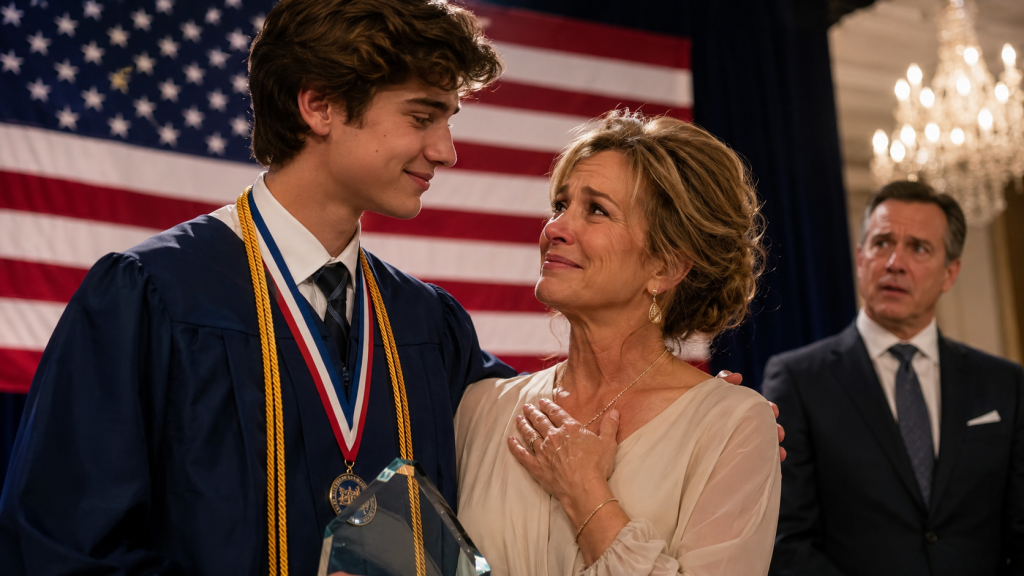
Ethan walked onto the stage wearing a simple graduation gown from his school’s honors program because the summit had asked all youth fellows to wear academic dress.
He looked small under the lights.
Then he reached the podium.
And somehow, he became the biggest person in the room.
He adjusted the microphone.
His hands shook once.
Then steadied.
“Good afternoon,” he said. “My project began with a question I asked when I was eight. Could something built from scraps still help someone hold on?”
The room quieted.
He demonstrated the device.
A lightweight robotic assistive hand built with low-cost materials, open-source software, and adjustable grip sensors.
He spoke clearly.
Confidently.
Not like a child trying to impress adults.
Like a young man inviting them to understand.
He showed videos of elderly patients using early prototypes. He explained cost barriers in prosthetic and adaptive technology. He thanked his science teacher, Mrs. Alvarez, the university lab that let him borrow equipment, and me.
Then he paused.
I knew before he spoke that something had shifted.
He looked into the audience.
His eyes found Richard.
“I also want to thank the man who said a child born to an old woman would never amount to anything.”
The room went silent.
My breath stopped.
Richard’s face emptied.
Ethan continued, voice steady.
“Dad, this presentation is for you.”
A murmur moved through the ballroom.
Richard sat frozen.
Cameras turned.
Ethan looked back at the audience.
“My mother was forty-one when I was born. She worked nights, weekends, and holidays so I could build things. When people called me unlikely, she called me possible. When someone treated me like a mistake, she treated me like a miracle. This project is named after her.”
The screen behind him changed.
CLAIRE.
Compassionate Low-Cost Adaptive Interface for Restoring Everyday grip.
I covered my mouth.
Tears blurred everything.
Ethan went on.
“The goal of CLAIRE is simple. To help people who have been told they are too old, too weak, too poor, or too late to still hold what matters.”
The applause began before he finished.
Then grew.
Then became thunder.
People stood.
Not all at once.
But enough.
Then everyone.
Everyone except Richard.
He sat there, white-faced, while the foundation bearing his name celebrated the son he had abandoned.
Within minutes, reporters began connecting the story.
Ethan Alden.
Richard Alden.
Same surname.
Same foundation.
A question was asked during the panel.
“Ethan, is Richard Alden your father?”
The moderator looked panicked.
Ethan glanced at me.
I gave the smallest nod.
Truth did not need my permission, but my son still asked for it.
“Yes,” he said calmly. “Biologically.”
The word landed like glass shattering.
A reporter asked Richard afterward whether he had supported Ethan’s development.
Richard smiled badly.
“Of course, I’ve always believed in talented young people.”
That was when Ethan did something I did not expect.
He opened his folder.
“I brought copies of the court record for my scholarship verification. It includes payment history and correspondence.”
Richard’s smile died.
The first article went online before we left the hotel.
Foundation Chair’s Abandoned Son Wins Top Youth Innovation Award.
Then another.
Teen Scientist Honors Mother After Father Claimed He Would Never Amount to Anything.
Then the memo lines appeared.
Charity case.
Old lady’s retirement baby.
Mistake money.
I had never released them.
Ethan had.
Not from revenge.
From accuracy.
By morning, Richard’s foundation board issued a statement saying they were reviewing leadership conduct.
By evening, two major donors withdrew pending investigation.
By the end of the week, Richard stepped down “to focus on family healing.”
That phrase made Ethan laugh.
“Family healing?”
He was sitting at our kitchen table with cereal and a national science medal beside the salt shaker.
“That man couldn’t heal a paper cut.”
I laughed so hard I cried.
Richard called three days later.
I almost did not answer.
But Ethan said, “It’s okay.”
So I put it on speaker.
“Claire,” Richard said, his voice rough. “I need to speak to my son.”
Ethan looked at the phone.
“You’re speaking to him.”
Silence.
Then Richard said, “I’m proud of you.”
Ethan did not blink.
“No, you’re embarrassed by me. There’s a difference.”
“Ethan, I was young and confused when you were born.”
I almost laughed.
“You were forty-three,” Ethan said.
Richard exhaled.
“I made mistakes.”
“You made choices.”
Another silence.
“I want to make things right.”
Ethan looked at me.
His eyes were not angry.
That hurt more somehow.
“You can start by apologizing to my mother.”
Richard was quiet too long.
Then he said, “Claire, I’m sorry.”
I listened to the apology I had once imagined needing.
It was smaller than I expected.
Too late.
Too thin.
Too careful.
I said, “Thank you.”
That was all.
Because forgiveness and access are not the same thing.
Ethan did not invite him into our life that day.
Or the next.
Or the next year.
He accepted a full scholarship.
His CLAIRE project became a nonprofit initiative with university support.
Mrs. Alvarez received the first finished device and cried into Ethan’s shoulder.
I framed the newspaper article, but not the one about Richard’s downfall.
I framed the one with Ethan’s photo beside his invention.
The headline read:
Teen Innovator Builds Device Inspired by Mother’s Sacrifice.
That was the story that mattered.
Not the man who left.
The boy who rose.
Years later, people asked whether I felt satisfied seeing Richard lose his reputation.
The honest answer is complicated.
There was satisfaction, yes.
I would be lying if I said otherwise.
But the deeper feeling was relief.
Relief that my son had not believed him.
Relief that cruelty had not become Ethan’s inheritance.
Relief that the child Richard dismissed had grown into someone who used pain as material, not poison.
One evening, after Ethan left for college, I found the blue baby blanket in a storage box.
My mother’s stitches were loose at the edges.
The fabric had faded.
I held it to my chest and remembered the woman I had been at forty-one.
Feverish.
Abandoned.
Bleeding through bandages.
Terrified.
A newborn crying beside me.
A husband laughing with a teenager in a restaurant.
I wanted to go back and sit beside that woman.
I wanted to tell her she would survive.
That the baby in her arms would one day stand on a stage and speak clearly enough for the whole world to hear.
That the insult meant to bury him would become the opening line of his victory.
That Richard was wrong.
About Ethan.
About me.
About what age means.
About what women can endure.
About what children born from long prayers can become.
My husband abandoned me at forty-one, just weeks after I gave birth to the son we had spent sixteen years trying to have.
He left me for an eighteen-year-old girl and laughed that a child born to an old woman would never amount to anything.
Fifteen years later, that same child walked onto a stage in a graduation gown and thanked him.
Not for love.
Not for support.
But for becoming proof that the people who underestimate you do not get the final word.
Richard lost his foundation.
He lost his applause.
He lost the story he had built around being a man who believed in young people.
But Ethan gained something better.
His own voice.
And when my son looked into that microphone and said, “Dad, this presentation is for you,” I finally understood that revenge does not always roar.
Sometimes it stands under bright lights, adjusts a microphone, and tells the truth calmly.
Sometimes it wears a graduation gown.
Sometimes it is only fifteen years old.
And sometimes it has your eyes.
THE END! THANKS FOR READING!