My twenty-two-year-old daughter brought her boyfriend over for dinner, and I welcomed him with a smile. But when he dropped his fork for the third time, I saw something under the table and dialed 911 without anyone hearing me. My daughter was pale.
He wasn’t blinking. And his shoe was stepping on her foot like a threat. My name is Mary Davis, and that night I made pot roast, mashed potatoes, green beans, and sweet tea because Danielle was finally going to introduce me to the man who, according to her, had “saved her life.” “His name is Evan, Mom,” she told me over the phone three days earlier. “Please don’t judge him, okay?”
I remember standing in the grocery store aisle with a bag of potatoes in my hand, listening to the careful way she said it.
Please don’t judge him.
Not, “You’re going to love him.”
Not, “I’m excited for you to meet him.”
Not even, “He’s good to me.”
Just please don’t judge him.
A mother hears the words her child does not say.
I tried to keep my voice light.
“Sweetheart, I don’t plan to judge him. I plan to listen to him.”
There was silence on the other end.
Then Danielle said, “He can be intense.”
“Intense how?”
“He just cares a lot.”
I closed my eyes.
I had heard women say that before.
He cares a lot.
He gets jealous because he loves me.
He tells me what to wear because he worries.
He checks my phone because he has trust issues.
It always sounded like love until it started sounding like permission.
But I did not say any of that.
If I pushed too hard, she would defend him.
So I only said, “Bring him Friday. I’ll cook.”
Danielle had always been my bright girl.
The kind of child who sang in the bathtub and rescued worms after rainstorms.
At sixteen, she wanted to become a teacher.
At eighteen, she left for college with two suitcases and a stack of sticky notes I had hidden in her clothes.
At twenty-two, she had stopped calling as much.
When she did call, her voice was softer.
Smaller.
She used to talk fast when she was excited.
Now she paused before answering simple questions, as if someone had trained her to check every word before letting it leave her mouth.
When I asked if she was happy, she always said, “I’m fine.”
Fine is a dangerous word when it comes from your child.
Friday night came warm and still.
I set the table with my good plates, the ones with the blue flowers around the edges. I polished the silverware even though no one cared about silverware except me. I lit the porch lamp. I put fresh flowers in the little glass vase Danielle made in high school ceramics class.
At eight exactly, headlights swept across my front windows.
I looked through the curtain and saw Danielle step out of the passenger side.
She was wearing a beige dress I had never seen before.
It looked expensive.
Too mature for her.
Her lipstick was perfect, but her smile was not.
That fake smile only a mother recognizes.
The kind of smile a daughter wears when she wants you to believe she is okay so badly that you almost pretend to.
He got out behind her.
Evan.
Tall.
Handsome.
White shirt.
Dark trousers.
Flowers in hand.
Every movement neat and practiced.
Too proper.
He walked up my porch like he owned every space his feet touched.
“Mrs. Davis,” he said when I opened the door. “A pleasure to meet you.”
His voice was smooth.
He leaned in and gave me a polite hug.
He smelled like expensive cologne and something else.
Control.
I smiled back.
“Call me Mary.”
His eyes flicked over my shoulder, toward my house, then returned to my face.
“Mary,” he repeated, like he was testing how it felt to use my name.
Danielle stood beside him, hands clasped in front of her.
I hugged her.
She stiffened first.
Then melted into me for half a second.
Only half.
Before Evan touched her lower back and she stepped away.
That small movement told me more than his introduction did.
At the table, Evan spoke well.
Too well.
He told me he owned several businesses in Dallas, though he never said exactly what kind. He talked about investments, property, discipline, and how young people today lacked structure.
Danielle sat beside him, barely eating.
“Danielle said you went to college together?” I asked.
Evan smiled.
“Not exactly. We met through mutual friends.”
Danielle opened her mouth.
He spoke over her.
“She was in a difficult place then. Very lost. I helped her focus.”
I looked at my daughter.
Her eyes stayed on her plate.
“Lost how?” I asked.
Evan cut his roast slowly.
“Mary, you know how young women can be. Emotional. Easily influenced. Danielle needed direction.”
I did not like that word.
Direction.
As if my daughter were a lost dog.
As if she needed a hand at her collar.
Danielle’s fork paused halfway to her mouth.
I saw her knuckles whiten around it.
“Danielle,” I said gently, “how is work?”
Evan answered.
“She prefers not to discuss work tonight.”
I looked at him.
“I asked Danielle.”
His smile did not move.
“And I answered because she’s tired.”
Danielle whispered, “It’s okay, Mom.”
But it was not okay.
I knew my daughter’s voice.
This was not her voice.
This was fear shaped like a word.
I tried again.
“Do you still see Megan from college?”
Danielle’s face changed.
Just slightly.
Enough.
Before she could speak, Evan placed his hand over hers.
“Danielle doesn’t spend time with those people anymore. Some friendships aren’t healthy.”
Those people.
I wanted to push.
I wanted to ask why my daughter had changed her phone number, why her old friends stopped tagging her in photos, why she had missed Christmas lunch and blamed car trouble, why every conversation ended when I asked too much.
But Evan’s gaze stayed fixed on me.
Calm.
Cold.
Watching.
So I played the role he expected.
A polite mother.
A harmless woman.
I smiled and said, “More potatoes?”
Dinner continued.
Evan complimented the food.
He asked about my late husband, Robert.
He said all the right things.
“I admire women who keep a home together.”
“I believe family values matter.”
“Danielle speaks highly of you.”
That last one made Danielle flinch.
Because I could tell she had not been allowed to speak freely about me at all.
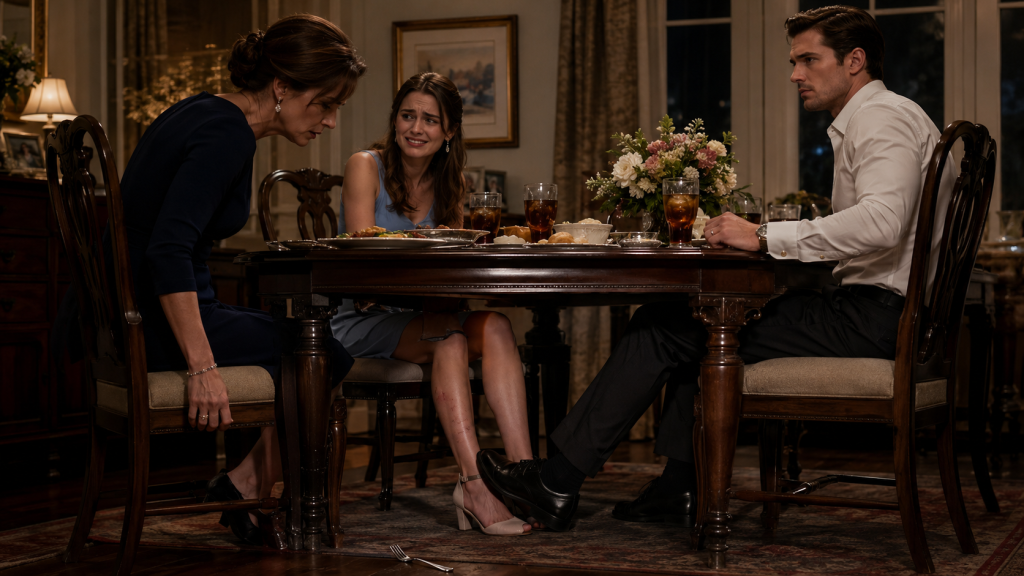
Then the first fork dropped.
Clink.
It hit the floor beneath the table.
“How clumsy of me,” Evan said, smiling.
He bent down to pick it up.
When he sat back up, he looked directly at me.
Not at Danielle.
At me.
His smile widened just enough to feel like a warning.
I picked up my sweet tea and took a slow sip.
A few minutes later, the fork fell again.
Clink.
This time, I heard Danielle’s breath catch.
Evan bent down, and his hand brushed near my daughter’s ankle.
She jerked so slightly that someone else might have missed it.
I did not.
“Everything okay, sweetie?” I asked.
Danielle’s eyes lifted to mine.
For one second, I saw my daughter.
The real one.
Terrified.
Then she blinked and was gone.
“Yes, Mom.”
Evan sat back up.
“She’s fine.”
I wanted to throw the mashed potatoes at his face.
Instead, I laughed softly.
“My goodness, Evan, maybe I should get you a spoon.”
He laughed too.
Danielle did not.
The third time, the fork fell farther away.
Almost near my chair.
Clink.
Evan moved to bend down, but I was faster.
“Oh, let me get that,” I said.
I leaned under the table.
And that was when I saw it.
Evan’s right shoe was planted firmly on top of Danielle’s foot, pinning it against the hardwood floor.
Not accidentally.
Not lightly.
Crushing.
Her toes curled inside her sandal.
My blood went cold.
Then I saw her calf.
Old bruises.
Yellowing at the edges.
A poorly hidden bandage.
And just beneath the hem of her dress, taped to the inside of her leg, a small folded piece of paper.
Danielle had placed it there so only someone under the table could see it.
So only I could see it.
My hand shook as I reached toward it.
Evan bent down too.
“I’ll get it, ma’am.”
His face appeared across from mine beneath the table, smiling.
But his eyes were not smiling.
His eyes ordered me to let it go.
I did not let go.
I grabbed the fork with one hand.
With the other, I pinched the paper between two fingers and ripped it free.
Danielle trembled.
Evan’s smile vanished for a fraction of a second.
Then we both stood.
I held the fork openly.
The paper was hidden in my fist.
“Found it,” I said, placing the fork beside his plate.
Danielle looked at my hand.
She knew.
Evan looked at my hand too.
Maybe he suspected.
Maybe he was not sure.
“I’m going to get more napkins,” I said.
I walked to the kitchen without running.
Because if I ran, he would know.
Because if Danielle cried, he would punish her.
Because my house, my safe little house with blue flower plates and lemon dish soap, suddenly felt like a cage.
At the sink, I opened the paper.
It was written in black eyeliner.
Six words.
Mom, don’t argue. He’s armed.
For a moment, the kitchen tilted.
I gripped the counter to stay upright.
Armed.
My daughter was sitting six feet away from me with a man who had bruised her, threatened her, controlled her voice, and brought a gun into my home.
From the dining room, Evan called, “Everything okay, Mom?”
Mom.
Not Mary.
Mom.
As if he had already decided where he belonged.
As if he had already imagined replacing me, controlling me, swallowing my daughter’s whole life one room at a time.
I opened the drawer where I kept recipe cards, rubber bands, and old receipts.
My cell phone was inside.
I had put it there earlier because Evan had made a comment about phones at dinner.
“People are so addicted now,” he had said. “I prefer real conversation.”
I had smiled and placed mine in the kitchen.
But I had not turned it off.
My hands were steady when I dialed 911.
I did not speak at first.
I placed the phone behind a glass near the sink, turned on the faucet, and let water rush loud enough to cover my breathing.
The operator answered.
“911, what is your emergency?”
I lowered my mouth near the counter and whispered, “Private residence. My daughter is in danger. There is an armed man in my house.”
The operator’s voice changed immediately.
“Ma’am, are you safe?”
“No. He is in the dining room. My daughter is with him. He has a gun.”
“What is your address?”
I gave it in a whisper.
In the dining room, a chair scraped.
“Mary,” Evan called.
Closer now.
“Who are you talking to?”
I hung up.
Not because I wanted to.
Because if he saw the call, he might hurt Danielle before help arrived.
I shoved the phone into my apron pocket and turned around.
Evan was standing in the kitchen doorway.
He was no longer smiling.
Danielle stood behind him, crying silently.
Her hands were empty.
Her face was pale.
Her eyes begged me not to make him angry.
Evan tilted his head.
“How curious,” he said. “Danielle told me you were an obedient woman.”
I almost laughed.
Obedient.
He did not know me at all.
I had buried a husband.
Worked two jobs.
Raised a daughter alone.
Stared down debt collectors, doctors, storms, grief, and nights so lonely they could swallow a person whole.
I had been many things in my life.
Obedient was not one of them.
Still, I kept my face soft.
“I was talking to myself,” I said. “Old habit.”
His eyes dropped to my apron pocket.
“What’s in there?”
“Napkins.”
“Show me.”
Danielle made a small sound.
Evan turned slightly toward her.
“Quiet.”
That one word had so much ownership in it that my hands curled into fists.
I slowly pulled out two folded napkins from the other pocket of my apron.
“See?”
His gaze stayed on me.
Then he stepped closer.
“Where is the paper?”
I blinked.
“What paper?”
His jaw tightened.
“The one she gave you.”
Danielle whispered, “Evan, please.”
He turned so fast she flinched.
“Did I ask you to speak?”
My daughter shrank back.
I saw red.
Not hot red.
Not wild red.
A clear, sharp red that made every detail in the kitchen stand out.
The knife block near the toaster.
The kettle on the stove.
The heavy cast-iron skillet drying beside the sink.
The side door leading to the backyard.
The porch bell wire on the wall.
And Evan’s belt.
There it was.
The black grip of a handgun tucked against his side.
I looked at it for less than a second.
He noticed anyway.
His hand moved to it.
“I was hoping we could be family,” he said.
I kept my voice low.
“Family doesn’t frighten a woman into silence.”
His face hardened.
“You don’t know what she needs.”
“I know she needs to leave.”
Danielle began crying harder.
“I’m sorry, Mom.”
I looked at her.
“No, baby,” I said. “You got the note to me. You did exactly right.”
Evan pulled out the gun.
The room became very quiet.
He pressed it against Danielle’s waist and wrapped one arm around her.
“Tell them everything is fine,” he whispered, “or your mother watches you die first.”
That was when the doorbell rang.
Once.
Twice.
No sirens.
No shouting.
Just the soft chime of my old doorbell.
The police had come carefully.
Thank God.
Evan’s eyes snapped toward the hall.
“Who is that?”
I forced my face to look confused.
“Probably Mrs. Keller. She lives next door. She borrows sugar every Friday.”
“Don’t lie to me.”
“I’m not.”
He shoved Danielle forward, keeping the gun low where it could not be seen from the door.
“You answer it. You smile. You get rid of them.”
I nodded.
“All right.”
He leaned close.
“If you try anything, I start with her.”
I walked down the hallway slowly.
Every step felt like walking across thin ice.
Behind me, I could hear Danielle’s broken breathing.
I could hear Evan’s shoes on my hardwood floor.
I could smell his cologne.
At the door, I paused.
“Smile,” he whispered.
So I smiled.
I opened the door.
Two police officers stood on my porch.
A man and a woman.
They were not rushing.
They were not shouting.
Their hands were visible but ready.
The female officer spoke first.
“Ma’am, we received a dropped call from this address.”
I saw her eyes move once.
Over my face.
Over my shoulder.
To Danielle.
To Evan.
To the place where his hand was hidden.
Evan smiled smoothly from behind me.
“Everything’s fine, officers. My future mother-in-law is a little dramatic. We were having dinner.”
The male officer looked at me.
“Is that true, ma’am?”
Evan’s arm tightened around Danielle.
I felt the room hold its breath.
I could not say no.
Not with the gun pressed into my child.
So I said the only thing I could.
“Oh yes. I’m sorry. It must have been an accident. You know how old phones are.”
The female officer did not move.
Her gaze dropped.
Danielle’s foot was visible near the hall light.
Her sandal strap had shifted.
There were bruises.
Then Danielle, my brave girl, did the smallest thing.
She lifted her heel.
Just enough.
The officer saw the torn tape mark on her calf.
Then she saw Danielle’s face.
The officer’s expression changed.
Not much.
Just enough for me to know she understood.
“Sir,” the male officer said calmly, “we need you to step away from her.”
Evan laughed.
“From my girlfriend?”
“Step away.”
His grip tightened.
I knew we had seconds.
Maybe less.
My eyes moved to the side table by the door.
The pitcher of sweet tea was still there from earlier, sweating onto a lace coaster.
Beside it sat a heavy glass.
Evan’s attention was on the officers.
Danielle’s eyes were on me.
I picked up the pitcher like I was moving it out of the way.
Then I threw the sweet tea into Evan’s face.
Not the glass.
Not something that would make the officers fire.
Just cold, sticky tea right into his eyes.
He shouted.
Danielle dropped to the floor.
The female officer surged forward and pulled her away.
The male officer rushed Evan, twisting his arm away as the gun clattered against the hall table and fell to the floor.
Everything happened so fast.
A shout.
A crash.
Danielle screaming.
Me falling back against the wall.
More officers running through the door.
Evan was forced down, cuffed, and shouting that we were all crazy.
“He’s lying!” Danielle cried. “He’s lying!”
I dropped to my knees beside her.
She crawled into my arms like she was a child again.
I held her so tightly she gasped.
Then I loosened my grip.
“I’m sorry,” I said. “I’m sorry, baby.”
She sobbed into my shoulder.
“He said he’d kill you if I left.”
“I know.”
“He said nobody would believe me.”
“I believe you.”
“He said I made him angry.”
“No,” I said fiercely. “He chose this. Not you.”
The officers found the gun on the floor.
Loaded.
They found another magazine in his jacket.
They found zip ties in his car.
They found Danielle’s phone in his pocket.
Later, I learned he had taken it before dinner and replaced it with an old broken one in her purse so she could not call for help.
He had parked down the street instead of in my driveway.
He had planned to leave with her after dinner and tell me she was “tired” if I asked too many questions.
My daughter had known she might not get another chance.
So she wrote the note in eyeliner in the bathroom before they left his apartment.
She taped it under her dress.
And she waited for me to notice.
The police questioned us separately.
Paramedics checked Danielle’s foot and bruises.
One officer stayed with me in the kitchen while another took photographs of the table, the fork, the note, and the dining room.
My pot roast sat cold on the plates.
The mashed potatoes had hardened.
The flowers Evan brought lay knocked sideways near the front door.
I wanted to throw them in the trash.
Instead, the officer bagged them as evidence because there was a small tracking device tucked inside the wrapping.
When he told me that, I had to sit down.
Danielle had not just been dating a controlling man.
She had been trapped.
Over the next few days, more truth came out.
Evan had isolated her from friends.
He had convinced her to quit her job.
He had access to her email.
He had cameras inside his apartment.
He monitored her spending, her clothing, her sleep.
He made her ask permission to call me.
And every time she tried to leave, he threatened someone she loved.
Mostly me.
That is the part Danielle cried about the hardest.
Not the bruises.
Not the threats against herself.
Me.
“He said he knew your address,” she whispered from the hospital bed where they checked her injuries. “He said if I left, he’d come here first.”
I took her hand carefully.
“Listen to me. What he did is not your shame.”
She shook her head.
“I should have told you sooner.”
“You told me when you could.”
“I was so scared.”
“And you were so brave.”
She cried then, but differently.
Not silently.
Not the way she cried behind Evan.
She cried loudly, messily, like a woman whose body finally understood she did not have to keep danger quiet anymore.
I slept in a chair beside her that night.
Every time she stirred, my eyes opened.
Every time footsteps passed the hallway, my heart jumped.
But Evan was in custody.
A protective order was issued.
His businesses, it turned out, were mostly lies.
His money came from his family.
His “partners” told police they had noticed his temper but “never thought he’d go that far.”
People always say that.
Never thought he’d go that far.
As if cruelty begins at the final act.
It does not.
It begins when he answers questions for her.
When he decides what she eats.
When he removes her friends.
When he calls control love.
When everyone around him mistakes politeness for character.
Danielle stayed with me after that.
At first, she jumped whenever the doorbell rang.
She slept with the hallway light on.
She apologized for everything.
For leaving a cup on the counter.
For taking too long in the shower.
For crying.
Every apology broke my heart because I heard his voice behind them.
I did not tell her to get over it.
I did not tell her she was safe now and expect fear to disappear.
Fear does not vanish because a bad man is handcuffed.
It leaves slowly.
Room by room.
Breath by breath.
We changed the locks.
Installed cameras.
Got new phone numbers.
Blocked old accounts.
Went to counseling.
Some days, Danielle laughed while making coffee, and I saw my girl again.
Some nights, I found her sitting on the kitchen floor at two in the morning, shaking because she had dreamed Evan was at the window.
I sat beside her every time.
No speeches.
No judgment.
Just presence.
One morning, about three months later, Danielle came downstairs wearing jeans and an old college sweatshirt.
Her hair was in a messy bun.
No makeup.
No careful smile.
She stood in the kitchen doorway and said, “I want pancakes.”
I turned from the stove.
She looked embarrassed.
“What?”
I smiled.
“Nothing. I’m just glad you want something.”
She laughed.
A real laugh.
The kind I had not heard in over a year.
We made pancakes together.
She burned the first one.
I burned the second because I was watching her instead of the pan.
For the first time, the house felt like ours again.
At Evan’s trial, I had to testify.
So did Danielle.
She wore a blue dress, not beige.
She chose it herself.
Before we entered the courtroom, she held my hand.
“I’m scared,” she said.
“I know.”
“What if I freeze?”
“Then you breathe. And if all you can do is tell one piece of the truth, that is enough.”
She nodded.
When she took the stand, Evan would not look at her.
But she looked at him.
Not for long.
Just long enough.
Then she told the truth.
About the foot under the table.
The note.
The gun.
The threats.
The phone.
The tracking device.
The isolation.
The months of fear.
Her voice shook, but it did not break.
When the prosecutor showed the note, my chest tightened.
Mom, don’t argue. He’s armed.
Six words that saved her life.
Maybe mine too.
Evan’s lawyer tried to make Danielle sound confused.
Tried to make her sound dramatic.
Tried to suggest the bruises came from clumsiness.
Danielle sat straight and said, “No. He hurt me.”
Three simple words.
No apology attached.
That was when I knew she was healing.
Evan was convicted.
I will not pretend that fixed everything.
Court did not erase her nightmares.
A sentence did not give her back the months he stole.
Justice is not magic.
But it is a door closing.
And for Danielle, that door needed to close loudly.
A year later, she moved into a small apartment ten minutes from my house.
The first night, I helped her unpack dishes.
She put the blue flower plates I had given her in the cabinet, then stood back and looked around.
“I’m scared to live alone,” she admitted.
“That’s normal.”
“But I want to.”
“That’s also normal.”
She smiled.
“I bought my own curtains.”
I looked at the yellow fabric in her hands and cried.
She laughed at me.
“Mom, they’re just curtains.”
“No,” I said. “They’re not.”
They were choice.
They were freedom.
They were proof that nobody stood over her deciding what she could like.
Now, every Friday, Danielle comes over for dinner.
Sometimes I make pot roast.
At first, she could not eat it.
Too many memories.
So we made spaghetti.
Then tacos.
Then soup.
One Friday, she walked in carrying a bag of potatoes.
“I think I’m ready for pot roast again,” she said.
I did not make a big moment out of it.
I just nodded.
“Then we’ll make pot roast.”
That night, she set the table.
She placed the forks carefully beside the plates.
Then she looked at me.
We both froze.
The memory passed between us.
Clink.
A fork hitting the floor.
A foot on hers.
A note hidden under a dress.
A phone call whispered through running water.
Then Danielle picked up one fork and dropped it deliberately onto the table.
Not the floor.
The table.
We both laughed.
Then she cried.
Then I did too.
Healing is strange like that.
It can sound like laughter and grief at the same time.
People ask me sometimes how I knew something was wrong.
I tell them the truth.
I did not know everything.
I did not know about the gun until the note.
I did not know about the tracking device.
I did not know how long she had been afraid.
But I knew my daughter.
I knew the difference between silence and peace.
I knew the difference between politeness and control.
I knew the difference between a boyfriend answering for her and a man stealing her voice.
And when that fork dropped for the third time, I knew enough to look.
That is what mothers do.
We look.
Under tables.
Behind smiles.
Between words.
Into the places our children try to hide their fear so we will not be hurt by it.
Evan thought my daughter was alone.
He thought my smile meant weakness.
He thought age made me harmless.
He thought a gun gave him power.
He was wrong.
My daughter had enough courage to write six words.
I had enough sense to read them.
And the police had enough patience to ring the doorbell instead of breaking it down.
That night, Evan walked into my house believing he controlled the room.
But he forgot something.
Before he ever knew her name, I had held Danielle through fevers, nightmares, heartbreak, and storms.
I knew her breathing.
I knew her eyes.
I knew the sound of her fear even when she called it fine.
He stepped on her foot to silence her.
But he could not stop her from reaching me.
And he could not stop me from hearing what my daughter never had to say out loud.
THE END! THANKS FOR READING!