 Reading Time: 25 minutes
I clipped the badge onto my dress. Nathan’s smirk disappeared. His eyes dropped to the white lettering beneath the state seal.
DR. MARA ELLIS
STATE ACADEMIC INTEGRITY BOARD
FINAL ROUND COMPLIANCE CHAIR
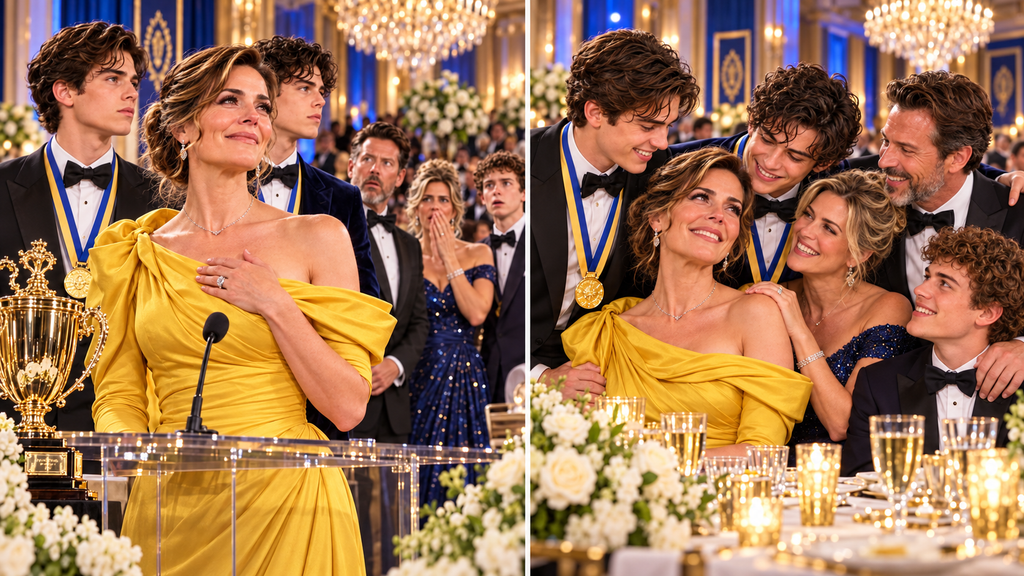
For several seconds, nobody spoke.
The convention center lobby was still crowded with hundreds of students, parents, teachers, judges, volunteers, and reporters.
But somehow the small circle around us had gone silent.
Celeste was the first to recover.
She gave a little laugh.
Not a real laugh.
The kind people use when something has suddenly stopped being funny, but they are not ready to admit it.
“Well,” she said, adjusting the strap of her designer handbag, “I suppose congratulations are in order.”
Nathan stared at my badge.
Then at me.
Then back at the badge.
“You’re on the board?”
“I am.”
His jaw tightened.
“Since when?”
“Long enough.”
“Mara—”
A voice interrupted him.
“Dr. Ellis?”
I turned.
A gray-haired man in a charcoal suit was approaching us quickly.
Professor Samuel Bennett.
Chairman of the State Academic Council.
He extended his hand.
“There you are. We’ve been looking everywhere for you.”
I shook it.
“Good morning, Samuel.”
“We’ve had a minor issue with the final-round scoring terminals. Nothing serious, but the technical committee needs your authorization before we reopen the system.”
“I’ll be there in five minutes.”
“Perfect.”
He glanced toward Nathan.
Recognition lit his face.
“Mr. Crowe.”
Nathan immediately straightened.
“Professor Bennett.”
“I’ve heard quite a lot about your son.”
Nathan’s confidence returned almost instantly.
“Preston has worked very hard.”
“So I understand.”
Nathan rested a hand proudly on Preston’s shoulder.
“He’s hoping to bring home the championship.”
Professor Bennett smiled politely.
“Then he’ll have some extraordinary competition.”
His eyes moved past Nathan.
Toward Eli and Ethan.
Something changed in his expression.
His smile widened.
“Gentlemen.”
Both boys nodded.
“Professor.”
Nathan looked between them.
For the first time, genuine curiosity appeared on his face.
“You know them?”
Professor Bennett chuckled.
“Know them?”
Eli immediately spoke.
“We should probably get registered, Professor.”
Bennett paused.
He looked at Eli.
Then at me.
I gave him the smallest nod.
He understood.
“Of course,” he said.
Then he turned back toward Nathan.
“Good luck today, Mr. Crowe.”
He walked away.
Nathan watched him go.
Then looked at my sons again.
Something was bothering him now.
I could see it.
But he couldn’t identify what.
Not yet.
“Who are they?” Celeste asked.
I looked at her.
“Competitors.”
“In what category?”
Ethan answered calmly.
“Several.”
Nathan studied his face.
Ethan looked directly back at him.
For one strange second, father and son stared at each other.
And I wondered whether blood could recognize blood even when memory refused to.
Apparently not.
Nathan’s expression remained blank.
Then Preston spoke for the first time.
“You’re Ellis?”
Ethan turned toward him.
“Yes.”
Preston’s face changed.
Not dramatically.
Just enough.
His eyes sharpened.
“Ethan Ellis?”
“Yes.”
“And you’re Eli?”
Eli nodded.
Preston looked from one twin to the other.
I saw recognition immediately.
Not familial recognition.
Competitive recognition.
He knew their names.
Nathan noticed.
“You’ve heard of them?”
Preston hesitated.
“They compete.”
Nathan laughed.
“So does everyone here.”
Preston didn’t laugh.
“They’re ranked.”
Nathan looked mildly interested.
“How highly?”
Preston glanced at his father.
Then at the twins.
“Very.”
Celeste smiled dismissively.
“Well, rankings are rankings. Finals are finals.”
Eli smiled.
“Exactly.”
There was no arrogance in his voice.
That made it sharper.
Nathan looked at me again.
“So you brought students?”
I stared at him.
For a moment, I almost couldn’t believe it.
He still didn’t see it.
He had stood beside their hospital bassinets.
He had once carried Eli on his shoulders through a pumpkin patch.
He had taught Ethan how to say the word “truck.”
He had held both boys on the night they turned two while I brought out a birthday cake with blue frosting.
And now he was standing three feet away from them asking whether they were my students.
“No,” I said.
“They came with me.”
His forehead creased.
Before he could ask another question, the overhead speakers crackled.
“Finalists and families, please proceed to the Grand Whitmore Auditorium. Opening ceremonies begin in fifteen minutes.”
Eli touched my arm.
“We should go.”
“Yes.”
We walked away.
This time, I could feel Nathan watching us.
I didn’t turn around.
But Ethan did.
Only once.
Later, he told me Nathan was still staring.
Not because he had recognized his sons.
Because for the first time that morning, Nathan Crowe had realized there was something important everyone else seemed to know.
And he didn’t.
That frightened him.
It should have.
Because the championship hadn’t even started.
And by the time it ended, Nathan was going to learn exactly what thirteen years of absence had cost him.
Not financially.
Something far worse.
He was going to discover the men his sons had become without him.
And he was going to discover it in front of everyone.
The Grand Whitmore Auditorium held nearly two thousand people.
By nine o’clock, almost every seat was occupied.
Banners representing schools from across the state hung from the balconies.
Television cameras were positioned along the side aisles.
The competition had grown dramatically over the previous decade.
What had once been a small academic tournament had become one of the most prestigious high-school competitions in the region.
Students competed in mathematics, science, engineering, logic, debate, computer science, history, and interdisciplinary problem solving.
The final championship combined all categories.
That was the part everyone cared about.
And Preston Crowe had been advertised for months as one of the favorites.
His photograph had appeared in newspapers.
Nathan had made certain of that.
There had been interviews.
Articles.
A local television segment titled:
THE MAKING OF A PRODIGY.
I had watched three minutes of it before turning it off.
Not because Preston had done anything wrong.
He hadn’t.
He was clearly talented.
What hurt was hearing Nathan talk about fatherhood.
“I believe gifted children need parents who recognize their potential early,” he had told the interviewer.
I remembered sitting alone at my kitchen table after hearing that sentence.
Eli had been asleep upstairs.
Ethan was studying calculus.
And I had stared at Nathan’s face on my laptop and wondered how a person could rewrite his own life so completely that eventually even he believed the lie.
Now Nathan sat six rows from the stage.
Celeste beside him.
Preston with the finalists.
I stood near the judges’ entrance reviewing compliance documents.
Eli and Ethan had already joined their team.
Their school was small.
Riverside Academy.
A public magnet school with outdated science labs, excellent teachers, and absolutely none of the prestige of Preston’s private academy.
That had never bothered the twins.
They liked being underestimated.
Especially Ethan.
At 9:07, the opening ceremony began.
Professor Bennett walked onto the stage.
Applause rolled through the auditorium.
He welcomed the schools.
Thanked the sponsors.
Introduced the judges.
Then he began announcing special distinctions.
“Before competition begins, I would like to recognize several students whose qualifying performances this year were particularly exceptional.”
I looked toward my sons.
Eli stared straight ahead.
Ethan looked like he wanted to disappear.
That made me smile.
He could solve a university-level mathematics problem in minutes.
But make him stand while people applauded and he became painfully shy.
Professor Bennett continued.
“This year, for the first time in championship history, two students from the same household achieved perfect regional qualifying scores.”
Murmurs moved through the audience.
Nathan leaned forward.
I watched him from the side of the auditorium.
Professor Bennett smiled.
“Eli Ellis and Ethan Ellis, Riverside Academy.”
The auditorium erupted.
My sons stood.
And Nathan’s face changed.
Slowly.
He looked at Eli.
Then Ethan.
Then me.
Then back at them.
I saw the question forming.
Ellis.
My surname.
Their surname.
Their ages.
Sixteen.
Twins.
His face went pale.
Celeste whispered something to him.
Nathan didn’t answer.
He couldn’t stop staring.
Eli sat down.
Ethan followed.
Nathan remained motionless.
The truth had finally reached the door.
But he still hadn’t opened it.
Not completely.
The first round was mathematics.
Twenty finalists.
Ten questions.
Increasing difficulty.
No calculators.
The first four questions disappeared quickly.
Preston answered two.
A girl named Amira Shah answered one.
Eli answered another.
The fifth problem appeared on the giant screen.
Silence fell.
I couldn’t participate in judging because of my relationship to two contestants.
That had been disclosed months earlier.
Instead, my role was procedural oversight.
So I stood near the technical desk watching.
The problem remained unanswered for nearly forty seconds.
Then Preston buzzed.
“Twenty-seven.”
A red light flashed.
Incorrect.
Nathan shifted in his seat.
Ten seconds passed.
Ethan buzzed.
“Thirty-two.”
Green.
Correct.
Applause.
Nathan didn’t clap.
The sixth question went to Preston.
The seventh to Amira.
The eighth to Eli.
Then came question nine.
It was difficult enough that several students immediately began covering pages with equations.
Ethan didn’t write.
He stared at the screen.
Five seconds.
Ten.
Fifteen.
Then he pressed his buzzer.
“Negative four.”
Professor Bennett looked toward the verification panel.
Green.
Correct.
The crowd reacted loudly.
Even several judges exchanged impressed looks.
Nathan leaned toward Celeste.
I couldn’t hear what he said.
But she looked toward me.
Then toward the twins.
Her face had lost some of its color.
The tenth question appeared.
Preston solved it.
The first round ended.
Scores appeared.
ETHAN ELLIS — 30
PRESTON CROWE — 25
AMIRA SHAH — 20
ELI ELLIS — 20
Nathan applauded when Preston’s name appeared.
Too loudly.
As if volume could change the scoreboard.
The science round followed.
Then engineering.
Then logic.
By lunch, the overall standings were displayed in the main lobby.
- ETHAN ELLIS
- PRESTON CROWE
- ELI ELLIS
- AMIRA SHAH
I was reviewing paperwork when Nathan approached me.
Alone.
He stopped six feet away.
“Mara.”
I continued reading.
“Mara.”
I looked up.
“Yes?”
“Who are they?”
There it was.
I closed the folder.
“Who?”
“Don’t do that.”
“Do what?”
“You know exactly what I’m asking.”
His voice had dropped.
“They’re sixteen.”
“Yes.”
“Twins.”
“Yes.”
“Your surname.”
“Yes.”
He stared at me.
“Are those…”
He couldn’t finish.
I waited.
Nathan swallowed.
“Are those my sons?”
My sons.
How strange those words sounded coming from him.
I studied the man standing in front of me.
For thirteen years, I had imagined this moment.
Sometimes I imagined screaming.
Sometimes crying.
Sometimes telling him every painful thing he had missed.
But standing there now, I felt strangely calm.
“Yes.”
Nathan staggered half a step backward.
Not dramatically.
Just enough that I noticed.
“No.”
I almost laughed.
Not because anything was funny.
Because denial was such an absurd response.
“You asked me a question.”
“They can’t be.”
“They are.”
“I would have recognized them.”
“No, Nathan.”
My voice softened.
“You wouldn’t.”
His mouth opened.
Closed.
Then opened again.
“Why didn’t you tell me?”
I stared at him.
For perhaps five seconds.
Maybe longer.
“Tell you what?”
“That they were here.”
“They registered under their legal names.”
“You know what I mean.”
“No. I actually don’t.”
His voice sharpened.
“You should have told me my sons were competing.”
I felt something cold move through me.
“Your sons?”
“Yes.”
I stepped closer.
“You don’t get to use that phrase because you finally discovered they’re impressive.”
His face tightened.
“Mara—”
“No.”
For the first time that day, anger entered my voice.
“You signed away visitation.”
“I was pressured.”
“You stopped paying support.”
“I had financial complications.”
“You changed your phone number.”
“Celeste thought boundaries were healthier.”
“You moved four states away.”
“My career—”
“You sent birthday cards back unopened.”
That stopped him.
He looked at me.
I continued.
“When Eli was six, he drew you a picture.”
Nathan said nothing.
“He drew four stick figures standing beside a red house. Me. Him. Ethan. And you.”
My throat tightened.
“He wrote, ‘Daddy, I still remember you.’”
Nathan looked down.
“I mailed it.”
Silence.
“It came back.”
“I never saw it.”
“Maybe not.”
I nodded.
“Because the envelope had been marked RETURN TO SENDER.”
His face changed.
“I didn’t do that.”
“I don’t care who physically wrote it.”
“Mara—”
“I had to explain to a six-year-old why his father didn’t want his drawing.”
Nathan rubbed a hand across his mouth.
“I didn’t know.”
“That sentence describes thirteen years of your life.”
He looked toward the auditorium doors.
“They’re really mine?”
“No.”
His eyes snapped back to me.
“They are biologically yours.”
I pointed gently toward the competition hall.
“But those young men belong to themselves.”
He stared at me.
“You don’t get to walk into the final chapter and pretend you wrote the book.”
Then I walked away.
I expected Nathan to tell Celeste.
Apparently he did.
Because twenty minutes later, she found me.
She cornered me near the women’s restroom.
“This is deliberate.”
I stopped.
“What is?”
“You bringing them here.”
I actually smiled.
“Celeste, they qualified.”
“You knew Preston would be competing.”
“So?”
“You wanted to humiliate Nathan.”
“No.”
She crossed her arms.
“You expect me to believe this is coincidence?”
“I don’t care what you believe.”
Her eyes narrowed.
“You’ve always been vindictive.”
That almost impressed me.
“Have I?”
“You could have warned us.”
“About what?”
“That they were his children.”
I looked at her carefully.
“You knew they existed.”
“That isn’t what I meant.”
“No. What you meant was that you wanted warning that the children you helped him abandon had grown into people you might have to face.”
Her expression hardened.
“I did not make Nathan abandon anyone.”
“No?”
“He made his own decisions.”
That was true.
And I nodded.
“Yes. He did.”
She seemed surprised by my agreement.
Then I added:
“But you certainly benefited from them.”
Her lips tightened.
“You have no idea what our marriage has been like.”
“And you have no idea what raising two abandoned children was like.”
For the first time, something uncertain crossed her face.
Then she whispered:
“Preston doesn’t know.”
I looked toward the auditorium.
“About the twins?”
“About any of it.”
That surprised me.
“He thinks Nathan’s first marriage ended before you had children.”
I stared at her.
“You lied to him?”
“Nathan handled it.”
“Meaning Nathan lied.”
“He wanted to protect Preston.”
“From what?”
She didn’t answer.
I understood.
“From knowing his father abandoned two children.”
Celeste looked away.
I felt no triumph.
Only sadness.
Because suddenly Preston wasn’t Nathan’s golden child.
He was another boy Nathan had built a lie around.
“Tell him,” I said.
Celeste looked at me.
“What?”
“Tell Preston the truth.”
“This is not the time.”
“There’s never a convenient time for truth.”
“He has finals.”
“And my sons have spent thirteen years living with the consequences of yours.”
She stepped closer.
“You stay away from Preston.”
I held her gaze.
“I have no intention of hurting your son.”
“He is Nathan’s son.”
“So are Eli and Ethan.”
She flinched.
Good.
Some truths should sting.
The afternoon debate round began at two.
This was Eli’s strength.
Ethan loved numbers.
Eli loved words.
When he was nine, he convinced a school committee to change a playground rule by presenting a three-page argument complete with injury statistics.
When he was twelve, he debated his science teacher about an ethics assignment so effectively that she invited him to address the class.
And when he was fourteen, he told me:
“Mom, people think arguing means talking louder. It doesn’t. It means understanding the other person well enough to know exactly where their logic breaks.”
That was Eli.
Quiet until he wasn’t.
The semifinal debate topic appeared on screen.
“Resolved: Exceptional talent creates an obligation to society.”
I almost laughed at the irony.
Eli drew affirmative.
Preston drew negative.
They stood at opposite podiums.
Nathan sat frozen in the audience.
Preston opened strongly.
He argued that talent itself created no moral debt.
That individual freedom mattered.
That forcing obligation onto gifted individuals transformed ability into punishment.
He was excellent.
Truly excellent.
And I found myself proud of him.
Not as family.
As a young person who had clearly worked hard.
Then Eli spoke.
He didn’t attack Preston.
He acknowledged him.
That was his gift.
“My opponent is correct about one important point. Talent should not become a prison.”
He paused.
“But obligation does not mean ownership.”
The auditorium quieted.
“It means responsibility.”
He looked toward the judges.
“If you can lift something another person cannot, you are not legally required to help them.”
Pause.
“But perhaps character begins where legal requirement ends.”
I saw Nathan lower his eyes.
Eli continued.
“Intelligence, wealth, strength, influence—none of these automatically make someone good.”
His voice remained calm.
“What matters is what we choose to do with advantages other people may never receive.”
Then he said something I knew had not been written in his prepared notes.
“Being capable of helping someone does not make you their owner.”
Pause.
“But walking away simply because helping is inconvenient tells the world something about who you are.”
Nathan went completely still.
So did I.
Eli never looked at him.
Not once.
But I knew.
The judges knew only the argument.
I knew the history beneath it.
When the scores appeared, Eli won by two points.
Preston extended his hand.
Eli shook it.
“Good round,” Preston said.
“You too.”
There was no hostility.
No cruelty.
That mattered.
Because this was never supposed to become a story where one child had to be destroyed so another could shine.
Preston had done nothing wrong.
His father had.
The final championship began at four.
Five students remained.
Eli.
Ethan.
Preston.
Amira.
And a brilliant engineering student named Lucas Chen.
The final consisted of one collaborative challenge followed by individual questioning.
Then something unexpected happened.
The teams were assigned randomly.
Ethan and Preston were paired together.
Nathan nearly stood when the names appeared.
Ethan looked toward me.
I gave him a small nod.
Compete.
Nothing else mattered.
Their challenge was a structural engineering simulation.
They had forty-five minutes.
At first, Preston dominated the conversation.
Ethan listened.
Then Ethan pointed toward one equation.
“You’re calculating static load.”
“Yes.”
“The third phase introduces vibration.”
Preston stopped.
He reread the prompt.
His face changed.
“You’re right.”
They adjusted.
Ten minutes later, Ethan made an error.
Preston caught it.
“You converted the coefficient twice.”
Ethan checked.
Then smiled.
“Good catch.”
They worked beautifully together.
That may have been the cruelest irony of the entire day.
Two brothers.
One knowing.
One not.
Solving the same problem side by side.
At one point, Preston laughed at something Ethan said.
Nathan watched from the audience.
His face looked devastated.
Because perhaps for the first time, he could see the life that might have existed.
Birthdays.
Christmas mornings.
Three boys growing up together.
Arguments.
Baseball games.
Homework.
Graduations.
Ordinary things.
The things people throw away without realizing ordinary things are often the most valuable things they will ever possess.
Their team finished first.
When time expired, Preston raised his hand.
Ethan slapped it.
A quick celebratory high five.
Nathan covered his mouth.
Celeste stared straight ahead.
Then came the final individual question.
The scoreboard was almost impossibly close.
ETHAN — 94
PRESTON — 92
ELI — 91
AMIRA — 88
LUCAS — 85
One question remained.
Worth ten points.
Professor Bennett stepped forward.
“This question requires both calculation and explanation.”
The problem appeared.
I won’t pretend I understood it immediately.
It involved probability, game theory, and resource allocation.
The students had three minutes.
Pens moved.
The clock counted down.
2:12.
1:45.
1:03.
Preston stopped writing.
Eli continued.
Ethan stared at the page.
Thirty seconds.
Then Preston submitted.
Eli submitted five seconds later.
Ethan still hadn’t.
Ten seconds.
Nine.
Eight.
I held my breath.
Seven.
Six.
Ethan wrote something.
Five.
Four.
He submitted.
Time.
The judges reviewed.
Preston’s answer appeared first.
Correct numerical result.
Incomplete reasoning.
Seven points.
Nathan jumped to his feet.
“Yes!”
Celeste grabbed his arm.
Eli’s answer.
Incorrect numerical result.
Excellent reasoning.
Five points.
Eli nodded.
Then Ethan’s.
Professor Bennett stared at the screen.
The verification judge leaned toward him.
They whispered.
A third judge joined them.
Murmurs filled the auditorium.
Nathan looked around.
“What’s happening?”
Professor Bennett returned to the microphone.
“Ethan Ellis has provided an answer that differs from our official key.”
My stomach dropped.
Ethan stared straight ahead.
Professor Bennett continued.
“However…”
Silence.
“Our review panel has determined that the official key failed to account for a conditional assumption in the problem.”
The auditorium exploded in whispers.
Professor Bennett smiled.
“Mr. Ellis identified the flaw.”
Ethan blinked.
“Therefore, his solution is correct.”
Ten points.
The scoreboard changed.
ETHAN ELLIS — 104.
The auditorium erupted.
I didn’t.
Not immediately.
I just stood there.
Hands over my mouth.
Watching my son.
My little boy.
The child who once did homework beside me in a laundromat because our washing machine had broken.
The boy who used to save pencil stubs because he knew money was tight.
The child whose father had once described him as an “old mistake.”
He had just won the State Academic Championship.
Then another announcement came.
Professor Bennett raised his hand.
“Ladies and gentlemen, please remain seated.”
The room slowly quieted.
“There is an additional distinction.”
Ethan looked confused.
So did I.
Professor Bennett smiled.
“Because the final challenge correction raises his aggregate performance beyond the championship threshold, Ethan Ellis has achieved the highest composite score in the twenty-eight-year history of this competition.”
The room exploded again.
This time, I cried.
I couldn’t stop it.
Eli reached his brother first.
He wrapped both arms around him.
Ethan laughed.
Then cried.
Then laughed again.
I ran toward them.
Protocol disappeared.
Board position disappeared.
Everything disappeared.
I hugged both of my sons.
“I’m so proud of you.”
Ethan buried his face against my shoulder.
“Mom.”
“You did it.”
“We did it.”
“No.”
I pulled back.
“You did.”
Eli shook his head.
“She means all of us.”
That broke me.
I kissed his forehead.
Then Ethan’s.
Cameras flashed.
Applause continued.
And somewhere behind us, Nathan Crowe was watching the family he had abandoned celebrate without him.
But the biggest surprise hadn’t happened yet.
Professor Bennett returned to the microphone.
“One more award.”
Eli groaned.
People laughed.
Professor Bennett smiled.
“The Whitmore Foundation annually selects one finalist for its full undergraduate scholarship, based on academic performance, leadership, ethics, and community contribution.”
My heart stopped.
Neither boy knew.
Neither did I.
“The award covers tuition, housing, books, and research expenses at any accredited university in the country.”
The audience murmured.
Nathan stared toward the stage.
Professor Bennett opened an envelope.
“This year’s recipient founded a free weekend tutoring program serving more than eighty middle-school students.”
I turned toward Eli.
His eyes widened.
“He also organized a laptop refurbishment initiative that has distributed forty-three computers to low-income students.”
Ethan started grinning.
“Dude.”
Eli whispered:
“No way.”
Professor Bennett continued.
“And he maintained the second-highest debate score in championship history.”
He smiled.
“Eli Ellis.”
I screamed.
Actually screamed.
I had never made that sound in my life.
Eli covered his face.
Ethan tackled him into a hug.
The auditorium rose in a standing ovation.
My knees almost gave out.
Both of them.
One champion.
One scholarship recipient.
Two little boys whose father had decided they were inconvenient.
And they had grown anyway.
Not because abandonment made them stronger.
I hated when people romanticized suffering that way.
They became strong because people stayed.
Teachers stayed.
Friends stayed.
Coaches stayed.
Neighbors stayed.
I stayed.
And most importantly, they stayed for each other.
The ceremony ended at six.
That should have been the end.
It wasn’t.
Because Preston found Ethan backstage.
I was close enough to hear.
“Congratulations.”
Ethan turned.
“Thanks.”
“You were incredible.”
“So were you.”
Preston smiled.
Then his expression changed.
“My dad’s acting weird.”
Ethan didn’t respond.
“He keeps staring at you.”
Silence.
“And my mom has been crying.”
Ethan looked toward me.
I walked closer.
Preston noticed.
“Dr. Ellis?”
“Yes?”
“Can I ask you something?”
My stomach tightened.
“Of course.”
He looked between me and Ethan.
Then toward Eli.
“Why do they look like my dad?”
Nobody moved.
Ethan’s face went pale.
This wasn’t how I wanted Preston to learn.
I looked toward the hallway.
Nathan and Celeste were approaching.
Too late.
Preston saw their faces.
He knew.
Maybe not the details.
But enough.
He turned toward Nathan.
“Dad?”
Nathan stopped.
“Preston.”
“What’s going on?”
“Not here.”
“No.”
Preston’s voice shook.
“Tell me.”
Celeste touched his arm.
“Sweetheart—”
He pulled away.
“Who are they?”
Nathan looked at me.
I said nothing.
This truth belonged to him.
Nathan swallowed.
“They’re…”
His voice broke.
Preston waited.
“They’re my sons.”
The hallway went silent.
Preston stared at him.
Then at Eli.
Then Ethan.
His face drained.
“Your what?”
“My sons.”
Preston shook his head.
“No.”
“Preston—”
“You said you didn’t have kids before me.”
Nathan closed his eyes.
“I lied.”
Three words.
Thirteen years.
A whole family collapsing inside them.
Preston backed away.
“How old are they?”
“Sixteen.”
Preston looked sick.
“I’m fifteen.”
“Yes.”
The math happened instantly.
His face changed again.
“You were married to her when you met Mom.”
Celeste began crying.
“Preston, please.”
He looked at her.
“You knew?”
She couldn’t answer.
That was answer enough.
Preston turned back toward Nathan.
“You abandoned them?”
“It’s complicated.”
Eli spoke for the first time.
“No.”
Everyone looked at him.
His voice was calm.
“It really isn’t.”
Nathan flinched.
Eli continued.
“You left.”
“Eli—”
“Don’t.”
Nathan froze.
It was the first time he had heard his son say his name to him.
“You don’t know everything that happened.”
Eli looked at him.
“I know enough.”
Nathan’s eyes filled.
“I was young.”
“You were thirty-three.”
Silence.
“I made mistakes.”
Ethan finally spoke.
“We were three.”
Nathan looked at him.
Ethan’s voice cracked despite his effort to control it.
“We weren’t mistakes.”
Nathan’s face collapsed.
“I know.”
“No.”
Ethan shook his head.
“You know now.”
That sentence silenced everyone.
Preston wiped his eyes.
Then he asked the question Nathan feared most.
“Did you ever try to see them?”
Nathan said nothing.
Preston stared.
“Dad?”
“I…”
“Did you?”
“No.”
Preston turned away.
Nathan reached for him.
“Preston.”
“Don’t touch me.”
Celeste gasped.
Nathan froze.
Preston looked at his brothers.
Brothers.
He seemed almost frightened by the word forming inside him.
“I didn’t know.”
Eli nodded.
“We know.”
“I swear.”
“We know.”
“I would never have…”
His voice broke.
Ethan stepped forward.
“This isn’t your fault.”
Preston started crying.
And something happened I hadn’t expected.
Ethan hugged him.
At first Preston stood rigid.
Then his shoulders collapsed.
He grabbed Ethan and cried against him.
Eli joined them.
Three boys.
Three brothers.
Standing in a convention center hallway.
Holding each other while their father watched from several feet away.
Nathan began crying too.
But nobody moved toward him.
That was the consequence.
Not revenge.
Not humiliation.
Consequence.
Nathan found me in the parking garage an hour later.
The boys had gone with Professor Bennett for photographs.
I was putting folders into my car.
“Mara.”
I turned.
He looked older.
Not thirteen years older.
Thirty.
His tie was gone.
His collar open.
His eyes red.
“I need to say something.”
“You can.”
He swallowed.
“I’m sorry.”
I waited.
“I know that isn’t enough.”
“No.”
“It isn’t.”
He looked down.
“I told myself stories.”
I said nothing.
“I told myself you hated me. That you would poison them against me. That they were young enough to forget.”
His voice broke.
“And eventually I convinced myself staying away was better.”
“For whom?”
He looked at me.
“You.”
He shook his head.
“Me.”
At least that was true.
“I was a coward.”
“Yes.”
“I thought if I built another life successfully enough, the first one would disappear.”
“It didn’t.”
“No.”
He wiped his face.
“I watched them today.”
I closed the trunk.
“They’re extraordinary.”
“They are.”
“I missed everything.”
“Yes.”
His mouth trembled.
“First days of school.”
“Yes.”
“Birthdays.”
“Yes.”
“Learning to ride bicycles.”
“Yes.”
“Everything.”
I looked at him.
“Yes, Nathan.”
Tears ran down his face.
“You missed everything.”
He nodded.
Then whispered:
“Can I fix it?”
I thought carefully before answering.
“No.”
His face crumpled.
“You cannot fix thirteen years.”
I softened my voice.
“But maybe you can decide what kind of man you are for the years that come next.”
Hope flickered.
“Do you think they’ll let me?”
“That isn’t my decision.”
“Would you stop them?”
“No.”
He stared at me.
“After everything?”
“I stopped organizing my life around punishing you a long time ago.”
That hurt him more than anger would have.
I continued.
“But understand something.”
He nodded.
“If they want nothing to do with you, you accept it.”
“Yes.”
“If they want answers, you tell the truth.”
“Yes.”
“If they are angry, you don’t defend yourself.”
He nodded.
“And you never, ever make them responsible for relieving your guilt.”
Nathan closed his eyes.
“I understand.”
“No.”
I opened my car door.
“You’re beginning to.”
Three months passed.
Nathan wrote letters.
Not texts.
Not emails.
Letters.
One to Eli.
One to Ethan.
He didn’t ask for forgiveness.
I respected that.
He told them the truth.
About the affair.
About Celeste.
About signing away visitation.
About the returned letters.
Celeste admitted she had intercepted some correspondence.
Nathan admitted he had eventually stopped asking whether anything arrived.
Neither boy responded immediately.
Then Ethan did.
One sentence.
“I’m willing to meet for coffee.”
Eli waited another month.
Preston, however, began messaging both of them.
That relationship grew faster.
Maybe because there was no betrayal between the boys.
Only stolen time.
Preston came to our house one Saturday.
He stood awkwardly on the porch holding a bakery box.
“I didn’t know what people bring when meeting secret brothers.”
Ethan laughed.
“Usually a goat.”
Preston stared.
“Seriously?”
“No.”
Eli groaned.
“Please don’t encourage him.”
Preston laughed.
That afternoon, the three of them played video games for six hours.
I made pizza.
At one point, I stood in the kitchen listening to them argue about which movie to watch.
And I cried quietly into a dish towel.
Not because I was sad.
Because somewhere inside all that damage, something good had survived.
Eli accepted the Whitmore Scholarship.
Ethan received offers from six universities.
He eventually chose a school only forty minutes from Eli’s campus.
When I asked why, he shrugged.
“Someone has to make sure he eats.”
Eli threw a pillow at him.
Preston began therapy.
So did Nathan.
Celeste and Nathan separated the following spring.
Not because of me.
Not because of the competition.
Because lies eventually collect interest.
And their marriage had been built on too many.
A year after the championship, Nathan attended Ethan’s graduation.
He sat in the back row.
He did not ask for a family seat.
He did not demand photographs.
He simply came.
After the ceremony, Ethan walked toward him.
Nathan stood.
For a second, neither moved.
Then Ethan extended his hand.
Nathan looked at it.
And started crying.
He shook it.
“Congratulations.”
“Thanks.”
Nathan hesitated.
“I’m proud of you.”
Ethan looked at him for a long moment.
Then said:
“I’m proud of me too.”
I smiled.
Because that was exactly the answer he should have given.
Two years later, something happened that I never expected.
Eli called me from college.
“Mom?”
“What’s wrong?”
“Nothing.”
“You sound weird.”
“I have news.”
“What kind?”
He laughed.
“The good kind.”
He had been selected for a national public policy fellowship.
I screamed.
Again.
Apparently I had become a mother who screamed.
Then Ethan called ten minutes later.
“Did he tell you?”
“Yes.”
“He’s unbearable now.”
“I can hear you!” Eli shouted somewhere in the background.
I laughed until my stomach hurt.
Then Ethan became quiet.
“Mom?”
“Yes?”
“Do you ever wish things had happened differently?”
I knew what he meant.
Nathan.
Our family.
The years.
I sat beside my kitchen window.
Outside, rain tapped softly against the glass.
“Sometimes.”
“Me too.”
He paused.
“But then I think…”
“What?”
“If everything had been different, maybe we’d be different.”
I understood.
“But listen to me.”
“Okay.”
“You never needed suffering to become remarkable.”
Silence.
“You and Eli deserved a father who stayed.”
His breathing changed.
“You deserved birthdays without wondering why he didn’t call. You deserved someone sitting in the front row at school plays. You deserved someone teaching you to drive and embarrassing you at graduation.”
He laughed softly.
“I can embarrass myself.”
“I know.”
Then I said:
“What happened shaped you. But don’t ever thank pain for the strength you built in spite of it.”
For a moment, he didn’t speak.
Then:
“I love you, Mom.”
“I love you too.”
Five years after the championship, I returned to the Grand Whitmore Convention Center.
This time, I wasn’t working.
I was invited.
Professor Bennett was retiring.
They were honoring former champions.
I entered the auditorium and saw three young men waiting near the stage.
Eli.
Ethan.
And Preston.
All three had changed.
Eli wore a dark suit and had somehow acquired the confident posture of someone accustomed to speaking before important people.
Ethan was finishing graduate research in applied mathematics.
Preston had chosen medicine.
They saw me.
“Mom!”
I smiled.
Technically, only two of them had the right to call me that.
But Preston had started doing it jokingly.
Then less jokingly.
Celeste hated it.
I secretly loved it.
Ethan hugged me.
Eli kissed my cheek.
Preston handed me flowers.
“For surviving them.”
“Excuse me?” Ethan said.
We laughed.
Then I noticed someone sitting near the back.
Nathan.
Gray at the temples now.
Quieter.
He raised one hand.
I nodded.
That was enough.
Our story had never become a fairy tale.
Nathan didn’t magically become the father he should have been.
The twins didn’t magically forget.
Forgiveness wasn’t one dramatic conversation.
It was hundreds of small choices.
Some days they trusted him.
Some days they didn’t.
Sometimes Eli disappeared from Nathan’s life for months.
Sometimes Ethan invited him to dinner.
Nathan learned not to complain.
He learned that reconciliation happens on the injured person’s timetable.
Not the offender’s.
And slowly, imperfectly, something grew.
Not the family we should have had.
Something different.
Something honest.
Professor Bennett walked onto the stage.
“Twenty years ago,” he began, “this competition was created to celebrate intelligence.”
He smiled.
“But over time, I learned something.”
He looked toward Eli and Ethan.
“Intelligence is common compared with character.”
The audience quieted.
“Scores tell us what someone can do.”
Pause.
“Character tells us what they choose to do.”
My eyes filled.
I remembered two little boys sitting at our kitchen table.
Secondhand laptops.
Cheap pencils.
Stacks of library books.
I remembered overdue bills hidden beneath grocery coupons.
I remembered Ethan falling asleep over algebra homework.
Eli practicing speeches in front of the bathroom mirror.
I remembered crying silently after they went to bed because I didn’t know whether I could keep doing it alone.
And I remembered the morning Nathan left.
Eli standing barefoot in the hallway.
Three years old.
Holding his stuffed dinosaur.
“Daddy coming back?”
I had lied.
“Soon.”
Soon became thirteen years.
Thirteen years became a championship.
A championship became three brothers finding each other.
And somehow, life continued.
Professor Bennett called their names.
Eli Ellis.
Ethan Ellis.
Preston Crowe.
The three young men walked onto the stage together.
The audience applauded.
I looked toward Nathan.
He was crying.
Then he noticed me watching.
He mouthed two words.
“Thank you.”
I shook my head.
No.
He looked confused.
I pointed toward the stage.
Those boys had done this.
Not me.
Not him.
Them.
Nathan understood.
He nodded.
After the ceremony, we gathered outside beneath the same enormous banner that had hung there years earlier.
Ethan insisted on taking a photograph.
“Everybody together.”
Eli groaned.
“You’re thirty seconds away from becoming someone’s suburban dad.”
“I’m documenting history.”
Preston laughed.
Nathan stood several feet away.
Uncertain.
Ethan noticed.
He looked at his father.
Then toward the empty space beside him.
“You coming?”
Nathan froze.
It was such a small question.
Two words.
But I knew what they meant.
Not forgiveness.
Not erasure.
An invitation.
Nathan walked over.
Slowly.
He stood beside Ethan.
Not touching him.
Then Ethan put an arm around his shoulder.
Nathan’s face collapsed.
“Oh, God,” Preston said. “He’s crying again.”
“I am not.”
“You absolutely are.”
Eli laughed.
I stood beside them.
Someone nearby offered to take the picture.
We arranged ourselves awkwardly.
Three brothers.
One mother.
One father.
Years of damage.
Years of healing.
No perfect ending.
Just an honest one.
“Ready?”
The photographer raised the phone.
Nathan looked at me.
I looked back.
For thirteen years, I had imagined victory as Nathan suffering.
I had imagined him losing money.
Status.
Respect.
I thought revenge would feel like watching him regret leaving.
I was wrong.
Victory was never Nathan’s destruction.
Victory was Eli laughing.
Ethan thriving.
Preston discovering brothers instead of enemies.
Victory was my sons learning that another person’s abandonment did not determine their value.
Victory was standing beside the children I had once been terrified I couldn’t raise alone and realizing they had become good men.
Not perfect.
Good.
There is a difference.
The camera flashed.
And that should have been the end.
Except Ethan suddenly said:
“Wait.”
Everyone looked at him.
He stepped toward me.
“What?”
He reached into his jacket.
“Eli and I have something.”
My heart immediately started pounding.
“No.”
Eli smiled.
“Yes.”
“What did you do?”
Preston grinned.
“I helped.”
“That makes me significantly more nervous.”
They laughed.
Ethan handed me an envelope.
For one terrible second, I remembered another envelope.
The registration envelope.
The one I had held thirteen years earlier while Nathan mocked me in that lobby.
This one was different.
My name was written across the front.
MOM.
I opened it.
Inside was a document.
At first, I didn’t understand.
Then I read the heading.
THE MARA ELLIS EDUCATIONAL OPPORTUNITY FUND.
I looked up.
“What is this?”
Eli’s eyes were wet.
“A scholarship.”
“For students raised by single parents,” Ethan added.
I stared at them.
“We funded the first five years.”
“How?”
“Donations. Alumni sponsors. Some of our own money.”
Eli smiled.
“And Professor Bennett helped.”
I looked toward Bennett.
He raised his hands.
“I was sworn to secrecy.”
My vision blurred.
Ethan continued.
“Every year, it’ll help students who almost don’t get opportunities because their families can’t afford tutoring, competition fees, travel, laptops…”
His voice faded because I was already crying.
“Why?”
Eli looked at me as if the answer were obvious.
“Because someone stayed.”
That destroyed me.
I covered my face.
Ethan hugged me.
Then Eli.
Then Preston.
Eventually Nathan stepped closer.
But he stopped.
He waited.
I noticed.
So did Ethan.
Ethan extended one arm.
Nathan joined us.
And for a moment, we stood together.
Not pretending the past hadn’t happened.
Not pretending everyone had been equally innocent.
Not pretending love automatically repaired betrayal.
Just acknowledging that human beings can sometimes build something decent from ruins.
That evening, after everyone left, I remained alone outside the convention center.
The October air was cool.
Cars disappeared one by one.
Workers began taking down banners.
I sat on a stone bench.
For the first time all day, everything was quiet.
I thought about the woman I had been thirteen years earlier.
Thirty-three.
Terrified.
Angry.
Standing in a courthouse parking lot with two sleepy toddlers.
Nathan had driven away in a black sedan.
Celeste beside him.
I had buckled Eli and Ethan into their car seats.
Then I sat behind the steering wheel.
And cried.
Not elegantly.
Not quietly.
I cried until my chest hurt.
Until Eli called from the back seat:
“Mommy sad?”
I wiped my face.
“I’m okay.”
Then Ethan reached his tiny hand between the seats.
I took it.
He said:
“We go home?”
Three words.
We go home?
“Yes,” I had whispered.
“We go home.”
That became my philosophy without me realizing it.
When money was short.
We went home.
When birthdays hurt.
We went home.
When Nathan didn’t call.
We went home.
When the boys struggled.
When I struggled.
When life felt unfair.
We went home.
Home wasn’t a building.
It was the place where nobody had to earn the right to belong.
And somehow, I had built that.
Not perfectly.
But enough.
I heard footsteps behind me.
Ethan.
“You okay?”
I smiled.
“Yeah.”
He sat beside me.
For a while, neither of us spoke.
Then he said:
“Dad told me what he said to you that first day.”
“What?”
“At the championship.”
I sighed.
“Oh.”
“How dare you show your face here.”
I laughed softly.
“Yes.”
Ethan shook his head.
“Wild.”
“He was different then.”
“So were we.”
“Yes.”
He leaned back.
“Do you hate him?”
I considered the question.
“No.”
“Did you?”
“Yes.”
“For how long?”
I looked toward the darkening sky.
“Long enough.”
He nodded.
“What changed?”
“You.”
He looked confused.
“You and Eli kept growing.”
I smiled.
“And eventually I realized hatred was asking me to keep staring backward while the two best things in my life were moving forward.”
Ethan swallowed.
“So you forgave him?”
“Forgiveness is a complicated word.”
I thought for a moment.
“I stopped needing him to suffer.”
Ethan nodded slowly.
“That sounds better.”
“It felt better.”
He rested his head against my shoulder.
He was twenty-one years old.
Nearly six feet tall.
And suddenly he felt three again.
“Mom?”
“Yes?”
“Thank you for staying.”
My eyes filled.
I kissed the top of his head.
“There was nowhere else I wanted to be.”
Years earlier, Nathan Crowe looked at two sixteen-year-old boys and saw strangers.
He had no idea one would become the highest-scoring champion in state competition history.
He had no idea the other would earn a scholarship for using his gifts to help children who had fewer opportunities.
He had no idea they would eventually meet the brother who had grown up with the father they had lost.
And he certainly had no idea that one day all three boys would stand together and create opportunities for children whose lives looked like theirs once had.
But that was never the most important thing Nathan failed to recognize.
The tragedy wasn’t that he didn’t recognize two brilliant young men.
It was that thirteen years earlier, he failed to recognize the value of two ordinary little boys.
Before the trophies.
Before the scholarships.
Before the applause.
Before anyone knew their names.
They were already worth staying for.
That is the part people forget.
Children should not have to become extraordinary before an absent parent realizes what they lost.
They should not have to win championships.
Earn scholarships.
Become doctors.
Scientists.
Lawyers.
CEOs.
Or anything else.
They are worthy when they are three years old and crying in the hallway.
They are worthy when they spill juice.
When they fail math tests.
When they wake from nightmares.
When they need shoes you can barely afford.
When they ask the same question a hundred times.
When they are inconvenient.
Especially then.
Nathan learned that lesson thirteen years too late.
But my sons learned something more important.
They learned it on time.
They learned that being abandoned did not mean they were disposable.
They learned that another person’s inability to love them properly was never proof that they were difficult to love.
And I learned something too.
The day Nathan walked away, I thought he had destroyed our family.
He hadn’t.
He had changed its shape.
That was painful.
Sometimes brutally so.
But the boys and I were still a family.
We had always been one.
And on that championship morning, when Nathan looked directly past Eli and Ethan without recognizing them, I thought the greatest surprise would come when he discovered they were his sons.
I was wrong.
The greatest surprise came much later.
When he finally understood they had never needed his recognition to become worthy.
They already were.
And when the lights inside the Grand Whitmore Convention Center finally went dark that evening, Ethan and I stood and started walking toward the parking lot.
Halfway there, he stopped.
“What?”
He smiled.
“Nothing.”
Then he held out his hand.
Exactly as he had when he was three.
I took it.
Together, we walked toward the car.
Toward Eli.
Toward home.
And for the first time when I remembered Nathan leaving us thirteen years earlier, I didn’t remember the door closing.
I remembered what happened afterward.
Three people remained on the other side.
A mother.
Two little boys.
And an entire life still waiting to be built.
We built it.
That was our victory.
Not the trophy.
Not the scholarship.
Not Nathan’s regret.
Us.
And no one could ever walk away with that.
THE END! THANK YOU FOR READING!❤️