 Reading Time: 13 minutes
On my way to my son’s house, I stopped for gas when a stranger suddenly warned me, “Don’t go. You’ll regret it.” I snapped back, “What the hell are you talking about?”
He looked at me with pity and said, “Twenty minutes. You’ll understand.” Soon after I drove away, something terrible happened. On my way to my son’s house in suburban Ohio, I stopped for gas at a small station off Route 42.
It was late afternoon, the kind of gray November day when the sky looked bruised and the wind carried the smell of wet leaves.
I was supposed to be at Daniel’s by five.
His wife, Marissa, had invited me for dinner, and Daniel had sounded strangely tense on the phone that morning.
“Mom, just come by,” he had said. “We need to talk.”
That was all.
No explanation.
No warmth.
Just those four words.
We need to talk.
I had spent the whole drive turning them over in my mind.
Maybe Marissa was pregnant.
Maybe Daniel was moving again.
Maybe they needed money, though Daniel had too much pride to ask directly.
Maybe he finally wanted to talk about the way his marriage had changed him.
Because it had.
My son used to call me three times a week.
After he married Marissa, the calls became shorter.
Then fewer.
Then formal.
He stopped dropping by for Sunday coffee.
Stopped asking about the garden.
Stopped laughing at the little things.
Every conversation seemed to have someone listening in the background.
Usually Marissa.
Sometimes her father.
I told myself that was marriage.
People grow up.
People build their own lives.
Mothers have to learn to stand at the edge and wave.
But that morning, Daniel’s voice had not sounded grown.
It had sounded afraid.
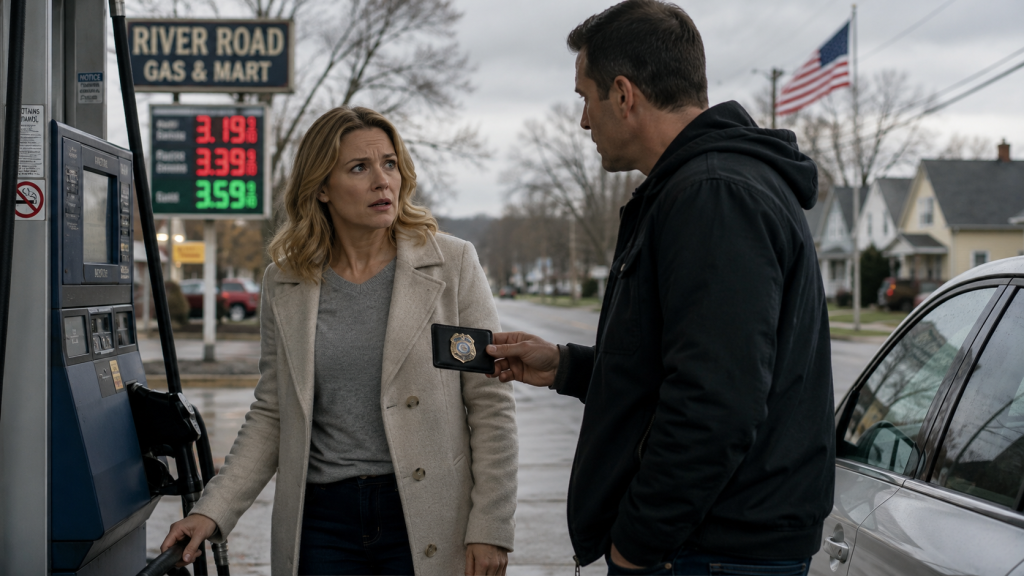
I was standing beside pump six, watching the numbers climb, when a man in a dark hoodie walked up from the side of the building.
He looked about forty, maybe older, with a tired face and nervous eyes.
I tightened my grip on my purse.
“Don’t go,” he said.
I stared at him.
“Excuse me?”
“Don’t go to your son’s house. You’ll regret it.”
My stomach dropped so suddenly I forgot the gas nozzle was still in my hand.
“What the hell are you talking about?”
He looked at me with pity, like he already knew I would not listen.
“Twenty minutes,” he said. “You’ll understand.”
Then he walked away fast, cutting behind a parked delivery truck and disappearing around the corner.
I stood there shaking.
For one wild second, I thought about calling Daniel.
But pride and fear are a dangerous combination.
I told myself the man was crazy.
Maybe he had overheard me on the phone.
Maybe he was trying to scare me.
Maybe he was one of those lonely people who saw trouble everywhere and handed it to strangers.
I put the gas nozzle back, got in my car, locked the doors, and drove.
Eighteen minutes later, I turned onto Daniel’s street and saw police lights.
At first, my mind refused to connect them to his house.
I slowed down, squinting through the flashing red and blue reflections bouncing off the wet pavement.
Then I saw Marissa sitting on the curb in her cream sweater, her hands covered in blood.
A police officer stepped in front of my car and shouted for me to stop.
“That’s my son’s house,” I said, stumbling out.
“Ma’am, stay back.”
“Where is Daniel?”
No one answered quickly enough.
I saw the front door hanging open.
I saw broken glass on the porch.
I saw two paramedics rushing inside with a stretcher.
Then I heard a voice from the driveway.
“Mrs. Whitaker?”
I turned.
The man from the gas station stood beside an unmarked police car.
His hoodie was gone.
Under it, he wore a detective’s badge clipped to his belt.
“My name is Detective Aaron Miles,” he said quietly. “I tried to stop you because we believed the situation was about to turn violent.”
“What situation?” I whispered.
He looked toward the house.
“Your son was planning to confess to something tonight. Someone made sure he couldn’t.”
My knees nearly gave out.
“Couldn’t what?”
Detective Miles did not answer before Daniel appeared in the doorway, alive but pale, one sleeve stained dark, an officer supporting him by the arm.
“Mom,” he whispered.
The sound of his voice broke me.
I tried to run to him, but the detective stopped me gently.
“He’s safe for now.”
Marissa suddenly stood from the curb, screaming, “He’s lying! Daniel’s confused!”
But Daniel looked past her at me and said, “Mom, Dad didn’t leave us. He was paid to disappear.”
The world went silent.
My husband, Robert, had vanished twelve years earlier, leaving behind a note that said he could not handle family life anymore.
I had hated him for it.
I had hated him for leaving me with bills, a teenage son, a broken mortgage, and a heart that did not know where to put all the questions.
For years, I imagined Robert alive somewhere else.
Different city.
Different woman.
Different name.
I imagined him laughing while I worked double shifts.
I imagined him forgetting Daniel’s birthday while Daniel pretended not to care.
I imagined him choosing freedom over us.
That hatred had kept me standing.
Now my son was looking at me from his own front porch and telling me hatred might have been built on a lie.
Daniel’s eyes filled with tears.
“I found bank records, Mom. Marissa’s father has been paying someone every month since Dad disappeared.”
Marissa lunged toward him, but two officers caught her before she reached the porch.
Detective Miles lowered his voice.
“Your son called us this morning. He said he had proof connecting his wife’s family to your husband’s disappearance. He wanted you here before he turned it over.”
I stared at Marissa.
Her cream sweater was streaked with panic, not grief.
“Why warn me at the gas station?” I asked.
The detective looked toward Daniel.
“Because someone inside this house knew he was about to confess, and we weren’t sure you weren’t the next target.”
I felt the cold November air go straight through my coat.
Daniel was guided to the ambulance, and I followed as far as the officer allowed.
“What happened?” I asked him.
He tried to answer, but pain tightened his face.
Detective Miles stepped beside me.
“Mrs. Whitaker, we need to get him checked first.”
“I’m his mother.”
“I know. That’s why I’m asking you to stay calm.”
Stay calm.
A phrase people use when the world is already on fire.
Daniel reached for me with his uninjured hand.
“I’m sorry, Mom.”
“For what?”
“For believing Dad left us.”
I pressed his hand to my cheek.
“So did I, sweetheart.”
The paramedics loaded him into the ambulance.
Marissa shouted from the curb, “Daniel, tell them you fell! Tell them!”
An officer told her to stop talking.
That was when I noticed her father standing near the garage.
Elliot Graves.
Wealthy.
Polished.
Silver-haired.
The kind of man who wore casual clothes that still looked more expensive than church suits.
He was speaking to another detective, his face arranged into concern.
I had never liked Elliot, though I could never explain why without sounding jealous.
He had money.
Influence.
A calm voice.
When Daniel married Marissa, Elliot paid for the wedding, the house down payment, and later Daniel’s job at his development company.
Daniel said it was generosity.
I thought it looked like a cage with velvet bars.
Elliot saw me watching and gave a small nod.
Like we were two civilized adults enduring an inconvenience.
My skin crawled.
At the hospital, Daniel received stitches for a cut on his arm and treatment for bruising.
The doctors said he was lucky.
I did not feel lucky.
I felt like I had walked into the middle of a story that had started twelve years ago.
Detective Miles met me in a private waiting room while Daniel rested.
He placed a recorder on the table.
“Mrs. Whitaker, I need to ask you about Robert.”
The name hurt like a door slamming.
“What about him?”
“Tell me about the day he disappeared.”
I closed my eyes.
It was December tenth.
Snow had fallen all morning.
Robert kissed my forehead before leaving for work at Whitaker Auto Parts, the little shop he owned with his brother.
Daniel was fourteen and angry about math homework.
Robert promised to help him that night.
He never came home.
At 9:30 p.m., I found the note on the kitchen table.
I’m sorry. I can’t do this anymore. Don’t look for me.
No signature.
No explanation.
The police treated it as a voluntary disappearance.
Robert was an adult.
No signs of struggle.
No immediate evidence of foul play.
The bank account showed one withdrawal two days before.
People whispered that he had another woman.
Then my brother-in-law closed the shop and moved away.
Bills arrived.
The house nearly went into foreclosure.
Daniel stopped asking questions.
And I learned to hate a ghost.
Detective Miles listened without interrupting.
Then he said, “Your son found a payment trail.”
“How?”
“He started doing accounting work for Graves Development. Three weeks ago, he noticed recurring payments from a subsidiary to a private investigator who had no active contract with the company.”
“That connects to Robert?”
“The investigator’s name is Paul Renner.”
My throat tightened.
“I don’t know him.”
“He was the first officer assigned to your husband’s missing person report. He left the department six months later.”
For a moment, I could not understand the words.
The first officer.
The man who told me Robert had probably chosen to leave.
The man who handed me tissues and said some husbands break under pressure.
The man who closed my life like a file.
Detective Miles continued.
“Renner has received monthly payments through shell vendors connected to Elliot Graves for twelve years.”
I gripped the edge of the table.
“Why would Marissa’s father pay him?”
“We believe your husband discovered something before he disappeared. Something related to land purchases, zoning approvals, and bribed inspectors connected to Graves Development.”
I stared at him.
“Robert owned an auto parts shop.”
“He also owned the parcel behind it. That parcel was part of a development corridor Elliot Graves wanted badly.”
I remembered Robert coming home angry weeks before he vanished.
Not dramatic angry.
Quiet angry.
He had papers folded in his jacket.
He told me not to worry.
I had worried anyway.
“What happened to the land?” I asked.
Detective Miles’s jaw tightened.
“It was transferred after your husband disappeared. Your signature appears on one document.”
I stood so fast the chair scraped the floor.
“I never signed anything.”
“We know.”
My body went cold.
Every year of grief tilted.
Not only Robert gone.
Not only Daniel growing up without his father.
But my name used to help bury the truth.
Daniel gave his statement the next morning.
I sat outside the room because the detective asked for it to be recorded cleanly.
Through the glass, I watched my son speak with a white bandage on his arm and exhaustion under his eyes.
He had found payments.
Then old land records.
Then a notarized form with my forged signature.
Then an archived email from Elliot Graves to Paul Renner that said:
The widow must never connect the parcel to Robert’s disappearance.
Widow.
Not wife.
Not Marlene.
Widow.
But no body had ever been found.
No death certificate.
Just a husband turned into a rumor and a woman left to survive the shame.
Daniel had planned to tell me everything that night at dinner.
He had also told Marissa he was going to the police.
That had been his mistake.
He still believed his wife might choose him over her father.
Instead, the argument turned violent.
Marissa claimed she panicked.
Daniel said she tried to grab the folder and destroy it.
Elliot arrived before police did.
That part mattered.
Daniel had called 911 at 4:27.
Elliot’s car entered the driveway at 4:23, according to a neighbor’s security camera.
He came before anyone called him.
Because Marissa had.
Police recovered the folder from behind a loose panel in Daniel’s office wall.
He had hidden copies there.
My son had become smarter than the people who underestimated him.
Detective Miles told me later, “That folder saved him.”
I thought of the man in the hoodie at the gas station.
“Why were you following me?”
He smiled faintly.
“Not following. Watching. Daniel told us you were coming. We were already monitoring the house, but we didn’t expect things to move so fast. When we saw Marissa’s father arrive early, I tried to intercept you.”
“You could have told me you were police.”
“I could have. But if anyone was watching you, it might have exposed the operation.”
I wanted to be angry at him.
Maybe I was.
But there were too many bigger angers in the room.
Elliot Graves was arrested two days later on financial charges first.
That was how they got him.
Not for Robert.
Not yet.
For fraud.
Forgery.
Obstruction.
Bribery.
Shell payments.
Tampering with records.
The Robert case reopened officially the same afternoon.
Marissa was arrested for assault and destruction of evidence-related charges.
She cried when they led her out.
Not for Daniel.
For herself.
She kept saying, “My father said he would handle it.”
That sentence told us everything about her life.
And Daniel’s marriage.
And the Graves family.
My son moved into my house after the hospital released him.
He slept in his old room, the one I had turned into storage but never fully changed.
The first night, he sat on the edge of the bed and looked at the baseball trophies on the shelf.
“Dad helped me win that one,” he said.
“I remember.”
“I hated him for missing my high school graduation.”
“So did I.”
Daniel looked at me.
“What if he didn’t choose to miss it?”
I sat beside him.
“Then we were both robbed.”
That became the word in my mind.
Robbed.
Not abandoned.
Robbed of answers.
Robbed of anger placed where it belonged.
Robbed of Robert’s voice.
Robbed of Daniel’s father.
Robbed of twelve years.
The investigation moved slowly after that.
Painfully slowly.
Detectives searched old storage units.
Pulled bank records.
Reinterviewed former Graves employees.
Found retired city officials who suddenly remembered things once immunity was mentioned.
Paul Renner, the former officer, broke first.
Men paid to keep secrets often believe they are loyal until prison becomes personal.
He admitted he had been hired to make Robert’s disappearance look voluntary.
He claimed Robert was alive when he last saw him.
He said Robert had been forced to sign land transfer documents and then taken to a private property near the state line.
He said he did not know what happened after that.
I did not know whether to believe him.
Hope can be cruel when it arrives late.
For three weeks, I lived suspended between mourning and impossible expectation.
Then Detective Miles came to my door one morning.
I knew by his face that whatever he carried would change me.
“We found Robert,” he said.
My knees weakened.
“Alive?”
His eyes softened with something like sorrow and relief mixed together.
“Yes.”
The word broke me.
Not because it fixed everything.
Because it opened everything.
Robert had been living under another name in a long-term care facility in Kentucky.
He had suffered a traumatic brain injury years earlier.
No one knew his real identity.
Someone had paid cash for his placement at first.
Then payments stopped.
He remained there as a state-supported patient, quiet, confused, with fragments of memory and a faded tattoo on his wrist that staff never thought to trace.
Daniel drove me there.
Neither of us spoke for most of the trip.
When the nurse led us into the common room, I saw him by the window.
Older.
Thinner.
Gray in his beard.
But Robert.
My Robert.
He was folding and unfolding a napkin, staring at the rain.
I stopped walking.
Daniel made a sound beside me that was almost a sob.
“Dad?”
Robert looked up.
For a second, nothing.
Then his eyes moved to Daniel’s face.
Something flickered.
“Danny?” he whispered.
Daniel crossed the room and dropped to his knees in front of him.
Robert touched his hair like he was seeing a boy and a man at the same time.
“My boy,” he said.
I covered my mouth.
Robert looked at me then.
Confusion.
Pain.
Recognition arriving slowly, like dawn through fog.
“Marlene?”
I had imagined screaming at him for twelve years.
Throwing the note in his face.
Demanding why.
Instead, I fell into the chair beside him and took his hand.
“You didn’t leave.”
His fingers tightened around mine.
“I tried to come home.”
That was all he could say before we were all crying.
The months that followed were not simple.
Robert’s memory returned in pieces.
He remembered being followed.
He remembered meeting Elliot Graves at the shop.
He remembered refusing to sell the parcel.
He remembered a blow, a car, a room, papers shoved in front of him.
He remembered signing because someone said they would hurt us.
Then flashes.
A motel.
A hospital.
A man named Renner.
Then nothing clear.
The legal case expanded.
Elliot Graves had not personally held Robert captive for twelve years, but he had initiated the scheme, covered it up, paid Renner, forged documents, and profited from the land.
That was enough to bury the empire he had built on our loss.
Graves Development collapsed under lawsuits and criminal indictments.
Former officials turned on him.
Investors fled.
Marissa accepted a plea to testify against her father.
Daniel did not attend her hearing.
He removed his wedding ring at our kitchen table and placed it in a coffee mug because he said he could not stand the sound of it hitting wood.
Divorce papers came later.
Healing came slower.
Robert moved to a rehabilitation facility closer to us.
He was not the man who disappeared.
Neither was I the woman he left behind.
We had both been changed by a crime that stole time more thoroughly than money ever could.
One afternoon, I brought him a photo album.
He touched Daniel’s graduation picture.
“I missed it.”
My throat tightened.
“Yes.”
“I’m sorry.”
“You didn’t choose that.”
“I still missed it.”
That was the hardest truth.
Innocence does not erase absence.
Daniel struggled with that most.
He loved his father immediately and resented him at the same time.
A therapist told us both feelings could be true.
I learned many things could be true at once.
Robert had not abandoned us.
I had still been abandoned by the life we were supposed to have.
Daniel had found the truth.
He had also married into the family that helped hide it.
Marissa had betrayed him.
She had also been raised by a man who taught loyalty as fear.
Detective Miles had scared me at a gas station.
He had also saved me from walking blindly into danger.
A year after that November day, we stood outside the courthouse as Elliot Graves was led away.
He did not look at me.
He looked at Daniel.
Maybe because Daniel had been the crack in his perfect wall.
Maybe because he had never imagined the son of the disappeared man would grow up and read the money trail.
Detective Miles stood beside us.
“You doing all right, Mrs. Whitaker?”
I looked at Robert in his wheelchair, Daniel’s hand resting on his shoulder.
“No,” I said honestly. “But I’m here.”
He nodded.
“Sometimes that’s enough for today.”
The gas station on Route 42 is closed now.
I passed it once months later.
The pumps were wrapped in yellow tape, the windows dark.
I pulled in anyway and sat beside pump six.
The same place where a stranger in a dark hoodie told me not to go.
I thought about how angry I had been.
How certain I was that he was crazy.
How close I had come to walking into a house where truth had already turned dangerous.
Twenty minutes, he had said.
You’ll understand.
He was wrong about one thing.
It took much longer than twenty minutes to understand.
It took police reports.
Hospital rooms.
Bank records.
Forged signatures.
A son’s courage.
A husband found alive after twelve years.
A courtroom full of people finally saying Robert Whitaker did not leave his family.
He was taken from them.
But that first warning was the door.
And once it opened, nothing stayed buried.
On my way to my son’s house, I stopped for gas when a stranger warned me not to go.
I went anyway.
And what I found at the end of that road destroyed the story I had believed for twelve years.
My husband was not a coward.
My son was not paranoid.
Marissa was not innocent.
Elliot Graves was not untouchable.
And I was not the abandoned woman everyone had pitied.
I was a wife whose anger had been pointed at the wrong ghost.
A mother whose son risked everything to bring the truth home.
And when Robert finally held my hand again, older and broken but alive, I understood something grief had never allowed me to believe.
Sometimes the dead do not return.
Sometimes the missing do.
And sometimes the worst day of your life is only the day the lie finally ends.
THE END! THANKS FOR READING!