 Reading Time: 12 minutes
My father saw the marks across my neck and shoulder, stepped back, and whispered, “I won’t walk a damaged woman down the aisle.” Three minutes before the wedding music was supposed to begin, Richard Vale rejected me in front of the chapel doors.
For a moment, the world blurred away. The white roses. The polished pews. The stained-glass windows glowing blue and gold. The quiet rustle of guests waiting for the bride.
All of it faded until the only sound left was the dull ringing that had followed me since the explosion in the Arabian Sea.
I stood there in my wedding dress, one hand holding my bouquet, the other resting lightly against the old scar that curved from the side of my neck to my shoulder.
The skin there was tight. Uneven.
A permanent memory of heat, smoke, and metal screaming apart in the dark.
My father stared at it as if it were something shameful.
He adjusted his silver cuff links and glanced toward the pews filled with politicians, executives, and naval officers.
“Those photos will exist forever,” he said coldly. “I refuse to be remembered standing beside… that.”
That.
That was all I was to him.
Not Lieutenant Evelyn Vale.
Not the daughter who had once skipped college parties to work weekend shifts so I could send money home when his company was collapsing.
Not the officer who had spent years building a career he bragged about whenever contracts were involved.
Not the woman who had pulled three sailors through burning wreckage while alarms screamed and smoke swallowed the deck.
Just that. My scars burned beneath his stare, but I refused to cover them.
I had survived fire.
Surgery.
Months of recovery.
Nights when pain woke me before dawn.
Days when strangers looked too long and pretended they had not.
I could survive my father’s cruelty too.
My sister Camille smiled behind him.
She wore a champagne silk dress and the delicate pearl earrings our mother left to me, though she had taken them from the family safe without asking.
“Dad is only protecting the family image,” she said softly. “You should have worn the high-neck gown.”
“My dress is already on.”
“Then postpone.”
Postpone.
As if my wedding were a public relations problem.
As if Daniel were waiting at the altar because of lighting and symmetry, not love.
My fiancé, Daniel Mercer, stepped forward from beside the chapel doors.
He was still in his dress uniform, his jaw tight, anger hardening every line of his face.
But I caught his wrist before he could speak.
“Not here,” I whispered.
His eyes flicked to my father.
“Evelyn—”
“Not yet.”
Richard leaned closer, mistaking my calm for weakness.
He had done that all my life.
Mistaken silence for surrender.
Dignity for obedience.
Love for permission.
“Without me, you’ll walk alone,” he said. “Maybe then everyone will understand what kind of woman comes back from deployment looking like a warning.”
My breath caught.
Not because of the insult.
Because I realized something in that moment.
He was not ashamed of what had happened to me.
He was ashamed that it could not be hidden.
My father’s life was built on polished surfaces.
Perfect family portraits.
Perfect donor dinners.
Perfect speeches about sacrifice.
Perfect public support for service members.
But real sacrifice had texture.
It had scars.
It did not photograph cleanly.
Then the chapel doors opened.
Every uniformed guest stood.
A hush moved through the entry hall like wind before a storm.
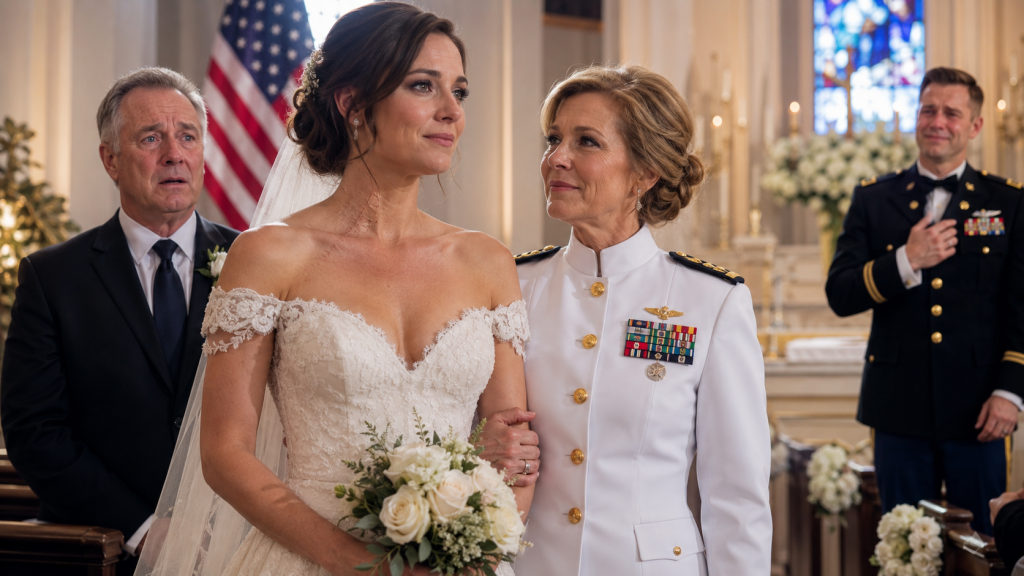
Four-star Admiral Helena Cross entered beneath the stained-glass light, her white dress uniform gleaming.
She was Chief of Naval Operations.
The one person my father had spent two years trying to impress because her office controlled the contracts his company desperately needed.
Richard’s face went pale.
Camille’s smile vanished for half a second before she repaired it.
Admiral Cross walked toward us with measured steps.
She stopped beside me, looked at my scars, then turned to Richard Vale.
“Your father may be ashamed of your scars, Lieutenant,” she said, offering me her arm, “but I know exactly how you earned them.”
The silence cracked.
Richard opened his mouth.
No sound came out.
I looked at the admiral’s arm, then at Daniel.
His eyes shone.
He nodded once.
I placed my hand on Admiral Cross’s sleeve.
As we stepped into the chapel, every naval guest stood taller.
Then applause began.
Not loud at first.
One pair of hands.
Then another.
Then the entire left side of the chapel rose into thunder.
Officers.
Sailors.
Nurses from the naval hospital.
Men and women who knew that scars were not defects.
They were receipts.
Daniel stood at the altar, his face full of tears he did not bother hiding.
My father remained near the doors, abandoned by the attention he worshiped.
Camille stood beside him, stiff and furious.
Admiral Cross walked slowly, giving me time to breathe.
The chapel smelled of roses and candle wax.
The music began late, but no one seemed to mind.
Halfway down the aisle, the admiral leaned close and whispered, “Your investigation packet reached my desk this morning.”
I kept my smile steady.
“Is the evidence enough?”
Her voice lowered.
“Enough to sink a fleet.”
Across the chapel, Richard slowly understood the admiral had not come only for my wedding.
She had come for him.
I had not planned for the truth to arrive at my wedding.
Not originally.
For most of my life, I had protected my father from consequences.
When I was eleven, I lied to neighbors and said he missed my school play because of a business emergency, not because he forgot.
When I was seventeen, I gave him my college savings after his first company nearly failed.
When I joined the Navy, he called it “dramatic,” until the local newspaper printed my commissioning photo.
Then suddenly I was his patriotic daughter.
The daughter he mentioned at investor dinners.
The daughter whose service made him look honorable.
The daughter whose uniform opened doors his business record never could.
Vale Maritime Systems was my father’s company.
It started as a small naval supply contractor and grew into a middle-sized defense manufacturer that made safety components, emergency seals, and equipment housings for ships.
On paper, it was a veteran-supporting family company.
In reality, it was Richard Vale’s shrine to himself.
When contracts were tight, he put my photo on brochures.
When donors attended galas, he placed my deployment shadow box near the podium.
When reporters asked about military families, he wiped fake tears and said, “My daughter serves so others can come home.”
He loved my service most when it benefited him.
Then came the explosion in the Arabian Sea.
A fire in a maintenance section.
A chain of failures.
Equipment that should have held, but did not.
A safety housing that cracked under pressure.
Three sailors trapped.
Smoke thick enough to blind.
I remember heat along my neck.
Hands pulling.
Someone screaming my name.
I remember refusing to leave without Petty Officer Ramos because he was pinned and conscious and terrified.
I remember waking days later, bandaged, drugged, and unable to turn my head.
They called me brave.
I did not feel brave.
I felt damaged.
Then I hated myself for using the same word my father would later choose.
During recovery, Daniel never looked away.
Not once.
He washed my hair when my arms were too weak.
He learned how to change dressings.
He sat through the nights when I woke shaking because I could still smell smoke.
When I told him he did not have to stay, he said, “I know.”
Then he stayed.
My father visited twice.
The first time, he brought a photographer from a military charity.
The second time, he asked if the doctors could “minimize visible distortion.”
Visible distortion.
That was the phrase.
Not pain.
Not trauma.
Not healing.
Distortion.
After that, I stopped expecting fatherhood from him.
But I still wanted him at my wedding.
That was my mistake.
The ceremony continued.
Daniel’s hands were warm around mine.
When the chaplain asked who gave me away, Admiral Cross answered clearly.
“Her country honors her, and those who know her stand with her.”
A murmur moved through the chapel.
Daniel squeezed my fingers.
I did not look back at my father.
Not once.
We said our vows beneath stained glass and candlelight.
Daniel promised to love me in strength and recovery, in calm seas and storms, in every version of the future.
My voice shook when I promised him the same.
But it did not break.
When the chaplain pronounced us married, applause rose again.
Daniel kissed me carefully, then rested his forehead against mine.
“You okay?” he whispered.
“No,” I said.
He smiled sadly.
“Me neither.”
Then Admiral Cross stepped forward.
The chapel doors opened once more.
This time, two naval investigators entered through the side door.
No one gasped.
No one moved.
Admiral Cross simply turned to Richard and said, “Mr. Vale, your company submitted forged veteran-employment records, falsified safety certifications, and used your daughter’s deployment injury as a public-relations shield while denying her medical benefits through a shell foundation.”
My father stood too fast.
“This is a misunderstanding.”
I stepped forward, still holding my bouquet.
“No, Dad. A misunderstanding is forgetting my birthday. You used my name, my scars, and my service to win contracts while telling me I was damaged.”
Camille’s smile vanished when one investigator opened a folder and showed emails she had sent approving the false reports.
Richard looked at Daniel.
“Control your wife.”
Daniel’s voice was calm.
“She outranks every lie in this room.”
The admiral placed a hand on my shoulder.
“Lieutenant Vale, your testimony protected more sailors than you know.”
For the first time, the chapel did not see my scars as shame.
They saw them as proof.
And my father finally understood he had rejected the only daughter who could have saved him.
The investigation had started quietly three months earlier.
I was still on medical leave, helping review incident records from the explosion, when a familiar supplier code appeared in a maintenance failure report.
Vale Maritime Systems.
My father’s company.
At first, I refused to believe it.
There had to be another Vale vendor.
Another division.
A subcontractor.
Anything.
Then I pulled the chain of custody.
Safety housing unit.
Emergency bulkhead seal assembly.
Certification batch.
Inspector approval.
All linked back to Vale Maritime.
I sat at my kitchen table with the file open, cold tea beside my laptop, feeling a different kind of heat crawl up my scar.
Daniel came home and found me staring at the screen.
“What is it?”
“My father’s company supplied one of the failed components.”
His face changed.
“Evelyn.”
“I don’t know yet,” I said quickly. “It could be coincidence.”
But it was not coincidence.
The deeper I looked, the worse it became.
Certifications signed by inspectors who no longer worked there.
Veteran-employment numbers that did not match payroll.
Safety testing dates that fell on weekends when the testing facility was closed.
A charitable foundation claiming it paid for injured service members’ recovery.
Including mine.
It had not paid a dollar.
My military medical care and Daniel’s insurance had carried most of it.
Yet Vale’s foundation had issued press releases praising itself for supporting my rehabilitation.
My scars had become a fundraising tool.
My pain had become a brochure.
I sent everything to a trusted former commander, who sent it up the chain.
Then Admiral Cross’s office requested a direct packet.
I prepared it myself.
Every invoice.
Every email.
Every false claim.
Every photo of my father standing beside my uniform at fundraising events.
I included one final page.
A copy of the medical appeal I had filed when a specialized scar-revision therapy was denied because the foundation listed me as “fully supported.”
The denial letter had my name.
The foundation claim had my name.
My father’s signature was on the annual report.
That night, I cried harder than I had during any surgery.
Not because of the fraud.
Because the truth was finally too complete to excuse.
Daniel held me on the bathroom floor while I said, “He used me.”
“I know.”
“He used my burns.”
“I know.”
“I still wanted him to walk me down the aisle.”
Daniel’s voice broke when he answered.
“I know.”
The wedding had already been planned.
Guests invited.
Uniforms pressed.
The chapel reserved.
I considered canceling.
Admiral Cross told me not to.
“You have given him enough,” she said over the secure line. “Do not give him your wedding too.”
So I kept the date.
I wore the dress I chose before my final surgery.
Off the shoulder.
Not because I wanted attention.
Because I was tired of dressing around other people’s discomfort.
My mother had died when I was twenty-one.
If she had lived, she would have walked me down the aisle herself.
She used to say scars were maps of where the body had refused to surrender.
I held that sentence close while the seamstress adjusted the bodice.
Camille saw the dress at the final fitting and said, “Brave choice.”
I said, “Thank you.”
She said, “That wasn’t a compliment.”
I knew.
By the time my wedding day arrived, I understood that my family image had never included the real me.
Only the usable parts.
The uniform.
The promotion.
The heroic headline.
The daughter who made Richard Vale look patriotic.
But not the wounded body.
Not the angry voice.
Not the officer who could read procurement documents and recognize fraud.
Not the woman who would testify.
After the ceremony, the reception did not happen the way anyone planned.
The ballroom at the naval club had been decorated with white flowers, candles, and small silver anchors at each table.
But instead of cocktail laughter, guests stood in clusters whispering.
News had already begun spreading.
Federal review.
Suspended contracts.
Procurement fraud.
Vale Maritime under investigation.
Richard tried to leave the chapel, but investigators stopped him outside.
Not dramatically.
No handcuffs.
Just badges, documents, and instructions.
He looked smaller without a crowd believing him.
Camille tried to push past them.
One investigator said, “Ms. Vale, we’ll need your cooperation as well.”
She looked at me then.
The old smugness was gone.
In its place was pure hatred.
“You ruined us.”
I looked at her.
“No. I stopped helping you hide.”
Richard’s face twisted.
“You think the Navy will protect you? You think Daniel will still want you when this becomes ugly?”
Daniel stepped beside me.
“It became ugly when you called her damaged.”
Richard ignored him.
He looked at Admiral Cross.
“Admiral, surely we can discuss this privately.”
Her eyes hardened.
“You had years to behave honorably in private, Mr. Vale. We are past that point.”
That sentence followed him out of the chapel.
The months after the wedding were brutal.
Not because I doubted what I had done.
Because telling the truth does not protect you from grief.
Vale Maritime’s contracts were suspended pending review.
The foundation accounts were frozen.
Several executives resigned.
My father gave interviews calling himself the victim of “family revenge.”
Camille posted a statement online saying I had become unstable after deployment.
It might have hurt more if I had not expected it.
Daniel and I spent our first married months not on a honeymoon, but in interviews with investigators, legal reviews, and quiet evenings where I wondered if I had destroyed the last pieces of my family.
One night, Daniel found me on the balcony of our apartment.
My scar was aching from the cold.
He wrapped a blanket around my shoulders.
“You’re thinking too loudly,” he said.
“I keep hearing him say it.”
“Damaged?”
I nodded.
Daniel stood beside me.
“You know what I saw when you walked down the aisle?”
I laughed bitterly.
“The admiral?”
“You. I saw the woman who walked through fire and still chose flowers.”
My throat tightened.
He touched my hand.
“Your father doesn’t get to define damage.”
For a long time, I said nothing.
Then I whispered, “What if some part of me believes him?”
Daniel turned toward me fully.
“Then I’ll spend the rest of my life reminding that part it’s wrong.”
That is love, I think.
Not grand speeches.
Not perfect healing.
Just someone willing to repeat the truth until the wounded places can hear it.
The investigation concluded the following year.
Vale Maritime was fined heavily.
Several contracts were permanently revoked.
The foundation was dissolved.
Funds were redirected to legitimate service-member recovery programs.
Camille accepted a plea agreement related to falsified administrative records.
My father avoided prison through cooperation and payment, but his company never recovered its former standing.
The politicians stopped taking his calls.
The executives stopped inviting him to dinners.
The naval officers whose respect he had tried to buy no longer shook his hand.
A man who worshiped image lost his reflection in every room that mattered.
He wrote me one letter.
Not an apology.
A defense.
He said he had done what was necessary to keep the family company alive.
He said I could not understand business pressure.
He said my scars had given the company a chance to “do meaningful outreach.”
I folded the letter carefully.
Then I burned it in the kitchen sink.
Not dramatically.
Not with tears.
Just enough flame to turn his excuses into ash.
I kept one thing from him.
The cuff links he had adjusted before rejecting me.
Camille mailed them months later with a note that said, “You’ve taken everything else.”
I did not answer her.
I placed the cuff links in a small box labeled: Things that looked valuable until they were tested.
Daniel laughed when he saw it.
Then he kissed my scar.
The simple tenderness of that gesture nearly undid me.
Two years later, I returned to full duty in a different capacity.
Not the same deployment track.
My body had limits now.
I hated admitting that until Admiral Cross told me, “A changed assignment is not a lesser life.”
I moved into safety oversight and procurement review.
The irony was not lost on anyone.
Especially me.
I became the officer who checked the paperwork people hoped no one would read.
I looked for false signatures.
Inflated claims.
Certification gaps.
The quiet lies that become disasters when no one respects the details.
Sometimes young officers stared at my scars and then quickly looked away.
I learned to say, “You can ask.”
Some did.
I told them the truth.
Not all of it.
Enough.
Fire.
Failure.
Rescue.
Recovery.
Fraud.
Accountability.
One ensign once asked, “Ma’am, does it bother you when people stare?”
I thought about my father at the chapel doors.
Then Daniel at the altar.
Then Admiral Cross offering her arm.
“Yes,” I said. “But it bothers me less than people pretending not to see what survival costs.”
She nodded like she understood more than her years should allow.
On our second anniversary, Daniel and I returned to the chapel.
No guests.
No flowers.
No investigation.
Just us.
The afternoon light poured through the stained glass, painting my skin in blue and gold.
I stood at the aisle entrance and remembered the exact place where my father stepped back.
Daniel took my hand.
“Want to walk?”
I nodded.
We walked slowly down the aisle together.
No applause this time.
No admiral.
No father.
No audience.
Just the sound of our footsteps.
At the altar, Daniel turned to me.
“I’d marry you again.”
I smiled.
“Even with all this?”
He looked directly at the scar across my neck and shoulder.
“Especially with all this.”
For the first time, I believed that answer without needing to test it.
My father saw the marks across my neck and shoulder and decided they made me unworthy of his arm.
But my scars were never the shameful part of that day.
His cruelty was.
His fraud was.
His cowardice was.
He refused to walk beside me because he thought the world would remember him standing next to a damaged woman.
He was right about one thing.
The world remembered.
But not the way he feared.
They remembered Admiral Helena Cross offering me her arm.
They remembered naval officers rising to applaud.
They remembered Daniel waiting at the altar with tears in his eyes.
They remembered investigators entering quietly while my father’s lies collapsed under the same roof where he had tried to humiliate me.
And they remembered my scars.
Not as damage.
As evidence.
Evidence that I had survived what should have ended me.
Evidence that I had rescued others when running would have been easier.
Evidence that my father could use my image but never own my courage.
He once called me a warning.
Maybe I am.
A warning to men like him.
Do not mistake a woman’s scars for weakness.
Sometimes they are the map that leads straight back to the truth you tried to bury.
THE END! THANKS FOR READING