 Reading Time: 34 minutes
I laughed nervously. “What does that mean, before we were married?” Paul leaned back in his chair. “It means exactly what I said.” For several seconds, neither of us spoke.
The old cardboard box sat between us. Suddenly it didn’t look ordinary anymore. It looked dangerous. I reached for the note taped to the lid.
My fingers hesitated before touching it.
Florence’s handwriting was unmistakable.
Daniel.
Just my name.
Nothing else.
I peeled the tape away carefully.
Underneath it was another sentence.
If you are reading this, then I was right about one thing.
My mouth went dry.
“Right about what?”
Paul folded his hands.
“You should open the box.”
I lifted the lid.
The first thing I saw was a photograph.
It was a picture of me.
I was standing outside the grocery store where Florence and I had first met.
I was twenty-nine again.
Jeans.
Gray sweatshirt.
One hand in my pocket.
Florence was visible in the corner of the photograph, sitting in her wheelchair beside the shopping cart.
I stared at it.
“Who took this?”
Paul said nothing.
I turned the photograph over.
There was a date written on the back.
September 14.
The day we met.
Under the date, Florence had written three words.
He finally came.
My heart gave a strange, heavy beat.
I looked up.
“What does that mean?”
Paul’s expression didn’t change.
“Keep going.”
Beneath the photograph was a thick stack of envelopes tied together with blue ribbon.
There were dates written across them.
Dozens of dates.
Some from before our wedding.
Some from afterward.
There was also a small digital recorder.
A brass key.
A bank envelope.
And at the very bottom, a sealed white envelope with the words:
OPEN THIS LAST.
I picked up the first letter.
It had been written three months after Florence and I met.
Daniel,
Today you fixed the kitchen window.
You pretended not to notice when I watched you count the paintings in the hallway.
I almost laughed.
You are not nearly as subtle as you believe you are.
My face burned.
I stopped reading.
Paul was watching me.
“She knew?”
“Yes.”
“From when?”
“Almost immediately.”
I stared at him.
“That’s impossible.”
“No.”
“I never asked her for money.”
“You asked questions.”
“What questions?”
“How much the property taxes were. Whether the house was paid off. Whether Douglas had left debts. Whether she had siblings. Whether she had children.”
I felt myself getting angry.
“They were normal conversations.”
“Perhaps.”
“They were.”
Paul nodded toward the letter.
“Florence apparently disagreed.”
I looked down again.
You are kind to me, Daniel.
That is what makes this complicated.
A greedy man is easy to recognize when greed is the only thing inside him.
You are more difficult.
You want my money.
But you also remember that I hate cinnamon in my coffee.
You want my house.
But you repaired the porch railing without asking me for a cent.
You look at my jewelry when you think I am not watching.
But last Tuesday, when I fell asleep in the garden, you put a blanket over me.
I have not decided what kind of man you are yet.
Perhaps you have not decided either.
I swallowed.
Something uncomfortable moved through my chest.
I remembered that afternoon in the garden.
Florence had been sitting under the maple tree.
I had gone inside to make coffee.
When I came back, she was asleep.
It had gotten cold.
I had brought her a blanket.
I hadn’t thought anything of it.
I put the letter down.
“How many of these are there?”
“Thirty-seven.”
“Thirty-seven?”
“One for every important decision she made concerning you.”
I looked at the stack.
Then at Paul.
“What exactly is happening here?”
Paul’s eyes hardened slightly.
“Florence is telling you the truth.”
“I already know the truth.”
“Do you?”
“Yes. I married her. She died. I’m her husband. Whatever game she was playing—”
“Daniel.”
His voice stopped me.
“There is something you should understand before you continue.”
“What?”
“The house was never Florence’s.”
I stared at him.
“What?”
“The Burlington property.”
“That was her house.”
“She lived there.”
“She told me Douglas left it to her.”
“He did.”
“Then it was hers.”
“For eleven months.”
I felt something cold crawl across my back.
“What happened after eleven months?”
“She transferred it.”
“To whom?”
Paul didn’t answer.
I leaned forward.
“To whom?”
“Keep reading.”
I stood up.
“I’m not playing this ridiculous game.”
Paul remained seated.
“You came here expecting to inherit several million dollars.”
I froze.
He continued calmly.
“You believed the house was worth approximately $2.4 million. You believed Florence had somewhere between $1.8 and $2.2 million in investments. You believed she had no children and no close relatives.”
Every number was close.
Too close.
“How do you know that?”
“Because Florence knew that.”
I stared at him.
“She wrote it down?”
“No.”
“Then how?”
Paul pointed toward the box.
I looked inside again.
Under the letters was a black notebook.
I picked it up.
The first pages contained dates.
Times.
Observations.
Then I saw something that made me stop breathing.
Daniel searched “Burlington property records” at 11:42 p.m.
Daniel searched “inheritance rights spouse Vermont.”
Daniel searched “can spouse contest will.”
Daniel searched “estate tax Vermont.”
I dropped the notebook.
“What the hell is this?”
Paul’s voice remained quiet.
“Your internet searches.”
“You were spying on me?”
“No.”
“Then where did she get these?”
“From the laptop you used in her house.”
I remembered.
Florence had an old laptop in the study.
Mine had broken during our first year together.
I used hers for several weeks.
I rubbed my forehead.
“This is insane.”
“No, Daniel. It was cautious.”
I looked at the box.
For the first time since entering that office, I felt genuinely afraid.
Not because I might lose the money.
Because I suddenly realized the woman I thought I had deceived for five years had been watching me the entire time.
I sat down.
“Why?”
Paul’s expression softened.
“That is the question she wanted you to ask.”
I picked up another letter.
This one was dated six months before our wedding.
Daniel,
You proposed tonight.
Yes, I know you believe I proposed first.
I did.
But only because I knew you were waiting for me to do it.
You were terrified that proposing yourself would make your intentions too obvious.
That sentence made me close my eyes.
She was right.
Completely right.
I had rehearsed proposals.
Three of them.
I never used any.
Instead, I waited.
Florence continued.
You looked happy when I asked.
Then you looked frightened.
Then guilty.
That guilt interested me.
A man without a conscience would have celebrated.
You did not.
You went into the bathroom and stayed there for eleven minutes.
You came out with red eyes.
You told me your allergies were bothering you.
It was February.
I smiled despite myself.
That was Florence.
Even from the grave, she could still make me feel ridiculous.
Then I reached the next paragraph.
I know why you need money.
My smile disappeared.
I know about your father.
I know about the rehabilitation bills.
I know about the second mortgage your mother took out.
I know about the collection notices.
And I know you have been sending nearly everything you earn to them.
I stared at the page.
I had never told Florence how bad things were.
She knew Dad had suffered a stroke.
That was all.
At least, I thought that was all.
I continued reading.
That is why I have not asked you to leave.
Greed born from cruelty is one thing.
Greed born from fear is another.
Do not misunderstand me.
Fear does not make dishonesty honorable.
But context matters.
People are rarely one thing.
Douglas taught me that.
I stopped.
“Douglas?”
Paul nodded toward the letters.
I continued.
My first husband loved money more than he loved almost anything.
For many years, I believed that included me.
I was wrong.
At the end, he proved it.
Perhaps you will too.
Perhaps you will prove the opposite.
I folded the letter.
“What happened with Douglas?”
Paul looked toward the window.
“That story belongs to Florence.”
I pulled out another envelope.
This one had been written shortly after our wedding.
There was a photograph inside.
Florence and me on our wedding day.
She was wearing pale blue.
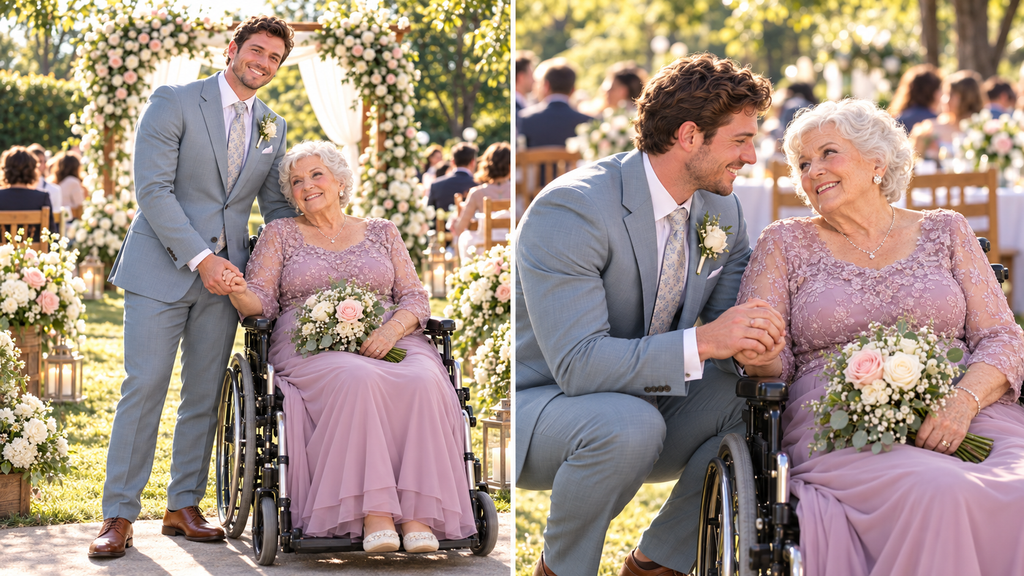
I was standing behind her wheelchair with my hand on her shoulder.
I remembered the photographer telling us to move closer.
Florence had laughed.
“If he gets any closer, he’ll be sitting in my lap.”
Everyone laughed.
Even me.
On the back she had written:
One of us knows this marriage is a test.
The other thinks it is a transaction.
We shall see which one is correct.
I suddenly felt sick.
“You helped her do this?”
Paul took a moment before answering.
“Yes.”
“You set me up.”
“No.”
“She targeted me.”
“No.”
“Then why was someone photographing us the first day?”
Paul finally leaned forward.
“Because Florence knew who you were before you knew who she was.”
Everything inside me went still.
“What?”
“She knew your name.”
I stared at him.
“No.”
“She knew your father’s name.”
My chair scraped against the floor as I stood.
“What did you just say?”
“Sit down, Daniel.”
“Tell me what she knew about my father.”
Paul looked at me for a long moment.
Then he reached into the box and removed the brass key.
He placed it in my palm.
“Storage locker 214.”
“What’s inside?”
“The rest.”
I closed my fingers around the key.
“No. You’re telling me now.”
Paul’s voice became firmer.
“Florence spent five years arranging this. I gave her my word that I would follow her instructions exactly.”
“She’s dead.”
“Yes.”
“So stop playing games.”
“I’m not playing.”
“Then tell me why she knew my father.”
Paul’s face changed.
Just slightly.
But enough.
“Because your father knew Douglas.”
I stared at him.
The room seemed to tilt.
“My father was a high-school custodian.”
“Not always.”
“He worked there for thirty-four years.”
“Before that.”
I shook my head.
“You’ve got the wrong man.”
“Thomas Mercer?”
Hearing Dad’s name come from Paul’s mouth made my skin prickle.
“Yes.”
“Born 1957?”
“Yes.”
“Worked for Halpern Manufacturing from 1978 until 1986?”
I said nothing.
I had heard the name.
Once.
Maybe twice.
Dad almost never talked about his twenties.
Paul nodded toward the key.
“Locker 214.”
I grabbed the box.
“When?”
“Now, if you want.”
“I do.”
Paul stood.
“There is one condition.”
I laughed bitterly.
“Of course there is.”
“You cannot open the final white envelope until you have seen what is inside the locker.”
“And if I do?”
“Then you’ll never receive what Florence actually left you.”
I looked at him.
“So there is an inheritance.”
Paul picked up his coat.
“I didn’t say that.”
“You implied it.”
“No, Daniel.”
He looked directly at me.
“You heard what you wanted to hear.”
That sounded so much like Florence that I hated him for it.
The storage facility was twenty minutes outside Burlington.
Paul drove separately.
I followed him in my car with the cardboard box strapped into the passenger seat.
Every red light felt too long.
Every possibility running through my mind sounded absurd.
My father knew Douglas.
Florence knew me before we met.
The grocery-store encounter hadn’t been an accident.
But why?
Dad had never mentioned Florence.
Never mentioned Douglas.
When I was growing up, our family had struggled constantly.
Dad fixed everything himself.
Mom clipped coupons.
Vacations meant camping at a state park.
If Dad had somehow known wealthy people like Florence and Douglas, he certainly had never benefited from it.
We reached the facility at 4:17.
Paul was waiting beside the entrance.
Locker 214 was at the end of a concrete corridor.
I inserted the key.
My hand shook.
The lock clicked.
I pulled up the metal door.
There were no stacks of cash.
No paintings.
No jewelry.
Just one filing cabinet.
One wooden chair.
And an old television sitting on a folding table.
Beside the television was a VCR.
I stared.
“You’re kidding.”
Paul walked past me.
“Florence preferred things she understood.”
He opened the filing cabinet and removed a VHS tape.
On the label were two words.
THOMAS MERCER.
My knees almost gave way.
“That’s my father.”
“Yes.”
“What is this?”
Paul inserted the tape.
The television flickered.
Static appeared.
Then the picture stabilized.
A man was sitting in a chair.
It took me several seconds to recognize him.
He was young.
Maybe twenty-eight.
Thick brown hair.
Thin mustache.
Nervous eyes.
My father.
I stepped toward the screen.
“Dad?”
The recording had been made decades earlier.
A date appeared briefly.
August 1985.
Someone off camera spoke.
A man.
“State your name.”
“Thomas Mercer.”
“And your position?”
“Maintenance supervisor, Halpern Manufacturing.”
“What did you discover?”
Dad looked terrified.
He swallowed.
“The safety reports were being falsified.”
My heartbeat changed.
“What reports?”
Paul didn’t answer.
On the television, Dad continued.
“Chemical exposure reports. They knew the ventilation system wasn’t working. Douglas told them.”
I turned toward Paul.
“Douglas?”
He pointed to the screen.
Dad continued.
“Douglas Whitmore ordered the shutdown.”
I stared.
Florence’s husband.
“But the board refused,” Dad said. “They said shutting down production would bankrupt the company.”
Another voice asked, “What happened next?”
Dad looked down.
“Douglas told me to copy everything.”
The picture jumped.
Then Dad was holding papers.
“He said if anything happened to him, I was supposed to take them to the authorities.”
My mouth went dry.
“What happened?”
The video changed.
Now another man appeared.
Older than Dad.
Tall.
Silver-haired.
Douglas.
I knew him from photographs in Florence’s house.
He stared directly into the camera.
“My name is Douglas Whitmore.”
I moved closer.
“If you are watching this,” Douglas said, “then someone has decided money matters more than human lives.”
For the next twenty minutes, I barely moved.
Douglas described everything.
Halpern Manufacturing had discovered dangerous chemical exposure in one of its facilities.
Workers had gotten sick.
Executives buried reports.
Douglas, who owned a substantial stake in the company, threatened to expose them.
My father helped him copy records.
Then Douglas discovered something worse.
Someone on the board was diverting money from employee compensation funds.
Millions.
Douglas gathered evidence.
He planned to go public.
But before he could, the company abruptly closed the affected facility.
Records disappeared.
Executives resigned.
Douglas survived.
Dad survived.
And somehow, nothing became public.
The tape ended.
I turned toward Paul.
“What happened?”
He opened the filing cabinet.
Inside were hundreds of documents.
“Douglas made a deal.”
“With whom?”
“The company.”
I stared at him.
“He took money?”
Paul nodded.
My stomach twisted.
“So he was just as bad.”
“No.”
Paul pulled out another folder.
“The settlement money went to the workers.”
I opened it.
Names.
Payments.
Medical bills.
Trust accounts.
Hundreds of them.
“Privately,” Paul said. “Douglas forced the remaining owners to compensate every affected employee and their families. In return, the company avoided public litigation.”
“And my father?”
“Was offered money.”
“How much?”
“Two hundred and fifty thousand dollars.”
In 1985, that would have changed my parents’ lives.
“Did he take it?”
“No.”
I looked at Paul.
“Why?”
“Because he said he had only done what any decent person should do.”
That sounded exactly like Dad.
Pain rose behind my eyes.
Paul continued.
“Douglas never forgot him.”
I looked again at the filing cabinet.
“What does this have to do with Florence?”
“Douglas died believing he owed your father a debt.”
“Then why didn’t he help him?”
“He tried.”
I frowned.
“Your father refused.”
Of course he did.
Stubborn old man.
Paul handed me another envelope.
This one was addressed to Florence.
The handwriting belonged to Douglas.
She had kept it for decades.
Florence,
If Thomas Mercer ever needs anything, help him.
He will refuse if you offer directly.
So don’t offer directly.
You’re smarter than I am.
Find another way.
He saved people who will never know his name.
Don’t let pride destroy him if life ever becomes difficult.
D.
I read it twice.
Then a third time.
My vision blurred.
“Florence knew about Dad’s stroke.”
“Yes.”
“How?”
“Douglas had arranged for periodic checks on several people involved in the case. After his death, Florence continued them.”
I stared at him.
“So she knew my family was drowning in medical bills.”
“Yes.”
“And she knew I was his son.”
“Yes.”
“Then the grocery store…”
Paul shook his head.
“She didn’t arrange that.”
I blinked.
“What?”
“That part really was coincidence.”
I almost laughed.
Paul continued.
“Florence recognized your surname when you introduced yourself. Then she recognized your father in a photograph you showed her several days later.”
I remembered that.
I had shown her a picture of Dad after rehabilitation.
Florence had stared at it longer than seemed normal.
I hadn’t noticed.
Or maybe I had noticed and forgotten.
“She called me that night,” Paul said.
“What did she say?”
Paul smiled faintly.
“She said, ‘Douglas has found a way to annoy me from the grave.’”
Despite everything, I laughed.
Then I covered my face.
Because suddenly I was crying.
Not loudly.
Just unexpectedly.
Dad.
My stubborn, ordinary father.
The man who bought used lawn mowers and repaired them instead of buying new ones.
The man who apologized whenever I paid one of his medical bills.
He had once been offered enough money to change our entire future.
And he had refused it.
I felt angry with him.
Proud of him.
Heartbroken for him.
All at once.
Then another realization hit me.
“Florence married me because of Dad.”
Paul was silent.
“She felt obligated.”
“No.”
“You just showed me proof.”
“I showed you why she first trusted you enough to let you remain in her life.”
“That’s the same thing.”
“No, Daniel.”
Paul looked at me carefully.
“Florence did not marry Thomas Mercer’s son.”
He paused.
“She married you.”
I shook my head.
“She knew I wanted her money.”
“Yes.”
“And she still married me.”
“Yes.”
“Why?”
Paul looked at the cardboard box.
“Read the letters.”
I sat on the concrete floor of locker 214 for nearly three hours.
I read every letter.
At first, Florence had written about me like a puzzle.
She documented every suspicious question.
Every glance toward an expensive object.
Every time I asked about her finances.
Then gradually, the letters changed.
Daniel took me to the hospital today.
He missed an important meeting at work.
He thinks I don’t know.
Daniel repaired my wheelchair ramp himself because the contractor wanted too much money.
He cursed for six hours.
His vocabulary is impressive.
I laughed through tears.
Another.
I tested him today.
I left $4,000 in cash in the desk drawer.
He found it while looking for stamps.
He counted it.
He stood there for almost a minute.
Then he closed the drawer.
Later he told me I shouldn’t leave that much money around.
Interesting.
I remembered that money.
I remembered staring at it.
I had needed $2,800 for Dad’s rehabilitation bill.
For one terrible minute, I had thought about taking some.
Florence would never know.
But I hadn’t.
Another letter.
Daniel lied today.
He told me he wasn’t worried about money.
He is.
I know because I heard him arguing with the hospital billing office.
He refuses to ask me for help.
This complicates my theory.
Then:
Daniel had the opportunity to change my will today.
He does not know that I know.
He found the unsigned amendment on my desk.
Had he encouraged me to sign it, he would have received the house.
Instead, he told me to speak to Paul because he didn’t want me signing legal documents while I was taking new pain medication.
I cried after he left the room.
Perhaps Douglas was right about people.
Perhaps what someone wants matters less than what they choose.
I stopped reading.
I remembered that day.
I had wanted her to sign it.
God, I had wanted it.
I had seen my name.
The house.
Everything.
For about thirty seconds, I had imagined simply placing a pen beside her.
Then Florence had looked confused.
Just slightly.
And something in me had recoiled.
I had called Paul instead.
At the time, I told myself I was protecting my future inheritance from being challenged.
Reading her letter now, I wasn’t sure anymore.
Maybe I had simply done the decent thing.
Maybe Florence had known that before I did.
I opened another.
This one was dated eighteen months into our marriage.
Daniel thinks I am asleep.
He is downstairs making soup.
It is terrible soup.
I can smell it from here.
He has made the same terrible soup four times because I once told him I liked it.
I lied.
I only said that because he looked so proud.
If there is an afterlife, I hope Douglas appreciates what I am enduring.
I laughed so hard that I cried harder.
I could hear Florence saying it.
Then the next paragraph destroyed me.
I believe I love him.
That is inconvenient.
I stared at those five words.
My hands trembled.
I kept reading.
I don’t love him because he is young.
I don’t love him because he makes me feel young.
That would be ridiculous.
I am old.
There is dignity in admitting that.
I love him because every morning he opens the curtains before waking me because he knows I hate waking in a dark room.
I love him because he pretends not to notice when my hands shake.
I love him because he makes me laugh.
I love him because when my pain became unbearable last Tuesday, he sat on the bathroom floor beside me for two hours and never once looked disgusted.
Does he love me?
I don’t know.
Perhaps not.
But I have learned something in seventy-eight years.
Love is not always pure.
Neither are people.
Sometimes love grows in contaminated soil.
That does not necessarily make the flower false.
I pressed the letter against my forehead.
I could barely breathe.
Because I remembered that night.
Florence had been sick.
Very sick.
She had vomited on herself before I could reach her.
She was humiliated.
She kept apologizing.
I cleaned her.
Changed her clothes.
Washed the floor.
Then I sat beside her.
At some point, she had taken my hand.
I remembered thinking:
I don’t want her to die.
Not:
I don’t want to lose the house.
Not:
I don’t want to lose the money.
Just:
I don’t want her to die.
And that terrified me.
Because somewhere along the way, my lie had become something else.
I had never admitted it.
Not even to myself.
I had spent so long telling myself I was pretending to love Florence that I failed to notice when I stopped pretending.
I opened the final dated letter.
It had been written six weeks before she died.
The handwriting was shakier.
Daniel,
You asked me tonight whether I was afraid.
I said no.
That was another lie.
I am frightened.
Not of death.
Of leaving things unfinished.
You fell asleep beside my hospital bed while holding my hand.
You looked exhausted.
Older than when I met you.
I suppose loving an old woman will do that to a man.
I watched you sleep.
And I realized I finally know the answer.
You came into my life because you wanted my money.
There is no point pretending otherwise.
You studied me.
You manipulated circumstances.
You made yourself useful.
You waited.
That was wrong.
It was dishonest.
It hurt me when I understood it.
I stopped reading.
My chest felt crushed.
But I continued.
And yet you stayed when staying became difficult.
That matters too.
When I lost control of my bladder, you stayed.
When I forgot your name after surgery, you stayed.
When I screamed at you because the medication made me confused, you stayed.
When I told you to leave because I was ashamed of what illness had turned me into, you slept in the hallway outside my room.
You could have hired nurses.
You could have disappeared until I died.
You didn’t.
So here is the problem, Daniel.
You entered my life as a liar.
But I am no longer certain that is who you are.
I covered my mouth.
The next lines blurred.
I wiped my eyes.
I know what you expect when I die.
I know you expect the house.
The accounts.
The investments.
Perhaps you think that is the ending.
It isn’t.
Money has a peculiar ability to reveal what people worship.
So I have arranged one final test.
You may hate me for it.
That is your right.
But if I simply leave you everything, you will spend the rest of your life wondering whether I loved you or merely rewarded you.
And I will spend eternity listening to Douglas say I handled it badly.
I laughed again.
Even Paul smiled.
I continued.
The box will lead you to the truth about your father.
You deserve to know who he was.
But there is another truth you need to discover.
Your father refused money because he believed accepting it would corrupt what he had done.
He was wrong about one thing.
Money itself does not corrupt people.
It reveals priorities.
Now you must reveal yours.
I lowered the letter.
“What test?”
Paul checked his watch.
“It’s almost eight.”
“So?”
“You have until midnight.”
My stomach tightened.
“To do what?”
He removed a document from the filing cabinet.
It was a legal agreement.
I read the first paragraph.
Then the second.
I looked up.
“You can’t be serious.”
“I am.”
The agreement offered me a choice.
Option one:
I could receive $3.2 million immediately.
No conditions.
No contest.
No delay.
But if I accepted it, all other provisions Florence had made concerning me would become void.
Option two:
I could reject the $3.2 million permanently.
In exchange, I would receive another sealed instruction.
That was all.
No promise of more money.
No guarantee of property.
Nothing.
I stared at Paul.
“So I either take $3.2 million or trade it for an envelope?”
“Yes.”
“What’s in the envelope?”
“I cannot tell you.”
“Do you know?”
“Yes.”
“Is it worth more?”
“I cannot answer that.”
“Is it money?”
“I cannot answer.”
“Property?”
“Daniel.”
“This is insane.”
“Florence knew you’d say that.”
I paced the storage locker.
Three point two million dollars.
Dad’s medical care.
Mom’s mortgage.
My debts.
Everything solved.
Instantly.
It was more money than I had ever imagined holding.
And Florence was offering it.
No punishment.
No humiliation.
No disinheritance.
I could take it.
Walk away.
And still tell myself I had won.
“What happens if I take the money?”
“You sign here.”
“And that’s it?”
“Yes.”
“What happens to the house?”
“I cannot tell you.”
“Her other assets?”
“I cannot tell you.”
“Who gets them?”
“I cannot tell you.”
I laughed bitterly.
“Convenient.”
Paul didn’t react.
I looked at the agreement again.
My original self would have signed before Paul finished explaining.
That was the frightening part.
Five years earlier, there would have been no decision.
But now?
I looked at Florence’s letters scattered across the concrete floor.
Thirty-seven pieces of her.
Thirty-seven conversations she had never been able to have with me.
I imagined her sitting at the kitchen table late at night, writing them.
Watching me.
Testing me.
Loving me.
Knowing I had lied.
And choosing me anyway.
“What happens if I reject the money?”
Paul held up a sealed envelope.
“You get this.”
“That’s all?”
“That’s all I am permitted to promise.”
I laughed.
“She really was impossible.”
Paul smiled.
“Yes.”
I sat down.
At 9:10, I still hadn’t decided.
At 10:25, I was furious.
At 11:03, I told Paul I wanted the money.
He placed the document in front of me.
I picked up the pen.
Then I remembered something.
Three weeks before Florence died, I had been helping her into bed.
She was weak.
Her fingers had closed around my wrist.
“Daniel?”
“Yes?”
“When I’m gone, don’t let fear choose your life.”
I thought she meant grief.
Now I understood.
I put the pen down.
Paul said nothing.
At 11:41, I picked it up again.
Three point two million dollars.
My father’s medical care alone could swallow hundreds of thousands.
I could buy my parents a home.
Pay every debt.
Never worry again.
I thought about the grocery store.
The mansion.
The first time I calculated Florence’s wealth.
Then I remembered her terrible laugh when I burned Thanksgiving dinner.
Her hand on mine in the hospital.
Her asleep beneath the maple tree.
Her whispering my name on our wedding night.
Her saying:
You don’t have to pretend with me.
At the time, I thought she meant I didn’t have to pretend to be comfortable about our age difference.
Now I knew she had meant everything.
I looked at Paul.
“If I take the money, what would Florence have thought of me?”
“I cannot answer that.”
“Come on.”
“No.”
“Paul.”
He looked me directly in the eye.
“My opinion is not part of her will.”
Damn lawyer.
11:53.
I stared at the signature line.
Then something occurred to me.
Florence had already offered me the money.
That mattered.
She wasn’t trying to punish me.
She wasn’t saying:
Prove you aren’t greedy.
She was asking something harder.
Who are you now?
Not who had I been?
Who was I now?
I pushed the document away.
“I don’t want it.”
Paul didn’t move.
“Be certain.”
“I reject the $3.2 million.”
“You understand that decision is irrevocable?”
“Yes.”
“You could receive nothing.”
“I understand.”
“Your parents’ financial circumstances do not alter the terms.”
My jaw tightened.
“I understand.”
Paul placed another form in front of me.
I signed.
11:57 p.m.
Paul looked at his watch.
Then at me.
“Florence would have appreciated the drama.”
“Give me the envelope.”
He did.
My hands shook as I tore it open.
Inside was one sheet of paper.
Three sentences.
Daniel,
Good.
Now go home.
There is someone waiting in my kitchen.
I stared at it.
“What?”
Paul was already putting on his coat.
“Who?”
He smiled.
“For once, Daniel, I genuinely don’t know.”
Florence’s house was dark when I arrived.
I still had my key.
For some reason, I hesitated at the front door.
Then I unlocked it.
“Hello?”
No answer.
I stepped inside.
The house smelled exactly as it always had.
Lavender.
Old books.
Furniture polish.
Home.
That word hurt.
I walked toward the kitchen.
A lamp was on.
Someone was sitting at the table.
A woman.
Maybe sixty.
Gray hair.
Thin face.
She stood when she saw me.
“You’re Daniel.”
“Who are you?”
She looked at me for several seconds.
Then she said something that made the entire night even stranger.
“My name is Rebecca.”
I waited.
She swallowed.
“Florence was my mother.”
I stared at her.
“No.”
“Yes.”
“She didn’t have children.”
Rebecca gave a sad smile.
“She told you that?”
“Yes.”
“She told everyone that.”
I stepped backward.
“No.”
“I was seventeen when she last saw me.”
My mind raced.
“Why?”
Rebecca looked around the kitchen.
“Because I left.”
“That doesn’t explain why she pretended you didn’t exist.”
“No.”
Rebecca sat again.
“Douglas wasn’t my father.”
I slowly pulled out a chair.
She told me the story.
Florence had been twenty-one when Rebecca was born.
Unmarried.
Terrified.
Her own parents considered pregnancy outside marriage a disgrace.
They forced Florence to give the baby up.
Florence spent years searching.
Eventually, when Rebecca was seventeen, they found each other.
But the reunion went badly.
Rebecca was angry.
Florence was defensive.
Both said terrible things.
Then Rebecca disappeared from her life again.
Years became decades.
Florence married Douglas.
Rebecca built her own family.
Neither reached out.
Until Florence became ill.
“She contacted me two years ago,” Rebecca said.
My stomach tightened.
“While we were married?”
“Yes.”
“You met her?”
“Three times.”
I felt betrayed.
“She never told me.”
“She was ashamed.”
“Of me?”
“Of herself.”
Rebecca looked down.
“She didn’t know how to tell her husband that she’d lied about having no children.”
I almost laughed at the irony.
Florence and I had both entered our marriage carrying lies.
“Why are you here?”
Rebecca reached into her bag.
She removed a document.
“The house belongs to me.”
My heart sank.
There it was.
The trap.
Of course.
Florence had transferred it to Rebecca.
I nodded slowly.
“All right.”
Rebecca looked surprised.
“That’s it?”
“What do you want me to say?”
“I expected you to be angry.”
“I’ve had a complicated day.”
That made her laugh.
Florence’s laugh.
Exactly Florence’s laugh.
It nearly broke me.
Rebecca’s eyes softened.
“She said you’d do that.”
“Do what?”
“Make a joke when you’re hurting.”
I looked away.
Rebecca slid another document across the table.
“You have sixty days.”
“For what?”
“To leave.”
I nodded.
“Okay.”
She studied me.
“You’re not going to fight?”
“No.”
“Why?”
“Because it’s your house.”
She looked confused.
“Florence thought you’d contest it.”
“Maybe I would have once.”
“And now?”
I looked toward Florence’s empty chair.
“I’m tired of trying to inherit things.”
Rebecca’s face changed.
Then she began crying.
Quietly.
I didn’t understand.
“What?”
She covered her mouth.
“I’m sorry.”
“For what?”
“There is no sixty-day deadline.”
I stared at her.
“What?”
“The house isn’t mine.”
“But you just—”
“Florence made me promise.”
I closed my eyes.
“Another test.”
Rebecca nodded.
I stood so fast the chair nearly fell.
“No.”
“Daniel—”
“No more.”
I walked into the hallway.
“Daniel.”
“I’m done.”
I turned.
“Do you understand? I loved that woman. Maybe I started badly. Maybe I was greedy. Maybe I deserved some of this. But I spent years caring for her. I held her while she was dying. I buried her. And now I’m being passed from one test to another like some lab animal.”
Rebecca wiped her face.
“I know.”
“No, you don’t.”
“She knew you’d be angry.”
“Good. She got something right.”
I grabbed my coat.
Then Rebecca said:
“She left you the house.”
I stopped.
I turned around.
“What?”
“The house was transferred to a trust years ago. Florence retained lifetime occupancy.”
“And after her death?”
Rebecca looked at me.
“The beneficiary is you.”
I stared at her.
“No.”
“Yes.”
“What about you?”
“She left me something else.”
“How much?”
Rebecca smiled through her tears.
“None of your business.”
That was so much like Florence that I laughed despite myself.
Then Rebecca reached across the table.
“There’s more.”
“Of course there is.”
She handed me a small envelope.
Inside was a flash drive.
On it were the words:
FOR DANIEL AND REBECCA.
We went into the living room.
I connected it to the television.
Florence appeared on the screen.
Alive.
Sitting in her favorite chair.
A blue blanket over her knees.
For one impossible second, I forgot she was dead.
“Hello, darling.”
My knees weakened.
Rebecca grabbed my hand.
Florence smiled into the camera.
“If Daniel is watching this without Rebecca, then something has gone catastrophically wrong with Paul’s instructions, and I expect someone to sue him.”
Rebecca laughed.
I cried.
Florence continued.
“If both of you are there, then congratulations. You have survived me.”
She took a breath.
“I owe both of you an apology.”
Her smile faded.
“Rebecca, I should have found you sooner. Pride stole decades from us.”
Rebecca squeezed my hand.
“Daniel, I should have trusted you sooner.”
I shook my head at the screen.
“No.”
“Yes,” Florence said, almost as if answering me.
“I knew what you wanted when you entered my life. But I also knew why.”
She leaned closer.
“And eventually, I knew something you did not.”
I stopped breathing.
“You loved me.”
Tears ran down my face.
“You fool.”
Florence smiled.
“You loved me long before you admitted it.”
I covered my mouth.
Rebecca was crying beside me.
“You proved it every day in small, irritating ways.”
Florence laughed.
“You also made dreadful soup.”
I laughed through my tears.
“I hated that soup.”
I stared at the screen.
“You said you liked it.”
“Daniel,” Florence continued, “if you are arguing with the television, please remember that I cannot hear you.”
Rebecca laughed harder.
I did too.
Then Florence became serious.
“I did not want my death to make you wealthy enough to become the man you once thought you wanted to be.”
I listened.
“So I divided my estate.”
My pulse quickened.
“The house is yours, Daniel.”
I closed my eyes.
“Not because you earned it by caring for me. Love is not employment. And not because marriage entitled you to it.”
She paused.
“It is yours because it became your home too.”
I cried silently.
“My liquid assets have been divided among several people and organizations.”
She named them.
Her longtime housekeeper.
A hospice organization.
A scholarship fund.
Several relatives.
Rebecca and her children.
Then she said:
“And Thomas Mercer.”
I stared at the screen.
“My father?”
Florence smiled.
“Your father cannot refuse this one because technically, Daniel, it isn’t for him.”
I laughed.
She had established a medical trust.
It would pay for Dad’s rehabilitation, home care, equipment, and related expenses for the rest of his life.
Not cash.
Not charity he could hand back.
Care.
Douglas’s debt finally repaid.
I broke down.
Completely.
For years, that fear had controlled me.
Every hospital bill.
Every collection call.
Every night wondering whether my parents would lose their home.
Gone.
Florence had solved it.
But only after forcing me to choose without knowing she had.
Rebecca put her arm around me.
On screen, Florence waited.
Then she said:
“There is one more thing.”
I wiped my eyes.
Of course there was.
“Daniel, the $3.2 million you rejected was real.”
I groaned.
Rebecca laughed.
“Had you accepted it, it would have been yours.”
Florence continued.
“And you would still have received your father’s medical trust.”
I froze.
What?
“The test was never whether you would choose money over your father.”
I leaned toward the screen.
“Then what was it?”
“The test was whether you believed money was the only valuable thing I could leave you.”
I sat back.
That hurt.
Because she was right.
At the beginning, that was exactly what I believed.
Florence smiled softly.
“You chose the unknown.”
She paused.
“That means you’re finally ready for it.”
The screen went black.
“What?”
I looked at Rebecca.
“Ready for what?”
She shrugged.
“I genuinely don’t know.”
Then the screen came back.
Florence was laughing.
“Sorry. I always wanted to do that.”
I stared at her.
“You evil woman.”
Rebecca was laughing so hard she could barely breathe.
Florence continued.
“Paul has one final envelope.”
I groaned.
“No.”
Rebecca wiped tears from her face.
“I like her.”
“You would.”
The next morning, Paul arrived at nine.
I opened the door.
“No more tests.”
He raised both hands.
“No more tests.”
“Promise?”
“Yes.”
“Lawyer promise or human promise?”
He almost smiled.
“Human.”
I let him inside.
Rebecca was making coffee.
Paul seemed genuinely surprised to see her.
“Rebecca.”
“Paul.”
They clearly knew each other.
“You said you didn’t know who was waiting.”
“I said I genuinely didn’t know.”
“You knew she existed.”
“Yes.”
I pointed at him.
“I don’t like lawyers anymore.”
“That’s fairly common.”
We sat at the kitchen table.
The cardboard box was there again.
Paul removed the final white envelope.
The one that had originally said:
OPEN THIS LAST.
He gave it to me.
I opened it.
Inside was a handwritten letter.
No legal documents.
No financial statements.
Just Florence.
Daniel,
If you reached this letter, then there is nothing left for me to test.
So now I will tell you what I should have told you while I was alive.
I knew.
I knew why you approached me.
I knew why you stayed close in those early months.
I knew you looked at my house and saw security.
And yes, sometimes that hurt.
But here is what you never understood.
When you first met me, everyone else saw an old woman.
You saw money.
That sounds terrible.
But you also saw me.
You listened.
You laughed at my jokes.
You argued with me.
You stopped speaking to me like I was fragile.
At seventy-six, people had begun treating me as if I were already halfway dead.
You didn’t.
Perhaps because you wanted something.
Perhaps because you were pretending.
But eventually, the pretending stopped.
I watched it happen.
So did you, although you were slower.
I paused.
My hands were shaking.
Paul and Rebecca remained silent.
I continued.
There was one evening when I knew for certain.
You probably don’t remember it.
We were watching television.
Nothing important.
I fell asleep.
When I woke up, you were still there.
The program had ended.
You were reading.
You could have gone home.
You had nothing to gain by sitting beside a sleeping old woman.
But you stayed.
I realized then that loneliness had stopped being the reason I wanted you there.
I wanted you there because you were you.
And I believe, somewhere along the way, you began wanting me there for the same reason.
My vision blurred.
I remembered that night.
She had fallen asleep during some detective show.
I had stayed until nearly two in the morning.
I didn’t know why.
Now I did.
The next paragraph was harder.
I am sorry I didn’t tell you I knew.
Perhaps we wasted years pretending to deceive each other.
But those years were happy for me.
Were they happy for you?
Only you can answer that.
I closed my eyes.
“Yes.”
The word escaped me.
“Yes, Florence.”
I continued.
You once told me you were afraid of becoming a bad man.
You were drunk and probably don’t remember.
I remember.
Bad people rarely spend much time worrying about whether they are bad.
Good people are not people who never want selfish things.
Goodness is often simply the decision not to let the worst thing inside you become the only thing inside you.
You wanted my money.
You also loved me.
Both things can be true.
Do not rewrite our marriage into a fairy tale because I am dead.
It was stranger than that.
Messier.
More human.
I laughed softly.
That was Florence.
Even her goodbye refused to be sentimental.
Then came the final paragraphs.
Take care of your father.
Forgive yourself eventually.
Not immediately.
A little guilt builds character.
And please do something useful with the house.
It is far too large for one lonely person.
I should know.
Love,
Florence.
P.S.
The Monet in the upstairs hallway is fake.
I watched you stare at it for five years.
I laughed so suddenly I nearly dropped the letter.
“That painting?”
Paul nodded.
“Completely fake.”
“I looked up what it was worth.”
“I know.”
“Forty thousand dollars.”
“Florence bought it at an estate sale for eighty-five.”
Rebecca laughed.
I shook my head.
“That woman.”
Then I noticed another line at the very bottom.
P.P.S.
The little landscape painting beside it is real.
I looked up.
Paul was smiling.
“How real?”
“Very.”
“How much?”
“Daniel.”
“What?”
He laughed.
“Some things never change.”
Dad was sitting on the porch when I arrived that afternoon.
His left side had never fully recovered from the stroke.
He could walk short distances with assistance, but most days he used a wheelchair.
Mom opened the door.
“Daniel?”
Dad looked at the cardboard box in my arms.
“What’s that?”
I set it on the table.
“The past.”
Dad frowned.
I took out the photograph of Douglas.
His face changed instantly.
I knew.
“You knew him.”
Dad stared at the photograph.
For a long time, he said nothing.
Then he whispered:
“Where did you get that?”
“Florence.”
His head snapped toward me.
“What?”
“Florence Whitmore.”
Dad’s face went pale.
“Your Florence?”
“Yes.”
He stared at me.
Then at Mom.
Mom sat down slowly.
“You never told him?”
Dad asked.
Mom shook her head.
“Told me what?”
Dad closed his eyes.
Then he began telling me.
Not the version from the videotape.
His version.
Douglas had been arrogant.
Difficult.
Wealthy.
Impatient.
But when he learned workers were getting sick, he became relentless.
Dad had helped him gather evidence.
One night, men from the company followed Dad home.
Douglas moved my parents into a hotel for two weeks.
Eventually, the settlement happened.
Then Douglas offered Dad money.
Dad refused.
“You idiot,” I said.
Mom slapped my arm.
Dad laughed.
“I’ve been called worse.”
“You had a quarter million dollars sitting in front of you.”
“I didn’t earn it.”
“You risked your life.”
“So did other people.”
“You could have bought a house.”
“We had a house.”
“You could have invested it.”
“I didn’t want it.”
I stared at him.
“Why?”
Dad looked at me for a long moment.
“Because I was scared.”
That surprised me.
“Of what?”
“Becoming someone who believed every decent thing deserved payment.”
I thought about Florence.
I thought about myself.
Dad continued.
“I wanted to know I had done one thing in my life simply because it was right.”
My anger disappeared.
I sat beside him.
“Douglas never forgot.”
Dad looked down.
“Neither did I.”
I told him about the medical trust.
He immediately shook his head.
“No.”
I laughed.
“Florence predicted that.”
“I don’t want charity.”
“It isn’t charity.”
“I can manage.”
“Dad.”
“No.”
I leaned toward him.
“You don’t get to refuse.”
He glared at me.
“I absolutely do.”
“No. Legally, the trust pays providers directly. You never touch the money.”
He stared.
“That sneaky old woman.”
I smiled.
“You have no idea.”
Then I told him everything.
Why I had first approached Florence.
Why I married her.
What I expected.
Dad listened without interrupting.
When I finished, I couldn’t look at him.
“I’m not proud of it.”
He remained silent.
“I thought you’d be ashamed of me.”
Still nothing.
Finally, I looked up.
Dad was smiling.
“What?”
“You think you’re the first young man who ever did something stupid because he was scared?”
“This was more than stupid.”
“Yes.”
“I manipulated an old woman.”
“Yes.”
“I married her partly because I wanted her money.”
“Yes.”
“Could you stop agreeing?”
“No.”
Mom laughed from the kitchen.
Dad reached out with his good hand.
He placed it on my shoulder.
“Did you love her?”
I looked at him.
“Yes.”
“Then start there.”
For the next several months, I lived alone in Florence’s enormous house.
At first, it was unbearable.
Every room contained her.
Her reading glasses beside the chair.
Her handwritten recipes.
Her ridiculous collection of porcelain birds.
Her coat still hanging near the back door.
Sometimes I would hear a floorboard creak and instinctively call:
“Florence?”
Silence would answer.
I finally understood something I had never understood when we met.
A large house could make loneliness feel larger.
One afternoon, I found myself sitting in her wheelchair.
I don’t know why.
I rolled it toward the window.
From there, I could see the grocery store in the distance.
The place where everything started.
I remembered the young man I had been.
Desperate.
Calculating.
Ashamed.
I wondered what he would think of me now.
Probably that I had lost my mind.
I rejected $3.2 million.
I laughed.
Then I cried.
Then I did what Florence told me to do.
Something useful.
Eighteen months later, a small brass plaque was installed beside the front door.
THE FLORENCE HOUSE
Temporary housing for families caring for elderly or disabled relatives receiving treatment in Burlington.
The idea came from something I remembered from Dad’s stroke.
During his first hospitalization, I met families sleeping in cars because they couldn’t afford hotels near the rehabilitation center.
Florence’s house had eight bedrooms.
Eight.
One man did not need eight bedrooms.
So I kept a small apartment in the rear of the property and converted the rest.
Rebecca helped.
So did Paul.
Dad complained about everything.
The ramps.
The contractor.
The price of lumber.
Eventually, we made him honorary maintenance supervisor.
He took the title far too seriously.
The first family arrived in November.
A woman named Maria brought her seventy-nine-year-old mother for cancer treatment.
They had been driving three hours each way.
When I showed Maria her room, she cried.
“How much?”
“Nothing.”
She stared at me.
“That can’t be right.”
“It is.”
“Why?”
I almost gave her a long explanation.
Instead, I looked at Florence’s photograph in the hallway.
“Because someone once gave me more than I deserved.”
Three years after Florence died, Paul called me.
“I found something.”
Those words still terrified me.
“No.”
“What?”
“No boxes.”
He laughed.
“It’s not a box.”
“No envelopes.”
“Daniel.”
“No secret tests.”
“It’s a bank statement.”
I paused.
“That sounds worse.”
“Come to my office.”
When I arrived, Rebecca was already there.
I pointed at both of them.
“If Florence recorded another video, I’m leaving.”
Paul shook his head.
“This isn’t from Florence.”
He handed me a document.
It concerned Douglas.
Specifically, an investment account established in 1986.
The original amount was $250,000.
My heart stopped.
“The money Dad refused?”
“Yes.”
Douglas had never reclaimed it.
Instead, he invested it.
For decades.
“What is it worth?”
Paul turned the page.
I stared at the number.
$4,870,000.
I sat down.
“No.”
Rebecca whispered, “Wow.”
“Who owns it?”
Paul pointed at the original trust language.
Douglas had specified that if Thomas Mercer never accepted the money during his lifetime, the account would eventually pass to a charitable purpose chosen jointly by Douglas’s surviving family and Thomas or his descendants.
I laughed.
“Even dead, these people won’t leave me alone.”
Rebecca smiled.
“So what do we do?”
I already knew.
Six months later, the Douglas and Thomas Fund opened.
It provided emergency support for families dealing with catastrophic illness.
Dad hated having his name on it.
Florence would have loved that.
Dad lived another seven years.
The trust paid for excellent rehabilitation.
He never walked normally again, but he regained enough strength to move around the house with a cane.
The first time he visited Florence House, he stood beneath the plaque for a long time.
“She knew you were after her money?”
“Yes.”
“And married you anyway?”
“Yes.”
Dad shook his head.
“She must have been crazy.”
“Probably.”
He smiled.
“Or lonely.”
I looked through the window.
A family was eating dinner inside.
Children laughing.
Someone burning toast.
A nurse coming down the stairs.
The house was alive.
“No,” I said.
“I don’t think she was lonely anymore.”
Years passed.
Rebecca became the sister I never expected to have.
Not legally.
Not biologically.
But Florence had somehow connected two people who otherwise would never have known each other.
Every September 14, we had dinner together.
The anniversary of the grocery store.
One year, Rebecca brought an old photograph.
Florence at twenty-three.
Young.
Beautiful.
Standing beside a lake.
I stared at it.
“She was gorgeous.”
Rebecca smiled.
“You sound surprised.”
“Florence always told me she was.”
“She was right.”
“She usually was.”
Rebecca looked at me.
“Do you ever regret it?”
“What?”
“Marrying her.”
I thought about that.
I remembered why I had said yes.
Money.
Security.
Fear.
Then I remembered everything afterward.
Her laugh.
Her letters.
Her hand in mine.
Her terrible habit of hiding the television remote.
Her stubbornness.
The hospital.
The funeral.
The box.
“No.”
Rebecca nodded.
“Do you regret not taking the $3.2 million?”
I considered that considerably longer.
She burst out laughing.
“Daniel!”
“What? I’m trying to be honest.”
Florence would have appreciated that.
I was forty-six when we finally sold the little landscape painting from the upstairs hallway.
The real one.
It went at auction for far more than I expected.
I donated the proceeds to Florence House.
Paul called me afterward.
“You know, Florence predicted you’d eventually do that.”
“Of course she did.”
“She wrote it down.”
I froze.
“Paul.”
“Yes?”
“If you tell me there’s another letter, I’m hanging up.”
Silence.
“Paul?”
“There is technically another—”
I hung up.
He called again.
I declined.
Then he texted me a photograph.
An envelope.
My name on it.
I stared at my phone.
“You have got to be kidding me.”
Twenty minutes later, I was driving to his office.
Some things never change.
The envelope was thin.
Inside was a single index card.
Daniel,
If Paul gave you this, then you sold the painting.
I hope you got a good price.
If you donated the money, stop looking so pleased with yourself.
You’re still the man who googled “how much is a Monet worth” in my bathroom.
Love,
Florence.
I laughed until my stomach hurt.
On the back was one final sentence.
P.S. I knew you’d come for the letter.
That night, I took the card home.
I placed it inside the old cardboard box.
The box had changed over the years.
At first, I hated it.
Then I feared it.
Eventually, it became the most valuable thing Florence left me.
Not because anything inside was worth money.
Because it contained the person I had been.
And the person Florence believed I could become.
I am sixty-three now.
Florence has been gone for almost thirty years.
The house is still operating.
We expanded twice.
There are now three Florence Houses in Vermont.
Dad is gone.
Mom too.
Paul retired years ago.
Rebecca has grandchildren.
And every once in a while, someone asks me how the whole thing started.
Usually, I tell them the respectable version.
I say I inherited a house from my wife and decided to use it to help families.
That is true.
It just isn’t the whole truth.
The whole truth is uglier.
I was twenty-nine.
I was scared.
My father was sick.
My parents were drowning financially.
And when I saw a lonely seventy-six-year-old woman living in an enormous house, I looked at her and saw an opportunity.
I helped her with groceries because I wanted something.
I returned because I wanted something.
I made myself indispensable because I wanted something.
Eventually, I married her because part of me believed that one day she would die and I would become rich.
There is no beautiful way to say that.
But there is another truth.
Somewhere between the lie and the funeral, I loved her.
Not perfectly.
Not innocently.
But genuinely.
Florence understood something about people that took me decades to understand.
We like stories where everyone is one thing.
Hero.
Villain.
Victim.
Thief.
Good husband.
Bad husband.
But real people aren’t built that way.
A person can begin with a selfish motive and make an unselfish choice.
A frightened man can become greedy.
A greedy man can learn generosity.
A lonely woman can manipulate someone and still love him.
A marriage can begin as a transaction and become a home.
Florence never excused what I did.
Neither do I.
That is important.
Forgiveness isn’t pretending the wrong thing was right.
It is deciding that the wrong thing does not have to be the final thing.
A few months ago, a young volunteer at Florence House asked me why there was an old cardboard box inside the glass cabinet in the entrance hall.
There is no money in it.
No jewelry.
No valuable documents anymore.
Just copies of Florence’s letters.
The photograph from the grocery store.
The brass key from locker 214.
And that final index card.
I told the volunteer:
“That box is why this place exists.”
She frowned.
“What was inside it?”
I thought about my answer.
Then I smiled.
“A trap.”
She laughed.
“No, really.”
“I am serious.”
“What kind of trap?”
I looked around the house.
A little boy was running through the hallway.
His grandmother called after him.
Someone was cooking in the kitchen.
A man was sitting beside his sick wife near the window.
The house was full.
Florence would have loved it.
“The kind,” I said, “that catches the person you used to be and gives you a chance to walk away as someone else.”
The volunteer probably thought I was being dramatic.
Maybe I was.
At sixty-three, I have earned the right.
That evening, after everyone went to bed, I walked through the hallway alone.
I stopped beneath Florence’s photograph.
She was seventy-eight in it.
Silver hair.
Sharp eyes.
That knowing little smile.
I touched the frame.
“You won,” I whispered.
Then I reconsidered.
“No.”
I smiled.
“We both did.”
I started toward my room.
Then stopped.
For the briefest moment, I could almost hear her voice behind me.
Don’t become sentimental, Daniel.
I laughed.
“Good night, Florence.”
And continued down the hallway.
Behind me, inside the glass cabinet, sat an ordinary cardboard box.
Most people who passed it never understood why it mattered.
They saw cardboard.
Old letters.
A photograph.
A key.
I once made the same mistake with Florence.
I looked at an elderly woman in a wheelchair and saw a fortune.
I saw a mansion.
Investments.
Security.
An inheritance.
I thought I understood exactly what she was worth.
I had never been more wrong.
Because Florence did leave me a fortune.
Just not the one I had gone looking for.
She left me my father’s story.
She gave my family dignity when we needed help.
She gave Rebecca a way back to the mother she had lost.
She turned an empty mansion into a place where frightened families didn’t have to sleep in their cars.
And somehow, impossibly, she gave a greedy twenty-nine-year-old man enough time to become someone he could finally live with.
That was Florence’s trap.
She knew I wanted her money.
She knew almost from the beginning.
And instead of exposing me, humiliating me, or throwing me out of her life, she did something far more difficult.
She waited.
She watched.
And she gave me enough chances to discover whether money was truly the only reason I had stayed.
By the time I finally learned the answer, she was gone.
But the answer was still there.
In every room.
Every letter.
Every family who came through that front door.
And every September 14, when I take the old grocery-store photograph from the box and look at the young man standing beside Florence’s wheelchair, I want to reach through the picture and tell him something.
Not that he is evil.
Not that he is good.
Something simpler.
You have no idea what is about to happen to you.
You think you’ve found a lonely rich woman.
You think you’re walking toward a fortune.
You think you’re the clever one.
But that woman already sees more of you than you see of yourself.
One day, she’s going to put a cardboard box in front of you.
And when you finally understand what is inside it, you will realize the truth.
You never trapped Florence.
Florence trapped you.
Not into poverty.
Not into humiliation.
Not even into guilt.
She trapped you into becoming the man she somehow knew you still had time to become.
And after all these years, there is only one thing I wish I could change.
I wish I had understood sooner.
Not that she knew.
Not that she had planned everything.
Not that the house was protected or that the money had conditions.
I wish I had understood sooner that every evening I spent sitting beside her wasn’t time I was investing in an inheritance.
It was the inheritance.
Every argument.
Every laugh.
Every terrible bowl of soup.
Every quiet night when neither of us needed to say anything.
Those were the riches.
And like a fool, I spent years waiting to become wealthy without realizing I already was.
So yes.
I married a lonely elderly woman because I wanted her money.
That is how the story began.
But it is not how Florence allowed it to end.
When she died, I thought I was waiting for her lawyer to tell me what I had inherited.
Instead, he placed an old cardboard box in front of me and showed me something worth far more.
The truth about my father.
The truth about Florence.
And finally—
the truth about me.
THE END! THANK YOU FOR READING!❤️