 Reading Time: 28 minutes
It wasn’t Jeffrey who made me gasp. It was what was waiting on the chair beside his hospital bed. A small wooden box. Dark blue velvet lined the inside, faded almost gray around the edges.
And resting in the center was a ring. For several seconds, I forgot how to breathe. The hospital room disappeared around me. The steady beeping of the heart monitor.
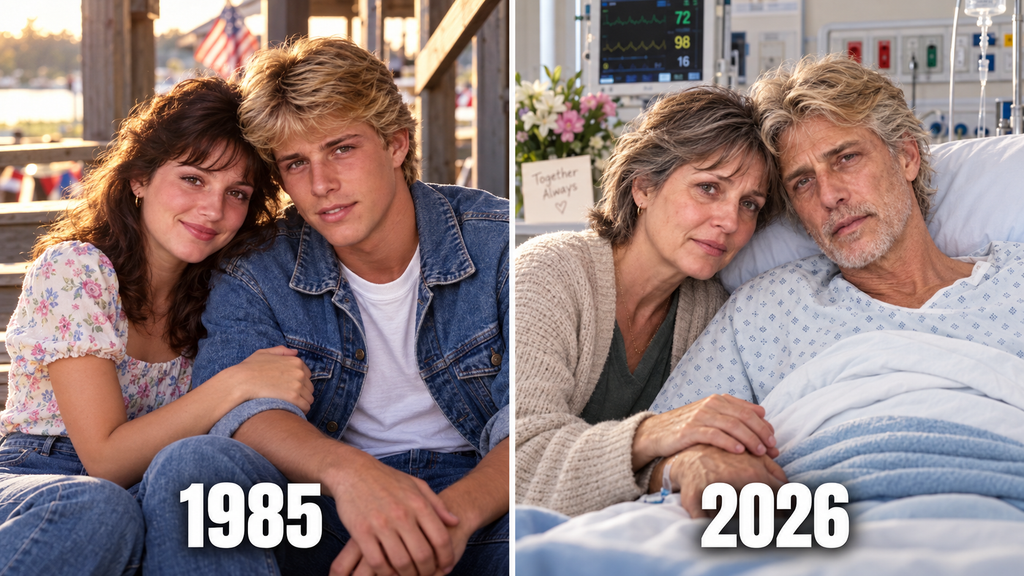
The faint hiss of oxygen.
The squeak of nurses’ shoes in the hallway.
All of it seemed to move farther and farther away.
There was only that ring.
And Jeffrey.
And forty-one years between us.
I stepped closer.
“You kept it?”
Jeffrey looked at the box.
His face crumpled.
“All this time.”
I reached for the chair but stopped before touching it.
The ring wasn’t extravagant.
A small diamond.
A thin gold band.
The kind of ring a nineteen-year-old boy could have bought after saving every dollar from a summer job.
My throat tightened.
“You bought this for me?”
Jeffrey nodded.
“In 1985.”
My knees nearly gave out.
Peter hurried forward and pulled another chair beside the bed.
“Please sit down.”
I barely heard him.
I sat.
Jeffrey and I stared at each other.
I had imagined seeing him again thousands of times.
Sometimes he was still nineteen.
Sometimes we met accidentally in a grocery store.
Sometimes he knocked on my door.
Sometimes I found him sitting beneath those old football bleachers, grinning as though no time had passed.
But never once had I imagined this.
A hospital.
An oxygen tube beneath his nose.
His son standing silently near the window.
And the ring Jeffrey had apparently carried through an entire lifetime.
I finally whispered,
“Tell me.”
Jeffrey closed his eyes.
For a moment, I thought he had fallen asleep.
Then he said,
“My father found the ring.”
I frowned.
“What?”
“The week before I left for college.”
His fingers tightened weakly around the blanket.
“You remember my father.”
Of course I remembered him.
Walter Bennett.
Tall.
Quiet.
Always dressed as though someone important might unexpectedly arrive.
He rarely smiled.
When Jeffrey and I were teenagers, Walter tolerated me.
That was the word for it.
Tolerated.
He never told me to leave.
But he never made me feel welcome either.
My father repaired furnaces.
My mother worked at the library.
Jeffrey’s father owned Bennett Manufacturing and had very definite ideas about what kind of future his only son should have.
I looked at Jeffrey.
“He knew?”
“He knew everything.”
My stomach tightened.
Jeffrey stared at the ceiling.
“I was working at Peterson’s Hardware that summer. Remember?”
I almost laughed through my tears.
“You hated that place.”
“I hated the aprons.”
“You said they made you look like somebody’s grandmother.”
A tiny smile crossed his face.
“There she is.”
“What?”
“That laugh.”
His eyes filled.
“I wondered if I’d ever hear it again.”
I looked away.
Forty-one years.
He didn’t get to make me cry and smile within five minutes.
Not yet.
“Keep talking.”
His smile vanished.
“I worked extra shifts because I wanted to buy you something. I didn’t know anything about diamonds. Mr. Peterson’s wife helped me pick it.”
I looked at the ring again.
“I was going to ask you the night before I left.”
My heart hurt.
Not metaphorically.
It actually hurt.
A pressure behind my ribs that made breathing difficult.
“You were nineteen.”
“I know.”
“You were going three states away.”
“I know.”
“We had never even kissed.”
Jeffrey laughed weakly.
“That was going to be part of the evening.”
Despite everything, I covered my mouth to keep from laughing.
Then the laughter turned into a sob.
Jeffrey watched me.
“I had a whole speech.”
“What did it say?”
“It was terrible.”
“Jeffrey.”
“Ruthie, I was nineteen.”
“What did it say?”
He swallowed.
“I was going to tell you that every girl I dated annoyed me because she wasn’t you.”
I stared at him.
“That was your romantic speech?”
“It got better.”
“It would have needed to.”
Peter laughed softly from the window.
Jeffrey pointed weakly toward him.
“See? No respect.”
For one beautiful second, I saw the boy again.
The skinny teenager who stole french fries from my plate.
The boy who drove an old Ford that only started if you kicked the dashboard.
The boy who once climbed through my bedroom window because I had the flu and he wanted to bring me grape soda.
Then Jeffrey coughed.
Hard.
Peter immediately crossed the room.
“Dad?”
Jeffrey lifted one hand.
“I’m okay.”
He wasn’t.
We all knew it.
When the coughing finally stopped, Jeffrey leaned back against the pillow.
His face had become frighteningly pale.
Peter adjusted his blanket.
“We can finish later.”
“No.”
“Dad—”
“No.”
Jeffrey looked at me.
“She waited forty-one years.”
My chest tightened.
“I didn’t know I was waiting.”
“Yes, you did.”
I wanted to argue.
But I couldn’t.
Because somewhere deep inside myself, I had known.
Every Christmas.
Every birthday.
Every time someone asked why I had never married.
Every time I saw two teenagers laughing in a parking lot.
Every time the phone rang unexpectedly.
Some small, ridiculous part of me had waited.
Not because I expected Jeffrey to return.
But because no one else had ever occupied the place he left behind.
Jeffrey took another breath.
“My father found the ring in my dresser.”
“And?”
“He went crazy.”
I had never heard Jeffrey describe his father that way.
“He told me I was throwing my future away. Said we were children. Said I would meet people at college who would change my entire understanding of the world.”
“That sounds like him.”
“He said something worse.”
Jeffrey hesitated.
“What?”
“He said you would hold me back.”
I felt something old and ugly stir inside me.
Jeffrey saw it.
“I told him he was wrong.”
“Did you?”
“I told him you were the smartest person I knew.”
My eyes burned.
“I told him you were the reason I had survived high school without becoming exactly like him.”
Peter looked toward the floor.
Jeffrey continued.
“My father told me that if I proposed to you, he wouldn’t pay for college.”
I stared at him.
“That’s why you left?”
“No.”
The answer came immediately.
“Then what?”
“I told him to keep his money.”
That surprised me.
Jeffrey smiled faintly.
“I had a plan. Loans. Work-study. Whatever it took.”
“Then why—”
“Because the next morning, my mother came into my room.”
Something in his expression changed.
Not sadness.
Shame.
Even after all these years.
“She was crying.”
I remembered Jeffrey’s mother, Margaret.
Soft-spoken.
Elegant.
Kind to me when Walter wasn’t around.
“She told me my father wasn’t bluffing. He had already canceled the tuition payment.”
Jeffrey stared down at his hands.
“Then she told me something I didn’t know.”
The monitor continued its slow rhythm.
Beep.
Beep.
Beep.
I waited.
Jeffrey whispered,
“My father had loaned your father money.”
I blinked.
“What?”
“Your dad’s repair business had nearly gone under that spring.”
I shook my head.
“No. Dad never said anything.”
“He wouldn’t have.”
“How much?”
“Enough that losing it would have cost your family the house.”
I stood abruptly.
The chair scraped against the floor.
“No.”
“Ruth—”
“No. My father would have told me.”
“Would he?”
I stopped.
That question hurt because I knew the answer.
My father had been proud.
Painfully proud.
He once drove with a cracked windshield for nine months because he refused to borrow money from my uncle.
If Walter Bennett had secretly helped him…
Dad would have taken that humiliation to the grave.
Jeffrey continued quietly.
“My father told me if I stayed away from you, the debt disappeared.”
My hands began trembling.
“If you stayed away?”
“He knew threatening my college wasn’t enough.”
“So he threatened my family.”
“Yes.”
I stared at the ring.
“You should have told me.”
“I know.”
“You should have told me!”
“I know.”
“We could have figured something out!”
“I know.”
My voice rose.
“Stop saying that!”
Peter moved toward the door.
“I’ll give you both some privacy.”
Jeffrey nodded.
Peter left.
The door closed softly behind him.
And suddenly Jeffrey and I were alone.
For the first time since 1985.
I stood beside his bed shaking with anger.
“You made that decision for me.”
“Yes.”
“You decided I couldn’t handle it.”
“Yes.”
“You decided losing you was somehow better than losing a house.”
“Yes.”
“You don’t get to call that love.”
Jeffrey closed his eyes.
“I know.”
“Then stop saying you loved me like it explains everything!”
His eyes opened.
“It doesn’t.”
That stopped me.
He looked directly at me.
“It explains nothing.”
His voice trembled.
“I was a coward.”
I stared at him.
“I told myself I was protecting you. That’s the story I repeated for years because it made me sound noble.”
A tear slid down his cheek.
“But the truth?”
He took a shaky breath.
“I was scared.”
I sat down again.
Jeffrey looked toward the ring.
“I was nineteen years old. My father had controlled everything my entire life. And when he put your family’s home in my hands, I panicked.”
I said nothing.
“So I left.”
“You still wrote to me.”
“I couldn’t stop.”
I remembered those letters.
Pages and pages.
Dormitory stories.
Bad cafeteria food.
Professors he hated.
Songs he thought I would like.
Then gradually fewer letters.
Shorter letters.
Longer spaces between them.
“I tried to do what my father demanded,” Jeffrey said.
“But every time something happened, you were still the person I wanted to tell.”
My eyes closed.
“I used to run to the mailbox.”
“I know.”
“How could you know?”
“Your mother told mine.”
I opened my eyes.
“Our mothers knew?”
“Not everything.”
Another secret.
Another piece of my life that other people had apparently understood better than I had.
Jeffrey continued.
“Then I met Elaine.”
His wife.
The woman whose name had destroyed me in 1986.
I stiffened.
Jeffrey noticed.
“She was kind.”
“I’m sure.”
“She deserved better than what I gave her.”
That wasn’t what I expected him to say.
I looked at him carefully.
“Did you love her?”
“Yes.”
The answer hurt.
But I respected it.
Jeffrey continued.
“Not the way I loved you.”
I looked down.
“But she was my wife, Ruth. She was Peter’s mother. She was my friend. And I did love her.”
“Then why keep the ring?”
He looked toward the little box.
“Because some parts of us belong to more than one chapter.”
I said nothing.
“I never wanted Elaine to compete with a ghost. You weren’t some secret fantasy I compared her to every morning.”
“Did she know about me?”
A long silence.
“Yes.”
That surprised me.
“How?”
“She found your letters.”
My stomach dropped.
“All of them?”
“All of them.”
“You kept those too?”
Jeffrey nodded.
“Every one.”
I covered my face.
“This is insane.”
“I know.”
“When?”
“1986.”
The year of the final letter.
I slowly lowered my hands.
“The letter.”
Jeffrey nodded.
Something cold moved through me.
“Elaine made you write it?”
“No.”
“Then what happened?”
Jeffrey struggled to sit higher.
I helped adjust his pillow without thinking.
The familiarity of the gesture nearly broke me.
My hands remembered caring for him even when my life had forgotten how.
He whispered,
“Elaine found the letters about three weeks before our wedding.”
I stared.
“She asked who you were.”
“What did you say?”
“The truth.”
“Which truth?”
“That you were my best friend.”
He paused.
“And the first person I ever loved.”
I flinched.
“She should have left you.”
“She almost did.”
I looked toward the window.
Rain had begun tapping softly against the glass.
Jeffrey continued.
“She asked if I still loved you.”
“And?”
“I lied.”
My eyes snapped toward him.
“I said no.”
“Why?”
“Because I was twenty years old, Ruth. I had spent a year convincing myself that what happened between us was over.”
He shook his head.
“And because admitting the truth would have meant admitting I was about to marry someone while part of my heart was somewhere else.”
“So you married her anyway.”
“Yes.”
There was no defense in his voice.
No attempt to make himself look better.
That somehow made it harder.
“And the letter?”
Jeffrey looked ashamed.
“My father found out Elaine had discovered your letters.”
I waited.
“He told me I needed to end things permanently.”
“You already had.”
“Not in his mind.”
My stomach tightened.
“What did he do?”
Jeffrey stared at me.
“He wrote the letter.”
Silence.
Absolute silence.
I heard the rain.
The monitor.
My own breathing.
“What?”
“The final letter you received.”
I stood again.
“No.”
“Ruth—”
“You wrote your name.”
“No.”
“I know your handwriting.”
“He copied it.”
“That’s impossible.”
“He had my old letters.”
I stared at him.
Jeffrey reached weakly toward the bedside drawer.
“Open it.”
I hesitated.
“Please.”
I pulled the drawer open.
Inside was a thick bundle tied with a faded blue ribbon.
Letters.
Dozens of them.
My handwriting.
My envelopes.
My stamps.
Forty years of dustless preservation.
Beneath them was another envelope.
Jeffrey said,
“Take it.”
I did.
Inside was a single sheet of paper.
I recognized Walter Bennett’s handwriting immediately.
I had seen it on birthday cards.
Graduation checks.
Notes Jeffrey carried from home.
The page contained several sentences copied repeatedly.
Please don’t contact me again.
Please don’t contact me again.
Please don’t contact me again.
Again.
Again.
Again.
Walter had been practicing Jeffrey’s handwriting.
My knees weakened.
“No.”
Jeffrey began crying.
“My mother found that page after my father died.”
I looked at the date.
My hands shook so violently that the paper rattled.
“I thought you hated me.”
“I never hated you.”
“I thought I had embarrassed myself.”
“No.”
“I thought every letter I sent you had become a burden.”
“Never.”
I pressed one hand against my mouth.
Forty-one years.
One forged letter.
One frightened young man.
One controlling father.
And an entire life had bent around it.
I looked at Jeffrey.
“Why didn’t you come back after your father died?”
The question hung between us.
Jeffrey looked away.
“My father died in 1994.”
“I know.”
“You knew?”
“Small towns.”
He nodded.
“By then Peter was six.”
I looked toward the door.
“And Elaine?”
“Pregnant with our second child.”
“You had another child?”
“A daughter. Emily.”
I absorbed that.
“Where is she?”
“Seattle.”
“Does she know I’m here?”
“She does.”
I almost laughed.
Apparently everyone knew everything except me.
Jeffrey understood the expression.
“I know.”
“Stop saying that.”
“Sorry.”
Despite myself, I smiled.
He smiled too.
Then his face became serious.
“I couldn’t destroy my family because I finally had permission to chase the life I wanted at nineteen.”
I sat down.
That answer, at least, I understood.
“I had made vows.”
“Yes.”
“And whatever mistakes created that marriage, Elaine wasn’t responsible for them.”
“No.”
“So I stayed.”
I looked at him.
“Were you happy?”
Jeffrey considered the question.
“Sometimes.”
That was probably the most truthful answer anyone could give about forty years.
“We raised two good children.”
His eyes moved toward the door.
“Peter teaches high school science. Emily is an architect. I loved watching them become people.”
“And Elaine?”
A softness appeared in his expression.
“She died six years ago.”
“I’m sorry.”
“Cancer.”
He looked at his hands.
“We had thirty-five years.”
I felt a strange grief for a woman I had never met.
A woman who had lived the life I once imagined would be mine.
But she hadn’t stolen it.
That mattered.
Elaine had not been the villain.
Neither had I.
Maybe even Jeffrey wasn’t.
We had simply been young people caught inside decisions made by frightened and controlling adults.
But one question remained.
“Why now?”
Jeffrey looked at me.
“You turned sixty.”
I laughed bitterly.
“You waited for the deadline?”
“Actually…”
He looked embarrassed.
“I started looking for you three years ago.”
“What?”
“Peter helped.”
The door opened slightly.
Peter leaned inside.
“I did.”
I stared at him.
“How?”
He entered.
“Dad is terrible with computers.”
“I am not.”
“You printed Google.”
Jeffrey frowned.
“I wanted to read it.”
Despite everything, I laughed.
Peter smiled.
“We searched social media. Alumni records. Property records. Anything public.”
“You couldn’t find me?”
“You never made it easy.”
I shrugged.
“I don’t use social media.”
“We noticed.”
“I still write checks.”
Peter laughed.
“That explains a lot.”
Jeffrey looked at his son.
“Tell her the rest.”
Peter’s smile disappeared.
“What rest?”
I asked.
Peter glanced at his father.
“Dad?”
“Tell her.”
Peter slowly sat near the foot of the bed.
“About eight months ago, Dad was diagnosed.”
I looked at Jeffrey.
“With what?”
He didn’t answer immediately.
Peter did.
“Pancreatic cancer.”
The words landed heavily.
I had suspected cancer.
But hearing it made the room change.
“How long?”
Jeffrey looked at me.
“Not long.”
“How long?”
“Doctors aren’t clocks.”
“Jeffrey.”
“Days. Maybe weeks.”
My eyes filled again.
No.
That wasn’t fair.
Forty-one years of silence, and now days?
I stood.
“This is cruel.”
“Ruthie—”
“No.”
I walked toward the window.
“You don’t get to come back into my life to die.”
He said nothing.
“You don’t get to call me after forty-one years, show me a ring, tell me you loved me, explain that half my life was built around a lie, and then leave again.”
My shoulders shook.
“That’s not fair.”
Behind me, Jeffrey whispered,
“No.”
I turned.
He was crying.
“No, it isn’t.”
And that was when my anger collapsed.
I crossed the room.
I sat beside him.
And for the first time since we were teenagers, I took Jeffrey Bennett’s hand.
His fingers were cold.
Thin.
But when they closed around mine, something inside me recognized them.
Not the shape.
Not the skin.
The person.
I bowed my head.
“I hated you.”
“I know.”
“For years.”
“You should have.”
“I burned your photograph.”
“I deserved that.”
“I kept the negative.”
He laughed.
Then I laughed.
Then somehow we were both crying.
Peter quietly left the room again.
Jeffrey squeezed my hand.
“I’m sorry.”
I shook my head.
“Don’t apologize because you’re dying.”
“I’m not.”
“Then why?”
“Because nineteen-year-old Jeffrey should have trusted nineteen-year-old Ruth.”
That sentence broke something open inside me.
I looked at him.
“Yes.”
“He should have told her everything.”
“Yes.”
“He should have let her choose.”
“Yes.”
“He shouldn’t have disappeared.”
“No.”
Jeffrey’s voice cracked.
“I’m sorry.”
I leaned forward and rested my forehead against his hand.
For several minutes, neither of us spoke.
Finally Jeffrey whispered,
“There’s something else.”
I lifted my head.
“Please tell me there isn’t another wife.”
He laughed.
“No.”
“Secret country?”
“No.”
“International espionage?”
“I worked in insurance.”
“That doesn’t rule it out.”
His laugh became a cough.
When it passed, he pointed toward the ring.
“I didn’t bring you here just to explain.”
I looked at him suspiciously.
“Jeffrey.”
“Open the box.”
“I already saw it.”
“Look underneath.”
I picked it up.
The velvet insert lifted.
Beneath it was a folded piece of paper.
Old.
Yellowed.
Creased.
I unfolded it carefully.
There were only six lines.
My eyes blurred before I reached the second.
Ruthie,
I don’t know what life will look like when we’re sixty.
Maybe we’ll have gray hair.
Maybe we’ll still argue about music.
Maybe we’ll have forgotten half the stupid things we did.
But if you are there, I hope I am too.
Jeffrey.
I stared at the page.
“When did you write this?”
“The night we made the promise.”
My mouth fell open.
“You were planning this even then?”
“I wasn’t planning anything.”
He smiled.
“I was nineteen.”
I touched the paper.
“You kept it for forty-one years?”
“Yes.”
“Why?”
“Because I never stopped hoping we’d get to sixty.”
My tears fell onto my hands.
“We did.”
“Barely.”
“Don’t joke.”
“Sorry.”
I looked at the ring.
Then at Jeffrey.
“You said you’d already bought it.”
“Yes.”
“You were going to propose?”
“Yes.”
“What exactly were you going to ask?”
He smiled.
“I don’t remember.”
“Liar.”
“Fine.”
His eyes closed for a moment.
When they opened again, they were wet.
“I was going to take you beneath the bleachers.”
My chest tightened.
“I was going to tell you I didn’t want to go through life comparing everyone to my best friend.”
I couldn’t speak.
“And then I was going to ask if you’d come with me.”
“To college?”
“To life.”
I started crying again.
“That’s still a terrible proposal.”
“I’ve had forty-one years to improve it.”
“You haven’t.”
“No.”
He smiled.
“Apparently not.”
Then his expression changed.
Serious.
Almost nervous.
Exactly like the boy I remembered.
“Ruth?”
“Yes?”
“Would you put it on?”
I looked at the ring.
“Jeffrey…”
“Not as an engagement ring.”
He swallowed.
“I have no right to ask that.”
“Then why?”
“Because it was always yours.”
I picked it up.
The gold was warm from my fingers.
I slipped it onto my ring finger.
It fit.
Perfectly.
I stared.
“How?”
Jeffrey smiled.
“You let me borrow one of your rings junior year.”
My mouth dropped open.
“You said you lost it!”
“I needed the size.”
“You thief.”
“I returned it.”
“Three months later!”
“Details.”
I held up my hand.
The diamond caught the pale hospital light.
Forty-one years late.
But finally where it had been intended to go.
Jeffrey stared at it.
And smiled.
Not the smile of a dying man.
The smile of a nineteen-year-old boy who had finally finished something he started.
“I knew it.”
“What?”
“Still looks right.”
I leaned toward him.
And then I did something we had failed to do forty-one years earlier.
I kissed him.
It wasn’t dramatic.
There was no music.
No applause.
No miracle.
It was soft.
Brief.
His lips trembled.
When I pulled away, Jeffrey’s eyes were closed.
Then he whispered,
“Well.”
I laughed through my tears.
“Well what?”
“That was worth waiting for.”
“You idiot.”
“Your idiot?”
I stared at him.
There it was.
The question beneath every other question.
I squeezed his hand.
“For today.”
He smiled.
“I’ll take it.”
THE DAYS THAT FOLLOWED
I didn’t go home that night.
Peter brought me coffee at midnight.
At two in the morning, Jeffrey woke and asked if I remembered the time we stole the school mascot.
“We didn’t steal it.”
“We relocated it.”
“You put it on Principal Harris’s roof.”
“It needed fresh air.”
We laughed until a nurse came in and told us Jeffrey needed rest.
At three thirty, he fell asleep holding my hand.
I watched him breathe.
Every rise of his chest felt borrowed.
Every minute suddenly mattered.
At sunrise, Peter found me still sitting there.
“You stayed.”
“Yes.”
He handed me coffee.
“Dad hoped you would.”
I looked at him.
“Peter, can I ask you something?”
“Anything.”
“Why did you agree to call me?”
He looked toward his sleeping father.
“Because I’ve heard your name my entire life.”
I froze.
“What?”
Peter smiled sadly.
“Not constantly.”
He sat.
“But whenever Dad told stories about being young, somehow Ruth was there.”
My throat tightened.
“The football bleachers.”
“Yes.”
“The broken Ford?”
“Yes.”
“The lake?”
Peter laughed.
“The canoe disaster?”
“It was his fault.”
“He said it was yours.”
“He lies.”
Peter smiled.
Then his expression softened.
“When Mom was dying, she asked me to make Dad promise something.”
“What?”
“That he wouldn’t spend the rest of his life alone because he thought loneliness was some kind of punishment he owed her.”
I looked toward Jeffrey.
“Elaine said that?”
“Yes.”
Peter hesitated.
“She knew about the ring.”
I stared at him.
“She knew?”
“She found it years ago.”
“And she let him keep it?”
Peter nodded.
“Mom understood Dad better than anyone.”
I didn’t know how to feel.
Jealousy seemed childish.
Gratitude seemed strange.
Grief seemed closest.
“She must have been extraordinary.”
“She was.”
Peter looked directly at me.
“And she wasn’t afraid of you.”
“What does that mean?”
“She once told me that loving someone who had loved deeply before wasn’t frightening.”
He paused.
“She said it proved they knew how.”
I looked away because I couldn’t stop crying.
Peter stood.
Before leaving, he said,
“She also knew about the promise.”
My head snapped up.
“What?”
“The sixty promise.”
“How?”
“Dad told her.”
“When?”
“Before they married.”
I stared.
Peter smiled faintly.
“Apparently Mom told him, ‘If we’re both still alive when you’re sixty, I’m driving you there myself.’”
A laugh escaped me.
Then I covered my face and cried.
Not because I hated Elaine.
Because suddenly I wished I had known her.
THE SECOND TWIST
Jeffrey was discharged three days later.
Not because he was better.
Because there was nothing more the hospital could do.
Peter asked where Jeffrey wanted to spend whatever time remained.
Jeffrey said,
“Home.”
Then he looked at me.
“Not my home.”
I understood immediately.
“No.”
“Ruthie.”
“No.”
“One afternoon.”
“You just got out of the hospital.”
“One afternoon.”
Peter looked between us.
“What place?”
I already knew.
The football field.
Our old high school had been renovated twice, but the original football bleachers still stood behind the newer stadium.
At least, I thought they did.
The next morning, Peter drove us there.
Jeffrey sat in a wheelchair.
I carried the old ring box in my purse.
When we reached the field, I stopped.
The bleachers were gone.
Nothing remained except a rectangle of newer grass.
Jeffrey stared.
“Well.”
I started laughing.
He looked at me.
“What?”
“Forty-one years.”
“What about it?”
“You waited forty-one years, and they tore down your romantic location.”
He began laughing too.
Peter looked horrified.
“I can find out where they moved them.”
That made us laugh harder.
Eventually Jeffrey wiped his eyes.
“Doesn’t matter.”
He pointed toward the empty patch of grass.
“There.”
Peter wheeled him over.
I sat beside him.
Not beneath the bleachers.
Where the bleachers used to be.
For a while we simply watched clouds move across the sky.
Then Jeffrey said,
“I need to tell you one more thing.”
I groaned.
“You really need to stop saying that.”
“This one’s important.”
“They’ve all been important.”
He reached into his jacket.
And pulled out an envelope.
My name was written across the front.
RUTH.
“What is it?”
“Open it after.”
“After what?”
He looked at me.
“You know.”
My throat closed.
“No.”
“Ruthie.”
“No.”
“I need you to promise.”
“I’ve already lost forty-one years. I’m not spending whatever time we have talking about losing more.”
He looked at me for a long moment.
Then placed the envelope in my hand.
“Fine.”
I put it in my purse.
But something bothered me.
The handwriting.
It wasn’t Jeffrey’s.
“Who wrote my name?”
He hesitated.
“Peter.”
“Why?”
“My hands shake.”
I accepted that.
I shouldn’t have.
Because that envelope contained the final secret.
And I wouldn’t discover it until six days later.
SIX DAYS
Six days.
That’s what we got.
Not forty years.
Not forty months.
Six days.
And strangely, they became some of the fullest days of my life.
We talked.
About everything.
About nothing.
Jeffrey told me about Elaine.
I told him about my parents’ final years.
He told me about Peter and Emily.
I told him about the bookstore where I had worked for twenty-three years.
He asked if I’d really never married.
“No.”
“Why?”
“I told you.”
“No right man?”
I looked at him.
“You want me to make your ego enormous right before you die?”
“Yes.”
“Absolutely not.”
He laughed.
Then I told him the truth.
“There were men.”
His eyebrows rose.
“Oh?”
“Don’t sound surprised.”
“I’m not.”
“You sound surprised.”
“I am appropriately threatened by men from thirty years ago.”
I smiled.
“One almost became serious.”
Jeffrey’s expression changed.
“What happened?”
“He asked me to marry him.”
“And?”
“I said no.”
“Why?”
I looked out the window.
“Because when I imagined walking toward someone at the end of an aisle, his wasn’t the face waiting for me.”
Jeffrey became quiet.
“Was mine?”
I didn’t answer.
I didn’t need to.
On the fourth day, Emily arrived from Seattle.
She walked into the room, looked at me, and immediately hugged me.
That startled me.
“You must be Ruth.”
“And you must be Emily.”
She pulled back.
“My dad’s impossible.”
“That hasn’t changed.”
“Good.”
She laughed.
Then she noticed the ring.
Her eyes filled.
“He gave it to you.”
“Yes.”
Emily nodded as if some unfinished family story had finally reached its proper page.
“Mom would be happy.”
I couldn’t speak.
That evening, the four of us ate terrible takeout Chinese food because Jeffrey said hospital food had made him “reconsider the concept of mercy.”
He ate three bites.
But he stayed awake through dinner.
At one point Peter asked,
“Dad, what was Ruth like at seventeen?”
Jeffrey answered immediately.
“Bossy.”
I threw a napkin at him.
“Loud.”
Another napkin.
“Terrible taste in music.”
“Your favorite band was Air Supply.”
“That information dies with me.”
Emily laughed so hard she nearly spilled her drink.
Then Peter asked me,
“What was Dad like?”
I looked at Jeffrey.
“Afraid.”
The room quieted.
Jeffrey stared at me.
Then I smiled.
“But brave when it mattered.”
His eyes filled.
He knew exactly what I meant.
Not that he had been brave at nineteen.
He hadn’t.
But bravery wasn’t something you either possessed or didn’t.
Sometimes it took forty-one years to find it.
THE LAST NIGHT
On the sixth night, Jeffrey became weaker.
The hospice nurse warned us.
“Tonight may be difficult.”
Peter stood near the kitchen pretending to make coffee.
Emily went into the bathroom and cried.
I sat beside Jeffrey.
We were at Peter’s house by then.
Jeffrey had refused to spend his final days surrounded by machines.
A hospital bed had been placed near the living-room windows.
Outside, autumn leaves moved in the wind.
Jeffrey slept most of the afternoon.
Around eleven, his eyes opened.
“Ruthie?”
“I’m here.”
“Sixty.”
I smiled.
“Both of us.”
“Technically I’m sixty-one.”
“You always were an overachiever.”
His fingers searched for mine.
I took his hand.
“Did we make it?”
My eyes filled.
“Yes.”
“The promise?”
“Yes.”
He smiled.
“We found each other.”
“Yes.”
His breathing became uneven.
“I’m sorry it took so long.”
I leaned close.
“You’re here.”
“Ruth.”
“Yes?”
“Don’t wait for me again.”
I froze.
“What?”
His eyes opened.
“Promise.”
I shook my head.
“No more promises.”
“Please.”
“Jeffrey—”
“Live.”
I looked away.
“Don’t make me do this.”
“Ruthie.”
His voice was barely audible.
“You spent too much of your life waiting for something you didn’t know you were waiting for.”
Tears ran down my face.
“Go somewhere.”
He took a breath.
“Do something stupid.”
Another breath.
“Fall in love.”
I laughed through tears.
“At sixty?”
“Especially at sixty.”
“You’re ridiculous.”
“Yes.”
His fingers tightened around mine.
“Promise me you won’t turn me into the ending of your story.”
I bowed my head.
“What if you were the story?”
“No.”
His voice became surprisingly firm.
“I was a chapter.”
I looked at him.
“A long one.”
“The best one.”
“Debatable.”
He smiled.
Then his eyes closed.
For a few minutes, neither of us spoke.
Finally I whispered,
“I promise.”
His lips moved.
“What?”
“I said I promise.”
Jeffrey smiled.
“Good.”
Those were the last words he ever said to me.
At 3:17 in the morning, with Peter on one side of him and Emily on the other, Jeffrey Bennett died holding my hand.
There was no dramatic final breath.
No sudden music.
No grand declaration.
His breathing simply slowed.
Then stopped.
And the room became impossibly quiet.
Peter lowered his head.
Emily whispered,
“Dad?”
I knew.
Before the nurse checked.
Before anyone said it.
I knew.
I leaned forward and kissed Jeffrey’s forehead.
“Sixty,” I whispered.
“We made it.”
THE LETTER
I found the envelope two days after the funeral.
I was sitting at my kitchen table.
The same landline that had started everything sat on the counter.
I had almost forgotten about the envelope.
Then I found it inside my purse.
RUTH.
Peter’s handwriting.
My hands shook as I opened it.
Inside were several pages.
The first sentence stopped me.
Ruthie,
If you’re reading this, I finally ran out of things to say out loud.
I laughed.
Then cried.
I kept reading.
I won’t ask you to forgive me.
Forgiveness given because someone died isn’t forgiveness. It’s guilt wearing nicer clothes.
I stared at that sentence for a long time.
Then continued.
I stole something from you when I was nineteen.
Not intentionally.
But I stole your choice.
I decided what you could survive.
I decided what was best for your family.
I decided silence would hurt less than truth.
I was wrong.
If I could go back, I wouldn’t change my father’s cruelty first.
I’d change my own fear.
I’d come to your window.
I’d tell you everything.
And then I’d let you decide.
My tears fell onto the paper.
But Ruthie, please don’t make the same mistake with the years you still have.
Don’t decide your life is finished because mine is.
I turned the page.
There was another paragraph.
And beneath it, something that made me stop breathing.
A name.
Daniel Mercer.
A phone number.
I frowned.
Who was Daniel?
Then I read Jeffrey’s explanation.
You once told me your dream was to see Ireland.
You said it under the bleachers when we were eighteen.
You probably forgot.
I didn’t.
Daniel runs a small travel company. Peter helped arrange everything.
There is a ticket waiting for you.
One month from now.
Dublin.
No return date booked.
I stood so abruptly my chair fell backward.
“No.”
I kept reading.
Before you get angry, yes, I know you hate surprises.
No, this isn’t charity.
And yes, I paid for it.
Consider it forty-one years of birthday presents with interest.
I laughed aloud.
That idiot.
That impossible, infuriating idiot.
Then came the final lines.
You asked me why I kept the ring.
Here is the real answer.
It wasn’t because I expected you to come back.
It was because keeping it reminded me that once, when I was very young, I knew exactly whom I loved.
Most people spend their lives searching for that certainty.
I had it.
Even if I was too afraid to honor it properly.
Thank you for finding me at sixty.
Now go find yourself at sixty-one.
Love,
Jeffrey
P.S. Air Supply still isn’t good.
I laughed so loudly I startled myself.
Then I cried for nearly an hour.
ONE MONTH LATER
I went to Ireland.
Of course I did.
Jeffrey knew I would.
I packed one suitcase.
I wore his ring on a chain around my neck.
Not on my finger.
That mattered.
The ring represented what might have been.
But my finger belonged to whatever might still be.
At the airport, Peter and Emily surprised me.
They had come to see me off.
Emily hugged me.
Peter handed me a small package.
“Dad wanted you to have this too.”
I stared at him.
“There are more?”
“Apparently he became very productive after his diagnosis.”
I opened it.
Inside was a photograph.
Jeffrey and me.
Seventeen years old.
Sitting on the hood of his terrible Ford.
I had forgotten the picture existed.
On the back, Jeffrey had written:
Before we knew how expensive fear could become.
Underneath:
Don’t waste another dollar on it.
I pressed the photograph to my chest.
Peter hugged me.
“Call when you land.”
“I will.”
Then he hesitated.
“Ruth?”
“Yes?”
“Thank you.”
“For what?”
“For making my father nineteen again.”
I couldn’t answer.
So I hugged him harder.
DUBLIN
Ireland was rainy.
Cold.
Beautiful.
I got lost twice on my first day.
I ate breakfast alone.
Walked beside the River Liffey.
Listened to musicians on Grafton Street.
And for the first time in decades, I didn’t feel as though I was waiting for something.
On my fifth day, I took a train west.
An elderly woman sat across from me.
She noticed the ring hanging from my necklace.
“Beautiful,” she said.
“Thank you.”
“Your husband’s?”
I almost corrected her.
Then I smiled.
“Someone I loved.”
She nodded.
“Past tense?”
I looked out the window.
Green fields rolled beyond the glass.
“No.”
The woman smiled.
“That’s the thing about love.”
“What?”
“People confuse ending with disappearing.”
I looked at her.
She shrugged.
“Old woman philosophy.”
I laughed.
But I wrote the sentence down later.
Because she was right.
Jeffrey’s life ended.
His love didn’t disappear.
Neither did mine.
But love, I eventually learned, isn’t always a destination.
Sometimes it is a bridge.
And Jeffrey, in his final days, had built one for me.
Not back to him.
Forward.
ONE YEAR LATER
On my sixty-first birthday, my phone rang.
Not the landline.
My cellphone.
I was standing outside the old high school.
Peter had called earlier that week.
“They’re putting up a memorial bench near the football field.”
“For Jeffrey?”
“For Mom and Dad.”
I smiled.
“That sounds right.”
So I went.
Peter and Emily were already there.
The bench sat near the place where the old bleachers had once stood.
A small plaque read:
JEFFREY AND ELAINE BENNETT
THE BEST STORIES LEAVE ROOM FOR ANOTHER CHAPTER.
I touched the words.
Emily came beside me.
“Dad picked the quote.”
“Of course he did.”
Peter grinned.
“He had opinions about font size too.”
“That also sounds right.”
We sat together.
For a while, nobody spoke.
Then Peter handed me a tiny envelope.
I stared at him.
“You’re kidding.”
He laughed.
“Last one.”
“You swear?”
“Last one.”
I opened it.
Inside was a single index card.
Jeffrey’s handwriting.
This time genuinely his.
Old handwriting.
Teenage handwriting.
Ruthie,
If we’re both single at sixty, we stop being idiots and find each other.
Deal?
Underneath, in my own seventeen-year-old handwriting, apparently added sometime later, was one word.
Deal.
I covered my mouth.
I remembered.
We had written it down.
Of course we had.
Because Jeffrey never trusted me to remember anything.
I looked at Peter.
“Where did you find this?”
“Dad’s wallet.”
“He carried it?”
“Every day.”
My eyes closed.
For forty-one years.
Every grocery store.
Every business trip.
Every birthday.
Every ordinary Tuesday.
That ridiculous little card had been inside his wallet.
I began to cry.
Emily put her arm around me.
But these tears were different.
They weren’t for what had been stolen.
They weren’t for Walter Bennett.
They weren’t for the forged letter.
They weren’t even entirely for Jeffrey.
They were for two teenagers beneath a set of football bleachers who had accidentally made the only promise they would both keep perfectly.
Not on time.
Not gracefully.
Not without pain.
But they kept it.
We found each other.
THE LAST SURPRISE
I thought that was the end.
It wasn’t.
Three weeks later, I received a letter from an attorney.
My first thought was that Jeffrey had done something ridiculous with his will.
He had.
But not what I expected.
The attorney explained that Jeffrey had created a small scholarship fund.
Not in his name.
Not in Elaine’s.
Mine.
THE RUTH MARSHALL SECOND CHAPTER SCHOLARSHIP.
It would help adults over fifty return to college, learn a trade, start a small business, or pursue something they had postponed because life got in the way.
I called Peter immediately.
“He named a scholarship after me?”
Peter laughed.
“He said you’d be furious.”
“I am furious.”
“He also said you’d secretly love it.”
“I hate when dead people are smug.”
Peter laughed harder.
Then his voice softened.
“There’s one condition.”
“Oh, good.”
“You choose the first recipient.”
I went silent.
“What?”
“Dad wanted you on the board.”
I sat down.
“Why?”
“Because he said nobody understood lost time better than you.”
That sentence stayed with me.
Two months later, I read the first group of applications.
One came from a fifty-eight-year-old woman named Carol.
She had raised four children.
Worked nights for thirty years.
Always wanted to become a nurse.
She wrote:
I used to think starting over after fifty was embarrassing. Now I think not starting at all would be worse.
I chose her.
Not because her story was the saddest.
Because it wasn’t.
Her story was hopeful.
And Jeffrey had taught me, in the strangest and most painful way possible, that hope mattered more than regret.
TWO YEARS LATER
At sixty-two, I did something Jeffrey would have found hilarious.
I went on a date.
His name was Thomas.
We met in Ireland.
Not on that first trip.
On my second.
Yes.
I went back.
Thomas was a widower.
He talked too much.
Burned toast.
Loved jazz.
Hated football.
And had absolutely no resemblance to Jeffrey.
That was important.
The first time Thomas asked me to dinner, I nearly said no.
Then I heard Jeffrey’s voice in my head.
Don’t wait for me again.
So I said yes.
Dinner became coffee.
Coffee became walks.
Walks became weekends.
And one evening Thomas noticed the ring hanging around my neck.
He didn’t ask me to take it off.
He simply said,
“He must have mattered.”
I looked at the little diamond.
“He did.”
Thomas nodded.
“Then I’m glad you had him.”
That was when I knew I could love again.
Not because Thomas replaced Jeffrey.
Nobody could.
But because he didn’t try.
FIVE YEARS AFTER THE PHONE CALL
I am sixty-five now.
The old landline is gone.
Peter finally convinced me to disconnect it.
I resisted for months.
Some foolish part of me thought removing the phone meant removing the night Jeffrey called.
Eventually I understood something.
Memories don’t live inside objects.
We put them there.
And we can carry them somewhere else.
The ring still hangs around my neck.
Jeffrey’s letters are in a wooden box upstairs.
The forged letter is there too.
For a while, I considered burning it.
Then I decided against it.
Because even cruel things can become evidence.
Evidence of what fear costs.
Evidence of what silence destroys.
Evidence that love without honesty can still wound the people it tries to protect.
Every year on my birthday, I visit the football field.
Sometimes Peter comes.
Sometimes Emily flies in.
Sometimes I go alone.
I sit on the memorial bench.
And I tell Jeffrey what happened.
Carol finished nursing school.
The scholarship has helped twenty-three people.
Peter became a principal.
Emily had a daughter.
She named her Margaret, after Jeffrey’s mother.
Thomas proposed to me last spring.
I said yes.
I laughed when I told Jeffrey that one.
“You told me to fall in love,” I said to the empty field. “You didn’t say anything about getting married.”
Wind moved through the trees.
No answer.
Of course.
But I smiled anyway.
Thomas and I are getting married next month.
Small ceremony.
No church.
No enormous reception.
Just family.
Peter is walking me down the aisle.
Emily is bringing flowers.
And inside my bouquet will be one tiny blue ribbon.
The same ribbon that held Jeffrey’s letters together for forty-one years.
Thomas knows.
He understands.
Love isn’t diminished by acknowledging what came before it.
If anything, it becomes more honest.
THE FINAL PROMISE
Last Tuesday, I turned sixty-five.
I went to the field alone.
The sun was beginning to set.
I sat on Jeffrey and Elaine’s bench and took the old index card from my purse.
I don’t carry it every day.
Only on birthdays.
I read the words again.
If we’re both single at sixty, we stop being idiots and find each other.
Deal?
I laughed.
“You always were dramatic.”
Then I looked toward the place where the bleachers used to stand.
For years, I believed my story with Jeffrey was about lost time.
It wasn’t.
Not entirely.
It was about choice.
At nineteen, choices were taken from us.
Jeffrey’s father made choices that weren’t his to make.
Jeffrey made choices that weren’t his to make for me.
And I spent decades making choices based on a wound whose true shape I didn’t understand.
But at sixty, something changed.
Jeffrey called.
I answered.
He told the truth.
I listened.
I became angry.
He let me.
I forgave some things.
I didn’t forgive others.
And that was all right.
Forgiveness doesn’t require rewriting the past.
Love doesn’t require pretending someone never failed you.
Sometimes love is simply looking at the whole truth and deciding that the beautiful parts still mattered.
I stood from the bench.
The sun was nearly gone.
I touched the ring around my neck.
“Goodbye, Jeffrey.”
For years, I couldn’t say those words.
Goodbye sounded too permanent.
Too cruel.
But now I understood.
Goodbye doesn’t mean it didn’t matter.
It means it mattered enough to deserve an ending.
I started walking toward my car.
Then stopped.
I looked back once.
And for half a second, memory played its favorite trick.
I could see him.
Seventeen years old.
Leaning against the bleachers.
Hair falling into his eyes.
That ridiculous grin on his face.
“Hey, Ruthie.”
I smiled.
“Hey, Jeffrey.”
Then the image disappeared.
I kept walking.
Because he had asked me to.
Because I had promised.
And because some promises aren’t meant to keep you waiting.
Some promises are meant to set you free.
Forty-one years after Jeffrey walked out of my life, I finally understood why he had left.
But that wasn’t the greatest gift he gave me.
The greatest gift came six days after he returned.
When a dying man who had spent most of his life regretting one frightened decision looked at me and refused to let regret become my future too.
At nineteen, we promised that if we were both single at sixty, we’d find each other.
We were.
We did.
We were late.
We were foolish.
We lost years we could never recover.
But beneath all that time, the promise survived.
And so did we.
Not in the way I once imagined.
Not with fifty years of marriage.
Not with children who had my eyes and Jeffrey’s smile.
Not with matching rocking chairs on some front porch.
Life didn’t give us that ending.
It gave us six days.
Six precious, heartbreaking days.
For a long time, I thought that wasn’t enough.
Now I know better.
Sometimes a lifetime is measured in years.
Sometimes it is measured in moments.
A phone ringing in an empty house.
A familiar voice saying your childhood nickname.
A tiny diamond waiting inside a faded box.
A first kiss forty-one years late.
A hand held through the night.
A final breath.
A letter.
A plane ticket.
A second beginning.
And sometimes, if you’re very lucky, the person you spent half your life missing comes back just long enough to teach you how to stop waiting.
Jeffrey kept our promise.
And then he made me keep one more.
Live.
So I did.
And tomorrow morning, at sixty-five years old, I’m going to wake beside a man I love, drink terrible coffee, complain about my knees, argue about where we’re spending Christmas, and continue writing a life I once believed had already passed me by.
The ring will still be around my neck.
Jeffrey will still be part of me.
Thomas will still be beside me.
There is room for both truths.
Because the heart is not a house with only one bedroom.
It doesn’t need to evict yesterday to make room for tomorrow.
It simply grows.
I wish I had understood that at nineteen.
But maybe some lessons require sixty years.
Before leaving the field that evening, I whispered one final sentence toward the empty grass.
“I found you, Jeffrey.”
Then I smiled.
“And now I’m going to find the rest of me.”
I walked away without looking back again.
This time, it didn’t feel like abandoning him.
It felt like keeping my promise.
And somewhere between the girl I had been at nineteen and the woman I became at sixty-five, I finally understood the truth:
The saddest love stories aren’t always the ones where two people fail to end up together.
Sometimes they’re the ones where fear steals the years they should have had.
But the most beautiful stories?
They’re the ones where, even after the years are gone, someone finds the courage to tell the truth.
Someone finds the courage to forgive.
And someone finds the courage to keep living.
Jeffrey and I found each other at sixty.
Exactly as we promised.
But in the end, he gave me something even greater than the future we never had.
He gave me back the future I still did.
And this time—
I wasn’t going to waste a single day of it.
THE END! THANK YOU FOR READING!❤️