
At my daughter’s funeral, my son-in-law pointed at his daughters and announced, “They’re going into foster care. I deserve a fresh start with my new fiancée.”
More than two hundred mourners stood frozen in silence. He had no idea the girls had already hidden their mother’s notebook, secret recordings, and one final envelope that would destroy his wedding before he ever reached the altar.
“If nobody wants to take responsibility for those girls, I’ll hand them over to Child Protective Services on Monday,” Arturo said. “I’m not wasting my life raising children whose mother is already dead.”
Those were the words my son-in-law chose to say beside my daughter’s coffin.
Not in a whisper.
Not through tears.
Not like a grieving husband standing over the woman he had once promised to love for the rest of his life.
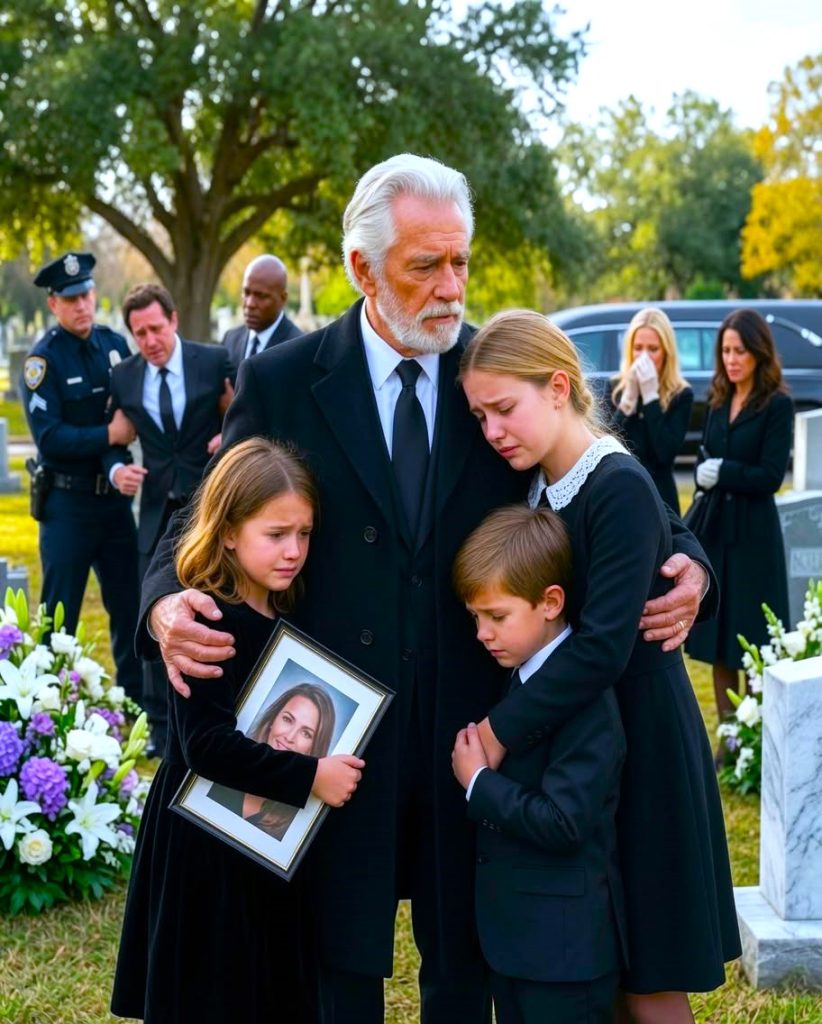
He said them loudly, in the middle of the cemetery in Puebla, while the earth covering Rosa’s grave was still fresh and the scent of white lilies lingered in the damp afternoon air.
My daughter had been buried less than an hour earlier.
She was only thirty-five years old.
Before the mourners had even begun to leave, Arturo was already talking about getting rid of their three daughters as though they were nothing more than an inconvenience standing between him and his new life.
Something inside my chest broke.
Beside me stood my granddaughters.
Twelve-year-old Lucía clutched her mother’s framed photograph so tightly that her knuckles had turned white.
Nine-year-old Renata stared silently at the freshly covered grave, her face completely empty.
Little Abril, only six years old, buried herself against my black coat, trembling so hard I could feel every shake of her tiny body.
Arturo looked untouched by grief.
His tailored gray suit was immaculate.
His expensive shoes gleamed despite the muddy ground.
A luxury watch rested beneath the cuff of his sleeve.
Not a single tear marked his face.
His phone vibrated.
He glanced down, read the message, and the faintest smile crossed his lips, as though someone, somewhere, was already waiting to celebrate with him.
I looked directly at him.
“What did you just say?”
He released a long, impatient sigh, as if I were the one making the day more difficult.
“Don Julián,” he replied calmly, “don’t do this. Rosa is gone. I have every right to move on with my life.”
“And your daughters?”
His eyes shifted toward the girls for barely a second.
Then he dismissed them with a careless wave of his hand.
“My girlfriend isn’t interested in raising three girls who barely respect me.”
He shrugged.
“You’re their grandfather. If they matter that much to you, then you take them.”
A heavy silence settled over the cemetery.
Several relatives lowered their eyes.
My godmother pressed both hands over her mouth.
Even the priest quietly looked away, unwilling to witness what had just happened.
For one brief moment, I wanted to hit him.
I wanted to wipe that smug expression off his face before another word left his mouth.
But then I felt a tiny hand wrap around mine.
Abril.
She squeezed my fingers so tightly that my anger dissolved into something even heavier.
Heartbreak.
When I looked down at the girls, something immediately felt wrong.
Lucía wasn’t crying.
That frightened me more than anything Arturo had said.
She wasn’t angry.
She wasn’t begging her father to stay.
She simply watched him with a calm, unreadable expression that no twelve-year-old should ever have.
Then she turned toward Renata.
Renata looked back.
Finally, both of them glanced at little Abril.
The three sisters exchanged a silent understanding.
No words.
No tears.
Just one look.
A look that made my stomach tighten.
In that instant, I realized they already knew something.
Something I didn’t.
I knelt beside them.
“You’re coming home with me,” I said softly.
Arturo let out a quiet laugh.
“Perfect. That solves my problem.”
He never hugged his daughters goodbye.
He never kissed their foreheads.
He never asked whether they had clothes, medicine, or even a place to sleep.
He simply turned his back and walked toward a white van waiting outside the cemetery gates.
Inside sat a young woman wearing oversized dark sunglasses.
She smiled the moment she saw him approaching.
He climbed in beside her.
The van drove away.
And he never looked back.
That night, my home felt painfully quiet.
I heated soup.
Warmed fresh tortillas.
Made up the small bedroom where Rosa used to sleep whenever she visited me during the most difficult months of her marriage.
Renata fell asleep wearing one of her mother’s oversized blouses.
Abril refused to let go of my hand until exhaustion finally closed her eyes.
Only Lucía stayed awake.
She sat beside the living-room window for hours, staring into the darkness without saying a single word.
Just after three o’clock in the morning, I heard soft footsteps.
She quietly walked into the kitchen, where I was sitting alone with a cup of untouched coffee.
“Grandpa.”
Her voice was barely louder than a whisper.
I looked up.
She was holding a small purple cloth bag against her chest.
“What is it, sweetheart?”
She swallowed hard.
Then she said the words that made the blood drain from my face.
“Mom didn’t die just because she was sick.”
Every muscle in my body froze.
I stared at her.
“What do you mean?”
Without answering immediately, Lucía carefully placed the little cloth bag on the kitchen table.
Her hands were shaking.
Slowly, she untied the string.
Inside were three things.
An old cellphone.
A worn notebook.
And a small USB drive.
She looked down at them before lifting her eyes to meet mine.
“Mom told us that if anything ever happened to her, we had to give these to someone who still loved her.”
The room fell completely silent.
I looked at the phone.
Then the notebook.
Then the USB drive.
In that moment, I realized my daughter hadn’t left us only with memories.
She had left behind the truth.
I reached for the phone, but Lucía placed her hand over it.
“There’s a password.”
“What is it?”
“Our birthdays.”
She entered six numbers.
The screen illuminated.
Dozens of audio recordings appeared in a folder labeled “Recipes.”
Some were only a few minutes long.
Others lasted nearly an hour.
The earliest had been recorded more than a year before Rosa’s death.
I pressed the first file.
My daughter’s voice filled the kitchen.
It was quiet and frightened.
“February fourth. Arturo came home after midnight again. He said he was meeting a client, but his shirt smelled like perfume. When I asked him about it, he called me paranoid. Later, I found a hotel receipt in his jacket.”
The recording ended.
Lucía stared at the table.
I selected another.
“March seventeenth. Arturo transferred money from the girls’ education account. He says he will replace it before anyone notices. I told him the money belongs to our daughters. He said everything in this house belongs to him.”
Another recording.
“April ninth. The doctor says the treatment is working slowly, but Arturo keeps telling people I am getting worse. He has begun asking questions about the house, my insurance policy, and what happens to my shares in Papá’s workshop if I die.”
My hands began to shake.
Rosa had inherited part ownership of the furniture workshop I had spent nearly forty years building.
The shares were supposed to pass to her daughters if anything happened to her.
Arturo knew that.
He had asked me about it more than once, always pretending he was simply helping Rosa organize her affairs.
I had trusted him because my daughter had trusted him.
Or at least, I believed she had.
I opened the notebook.
Rosa’s handwriting covered every page.
Dates.
Amounts of money.
Names of banks.
Descriptions of arguments.
Copies of account numbers.
She had even written down the license plate of the white van that had carried Arturo away from the cemetery.
Next to it was the name Camila Torres.
The woman in the van.
The new fiancée.
Lucía watched me reading.
“Mom knew about her,” she said.
“How long?”
“Almost a year.”
I looked at my granddaughter.
“And you knew?”
Lucía nodded.
“Mom told me not to say anything because Dad would get angry.”
“What did he do when he got angry?”
She lowered her eyes.
“He shouted. He broke things. He took Mom’s medicine away once and said she could have it back when she apologized.”
My heart felt as though it had been crushed beneath a stone.
“Did he ever hurt you?”
“He never hit us,” Lucía said quickly. “But he told us that if we made trouble, Mom would die faster because of the stress.”
Renata appeared in the doorway behind us.
She had been listening.
“He said Grandpa wouldn’t believe us,” she added.
I stood and pulled both girls into my arms.
They were children.
They should have been worrying about school, games, birthday parties, and which movie to watch on Sunday.
Instead, they had spent months protecting their dying mother from the man who was supposed to protect all of them.
“What is on the USB drive?” I asked.
Lucía’s face became pale.
“Mom said that was the most important part.”
I carried my old laptop into the kitchen and inserted the drive.
A collection of folders appeared.
Bank records.
Emails.
Photographs.
Medical documents.
A copy of Rosa’s will.
And one video file.
The date showed that it had been recorded three weeks before she died.
I clicked it.
Rosa appeared on the screen.
She was sitting in her bedroom, wrapped in a blue shawl.
Her face was thin from illness, but her eyes were clear.
For several seconds, she simply looked at the camera.
Then she spoke.
“If you are watching this, I am probably gone.”
I covered my mouth.
The girls moved closer to me.
“I need you to know that I was sick,” Rosa continued. “But my illness is not the only reason I became weaker.”
She paused to catch her breath.
“Arturo has been controlling my medication, my bank accounts, and my access to the doctor. He tells everyone he takes care of me. Sometimes he does. Other times, he hides my medicine or gives it to me late. He says I am confused because of the treatment.”
My vision blurred with tears.
“I do not know whether he wants me dead,” she said. “I only know he has already planned a life that does not include me or our daughters.”
Lucía began crying silently.
On the screen, Rosa looked down for a moment.
“When I confronted him about Camila, he said I should be grateful anyone was willing to stay near a sick woman. He said that after I died, he would sell the house, take the insurance money, and begin again.”
My fists tightened.
“But the house is not his,” Rosa said.
She looked directly into the camera.
“I changed my will. Everything I own is being placed in trust for Lucía, Renata, and Abril. My father, Julián, will be the trustee and guardian if he is willing.”
The girls looked at me.
I placed my arm around them.
“I am willing,” I whispered.
Rosa continued.
“I have also contacted an attorney. Her name is Elena Vargas. She has copies of these records. If Arturo abandons the girls or tries to take their inheritance, she will know what to do.”
The video ended with Rosa crying.
Not for herself.
For her daughters.
“Papá,” she said in the final seconds, “I’m sorry I didn’t tell you sooner. I was ashamed. I thought I could fix everything. Please don’t let my girls believe they were unwanted. They were the greatest joy of my life.”
The screen turned black.
For a long time, none of us moved.
Then Abril entered the kitchen, rubbing her eyes.
“Is Mommy in the computer?”
Lucía immediately wiped her tears.
“Yes,” she said. “Mommy left us a message.”
Abril climbed onto my lap.
“Can we watch it again?”
I closed the laptop.
“Not tonight, little flower.”
She rested her head against my chest.
“Daddy said Mommy left because she didn’t love us enough to stay.”
I felt a pain so sharp that I almost stopped breathing.
I held her tighter.
“Your mother fought every day to stay with you. Never believe anything different.”
The next morning, I called Elena Vargas.
She answered on the second ring.
The moment I said Rosa’s name, her voice changed.
“Don Julián, I have been expecting your call.”
We met that afternoon in her office.
Elena was a composed woman in her forties with sharp eyes and a quiet voice.
She listened while I explained what Arturo had said at the funeral.