 Reading Time: 14 minutes
My husband filed for divorce, hoping to take my daughter. But in court, she surprised the judge. “I want to show you something Mom doesn’t know about, Your Honor.” That was the moment everything changed.
Not long before that day, I donated a kidney to my husband, Nick.
It still feels strange to write those words.
I gave him a part of my body.
I let doctors cut me open, remove something I was born with, and place it inside the man I believed I would grow old beside.
For months before the surgery, Nick had been sick.
He was pale, thin, and angry all the time. His kidneys were failing, and the waiting list was uncertain. We had been married for fifteen years, and I did not hesitate when the doctors asked if I wanted to be tested.
Of course I wanted to be tested.
He was my husband.
He was Chloe’s father.
When the results came back and I was a match, everyone called it a miracle.
Nick cried in my arms that night.
At least, I thought he cried from gratitude.
“I don’t deserve you,” he whispered.
I kissed his forehead and told him not to say that.
I believed love meant giving everything when someone needed you.
I did not know I was giving him exactly what he had been waiting for.
The surgery was hard.
Harder than I admitted to anyone.
When I woke up, my throat was dry, my side burned, and my whole body felt like it had been dragged across concrete. The nurses told me the transplant had gone well. Nick was stable. His new kidney was working.
My kidney.
I remember smiling through the pain.
For the first time in months, I thought we might be okay.
Two days after surgery, I was lying in my hospital bed, still groggy from medication, my stitches pulling every time I shifted. A nurse had just helped me sit up enough to sip water. Chloe was with my sister in the cafeteria, getting lunch.
Nick was in the bed across the recovery suite.
He looked weak, but better.
Color had returned to his face.
His voice was thin when he said my name.
“Rachel.”
I turned my head slowly.
“Yeah?”
He stared at the ceiling for a moment, then looked at me.
“You finally fulfilled your purpose.”
I thought I misheard him.
“What?”
He adjusted his blanket with trembling hands.
“You gave me the kidney. That’s what I needed from you.”
I laughed softly because I thought he was making some awful joke under pain medication.
“Stop,” I whispered. “The nurse will hear you.”
“I’m not joking.”
The room went cold.
“What are you talking about?”
Nick looked at me as if he had been waiting years to say the words.
“Let’s get divorced.”
At first, I could not understand.
The pain medicine made everything feel far away, but his face was sharp and clear.
Divorced?
After everything?
I stared at him, waiting for him to smile.
He did not.
“Nick,” I said, my voice barely above a whisper. “I just saved your life.”
“And I appreciate that,” he replied. “But appreciation doesn’t equal love.”
Something inside me went silent.
Not broken.
Silent.
The kind of silence that comes before your whole world collapses.
He continued as if he were explaining a business decision.
“The truth is, I can’t stand you. I never loved you the way you loved me. I stayed because it was convenient. Then I got sick, and leaving would have looked bad. But now the surgery is done.”
My heart pounded so hard that the monitor beside my bed began to beep faster.
“You’re saying this now?” I breathed. “Here?”
“When else would I say it?”
The cruelty of that question stunned me more than the divorce.
When else?
Maybe before I agreed to lose an organ.
Maybe before I signed the consent forms.
Maybe before I kissed Chloe goodnight and promised her both parents would come home stronger.
Maybe before I prayed in a hospital chapel for his life while ignoring my own fear.
“You used me,” I whispered.
Nick looked away.
“Don’t make it dramatic.”
Then he said the sentence that truly terrified me.
“I’ll be asking for full custody of Chloe.”
My blood turned to ice.
“No.”
“Rachel, be realistic. You’re recovering. You’re emotional. You won’t be stable for a while.”
“I am her mother.”
“And I am her father.”
“You don’t even know her teacher’s name.”
His jaw tightened.
“My lawyer says stability is what matters. I have income. I have the house. I can provide continuity.”
I tried to sit up and gasped from the pain.
“You are not taking my daughter.”
Nick watched me struggle with no pity in his eyes.
“That reaction is exactly what I’m talking about. Unstable.”
I pressed the call button because I suddenly felt like I could not breathe.
The nurse came in, and Nick closed his eyes, pretending to be exhausted.
I said nothing.
What could I say?
My husband just told me he used me for my kidney and now wants to take my child?
It sounded insane.
And somehow, over the next weeks, he made me look like the insane one.
By the time we were both discharged, Nick had already hired one of the best divorce lawyers in the state.
His name was Daniel Cross.
He was smooth, expensive, and cruel in a polished way. He wore perfect suits and spoke as if every word had been sharpened before leaving his mouth.
I did not have that kind of money.
Nick had already moved funds from our joint accounts, claiming he was “protecting marital assets.” He canceled one credit card and lowered the limit on another. He changed passwords to accounts I had used for years.
When I asked how I was supposed to pay for my medication and follow-up appointments, he shrugged.
“Ask your sister.”
I was still recovering.
I could barely walk across the room without holding my side.
I could not lift laundry baskets.
I could not drive for long.
I could not even sleep properly because pain woke me every time I turned.
And Nick used all of it as evidence.
He filed emergency custody paperwork claiming I was medically fragile, emotionally erratic, and incapable of caring for Chloe full-time.
Chloe was eleven.
Old enough to understand that something terrible had happened.
Too young to be dragged into it.
I tried to shield her as much as I could, but children are not blind. She saw the way Nick spoke to me. She saw the way I flinched when bills arrived. She saw me cry silently in the kitchen when I thought she was asleep.
The night before our next court appearance, Chloe climbed into my bed.
She was wearing her purple pajamas, the ones with little moons on them. Her hair was tangled from crying, and her eyes were swollen.
“I don’t want to leave you, Mommy,” she sobbed. “I want to live with you.”
I held her carefully against me, trying not to let her body press against my incision.
“Don’t cry, my angel,” I whispered. “I’ll figure something out.”
“But Dad said the judge might make me stay with him.”
My throat tightened.
“What else did Dad say?”
Chloe went still.
That was when I should have known.
She looked down at the blanket and shook her head.
“Nothing.”
“Chloe.”
“He said grown-up stuff.”
The fear in her voice made my blood heat.
I wanted to ask more, but I also did not want to make her feel like she had to choose sides.
So I kissed her forehead.
“I love you,” I said. “No matter what happens, I will never stop fighting for you.”
She clung to me like she was afraid someone would pull her away before morning.
I did not sleep that night.
I stared at the ceiling and tried to think of a miracle.
I had no lawyer.
I had no money.
I had a healing surgical wound, a stack of medical bills, and a husband who had turned my sacrifice into a weapon.
The next morning, my sister drove us to court.
I wore a black dress loose enough not to touch my incision.
My hands shook as I signed in.
Nick arrived ten minutes later.
He looked healthier than he had in months.
That was the cruel part.
The kidney was working.
My kidney was giving him color, strength, and confidence.
He walked beside Daniel Cross, wearing a gray suit, looking like a respectable father who only wanted what was best for his child.
When his eyes met mine, he smiled slightly.
Not kindly.
Victoriously.
The courtroom felt too bright.
Too cold.
I sat alone at one table.
Nick sat with his lawyer at the other.
My sister sat behind me with Chloe, holding her hand.
The judge entered, and everyone stood.
When the hearing began, Daniel Cross started speaking.
He painted me as unstable before I even opened my mouth.
“My client has been the primary financial provider,” he said. “Mrs. Rachel Bennett is recovering from major surgery, and while we respect her medical condition, there are serious concerns about her ability to provide daily care for the minor child.”
He said minor child like Chloe was an object.
He continued.
“Since the separation, Mrs. Bennett has demonstrated emotional volatility, vindictiveness, and poor judgment. My client is simply seeking stability for Chloe.”
I gripped the edge of the table.
Stability.
That word again.
Apparently, stability meant betraying your wife in a hospital bed after she saved your life.
Apparently, stability meant draining accounts and threatening a child.
But when I tried to speak, Daniel objected.
“Speculation.”
“Emotional conjecture.”
“Irrelevant.”
Each word cut me down before I could stand.
The judge was not unkind, but he was careful.
Without a lawyer, I sounded like exactly what Daniel wanted me to sound like.
A hurt wife.
A bitter woman.
A mother too emotional to present evidence properly.
Nick sat calmly, hands folded, his expression practiced.
At one point, Daniel said, “My client has never attempted to alienate Chloe from her mother.”
I turned to Nick, stunned.
His eyes did not move.
The lie sat between us like a stone.
Then, unexpectedly, a small voice cut through the room.
“Your Honor?”
Every head turned.
Chloe stood from the bench beside my sister.
My baby looked so small in that big courtroom, but she was not shaking.
The judge leaned forward.
“Yes, young lady?”
Chloe swallowed.
“May I say something?”
Daniel immediately stood.
“Your Honor, the child has not been called—”
The judge raised his hand.
“I’ll allow her to speak briefly. Come forward.”
My heart pounded.
“Chloe,” I whispered.
She glanced at me, and there was something in her face I had never seen before.
Determination.
She walked forward with her backpack clutched in both hands.
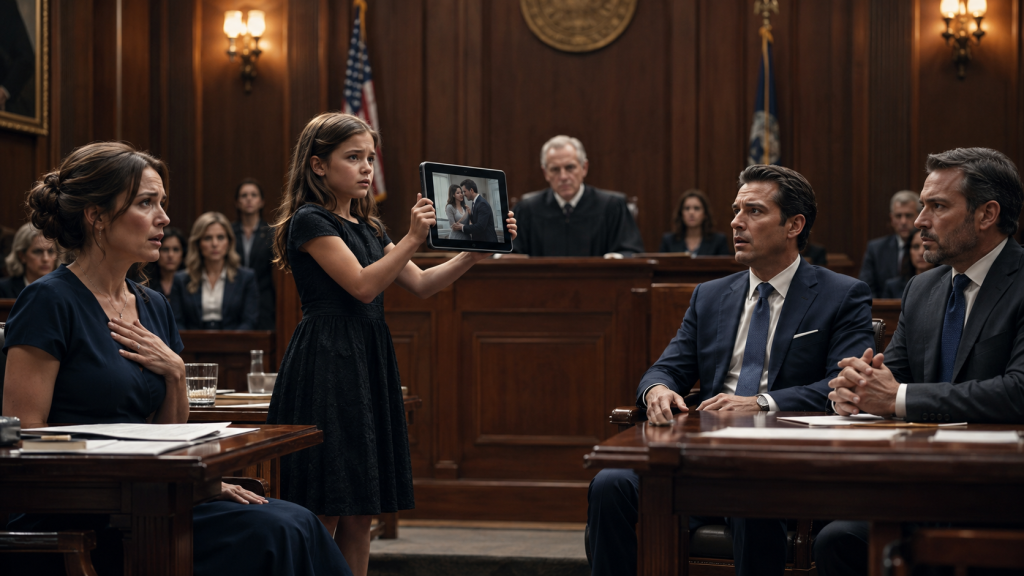
“Your Honor,” she said, “I want to show you something Mom doesn’t know about.”
The room went silent.
The judge studied her carefully.
“You understand that anything you say must be truthful?”
“Yes, sir.”
“And you understand this is a serious matter?”
“Yes, sir.”
“All right,” the judge said. “What would you like to show me?”
Chloe unzipped her backpack and pulled out her tablet.
It had a cracked corner.
I noticed it immediately and felt a strange stab of guilt. When had that happened? How had I not seen it?
The bailiff took the tablet and connected it to the courtroom screen.
I had no idea what was coming.
Nick shifted in his chair.
For the first time all morning, he looked uneasy.
The first image appeared on the big screen.
It was dark and grainy.
At first, I did not understand what I was seeing.
Then I recognized the hospital window.
The recovery room.
The black glass reflected Nick’s bed.
And in the reflection, his phone screen was visible.
Chloe had taken a photo from the corner of the room while pretending to play on her tablet.
On Nick’s phone was a message thread with a woman named Vanessa.
The message on screen read:
Once Rachel signs the divorce papers, you’ll have the house and Chloe. Then we can finally be a real family.
A gasp moved through the courtroom.
My mouth went dry.
Vanessa.
I had never heard that name.
Nick’s face drained of color.
Daniel leaned toward him sharply.
Chloe swiped to the next image.
Another screenshot.
Nick’s reply.
She gave me the kidney. Now we wait until the doctors clear me, and I file. She’ll be too weak to fight.
My vision blurred.
The words did not feel real.
She gave me the kidney.
Not my wife saved my life.
Not Rachel sacrificed for me.
She gave me the kidney.
Like I was a transaction.
Like my body had been a step in his plan.
The judge’s expression hardened.
Daniel stood again.
“Your Honor, we object to the admission of these images without authentication.”
The judge looked at him.
“Sit down, Mr. Cross. I am not admitting anything formally yet. I am listening to a child who appears to have relevant information.”
Daniel sat, jaw tight.
Chloe’s hands trembled as she opened a video.
The courtroom speakers crackled.
Then Nick’s voice filled the room.
It was weak but clear.
“Rachel was useful for one thing. She gave me the kidney. Now I can get rid of her.”
My hand flew to my mouth.
The recording continued.
Another voice, Vanessa’s, came through the phone speaker.
“What about Chloe?”
Nick answered.
“I’ll get custody. Rachel won’t have the money or strength to fight. Daniel says the surgery makes her look unstable. I can say she’s depressed, overwhelmed, whatever. Judges hate chaos.”
There was a pause.
Then Vanessa laughed softly.
“Poor Rachel.”
Nick said, “Don’t feel sorry for her. She always wanted to be useful.”
The courtroom was completely still.
Even the air seemed to stop moving.
I could not look at him.
If I looked at him, I thought I might fall apart in front of everyone.
The judge leaned back slowly.
“Where did you get this recording, Chloe?”
Chloe’s voice trembled.
“I was in the hospital room. Mom was sleeping. Dad thought I was watching cartoons. I heard him talking. I got scared, so I recorded it.”
Daniel stood again.
“Your Honor, this is highly inappropriate. The child was clearly influenced—”
“No,” Chloe said suddenly.
Everyone looked at her.
Tears rolled down her cheeks now, but her voice grew stronger.
“No one told me to do it. Mom didn’t even know. She never says bad things about Dad in front of me. She kept telling me everything would be okay. But Dad told me if I chose Mom, he’d make sure she had no home to come back to.”
Nick stood halfway.
“Chloe, stop.”
The judge’s voice cracked like thunder.
“Mr. Bennett, sit down.”
Nick sat.
Chloe wiped her cheek.
“He said Mom was weak now. He said I needed to be smart and choose the parent who could give me a better life. But he doesn’t give me a better life. He doesn’t even know I hate mushrooms. He doesn’t know my science teacher’s name. He didn’t come to my piano recital because Vanessa had a birthday dinner.”
Another gasp.
Vanessa was not just a message.
She was a life Nick had already been building.
Chloe looked at the judge.
“I want to live with my mom. She gave Dad a kidney because she loved him. And he used it to hurt her.”
I broke then.
I covered my face and sobbed quietly, not from weakness, but from the unbearable pain of hearing my child defend me when I had spent months trying to protect her.
The judge called a recess.
Everyone stood.
Nick turned toward Chloe, but the bailiff stepped between them.
My sister wrapped her arms around Chloe.
I wanted to hold my daughter, but my body was shaking too hard.
During the recess, a court-appointed child advocate was called in.
The judge ordered that Chloe be interviewed privately.
He also ordered Nick to have no unsupervised contact with her until further review.
Nick’s lawyer argued.
The judge shut him down.
When we returned to the courtroom, everything had shifted.
Daniel Cross no longer spoke like a man in control.
Nick no longer looked victorious.
The judge addressed me directly.
“Mrs. Bennett, do you have medical documentation regarding your surgery and recovery?”
“Yes, Your Honor.”
My sister quickly handed me the folder we had brought.
Hospital discharge papers.
Follow-up instructions.
Medication lists.
Proof that I was recovering normally and had not been declared mentally unstable by any doctor.
The judge read through them.
Then he looked at Nick.
“Mr. Bennett, did you initiate divorce proceedings shortly after receiving a kidney from your wife?”
Nick swallowed.
“Yes, but—”
“And did you communicate with a woman named Vanessa regarding custody and property before filing?”
Daniel placed a hand on Nick’s arm, warning him.
Nick said nothing.
The judge’s face hardened.
“Your silence is noted.”
By the end of the hearing, temporary custody was awarded to me.
Nick was ordered to continue financial support and pay for my immediate medical needs from marital funds.
He was forbidden from moving money, selling property, or contacting Chloe outside supervised channels.
The judge also referred the matter for further review because of the apparent coercion, financial manipulation, and emotional abuse.
When the gavel came down, I did not feel victory.
I felt my body remember how to breathe.
Outside the courtroom, Chloe ran into my arms carefully, mindful of my side.
“I’m sorry,” she sobbed. “I didn’t know if I should show it.”
I held her as tightly as I could.
“You saved us,” I whispered.
She shook her head against me.
“No, Mommy. You saved him. I just told the truth.”
That sentence stayed with me.
The truth.
It sounds simple.
But sometimes the truth is the heaviest thing a child can carry.
Over the next months, the divorce became ugly in the way people warned me divorces could be.
Nick tried to claim the recordings were manipulated.
They were not.
A digital forensic expert confirmed the files were real.
He tried to claim Chloe misunderstood.
She had not.
The child advocate’s report stated clearly that Chloe felt unsafe with her father and believed he had threatened her mother’s housing and stability.
Vanessa disappeared at first.
Then she was subpoenaed.
That was when more came out.
Nick had been having an affair for nearly two years.
Two years.
While I drove him to appointments.
While I researched transplant diets.
While I learned medication schedules.
While I held his hand through fear.
He had been promising another woman my home, my child, and a life paid for by my sacrifice.
The worst discovery came from old emails.
Nick had known he wanted a divorce before the transplant.
He had written to Vanessa:
I just need to get through surgery first. If I leave before that, Rachel might back out.
I read that line sitting in my lawyer’s office, the one my sister helped me find after the hearing.
My hands went numb.
He had been afraid I would keep my kidney if I knew the truth.
He was right.
That was the kind of truth that destroys you and rebuilds you at the same time.
I stopped crying for the marriage after that.
I still cried for the woman I had been.
The woman who thought love meant bleeding quietly for someone who would not even bandage the wound.
But I did not cry for Nick.
In the final divorce judgment, the court granted me primary custody.
Nick received limited supervised visitation, subject to Chloe’s comfort and therapy recommendations.
The judge awarded me the house temporarily until Chloe turned eighteen, noting that Nick had attempted to weaponize housing against both mother and child.
He was ordered to pay support, medical expenses, and a portion of my legal fees.
He did not lose everything.
Men like Nick rarely do.
But he lost control.
And that was what he wanted most.
The first night after the final order, Chloe and I sat on the living room floor eating takeout noodles from paper cartons.
I still could not sit too long without shifting carefully, but I was stronger than before.
Chloe leaned against my shoulder.
“Are we safe now?” she asked.
I looked around the house.
For months, it had felt like a battlefield.
Now it felt quiet.
Ours.
“Yes,” I said. “We’re safe.”
She nodded.
Then after a long pause, she whispered, “Do you hate him?”
I thought about lying.
Then I chose the truth.
“I hate what he did,” I said. “But I don’t want to spend my life carrying him inside me anymore. I already gave him enough.”
Chloe understood.
Maybe not fully.
But enough.
A year later, I still have the scar.
It runs across my side, pale and raised, a permanent reminder of the woman I was and the woman I became.
At first, I hated looking at it.
It felt like proof that I had been foolish.
Used.
Tricked.
But my therapist helped me see it differently.
The scar was not proof of Nick’s betrayal.
It was proof of my capacity to love.
His choices belonged to him.
My heart belonged to me.
And Chloe?
Chloe is thirteen now.
She is taller, louder, and somehow even braver.
She still carries too much for someone her age, but we are working on that together.
She goes to therapy.
So do I.
Some nights, she asks if love is always dangerous.
I tell her no.
Love is not dangerous.
People who use love as a weapon are dangerous.
Real love does not demand that you disappear.
Real love does not punish you for needing help.
Real love does not take your kidney, your house, your money, and your child, then call you unstable for bleeding.
Real love stays when the hospital room gets quiet.
Real love tells the truth even when its voice shakes.
Real love looks like my sister sitting beside me in court.
Real love looks like my daughter standing before a judge with a cracked tablet and more courage than every adult in that room.
Sometimes people ask if I regret donating the kidney.
That question is complicated.
I regret giving it to Nick.
But I do not regret learning who I am when everything is taken from me.
I do not regret showing Chloe that survival is possible.
I do not regret the moment my daughter saw a courtroom full of adults fall silent because she told the truth.
Nick once said I had fulfilled my purpose.
He was wrong.
My purpose was never to save him.
My purpose was to come back from what he did.
To raise my daughter.
To teach her that kindness is not weakness.
To teach her that sacrifice without respect is not love.
And to teach her that sometimes the smallest voice in the room can bring down the biggest lie.
Because that day in court, Nick arrived expecting to take everything.
My home.
My dignity.
My daughter.
But Chloe opened her backpack, pulled out the truth, and gave me back my life.
THE END! THANKS FOR READING!