 Reading Time: 12 minutes
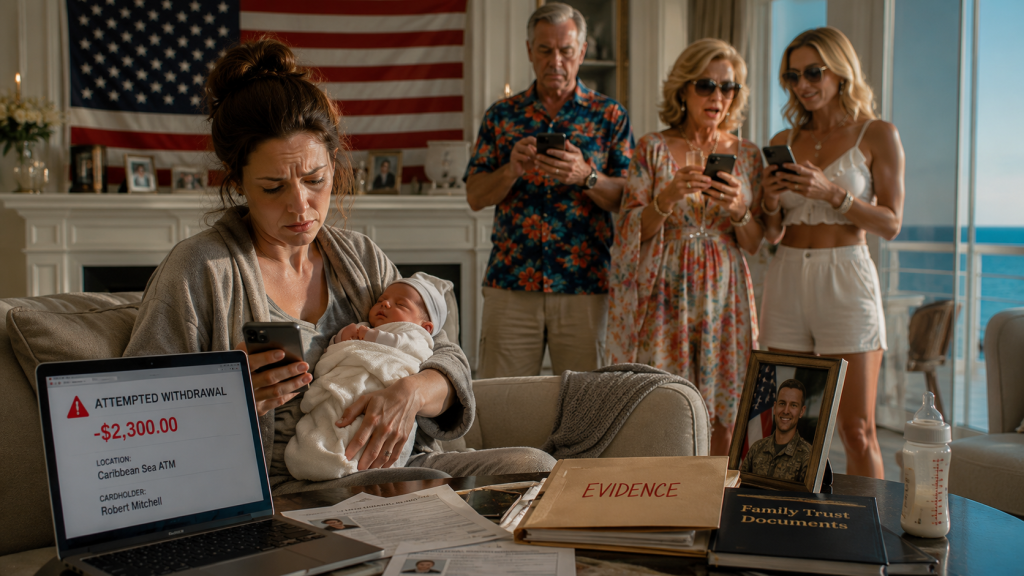
Six days after giving birth, my father tried to withdraw money from my account while my mother posted vacation photos instead of helping me. I was sitting in bed with my newborn son asleep against my chest, one tiny fist curled under his chin.
My incision burned every time I breathed. The hospital bracelet was still around my wrist. My hair had not been washed in days. The nurse had told me before discharge that I should not lift anything heavier than the baby.
That would have been almost funny if there had been anyone around to lift everything else.
My husband, James, was deployed overseas.
My best friend lived two states away.
My body felt like it had been split open and stitched back together with fire.
And my apartment was so quiet I could hear my own phone buzz from across the room like an alarm.
Three days earlier, from the hospital bed, I had texted my parents.
Please, can someone come help me?
I stared at those six words for ten minutes before sending them.
Asking my parents for help had always felt like signing a blank invoice.
But I was desperate.
My mother, Patricia, read the message.
The little notification changed from delivered to read.
Then nothing.
Thirty minutes later, she posted a smiling photo from the deck of a luxury anniversary cruise.
One arm around my sister Vanessa.
The golden child.
The daughter who always needed support but was never called a burden.
Behind them, the ocean gleamed blue and perfect.
A champagne bucket sat on the table.
My mother’s caption read:
Blessed to finally relax with the people who appreciate us.
I stared at the picture from my hospital bed while my son slept against my chest.
His name was Noah.
He was six pounds, nine ounces, with dark hair and a tiny crease between his eyebrows that made him look serious about life already.
I whispered, “It’s okay. I’m here.”
But I was not sure I was okay.
The next morning, my mother finally replied.
You’re a mother now, Rachel. Figure it out.
Two minutes later, Vanessa sent a photo of herself in a white swimsuit beside that same champagne bucket.
Don’t be dramatic, Rachel. Mom and Dad deserve joy too.
I did not answer.
I changed my son’s diaper with shaking hands.
I signed my discharge papers alone.
I paid for a ride home because my father, Robert, had “forgotten” I was leaving the hospital that day.
Forgotten.
That word had covered a lifetime of choices.
He forgot school plays.
He forgot my college move-in.
He forgot to pay back the money he borrowed when I was nineteen.
He forgot every promise made to me.
But he never forgot Vanessa’s birthday.
Never forgot Mom’s cruises.
Never forgot his golf weekends.
Never forgot where I kept financial documents when he needed something.
By the sixth day home, I had learned to stand up from bed without crying out.
I had learned to warm bottles with one hand.
I had learned to change diapers while gripping the edge of the changing table for balance.
I had learned that loneliness has a sound.
The soft buzz of a phone nobody answers.
Then my bank app flashed red.
Attempted withdrawal: $2,300.
Location: Caribbean Sea ATM.
Cardholder: Robert Mitchell.
My father.
For a few seconds, I simply stared.
Then another alert appeared.
Security question failed.
Second attempt pending.
My son whimpered in his bassinet.
I leaned over slowly, kissed his forehead, and whispered, “Not this time.”
Because my parents thought I was still the daughter who apologized when they stole from her college fund.
They thought I was still the girl who stayed silent when Vanessa used my name to open store cards.
They thought childbirth had made me weak.
They had forgotten what I did for a living.
I was a fraud compliance analyst for Atlantic National Bank.
For seven years, I had traced stolen identities, forged signatures, fake hardship claims, elder exploitation, account takeovers, and families who smiled in public while bleeding one another dry.
I knew how theft sounded when it dressed itself as obligation.
And three months before my son was born, I had copied every document they thought I would never understand.
I did not call my father.
I did not scream at my mother.
I did not send Vanessa a furious message she could screenshot and use to call me unstable.
I opened my laptop at the kitchen table, moving slowly because every step pulled at my incision, and began building a file.
First: the attempted withdrawal.
Time.
Terminal ID.
Failure code.
Location.
Second: the card my father had no legal right to possess.
I had never given him permission to use my account.
He must have taken the spare from my drawer months ago, the last time my parents visited “to help set up the nursery.”
Help meant my mother criticizing the crib placement while my father wandered through the apartment pretending to check light switches.
Third: the old emails Vanessa had sent me while pretending to “help” with family taxes.
Buried inside those emails were scanned copies of my driver’s license, my Social Security card, and my signature on blank authorization forms.
My parents had always called it family paperwork.
I called it evidence.
At noon, Mom finally texted.
Your father said your card declined. Why are you embarrassing us on vacation?
I stared at the message.
Not Are you healing?
Not How is the baby?
Not Do you need food?
Why are you embarrassing us?
I replied with one sentence.
Why was Dad using my card?
The answer came from Vanessa.
Because you owe them. They raised you. Don’t act rich just because you married a soldier and got a bank job.
I almost laughed.
Rich.
I was wearing a robe with dried formula on the sleeve, counting pain pills to make sure I did not take them too close together, and wondering whether I could carry the trash downstairs without tearing open my stitches.
Then Dad called.
I let it go to voicemail.
His voice came through loud and irritated.
“Rachel, unlock the account. We need the upgrade today. Don’t start your nonsense while your mother is trying to enjoy herself. You have money sitting there. We only need twenty-three hundred.”
He paused.
Then he added the sentence that sealed him.
“And don’t forget, I still have access to the trust documents. If you make trouble, you’ll never see a dime of your grandmother’s house.”
That voicemail was the gift he never meant to give me.
I saved it.
Exported it.
Added it to the file.
Then I called the bank’s internal fraud hotline from my employee portal and reported the attempted withdrawal as unauthorized access by a family member.
The analyst on the line recognized my employee ID.
“Rachel, are you safe?”
That question almost broke me.
“I’m safe,” I said, looking at Noah. “Just tired.”
Within minutes, my account was frozen for protection.
My cards were canceled.
New credentials were issued.
A case number appeared in my inbox.
Then I emailed my attorney, Melissa Grant, everything I had copied months earlier.
My grandmother’s trust papers.
The house deed.
The blank authorization forms.
Vanessa’s emails.
Dad’s voicemail threat.
Melissa had once told me, “Your family is not messy, Rachel. It is organized around taking from you.”
At the time, I thought that sounded harsh.
Now it sounded precise.
At 3:40 p.m., my mother finally called.
I answered on speaker while feeding Noah.
“Do you have any idea what you’ve done?” she snapped.
“Yes.”
“You reported your own father?”
I looked at my newborn sleeping beside the bottle, milk at the corner of his mouth.
“No, Mom. I reported a thief.”
She gasped dramatically.
“How dare you speak about your father that way after everything we sacrificed for you?”
There it was.
The family invoice.
Food.
School clothes.
Doctor visits.
The cost of raising me.
My parents never saw parenting as love.
They saw it as a loan.
“You’re on a cruise,” I said quietly. “I am six days postpartum.”
“You chose to have that baby.”
“I asked for help.”
“You’re not helpless.”
“No,” I said. “I’m not.”
That made her pause.
Because for once, helpless was exactly what she needed me to be.
Vanessa took the phone from her.
“You are ruining their anniversary trip.”
“I didn’t steal my card.”
“You’re so dramatic.”
“Vanessa, you opened a store card in my name when I was twenty-one.”
Silence.
Then, “That was different.”
“It was identity theft.”
“You paid it off!”
“Because I was afraid.”
Her voice sharpened.
“And now you’re not?”
I looked at Noah.
His tiny hand rested against my wrist.
“No,” I said. “Now I’m a mother.”
I ended the call.
Ten minutes later, Melissa replied.
The subject line said:
URGENT — READ NOW.
My hands shook as I opened the email.
Rachel,
Your father is not the trustee. Your grandmother changed everything before she died.
I stared at the sentence.
Then opened the attachment.
It was a letter from my grandmother, dated eighteen months before her death.
My grandmother, Evelyn Mitchell, had been the only person in my family who never made love feel expensive.
She knew my favorite tea.
She sent birthday cards with cash tucked inside and wrote, For Rachel only.
She once told me, “Child, some people don’t borrow. They harvest.”
I had not understood then.
I did now.
The attachment contained updated trust documents.
The house.
The trust.
The accounts.
None of it belonged to my parents.
None of it was controlled by my father.
Grandma had appointed Melissa as trustee until certain conditions were met.
Then control transferred to me.
Not after I turned thirty.
Not after my parents approved.
After the birth of my first child.
My breath caught.
There was a note from Grandma.
My dear Rachel,
If you are reading this, then you have become a mother. I wish I could be there to hold your hand and kiss that baby’s head.
I know your parents. I know Vanessa. I know how they ask with one hand and take with the other.
I have delayed notice of this trust until after your child is born because motherhood will show you something I could not teach you with words: protection is not selfish.
You are not the family wallet.
You are not responsible for repairing adults who break themselves on purpose.
The house is yours.
The trust is yours.
But most importantly, your life is yours.
Use it to build safety.
Do not let them call that betrayal.
I covered my mouth with one hand.
For the first time since Noah was born, I cried in a way that did not feel like panic.
It felt like someone had finally arrived.
Not in the room.
But through paper.
Through planning.
Through love that had seen the future clearly enough to protect me from it.
By sunset, the cruise line had locked my father’s onboard spending account.
The bank had flagged the ATM footage.
Melissa had sent cease-and-desist letters to my parents and Vanessa.
She also filed notice regarding attempted financial exploitation, unauthorized card use, possession of personal identifying documents, and threats tied to trust assets.
My mother left a voicemail.
This one was not angry.
It was crying.
“Rachel, please. Your father is humiliated. The cruise line is treating us like criminals. We’re stranded without upgrades. We had plans.”
I held Noah against my chest and listened.
Then I deleted it.
Vanessa texted:
You’re really doing this over $2,300?
I replied:
No. I’m doing this over twenty-nine years.
Then I blocked her.
The next morning, Melissa came to my apartment.
She brought groceries, diapers, and soup.
Not because I asked.
Because help does not require humiliation when it comes from someone decent.
She placed the bags on the counter, looked at me carefully, and said, “You should have someone here.”
I laughed weakly.
“I tried.”
“I know.”
She glanced toward Noah sleeping in the bassinet.
“He’s beautiful.”
“He looks like James.”
“When is James able to call?”
“Tonight, maybe. Signal is unreliable.”
Melissa nodded.
Then she sat across from me and opened her folder.
“Rachel, your grandmother’s house is fully yours. Your parents have been occupying part of the property’s rental income through a side arrangement they never disclosed.”
My stomach dropped.
“What?”
She slid documents across the table.
Grandma’s house had been rented after her death.
I had been told the rent covered maintenance and taxes.
But the records showed deposits diverted into an account connected to my parents.
Not all of it.
Enough.
Enough to pay for cruises.
Enough to support Vanessa.
Enough to prove my father’s voicemail was not an empty threat.
It was a confession from a man who believed he still held the keys.
“He doesn’t have access anymore,” Melissa said. “He never should have.”
“What happens now?”
“We recover what we can. We secure what remains. And you decide who gets access to you and your son.”
That last part felt bigger than money.
Access.
My parents had always treated access to me as automatic.
My time.
My documents.
My accounts.
My forgiveness.
My guilt.
My future.
Motherhood changed that.
Noah stirred in the bassinet.
I stood slowly, wincing as my incision pulled.
Melissa stood too.
“Let me.”
For a second, I almost said no.
Then I stopped myself.
Not all help was a trap.
I nodded.
She lifted Noah gently and brought him to me.
I whispered, “Thank you.”
That evening, James called.
The video connection froze twice before his face appeared.
He looked exhausted.
Worried.
Far away.
“Rachel,” he said. “Tell me everything.”
I did.
Not the softened version.
Not the version where I made my parents sound less cruel.
Everything.
The hospital.
The cruise photo.
The ATM.
The trust.
The voicemail.
By the end, James’s jaw was tight.
“I’m so sorry I’m not there.”
“You’re serving overseas,” I said. “That’s not abandonment.”
“I’m still sorry.”
“I know.”
He looked at Noah, who was asleep on my chest.
Then back at me.
“You protect yourself. You hear me? Don’t worry about making them mad.”
I smiled tiredly.
“They’re already mad.”
“Good.”
That made me laugh.
A real laugh.
Small, but real.
The legal process moved quickly at first.
Then slowly.
That is how these things work.
The bank investigation confirmed unauthorized access attempts.
My father claimed he had permission.
Then my voicemail transcript appeared.
He changed his story.
My mother claimed it was a misunderstanding.
Then cruise records showed my card was used for a failed upgrade attempt.
Vanessa claimed she had never handled my documents.
Then her emails proved otherwise.
The trust investigation uncovered rental income diversion.
Melissa filed civil claims.
My parents hired a lawyer who sent one aggressive letter.
Melissa responded with fifty pages of evidence.
Their lawyer became much less aggressive after that.
Two weeks later, my mother showed up at my apartment building.
I saw her through the camera.
She held flowers.
The same grocery store bouquet she always bought when she wanted forgiveness to look visual.
My phone rang.
“Rachel, I know you’re there.”
I did not answer.
“You can’t keep me from my grandson.”
I pressed the intercom.
“My son is not a prize for people who tried to steal from his mother.”
There was silence.
Then her voice changed.
Small.
Cold.
“You’ll regret treating family like this.”
“No,” I said. “I regret not doing it sooner.”
I hung up.
She left the flowers by the door.
I threw them away.
Not because flowers are bad.
Because apologies with thorns are still weapons.
A month after Noah was born, James arranged emergency leave.
When he walked through the apartment door, I nearly collapsed from relief.
He dropped his bag and held me carefully, mindful of my healing body.
Then he held Noah and cried silently.
For three days, he took over everything.
Diapers.
Bottles.
Laundry.
Meals.
He helped me shower and changed the sheets while I slept.
He never once called it helping.
He called it being home.
On his fourth day back, we drove to Grandma’s house with Melissa.
I had not been there since the funeral.
It was a small white house with green shutters and a porch swing that creaked in the wind.
Inside, the air smelled faintly of cedar and dust.
My grandmother’s teacups still lined the cabinet.
Her quilt was folded over the back of the sofa.
I stood in the living room holding Noah and felt grief and safety hit at the same time.
Melissa handed me the keys.
“Legally, it’s yours.”
I looked down at Noah.
Then at James.
“We could live here.”
James smiled.
“We could.”
The house needed work.
A lot of work.
The roof leaked near the back room.
The kitchen floor sagged.
The porch rail was loose.
But it was paid for.
Protected.
Ours.
Two months later, we moved in.
Not all at once.
Slowly.
Between feedings and recovery and James’s limited time home.
Neighbors brought casseroles.
Melissa sent a locksmith.
My best friend drove in and painted the nursery pale blue.
I hung Grandma’s letter in a frame inside my closet, where I would see it every morning.
Protection is not selfish.
That became my prayer.
My parents sent messages through relatives.
Some said I was cruel.
Some said I was tearing the family apart.
Some asked whether I could at least let my mother meet the baby.
But none of them had been there when I asked for help.
None had stood beside my hospital bed.
None had watched my father use my card from a cruise ship while my C-section incision burned.
So I stopped explaining.
Peace often begins when explanations end.
The civil case settled before trial.
My parents agreed to repay a portion of the diverted rental income.
My father accepted a formal fraud warning tied to the attempted card use.
Vanessa signed an agreement acknowledging she had no authorization to use my identity documents and surrendered all copies.
Was it perfect justice?
No.
Perfect justice rarely arrives.
But practical protection did.
My accounts were secured.
My credit was locked.
My trust was safe.
My son’s future was untouched by their hands.
That was enough.
The first time my mother saw Noah was not in person.
It was through a photograph I posted on his three-month birthday.
Not a public post.
A limited family update.
No location.
No details.
Just Noah smiling in a yellow onesie on Grandma’s quilt.
She texted from a new number.
He looks like you.
I stared at the message.
For once, there was no demand.
No guilt.
No request.
Just a sentence.
I did not answer.
But I did not block it either.
Maybe one day.
Maybe not.
Forgiveness, I learned, is not the same as access.
By the time Noah turned six months, the house felt alive again.
James was overseas again, but this time I was not alone in the same way.
I had neighbors.
Friends.
A schedule.
A lawyer who became almost family.
A baby who laughed every time the porch swing creaked.
One morning, I sat on that porch with Noah in my lap, watching sunlight move across the yard.
My phone buzzed.
A bank alert.
For a split second, my stomach tightened.
Then I opened it.
Deposit confirmed: trust distribution for home repairs.
Approved by trustee.
I smiled.
Money moving toward safety.
For once, money moving toward me.
I kissed Noah’s head.
“Your great-grandma was something else,” I whispered.
He grabbed my finger and held on.
Six days after giving birth, my father tried to use my bank card while my mother posed on a cruise and my sister called me dramatic.
They thought I was weak because I was healing.
They thought I was alone because I had asked for help.
They thought motherhood would make me easier to control.
They were wrong.
Motherhood did not make me weak.
It clarified everything.
It turned my fear into a locked account.
My silence into a case file.
My pain into a boundary.
My grandmother had waited until my son was born for me to learn the lesson she already knew.
Protecting yourself is not selfish.
Protecting your child is not betrayal.
And family does not mean handing thieves the key because they know your childhood nickname.
My parents told me to figure it out.
So I did.
I figured out the card.
The trust.
The house.
The lies.
The difference between help and control.
And when my mother cried that they were stranded without upgrades, I held my newborn son close in the quiet apartment they had refused to visit and whispered the only answer that finally felt true.
“Good.”
Then I kissed his forehead.
“Let them figure it out.”
THE END! THANKS FOR READING!