 Reading Time: 39 minutes
The officer carrying the secure tablet didn’t slow down until he was directly in front of Vice Admiral Harrison Cole. He was breathing hard.
Not from fear. From running. “Sir.” Cole’s face was still flushed from anger. Behind him, eight thousand sailors and Marines remained frozen in formations that no longer looked ceremonial.
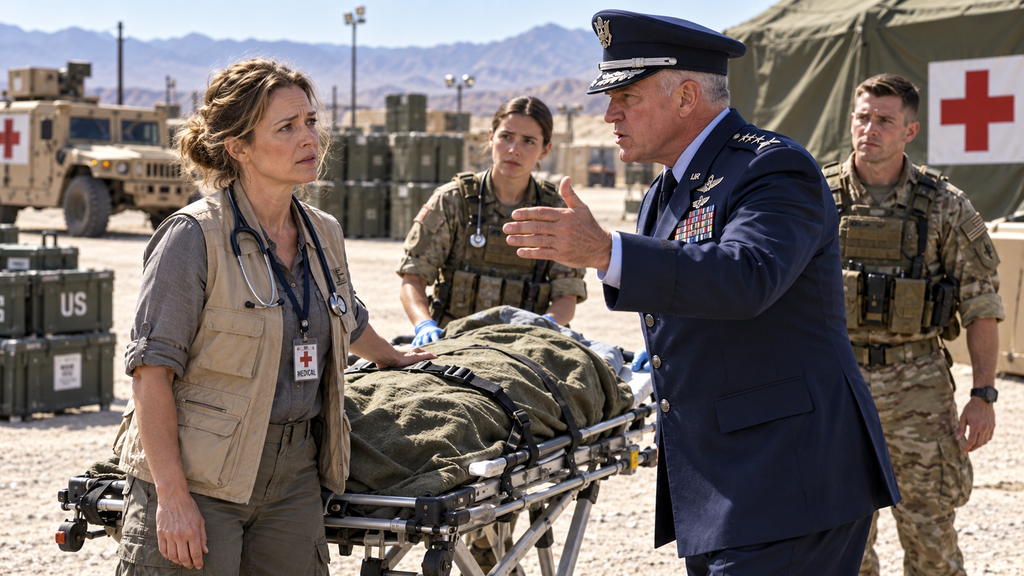
They looked like witnesses.
Sergeant Collins still held my restrained arm, although barely.
The plastic ties around my wrists had already begun biting into my skin.
My cheek burned.
I could taste blood where the inside of my mouth had struck my teeth.
None of that mattered.
Through the open doors of the medical building, I could still hear people shouting around the man I had just treated.
That mattered.
Cole pointed toward me without even looking.
“Commander, whatever this is can wait. Lieutenant—”
“Sir.”
The officer’s tone changed.
Not louder.
Sharper.
Cole finally looked at him.
The commander extended the tablet.
“You need to see this.”
Cole snatched it from his hands.
For the first two seconds, his expression didn’t change.
Then his eyes stopped moving.
The tarmac became so quiet I could hear the distant thump of helicopter blades slowing behind us.
Cole stared at the screen.
His face lost color.
“What is this?”
The commander swallowed.
“A network isolation directive.”
“From whom?”
“U.S. Cyber Command.”
Cole looked toward the command tent.
Several technicians were standing helplessly in front of black monitors.
“What do you mean, isolation?”
“Your command credentials have been suspended.”
Cole’s head snapped around.
“My credentials?”
“Yes, sir.”
“I am the operational commander of this inspection.”
“Not anymore.”
The voice came from behind us.
Everyone turned.
A black government SUV had stopped near the edge of the flight line.
A woman stepped out.
She wore service dress whites.
Two stars gleamed on her shoulders.
Rear Admiral Evelyn Shaw.
Cole knew her.
More importantly, judging from the way his mouth tightened, he knew exactly why she was there.
She crossed the tarmac slowly.
No shouting.
No rushing.
No theatrics.
She didn’t need any.
People moved aside for her without being told.
When she reached us, her eyes went first to my wrists.
Then to my cheek.
Then to Cole.
“What happened here?”
Cole immediately straightened.
“Rear Admiral, this officer disrupted an official fleet inspection, refused a direct order, behaved insubordinately in front of thousands of personnel, and—”
Shaw raised one hand.
Cole stopped talking.
She looked at Sergeant Collins.
“Sergeant.”
“Ma’am.”
“Why is Lieutenant…”
She looked at my name tape.
“Lieutenant Mara Vance restrained?”
Collins hesitated.
I could practically hear every calculation happening behind his eyes.
Cole was a vice admiral.
Three stars.
Shaw had two.
On paper, the answer looked obvious.
But command authority was more complicated than stars when an investigation had already begun.
Collins looked at Shaw.
“Vice Admiral Cole ordered me to detain Lieutenant Vance for gross insubordination, ma’am.”
“What was Lieutenant Vance doing immediately before the alleged insubordination?”
“Providing emergency treatment to a casualty.”
“What kind of emergency?”
Collins looked toward the medical building.
“Airway compromise, ma’am.”
“Was the casualty stable?”
“Not when she reached him.”
“Did Lieutenant Vance abandon her patient?”
“No, ma’am.”
Shaw looked at me.
“Did you strike Vice Admiral Cole?”
“No, ma’am.”
“Threaten him?”
“No.”
“Touch him?”
“No.”
Her gaze moved to the red mark on my cheek.
“Did he strike you?”
I didn’t answer immediately.
Not because I was afraid.
Because my entire career had trained me to separate emotion from observation.
So I gave her exactly what I would have entered into a medical record.
“Vice Admiral Cole struck me across the left side of my face with an open hand after I instructed him to leave the active triage area.”
There was a movement through the formation.
Not loud.
Thousands of people shifting almost simultaneously.
Shaw looked at Cole.
“Is that accurate?”
Cole’s nostrils flared.
“She was openly defiant.”
“That wasn’t my question.”
“She embarrassed the command.”
“That wasn’t my question either.”
Cole’s voice dropped.
“She challenged me in front of eight thousand personnel.”
Shaw’s expression didn’t move.
“Did you strike her?”
Cole looked around.
For the first time, I think he truly saw the crowd.
Not personnel.
Witnesses.
Thousands of them.
Camera crews had been recording the ceremony.
Public affairs officers had been filming from three separate locations.
Security cameras covered the flight line.
Body cameras were active on several security personnel.
And half the people standing nearby had watched the entire thing with their own eyes.
Cole seemed to realize all of this at once.
“It was a disciplinary response.”
Shaw stared at him.
“A what?”
Cole didn’t answer.
The silence lasted nearly five seconds.
It felt longer.
Shaw turned toward Collins.
“Remove the restraints.”
Cole stepped forward.
“You do not have the authority to countermand—”
“I do today.”
That stopped him.
Shaw took a sealed envelope from the folder beneath her arm.
“I arrived at 0938 hours under written authority from Fleet Forces Command and the Department of Defense Inspector General.”
Cole’s eyes went to the envelope.
Shaw continued.
“Your command access was frozen at 0941.”
Cole’s mouth opened.
Nothing came out.
“Effective immediately,” Shaw said, “you are relieved of operational authority pending investigation.”
A sound moved through the formation.
Not cheering.
Nobody was stupid enough to cheer.
But eight thousand people inhaling at once can sound like weather.
Collins cut the restraints from my wrists.
The plastic dropped onto the concrete.
I rubbed one wrist once.
My cheek still burned.
Cole stared at me.
There was something different in his eyes now.
The rage was still there.
But underneath it was something I hadn’t seen before.
Fear.
Not fear of me.
Fear of losing control.
People like Harrison Cole understood power as a ladder.
Someone was always above.
Someone was always below.
He had spent so many years climbing that he had apparently forgotten one simple truth.
A uniform did not make the person beneath it untouchable.
Shaw looked at me again.
“Lieutenant Vance, are you injured?”
“I’m functional, ma’am.”
One corner of her mouth moved slightly.
“That’s not what I asked.”
“My cheek hurts.”
“Medical evaluation.”
“I need to check my patient first.”
Cole gave a bitter laugh.
“There. You see? She refuses orders whenever she—”
Shaw turned her head.
Just slightly.
Cole went silent.
Then she looked back at me.
“Your patient is receiving care?”
“Yes, ma’am.”
“Then you’ll be examined.”
I nodded.
“Yes, ma’am.”
But before I moved, the doors to the medical building opened.
Dr. Aaron Houseman appeared.
He was still wearing blood-spattered gloves.
I knew from his face that something had happened.
I took one step toward him.
“How is he?”
Houseman pulled off his surgical mask.
“Alive.”
My lungs finally released the breath I had apparently been holding since the helicopter landed.
“Stable?”
“For the moment.”
“Airway?”
“Holding.”
“Thoracic bleeding?”
“Controlled.”
I closed my eyes for one second.
Only one.
Houseman looked from me to Cole.
Then to the restraints on the ground.
His expression hardened.
“What happened to your face?”
“I’m fine.”
“Mara.”
“I’m fine.”
He had known me long enough to know that meant I wasn’t ready to discuss it.
Houseman glanced toward Shaw.
“Ma’am, the patient is asking for Lieutenant Vance.”
Shaw nodded.
“Go.”
I turned toward the medical building.
Cole’s voice followed me.
“You think this makes you important?”
I stopped.
Every instinct told me to keep walking.
For almost my entire career, I had believed that professionalism meant silence in the presence of arrogance.
Do the job.
Save the patient.
File the report.
Let the system handle the rest.
Most of the time, that belief had served me well.
But there are moments when silence becomes something else.
Permission.
I turned around.
Cole stood between two security officers.
The sun reflected off the ribbons on his uniform.
His ceremony had collapsed around him.
His monitors were black.
His authority had been suspended.
The formation he had wanted flawless had become the audience to his worst decision.
I looked directly at him.
“No, sir.”
His jaw tightened.
I continued.
“I don’t think saving that man makes me important.”
I pointed toward the medical doors.
“I think it makes him alive.”
Nobody moved.
“And if you still can’t understand the difference,” I said quietly, “then losing your command is the least serious problem you have.”
Then I walked away.
The patient was in Surgical Bay One.
His name was Chief Warrant Officer Daniel Reyes.
Forty-three years old.
Joint communications specialist.
Married.
Two children.
Blood type O-positive.
Penetrating trauma below the clavicle.
Collapsed lung.
Airway swelling.
Possible vascular damage.
All of those facts were written neatly on the trauma board.
The fact that nearly killed him wasn’t.
Someone had delayed his evacuation.
I stood beside his bed while the surgical team worked.
Daniel’s eyes opened briefly.
His pupils found me.
“You…”
His voice was rough around the tube.
“Don’t talk.”
He tried anyway.
“You…”
I leaned closer.
“I’m here.”
His fingers moved weakly against the sheet.
I took his hand.
“You made it,” I told him.
His eyes closed again.
His grip loosened.
Houseman glanced at the monitor.
“Pressure’s improving.”
I nodded.
Only then did I notice my hands were shaking.
It surprised me.
They hadn’t shaken during the airway.
They hadn’t shaken when Cole hit me.
They hadn’t shaken when the restraints went around my wrists.
Now, with Daniel alive and surrounded by people who knew how to keep him that way, my hands began trembling so hard that I had to curl them into fists.
Houseman saw.
“Sit down.”
“I’m fine.”
“That’s twice you’ve lied to a physician in ten minutes.”
“A terrible crime.”
“Mara.”
I sat.
He crouched in front of me.
His eyes moved over my cheek.
The swelling had started.
“You may have a minor fracture.”
“I don’t.”
“You diagnosed that through stubbornness?”
“Years of practice.”
He almost smiled.
Almost.
Then his expression changed.
“I saw it from the trauma bay window.”
I looked at him.
“The slap?”
“All of it.”
I stared at the floor.
Houseman lowered his voice.
“You don’t have to act like it didn’t hurt.”
“It hurt.”
“I’m not talking about your face.”
That landed harder.
I looked away.
He sat in the chair beside me.
Neither of us spoke for a while.
Around us, the medical team continued working.
Machines beeped.
Someone requested another unit of blood.
A nurse adjusted an IV.
The ordinary sounds of medicine.
The sounds I trusted.
Finally I said, “There were thousands of people watching.”
“I know.”
“I’ve been shelled in Afghanistan.”
Houseman didn’t interrupt.
“I’ve treated patients in tents while generators failed. I’ve held pressure on wounds while people were firing less than a mile away. I’ve told parents their nineteen-year-old son wasn’t coming home.”
My voice remained steady.
“None of that made me feel the way that did.”
Houseman’s face softened.
“Because he humiliated you.”
“No.”
I looked at my hands.
“Because for one second, after he hit me, I wanted to stop being a nurse.”
Houseman said nothing.
“I wanted to hit him back.”
There it was.
The thought I had refused to admit.
“I wanted everyone watching to see that he couldn’t do that to me.”
My throat tightened.
“But Daniel stopped breathing again.”
I looked toward the bed.
“So I turned away from Cole.”
Houseman nodded slowly.
“And saved your patient.”
“Yes.”
“You think that was weakness?”
“No.”
I finally looked at him.
“I think it was the hardest thing I’ve ever done.”
Houseman sat back.
“Good.”
“Good?”
“Because it was.”
He stood.
Then he pointed toward the examination room.
“Now let someone take care of you.”
I had no fracture.
Just bruising.
A split inside my mouth.
A headache.
The medical officer recommended observation for several hours.
I argued.
She threatened to put it in writing.
I stopped arguing.
By noon, videos had begun spreading.
Not publicly yet.
The base network had been restricted while the investigation began, but thousands of people had seen what happened.
Rumors moved faster than official statements.
Some said Cole had been arrested.
He hadn’t.
Some said I was the daughter of the chairman of the Joint Chiefs.
I wasn’t.
Some said I had secretly worked for Cyber Command.
Also false.
The truth was less dramatic.
And much worse for Cole.
He had been under investigation for three months.
I learned that at 1330, when Rear Admiral Shaw entered the medical conference room with two JAG officers and an investigator from the Department of Defense Inspector General’s office.
I was seated with an ice pack against my cheek.
Shaw closed the door.
“Lieutenant Vance, what I am about to tell you is sensitive.”
I set down the ice pack.
“Understood.”
“The incident this morning intersects with an active investigation.”
“Into Vice Admiral Cole?”
“Yes.”
I thought about the black monitors.
“The network freeze.”
Shaw nodded.
“Cole’s command had been subject to enhanced audit monitoring after discrepancies appeared in operational readiness reports.”
“What kind of discrepancies?”
One of the investigators opened a folder.
“Maintenance failures recorded by subordinate units were being removed or reclassified before reaching higher command.”
I frowned.
“Why?”
“Readiness statistics.”
Of course.
Numbers.
Every command had numbers.
Mission capability rates.
Inspection scores.
Accident rates.
Medical readiness.
Training completion.
Numbers went upward through the chain of command until they became slides presented to people who rarely met the sailors represented by those slides.
Good commanders used numbers to find problems.
Bad commanders used people to protect numbers.
Shaw continued.
“Vice Admiral Cole’s region had reported unusually high readiness levels despite a statistically abnormal number of maintenance-related incidents.”
I looked toward the trauma bay.
“Daniel?”
The investigator nodded.
“Chief Warrant Officer Reyes is assigned to a joint cyber protection and communications audit team.”
My eyes narrowed.
“Why was he injured?”
“That’s what we’re still determining.”
The investigator slid a page across the table.
“At 0712 this morning, Reyes’ team identified an unauthorized command-level override affecting flight operations and medical priority routing.”
I stopped breathing for a second.
“Medical routing?”
“Yes.”
“What override?”
Shaw answered.
“Temporary airspace restrictions were entered around the ceremony.”
I stared at her.
“That’s normal during a major event.”
“Some restrictions are.”
She paused.
“This one wasn’t.”
The investigator tapped the page.
“The order suppressed unscheduled approach priority for several categories of aircraft during the inspection window.”
My stomach turned cold.
“Including medevac?”
Silence.
That was the answer.
I stood.
“You’re telling me somebody restricted emergency medical flights because Cole didn’t want helicopters interrupting his ceremony?”
“We’re telling you the system contains evidence that an order from his command credentials modified the routing priority.”
“His credentials?”
“Yes.”
“Did he know what the order did?”
“We’re determining that.”
I laughed once.
There was no humor in it.
“Daniel almost died on the tarmac.”
Shaw’s face remained controlled.
“I know.”
“No.”
I pointed toward the trauma wing.
“He had maybe minutes. Maybe less. If that helicopter had circled—”
“I know, Lieutenant.”
My voice cracked.
That surprised me more than anything else that day.
I sat back down.
The investigator continued.
“Reyes detected the override and attempted to restore emergency priority.”
“That’s why he was on the helicopter?”
“No.”
He looked down at the document.
“Reyes was injured at 0826 during a communications equipment failure at a remote training site. His own team requested immediate evacuation.”
I felt sick.
“So he became trapped by the restriction he discovered.”
“Essentially.”
“How long was his evacuation delayed?”
“Seventeen minutes.”
Seventeen.
In trauma care, seventeen minutes is not a number.
It’s oxygen.
It’s blood.
It’s brain tissue.
It’s the difference between a spouse receiving a phone call saying your husband is alive and one saying we did everything we could.
I pressed my fingertips against the table.
“Who removed the restriction?”
“Reyes did.”
I looked up.
“After he was injured?”
“One of his technicians accessed Reyes’ authenticated emergency protocol and restored medevac priority. That is why the Black Hawk came straight through the ceremonial airspace.”
Suddenly I remembered Cole marching toward us.
Who gave permission for this?
Get this mess out of my sight.
Something inside me went cold.
“He knew.”
Shaw watched me carefully.
“We don’t know exactly what he knew at that moment.”
“He asked who gave permission.”
“Yes.”
“He wasn’t surprised by an aircraft.”
“Lieutenant—”
“He was angry that the restriction had been ignored.”
The investigator didn’t answer.
He didn’t need to.
I looked at the black-screen notification described in the report.
“Why did Cyber Command freeze him when it did?”
“Because while you were treating Reyes, someone using Cole’s credentials attempted to access and delete the audit trail for the routing override.”
My skin prickled.
“What time?”
The investigator looked at me.
“0940 and twenty-one seconds.”
I remembered the slap.
The stretcher.
Collins putting the ties around my wrists.
“Where was Cole?”
“On the tarmac.”
“So he couldn’t have been at the terminal.”
“Correct.”
My thoughts moved quickly.
“Someone on his staff.”
“Possibly.”
“Using his credentials.”
“Yes.”
“And Cyber Command blocked the deletion.”
“Correct.”
The room went quiet.
Shaw folded her hands.
“We had monitoring in place. The deletion attempt triggered automated containment. His credentials were disabled across the network.”
I stared at the table.
Cole’s screen hadn’t gone black because I was important.
It hadn’t gone black because someone powerful saw him hit me and pressed a magical button.
It went black because somewhere behind all his medals, speeches, and ceremony, evidence had already been accumulating.
The slap hadn’t created his problem.
It exposed the man at the center of it.
I looked at Shaw.
“What do you need from me?”
“Your statement.”
“You’ll have it.”
“Everything you remember.”
“You’ll have that too.”
She nodded.
Then I asked the question that mattered more.
“What happens to Daniel?”
“His condition is still serious.”
“I mean the investigation.”
Shaw understood.
“His medical condition comes first.”
“Good.”
“Lieutenant.”
I looked at her.
“I want you to understand something. What happened to you this morning is not being treated as a side issue.”
“I don’t want special treatment.”
“Neither do I.”
Her voice hardened.
“I want lawful treatment.”
She leaned forward.
“You were carrying out emergency medical duties. A senior officer physically struck you while you were doing so, then ordered you restrained. Rank does not erase that.”
I held her gaze.
Shaw continued.
“And because you are probably going to try to minimize it, I’m telling you now not to.”
I almost smiled.
“You know nurses.”
“I know soldiers, sailors, Marines, doctors, pilots, mechanics, and command staff who convince themselves that enduring mistreatment is somehow part of serving.”
Her eyes did not leave mine.
“It isn’t.”
That stayed with me.
Not just that afternoon.
For years.
Daniel survived the night.
Then the next.
On the third morning, Houseman found me standing outside the ICU.
“You know you are allowed to sleep.”
“I slept.”
“Four hours.”
“That’s practically retirement.”
He handed me coffee.
I took it.
“How is he?”
Houseman leaned against the wall.
“Awake.”
I looked through the glass.
Daniel was pale.
There were lines everywhere.
His chest tube was still in place.
But his eyes were open.
“Can I see him?”
“Five minutes.”
“You always say five.”
“And you always take twenty.”
“Then we’re both consistent.”
When I entered, Daniel turned his head.
His voice was weak.
“You look terrible.”
I stopped beside the bed.
“You nearly died and that’s your opening line?”
His mouth twitched.
“I’ve had time to prepare.”
I laughed.
It hurt my cheek.
Daniel noticed the bruise.
His expression changed.
“I heard.”
“News travels.”
“He hit you.”
“It appears so.”
“Because of me?”
“No.”
I pulled the chair closer.
“Because of him.”
Daniel looked at me for a long moment.
Then his eyes filled.
I had seen that reaction many times.
People assume surviving trauma produces immediate gratitude.
Sometimes it does.
Sometimes survival arrives carrying terror.
Daniel swallowed.
“I thought I was going to die.”
“I know.”
“I couldn’t breathe.”
“I know.”
“I could hear people talking.”
His fingers tightened around the blanket.
“I remember the helicopter doors opening.”
I waited.
“I remember seeing all those uniforms.”
His voice broke.
“And nobody was moving.”
I leaned forward.
“We moved.”
“You did.”
“We did.”
“You.”
His eyes found mine.
“You were the first face I saw.”
I didn’t know what to say to that.
So I said what nurses often say when words are too small.
“You’re safe now.”
Daniel closed his eyes.
A tear slipped toward his ear.
“I have a daughter.”
“I know.”
“She’s nine.”
“I know.”
“Her birthday is next month.”
I smiled.
“Then you have somewhere to be.”
His eyes opened again.
“They said seventeen minutes.”
I felt the air leave my chest.
“Daniel—”
“They told me the evacuation was delayed.”
“You don’t need to think about that right now.”
“I found the restriction.”
Of course he remembered.
“I thought it was a configuration error.”
His breathing became faster.
I watched the monitor.
“Slow down.”
He nodded.
“I thought someone made a mistake.”
He swallowed.
“Then I saw the authorization.”
“Cole?”
Daniel closed his eyes.
“Command-level credential.”
I didn’t push him.
That wasn’t my job.
He opened his eyes again.
“Do you know what the worst part is?”
“What?”
“I almost ignored it.”
I frowned.
“Why?”
“Because everyone was preparing for the inspection. Nobody wanted problems.”
His voice became bitter.
“Everything had to look perfect.”
There it was again.
Perfect.
Perfect formation.
Perfect readiness.
Perfect ceremony.
Perfect reports.
Daniel looked toward the window.
“I’ve spent twenty-two years doing this job. You learn when people want answers and when they want numbers.”
I understood exactly what he meant.
“I thought I’d fix the routing after the ceremony.”
“But you didn’t.”
“No.”
“Why?”
He looked at me.
“Because the restricted category included emergency flights.”
I nodded.
“So you acted.”
“I sent the alert.”
“And restored the protocol.”
“Eventually.”
“Daniel.”
He looked at me.
“You did your job.”
“So did you.”
Neither of us spoke for a moment.
Then he asked, “Why didn’t you hit him back?”
I laughed softly.
Apparently everyone knew every detail.
“Because you weren’t breathing.”
He gave the smallest smile.
“Good answer.”
“The only answer.”
He stared at the ceiling.
“I wish I’d seen his face when the screens went black.”
That made me laugh harder.
Houseman appeared at the door.
“Time.”
Daniel looked offended.
“I outrank her.”
“Not in my ICU.”
I stood.
Daniel reached for my hand.
I gave it to him.
“Lieutenant.”
“Yeah?”
“Thank you.”
I squeezed his fingers.
“Make it to your daughter’s birthday.”
He nodded.
“I will.”
The investigation widened quickly.
Not publicly.
Not at first.
The military is very good at silence when silence is necessary.
Interviews took place behind closed doors.
Computers were seized.
Emails were preserved.
Access logs were reconstructed.
Orders were compared against system records.
Every person involved was told not to speculate.
Naturally, everyone speculated.
I returned to duty after four days.
My bruise had turned yellow around the edges.
A few people stared.
Most pretended not to.
The corpsmen in my unit became unnaturally polite.
On my first morning back, I found a coffee on my desk.
Then another.
Then three protein bars.
Then a note.
WE DON’T ABANDON THE PATIENT.
No signature.
I stared at it longer than I should have.
I folded the note and put it inside my locker.
I still have it.
For the next two weeks, my life became a cycle of patient care and interviews.
JAG.
Inspector General.
Command investigation.
Medical documentation.
Witness verification.
Each group wanted the same moment.
Describe what Vice Admiral Cole said.
Describe your response.
Describe the strike.
Which hand?
Open or closed?
Where were you standing?
Did you feel threatened?
Did he issue a direct order?
Did you believe the order was lawful?
Why did you refuse?
That last question appeared in every interview.
My answer never changed.
“Because complying would have required me to stop lifesaving treatment.”
One investigator asked, “Did you consider his rank before refusing?”
“Yes.”
“And?”
“The patient still couldn’t breathe.”
That ended the question.
The hardest interview came three weeks later.
Not because of Cole.
Because of a young petty officer named Leah Morgan.
She entered the room with trembling hands.
I recognized her from the ceremony.
She had been working inside the command tent.
She sat across from investigators for nearly four hours.
Afterward, I saw her alone in the hallway.
Her face was gray.
“You okay?” I asked.
She looked at my uniform.
Then my face.
The bruise was mostly gone by then.
“I don’t know.”
I sat beside her.
She stared at the floor.
“I logged into his terminal.”
My stomach tightened.
I didn’t ask whose.
She told me anyway.
“Admiral Cole’s.”
I remained silent.
“He gave Commander Pike his access token weeks ago.”
“Don’t tell me anything you’re not allowed to.”
She shook her head.
“I already gave the statement.”
Still, I waited.
She seemed to need to say it somewhere that didn’t have a recorder.
“The commander told me to pull the routing audit.”
“When?”
“While you were treating Reyes.”
My breathing slowed.
“What happened?”
“He said there had been a system glitch and we needed to clean it before inspection review.”
Clean it.
Such an ordinary word.
“What did you do?”
“I opened the audit log.”
“And?”
She looked at me.
“I saw the override.”
I didn’t speak.
“I knew what it was.”
Her voice cracked.
“I knew emergency routing had been suppressed.”
“Leah—”
“Commander Pike told me to delete it.”
She pressed her palms together.
“I asked whether we should preserve it for review.”
“What did he say?”
Her lower lip trembled.
“He said, ‘Do you want to spend the rest of your career cleaning heads?'”
I felt anger begin somewhere behind my ribs.
Not explosive anger.
Worse.
Cold anger.
“What did you do?”
“I tried to delete it.”
The words came out as a whisper.
I could have judged her.
Part of me wanted to.
Daniel had almost died.
Seventeen minutes.
But I looked at Leah and saw a junior service member sitting beneath the weight of people who had spent years teaching her that obedience and survival were the same thing.
“What happened?”
“The system locked.”
“Cyber Command.”
She nodded.
“Then the monitors went black.”
She started crying.
Not loudly.
Almost silently.
“I could hear Cole yelling outside.”
I gave her a tissue.
She took it.
“I’m sorry.”
“For what?”
“If the system hadn’t stopped me…”
“But it did.”
“I still tried.”
I looked at her.
“Did you tell investigators everything?”
“Yes.”
“Even the threat?”
“Yes.”
“Then don’t lie now.”
She blinked.
“You were afraid.”
Her eyes dropped.
“Yes.”
“That’s not the same thing as being innocent.”
She flinched.
I continued before she could misunderstand.
“But it’s also not the same thing as being beyond redemption.”
She looked at me.
“Tell the truth every time you’re asked.”
“I will.”
“Even if it hurts your career.”
“I will.”
“Especially then.”
She nodded.
I stood.
As I turned away, she said my name.
“Lieutenant Vance?”
I looked back.
“Why are you being nice to me?”
I thought about that.
“I’m not.”
She frowned.
“I’m telling you what I wish more people had told everyone around Cole years ago.”
“What?”
“Your career is not worth becoming someone you can’t respect.”
Then I left.
Commander Nathan Pike was relieved of duty two days later.
The story began leaking publicly the following week.
At first, the headlines focused on the slap.
VICE ADMIRAL ACCUSED OF STRIKING NURSE DURING CEREMONY.
VIDEO UNDER REVIEW AFTER TARMAC ALTERCATION.
SENIOR NAVY OFFICER RELIEVED AMID INVESTIGATION.
The video appeared shortly afterward.
Somebody had filmed it from less than thirty yards away.
I watched it once.
Only once.
The camera shook when the helicopter landed.
You could hear Cole shouting.
You could see me kneeling beside Daniel.
Then standing.
Then Cole’s hand moving.
The sound of the slap was louder on video than I remembered.
I watched my own head turn.
Watched myself stand perfectly still.
Watched Cole point toward the MPs.
Watched myself turn back toward the stretcher.
That was where I stopped the video.
The internet did what the internet always does.
People argued.
Some praised me.
Some criticized me.
Some said Cole had been under pressure.
Some said I should have followed the chain of command.
Some said I should have hit him back.
Some invented entire biographies for both of us.
One article described me as a “decorated battlefield hero.”
I hated that phrase.
Another called Cole a “monster.”
I hated that too.
Calling people monsters makes everything too easy.
Monsters aren’t responsible.
They’re imaginary.
Cole was a man.
A highly educated, experienced, decorated man who made choices.
That mattered.
The problem wasn’t that he was inhuman.
The problem was that he was human enough to know better.
I refused every interview.
For months.
My commanding officer supported the decision.
My father did not.
He called me one evening.
“You could at least tell them you aren’t five-foot-two.”
“I’m five-four.”
“That’s my point.”
“Dad.”
“And one article says you grew up in Texas.”
“We lived there for eight months.”
“Exactly. Journalism is collapsing.”
I smiled despite myself.
“Mom told you to call, didn’t she?”
“Your mother believes you’re suppressing your emotions.”
“Are you reading from something she wrote?”
There was silence.
“Dad?”
“No.”
“Dad.”
“She made bullet points.”
I laughed.
He went quiet.
Then he said, “Sweetheart.”
I knew from his voice what was coming.
“I’m okay.”
“That’s not what I was going to ask.”
“What were you going to ask?”
Another pause.
“Are you?”
The question hit differently coming from him.
I sat on the edge of my couch.
“I don’t know.”
“That’s allowed.”
“I keep replaying it.”
“The slap?”
“Everything.”
I stared at the dark window.
“I keep thinking about what would have happened if Daniel had died.”
My father’s voice softened.
“But he didn’t.”
“That doesn’t erase the seventeen minutes.”
“No.”
“And it doesn’t erase what people knew.”
“No.”
“I’ve been thinking about all the people who probably saw Cole behave like that before.”
Dad didn’t interrupt.
“Maybe not the hitting.”
I swallowed.
“But the intimidation. The threats. The obsession with appearances.”
“People probably did.”
“And nobody stopped him.”
“Maybe some tried.”
“Maybe.”
My father took a breath.
“You’re angry.”
“Yes.”
“Good.”
I frowned.
“Good?”
“Anger is information.”
That sounded like something my mother would say.
“Did Mom write that too?”
“No. That one’s mine.”
Despite myself, I smiled.
Dad continued.
“Anger tells you something violated a boundary.”
“Then what?”
“You decide whether to build something with it or burn something down.”
I looked at the note taped above my desk.
WE DON’T ABANDON THE PATIENT.
“I don’t want revenge.”
“I know.”
“I want it to matter.”
“Then make it matter.”
Daniel left the hospital forty-one days after the tarmac.
I stood outside with his family.
His wife, Sofia, cried before he even reached the doors.
His nine-year-old daughter, Elena, had made a sign.
WELCOME HOME DAD.
The letters were purple.
There were too many hearts.
Daniel emerged in a wheelchair because hospital policy insisted on it.
He complained the entire way.
When Elena saw him, she ran.
Sofia tried to stop her from jumping into him.
Daniel opened both arms.
The look on his face when his daughter reached him is one of the few memories from that year I never wanted to fade.
He buried his face against her hair.
Sofia leaned over both of them.
For a while, I looked away.
Some moments belong to families.
Eventually Daniel noticed me.
He pointed.
Elena turned.
“Are you the nurse?”
I smiled.
“I am.”
She walked toward me.
She was tiny.
Nine years old and solemn.
“My dad says you saved him.”
I looked at Daniel.
He raised his eyebrows as if to say good luck.
I crouched.
“There were a lot of people who helped your dad.”
“But you saved him.”
“I helped.”
Elena considered that.
Children are very good at refusing adult evasions.
Then she wrapped her arms around my neck.
I froze.
For just a second.
Then I hugged her.
“Thank you for bringing him home.”
My eyes closed.
Suddenly I was back on the tarmac.
Heat.
Dust.
Blood.
Cole shouting.
Daniel choking.
My hands working around his throat.
The sound of the slap.
I held Elena a little tighter.
“You’re welcome.”
When she released me, Daniel was watching.
He didn’t say anything.
He didn’t need to.
The formal hearing began seven months later.
By then, the investigation had become much larger than the incident everyone had seen on video.
Cole faced allegations involving assault, conduct unbecoming, obstruction, misuse of authority, falsification of readiness reporting, and improper operational interference.
Commander Pike faced separate charges.
Several officers received administrative action.
Others became cooperating witnesses.
Some careers ended quietly.
Some people were cleared.
The details were complicated.
The lesson wasn’t.
Systems rarely fail because of one dramatic villain.
They fail because small compromises accumulate.
A report changed here.
A warning ignored there.
A junior officer told not to make trouble.
A technician afraid to ask why.
A commander more concerned about appearances than truth.
By the time someone gets slapped in front of eight thousand witnesses, the real damage usually started long before.
I testified on the fourth day.
Cole sat at the defense table.
I hadn’t seen him since the tarmac.
Without command authority around him, he seemed smaller.
Not physically.
The illusion had changed.
His attorney stood.
“Lieutenant Vance, you acknowledge that Vice Admiral Cole gave you a direct order.”
“Yes.”
“And you refused.”
“Yes.”
“You told a superior officer to move.”
“Correct.”
“In front of thousands of personnel.”
“Yes.”
“Would you describe your tone as respectful?”
I thought about it.
“No.”
A few people shifted in the gallery.
The attorney seemed pleased.
“You admit you were disrespectful.”
“I admit my tone was direct.”
“You said, and I quote, ‘Move.'”
“Correct.”
“Not ‘please move.'”
“No.”
“Not ‘sir, would you move.'”
“No.”
“Just ‘move.'”
“Correct.”
The attorney looked toward the panel.
“So you knowingly addressed a three-star flag officer in a manner inconsistent with normal military courtesy.”
I met his eyes.
“Yes.”
He paused.
Perhaps he expected me to defend myself.
I didn’t.
“Why?”
“Because he was standing inside an active emergency treatment space.”
“Did his presence physically prevent you from providing care?”
“Yes.”
“How?”
“He was within the working radius required by the medical team and equipment. He was also distracting personnel during an airway emergency.”
The attorney walked closer.
“Could you have explained this more politely?”
“Possibly.”
“So you chose not to.”
“I chose speed.”
“Why?”
“Because my patient couldn’t breathe.”
He turned toward the panel again.
“But Vice Admiral Cole was your superior officer.”
“Yes.”
“You understood his authority.”
“Yes.”
“And yet you concluded that your judgment mattered more than his.”
“No.”
That stopped him.
He turned.
“No?”
“My patient’s airway mattered more than either of our egos.”
Silence.
The attorney’s expression tightened.
“Lieutenant, please answer the question asked.”
“I did.”
He glanced at his notes.
“Did you know the casualty’s identity at that time?”
“No.”
“So you did not know Chief Warrant Officer Reyes was associated with the audit investigation.”
“No.”
“You did not know he had evidence potentially relevant to Vice Admiral Cole.”
“No.”
“You did not know the airspace restriction was under investigation.”
“No.”
“You did not know Cyber Command was monitoring Cole’s credentials.”
“No.”
“Then your decision to disobey had nothing to do with protecting evidence.”
“Correct.”
“It had nothing to do with Vice Admiral Cole’s investigation.”
“Correct.”
“It had nothing to do with Chief Warrant Officer Reyes’ importance as a witness.”
“Correct.”
He paused.
“Then why did you refuse?”
I looked at him.
“Because he was a wounded man who couldn’t breathe.”
For the first time, the attorney had no immediate next question.
He eventually returned to the table.
Cole watched me.
His expression was unreadable.
The prosecutor approached.
“Lieutenant Vance, after Vice Admiral Cole struck you, why didn’t you respond?”
“I did respond.”
The prosecutor raised an eyebrow.
“How?”
“I went back to my patient.”
“Why?”
“Because he needed me.”
“Did you believe Vice Admiral Cole might strike you again?”
“Yes.”
“Did that affect your decision?”
“No.”
“Why not?”
I took a breath.
“Because fear doesn’t change physiology.”
The room became very quiet.
“Your patient still needed an airway.”
“Yes.”
“Even after you were struck.”
“Yes.”
“Even after you were threatened with arrest.”
“Yes.”
“Even after you were ordered restrained.”
“Yes.”
The prosecutor nodded.
“No further questions.”
I stepped down.
As I passed the defense table, Cole spoke.
Very quietly.
Only I heard him.
“You enjoyed this.”
I stopped.
The guard looked at me.
I turned toward Cole.
He expected anger.
Maybe satisfaction.
I felt neither.
Mostly, I felt tired.
“No, sir.”
His eyes narrowed.
I continued softly.
“I would have preferred you never hit me.”
He said nothing.
“I would have preferred Daniel never get hurt.”
His jaw tightened.
“I would have preferred every readiness report under your command to be accurate.”
I took one step closer.
“And I would have preferred eight thousand people to remember that ceremony because nothing happened.”
For the first time since I’d known his name, Harrison Cole looked away first.
I walked out.
Daniel testified two days later.
I wasn’t in the room.
I watched from an authorized overflow feed with Sofia beside me.
Daniel wore his uniform.
His movements were still stiff from the injury.
He described discovering the routing restriction.
He described reporting it.
He described recognizing that the restricted categories included medical evacuation.
Then the prosecutor asked him about the day of his injury.
Daniel’s voice changed.
“I was working at a communications site when an equipment housing failed.”
“What happened?”
“I was struck by fragmentation and debris.”
“Were you conscious?”
“Most of the time.”
“Did you know you needed urgent evacuation?”
“Yes.”
“What happened when evacuation was requested?”
“There was a delay.”
“Did you know why?”
“Not initially.”
“When did you understand?”
“In the helicopter.”
“Explain.”
Daniel took a drink of water.
“One of my technicians told me they had used my credentials to restore medical flight priority.”
The prosecutor paused.
“How did that make you feel?”
The defense objected.
The judge allowed a limited answer.
Daniel looked down.
“I thought I might die because of an order I’d discovered but hadn’t been able to stop sooner.”
Sofia took my hand.
On screen, Daniel continued.
“I have spent my career working in systems security.”
He looked toward the panel.
“We tell people systems fail in layers.”
His voice strengthened.
“One firewall doesn’t protect everything. One person doesn’t protect everything. You build layers because people make mistakes.”
He glanced toward Cole.
“Command works the same way.”
The room was silent.
“We need people willing to say when something is wrong.”
His mouth tightened.
“And we need leaders who don’t punish them for saying it.”
Sofia began crying.
Daniel looked directly toward the camera for just a second.
I don’t know whether he knew we were watching.
It felt like he did.
Then he finished.
“The lieutenant who treated me didn’t know my name.”
His voice cracked.
“She didn’t know my rank.”
He swallowed.
“She didn’t know what evidence I had.”
A long pause.
“She just knew I couldn’t breathe.”
I looked away from the screen.
Sofia squeezed my hand.
“That’s enough,” Daniel said.
“That’s what command is supposed to protect.”
The verdict did not arrive dramatically.
Real consequences rarely do.
No thunder.
No cinematic music.
No gasps synchronized by invisible hands.
Just findings read in a controlled room.
Cole was found responsible on multiple charges and specifications.
Not every allegation resulted in a conviction.
Some evidence was contested.
Some actions could not be conclusively tied to him personally.
That mattered.
Justice that ignores uncertainty isn’t justice.
But there was enough.
The assault.
The misuse of authority.
The obstruction-related conduct.
The pressure surrounding inaccurate reporting.
The unlawful interference with operational processes.
His command was over.
His career was over.
The institution he had spent decades climbing would continue without him.
I felt less satisfaction than I expected.
Mostly I felt empty.
Afterward, reporters waited outside.
Microphones rose as I walked toward the parking area.
“Lieutenant Vance!”
“Lieutenant, do you feel vindicated?”
“Do you forgive Vice Admiral Cole?”
“Should he have received a harsher sentence?”
“Do you consider yourself a hero?”
I kept walking.
Then someone asked the question that stopped me.
“What should young service members learn from what happened?”
I turned.
That wasn’t a question about Cole.
It was about everyone who might someday stand where Leah stood.
Where Collins stood.
Where I stood.
I walked toward the microphones.
For months I had avoided speaking publicly.
Now I looked directly into the cameras.
“Learn your duty.”
The reporters went quiet.
“Learn it so well that fear cannot rewrite it for you.”
A microphone shifted closer.
I continued.
“Rank matters. Discipline matters. The chain of command matters.”
I paused.
“But none of those things require you to stop thinking.”
I could see people scribbling.
“If you’re responsible for a patient, protect the patient.”
“If you’re responsible for aircraft, protect the crew.”
“If you’re responsible for information, protect the truth.”
“If you’re responsible for people, protect them.”
My throat tightened.
“And if you’re given authority, remember that authority doesn’t make you more valuable than the people below you.”
I stepped back.
A reporter called, “Are you a hero?”
I almost laughed.
“No.”
Another reporter shouted, “Then what are you?”
I thought about Daniel.
Houseman.
Collins.
Leah.
The helicopter crew.
The surgical team.
Eight thousand witnesses.
“My job that morning was nursing.”
I looked toward the camera.
“So I was a nurse.”
Then I walked away.
Sergeant Collins found me two weeks later in the hospital cafeteria.
He carried two trays.
“You always eat alone?”
“When people interrupt me, yes.”
He sat anyway.
“Good to see you too.”
I smiled.
Collins looked older than he had on the tarmac.
Or maybe I simply hadn’t noticed his age then.
He stirred his coffee.
“I’ve wanted to ask you something.”
“About the restraints?”
His eyes dropped.
I immediately regretted saying it.
He nodded.
“I should’ve refused.”
I set down my fork.
“Collins.”
“I knew the order was wrong.”
“You knew it was uncomfortable.”
“No.”
He looked at me.
“I knew.”
His voice hardened.
“I watched him hit you.”
I waited.
“And I still put the ties on.”
“You were carrying out an order.”
“That’s what everybody says when they don’t want to examine what they did.”
That silenced me.
Collins looked toward the window.
“My grandfather was Navy.”
He smiled faintly.
“Forty years. Meanest old man alive.”
I smiled.
“He used to tell me the uniform doesn’t do your thinking for you.”
“Smart man.”
“I forgot.”
“No.”
Collins looked back at me.
“You hesitated.”
“Not enough.”
“You loosened the restraints.”
“Not enough.”
“You apologized.”
“Not enough.”
I leaned forward.
“What would be enough?”
He opened his mouth.
Closed it.
I answered for him.
“Nothing.”
His brow furrowed.
“Nothing lets us go backward.”
I tapped the table.
“So stop trying.”
He stared at me.
“Next time, do better.”
“What if there is no next time?”
“There is always a next time.”
I smiled slightly.
“It just won’t look the same.”
Collins nodded slowly.
Then he pointed toward my plate.
“Are you eating that?”
“Touch my fries and I’ll report you.”
“Now that’s an order I recognize.”
For the first time since the tarmac, we both laughed.
Leah stayed in the Navy.
Barely.
Her cooperation mattered.
So did the evidence that she had acted under pressure and immediately told investigators the truth once questioned.
Her clearance was reviewed.
Her advancement delayed.
She accepted the consequences.
A year later, I received an email.
It contained one sentence.
I SAID NO TODAY.
I stared at it for a long time.
Then I called her.
“What happened?”
“A commander asked me to change a timestamp on a report.”
My stomach tightened.
“Why?”
“Nothing criminal. He missed a filing deadline and wanted the record to look cleaner.”
“And?”
“I told him I wouldn’t.”
“How did he react?”
“He was angry.”
“Are you okay?”
“Yeah.”
She sounded almost surprised by that.
“Actually… yeah.”
I smiled.
“Good.”
“Mara?”
“Yeah?”
“It was terrifying.”
“I know.”
“But afterward…”
She laughed softly.
“I could breathe.”
That sentence stayed with me too.
One year after the ceremony, Joint Expeditionary Base Little Creek held another inspection.
I almost requested leave.
Almost.
Then I decided hiding from a tarmac would give it more power than it deserved.
The morning was warm.
Not as hot as the year before.
Rows of uniforms filled the flight line.
The podium had been moved thirty yards from where Daniel’s stretcher had landed.
I noticed anyway.
Trauma remembers geography.
My body knew the exact patch of concrete.
I stood with the medical contingent near the edge of the formation.
Houseman stood beside me.
“You okay?”
“Stop asking.”
“Never.”
The ceremony began.
Different admiral.
Different speech.
Shorter, thankfully.
Halfway through, we heard rotor blades.
My shoulders tightened before I could stop them.
Houseman noticed.
The helicopter crossed beyond the restricted zone.
Routine training.
Nothing more.
I exhaled.
Then the speaker at the podium said something I didn’t expect.
“Before we continue, there is one individual I would like to recognize.”
My stomach dropped.
Houseman smiled.
I turned toward him.
“You knew.”
“Maybe.”
“I hate you.”
“No, you don’t.”
My name came over the speakers.
“Lieutenant Commander Mara Vance.”
I closed my eyes.
Promotion had come three months earlier.
Apparently that wasn’t enough embarrassment for everyone.
“Please step forward.”
Thousands of faces turned.
I wanted the earth to open.
Houseman whispered, “Go.”
“I’m going to kill you.”
“After the ceremony.”
I walked toward the podium.
The admiral waiting there was not Shaw.
It was Admiral Thomas Bennett.
Four stars.
He shook my hand.
“Lieutenant Commander.”
“Sir.”
He turned toward the formation.
“One year ago, during a medical emergency on this flight line, Lieutenant Commander Vance demonstrated professional courage under extraordinary circumstances.”
My jaw tightened.
I hated speeches about me.
Bennett continued.
“Her actions saved a life.”
Applause began.
I looked down.
Then Bennett raised a hand.
The applause stopped.
“But I asked Lieutenant Commander Vance before this ceremony whether she wanted to be recognized for that morning.”
I looked at him.
He smiled slightly.
“She said no.”
A few people laughed.
I didn’t.
Because it was true.
Bennett continued.
“So I asked her what she did want recognized.”
My throat tightened.
I had forgotten that conversation.
It had happened three months earlier.
A phone call.
I had assumed nothing would come from it.
Bennett looked toward the formation.
“She gave me six names.”
My eyes stung.
No.
He wouldn’t.
“Hospital Corpsman Second Class James Patel.”
Patel stepped forward.
He had bagged Daniel while I secured the airway.
“Sergeant Anthony Collins.”
Collins froze.
People near him nudged him forward.
“Petty Officer First Class Leah Morgan.”
Leah covered her mouth before stepping out of formation.
“Commander Aaron Houseman.”
Houseman muttered something behind me that I couldn’t hear.
Probably inappropriate.
“Chief Warrant Officer Daniel Reyes.”
A movement appeared near the front row.
Daniel stepped out.
He wasn’t in a wheelchair.
He walked.
Slowly.
But he walked.
My vision blurred.
“And Chief Warrant Officer Sofia Ramirez, aviation medical operations.”
I knew that name.
She had been the officer who overrode the aviation restriction using Daniel’s restored protocol and cleared the Black Hawk straight through ceremonial airspace.
One by one, they came forward.
Bennett waited until they stood beside me.
Then he addressed the formation again.
“Organizations often tell stories about individuals.”
His voice carried across the tarmac.
“One hero.”
“One villain.”
“One decision.”
He shook his head.
“Reality is rarely that simple.”
I looked at the people standing beside me.
Patel.
Collins.
Leah.
Houseman.
Daniel.
Ramirez.
“Chief Warrant Officer Reyes found a dangerous restriction.”
“His team restored emergency routing.”
“An aircrew carried him through restricted airspace.”
“A medical team kept him alive.”
“A junior technician later told investigators the truth.”
“A military police sergeant provided testimony about an unlawful act he witnessed.”
“Physicians, nurses, investigators, cyber specialists, attorneys, and commanders did their jobs.”
Bennett paused.
“The lesson is not that institutions never fail.”
His expression hardened.
“They do.”
“The lesson is that institutions survive when enough people refuse to participate in the failure.”
The words hit me so hard I forgot to breathe.
Bennett turned toward Daniel.
“Chief Reyes.”
Daniel stepped forward.
“Sir.”
“How is your daughter?”
Daniel smiled.
“Ten years old, sir. Meaner every day.”
Laughter rolled through the formation.
Bennett nodded gravely.
“Sounds operationally ready.”
More laughter.
Then Daniel looked at me.
For a second, the entire ceremony disappeared.
No eight thousand service members.
No podium.
No flags.
Just a man who had once been dying under my hands.
He reached into his pocket.
“I brought something.”
I frowned.
He handed me a folded sheet of paper.
“What is this?”
“Open it.”
I did.
It was a drawing.
Purple marker.
A helicopter.
A woman wearing what appeared to be either medical scrubs or a superhero cape.
A man on a stretcher.
A giant red heart.
At the bottom, written in uneven handwriting:
THANK YOU FOR BRINGING MY DAD HOME.
ELENA.
I couldn’t speak.
Daniel leaned closer.
“She wanted you to have the original.”
I laughed through the tears.
“You could have warned me.”
“And miss this?”
“You’re terrible.”
“I learned from Houseman.”
Houseman protested from behind us.
I pressed the drawing against my chest.
For a long moment, I couldn’t look up.
When I finally did, thousands of service members were standing in silence.
Waiting.
Not for me to say something heroic.
Just waiting.
Bennett stepped away from the microphone.
Apparently I was expected to speak.
I leaned toward him.
“You didn’t mention this part.”
“Command privilege.”
I gave him a look.
He smiled.
I stepped toward the microphone.
Eight thousand faces.
One year earlier, the same number had watched me get hit.
For months afterward, I believed that would always be the memory attached to that tarmac.
The humiliation.
The sound.
The restraint around my wrists.
I had been wrong.
Places do not belong permanently to the worst thing that happened there.
Neither do people.
I looked at the paper in my hand.
Then at Daniel.
Then at Leah.
Then Collins.
Then Houseman.
I leaned toward the microphone.
“I was told I should say a few words.”
A small laugh moved through the crowd.
“I’ll keep it shorter than Admiral Bennett’s speech.”
Bennett looked offended.
More laughter.
I waited until it faded.
“One year ago, something happened here that many of you witnessed.”
The tarmac became still.
“I spent a long time wishing it hadn’t.”
My fingers tightened around Elena’s drawing.
“Not because I was ashamed of what I did.”
I paused.
“Because I wished nobody had been forced to make those choices at all.”
I looked at Daniel.
“I wish his evacuation had never been delayed.”
At Collins.
“I wish no military police officer had been ordered to restrain someone for treating a casualty.”
At Leah.
“I wish no junior service member had been afraid that telling the truth could destroy her career.”
Then I looked across the formation.
“But wishing the moment away would mean missing what came after.”
My voice steadied.
“People told the truth.”
“People admitted mistakes.”
“People accepted consequences.”
“People changed.”
I swallowed.
“That matters.”
The wind lifted the corner of Elena’s drawing.
I held it tighter.
“We talk a lot about courage in the military.”
“We picture gunfire.”
“Explosions.”
“Battlefields.”
“Sometimes that’s exactly what courage looks like.”
I paused.
“But sometimes courage is a junior sailor saying, ‘No, I won’t change that report.'”
Leah’s eyes filled.
“Sometimes courage is a sergeant admitting, ‘I should have questioned that order.'”
Collins looked down.
“Sometimes courage is a patient deciding that surviving something means speaking about it.”
Daniel nodded once.
“Sometimes courage is telling a commander something he doesn’t want to hear.”
I looked at the officers near the front.
“And sometimes courage is being the commander who listens.”
The wind moved across the tarmac.
“None of us gets every moment right.”
I thought about Leah.
About Collins.
About myself admitting to Houseman that I’d wanted to hit Cole back.
“But the uniform doesn’t require perfection.”
I looked down at the drawing.
“It requires responsibility.”
I raised my eyes again.
“If someone trusts you with authority, use it carefully.”
“If someone trusts you with the truth, protect it.”
“If someone trusts you with their life…”
My voice broke.
I looked at Daniel.
He smiled.
I finished quietly.
“Don’t abandon them.”
For a second, there was silence.
Then the applause began.
Not explosive.
Not theatrical.
It started somewhere near the medical formation.
Then spread.
Row after row.
Thousands of people.
Houseman clapped.
Collins clapped.
Leah was crying openly now.
Daniel stood beside me, applauding with everyone else.
I looked down.
One year earlier, I had stood on almost the same spot with my wrists restrained and my cheek burning.
I had believed the entire crowd was watching my humiliation.
Now I understood something I hadn’t understood then.
They hadn’t only been watching me.
They had been watching a choice.
A wounded man or a ceremony.
Duty or ego.
Truth or appearance.
Fear or responsibility.
The slap had echoed across the tarmac.
But it wasn’t the loudest thing that happened that day.
The loudest thing was everything that came afterward.
Years passed.
I stayed in military medicine.
Houseman eventually retired and immediately became unbearable about fishing.
Collins made master sergeant.
Every Christmas, he mailed me a card containing a photograph of french fries.
No explanation.
Leah became a chief.
The day she pinned her anchors, she sent me a picture.
Underneath it she wrote:
I STILL SAY NO WHEN I NEED TO.
Daniel returned to limited duty before eventually moving into a training role.
His daughter Elena grew up.
When she was seventeen, she sent me an email.
I hadn’t heard from her in years.
The subject line said:
COLLEGE ADVICE.
She wanted to study nursing.
I stared at the message for nearly a minute before laughing.
Then crying.
Then calling Daniel.
He answered immediately.
“You did this.”
“I absolutely did not.”
“She wants to be a trauma nurse.”
“Excellent career choice.”
“She hates blood.”
“Temporary problem.”
“Mara.”
“What?”
“This is your fault.”
I smiled.
“Bring her to the hospital next summer.”
There was silence on the line.
Then Daniel said softly, “You know, she still has the copy of that drawing.”
“So do I.”
“You kept it?”
I looked across my office.
It was framed behind my desk.
Purple helicopter.
Crooked heart.
Superhero nurse.
“Yeah.”
I swallowed.
“I kept it.”
I saw Harrison Cole one final time.
It happened almost six years after the tarmac.
No courtroom.
No uniform.
No reporters.
I was in an airport in Washington, waiting for a delayed flight.
I had just bought coffee when I noticed him sitting alone near the windows.
He looked older.
Much older.
Gray hair.
Civilian jacket.
No ribbons.
No stars.
No aides.
For a moment, I considered walking away.
Then he looked up.
Our eyes met.
Recognition happened instantly.
He stood.
“Mara.”
Not Lieutenant.
Not Commander.
Mara.
I remained where I was.
“Harrison.”
He almost smiled at hearing his first name.
Then the smile disappeared.
“I wondered if I’d ever see you again.”
“I didn’t.”
A boarding announcement echoed through the terminal.
People walked around us.
Nobody recognized either of us.
That felt strangely right.
Cole looked toward an empty chair.
“Would you sit for a minute?”
I could have said no.
Part of me wanted to.
Instead, I sat.
He lowered himself into the chair across from me.
For several seconds, neither of us spoke.
Finally he said, “I watched your speech.”
“Which one?”
“The anniversary ceremony.”
I nodded.
He looked down at his hands.
“You never said my name.”
“No.”
“Why?”
I considered the question.
“Because the speech wasn’t about you.”
That hurt him.
I could see it.
Strangely, I didn’t enjoy that.
He nodded.
“I suppose I deserved that.”
I didn’t answer.
He stared through the windows toward the runway.
“Do you hate me?”
There are questions people ask because they want truth.
And questions people ask because they want relief.
I wasn’t sure which this was.
“No.”
He looked surprised.
“You don’t?”
“No.”
“After everything?”
“I was angry for a long time.”
“And now?”
“Now you’re somebody who did something terrible to me.”
His jaw tightened slightly.
“That’s all?”
“No.”
I held his gaze.
“You’re also somebody who did terrible things that had consequences for other people.”
He looked away.
“I lost everything.”
I felt something rise in me.
Not anger.
Clarity.
“No.”
He looked back.
“You lost your position.”
“My career.”
“Yes.”
“My reputation.”
“Yes.”
“My pension was reduced.”
“I know.”
“My marriage ended.”
I paused.
“I’m sorry your family suffered.”
He studied me.
“You still don’t think I lost everything.”
“No.”
“Why?”
“Because Daniel almost lost everything.”
Cole stopped breathing for a moment.
I continued.
“He almost lost his wife.”
“His daughter.”
“His life.”
I leaned back.
“You lost things because of choices you made.”
I kept my voice quiet.
“That’s not the same.”
Cole stared at the floor.
For almost a minute, he said nothing.
Then:
“I was obsessed with the inspection.”
“I know.”
“I thought if the command looked weak…”
He stopped.
I waited.
“My whole career was numbers.”
His voice became distant.
“Readiness percentages. Completion rates. Incident reports.”
He shook his head.
“You become a captain and everyone wants the numbers green.”
“Then rear admiral.”
“More numbers.”
“Vice admiral.”
“Everything becomes a dashboard.”
I listened.
He looked at me.
“Eventually I stopped seeing what the numbers represented.”
It wasn’t an excuse.
At least he didn’t present it as one.
“I knew there were reporting problems.”
My chest tightened.
“I told myself I was pushing people toward excellence.”
He laughed bitterly.
“I was pushing them toward lying.”
I said nothing.
“I didn’t personally enter the medevac restriction.”
“I know.”
“But I created the environment where Pike thought that was what I wanted.”
That was perhaps the first honest thing I had ever heard Harrison Cole say about leadership.
He rubbed his hands together.
“I spent years blaming him.”
“Did it help?”
“No.”
“Then what changed?”
Cole looked out the window.
“My grandson.”
I waited.
“He was born two years ago.”
Something softened in his face.
“Respiratory distress.”
My body went still.
“He couldn’t breathe.”
Cole swallowed.
“They rushed him to neonatal intensive care.”
He rubbed his thumb against the edge of his hand.
“I stood outside the room watching nurses work.”
His eyes became wet.
“And all I could think about was you.”
Neither of us moved.
“I finally understood what I had interrupted.”
His voice broke.
“Not the medicine.”
I waited.
“The human being.”
For six years, I’d imagined what I might say if he ever apologized.
I had built speeches.
Angry ones.
Cold ones.
Perfect ones.
When the moment finally arrived, none of them mattered.
Cole looked at me.
“I’m sorry.”
There it was.
Simple.
Late.
Real, I think.
“I’m sorry I hit you.”
He swallowed.
“I’m sorry I tried to humiliate you.”
Another breath.
“I’m sorry I valued a ceremony more than an injured man.”
His eyes dropped.
“And I’m sorry people under my command learned that protecting me mattered more than telling me the truth.”
The terminal seemed strangely quiet.
I looked at the man who had once stood three stars above me and believed that difference gave him the right to treat me however he wanted.
Now there was no rank between us.
Only memory.
“Thank you for saying it.”
Cole looked up.
“Do you forgive me?”
I thought carefully.
Forgiveness is not a medal.
It’s not something someone earns by saying the correct words.
And I had learned not to lie just because truth made another person uncomfortable.
“I don’t know.”
He nodded slowly.
Fair.
I continued.
“But I don’t wake up angry anymore.”
Something loosened in his face.
“Maybe that’s enough.”
“For me, it is.”
My flight began boarding.
I stood.
Cole stood too.
“Mara.”
I turned.
“What happened to Reyes?”
I smiled.
“His daughter became a nurse.”
Cole closed his eyes.
A strange laugh escaped him.
“Of course she did.”
I picked up my bag.
Then he said, “For what it’s worth…”
I looked back.
“If I could go back to that tarmac—”
“You can’t.”
He stopped.
I wasn’t trying to be cruel.
I simply didn’t want either of us pretending time could be negotiated.
“No,” he said.
“I can’t.”
I nodded.
“But you can decide what you do with the years you still have.”
Cole stared at me.
Then he nodded.
I walked toward my gate.
I didn’t look back.
Three years later, I stood inside a university auditorium watching Elena Reyes receive her nursing pin.
Daniel sat beside me.
Sofia sat on his other side.
Daniel cried before Elena even walked onto the stage.
“You’re embarrassing her.”
“I nearly died. I’m allowed.”
“That was nine years ago.”
“I’m grandfathered in.”
Sofia handed him a tissue.
Elena crossed the stage.
Twenty-two years old.
Confident.
Bright.
Alive with possibility.
When they pinned the small nursing emblem to her uniform, Daniel reached for Sofia’s hand.
Then mine.
I held it.
After the ceremony, Elena came running toward us.
She hugged her parents first.
Then me.
“I did it.”
“You did.”
“I’m terrified.”
“Good.”
She pulled back.
“Good?”
“Means you understand the responsibility.”
She smiled.
Then reached inside her graduation folder.
“I have something for you.”
She handed me a sheet of paper.
A copy of the childhood drawing.
The purple helicopter.
The red heart.
The woman in scrubs.
Except Elena had added something beneath her nine-year-old handwriting.
A new sentence.
Adult handwriting this time.
YOU BROUGHT MY DAD HOME.
NOW I’LL HELP BRING SOMEONE ELSE’S HOME.
I couldn’t speak.
Elena hugged me again.
Over her shoulder, I saw Daniel crying.
“Stop it,” I mouthed.
He shook his head.
“No chance.”
I laughed.
And cried anyway.
People still sometimes ask about the slap.
Someone recognizes my name.
Someone finds the old video.
Someone asks what I thought when Cole’s hand hit my face.
They expect a dramatic answer.
The truth is simpler.
I thought about my patient.
Not because I was fearless.
I wasn’t.
Not because I was stronger than everyone else.
I’m not.
Not because I knew justice was coming.
I didn’t.
When Harrison Cole struck me, I had no idea his command credentials were seconds away from being frozen.
I didn’t know investigators had been monitoring his network.
I didn’t know Daniel Reyes carried information connected to a larger inquiry.
I didn’t know thousands of witnesses would later give statements.
I didn’t know my face would appear in headlines.
I didn’t know Cole would lose his command.
I didn’t know Daniel would survive long enough to see his daughter become a nurse.
I knew only one thing.
The man on the stretcher couldn’t breathe.
So I finished the job.
Everything else came afterward.
And maybe that is the part worth remembering.
We imagine important moments announce themselves.
They don’t.
Sometimes they look like a junior service member sitting before a computer while someone tells her to delete a file.
Sometimes they look like a sergeant holding restraints and deciding how tightly to pull them.
Sometimes they look like a wounded man forcing himself to report a dangerous system change.
Sometimes they look like a commander deciding whether the truth matters more than his reputation.
And sometimes they look like a tired nurse kneeling on hot concrete while somebody powerful screams at her to stop.
You rarely know in the moment which decisions will follow you for years.
You only know what is in front of you.
A choice.
That’s all.
Duty or fear.
Truth or convenience.
A human being or an image.
Harrison Cole thought that morning was about his ceremony.
For a long time, I thought it was about the slap.
We were both wrong.
It was about what happened after power demanded obedience from people whose conscience told them something else.
Daniel chose to sound the alarm.
His technician chose to restore emergency access.
A flight crew chose to bring him in.
I chose not to leave the stretcher.
Collins chose to tell investigators exactly what he witnessed.
Leah chose eventually to tell the truth about what she’d been ordered to erase.
Shaw chose to act on evidence rather than protect rank.
And years later, Cole finally chose to look honestly at what he had become.
None of those choices erased the others.
That’s not how accountability works.
The good doesn’t cancel the harm.
The harm doesn’t make growth meaningless.
We carry both.
I still have a faint sensitivity along the inside of my cheek where my teeth cut it that morning.
Most days I don’t notice.
I still have the photograph from Elena’s pinning ceremony.
I notice that every day.
It’s beside her childhood drawing in my office.
When young nurses come through my unit, they sometimes stare at it.
One finally asked me, “Is that the girl whose father you saved?”
“Yes.”
“Did you know she’d become a nurse?”
“No.”
The young lieutenant smiled.
“That’s incredible.”
I looked at the drawing.
“Yeah.”
Then she hesitated.
“Can I ask something?”
“Sure.”
“Weren’t you scared when the admiral hit you?”
I leaned back in my chair.
“Absolutely.”
She looked surprised.
The stories always leave that part out.
“What did you do with the fear?”
I thought about it.
Then I gave her the answer I wish someone had given me at twenty-three.
“You don’t have to get rid of fear.”
She waited.
“You just can’t let it choose for you.”
The lieutenant nodded slowly.
Then she looked toward the framed drawing.
“I hope I can do that.”
“You will.”
“How do you know?”
“Because you’ll practice before the big moment.”
She frowned.
“Practice?”
“Every small moment.”
I pointed toward the hospital corridor.
“When a medication looks wrong, ask.”
“When a patient’s numbers don’t make sense, check again.”
“When someone dismisses a corpsman because they’re junior, listen anyway.”
“When you’re exhausted and tempted to cut a corner, don’t.”
“When someone with more rank makes you feel stupid for raising a concern, raise it clearly.”
I smiled.
“That’s how you practice.”
She nodded.
Then walked back toward the ward.
I watched her go.
Outside my office window, a helicopter crossed the afternoon sky.
For a moment, sunlight flashed against its windows.
I could almost see another helicopter.
Another morning.
Dust whipping across a tarmac.
A stretcher coming through open doors.
A man fighting for air.
An admiral shouting about a ruined ceremony.
My younger self running forward.
No hesitation.
No knowledge of what would follow.
Just a trauma bag in my hand and a patient in front of me.
For years, people told me that morning changed my life.
Maybe it did.
But not because a vice admiral struck me.
Not because Cyber Command froze his screen.
Not because investigators arrived or cameras recorded what happened.
Those things became headlines.
The real change came later.
It came when I understood that professionalism is not silent obedience.
That courage does not require anger.
That forgiveness and accountability can exist in the same world without canceling each other.
That people can fail badly and still choose whether they keep failing.
And that sometimes the strongest response to humiliation is refusing to let someone else’s cruelty decide who you become.
I didn’t hit Harrison Cole back.
For years, people praised me for that.
But they misunderstood.
I wasn’t thinking about restraint.
I wasn’t thinking about discipline.
I wasn’t thinking about being watched.
I was thinking about Daniel.
His chest had started moving again.
But his oxygen was still low.
There was blood beneath my gloves.
His pulse was weak.
And somewhere in the world was a nine-year-old girl who had no idea that her father was lying on a stretcher three hundred yards from a ceremony that someone considered more important than his life.
That girl would one day draw me a purple helicopter.
She would one day graduate from nursing school.
She would one day stand beside another patient’s bed.
Maybe that patient will never know my name.
Maybe they shouldn’t.
Because this was never really my story alone.
It belonged to everyone who stood in the space between power and responsibility and had to choose.
The first time I stood on that tarmac, my wrists were bound.
The second time, I held a child’s drawing.
If you want to know which moment defined me, it wasn’t the one when someone powerful raised his hand.
It was the one when I lowered mine toward