 Reading Time: 33 minutes
I stood at the bottom of the staircase with the small brass key pressed into my palm. For several seconds, neither David nor I spoke. The house felt different now. Twenty minutes earlier, it had simply been my home.
The place where I had raised my son. The place where my husband and I had celebrated birthdays, Christmas mornings, graduations, anniversaries, and quiet Sunday afternoons.
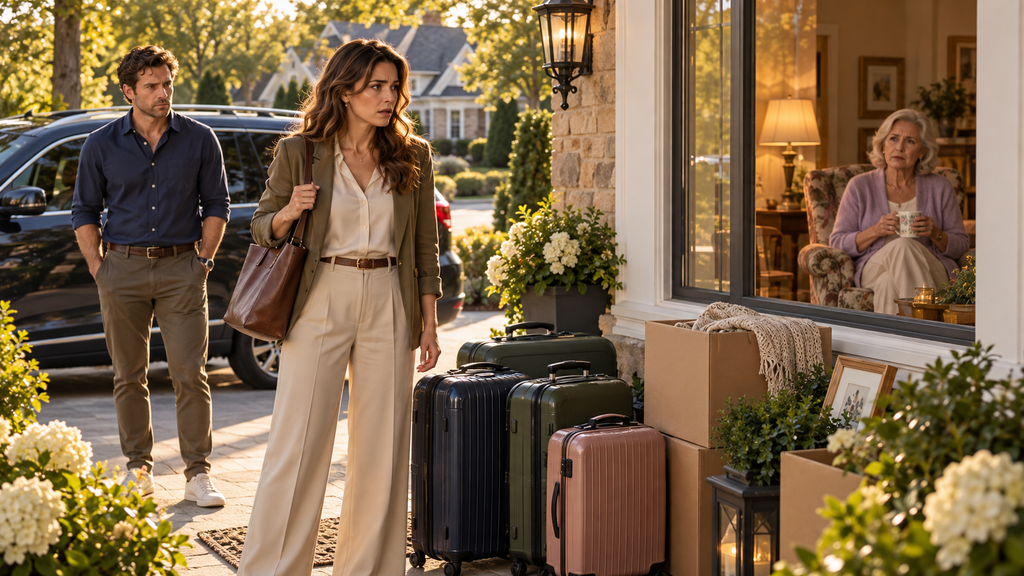
Now every shadow seemed to be hiding something.
I looked at David.
“How did Sarah know about the compartment?”
His face tightened.
“Mom…”
“How did she know?”
He looked toward the staircase.
Then toward the kitchen.
Anywhere except at me.
Finally, he whispered,
“She found something.”
My stomach dropped.
“What?”
“A note.”
I didn’t move.
David rubbed both hands over his face.
“She was upstairs yesterday while you were grocery shopping.”
Yesterday.
They had been living in my house for two days.
Two days.
And Sarah had already been searching through my private belongings.
“She said she was looking for an extra blanket,” David continued.
I almost laughed.
Not because it was funny.
Because the lie was so insulting.
“There are six blankets in the hallway closet.”
“I know.”
“And none of them are inside my husband’s desk.”
“I know.”
David looked ashamed.
That was something, at least.
Not enough.
But something.
“What did she find?”
David hesitated again.
Then he reached into his pocket and handed me a folded piece of yellowed paper.
I recognized my husband’s handwriting instantly.
My breath caught.
Even after seven years, I could still recognize the way Michael wrote the letter K.
He always gave it an extra loop.
He had written my name thousands of times during our marriage.
Birthday cards.
Grocery lists.
Notes on the refrigerator.
Little scraps of paper beside the coffee maker.
Kim — plumber comes Tuesday.
Kim — don’t forget dinner at seven.
Kim — I love you.
Seeing that handwriting again made something inside my chest ache.
I unfolded the paper.
There were only three sentences.
Kimberly,
The blue folder is in the locked compartment.
If anyone besides David asks about it, say nothing until you speak to Martin.
The key will be where David eventually finds it.
Michael.
I read it twice.
Then a third time.
“Who is Martin?” David asked.
I looked up.
“Martin Ellis.”
David frowned.
Then recognition appeared.
“Dad’s lawyer?”
“Our lawyer.”
Michael and I had used Martin for nearly thirty years.
Wills.
Property documents.
Business matters.
Anything important.
I stared at the note again.
My husband had died seven years earlier.
Whatever was inside that blue folder had mattered enough for him to leave instructions.
And apparently he had believed David would someday need to give me the key.
That thought chilled me more than anything Sarah had done.
“Where did you find the key?” I asked.
David swallowed.
“In Dad’s toolbox.”
My eyes narrowed.
“You went through his toolbox?”
“Sarah did.”
Of course.
I closed my eyes.
For seven years, Michael’s old workbench in the garage had barely been touched.
His tools still hung exactly where he had left them.
Sometimes I would walk past them and remember Saturday mornings when he would disappear into the garage with coffee and come back three hours later covered in sawdust.
Sarah had been living here for three days.
And she had already searched the master bedroom and the garage.
That wasn’t curiosity.
That was hunting.
“How long has she been looking for this folder?”
David didn’t answer.
“David.”
He whispered,
“Before we moved in.”
I stared at him.
“What?”
“She knew Dad had left something.”
“How?”
“She found an old tax document when we were going through some boxes last year.”
“What tax document?”
“A property assessment.”
I felt my stomach tighten.
“Which property?”
David looked miserable.
“I don’t know. Something in Jefferson County.”
I did know.
At least, I thought I did.
Thirty-two acres of land.
Mostly trees and open field.
Michael had bought it almost twenty-five years earlier.
We used to joke about building a little retirement cabin there someday.
But life became busy.
Then Michael got sick.
After he died, I had assumed the land had been sold as part of settling the estate.
Martin handled most of the paperwork because I could barely remember my own name during those first months of grief.
I looked toward the stairs.
“Come with me.”
“Mom…”
“Now.”
I walked upstairs.
David followed.
Neither of us spoke.
At the end of the hallway, sunlight spilled through my bedroom windows.
Michael’s old reading chair sat beside them.
His desk stood against the far wall.
For seven years, I had never moved it.
Sometimes grief makes ordinary furniture sacred.
That desk was where he had paid bills.
Written birthday cards.
Done crossword puzzles.
Filed receipts.
And occasionally fallen asleep while pretending he was working.
I ran my hand across the wood.
There was a scratch near the edge.
David had made it when he was fourteen.
He had been building a model airplane and slipped with a screwdriver.
Michael had pretended to be furious for five minutes.
Then he laughed.
I could almost hear him.
I opened the lower cabinet.
At first, I saw nothing unusual.
Then David crouched beside me.
“There.”
A tiny brass keyhole was hidden beneath the underside of the drawer.
I would never have noticed it.
I pushed the key inside.
It turned smoothly.
Click.
A narrow panel released.
My heart started beating harder.
Behind it was a shallow compartment.
And inside that compartment…
Was a blue folder.
Nothing else.
Just one thick blue folder tied closed with a black elastic band.
I lifted it out.
It was heavier than I expected.
Across the front, Michael had written two words.
FOR KIMBERLY.
My throat tightened.
David stood behind me.
Neither of us moved for a moment.
Then I carried it to the bed.
My hands trembled as I pulled away the elastic.
The first document was a letter.
The envelope had my name written across the front.
I sat down.
David remained standing.
“Do you want me to leave?” he asked quietly.
I looked at him.
Part of me wanted to say yes.
But another part of me knew Michael had included him in this somehow.
“Stay.”
I opened the envelope.
The paper inside was several pages long.
Michael’s handwriting covered every page.
I took a breath.
And began reading.
Kim,
If you are reading this, I’m probably gone.
I stopped.
My vision blurred instantly.
Seven years disappeared.
Suddenly I was sitting beside Michael in a hospital room again, listening to machines breathe beside him.
I wiped my eyes.
Then kept reading.
I know you hate when I try to prepare for the worst.
You always tell me I’m stubborn.
You are correct.
But you married me anyway, so technically this is partly your fault.
A broken laugh escaped me.
That sounded exactly like him.
David lowered his head.
I continued.
There are some things I handled quietly because I wanted you protected without making you afraid.
The land in Jefferson County was never sold.
I placed it into the Porter Family Trust six months before my diagnosis became serious.
You are the sole controlling beneficiary during your lifetime.
After your death, whatever remains passes to David under the protections Martin and I established.
My hands froze.
I looked at David.
He looked equally stunned.
I turned the page.
The trust also contains the investment account we built over the years.
You probably know less about that account than you should because I handled most of our investing.
For once, please resist saying, “I told you so.”
I laughed through my tears.
Michael had hated admitting I was right.
Even from beyond the grave, apparently.
Then the letter changed.
The handwriting became heavier.
More deliberate.
There is something else you need to know.
A year before I became sick, Sarah approached me privately.
I stopped reading.
David’s face went pale.
“What?”
I looked at him.
Then continued.
She asked me whether the Jefferson County land was going to David when I died.
At the time, I thought it was an odd question.
I told her the land belonged to you and me and that our estate planning was private.
Two weeks later, she asked whether you planned to sell the house after my death.
That concerned me.
My chest tightened.
I remembered that year.
Michael had been tired more often.
Nothing serious, we thought.
Sarah and David had been married for two years.
Family dinners still happened every Sunday.
Sarah always offered to help me wash dishes.
She hugged me on birthdays.
She called Michael “Dad.”
I kept reading.
I did not tell you because I knew you would worry about David.
I watched instead.
I discovered Sarah had been encouraging David to think of our property as his future inheritance.
That is why I created the trust.
Not because I wanted to punish David.
Because I wanted him protected from decisions he might make under pressure.
David sat heavily in Michael’s old reading chair.
His face had drained of color.
“Dad knew?”
I said nothing.
There were still two pages.
The next paragraph hurt most.
Kim, our home is not David’s inheritance.
It is your home.
Never let anyone make you feel guilty for continuing to live your life in something we worked forty years to build.
I don’t care whether you are sixty, seventy, ninety, or one hundred and five.
As long as you are alive, your life is not an obstacle standing between someone else and an inheritance.
My eyes filled completely.
I covered my mouth.
For seven years, I had missed him in a thousand different ways.
His coffee cup.
His jacket by the door.
His terrible singing in the shower.
The warmth of his hand against mine in bed.
But at that moment, I missed him with such force that it felt like losing him again.
David was crying too.
Quietly.
I continued.
If David is standing beside you while you read this, tell him I love him.
Tell him I always loved him.
But tell him something else.
Being a good husband does not mean surrendering your judgment.
Being a good son does not mean choosing your mother over your wife.
Being a good man means knowing when someone you love is asking you to become someone you should not be.
I looked at David.
His shoulders shook once.
He wiped his face quickly.
The final lines were simple.
Kim, trust yourself.
You were always stronger than you believed.
And David, if you are reading over your mother’s shoulder, stop slouching.
Love,
Dad.
David laughed.
Then cried harder.
Because Michael used to say that constantly.
“Shoulders back, son.”
Every photograph from David’s childhood seemed to contain Michael somewhere in the background telling him to stop slouching.
For a minute, neither of us spoke.
Then I returned to the folder.
Beneath the letter was a copy of the Porter Family Trust.
Property deeds.
Investment statements.
Insurance records.
And a sealed envelope addressed to David.
He stared at it.
“Open it,” I said.
His hands shook.
Inside was another letter.
This one was shorter.
David read silently at first.
Then his jaw tightened.
“What does it say?”
He handed it to me.
Son,
I’m writing this because there may come a day when you need someone who loves you enough to tell you something you don’t want to hear.
Sarah has repeatedly asked questions about money that does not belong to her.
That alone does not make her a bad person.
But I have also learned about the credit card opened using your information last March.
David went completely still.
I stopped reading.
“What credit card?”
His voice was barely audible.
“I don’t know.”
I looked back at the letter.
Your mother does not know.
I am giving you a chance to handle this yourself.
I spoke with Sarah and told her the account needed to be closed and the balance repaid.
She promised me it would be.
I hope she kept that promise.
If she did, forgive her and move forward carefully.
If she did not, son, please understand the difference between love and surrender.
I folded the letter.
The room was silent.
David stared at the carpet.
“That was eight years ago,” he whispered.
I nodded.
He stood suddenly.
Then he took out his phone.
“What are you doing?”
“Checking something.”
He opened his banking app.
Then another application.
Then his email.
His expression changed.
Confusion.
Then concern.
Then fear.
“David?”
He looked at me.
“There are accounts I don’t recognize.”
My stomach dropped.
“How many?”
“I don’t know.”
He started scrolling faster.
“David.”
“Mom, I don’t know.”
He walked toward the window.
His breathing changed.
I had seen that expression once before.
When he was nineteen and totaled Michael’s car.
He looked like a child waiting for someone to tell him the disaster wasn’t real.
But he was forty-two years old now.
And nobody could fix this for him.
“Call the bank,” I said.
He looked at me.
“Now.”
He nodded.
Before he could dial, footsteps sounded in the hallway.
Sarah appeared in the doorway.
Her eyes immediately landed on the blue folder.
Everything about her face changed.
It happened quickly.
But I saw it.
Relief.
Excitement.
Then calculation.
“You found it.”
Neither David nor I spoke.
Sarah stepped into the room.
“What’s in it?”
David looked at his wife as though he had never seen her before.
“Did you open a credit card in my name eight years ago?”
Sarah stopped.
For just a second.
Then she laughed.
A strange little laugh.
“What?”
“Answer me.”
“David, seriously?”
“Did you?”
Sarah crossed her arms.
“This is what your mother does. She creates drama and turns you against me.”
I stood.
“I haven’t said anything about you.”
Sarah pointed at the folder.
“You’re literally going through private documents!”
“They’re my documents.”
“That affects David.”
David stepped between us.
“Sarah.”
She looked at him.
“What?”
“Did you open the card?”
Silence.
Then Sarah sighed.
“Oh my God. That was years ago.”
My son went white.
“You did.”
“It was eighteen hundred dollars.”
Michael’s letter said nothing about the amount.
Which meant Sarah remembered exactly what she had done.
David stared at her.
“You told me Dad was lying when he warned me about you.”
Sarah’s expression hardened.
“Your father hated me.”
“No,” I said.
She snapped her head toward me.
“He didn’t hate you.”
“You have no idea what he said to me.”
“I know exactly what he wrote about you.”
She looked at the folder again.
And there it was.
That hunger.
“What else is in there?”
I closed the folder.
“That is none of your business.”
“David is Michael’s son.”
“And I was Michael’s wife.”
“So?”
The word came out before she could stop it.
So.
As though forty years of marriage were some inconvenient technicality.
I felt something inside me settle.
Not anger.
Something stronger.
Clarity.
I picked up the folder.
Sarah stepped forward.
“Kimberly, wait.”
I held up one hand.
“Don’t.”
She stopped.
“You have searched my bedroom.”
“You searched my husband’s desk.”
“You searched my garage.”
“You pressured my son to take my bedroom because you wanted access to private documents.”
Her face tightened.
“I wasn’t trying to steal anything.”
“Then why didn’t you ask me?”
She had no answer.
“Because you knew I would say no.”
Still silence.
I nodded.
“That’s what I thought.”
David lowered his voice.
“What were you looking for, Sarah?”
She looked at him.
“The land.”
My pulse jumped.
David frowned.
“What land?”
Sarah looked toward me again.
“The property in Jefferson County.”
“How do you know about that?” I asked.
“I found the assessment.”
“You told me you found one document.”
“I found several.”
David stared at her.
“When?”
“Last year.”
“And you didn’t tell me?”
“I was going to.”
“When?”
Sarah’s voice rose.
“When it mattered!”
“It matters now!”
She threw both hands in the air.
“Oh, please. Stop acting like some victim.”
David flinched.
Sarah pointed toward me.
“Your mother is sitting in a four-bedroom house by herself!”
I said nothing.
“She has investments.”
“Property.”
“Money.”
“Everything.”
“And we were drowning!”
There it was.
Not a misunderstanding.
Not a closet.
Not remote work.
Resentment.
Raw and ugly.
“We were drowning,” Sarah repeated, “and she never once offered to help.”
My mouth fell open.
“I invited you into my house rent-free.”
“For three months!”
“Yes.”
“You know what three months does for us? Nothing!”
David stared at her.
“What do you mean?”
Sarah suddenly realized she had said too much.
My son noticed.
“What do you mean, nothing?”
“David…”
“How much do we owe?”
Sarah looked away.
He stepped closer.
“How much?”
She said nothing.
“Sarah.”
“Don’t yell at me.”
“I am not yelling.”
“You’re interrogating me!”
“How much debt do we have?”
She folded her arms tightly.
“Some.”
“How much?”
Silence.
David’s voice cracked.
“How much?”
Finally, she whispered,
“About seventy-eight.”
He frowned.
“Seventy-eight hundred?”
Sarah said nothing.
And then I understood.
So did David.
“Seventy-eight thousand dollars?”
Sarah looked away.
My son sat down as though his knees had stopped working.
I felt cold.
He stared at her.
“We don’t have seventy-eight thousand dollars of debt.”
Apparently they did.
Sarah began talking quickly.
“It’s not all credit cards.”
“That doesn’t make it better.”
“Some of it is personal loans.”
David blinked.
“Loans?”
“And the car.”
“The car is financed.”
“There was negative equity from the last one.”
He stared at her.
“What last one?”
Sarah’s mouth closed.
David stood again.
“The BMW?”
She said nothing.
“You told me the dealership bought out the lease.”
“They did.”
“What did you roll into the new loan?”
Silence.
“How much?”
Sarah’s eyes flashed.
“Why are you doing this in front of your mother?”
David looked stunned.
“I’m doing this because apparently my mother knows less about our marriage than I do.”
Sarah’s face hardened.
Then she said something I think destroyed whatever remained between them.
“You were never good with money.”
David looked at her.
He didn’t raise his voice.
He didn’t slam a door.
He simply said,
“You never let me see it.”
Sarah rolled her eyes.
“Because you panic.”
“You told me everything was fine.”
“It was manageable.”
“You told me our rent went up.”
“It did.”
“Did we get evicted?”
Silence.
David stared at her.
My stomach tightened.
“Sarah.”
She looked away.
“Did we get evicted?”
“Not technically.”
David laughed once.
There was no humor in it.
“What does that mean?”
“We were asked to leave.”
“Because?”
“The rent was late.”
“How late?”
She didn’t answer.
“Sarah!”
“Three months!”
My son closed his eyes.
I felt like I was watching something collapse in slow motion.
The apartment.
The debt.
The hidden credit accounts.
The lies.
Suddenly their desperate need to move into my house made sense.
Sarah had not come here because she wanted time to save money.
She had come here looking for money.
My money.
Michael’s money.
The land.
The trust.
My house.
David opened his eyes.
“You knew about the land.”
Sarah said nothing.
“You knew there might be money.”
Silence.
“And that’s why you wanted Mom’s bedroom.”
Sarah’s face changed.
Just slightly.
But enough.
David whispered,
“Oh my God.”
She stepped toward him.
“David, listen to me.”
“No.”
“We needed a way out.”
“You lied to me.”
“I was trying to protect us.”
“You lied to me!”
His voice finally rose.
Sarah flinched.
“I was going to fix it!”
“With my mother’s money?”
“With family money!”
I stood.
“No.”
Sarah turned.
“What?”
“It is not family money.”
She stared at me.
“It is mine.”
Her expression filled with contempt.
“You don’t need all of it.”
Maybe she expected me to feel guilty.
For years, that sentence would have worked on me.
You don’t need it.
You have enough.
You’re alone.
You’re older.
What are you going to do with it?
For some reason, people sometimes treat widows as though our lives have entered a waiting room.
As though everything we have is simply sitting there waiting to be distributed to the younger generation.
But Michael’s words were still fresh in my mind.
Your life is not an obstacle standing between someone else and an inheritance.
I looked straight at Sarah.
“You don’t get to decide what I need.”
She scoffed.
“You’re sixty-four.”
“Yes.”
“You have no mortgage.”
“Yes.”
“You have retirement accounts.”
“Yes.”
“And land.”
“Yes.”
“Then why are you acting like helping your own son would destroy you?”
I looked at David.
Then back at her.
“I was helping my son.”
Sarah opened her mouth.
I continued.
“I gave you a home.”
“No rent.”
“No deposit.”
“No utilities.”
“No deadline except three months.”
“You were supposed to use that time to repair your finances.”
“Instead, within seventy-two hours, you tried to take my bedroom and search my dead husband’s private papers.”
Her cheeks flushed.
“When you put it like that—”
“There is no other way to put it.”
David looked at me.
“Mom…”
I turned to him.
“You both need to leave.”
Sarah laughed.
“No.”
I stared at her.
She blinked.
“What did you say?”
“I said no.”
“This is my house.”
“We live here.”
“For three days.”
“We have an agreement.”
“Yes.”
I lifted the paper from the dresser.
“And you violated it.”
Sarah’s jaw clenched.
“You can’t just throw us out.”
“I am not debating housing law with you in my bedroom.”
I picked up my phone.
“My attorney can handle whatever legal process is necessary.”
The confidence disappeared from her face.
For the first time that day, Sarah looked uncertain.
I continued.
“But you will not sleep in this house tonight.”
“Kimberly—”
“No.”
I didn’t shout.
I didn’t need to.
“I offered you my home because I loved my son.”
“I treated you like family because you were his wife.”
“You rewarded that kindness by searching through my private belongings and planning how to access property that does not belong to you.”
“You are leaving.”
Sarah looked at David.
“Say something.”
He didn’t.
“David.”
Nothing.
She walked toward him.
“Tell her.”
He looked at Sarah for a long time.
Then he said,
“I think we should go.”
Sarah stared at him.
“What?”
“We should leave.”
“You’re choosing her?”
His expression changed.
“No.”
He shook his head.
“For once, I think I’m choosing myself.”
Sarah stepped backward.
I watched those words hit her.
She reached for her purse.
“Fine.”
Then she looked at me.
“You’ll regret this.”
Maybe she expected fear.
Instead, I opened my bedroom door.
“Your luggage is downstairs.”
She stared at me for several seconds.
Then stormed out.
A bedroom door slammed down the hall.
David remained where he was.
After a moment, he whispered,
“I’m sorry.”
I looked at my son.
He appeared smaller somehow.
Not physically.
Emotionally.
Like the boy who once stood beside a broken window with a baseball in his hand and confessed before Michael even asked.
But this wasn’t a broken window.
This was years of avoidance.
“Sorry doesn’t fix this today.”
He nodded.
“I know.”
“And I need you to understand something.”
He looked at me.
“I am angry with Sarah.”
“But I am also angry with you.”
His eyes filled.
“I know.”
“You stood in my kitchen this morning and told me to show some respect.”
He lowered his head.
“To my own daughter-in-law.”
“In my own house.”
“I know.”
“You didn’t ask what I wanted.”
“You didn’t defend me.”
“You didn’t even look me in the eye.”
“I know.”
His voice broke.
“I know, Mom.”
I took a slow breath.
“I love you.”
He looked up.
“But loving you does not mean pretending that didn’t happen.”
He nodded.
A tear slid down his cheek.
“You taught me something today.”
“What?”
“That Dad was right.”
I looked toward the letter.
David wiped his face.
“I thought keeping Sarah happy meant being a good husband.”
He laughed bitterly.
“I kept telling myself every compromise was temporary.”
“One credit card.”
“One expensive car.”
“One vacation we couldn’t afford.”
“One apartment that was too expensive.”
“One lie to you.”
“One more thing.”
“And then today I heard myself telling you to leave your own bedroom.”
He looked at me.
“And I didn’t even recognize myself.”
That hurt more than I expected.
Because I recognized exactly what he meant.
People rarely wake up one morning as strangers to themselves.
It happens slowly.
One concession at a time.
One silence.
One uncomfortable truth ignored because confronting it feels harder than tolerating it.
Until eventually you look in the mirror and wonder how you arrived there.
I walked toward him.
For a moment, I almost hugged him.
Then I stopped.
Not because I didn’t love him.
Because I needed him to feel the distance his choices had created.
Some bridges should not be rebuilt before the person who burned them learns what fire costs.
“You need to handle your marriage,” I said.
“Yes.”
“And your finances.”
“Yes.”
“And you need to do both somewhere else.”
He nodded.
“I understand.”
Downstairs, something crashed.
Sarah shouted a curse.
David closed his eyes.
“I should go.”
“Yes.”
He reached the doorway.
Then stopped.
“Mom?”
“Yes?”
“I never wanted your house.”
I believed him.
That almost made it worse.
Because sometimes people do terrible things without wanting the reward themselves.
They simply lack the courage to say no to the person who does.
“I know,” I said.
He nodded.
Then went downstairs.
I stayed in the bedroom.
Alone.
For several minutes, I stared at Michael’s desk.
Then I picked up his letter again.
Trust yourself.
You were always stronger than you believed.
I pressed the paper against my chest.
“You stubborn old man,” I whispered.
And for the first time in seven years, I felt as though he had answered me.
Not with words.
With foresight.
With protection.
With one last reminder that being kind did not require being weak.
Twenty minutes later, I heard suitcases rolling across the hardwood floor downstairs.
Then the front door opened.
Sarah was talking loudly.
“I cannot believe you’re doing this.”
David didn’t respond.
“I said I cannot believe you’re doing this!”
Still nothing.
I walked downstairs.
Sarah had two suitcases beside her.
David carried the others.
The cardboard boxes were still on the porch exactly where I had left them that morning.
Sarah looked at me.
“I hope you enjoy sitting alone in this giant house.”
The cruelty was deliberate.
She wanted that sentence to wound me.
Once, it might have.
I had spent years fearing loneliness after Michael died.
Some nights, the silence had been so heavy that I left the television running just to hear another human voice.
But loneliness and peace are not the same thing.
And I was finally learning that company purchased with disrespect is far more expensive than solitude.
I opened the door wider.
“I will.”
Her face tightened.
She walked outside.
David paused beside me.
“I’ll call you.”
“Not tonight.”
He swallowed.
“Okay.”
“Figure out where you’re going.”
“I will.”
Then he carried the last suitcase outside.
Sarah climbed into the SUV.
David loaded the luggage.
He stood beside the passenger door for several seconds.
Then, unexpectedly, he closed it.
He didn’t get in.
Sarah lowered the window.
“What are you doing?”
“I’m not going with you.”
Her face changed.
“What?”
“I’m staying at a hotel.”
“We can go together.”
“No.”
“David.”
“I need space.”
Her voice became sharp.
“You don’t get space.”
He almost smiled.
It was a sad smile.
“I think that sentence explains a lot.”
Sarah stared at him.
Then she looked at me.
As though somehow I had caused this.
I hadn’t.
I hadn’t ended their marriage.
I had simply stopped offering my house as a place for their problems to hide.
Sarah threw the SUV into reverse.
The tires rolled over the edge of my flower bed.
Then she sped down the driveway.
David watched until the vehicle disappeared.
He stood there for another moment.
Then he ordered a car from his phone.
We waited in silence.
When it arrived, he looked at me.
“Goodnight, Mom.”
“Goodnight, David.”
He got in.
The car pulled away.
I closed the front door.
And for the first time that day…
The house was completely quiet.
I locked the deadbolt.
Then I leaned against the door.
My legs suddenly felt weak.
All the strength I had carried through the confrontation disappeared at once.
I slid down until I was sitting on the floor.
And then I cried.
Not because Sarah had left.
Not because David had disappointed me.
Not even because of the money.
I cried because grief had a strange way of returning when you least expected it.
Reading Michael’s handwriting had opened a door inside me that I had carefully kept closed.
For twenty minutes, I cried for the husband who should have been standing beside me.
For the man who would have marched downstairs and thrown Sarah’s suitcase into the driveway himself.
For the father David still needed.
For the life we had expected to have.
Eventually, I stood.
I made tea.
Then I carried Michael’s letter into the living room.
His photograph sat on the mantel.
It was taken on our thirty-fifth anniversary.
His hair was silver.
His tie was crooked.
I had been laughing because five seconds before the picture was taken, he whispered that the restaurant charged twelve dollars for mashed potatoes and civilization was clearly ending.
I touched the glass.
“You knew,” I whispered.
He had known enough.
Not everything.
But enough.
I slept badly that night.
At 7:12 the next morning, my phone rang.
Martin Ellis.
I had left him a voicemail the previous evening.
“Kimberly?”
“Hello, Martin.”
“It’s been a long time.”
“Yes.”
“What happened?”
I told him everything.
The bedroom.
The desk.
The key.
The blue folder.
Sarah.
David.
The debt.
Martin listened without interrupting.
When I finished, there was silence.
Then he exhaled slowly.
“Michael always worried something like this might happen.”
My fingers tightened around the phone.
“You knew?”
“I knew he had concerns.”
“Why didn’t anyone tell me?”
“Because Michael asked me not to unless it became necessary.”
I closed my eyes.
“That sounds like him.”
“Yes.”
Martin continued.
“He didn’t want to poison your relationship with David or Sarah based only on suspicion.”
“But he changed the trust.”
“Yes.”
“Tell me what’s in it.”
Martin paused.
“The house is yours outright.”
“I knew that.”
“The Jefferson County property belongs to the trust.”
“And?”
“The investment account.”
“How much?”
Another pause.
“Kimberly, the value has changed significantly since Michael died.”
My heart started beating faster.
“How much?”
“As of last quarter, approximately eight hundred and forty thousand dollars.”
I gripped the edge of the counter.
I genuinely thought I had heard him wrong.
“What?”
“The investment account is about eight hundred and forty thousand.”
I sat down.
“And the land?”
“That’s more complicated.”
“Why?”
“Because the area has been rezoned.”
I remembered hearing something about new development outside Jefferson.
“A logistics company purchased adjacent parcels last year.”
“Yes.”
Martin cleared his throat.
“You may have received correspondence.”
“I throw away most property advertisements.”
“This one wasn’t an advertisement.”
My pulse quickened.
“What was it?”
“An inquiry.”
“For what?”
“To purchase the property.”
“How much?”
“Just under one point six million.”
I stopped breathing for a moment.
Martin continued talking.
I barely heard him.
One point six million.
The number felt ridiculous.
Unreal.
I looked around my kitchen.
At the same refrigerator.
The same chipped fruit bowl.
The same curtains I had owned for eleven years.
Nothing looked different.
Yet apparently, hidden inside a folder upstairs was proof that my financial life was far more secure than I had ever imagined.
“Michael knew?”
“Not what the land would eventually be worth.”
Martin’s voice softened.
“He bought that property because he believed the area would grow someday.”
I almost laughed.
Of course he did.
Michael could look at a dirt road surrounded by weeds and somehow imagine a shopping center twenty years later.
“But listen carefully,” Martin said.
“I’m listening.”
“None of that money belongs to David.”
“I understand.”
“Not now.”
“Yes.”
“And certainly not Sarah.”
“I understand.”
“Michael made you sole controlling beneficiary for your lifetime.”
I looked toward the ceiling.
Toward the room where the folder waited.
“What happens after I die?”
“Under the current documents, David becomes beneficiary of what remains.”
I was silent.
Martin understood.
“You can change portions of the estate structure if you wish.”
“Did Michael expect me to?”
“No.”
“What did he expect?”
Martin gave a quiet laugh.
“For you to make your own decisions.”
That sounded like him too.
I scheduled an appointment with Martin for that afternoon.
At 10:37, a truck pulled into my driveway.
A moving truck.
I frowned.
Two men stepped out.
Then another vehicle appeared behind them.
Sarah.
Of course.
She had scheduled furniture delivery for eleven.
Just as she had promised.
For one absurd second, I stood at the window staring at the truck and remembered her voice from the day before.
Make sure the room is empty by eleven.
I almost smiled.
The driver rang the bell.
I opened the door.
“Delivery for David and Sarah Porter?”
“No.”
He looked at his clipboard.
“This is 1478 Willow Ridge?”
“Yes.”
“We have a bedroom set.”
“It is not being delivered here.”
He frowned.
“Customer confirmed the address.”
“The customer does not live here.”
Behind him, Sarah climbed out of her SUV.
“Bring it inside.”
The driver looked between us.
I folded my arms.
“No.”
Sarah marched toward the porch.
“Kimberly, don’t do this.”
“I’m not doing anything.”
“You agreed we could stay three months.”
“You violated that agreement.”
“I paid for delivery.”
“Then you should give them your new address.”
The driver looked deeply uncomfortable.
He had clearly not planned to spend his morning in the middle of a family war.
Sarah lowered her voice.
“We need to talk.”
“No.”
“You can’t avoid me forever.”
“I’m not avoiding you.”
I looked directly at her.
“I’m refusing to argue with you.”
Her eyes hardened.
“David isn’t answering me.”
“That sounds like something you should discuss with David.”
“You turned him against me.”
“No.”
I shook my head.
“Your bank statements might have done that.”
She went pale.
So I knew David had confronted her further.
Sarah stepped closer.
“You have no idea what marriage is like.”
I almost laughed.
“I was married forty years.”
“To a man who worshipped you.”
“Michael did not worship me.”
“We argued.”
“We disagreed.”
“He once refused to speak to me for half a Saturday because I donated his favorite recliner.”
Despite myself, I smiled.
“But we respected each other.”
Sarah looked away.
I continued.
“He never needed me frightened or confused in order to feel secure.”
“He never hid debt from me.”
“And I never searched his parents’ house looking for an inheritance.”
Her jaw tightened.
“This isn’t about inheritance.”
“Then tell me what it is about.”
She hesitated.
I waited.
Finally, Sarah said,
“I was trying to save my marriage.”
That was not the answer I expected.
My expression changed.
She looked tired.
For the first time since I had known her, truly tired.
Not angry.
Not polished.
Not superior.
Just exhausted.
“David was going to leave me last year,” she said.
I said nothing.
“He found one of the credit cards.”
“What happened?”
“I told him I had it under control.”
“Did you?”
“No.”
The word was barely audible.
She looked toward the moving truck.
“I thought if we could pay everything off, things would go back to normal.”
“So you came after my money.”
“I thought David would inherit it eventually.”
“Eventually means after I die.”
She winced.
“I didn’t mean it like that.”
“But that is what it means.”
Sarah rubbed her forehead.
“I wasn’t wishing you dead.”
“I’m glad.”
“I just…”
She stopped.
Then her voice broke slightly.
“I needed something to fix it.”
For the first time, I saw the frightened person underneath all that entitlement.
It did not erase what she had done.
Understanding someone’s fear does not require surrendering your boundaries to it.
“You cannot fix dishonesty with someone else’s money,” I said.
She looked at me.
“I know.”
“Do you?”
Tears filled her eyes.
“I do now.”
I wanted to believe her.
Maybe someday I would.
But consequences are often the only language denial understands.
“The furniture cannot stay here.”
She nodded.
The driver cleared his throat.
“So…”
Sarah turned to him.
“I’ll give you another address.”
She walked back toward the truck.
Then stopped.
“Kimberly?”
“Yes?”
“Is there really something valuable in the folder?”
I looked at her.
That question told me more than her tears had.
Even now.
Even after everything.
She still wanted to know.
I gave her the only answer she deserved.
“Nothing that belongs to you.”
I closed the door.
At 1:30 that afternoon, I sat in Martin’s office.
The blue folder lay on the table between us.
He reviewed every document.
The trust was valid.
The property was secure.
The investment account was intact.
Nothing had been stolen.
Nothing had been transferred.
Sarah had managed to find clues.
But not access.
Michael had made sure of that.
Then Martin slid another document toward me.
“What is this?”
“Michael’s memorandum.”
I frowned.
“I already read his letter.”
“This is different.”
It was typed.
Several pages.
Michael had apparently written it for Martin, explaining his decisions.
I read one paragraph slowly.
My intention is not to control David from beyond the grave. My intention is to ensure Kimberly is never pressured into surrendering her security because our son has difficulty saying no to someone he loves.
I stopped.
Martin watched me.
“He understood David.”
“Yes.”
I looked down.
“He understood him better than I did.”
“Parents often understand different pieces of their children.”
I sighed.
“I kept thinking David would become more confident.”
“He may.”
“He’s forty-two.”
Martin smiled gently.
“Some lessons are late.”
I looked toward the folder.
“What would you do?”
He shook his head.
“I’m your attorney, Kimberly.”
“I’ll explain options.”
“You decide.”
That afternoon, we reviewed everything.
For the first time in years, I understood my finances completely.
The house.
The trust.
The property.
The investments.
The beneficiaries.
Every signature.
Every account.
Every decision Michael had made.
And one uncomfortable truth became obvious.
I had allowed grief to make me passive.
After Michael died, I handed everything to professionals because thinking about money felt almost disrespectful.
Money had been something we managed together.
Without him, every statement reminded me that I was alone.
So I stopped looking.
That had been a mistake.
Not because Martin had done anything wrong.
He had not.
But because security you don’t understand can become vulnerability.
I left his office with copies of every document.
And with a decision.
I was not selling the house.
I was not signing anything over to David.
I was not giving Sarah money.
And I was not making any permanent decision about my estate while angry.
Michael had spent his life protecting me from fear.
I would not spend the rest of mine making decisions out of rage.
That evening, David called.
I almost didn’t answer.
Then I did.
“Hi.”
“Hi, Mom.”
He sounded exhausted.
“Where are you?”
“Hotel.”
“Are you safe?”
“Yes.”
“Good.”
Silence.
Then he said,
“I pulled my credit report.”
I closed my eyes.
“How bad?”
“Worse.”
I waited.
“One hundred and thirteen thousand.”
I sat down.
“How?”
“Cards.”
“Loans.”
“The car.”
“Some medical debt she never told me about.”
“And…”
He stopped.
“What?”
“A business loan.”
“What business?”
“Apparently Sarah tried starting an online boutique two years ago.”
I frowned.
“You never knew?”
“I knew she sold clothes online.”
“I didn’t know she borrowed forty thousand dollars.”
I rubbed my forehead.
“What are you going to do?”
“I called a financial counselor.”
That surprised me.
“Good.”
“And an attorney.”
I didn’t ask which kind.
I already knew.
He continued.
“Sarah and I talked.”
“How did that go?”
“Bad.”
I heard something in his voice.
Grief.
“I don’t know if we’re going to stay married.”
I stared at Michael’s photograph across the room.
“That’s your decision.”
“I know.”
“I won’t tell you to leave her.”
“I know.”
“And I won’t tell you to stay.”
“I know.”
“But I will tell you this.”
“What?”
“Whatever you decide, decide because it is your decision.”
Silence.
Then David whispered,
“Dad said the same thing.”
I smiled sadly.
“He usually got there first.”
David laughed.
Then he became quiet.
“Mom?”
“Yes?”
“How much is the land worth?”
There it was.
For one second, disappointment stabbed through me.
Then he immediately added,
“Actually, don’t answer that.”
I waited.
“It’s none of my business.”
That mattered.
More than he probably understood.
“You’re right.”
“I’m sorry I asked.”
“It’s okay.”
“No.”
He exhaled.
“It isn’t.”
Another pause.
“I think Sarah and I spent so many years talking about what we would have someday that I stopped paying attention to what we were doing now.”
I thought about that sentence for a long time.
Inheritance.
Future money.
Future houses.
Future comfort.
How easily people can mortgage their present for a life they expect someone else to provide later.
“You need to build a life that works without waiting for mine to end,” I said.
His voice cracked.
“I know.”
We talked another ten minutes.
Then I went to bed.
The next several weeks were uncomfortable.
And slow.
Real life rarely gives you the clean endings stories do.
Sarah did not disappear dramatically.
David did not become a different man overnight.
Nobody stood in a courtroom and announced that I had been right about everything.
Instead, consequences unfolded quietly.
David moved into a furnished studio apartment.
It was small.
One bedroom.
Second floor.
No walk-in closet.
No granite counters.
No luxury gym.
He sent me a photo the first night.
A folding chair beside a card table.
His message said:
Dad would call this “character building.”
I laughed harder than I expected.
I wrote back:
Your father would have bought you a secondhand chair and complained the whole time.
David replied:
Accurate.
That was the first normal conversation we had after everything happened.
But I still didn’t invite him home.
Not yet.
Love needed boundaries now.
A month later, Sarah filed for separation.
Or maybe David did.
He never told me exactly.
I didn’t ask.
He only said they had decided to live apart while sorting through the finances.
Sarah moved in with her sister.
David began meeting weekly with a counselor.
He also started financial counseling.
For the first time in his adult life, he made a budget.
He called me after his first session.
“Mom.”
“Yes?”
“Do you know how much coffee costs?”
I laughed.
“You’re forty-two years old.”
“I mean over a year.”
“Apparently you didn’t.”
“I spent almost three thousand dollars last year on coffee.”
“That seems ambitious.”
“I feel attacked.”
“By arithmetic?”
He laughed.
It was good to hear.
Gradually, something changed between us.
Not back to what it had been.
Something different.
More honest.
David stopped calling when he needed something.
Instead, he called just to talk.
Sometimes he asked about Michael.
Stories he had forgotten.
Questions he had never thought to ask.
“What was Dad like when you met him?”
“Annoying.”
“Seriously?”
“Very.”
“How?”
“He owned exactly two decent shirts and somehow believed both were appropriate for every occasion.”
David laughed.
Another time he asked,
“Did you ever almost leave him?”
I was quiet.
“Yes.”
He sounded surprised.
“When?”
“About twelve years into our marriage.”
“Why?”
“Because we were both stubborn.”
“That seems genetically relevant.”
I laughed.
Then told him the truth.
Michael and I had nearly separated after months of arguments about work, money, and the fact that he kept missing dinner because he was trying to build his business.
“What happened?”
“We changed.”
“Both of you?”
“Yes.”
“That simple?”
“No.”
I smiled.
“Nothing important is simple.”
We learned how to apologize.
How to disagree without trying to win.
How to stop treating compromise like defeat.
How to say what we meant before resentment turned it into something cruel.
David listened.
Then he said,
“I don’t think Sarah and I ever learned that.”
“Maybe not.”
“Do you hate her?”
I thought carefully.
“No.”
“You should.”
“No.”
I looked out my kitchen window.
“Hating her would require renting space in my mind to someone I already asked to leave my house.”
David laughed.
Then became serious.
“I’m still angry.”
“You’re allowed.”
“At her.”
“At myself.”
“You’re allowed that too.”
“I embarrassed you.”
“Yes.”
“I disrespected you.”
“Yes.”
He was quiet.
“You’re really not going to make this easy for me, are you?”
“No.”
He laughed softly.
“Good.”
That surprised me.
Then he said,
“I think easy is how I got here.”
Three months after the morning Sarah ordered me out of my bedroom, David came over for dinner.
It was the first time he had entered my house since leaving.
He stood on the porch holding a grocery bag.
“What’s that?”
“Dinner.”
I raised an eyebrow.
“You’re cooking?”
“I’ve been learning.”
“Should I call the fire department now?”
He rolled his eyes.
“Dad was right about you.”
“What did he say?”
“That you become meaner with age.”
I smiled.
“Come inside.”
He paused.
“Are you sure?”
“Yes.”
That question mattered too.
He no longer assumed my door was his.
He waited to be invited.
The house smelled like garlic twenty minutes later.
David was making pasta.
Poorly.
I watched him attempt to chop an onion.
“Have you never held a knife before?”
“Stop judging me.”
“You’re holding it backward.”
“I am not.”
“You absolutely are.”
He looked at it.
Then laughed.
For a moment, I saw the boy he had once been.
Seven years old.
Standing on a chair beside Michael while they attempted pancakes.
Flour everywhere.
Burned batter.
Michael insisting it was “rustic.”
My eyes suddenly filled.
David noticed.
“What?”
“Nothing.”
“Mom.”
I smiled.
“Your father would have loved this.”
David looked down at the cutting board.
“Yeah.”
For a while, only the sound of the knife against wood filled the kitchen.
Then he said,
“Sarah and I are getting divorced.”
I had expected it.
Still, hearing it hurt.
Not because I wanted their marriage to continue at any cost.
Because every divorce is still the death of something people once believed would last.
“I’m sorry.”
He nodded.
“I am too.”
“Are you sure?”
“Yes.”
I waited.
“She finally gave me access to everything.”
“And?”
“She had been moving money between accounts for years.”
“I see.”
“She says she was ashamed.”
“That may be true.”
“I believe her.”
He looked at me.
“But believing her doesn’t mean I trust her anymore.”
“No.”
“I wish I had paid attention.”
“We all wish things.”
“I keep thinking Dad tried to warn me.”
I shook my head.
“Your father didn’t expect you to predict the future.”
“But he knew.”
“He suspected.”
“There’s a difference.”
David nodded.
“I’m learning there are lots of differences I used to ignore.”
“Like what?”
“Peace and avoidance.”
I smiled.
“That’s a good one.”
“Kindness and weakness.”
I looked at him.
“That’s an even better one.”
“Love and surrender.”
Michael’s words.
David swallowed.
“That one hurts.”
“Yes.”
Dinner was terrible.
The pasta was overcooked.
The sauce was too salty.
The garlic bread was burned.
We ate every bite.
Afterward, David helped me wash dishes.
At one point, he looked upstairs.
“Did you ever move Dad’s desk?”
“No.”
“Do you think you will?”
“Maybe someday.”
He nodded.
“Can I ask you something?”
“Yes.”
“Did you change the trust?”
I dried my hands.
“I reviewed it.”
His face remained calm.
“That isn’t what I asked.”
“No.”
He waited.
I looked at him.
“Yes.”
Something flickered across his face.
Not anger.
Not exactly.
Maybe disappointment.
But he nodded.
“I figured.”
“I haven’t disinherited you.”
“I didn’t ask.”
“I know.”
That mattered too.
I continued.
“I changed how anything you might receive someday will be handled.”
“Okay.”
“I also changed some charitable provisions.”
“Okay.”
“And I added instructions that nobody living in my house can order me out of my bedroom.”
He stared at me.
Then laughed so loudly he nearly dropped a plate.
“That is not in there.”
“No.”
“Mom.”
“Fine.”
He was still laughing.
I smiled.
Then he became serious again.
“It’s your money.”
“Yes.”
“Your house.”
“Yes.”
“Your life.”
I looked at him.
“Yes.”
He swallowed.
“I’m sorry it took me so long to understand that.”
I reached across the counter.
This time, I hugged him.
The first real hug since everything happened.
He held me tightly.
“Dad would be ashamed of me,” he whispered.
I pulled back.
“No.”
He looked at me.
“Your father would be angry with some of your choices.”
“That is not the same thing as being ashamed of who you are.”
His eyes filled.
“Don’t confuse mistakes with identity.”
“You did something wrong.”
“Now do something better.”
He nodded.
Then hugged me again.
Six months later, the Jefferson County property sold.
Not for the original offer.
Martin negotiated.
The final price was a little over one point seven million dollars.
When the transfer went through, I sat in Martin’s office staring at the paperwork.
“Congratulations,” he said.
“It feels strange.”
“Why?”
“Michael bought that land for forty-eight thousand dollars.”
Martin smiled.
“He was patient.”
“He was cheap.”
“That too.”
I laughed.
Then I cried a little.
Not because of the money.
Because I wished Michael could have seen it.
He would have pretended he had predicted the exact sale price.
He would have walked around the house for six months saying,
“Told you that land was worth keeping.”
I knew exactly what I wanted to do with part of it.
The hospice where Michael spent his final weeks had a family-support program.
They had helped me through the worst days of my life.
I donated enough to establish a small fund in Michael’s name.
The rest stayed invested.
I paid off the remaining balance on my house, although the mortgage had already been small.
Then I did something completely irresponsible.
At least, irresponsible by Michael’s standards.
I booked a three-week trip to Italy.
For years, we had talked about going.
Michael always said,
“Next year.”
There is a danger in believing life owes you a next year.
Sometimes it doesn’t.
So I went.
David drove me to the airport.
When I lifted my suitcase from his trunk, he looked at it.
“Three weeks?”
“Yes.”
“What did you pack, bricks?”
“Shoes.”
“How many?”
“None of your business.”
He laughed.
Then he hugged me.
“Have fun, Mom.”
“I intend to.”
“Spend Dad’s money.”
I raised an eyebrow.
“My money.”
He grinned.
“Exactly.”
That was the moment I knew something inside him had truly changed.
When I returned, the house felt different.
Not emptier.
Mine.
Completely mine.
I changed the guest bedroom.
Not out of anger.
Because I wanted something new.
I donated the old furniture and turned the room into a small reading room.
A soft green chair.
Bookshelves.
A desk beside the window.
A place for tea.
A place for quiet mornings.
I kept the master bedroom exactly as it was.
Not because Sarah had wanted it.
Because I loved it.
Michael’s reading chair remained near the window.
His desk stayed against the wall.
And the blue folder?
That no longer lived inside the desk.
It went into a secure deposit box along with everything else important.
I learned that memory can be sacred without being careless.
About a year after everything happened, I saw Sarah again.
Unexpectedly.
I was leaving a bookstore when I heard someone call my name.
“Kimberly?”
I turned.
Sarah stood near the entrance.
She looked different.
Her hair was shorter.
No designer purse.
No enormous sunglasses.
No iced latte.
For one ridiculous second, that was what I noticed most.
She looked nervous.
“Hello, Sarah.”
“Hi.”
Neither of us knew what to say.
Then she asked,
“How are you?”
“Good.”
She nodded.
“I heard you traveled.”
“I did.”
“Italy?”
“Yes.”
“That’s nice.”
“It was.”
Silence.
Then Sarah looked at me.
“I owe you an apology.”
I said nothing.
“I know that doesn’t fix anything.”
“No.”
“I was awful.”
I waited.
“I was scared.”
“I was ashamed.”
“And instead of admitting what I had done, I kept trying to find bigger ways to cover it.”
Her eyes filled.
“I kept thinking one big solution would erase a thousand small lies.”
That was probably the most honest thing I had ever heard her say.
She continued.
“I blamed David.”
“I blamed you.”
“I blamed rent.”
“My parents.”
“Banks.”
“Everything except myself.”
I looked at her.
“What changed?”
She laughed sadly.
“Losing everything.”
I didn’t respond.
She shook her head.
“Not literally everything.”
“But enough.”
Then she took a breath.
“I’m sorry I searched your house.”
“I’m sorry I tried to take your bedroom.”
“I’m sorry I treated you like you were standing between us and something we deserved.”
Something tightened in my chest.
Not anger.
Grief.
Maybe even compassion.
“I appreciate you saying that.”
Sarah nodded.
“I don’t expect forgiveness.”
I thought about Michael.
About all the years I had spent with him.
About arguments.
Mistakes.
Second chances.
Then I said,
“I forgive you.”
Her eyes widened.
“But forgiveness does not mean returning to the relationship we had.”
She nodded immediately.
“I understand.”
“I hope you do well.”
“I mean that.”
Tears slipped down her cheeks.
“Thank you.”
She turned to leave.
Then stopped.
“Kimberly?”
“Yes?”
“I was wrong about something else.”
“What?”
She smiled faintly.
“You do need that house.”
I smiled.
“No.”
I looked toward the parking lot.
“I don’t need the house.”
“I choose it.”
There is a difference.
Sarah nodded.
Then walked away.
I never became close to her again.
Maybe someday our lives will cross differently.
Maybe they won’t.
Not every relationship needs to be repaired simply because forgiveness happened.
Sometimes forgiveness is simply putting down the weight and continuing in another direction.
David eventually finished his divorce.
It was painful.
Expensive.
Messy.
He paid his portion of the debts.
Sold the SUV.
Moved from his tiny apartment into a modest townhouse he could actually afford.
He started cooking.
Badly.
Then less badly.
He stayed in therapy.
And slowly, he became someone I think Michael would have recognized again.
Not perfect.
But awake.
One Sunday afternoon, almost two years after the morning Sarah ordered me from my bedroom, David came over carrying a wooden box.
“What is that?”
“Open it.”
I did.
Inside was a small brass plaque.
Engraved on it were the words:
KIMBERLY PORTER
OWNER OF THE MASTER BEDROOM
NO APPEALS ACCEPTED
I stared at him.
“You paid money for this?”
“Twelve dollars.”
“Too much.”
“Mom.”
I started laughing.
He laughed too.
Then I carried it upstairs.
David followed.
We stood outside my bedroom.
“You’re actually going to hang it?”
“Absolutely.”
“Dad would hate this.”
“Your father would have bought a second one.”
David smiled.
“Yeah.”
I placed it on the door.
Then stepped back.
For a moment, neither of us spoke.
Sunlight moved across the hallway floor.
The house was quiet.
Warm.
Safe.
Mine.
David slipped his hands into his pockets.
“You know what I think about sometimes?”
“What?”
“That morning.”
“So do I.”
“You had our suitcases packed before eleven.”
“Yes.”
“You didn’t even hesitate.”
I smiled.
“Oh, I hesitated.”
“You did?”
“Of course.”
I looked toward the master bedroom.
“I was scared.”
“Of Sarah?”
“No.”
“Of losing you.”
His face softened.
I continued.
“I knew that putting those bags on the porch might make you choose her over me.”
“I knew you might leave angry.”
“I knew you might stop speaking to me.”
“And I did it anyway.”
David swallowed.
“Why?”
“Because sometimes loving someone means refusing to help them become worse.”
His eyes filled.
I placed my hand against his cheek.
“And sometimes loving yourself means refusing to disappear just to keep someone else comfortable.”
He nodded.
Then hugged me.
I looked over his shoulder toward Michael’s old desk.
And for a strange, beautiful second, I could almost imagine him sitting there.
Silver hair.
Crooked smile.
Probably complaining about the plaque costing twelve dollars.
I smiled through my tears.
The morning Sarah told me to empty my bedroom, she thought she was asking an old widow to move a few dresses and boxes.
She thought politeness meant weakness.
She thought motherhood meant endless surrender.
She thought because I loved my son, I would keep shrinking until everyone else had enough room.
She was wrong.
At 9:15 that morning, I did move something.
Not my bed.
Not my dresser.
Not Michael’s chair.
I moved the boundary.
I moved the expectation that I would always say yes.
I moved the guilt that had kept me silent.
I moved the fear of disappointing my son.
And eventually, David moved too.
Out of my house.
Out of a marriage built on avoidance.
Out of the habit of letting other people make his choices.
The blue folder never contained a magical solution.
Money didn’t repair our family.
The land didn’t save David.
The trust didn’t change Sarah.
What changed us was the moment each of us finally had to face what we had been avoiding.
Sarah had to face her dishonesty.
David had to face his passivity.
And I had to face the fact that kindness without boundaries can become permission.
Today, when I wake up, I still sleep in the same master bedroom.
My clothes are still in the walk-in closet.
Michael’s chair still sits beside the window.
And every morning, sunlight falls across his old desk.
Sometimes I sit there with my tea.
Sometimes I read his letter again.
But there is one line I no longer need to read.
I know it now.
I live it.
My life is not an obstacle standing between someone else and an inheritance.
My life is still happening.
And nobody gets to order me out of it.
Not by eleven.
Not ever.
THE END! THANK YOU FOR READING!❤️