
“Sir…” Judge Okafor’s voice was quiet. Almost too quiet. “Do you know what your daughter is?” For the first time all morning, my father’s expression slipped.
Only slightly. A tightening near the corner of his mouth. A faint crease between his eyebrows. But I saw it.
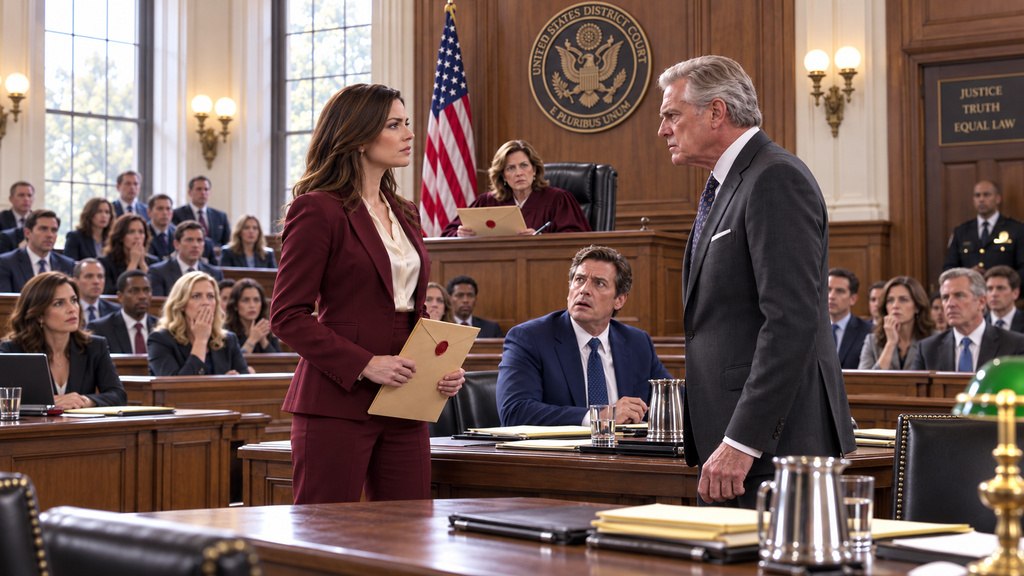
Gerald Foss saw it too. My father slowly turned his head toward me, as if he expected me to explain the question for him.
Then he looked back at the judge.
“She’s my daughter,” he said.
His voice still carried that polished confidence.
That same tone he had used for decades whenever he believed the room belonged to him.
Judge Okafor didn’t blink.
“I’m aware of that.”
Dad shifted in his chair.
Foss leaned toward him and whispered something.
Judge Okafor lifted one hand.
“Counsel, don’t.”
Foss immediately stopped.
The courtroom became so silent that I could hear the faint mechanical hum of the ventilation system above us.
Judge Okafor looked down at the document again.
Then she turned one page.
Another.
Her eyes moved slowly.
Carefully.
When she finally looked at me, there was something in her expression I hadn’t seen from anyone in my family for most of my life.
Recognition.
Not pity.
Not surprise.
Recognition.
“Colonel White,” she said.
My father’s head snapped toward me.
Lauren stopped breathing.
Even Foss stared.
I remained standing beside the defense table.
“Yes, Your Honor.”
Dad actually laughed.
It was short.
Sharp.
Disbelieving.
“Colonel?”
No one answered him.
He looked around the courtroom as though someone was supposed to explain the joke.
Then he looked directly at me.
“You told us you were still working in operations.”
“I am.”
“That’s not—”
Judge Okafor interrupted him.
“Mr. White, you will not speak unless addressed.”
Dad’s face darkened.
But he obeyed.
Barely.
Judge Okafor lifted the document.
“This certification was issued by the Department of Defense?”
“Yes, Your Honor.”
“And the identification number on page two can be independently verified?”
“Yes.”
She turned toward the clerk.
The clerk nodded.
Already verified.
Judge Okafor’s eyes returned to the file.
Then she said the words that changed the entire atmosphere in that courtroom.
“This court has received confirmation that Colonel Evelyn White is a highly decorated active-duty officer whose assignments during several of the dates cited in the plaintiff’s complaint are documented by official federal records.”
Dad’s lawyer went completely still.
My father didn’t understand yet.
Not fully.
But Foss did.
I saw it happen.
The moment the attorney realized that the case he thought he had already won had just developed a very serious problem.
Judge Okafor continued.
“The plaintiff alleges that Colonel White personally pressured her grandmother into altering estate documents on March 14th.”
She looked at Dad.
“Correct?”
Foss slowly stood.
“Your Honor, that is one of several allegations—”
“It is allegation seventeen.”
Foss swallowed.
“Yes, Your Honor.”
Judge Okafor looked at the document again.
“According to independently authenticated military records, Colonel White was approximately seven thousand miles away on March 14th.”
Nobody moved.
“She was deployed.”
My father blinked.
Once.
Twice.
Judge Okafor continued.
“Not in North Carolina.”
She paused.
“Not in the United States.”
Another pause.
“She was participating in an operation whose location remained classified until eighteen months ago.”
I watched Dad’s fingers curl against the table.
For years, he had joked about my deployments.
Called them camping trips.
Called my military career a government paycheck for people who couldn’t make it in business.
Whenever relatives asked what I did, he would wave his hand.
“Nothing exciting. Logistics or something.”
I stopped correcting him years ago.
Because I had learned something about my father.
Facts only mattered to him when they made him larger.
Anything that made someone else larger had to be reduced.
So I let him believe I carried boxes.
I let him tell people I was a clerk.
I let him laugh.
Until today.
Judge Okafor turned another page.
“The plaintiff also alleges that Colonel White personally transported Mrs. Eleanor White to Attorney Samuel Greene’s office on April 2nd, where she supposedly coerced her into signing estate documents.”
She looked toward Foss.
“That allegation appears three times in your filing.”
Foss glanced down at the complaint.
“Yes.”
Judge Okafor’s face hardened.
“Colonel White was still overseas on April 2nd.”
Dad whispered something.
I couldn’t hear him.
The judge did.
“What was that, Mr. White?”
Dad cleared his throat.
“I said records can be wrong.”
The entire courtroom seemed to change temperature.
Judge Okafor leaned back.
“Military deployment records?”
“My daughter has friends.”
Judge Okafor stared at him.
He continued.
“She knows people. She’s obviously arranged—”
“Stop.”
One word.
That was all.
But Dad stopped.
Judge Okafor closed the folder halfway.
“You accused your daughter in a federal filing of falsifying military documents.”
Foss rose again.
“Your Honor, my client was relying on information available to him at the time—”
“And what information was that?”
Foss hesitated.
Dad answered for him.
“My daughter lies.”
That sentence should have hurt.
Maybe twenty years earlier it would have.
Maybe even ten.
But sitting there that morning, I felt something unexpected.
Nothing.
No sting.
No desperate need to defend myself.
No little girl inside me begging her father to see her differently.
Nothing.
For most of my life, Dad’s opinion had functioned like gravity.
Even when I hated him for it, some part of me still revolved around it.
His approval.
His contempt.
His silence.
His disappointment.
His imaginary standards.
I had spent years pretending I didn’t care.
But pretending not to care and truly becoming free are very different things.
That morning, when he looked across the courtroom and called me a liar, I realized something had finally broken.
Not in me.
Between us.
The final thread.
And strangely, it felt peaceful.
Judge Okafor opened the folder again.
“There is considerably more here than deployment verification.”
That was when Foss looked at me.
Really looked at me.
His confidence was gone.
He had spent months treating me like some frightened soldier who had wandered into a legal battle she couldn’t understand.
Every email from his office had been condescending.
Every deposition question had carried the same implication.
You don’t belong here.
You cannot afford this.
You cannot outlast us.
Eventually, you will surrender.
Foss adjusted his tie.
“Your Honor, may I request a short recess so counsel can review this material?”
“No.”
His face changed.
“Your Honor—”
“You were provided notice during discovery that the defense disputed the authenticity of several records submitted by the plaintiff.”
“Yes, but—”
“You declined additional verification.”
“We believed—”
“You believed your client.”
Foss stopped.
Judge Okafor looked toward my father.
“That may prove unfortunate.”
My father’s cheeks had started turning red.
“What is she claiming now?”
The judge ignored the tone.
“She is not claiming.”
She raised the folder.
“She is documenting.”
Those four words hit harder than anything I could have said myself.
Dad looked at me again.
I met his eyes.
No anger.
No smile.
Nothing.
And somehow that seemed to disturb him more.
Because Dad understood rage.
He understood fear.
He understood begging.
He could work with emotion.
Emotion created leverage.
Silence gave him nowhere to push.
Judge Okafor turned to me.
“Colonel White, explain how you obtained the remaining documents.”
I stood.
“Through discovery, public records requests, forensic review, and records provided by my grandmother’s estate attorney.”
Foss immediately spoke.
“Objection to characterization—”
“Overruled.”
I continued.
“After my command received anonymous allegations accusing me of financial exploitation, document fraud, and conduct unbecoming an officer, an internal review was initiated.”
My father stared straight ahead.
“The review temporarily affected my access to certain assignments,” I said.
My voice almost cracked there.
Not because of Dad.
Because I remembered it.
Walking through the corridor at headquarters.
People becoming quiet when I approached.
My access badge suddenly denying entry to rooms I had worked inside for years.
A major who had once asked me to mentor his daughter suddenly pretending to study his phone when we passed each other.
The humiliation wasn’t loud.
That was what made it worse.
Nobody called me guilty.
They just stopped acting certain that I wasn’t.
I continued.
“My command completed the review.”
Judge Okafor asked, “Outcome?”
“Unsubstantiated.”
Dad’s jaw tightened.
“All allegations?”
“Yes, Your Honor.”
“And your status?”
“Fully restored.”
The judge nodded.
“But during the investigation, questions arose about the materials attached to the anonymous complaints.”
Now Foss turned toward Dad.
Slowly.
Dad didn’t look at him.
I continued.
“Some of those materials were documents only three people outside the military should have possessed.”
Judge Okafor looked at me.
“Who?”
“Myself.”
I paused.
“My attorney.”
Another pause.
“And my father.”
Lauren’s hand flew toward her mouth.
Dad finally spoke.
“That doesn’t prove anything.”
Judge Okafor’s eyes moved to him.
“I did not invite you to speak.”
He leaned back.
But the color in his face deepened.
I opened my second folder.
Dad noticed it.
And for the first time that morning, I saw fear.
Not panic.
Not yet.
Just fear.
A small amount.
Enough.
I removed three sheets.
“During discovery,” I said, “the plaintiff produced an audio recording he claimed showed me threatening him.”
Foss closed his eyes.
Just for a second.
He knew what was coming now.
Dad did not.
He smiled again.
“There.”
He pointed toward me.
“Play that.”
Judge Okafor’s expression remained unreadable.
I continued.
“The recording submitted by the plaintiff was forty-one seconds long.”
“Yes,” Dad said.
“It clearly showed what you are.”
Judge Okafor turned toward him.
“Mr. White.”
He shut his mouth.
I placed another document on the table.
“The forensic examination found that the forty-one-second recording was exported from a longer file.”
Foss whispered, “Richard…”
Dad didn’t respond.
“The original recording was eighteen minutes and thirteen seconds.”
That smile disappeared.
For good.
My father looked at Foss.
Then at me.
Then back at Foss.
“You said—”
Foss stood instantly.
“Your Honor, I need to confer with my client.”
Judge Okafor’s voice was cold.
“You may sit down.”
“But—”
“Sit.”
He sat.
I could hear Lauren breathing behind them.
Fast.
Shallow.
I had heard that breathing before.
When we were children.
Whenever Dad was about to explode.
She used to disappear into her room.
I used to stand my ground.
That was the difference between us.
Not courage.
Survival style.
Judge Okafor addressed me.
“Was the original recovered?”
“Yes, Your Honor.”
“How?”
“The plaintiff produced the recording device during discovery after using portions of recordings as evidence. The device had not been securely wiped. A forensic specialist recovered deleted files.”
Foss looked like he might be sick.
Dad whispered, “That’s illegal.”
“No,” Judge Okafor said.
“It isn’t.”
He stared at her.
She looked toward the clerk.
“Has the audio already been marked?”
The clerk checked.
“Yes, Your Honor. Defense Exhibit 44.”
Judge Okafor looked at me.
“Play the relevant portion.”
My heart beat once.
Hard.
Then I nodded.
The clerk started the audio.
For three seconds there was nothing except muffled movement.
Then my father’s voice filled the courtroom.
Not angry.
Not emotional.
Relaxed.
Almost amused.
“Once the command suspends her clearance, she’ll panic.”
The blood drained from Dad’s face.
Someone in the gallery shifted.
Then another voice.
Lauren’s.
“Dad, what if they investigate?”
The recording continued.
My father laughed.
“They won’t find anything. They don’t need to. The accusation only needs to slow her down long enough.”
Lauren’s breathing in the courtroom stopped.
On the recording she whispered:
“You said the letters were anonymous.”
“They are.”
“What about the medical records?”
“Gerald has what he needs.”
Foss shot to his feet.
“Your Honor!”
The judge slammed the gavel.
“Sit down!”
For the first time, Foss looked genuinely frightened.
The audio continued.
Dad’s voice.
Cold.
Certain.
The voice I knew better than any other.
“She has one weakness.”
Lauren asked, “What?”
“She still wants to prove herself.”
A pause.
“She always has.”
My fingers curled against the edge of the defense table.
The audio continued.
“So you keep pressure on the military side. I keep pressure on the estate side. Eventually she’ll decide the house isn’t worth losing her career.”
Then came a sound.
Ice dropping into a glass.
My father chuckled.
“And if she doesn’t?”
Lauren asked.
Dad answered immediately.
“Then I destroy the career too.”
The clerk stopped the recording.
Nobody moved.
Not even Dad.
Especially Dad.
I had heard the audio before.
Many times.
The forensic team had warned me before they played it.
My attorney had offered to stay in the room.
I told him I was fine.
I wasn’t.
The first time I heard those words, I went home and sat on Gran’s porch until after midnight.
No lights.
No television.
No tears for almost an hour.
Then they came.
Not because I had learned something new about my father.
That was the worst part.
I already knew what he was capable of.
I cried because some stupid, stubborn part of me had still been holding onto the possibility that somewhere underneath everything, he loved me.
Badly.
Imperfectly.
Cruelly.
But loved me.
That recording ended the argument.
He wasn’t trying to teach me a lesson.
He wasn’t trying to make me stronger.
He wasn’t a damaged father who didn’t know how to show affection.
He had deliberately tried to destroy something I had spent my entire adult life building.
Because he wanted a house.
Because I had something he believed belonged to him.
That was all.
Judge Okafor stared at Dad.
He opened his mouth.
Nothing came out.
Then he found his voice.
“That is taken out of context.”
No one laughed.
Which somehow made it worse.
Judge Okafor leaned toward him.
“What context, precisely, would improve that statement?”
Dad looked toward Foss.
Foss wasn’t looking back.
“That conversation had nothing to do with military complaints.”
Lauren suddenly spoke.
“Yes, it did.”
Dad turned.
The sound that came out of his chair was sharp as his body twisted toward her.
“What?”
Lauren was pale.
Her hands were shaking against the table.
But this time she didn’t lower her eyes.
She looked at him.
“Yes, it did.”
Dad stared at her.
“Lauren.”
Just her name.
But I knew the warning inside it.
So did she.
Her shoulders instinctively pulled inward.
For one second she looked twelve years old again.
Then she looked at me.
And something shifted.
She stood.
Foss said quickly, “Ms. White, do not make any statements without—”
“I already made statements.”
Her voice trembled.
“I lied.”
The courtroom erupted into whispers.
Judge Okafor struck the gavel.
“Order.”
Dad’s face went white.
Lauren started crying.
Not dramatically.
No sobbing.
Just tears slipping silently down her face.
“I lied in my affidavit.”
Dad pushed his chair back.
“Sit down.”
Judge Okafor rose slightly.
“Mr. White!”
Lauren flinched.
Dad froze.
The judge’s eyes sharpened.
“You do not direct witnesses in my courtroom.”
Lauren wiped her face.
Dad leaned close to Foss.
Foss refused to meet his eyes.
Judge Okafor looked at Lauren.
“You understand that you are currently under oath?”
“Yes.”
“You understand the seriousness of what you just said?”
“Yes.”
Lauren nodded again.
“I lied.”
She looked at me.
“I’m sorry.”
I said nothing.
Not because I hated her.
Not because I wanted her to suffer.
But some apologies need more than five seconds before they can enter the place where the damage lives.
Lauren turned back toward the judge.
“Grandma wasn’t confused when she changed the estate documents.”
Dad closed his eyes.
Lauren kept going.
“She knew exactly what she was doing.”
“Lauren,” Dad whispered.
Judge Okafor lifted the gavel.
He stopped.
Lauren clasped her hands together.
“Grandma told me almost a year before she died that the house would go to Evelyn.”
My lungs tightened.
That part was new.
I hadn’t known.
Lauren looked toward me again.
“She said Evelyn was the only person in the family who loved the house instead of its value.”
I looked down.
Suddenly the courtroom blurred.
Gran.
Her kitchen.
Her flour-covered hands.
The old radio playing softly while she baked peach cobbler.
The porch swing Dad wanted replaced because it looked cheap.
The vegetable garden Lauren hated because mosquitoes gathered near it.
The tiny marks inside the pantry door where Gran had measured us as children.
Evelyn, age 8.
Lauren, age 11.
Evelyn, age 13.
Lauren, age 16.
Dad saw acreage.
I saw fingerprints.
I saw Sunday mornings.
I saw the only place in my childhood where I hadn’t felt like an invoice.
Lauren continued.
“Grandma said Dad would sell it within six months.”
Dad’s lips tightened.
“She said he’d cut down the back trees and divide the land.”
Dad finally shouted.
“That old woman had no idea what she was talking about!”
The words slammed into the courtroom.
Silence followed.
Absolute silence.
My father realized what he had said.
Too late.
Judge Okafor stared at him.
Lauren’s face crumpled.
I closed my eyes.
For just one heartbeat.
Then opened them again.
Dad tried to recover.
“I mean toward the end. She was sick.”
Lauren shook her head.
“No.”
“Lauren.”
“No.”
Her voice grew stronger.
“She wasn’t.”
Dad stared at his favorite child as if she had transformed into a stranger.
Lauren inhaled shakily.
“The doctor’s letter saying Grandma had advanced cognitive impairment was false.”
Foss’s head snapped toward her.
“What?”
Lauren looked at him.
“You didn’t know?”
Foss didn’t answer.
That answer told everyone enough.
Lauren reached into her purse.
Dad moved.
Only slightly.
But two courtroom security officers instantly stepped closer.
Lauren removed an envelope.
“I brought this because I didn’t know what I was going to do.”
She held it with both hands.
“I’ve had it for six weeks.”
The clerk approached.
Lauren surrendered the envelope.
Judge Okafor examined it.
“What is this?”
“A copy of an email Dad sent me.”
My father exploded.
“She stole private correspondence!”
Judge Okafor struck the gavel again.
“Enough!”
Her voice filled the courtroom.
Dad sat down.
Lauren’s tears kept falling.
“He asked me to delete it.”
The judge looked at the envelope.
“Why didn’t you?”
“Because…”
Lauren looked at Dad.
Then me.
“Because for once I thought Evelyn might be telling the truth.”
I almost smiled.
Not because it was funny.
Because that sentence summarized our entire childhood.
For once.
Maybe Evelyn was telling the truth.
Judge Okafor reviewed the page.
Her expression hardened.
She handed it toward the clerk.
Foss leaned forward.
“Your Honor, counsel requests access.”
“You’ll receive it.”
“What does it say?”
The judge looked directly at him.
“You may wish to ask your client.”
Foss turned toward Dad.
“What did you send her?”
Dad’s nostrils flared.
“Nothing relevant.”
Lauren whispered:
“He told me to stick to the timeline.”
Foss’s eyes narrowed.
“What timeline?”
“The one he gave me.”
I watched Foss slowly pull his chair away from my father.
Only a few inches.
But it was unmistakable.
Distance.
The kind people create when they realize the fire beside them is spreading.
Lauren continued.
“He told me what dates to say Grandma was confused.”
Judge Okafor asked, “Did you personally witness those incidents?”
Lauren shook her head.
“No.”
“How many?”
“None.”
Dad’s entire case began collapsing in real time.
Not dramatically.
Not with shouting.
Piece by piece.
Like a building losing support beams.
The forged timeline.
The false accusation.
The edited recording.
The anonymous complaints.
The deployment contradiction.
The medical claim.
The affidavit.
Every weapon he had built to destroy me was now lying on the table between us.
Judge Okafor called a recess.
Dad immediately stood.
He turned toward Lauren.
“You stupid little—”
Two officers stepped between them.
I had never seen him look like that.
Not at her.
He had looked at me that way countless times.
But never Lauren.
She recoiled.
I moved without thinking.
One second I was beside the defense table.
The next I was standing between my sister and our father.
Dad stared at me.
I stared back.
The bailiff approached.
“Colonel White.”
“I’m fine.”
Dad laughed bitterly.
“There she is.”
His eyes traveled over me.
“The hero.”
I said nothing.
His voice lowered.
“You’ve been waiting your whole life for this.”
I still said nothing.
“For me to fall.”
“No.”
It was the first word I had spoken directly to him all day.
Dad stopped.
I looked at him.
“I spent my whole life waiting for you to stand up.”
Something changed in his face.
I continued.
“I waited for you to come to one ceremony and mean it when you said congratulations.”
His jaw flexed.
“I waited for you to ask what I actually did instead of telling everyone what you decided I did.”
People nearby had gone silent.
I didn’t care anymore.
“I waited for you to stop measuring Lauren and me against each other.”
Lauren lowered her eyes.
“I waited for you to talk about Mom without turning her death into proof that you suffered more than everyone else.”
Dad whispered, “Don’t bring your mother into this.”
“Why?”
My voice didn’t rise.
That surprised even me.
“She’s the beginning of this.”
His face changed.
I stepped closer.
“When Mom died, you decided grief gave you ownership of everyone around you.”
He shook his head.
“You know nothing about my grief.”
“You’re right.”
I nodded.
“I don’t.”
Then I looked directly into his eyes.
“Because you never let anyone else have any.”
That landed.