 Reading Time: 12 minutes
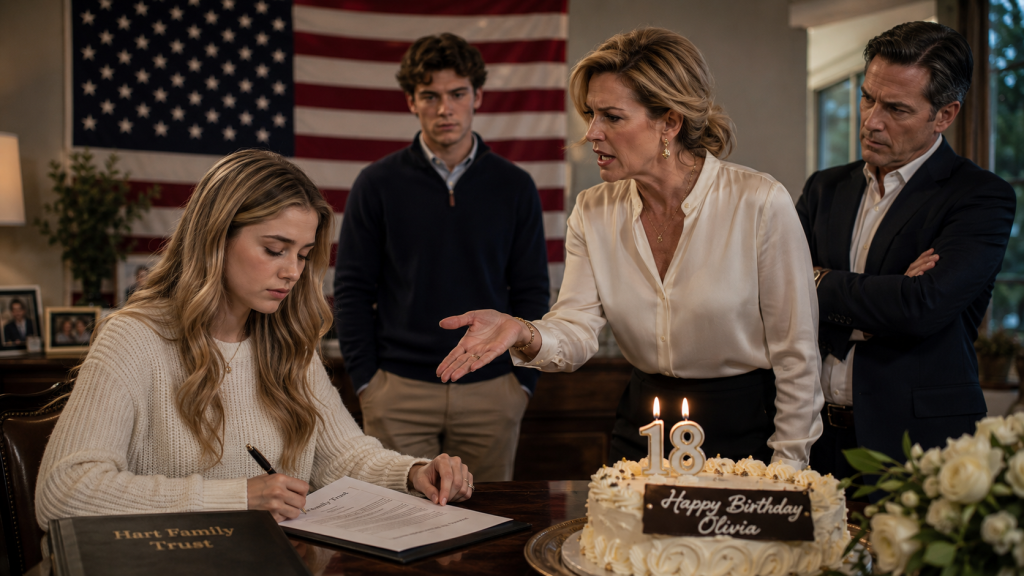
Hours before my eighteenth birthday, my family raised a toast to “my future” while my mother kept asking what time my trust fund would finally be accessible. I smiled, cut the cake, and said nothing.
Because by then, I had already signed something she never saw coming. My mother had a special voice for money. Soft enough to sound like concern. Sharp enough to make you feel she had already spent it.
At midnight, she lifted her glass across the cake and smiled like a proud mother.
My stepfather, Brent, stood beside her and said I was finally old enough to make “mature decisions.”
Mature decisions.
That phrase stayed in the room longer than the candle smoke.
My name is Olivia Hart.
I turned eighteen that night.
But the truth is, my birthday had not been about me for months.
It had been about the trust fund my grandmother left behind.
My grandmother called it protection.
My mother called it accessible.
That was her favorite word.
“When it becomes accessible, we can finally breathe.”
“When it becomes accessible, we can stabilize the house.”
“When it becomes accessible, you can start contributing like an adult.”
She never said college.
She never said safety.
She never said your future.
Just accessible.
By the time I was sixteen, I already understood how money worked in our house.
It moved toward Brent’s business problems.
Toward my stepbrother Tyler’s emergencies.
Toward bills my mother called temporary right before they became my responsibility.
Money never moved toward me unless my grandmother sent it.
And even then, it had a way of disappearing into the household.
Birthday checks became grocery money.
Christmas money became emergency repairs.
School clothes money became Brent’s truck payment.
My mother always explained it the same way.
“We’re family, Olivia. Everyone helps.”
But somehow, everyone usually meant me.
My grandmother, Margaret Hart, saw more than people thought.
She was quiet, not blind.
She watched my mother borrow from relatives and call it bad timing.
She watched Brent start business ideas with other people’s money and end them with excuses.
She watched me learn to stop asking where my money went because the answer always made my mother cry.
A year before she died, Grandma took me to lunch at a little café with yellow curtains.
She ordered tea.
I ordered soup.
She looked at me for a long time and said, “Olivia, love and obligation are not the same thing.”
I frowned.
“I know.”
“No, sweetheart. You don’t. Not yet.”
Then she told me about the trust.
Not everything.
Just enough.
“It’s for your education and your future,” she said. “Not anyone else’s panic.”
I promised I understood.
I didn’t.
Not fully.
Not until the week before my eighteenth birthday.
That was when my mother started preparing.
Not party decorations.
Not birthday surprises.
Documents.
She bought a leather folder.
She printed forms.
She whispered with Brent in the kitchen after I went to bed.
She asked twice whether I still had the trust officer’s card in my desk drawer.
Then she asked the exact time the account would unlock, like my birthday was not a birthday at all, but a vault door she had been standing beside for years.
At dinner three nights before my birthday, Brent smiled at me over takeout noodles.
“You know, adulthood comes with responsibility.”
I looked up.
“So I’ve heard.”
He leaned back.
“You’ve had a lot of advantages.”
I almost laughed.
Advantages.
The girl who had worked weekends since fifteen.
The girl who had packed her own lunches because grocery money got tight after Brent’s “investment opportunities.”
The girl who filled out scholarship applications at midnight while her mother asked whether the trust could help with the electric bill.
“What kind of responsibility?” I asked.
My mother gave him a look.
Not yet.
That look told me everything.
They had a plan.
They just had not decided how to sell it to me.
So during the week of my birthday, I stopped listening to what they said and started watching what they prepared.
The leather folder had tabs.
I saw them when my mother left it open on the kitchen counter.
Household.
Brent.
Tyler.
Stabilization.
Olivia Future.
That last tab made my stomach twist.
My future was listed after everyone else’s problems.
The night before my birthday, while my family was setting out cake plates and champagne glasses, I said I needed to pick up something from a friend.
My mother barely looked up.
“Don’t be late. We’re doing cake at midnight.”
“I won’t.”
But I did not go to a friend’s house.
I went downtown.
Three hours before midnight, I sat across from Mr. Keading, the quiet attorney who had handled my grandmother’s trust from the beginning.
His office smelled like old wood and lemon polish.
A notary sat beside him.
A pen rested on the table between us.
Mr. Keading had kind eyes and a voice that never rushed.
“You’re certain?” he asked.
I looked at the papers.
“No,” I admitted.
Then I looked at my grandmother’s framed photo on his desk.
She was smiling the way she did when she knew something I did not.
“I’m not certain about anything except this: if the money becomes easy to take, it won’t be mine for long.”
Mr. Keading nodded.
“That is a very adult answer.”
I asked him one question.
“What can I do before tomorrow?”
He looked at me for a long second.
“You can decide whether access means spending power or protection.”
So I decided.
The trust had been designed with one final choice.
At eighteen, I could take direct access.
Or I could elect to amend it into a protected educational and investment structure until age twenty-five.
The principal would be locked.
Funds could only be released for college, housing, medical needs, verified emergencies, or approved long-term investment.
No lump-sum withdrawals.
No family loans.
No household bailouts.
No signatures under pressure.
Grandma had planned for this.
Of course she had.
She knew love could become leverage when money entered the room.
I signed.
The notary stamped.
Mr. Keading placed copies into an envelope.
“Your grandmother asked me to give you something after you made your choice,” he said.
He opened a drawer and removed a sealed letter with my name written in Grandma’s handwriting.
My throat tightened.
“She wrote this?”
“Two years before she passed.”
I held it carefully.
“Should I read it now?”
“That is up to you.”
I shook my head.
“Tomorrow.”
Then I went home.
At midnight, they gathered around the cake.
My mother lit candles.
Brent opened champagne.
Tyler barely looked up from his phone.
My mother raised her glass.
“To Olivia’s future.”
Everyone smiled.
I smiled too.
The candles flickered.
My mother’s eyes looked bright, but not emotional.
Eager.
She asked, “So, does the account become accessible right away at midnight, or first thing in the morning?”
There it was.
I cut the cake.
“I’m not sure.”
Brent chuckled.
“We’ll sort it out tomorrow.”
Tomorrow.
I handed my mother a slice.
“Yes,” I said. “Tomorrow.”
That night, I slept better than I expected.
Maybe because for the first time in years, I had made a decision before they could make it for me.
At 8:07 the next morning, my mother walked into my room without knocking.
No happy birthday.
No hug.
No breakfast tray.
Just my mother in the doorway with that leather folder in one hand and a mug of coffee in the other.
She sat on the edge of my bed like the meeting had already been approved by everyone who mattered except me.
Then she opened the folder.
There were tabs.
Not notes.
Not questions.
Tabs.
Household.
Brent.
Tyler.
Stabilization.
Olivia Future.
That last one almost made me laugh.
My mother slid a typed page across my blanket.
“We’ve done the math,” she said.
Of course she had.
Some people only respect numbers when the total comes out in their favor.
Brent appeared in the doorway and used the calm, patient voice grown men use when they think a young woman is being emotional around money.
“We’re not taking anything from you,” he said. “We’re organizing it.”
I looked at the page.
The polite language.
The signature line.
The phrase shared family obligations sitting there like a clean napkin over something rotten.
My grandmother would have called it fiction with formatting.
Then my mother tapped one blank line with her fingernail.
“This just keeps everything simple.”
I looked from her to Brent.
Then down at the tabs spread across my bed like they had already divided my life into categories.
The document listed planned distributions.
Forty thousand dollars toward Brent’s business debt.
Twenty thousand toward Tyler’s school balance.
Fifteen thousand for kitchen renovation.
Twelve thousand for overdue household expenses.
Ten thousand for a family vacation because, as the note said, “reconnection is important.”
My portion?
Ten thousand into a savings account.
Under joint supervision.
I stared at the page until the words blurred.
“You already spent it,” I said.
My mother sighed.
“Olivia, don’t be dramatic.”
Brent crossed his arms.
“This is what families do.”
“No,” I said. “This is what people do when they think the youngest person in the room has no power.”
Before either of them could answer, my phone buzzed.
Mr. Keading’s name lit up on the screen.
My mother saw it.
Her smile disappeared so fast it felt like someone had turned off a light.
“Why is he calling you?” she asked.
I answered before she could reach for the phone.
“Good morning, Olivia,” Mr. Keading said warmly. “I’m confirming the amended trust instructions were accepted at 8:00 a.m. You are now sole trustee and beneficiary under the protected structure.”
Across from me, my mother’s hand tightened around her coffee mug.
“Thank you,” I said.
“And congratulations,” he continued. “The principal will remain protected until age twenty-five. Approved distributions are limited to education, housing, medical care, and verified emergencies.”
Brent stopped breathing.
I thanked him again and ended the call.
The room went silent.
Finally my mother laughed nervously.
“Amended trust instructions?”
I set my phone down.
“Yes.”
“What does that mean?”
“It means I made some changes.”
Brent stepped farther into the room.
“What kind of changes?”
“The kind Grandma wanted me to make.”
My mother stood.
“You can’t change the trust.”
“I already did.”
“No, sweetheart, you don’t understand—”
“I understand perfectly.”
I walked to my desk and picked up the envelope Mr. Keading had given me.
I handed her the copies.
She opened them.
Her eyes moved across the page.
Then stopped.
“No,” she whispered.
Brent grabbed the papers.
“What is this?”
I answered calmly.
“The money is no longer directly accessible.”
“What do you mean no longer?”
“I mean exactly that.”
My mother’s eyes filled with panic.
“But today is your birthday.”
“I know.”
“It was supposed to unlock.”
“It did. And I chose protection.”
Brent began flipping pages as if anger could change legal language.
“There has to be a mistake.”
“There isn’t.”
My mother looked betrayed.
“You changed everything?”
“Yes.”
“You had no right.”
That almost made me laugh.
No right.
The money my grandmother left specifically for me.
The future my grandmother tried to protect.
“No right?” I repeated.
“After everything I’ve done for you?” she snapped.
There it was.
The invoice.
Parents like my mother always kept one.
Food.
Clothes.
School supplies.
Gas.
Love.
Everything became a bill eventually.
Brent threw the papers onto my bed.
“You’ve made a huge mistake.”
“Really?”
“Yes. Families share resources.”
I picked up the leather folder and opened it to the tabs.
“My future was last.”
My mother looked away.
“You’re twisting this.”
“No. I’m reading it.”
“You’re eighteen,” Brent said. “You don’t understand how hard life is.”
“I understand enough to know you planned to use my inheritance before wishing me happy birthday.”
That landed.
My mother’s face crumpled.
“Sweetheart, we need help.”
For a second, guilt tugged at me.
A familiar rope.
One they had used for years.
Then I remembered how she walked in.
No hug.
No breakfast.
No birthday.
Just a folder.
I opened Grandma’s letter.
My hands shook when I unfolded it.
Her handwriting filled the page.
To my beautiful Olivia,
If you are reading this, then your eighteenth birthday has arrived. I hope I am wrong, but I suspect some people may already have plans for this money.
My mother sat slowly on the bed.
Brent muttered, “Oh, for God’s sake.”
I kept reading.
Remember something important: inheritance is not repayment for love. You owe no one your future simply because they expect it.
My voice cracked.
I continued.
I have watched money disappear around you for years. I have watched adults call sacrifice family duty whenever they needed something from you. So I built this trust to protect you, not only from strangers, but from anyone who mistakes your generosity for obligation.
Tears blurred the words.
My mother was crying now too, but I did not stop.
Go to college. Travel. Build something beautiful. Fall in love with your own life before financing someone else’s. And never apologize for protecting what belongs to you.
Love always,
Grandma.
The room was completely still.
Then Brent scoffed.
“Your grandmother poisoned you against this family.”
I folded the letter carefully.
“No,” I said. “She prepared me.”
He slammed his hand against the dresser.
“What are we supposed to do now?”
There it was again.
Not How are you?
Not Happy birthday.
Not Are you okay?
What are we supposed to do now?
I suddenly felt very tired.
“I don’t know,” I said. “But it isn’t my responsibility.”
My mother looked up.
“Olivia, please.”
I picked up my backpack.
“Where are you going?”
“To breakfast.”
“With who?”
“Mr. Keading.”
Brent laughed sharply.
“Of course. Run to the lawyer.”
“No,” I said. “I’m going to open my own bank account. Then I’m going to campus for orientation.”
My mother blinked.
“Campus?”
“I got accepted.”
She stared.
I realized then that I had never told her.
Or maybe I had tried, and she had been too busy discussing access.
“Where?”
“Northwestern.”
Her face changed.
Shock.
Then pride.
Then grief.
“Why didn’t you tell me?”
“I wanted you to ask.”
She had no answer.
I walked toward the door.
“Olivia, wait.”
I stopped.
For the first time that morning, her voice sounded small.
“What happens now?”
I looked back at her.
At the woman who had spent months planning my inheritance before I even turned eighteen.
At Brent.
At the leather folder.
At the tabs.
At the future they had already divided.
“Now?” I said softly. “Now I get to have a birthday.”
I walked downstairs.
Nobody followed me.
At the front door, I paused by the family photos.
Grandma’s picture sat in a silver frame near the stairs.
She looked serious.
Almost amused.
I touched the frame.
“Thank you,” I whispered.
Outside, the morning felt different.
Lighter somehow.
Mr. Keading was waiting by his car.
He stepped out when he saw me.
“How did it go?”
I laughed.
“Exactly the way Grandma predicted.”
He smiled.
“She was a very smart woman.”
“The smartest.”
We drove to the bank first.
For the first time in my life, I opened an account only I controlled.
Then he took me to a diner with blue booths and terrible coffee.
He ordered pancakes.
I ordered eggs and toast.
Halfway through breakfast, my phone buzzed.
A text from Mom.
Happy birthday, sweetheart.
I stared at it for a long time.
Then another message arrived.
I’m sorry.
I did not answer right away.
Because some apologies need time.
And some futures need protection.
Over the next few weeks, the house changed.
Brent stopped speaking to me unless he had to.
Tyler texted once asking if I could still help with his school balance.
I replied, Ask your father.
My mother moved quietly around me, like guilt had made her smaller.
One evening, she knocked on my door for the first time in years.
“Can I come in?”
That alone made me pause.
“Yes.”
She sat on the chair beside my desk.
No folder.
No mug.
No papers.
Just her.
“I was wrong,” she said.
I waited.
She swallowed.
“I thought because I was your mother, needing help meant I had a right to ask.”
“You didn’t ask,” I said.
Her eyes filled.
“I know.”
“That was the problem.”
She nodded.
“I don’t know how to fix this.”
“You don’t fix it with one apology.”
“I know.”
“But you can start by seeing me as a person instead of a solution.”
She cried then.
Quietly.
For once, I did not comfort her immediately.
Not because I wanted to be cruel.
Because I was learning that other people’s feelings were not always my job.
A month later, I moved into student housing.
My room was small.
The mattress was stiff.
The desk wobbled.
The hallway smelled like detergent and microwave noodles.
It was perfect.
On my first night there, I taped Grandma’s letter above my desk.
Then I opened my laptop and looked at my class schedule.
Economics.
Literature.
Intro to Law.
Financial Ethics.
That one made me smile.
My mother called the next day.
Not to ask for money.
To ask if I had eaten.
It was awkward.
Careful.
New.
But it was a beginning.
I still loved her.
That was the complicated part.
Protecting yourself does not always mean you stop loving people.
Sometimes it means you love them from behind a locked door.
Sometimes it means you give the relationship a chance to heal without giving it access to your bank account.
Months passed.
The trust paid tuition directly.
Housing directly.
Books directly.
No cash in anyone’s hands.
Exactly as Grandma designed.
When my first semester ended, I visited home for Christmas.
The leather folder was gone.
Brent was gone too.
My mother said he had left after realizing there would be no money.
I was not surprised.
She looked embarrassed when she told me.
“I think he loved the idea of rescue more than me,” she said.
I did not say I told you so.
Some truths are cruel enough without decoration.
We made dinner together.
She asked about classes.
Actually asked.
Listened.
Remembered.
When dessert came, she placed a small cupcake in front of me with one candle.
“I know it’s late,” she said. “But I don’t think I ever gave you a birthday.”
My throat tightened.
“No,” I said. “You didn’t.”
She lit the candle.
“So make a wish.”
I looked at the tiny flame.
For years, I thought freedom would feel like anger.
Like proving everyone wrong.
Like walking away and never looking back.
But freedom felt quieter than that.
It felt like choosing.
Choosing when to answer.
Choosing what to give.
Choosing what to protect.
Choosing a future that belonged to me.
I blew out the candle.
“What did you wish for?” Mom asked.
I smiled.
“That it stays accessible.”
She winced, then laughed softly through tears.
Fair.
One year earlier, my mother had raised a glass to my future while planning how to spend it.
I had smiled and said nothing because the real decision had already been made.
She thought morning belonged to her.
But my grandmother had taught me better.
Morning belonged to the person brave enough to protect it.
And for the first time in my life, that person was me.
THE END! THANKS FOR READING!