 Reading Time: 46 minutes
Aaron Wells stood beside my black SUV with a leather folder tucked beneath one arm. He had been my father’s attorney for nearly fifteen years.
More importantly, he was the man who had prepared almost every document Ethan had casually signed during our marriage without reading more than the line above his signature.
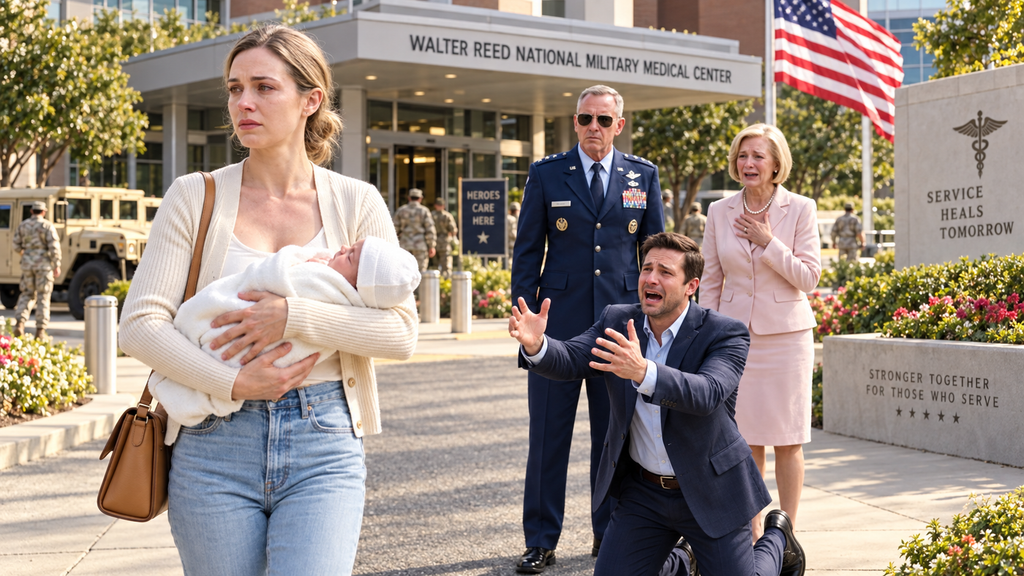
Ethan walked out of the restaurant beside his mother, Diane.
His father followed.
His sister came last, carrying a shopping bag and laughing at something Diane had whispered.
They looked relaxed.
Happy, even.
Apparently abandoning a woman five days after abdominal surgery with a newborn and twelve dollars had not interfered with their appetites.
Ethan spotted Aaron.
His smile disappeared.
“Can I help you?”
Aaron’s expression remained polite.
“Ethan Hale?”
“You know who I am.”
“Yes.”
Aaron opened the leather folder.
“My name is Aaron Wells. I represent Claire Morgan.”
Ethan glanced toward my SUV.
Then back at Aaron.
“My wife?”
“For the moment.”
Diane immediately stepped forward.
“What exactly is that supposed to mean?”
Aaron ignored her.
He removed a document from the folder.
“I’m here regarding this vehicle.”
Ethan laughed.
“What about it?”
“The vehicle belongs exclusively to Mrs. Morgan.”
“Claire is my wife.”
“That does not transfer ownership.”
Ethan folded his arms.
“We’re married. It’s basically our car.”
Aaron gave him the patient look attorneys reserve for people confidently explaining laws they do not understand.
“No, Mr. Hale. It isn’t.”
Diane’s mouth tightened.
“My son drives that vehicle every day.”
“That is irrelevant.”
“He’s her husband.”
“Also irrelevant.”
Ethan’s father, Richard, finally stepped closer.
“What exactly are you trying to do here?”
Aaron turned one page around.
The registration was visible.
My name.
Only my name.
The vehicle had been purchased three months before Ethan and I married.
Paid in full.
No loan.
No joint ownership.
No claim belonging to Ethan.
Aaron tapped one line.
“The SUV was purchased by Claire Morgan with funds held in a premarital trust established by her grandfather.”
Ethan stared at the paper.
For several seconds, he said nothing.
Then he shrugged.
“So?”
“So Mrs. Morgan has revoked your permission to use it.”
Diane laughed sharply.
“You cannot be serious.”
Aaron looked at her.
“I rarely deliver legal notices for entertainment.”
Ethan reached into his pocket.
The keys jingled between his fingers.
“You came all the way down here because Claire threw a tantrum over taking a bus?”
Aaron’s face changed.
Only slightly.
But I knew him well enough to recognize anger.
“Mrs. Morgan did not throw a tantrum.”
“She called Daddy.”
“Yes.”
Ethan smirked.
“That sounds like Claire.”
Aaron closed the folder.
“No. What sounds like Claire is tolerating far more than she should because she keeps hoping the people she loves will eventually behave better.”
The smirk vanished.
Aaron extended his hand.
“The keys.”
Ethan stared at him.
“No.”
Aaron nodded once.
“I expected that.”
He turned.
A man in a dark jacket stepped out from one of the black sedans.
Then another.
Neither threatened Ethan.
Neither needed to.
Diane looked around the parking lot.
Her confidence began to crack.
“What is this?”
Aaron answered calmly.
“Mrs. Morgan’s father asked that the recovery of her property be handled without conflict.”
Diane gave a humorless laugh.
“Recovery? My son isn’t a thief.”
“No one called him one.”
“You’re treating him like one.”
Aaron’s eyes settled on Ethan.
“I am treating him like a man who has been formally informed that he no longer has permission to possess someone else’s property.”
Ethan’s jaw tightened.
“You’re not taking my car.”
Aaron lifted the registration again.
“Your car?”
Ethan said nothing.
Richard lowered his voice.
“Son, give him the keys.”
Ethan turned sharply.
“Dad.”
“Give him the keys.”
Ethan’s cheeks reddened.
And for the first time that day, someone from his own family seemed embarrassed by him.
He pulled the keys from his pocket and slapped them into Aaron’s palm.
“There.”
Aaron handed them to one of the men beside him.
Diane immediately spoke.
“How are we supposed to get home?”
Aaron looked toward the restaurant entrance.
“I believe rideshare services operate in Manhattan.”
Diane’s face went crimson.
“You expect us to take a taxi?”
Aaron’s expression did not move.
“Mrs. Morgan took a city bus five days after a C-section while carrying your five-day-old grandson.”
The parking lot went completely silent.
Even Ethan looked away.
Aaron continued.
“So yes, Mrs. Hale. I believe transportation can be arranged.”
For once, Diane had nothing to say.
Aaron removed another envelope.
“Mr. Hale, this is for you.”
Ethan stared at it.
“What?”
“Formal notice that Claire has retained counsel regarding a legal separation.”
His face changed.
Not dramatically.
Just enough.
His shoulders stiffened.
His mouth opened slightly.
That tiny expression told me something I would understand much later.
Ethan had believed I would be angry.
He had believed I would cry.
He had believed we would have a terrible argument when he came home.
Maybe I would sleep in the guest room.
Maybe I would threaten divorce.
Maybe he would apologize just enough to stop me from leaving.
But he had never imagined that I would actually go.
Men like Ethan often confuse endurance with weakness.
They watch someone forgive them again and again, and instead of seeing love, they see permission.
He looked down at the envelope.
“You’re joking.”
Aaron shook his head.
“You should read it carefully.”
Ethan snatched it from him.
“This is ridiculous.”
“Possibly.”
Aaron stepped toward the SUV.
“But unlike the vehicle documents, I strongly suggest you read these.”
I did not see that confrontation in person.
Aaron told me about it later.
At the time, I was sitting in the back of one of my father’s sedans with Noah asleep against my chest.
The woman beside me was named Maria.
She had worked for Dad’s security team for years.
She had been standing outside my college graduation.
She had attended my wedding.
She had once driven six hours through a snowstorm because Dad was convinced I should not be alone after I had pneumonia.
Now she sat beside me holding a bottle of water while I tried not to cry.
My body hurt.
Everything hurt.
My abdomen.
My back.
My breasts.
My head.
Even breathing seemed exhausting.
But underneath the physical pain was something stranger.
Relief.
Cold, terrifying relief.
I had spent three years trying to save my marriage.
Now, for the first time, I understood that I did not have to.
The realization felt almost shameful.
I looked down at Noah.
His tiny hand rested against my chest.
Five days old.
Five days in the world, and already he had taught me the lesson I had refused to learn for myself.
Love was not supposed to require humiliation.
Love was not supposed to make you prove how much pain you could tolerate.
Love was not twelve dollars pressed into your palm while your husband drove away.
Maria glanced at me.
“You okay?”
I nodded automatically.
Then stopped.
“No.”
It was the first honest answer I had given anyone in months.
Maria reached into the console and handed me a packet of tissues.
“You don’t have to be okay today.”
That was all she said.
And somehow those words broke me.
I turned my face toward the window and cried silently while Manhattan moved past us.
I cried for the woman I had been before Ethan.
I cried for the woman I had become with him.
I cried because I remembered the first year of our marriage when he brought me coffee every Sunday morning.
I cried because there had been good days.
That was the part people never understood.
Bad marriages are rarely bad every single minute.
If Ethan had been cruel from the first date, I would never have married him.
He had been charming.
Funny.
Attentive.
When we first met at a charity event in Boston, he spent twenty minutes talking to an elderly veteran nobody else seemed to notice.
That kindness attracted me.
I believed it revealed his character.
Later I realized Ethan was exceptionally kind when kindness benefited him.
The cruelty came slowly.
A joke about my weight.
A comment about my friends.
An argument because I had not answered his text quickly enough.
A complaint that my father made him feel inferior even though Dad had never once insulted him.
Then the financial expectations began.
My SUV became “ours.”
My savings became “our safety net.”
My connections became “our opportunities.”
My family’s generosity became something Ethan considered his right.
But his money?
His time?
His loyalty?
Those remained his.
The imbalance became normal because it happened gradually.
By the time I recognized what my marriage had become, I was pregnant.
Then I told myself Noah deserved two parents.
I told myself Ethan would become gentler when he became a father.
I told myself holding his newborn son would change him.
For five days after Noah was born, I waited for that transformation.
It never came.
Instead, Ethan handed me twelve dollars.
And walked away.
Dad did not take me to his house.
He took me back to mine.
Or what I had always thought of as mine and Ethan’s.
When the sedan pulled into the driveway, another vehicle was already there.
My father stood beside it.
At sixty-three, General Thomas Morgan still carried himself like a man who expected rooms to become orderly when he entered them.
He had retired from the Army six years earlier.
His hair was silver now.
His shoulders slightly narrower than I remembered from childhood.
But his eyes were exactly the same.
Steady.
Observant.
Impossible to fool.
The moment the car stopped, he walked toward me.
Maria opened the door.
Dad did not ask questions.
He did not say, “I told you so.”
He did not mention the warnings he had given me before the wedding.
He simply bent down and looked at Noah.
Then at me.
“Can I hug you?”
That question nearly broke me again.
I nodded.
He hugged me carefully, avoiding my incision.
My face pressed against his shoulder.
For a few seconds, I became seven years old again.
The little girl who believed her father could fix anything.
“I should have called sooner,” I whispered.
Dad’s hand rested against the back of my head.
“You called when you were ready.”
“I kept thinking it would get better.”
“I know.”
“I feel stupid.”
He pulled away.
“Don’t.”
“But—”
“Claire.”
His voice sharpened.
Not cruelly.
Firmly.
“You made decisions based on hope. Now you’re making decisions based on evidence.”
I swallowed.
Dad looked at Noah.
“That’s what matters.”
We went inside.
The house felt unfamiliar.
Ethan’s shoes were beside the entryway.
His jacket hung over a dining chair.
A coffee mug he had left that morning sat beside the sink.
Ordinary things.
That was the strangest part.
A marriage could end while coffee stains still dried at the bottom of a cup.
Dad walked slowly through the living room.
“Where’s your medication?”
“Upstairs.”
“You’re not climbing stairs.”
“I have to.”
“No.”
“Dad.”
He pointed toward the couch.
“Sit.”
I almost smiled.
“You’ve been retired six years. You can’t command civilians anymore.”
“I’m not commanding you.”
“You pointed.”
“I strongly suggested with military efficiency.”
Despite everything, I laughed.
It hurt my incision.
I pressed a hand against my abdomen.
Dad’s expression immediately changed.
“Sit down.”
This time I obeyed.
Maria collected my medication.
Another member of Dad’s team moved Noah’s bassinet downstairs.
Within thirty minutes, my living room had been reorganized into something resembling a postpartum recovery area.
Water.
Medication schedule.
Blankets.
Bassinet.
Changing supplies.
Phone charger.
Food.
Dad had always handled fear by creating order.
Then Aaron arrived.
He placed the SUV keys on the coffee table.
“Retrieved without incident.”
Dad raised an eyebrow.
Aaron hesitated.
“Minimal incident.”
Despite myself, I smiled.
“What happened?”
Aaron sat across from me.
“Ethan initially disputed ownership.”
“Of course he did.”
“Then I showed him the registration.”
“And?”
“He gave us the keys.”
Dad folded his arms.
“How long did ‘gave’ take?”
Aaron ignored him.
I understood enough.
“What about the separation papers?”
“Delivered.”
My stomach tightened.
Saying I wanted to leave Ethan had felt powerful on the bus.
Hearing that the paperwork had actually been delivered felt different.
Real.
Final.
Terrifying.
Aaron noticed.
“Nothing needs to happen tonight.”
I nodded.
“I know.”
“We’ll take this one step at a time.”
Dad looked toward me.
“What do you want?”
I rubbed my thumb over the edge of Noah’s blanket.
“I want him out of this house.”
Aaron nodded.
“That can be addressed.”
“And I want my accounts protected.”
Another nod.
“And I want to know what he has access to.”
Aaron’s expression changed.
That tiny hesitation made me look at him.
“What?”
He leaned forward.
“Claire, there’s something we should discuss.”
Dad remained silent.
I looked between them.
“What happened?”
Aaron opened his folder.
“Before we recovered the vehicle, I asked our financial team to review the accounts we could legally access.”
My stomach dropped.
“Why?”
“Because when someone becomes comfortable treating one thing as jointly owned simply because they can access it, it’s prudent to verify whether they’ve made the same assumption elsewhere.”
I stared at him.
“Did Ethan take money?”
“We don’t know yet.”
“But you found something.”
“Yes.”
Aaron placed several printed pages on the table.
“There have been repeated transfers from your household account over the last fourteen months.”
I frowned.
“How much?”
“Individually, most are relatively small.”
“How much altogether?”
Aaron looked at Dad.
Then me.
“Eighty-seven thousand four hundred dollars.”
For several seconds, I genuinely thought I had misheard him.
“What?”
Dad’s face hardened.
Aaron pushed the pages toward me.
“Transfers to an account associated with Hale Strategic Consulting.”
I shook my head.
“That’s Ethan’s company.”
“Yes.”
“He told me that company barely had any activity.”
“Apparently it had enough activity to receive money.”
I grabbed the papers.
Rows of transfers.
$2,500.
$4,000.
$7,500.
$3,200.
Again.
Again.
Again.
Some of them appeared beside descriptions I had never noticed because Ethan handled most of the household payments.
Consulting reimbursement.
Tax reserve.
Insurance transfer.
Business expense.
“Wait.”
I looked closer.
One date stood out.
Two weeks before Noah was born.
$15,000.
“What is this?”
Aaron tapped the entry.
“We’re investigating.”
My fingers started trembling.
Dad moved closer.
“Claire.”
“I’m fine.”
“No, you’re not.”
“I said I’m fine.”
My voice broke.
Noah stirred in the bassinet.
I immediately stopped.
That tiny movement brought me back.
I breathed slowly until he settled.
Then I looked at Aaron.
“Find everything.”
He nodded.
“I will.”
“Every account.”
“Yes.”
“Every transfer.”
“Yes.”
“Every dollar.”
Aaron held my gaze.
“Claire, if I find something painful—”
“I’m done being protected from the truth.”
Dad’s eyes moved toward me.
I continued.
“I spent three years protecting Ethan from consequences. I’m not going to spend another three protecting myself from facts.”
Aaron closed the folder.
“Understood.”
The front door opened.
All three of us turned.
Ethan walked inside.
He stopped when he saw my father.
For one second, I watched his face.
Surprise.
Then anger.
Then calculation.
Ethan had always been intimidated by Dad.
Not because Dad had threatened him.
He never had.
Dad had actually made an extraordinary effort to welcome him.
He paid for our wedding without controlling a single detail.
He helped Ethan secure introductions for his consulting business.
He gave us privacy.
But Ethan hated him anyway.
I eventually realized why.
Dad was one of the few people Ethan could not impress.
“Thomas.”
Dad stood.
“Ethan.”
No handshake.
Ethan looked at me.
“You called him?”
“Yes.”
He laughed once.
“Of course you did.”
Aaron rose from the chair.
“Mr. Hale, I advised you in writing to direct communications regarding legal matters through my office.”
“This is my house.”
“No,” I said.
Ethan turned.
“What?”
I stood carefully.
Pain pulled across my abdomen.
Dad instinctively moved toward me.
I raised a hand.
I wanted to stand alone.
“This house is mine.”
Ethan stared at me.
“Our house.”
“No.”
“Claire, don’t start.”
Aaron opened his folder again.
“The property was acquired by Mrs. Morgan eighteen months before the marriage.”
Ethan’s head snapped toward him.
“I don’t care what some document says.”
I almost laughed.
That sentence summarized our entire marriage.
Documents.
Boundaries.
Promises.
Reality.
None of it mattered if Ethan did not like what it said.
I looked at him.
“You should start caring what documents say.”
His eyes narrowed.
“What does that mean?”
“It means you should pack.”
Diane had apparently followed him.
Her voice erupted from the doorway.
“Absolutely not.”
I closed my eyes.
Of course.
Diane marched inside carrying her handbag against her chest as if she owned the house too.
Richard followed more slowly.
His expression was exhausted.
Diane pointed toward my father.
“This is a family matter.”
Dad’s voice stayed calm.
“My daughter is family.”
“You know what I mean.”
“No. Explain it.”
Diane opened her mouth.
Nothing came out.
Dad had that effect on people.
He never shouted.
He simply required them to finish the ugly sentences they usually expected others to politely ignore.
Ethan stepped between us.
“Claire, we’re going upstairs.”
“No.”
“We need to talk privately.”
“No.”
His voice lowered.
“You’re embarrassing me.”
I stared at him.
Five days earlier, that sentence would have worked.
I would have felt guilty.
I would have followed him upstairs because I hated scenes.
I would have tried to smooth everything over.
But something inside me had changed on that bus.
Maybe it had happened when the elderly woman offered me her seat.
Maybe when the driver waited until I was safely settled before moving.
Maybe when Dad asked if I wanted to go back.
Whatever it was, Ethan’s shame no longer belonged to me.
“You embarrassed yourself.”
His nostrils flared.
Diane jumped in.
“She just had a baby. She’s hormonal.”
Aaron visibly stiffened.
Dad looked at Diane.
“Be very careful.”
Diane scoffed.
“Oh, please. Every woman has babies. Claire acts like she survived combat.”
Dad took one slow step forward.
“I spent forty years around soldiers recovering from gunshot wounds, blast injuries, amputations, and major surgery.”
His voice remained quiet.
“Not one decent person I knew would have abandoned someone five days after an operation with a newborn and twelve dollars.”
Diane’s face drained slightly.
Dad continued.
“So before you dismiss my daughter’s recovery, understand that I know the difference between weakness and injury.”
Nobody spoke.
Richard stared at the floor.
Ethan looked furious.
I looked toward Diane.
“Why did you need my SUV today?”
Her eyebrows lifted.
“What?”
“You heard me.”
“For lunch.”
“No. Why did you need my SUV?”
“It’s nicer than our car.”
“And?”
She shrugged.
“I wanted to arrive properly.”
There it was.
So small.
So revealing.
I almost admired the honesty.
“You wanted to look wealthy.”
Her expression hardened.
“Don’t twist my words.”
“I’m not.”
Ethan stepped forward.
“This is getting ridiculous.”
“No,” I said. “It’s getting clear.”
I looked at him.
“You left your recovering wife and newborn on a sidewalk because your mother wanted to arrive at a restaurant in an expensive vehicle.”
“It was a bus ride.”
“I had major surgery.”
“You were discharged.”
“The doctor said I could go home. Not tour Manhattan on public transportation carrying a newborn.”
“You’re being dramatic.”
I nodded slowly.
“Maybe.”
That answer surprised him.
“Maybe I am.”
I picked up the twelve dollars from the coffee table.
I had placed the bills there after arriving home.
A ten.
Two ones.
Wrinkled from being clenched inside my palm.
I walked toward Ethan.
“Do you remember handing me this?”
He looked at the money.
“Yes.”
“Do you remember what you said?”
His jaw tightened.
I answered for him.
“‘That’s more than enough for the fare.’”
Diane rolled her eyes.
“Claire—”
I turned.
“No.”
My voice was quiet.
But everyone stopped.
I faced Ethan again.
“Those twelve dollars were the last thing you ever gave me as your wife.”
His face changed.
“Don’t be stupid.”
“And they turned out to be the most valuable.”
He stared at me.
“Because they finally taught me what staying married to you would cost.”
Silence.
Absolute silence.
I placed the bills into his hand.
“Keep them.”
Ethan looked down.
“Claire.”
“Use them toward your ride.”
Dad turned away, hiding what I suspected was the beginning of a smile.
Diane was nearly shaking with rage.
“You spoiled little—”
Richard caught her arm.
“Enough.”
She pulled free.
“No. I will not be spoken to this way in front of everyone.”
“This isn’t about you,” Richard said.
Her head snapped toward him.
“It became about me when she humiliated our son.”
Richard looked at Ethan.
“No.”
His voice was tired.
“He did that himself.”
Ethan stared at his father.
“What?”
Richard rubbed a hand across his face.
“You left your wife outside a hospital.”
“You’re taking her side?”
“I’m taking the side of basic decency.”
Diane looked stunned.
“Richard.”
He ignored her.
“Your wife had surgery five days ago. Your son is five days old.”
Ethan crossed his arms.
“They had transportation.”
Richard looked at him for a long moment.
Then shook his head.
“I don’t know when you became this person.”
That sentence hit Ethan harder than anything I had said.
I could see it.
But instead of reflecting, he became angrier.
He looked at me.
“You poisoned him against me.”
I actually laughed.
It escaped before I could stop it.
“Ethan, your father watched you do it.”
Aaron stepped forward.
“Mr. Hale, I think it would be best if you gathered essential belongings tonight.”
Ethan ignored him.
“I’m not leaving.”
Aaron’s voice remained calm.
“You have already been served notice regarding occupancy. We can follow formal procedures if necessary.”
“This is my home.”
I looked directly into Ethan’s eyes.
“You made sure it wasn’t.”
For the first time, fear entered his face.
Not heartbreak.
Not regret.
Fear.
The fear of losing comfort.
Access.
Status.
Things.
And seeing that distinction hurt more than I expected.
Part of me had still been waiting for him to say:
Claire, I’m sorry.
Not for the car.
Not for the legal papers.
Not because my father was there.
Because he had hurt me.
He never did.
Instead he said:
“What am I supposed to do?”
I looked at him.
The question was almost unbelievable.
Five days after I had given birth to his child, he had left me on a sidewalk and never asked how I was supposed to get home.
Now he wanted me to solve his inconvenience.
“I don’t know.”
His mouth opened.
I continued.
“Take the bus.”
Ethan packed two suitcases.
He made sure everyone heard him doing it.
Closet doors slammed upstairs.
Drawers banged.
Something crashed against a wall.
Every few minutes Diane muttered loudly about lawyers, rights, and “Morgan money.”
I sat beside Noah’s bassinet.
Dad made tea.
Aaron reviewed paperwork at the dining table.
Richard stood near the front door.
At some point, he walked over to me.
“Claire.”
I looked up.
His face seemed older than it had that morning.
“I’m sorry.”
I swallowed.
“You didn’t leave me there.”
“No.”
“But I raised him.”
I looked toward the stairs.
“So did Diane.”
He almost smiled.
Almost.
Then his expression became serious.
“I should have said something before.”
“About what?”
He hesitated.
“About the way he treated you.”
I stared at him.
“You noticed?”
“I noticed enough.”
The admission hurt.
“When?”
“A while ago.”
“How long?”
He rubbed the bridge of his nose.
“A year. Maybe longer.”
I looked away.
“Why didn’t you say anything?”
“Because Diane always said marriages have private problems. She said interfering would make things worse.”
My throat tightened.
“And you believed her?”
“I wanted to.”
There was an important difference.
Richard continued.
“I told myself Ethan was stressed. That becoming a father would settle him. That you were strong enough to push back when he crossed a line.”
I stared at Noah.
“I kept waiting for someone else to confirm I wasn’t imagining it.”
Richard closed his eyes briefly.
“I’m sorry.”
This time, I believed him.
Not because apologies fixed anything.
They didn’t.
But there was no defense inside his.
No excuse disguised as regret.
Just shame.
“Thank you.”
He nodded.
“If you need anything for Noah—”
“I’ll let you know.”
Diane’s voice came from behind us.
“Richard, we’re leaving.”
She stood beside Ethan.
He had one suitcase in each hand.
Diane looked at Richard.
“Come.”
Richard did not move.
Her eyes widened.
“Richard.”
“I’ll get home myself.”
“You’re staying here?”
“For a few minutes.”
“With her?”
He sighed.
“She’s the mother of your grandson.”
Diane turned toward me.
“This family was fine before you arrived.”
I looked around the house.
Then at Ethan.
“No, Diane.”
My voice was soft.
“You were comfortable before I arrived.”
Her eyes sharpened.
“That isn’t the same thing.”
She marched outside.
Ethan remained.
For a moment, neither of us spoke.
Then he set down one suitcase.
“I want to see Noah.”
Every muscle in my body tensed.
But I forced myself to stay calm.
Noah was his son too.
This was not a weapon.
This was not revenge.
I nodded.
Ethan walked toward the bassinet.
Dad watched him carefully.
Ethan looked down.
Noah slept with both fists tucked near his face.
For a second, something softened in Ethan.
He reached toward him.
Then stopped.
Maybe because he saw everyone watching.
Maybe because touching his son made the situation real.
“I’m his father,” he said.
“Yes.”
“You can’t keep him from me.”
“I didn’t say I would.”
His eyes met mine.
“But everything goes through attorneys until we establish what’s safe and appropriate.”
His face hardened.
“You think I’m dangerous?”
“I think you abandoned a five-day-old newborn and his recovering mother outside a hospital because your mother wanted to use my car.”
“I didn’t abandon him.”
“You drove away.”
“He was with you.”
“And who was I with?”
He looked away.
That question finally landed.
Only for a second.
Then defensiveness returned.
“You always make everything about you.”
Something inside me became very still.
“Get out.”
“Claire—”
“Get out.”
He grabbed his suitcases.
At the doorway, he turned.
“You’ll regret this.”
Dad stood.
Aaron stood.
Richard closed his eyes.
I remained seated.
“No,” I said.
“I already regret what came before it.”
Ethan walked out.
The door closed.
And my marriage ended.
Not legally.
Not officially.
That would take months.
But emotionally?
It ended with the click of that lock.
The first night was terrible.
Freedom did not feel triumphant.
It felt quiet.
Too quiet.
At 2:17 a.m., Noah woke crying.
My body hurt so badly I could barely sit upright.
For one irrational second, I reached toward Ethan’s side of the bed.
Empty.
Then I remembered.
I changed Noah downstairs because I still could not climb the stairs comfortably.
I fed him beneath the dim lamp in the living room.
His fingers curled around mine.
Outside, rain tapped against the windows.
I started crying.
Not dramatically.
Not loudly.
Just tears sliding down my face while my son drank his milk.
“I’m sorry,” I whispered.
Noah kept eating.
“I thought I picked better.”
More tears.
“I thought your dad would be different.”
His tiny hand squeezed my finger.
“I’m going to do better for you.”
I kissed his forehead.
“I promise.”
The next morning, Dad found me asleep upright on the couch with Noah against my chest.
He carefully lifted the baby.
I woke immediately.
“Dad?”
“Go back to sleep.”
“I’m fine.”
“You’ve said that enough for one lifetime.”
He carried Noah toward the bassinet.
I watched him.
“You stayed?”
He looked confused.
“Obviously.”
“You could’ve gone to a hotel.”
“I could also wear roller skates to church. The fact that something is possible doesn’t make it sensible.”
I smiled weakly.
Dad tucked Noah into the bassinet.
Then he looked around.
“Coffee?”
“Yes.”
“Breakfast?”
“No.”
“Incorrect answer.”
“Dad.”
“Toast?”
I sighed.
“Fine.”
He nodded as if he had won a negotiation with NATO.
For the first time in years, someone was taking care of me without keeping score.
It was almost uncomfortable.
That realization broke my heart in a different way.
Three days later, Aaron returned with bad news.
Then worse news.
Then something that changed everything.
He placed a thick binder on my dining table.
“We completed the preliminary financial review.”
I looked at the binder.
“How bad?”
“The eighty-seven thousand wasn’t all of it.”
Dad’s jaw tightened.
“How much?”
Aaron looked at me.
“One hundred eighty-six thousand, four hundred and twenty dollars.”
The room went cold.
I gripped the edge of the table.
“From where?”
“Your household account. One investment account Ethan had authorized access to for bill payments. Two reimbursement checks. And several withdrawals from an emergency reserve.”
I shook my head.
“No.”
“I have documentation.”
“No, I mean—he couldn’t access the reserve.”
“He shouldn’t have been able to.”
That wording terrified me.
“What does that mean?”
Aaron opened the binder.
“A signature authorization was filed last year.”
I stared.
“I never signed one.”
“I know.”
Dad leaned forward.
“What are you saying?”
Aaron slid a photocopy toward me.
My signature appeared at the bottom.
Except it wasn’t mine.
It looked like mine.
Close enough to fool someone who had only seen it occasionally.
But I knew instantly.
The C in Claire curved the wrong direction.
I always crossed the final stroke.
This one did not.
“He forged it.”
Aaron remained careful.
“It appears someone submitted a document containing a signature you say you did not provide.”
I looked at him.
“You’re my lawyer. You can say it.”
His eyes hardened.
“Then yes. I believe we may be dealing with forgery.”
My hand moved unconsciously toward my incision.
Dad stood and walked toward the window.
I knew that posture.
He was furious.
“Aaron.”
“Yes, General?”
“Tell me there is a legal process for this.”
“There is.”
“Good.”
Dad turned.
“Because I’m trying very hard to remember I’m retired.”
Despite everything, I laughed.
Then I cried.
The emotional whiplash embarrassed me.
Aaron pushed the tissues toward me.
“I’m sorry, Claire.”
“What did he do with the money?”
“That’s the third thing.”
I wiped my eyes.
“What third thing?”
Aaron opened another section.
“Hale Strategic Consulting wasn’t really operating as a consulting company.”
“What was it?”
“A holding vehicle.”
“For what?”
“Primarily investments.”
I frowned.
“That doesn’t make sense.”
Aaron slid a page toward me.
Several payments went to something called Northbridge Development Partners.
“Real estate?”
“Yes.”
“Ethan never told me he invested in real estate.”
“There’s more.”
Of course there was.
“There’s always more.”
Aaron looked at Dad.
Then back at me.
“One of the investment partners is Diane.”
I stared at him.
“His mother?”
“Yes.”
I laughed once.
Not because it was funny.
Because sometimes reality becomes so absurd the body chooses laughter instead of screaming.
“My husband stole money from me to invest with his mother.”
Aaron hesitated.
“Allegedly transferred without authorization.”
“Aaron.”
“Yes.”
“Stop lawyering me for five seconds.”
He took off his glasses.
“Based on what I’ve seen?”
I nodded.
“He took your money and moved it into a venture involving his mother without telling you.”
There it was.
Plain.
Ugly.
True.
I leaned back.
Suddenly the lunch reservation made more sense.
The SUV.
The expensive restaurants.
Diane constantly talking about appearances.
Her obsession with people knowing where she ate, what she wore, which car arrived at her door.
I remembered conversations I had dismissed.
Diane talking about a property deal.
Ethan telling me not to worry about “business stuff.”
His sudden anxiety whenever I asked questions about our finances.
The puzzle had existed in front of me for months.
I simply had not known I was looking at pieces.
“Is the money gone?”
“Not necessarily.”
I looked up.
“The investment owns assets.”
“So we can recover it?”
“Some of it, potentially.”
Dad turned from the window.
“And the forged authorization?”
“We’ll document everything properly and proceed through the appropriate channels.”
I stared at the false signature.
Something strange happened.
Instead of feeling devastated, I felt calm.
Because the money transformed the story.
Until that moment, some irrational part of me had still wondered whether I was overreacting.
Maybe Ethan had just been selfish.
Maybe he had been thoughtless.
Maybe postpartum hormones had made everything seem worse.
Maybe abandoning me at the hospital had been one terrible mistake.
But this was not impulsive.
Forgery required intention.
Transfers required repetition.
Concealment required planning.
This had not happened because Ethan was stressed.
He had made choices.
Again.
And again.
And again.
I closed the binder.
“What happens next?”
Aaron looked at me carefully.
“That depends on what you want.”
“I want everything documented.”
“Yes.”
“I want every account protected.”
“Already in progress.”
“I want a full audit.”
“We’ve begun one.”
“And I want custody arrangements handled immediately.”
Aaron nodded.
“We can file.”
I looked toward Noah, asleep in his bassinet.
“One more thing.”
“What?”
“I don’t want my father’s influence used to intimidate anyone.”
Dad turned toward me.
I continued.
“I don’t want favors. I don’t want phone calls. I don’t want anyone doing anything because Thomas Morgan used to have stars on his uniform.”
Dad studied me.
Then nodded.
“Good.”
Aaron looked surprised.
Dad smiled faintly.
“My daughter doesn’t need me to win her battles.”
He looked at me.
“She just needed someone to stand nearby while she remembered that.”
Ethan called forty-three times over the next week.
I answered none.
Aaron instructed him to communicate through counsel regarding finances and separation.
For matters involving Noah, we established a written communication channel.
At first Ethan sent angry messages.
You’re blowing this out of proportion.
Your father is manipulating you.
You’re trying to destroy my family.
You can’t keep my son from me.
Then the messages changed.
I miss you.
I was stressed.
Mom pushed me.
I didn’t understand how much pain you were in.
I should have driven you home.
We can fix this.
Then:
Please, Claire.
Then:
I love you.
That one almost got me.
Not because I believed it.
Because I wanted to.
I sat on the edge of my bed reading those three words while Noah slept beside me.
I remembered the first time Ethan said them.
We had been standing outside a tiny Italian restaurant during a summer rainstorm.
He had taken off his jacket and held it over my head.
We ran three blocks laughing.
I had thought:
This is the man I’ll grow old with.
Grief is strange.
Sometimes you do not grieve the person.
You grieve the future you built around them.
The Christmas mornings that will never happen.
The vacations.
The anniversaries.
The old photographs you imagined showing grandchildren.
The version of yourself who believed those things were secure.
I nearly replied.
Then another message arrived.
If you loved Noah, you wouldn’t tear apart his family over one bad afternoon.
I stared at the screen.
And there he was.
The real Ethan.
Not remorse.
Leverage.
I took a screenshot and sent it to Aaron.
Then I blocked the personal number.
Diane came to my house two days later.
Uninvited.
She rang the bell seven times.
Then pounded on the door.
Maria, who had been staying nearby at Dad’s insistence, looked through the security camera.
“It’s your mother-in-law.”
“Former mother-in-law in progress.”
“Want me to tell her to leave?”
I looked at the monitor.
Diane wore a cream coat and enormous sunglasses.
She looked furious.
“No.”
I stood carefully.
“I’ll do it.”
Maria raised an eyebrow.
“You sure?”
“Yes.”
I opened the door but kept the security chain in place.
Diane pulled off her sunglasses.
“You blocked Ethan.”
“Yes.”
“What kind of mother blocks the father of her child?”
“The kind whose attorney established another communication method.”
“Don’t talk to me like a lawyer.”
“Then stop creating legal problems.”
Her mouth tightened.
“I need to come inside.”
“No.”
“Claire.”
“No.”
“You cannot leave me standing on a doorstep like some stranger.”
I almost smiled.
“Interesting.”
“What?”
“Nothing.”
She realized.
Her expression darkened.
“You think this is funny?”
“No.”
I looked at her.
“I think you standing outside somewhere you expected to be welcomed is educational.”
“Ethan told me about the accusations.”
“They’re documents, Diane.”
“He did not steal from you.”
“Then the audit will prove that.”
“You gave him access.”
“Not to everything he accessed.”
“You’re married.”
“That doesn’t give him permission to forge my signature.”
Her face changed.
Tiny.
Quick.
But I saw it.
“You knew.”
She recovered immediately.
“I don’t know what you’re talking about.”
“You knew.”
“About what?”
“The signature authorization.”
“Don’t be ridiculous.”
I stared at her.
“Did you sign it?”
Her face became pale.
That was answer enough.
“I’m leaving.”
She turned.
“Diane.”
She stopped.
I had never called her back before.
Usually, when she ended a conversation, I let her.
This time, I wanted her to hear me.
“You spent years telling Ethan that marrying me meant he deserved access to my family’s money.”
She turned slowly.
“I never said that.”
“You didn’t need to say it exactly.”
“You think you’re better than us because your father is rich and important.”
“No.”
I shook my head.
“I spent years trying to prove I didn’t think that.”
She said nothing.
“I paid for vacations because I didn’t want anyone uncomfortable.”
I continued.
“I paid restaurant bills before they reached the table so Ethan wouldn’t feel embarrassed.”
Her eyes shifted.
“I let him take my SUV whenever he wanted. I covered business expenses. I helped your family with medical bills. I never mentioned any of it because I wanted you to know I wasn’t keeping score.”
“You’re keeping score now.”
“No.”
My voice softened.
“I’m finally reading it.”
She looked confused.
“The score was always there, Diane. I just refused to look.”
She crossed her arms.
“You’ll regret humiliating my son.”
“I’m not humiliating him.”
“You took his car.”
“My car.”
“You’re throwing him out.”
“My house.”
“You’re freezing accounts.”
“My money.”
Her lips parted.
I continued.
“That’s the problem, isn’t it?”
“What?”
“You became so comfortable using everything that belonged to me that somewhere along the way you convinced yourselves it belonged to you.”
She stepped closer.
The chain between us tightened.
“Families share.”
“Yes.”
I nodded.
“Families also ask.”
That silenced her.
I closed the door.
My hands shook afterward.
Maria noticed.
“You okay?”
I leaned against the wall.
“No.”
Then I smiled weakly.
“But I think I will be.”
The audit took seven weeks.
By then, I could climb stairs again.
My incision had healed into a thin red line.
Noah had started smiling.
Real smiles.
Not the accidental newborn expressions everyone tried to convince me were intentional.
The first time he smiled at me, I cried so hard Dad thought something was wrong.
“What happened?”
I held Noah against my chest.
“He smiled.”
Dad stared at me.
“That’s it?”
“Yes.”
He looked at Noah.
Then at me.
“Your generation is emotionally exhausting.”
But ten minutes later, I caught him trying to make Noah smile again.
Dad spent more time at my house than his own during those weeks.
Not because I needed security.
Because he wanted to know his grandson.
He changed diapers badly.
He warmed bottles too slowly.
He bought an absurd number of baby books, including one about military aircraft that Noah could obviously not understand.
“This is not age appropriate,” I told him.
Dad turned a page showing an F-16.
“He seems interested.”
Noah was asleep.
“He’s unconscious.”
“Deep concentration.”
I laughed.
For the first time since leaving the hospital, the house began to feel warm again.
Not haunted.
Not abandoned.
Mine.
Then Aaron called.
“We found the rest.”
I knew from his voice it was serious.
He arrived that afternoon with a forensic accountant.
Her name was Priya Shah.
She carried two laptops and a file box.
Dad offered to leave.
I asked him to stay.
Priya sat across from me.
“I’m going to explain this as simply as possible.”
I nodded.
Over three years, Ethan had moved money through several channels.
Some transfers were authorized.
Some were not.
Some were disguised as household expenses.
Others had been reimbursed through his company and redirected.
The total exposure was far larger than the first estimate.
Three hundred twelve thousand dollars.
I listened without interrupting.
Priya turned her laptop toward me.
“Approximately one hundred ninety thousand appears tied to Northbridge Development Partners.”
“Diane’s investment.”
“Yes.”
“What did they invest in?”
“A commercial property redevelopment project in Queens.”
I frowned.
“Is it legitimate?”
“The underlying property exists.”
“That wasn’t my question.”
Priya’s expression remained careful.
“The project appears legitimate. The way Ethan financed his participation is the issue.”
Of course.
“What about the rest?”
“Some went toward credit card balances.”
“How much?”
“Approximately forty-eight thousand.”
My stomach turned.
“For what?”
“Restaurants. Travel. Clothing. Jewelry. Hotels.”
I stared.
“Hotels?”
Priya paused.
“Yes.”
The room became very still.
Dad looked at me.
I looked only at Priya.
“Hotels where?”
“Primarily Manhattan.”
“Dates?”
She turned the screen.
I read them.
One made my heart stop.
Our anniversary.
Last year.
Ethan had told me he was working late.
I had eaten dinner alone.
Pregnant.
Waiting.
I had fallen asleep on the couch before he came home.
The hotel charge was $1,480.
My voice sounded distant.
“Was he having an affair?”
Priya looked uncomfortable.
“I can’t determine that from financial records.”
Aaron stepped in.
“We don’t know.”
I stared at the date.
Dad said quietly, “Claire.”
I raised a hand.
“I’m okay.”
This time, nobody corrected me.
Maybe because they understood I needed the lie for thirty more seconds.
I went upstairs.
Locked myself in the bathroom.
And vomited.
Ethan admitted the affair two days later.
Not voluntarily.
Not exactly.
Aaron’s team had requested documentation related to several expenditures.
Ethan’s attorney apparently told him that continuing to deny obvious facts would not help.
So Ethan sent a written disclosure.
Her name was Melissa.
She worked at a marketing agency that had contracted with one of Ethan’s clients.
The affair lasted eleven months.
It ended when I was seven months pregnant.
I sat at my kitchen table reading the statement.
Eleven months.
I counted backward.
He had started sleeping with another woman before we began trying for Noah.
He had held my hand during fertility appointments while cheating on me.
He had watched me cry after one negative pregnancy test after another.
He had kissed my forehead.
Told me not to stress.
Promised that when our baby finally came, everything would be perfect.
Then he went to hotels.
Paid with money routed through accounts I funded.
I did not throw anything.
I did not scream.
I folded the paper carefully.
Placed it inside the folder.
Then I went upstairs and picked up my son.
That was the day I stopped missing Ethan.
Not all at once.
But something essential died.
The fantasy.
The version of him I had been grieving.
The man I missed had never existed continuously.
He appeared when useful.
Disappeared when inconvenient.
And I had mistaken those temporary appearances for evidence of who he truly was.
The temporary custody hearing took place when Noah was almost three months old.
I had dreaded it for weeks.
Not because I wanted to keep Ethan away from his son.
I didn’t.
I wanted Noah to have a father.
I simply no longer trusted Ethan’s judgment.
There is a difference between punishment and protection.
It took therapy for me to understand that.
My therapist, Dr. Feldman, asked me one afternoon:
“If Ethan were not your husband—if he were simply a babysitter who left your five-day-old newborn and recovering mother outside a hospital to attend lunch—would you hire him again without conditions?”
“No.”
“Then why does marriage lower the standard?”
That question stayed with me.
At the hearing, Ethan sat across the room in a navy suit.
He looked tired.
Thinner.
For the first time since I had known him, he looked unsure of himself.
Diane sat behind him.
Richard sat on the opposite side of the aisle.
Not beside me.
Not beside Ethan.
Alone.
That told me everything about what had happened to their family.
The judge reviewed the temporary agreement proposed by both attorneys.
Supervised parenting time initially.
Parenting classes.
A gradual transition based on consistency.
No unsupervised transportation until appropriate infant-care preparation had been completed.
Ethan’s attorney did not fight most of it.
Apparently, documented messages in which Ethan called caring for a newborn “women’s stuff” had not helped.
Neither had the hospital discharge incident.
The judge looked at Ethan.
“Mr. Hale, do you understand the agreement?”
“Yes, Your Honor.”
“Do you intend to participate fully?”
“Yes.”
Then she looked at me.
“Mrs. Hale?”
I hesitated.
“Your Honor, I’m using Morgan again.”
She nodded.
“Ms. Morgan, do you understand?”
“Yes.”
I expected triumph.
Instead, I felt sad.
A clerk read the conditions aloud.
This was what remained of the family I had imagined.
Schedules.
Signatures.
Supervised hours.
Exchange locations.
I looked at Noah sleeping in his carrier.
He deserved better than resentment.
From both of us.
So when we left the courtroom and Ethan approached me, I did not turn away.
“Claire.”
Aaron looked at me.
I nodded.
He stepped aside but remained nearby.
Ethan glanced at Noah.
“Can I see him?”
I adjusted the blanket.
“Yes.”
He crouched.
Noah woke.
His eyes opened.
Ethan smiled.
A real smile.
Not the charming public version.
Something softer.
“Hey, buddy.”
Noah stared at him.
Then sneezed.
Ethan laughed.
For one moment, I remembered why I had once believed he could become a good father.
Maybe he still could.
Not a good husband to me.
That chapter was closed.
But fatherhood did not belong to our marriage.
It belonged to Noah.
Ethan stood.
“I’m doing the classes.”
“I know.”
“They’re stupid.”
I raised an eyebrow.
He sighed.
“That sounded bad.”
“Yes.”
He looked down.
“I mean—I thought they were going to be stupid.”
“And?”
“They’re not.”
I waited.
He rubbed the back of his neck.
“I didn’t know newborns could become dehydrated that fast.”
“No.”
“I didn’t know how much C-section recovery involved.”
I said nothing.
His eyes met mine.
“I should have known.”
“Yes.”
This time, there was no anger in my answer.
That seemed to hurt him more.
He swallowed.
“Claire, I’m sorry.”
My heart stopped for half a second.
There it was.
The sentence I had once desperately wanted.
But it arrived too late to save anything.
“I’m glad you understand that now.”
His face fell slightly.
“That’s all?”
“What do you want me to say?”
“I don’t know.”
I looked at him.
“I spent years knowing what you wanted me to say.”
A tear burned behind my eyes.
“I knew when you wanted reassurance. I knew when you wanted me to apologize. I knew when you wanted me to pretend something didn’t hurt.”
His eyes dropped.
“I’m done guessing.”
He nodded slowly.
“I miss you.”
I took a breath.
“I miss who I thought we were.”
He looked up.
“That isn’t the same thing.”
“No.”
I touched Noah’s blanket.
“It isn’t.”
Then I walked away.
The financial investigation became uglier before it became better.
Diane had not forged my signature herself.
At least investigators found no evidence that she physically signed the document.
But emails showed that she knew Ethan had gained access to funds I had never agreed to invest.
One message from her read:
Claire has more money sitting around than she could ever spend. Stop asking permission for every little thing. You’re her husband, not an employee.
Another:
Once Northbridge pays out, you can replace it before she notices.
That email ended my relationship with Diane permanently.
Not because she disliked me.
I could survive dislike.
But because she had encouraged her son to treat trust as a resource to exploit.
Her defense, according to Aaron, was that she believed the money was marital.
The legal system could decide what mattered there.
Emotionally, the answer was simpler.
She knew Ethan was hiding it.
Otherwise, there would have been nothing to “replace before she notices.”
Richard filed for separation from Diane four months later.
I did not celebrate.
I did not feel responsible.
Their marriage had cracks long before mine ended.
I had simply stopped covering one of them.
Richard visited Noah twice a month.
He never spoke badly about his son.
Never spoke badly about Diane.
He simply showed up.
Sometimes accountability looks dramatic.
Other times it looks like an older man sitting cross-legged on a rug, building a tower with plastic blocks beside the grandson he almost lost access to because he stayed silent too long.
The divorce took eleven months.
Eleven months of disclosures.
Depositions.
Negotiations.
Appraisals.
Schedules.
Parenting plans.
Therapy.
Financial tracing.
Arguments over property Ethan had assumed was partly his.
Some days I felt powerful.
Some days I cried in the grocery store because I saw Ethan’s favorite cereal.
Healing was humiliating like that.
You could sit calmly through a meeting about hundreds of thousands of dollars and then collapse because a song played in a pharmacy.
I learned not to judge myself for it.
Grief did not move logically.
Neither did recovery.
At six months old, Noah started sitting independently.
At seven months, he began crawling.
At eight months, he said something that sounded like “Da.”
Ethan cried when I told him.
By then, his supervised visits had transitioned into longer parenting periods.
He completed every class.
Never missed an exchange.
Always arrived early.
At first, I distrusted the consistency.
I assumed it was for court.
Maybe it was.
But consistency maintained long enough eventually becomes behavior, regardless of the original motivation.
One afternoon, Ethan returned Noah after a four-hour visit.
He handed me the diaper bag.
“Two bottles left. He ate at three. Diaper changed twenty minutes ago.”
I blinked.
A year earlier, he had once asked me where we kept diapers while standing beside the changing table.
“Okay.”
“He has a little redness on his chin.”
“I know. Teething.”
“I put the cream on.”
I looked at him.
“Thank you.”
He nodded.
Neither of us knew what to do with the moment.
Then Noah leaned toward me.
I took him.
Ethan smiled sadly.
“He does that every time.”
“What?”
“Reaches for you.”
“He’s tired.”
“I know.”
There was no bitterness in his voice.
Just acceptance.
He touched Noah’s foot.
“See you Tuesday, buddy.”
Then he left.
I stood in the doorway watching him walk toward a modest sedan parked beside the curb.
His own sedan.
No borrowed luxury vehicle.
No performance.
No Diane in the passenger seat.
For a strange second, I felt proud of him.
Not as my husband.
As Noah’s father.
People are complicated.
Someone can fail you terribly and still become better in another role.
Forgiveness does not require reunion.
Growth does not erase damage.
And boundaries do not require hatred.
Those lessons took me longer to learn than anything Dad ever taught me.
The financial settlement was finalized three weeks before the divorce.
A large portion of the misused funds was recovered through Ethan’s interest in Northbridge.
The property had appreciated unexpectedly.
Ironically, the investment itself had performed well.
Aaron explained the numbers for twenty minutes.
I finally interrupted.
“How much comes back?”
He gave me the figure.
Nearly everything.
After legal costs and adjustments, I lost far less financially than I had feared.
Emotionally was another matter.
But money can be counted.
Trust cannot.
The question of the forged authorization was resolved through the legal process in a way Aaron advised me not to discuss publicly.
Ethan accepted responsibility for improper financial actions and agreed to restitution terms.
That was enough for me.
I did not want prison.
I did not want destruction.
I wanted distance.
Accountability.
And peace.
Diane blamed me anyway.
She sent one final letter.
Eight handwritten pages.
She accused me of destroying her family.
Turning Richard against her.
Ruining Ethan’s career.
Using my father’s influence.
Taking her grandson.
Pretending to be a victim.
I read the first two pages.
Then stopped.
Old Claire would have read every word.
Old Claire would have drafted a response.
Explained.
Defended.
Corrected.
New Claire placed the letter in the shredder.
Some arguments only survive because we keep attending them.
The divorce hearing occurred on a bright April morning.
Almost exactly one year after Noah was conceived.
I wore a navy dress.
Not intentionally.
I realized only after leaving home that it was the same color as the gown I had worn at our rehearsal dinner.
Life has an odd sense of symbolism.
Dad offered to come.
I told him I wanted to go alone.
He understood.
Aaron met me outside the courthouse.
“You ready?”
“No.”
He smiled.
“Good answer.”
Inside, Ethan sat with his attorney.
No Diane.
No family audience.
Just us.
The marriage had begun with two hundred guests.
It ended with six people in a quiet courtroom.
The judge reviewed the agreement.
Property.
Finances.
Parenting.
Support.
Custody.
Names.
Then she asked the standard questions.
Did I understand?
Yes.
Was I entering voluntarily?
Yes.
Did I believe the marriage was irretrievably broken?
My throat closed.
For one second, three years flashed through my mind.
Our first date.
Our wedding.
The positive pregnancy test.
Ethan kissing my stomach.
The hospital.
Twelve dollars.
The bus.
The SUV.
The forged signature.
The hotel charge.
Noah laughing in his father’s arms months later.
Love.
Betrayal.
Loss.
Growth.
All of it.
“Yes, Your Honor.”
The judge nodded.
A few minutes later, it was finished.
Claire Morgan.
Not Claire Hale.
Not Ethan’s wife.
Just me.
When we stepped outside, Ethan followed.
“Claire.”
I turned.
He looked different.
Not physically.
Something in the way he stood.
Less entitled to my attention.
“Can I ask you something?”
“Yes.”
“Was there ever a chance?”
I knew what he meant.
After the hospital.
After the apology.
After therapy.
After months of becoming a more responsible father.
Could we have rebuilt the marriage?
I thought about lying.
A gentle answer would have been easier.
“I don’t know.”
He looked surprised.
I continued.
“Maybe if the hospital had been the only thing.”
His eyes lowered.
“But it wasn’t.”
“No.”
“It was the money.”
“Yes.”
“The affair.”
“Yes.”
“The lying.”
“Yes.”
He nodded.
“I kept thinking if I fixed enough things…”
“You could undo them?”
“Yeah.”
I looked at him.
“You can’t.”
“I know that now.”
“But fixing them still matters.”
He looked up.
“For Noah.”
“For you too.”
His face tightened emotionally.
I continued.
“You should become better even when there’s no prize for becoming better.”
He gave a small, painful laugh.
“Your dad say that?”
“No.”
I smiled faintly.
“That one’s mine.”
We stood quietly.
Then Ethan reached into his wallet.
He pulled something out.
A folded ten-dollar bill.
And two ones.
I stared.
My chest tightened.
“You kept them?”
“Yes.”
All this time.
The same twelve dollars.
The bills were worn now from being folded.
“I almost spent them once.”
“On what?”
“Coffee at the parenting class.”
I laughed despite myself.
“But I didn’t.”
He held them toward me.
“I think these belong to you.”
I looked at the money.
Then shook my head.
“No.”
“Claire.”
“Keep them.”
“Why?”
I looked into the eyes of the man I had once planned to spend my life with.
“Because I don’t need them anymore.”
His eyes filled.
Mine did too.
For a moment, neither of us tried to hide it.
Then he folded the bills again.
Put them back into his wallet.
“Take care of yourself.”
“You too.”
I walked down the courthouse steps.
And did not look back.
One year later, I stood outside the same hospital.
St. Vincent’s.
This time, I was not holding a newborn.
I was holding the hand of a toddler who refused to walk in a straight line.
Noah had inherited my eyes.
Ethan’s dimples.
Dad’s stubbornness.
And apparently the energy of six professional athletes.
“Slow down,” I laughed.
He pulled toward a pigeon.
“Bird!”
“Yes, bird.”
“Bird!”
“I see it.”
Dad followed behind us carrying three shopping bags.
“You’re encouraging him.”
“I acknowledged a pigeon.”
“You acknowledged it enthusiastically.”
“He’s two.”
“That is how indiscipline starts.”
I looked over my shoulder.
“You once let me drive a golf cart into a hedge.”
“You were demonstrating initiative.”
“I was nine.”
“Early leadership.”
I laughed.
We were at the hospital because I had been invited to speak at a maternal support fundraiser.
Not because I was famous.
Not because of Dad.
Because a nurse named Jennifer had remembered me.
The nurse who stopped me from bending down for the diaper bag.
The nurse who had watched Ethan leave.
Months later, after everything became public within our small circle, she contacted me through Aaron.
She told me something I never forgot.
She had seen dozens of women leave hospitals without enough help.
Women recovering from C-sections.
Women without partners.
Women without money.
Women trying to carry babies, bags, prescriptions, and their own pain at the same time.
Some had no father with black sedans.
No lawyer.
No private home.
No safety net.
I had resources.
Many women did not.
So I started a foundation.
Not enormous.
Not flashy.
We called it Home First.
It provided transportation assistance and short-term postpartum support for mothers leaving hospitals after complicated deliveries.
Dad donated.
I donated more.
Richard donated anonymously, though I recognized his handwriting on the first check.
Eventually local businesses joined.
Transportation companies offered rides.
Nurses helped identify families who needed support.
We hired social workers.
Nobody was asked why they needed help.
Nobody had to prove they deserved kindness.
Nobody was handed twelve dollars and told to figure it out.
At the fundraiser, Jennifer hugged me.
“You look good.”
“I feel good.”
She crouched beside Noah.
“And you got big.”
Noah stared suspiciously at her badge.
“He doesn’t trust anyone with hospital identification,” I said.
Jennifer laughed.
“Smart kid.”
Across the courtyard, a black sedan stopped.
I froze for half a second.
Then smiled.
Dad noticed.
“What?”
“Nothing.”
I looked at the sedan.
Then at the city bus moving past the intersection.
Funny.
For months, I had hated buses.
Not logically.
Just emotionally.
They reminded me of humiliation.
Pain.
Abandonment.
Then one morning, I realized I was remembering the wrong part.
The bus had not abandoned me.
The bus took me away.
The driver lowered the steps.
A stranger gave me her seat.
Someone asked whether I needed help.
That bus was the first place I experienced kindness after leaving the hospital.
It had carried me from the worst moment of my marriage toward the first moment of my new life.
So I stopped hating it.
I started seeing it differently.
Sometimes the vehicle that feels like humiliation is actually escape.
Ethan arrived twenty minutes before my speech.
That surprised me.
He wore a simple gray jacket.
No tie.
No performance.
No Diane.
He knelt when Noah saw him.
“Daddy!”
Noah ran.
Ethan caught him.
And my heart did something complicated.
Not love for Ethan.
Not anymore.
But gratitude that my son could run toward his father happily.
That had not been guaranteed.
Ethan had earned that relationship slowly.
Tuesday by Tuesday.
Weekend by weekend.
Bottle by bottle.
Diaper by diaper.
Apology by apology.
He was still imperfect.
So was I.
But Noah did not need perfect parents.
He needed parents who were safe.
Present.
Honest.
And willing to put him before their pride.
Ethan carried Noah toward me.
“Big day.”
“Yes.”
“Nervous?”
“Terrified.”
“You always give good speeches.”
I smiled.
“You used to say I talked too much.”
His expression tightened.
“I said a lot of stupid things.”
“That one wasn’t entirely wrong.”
He laughed.
There was no tension in it.
No secret hope.
We had finally become something neither of us had imagined.
Not friends exactly.
Not enemies.
Parents.
“You want me to take him while you speak?”
“Yes, please.”
Ethan held out his arms.
Noah immediately grabbed his collar.
“Bird!”
Ethan looked around.
“What bird?”
Noah pointed urgently.
“There.”
“Oh.”
Ethan nodded seriously.
“That is an excellent bird.”
Dad approached.
“Don’t encourage him.”
I laughed so loudly several people turned.
For a second, everything felt easy.
Not because the past had disappeared.
Because it no longer controlled the room.
When my name was called, I walked to the podium.
About two hundred people sat beneath white tents.
Doctors.
Nurses.
Donors.
Mothers.
Fathers.
Volunteers.
At the back stood Dad.
Beside him, Ethan held Noah.
I had written a speech.
Eight pages.
I placed them on the podium.
Then ignored them.
“My son was five days old when I learned the difference between having resources and having support.”
The room became quiet.
“I had money.”
I looked toward Dad.
“I had family.”
Then toward Jennifer.
“I had access to good medical care.”
I paused.
“But when I left this hospital after major surgery, the person who was supposed to take me home chose not to.”
Ethan lowered his eyes.
I had warned him that part would be in the speech.
He had said:
Tell the truth.
So I did.
“I was handed twelve dollars and told the bus fare was cheaper than that.”
A murmur moved through the audience.
“I used to think that was the worst thing anyone had ever given me.”
I smiled faintly.
“I don’t anymore.”
I looked at Noah.
“Those twelve dollars forced me to ask a question I had avoided for years.”
I paused.
“What am I teaching my child about love if I stay where cruelty is treated as normal?”
Silence.
“So I left.”
My throat tightened.
“Leaving did not make me brave every day.”
I shook my head.
“Some days I was terrified.”
“Some days I missed the person who hurt me.”
“Some days I wondered whether I had ruined my son’s life by refusing to preserve a family that looked whole from the outside.”
I took a breath.
“But I learned something.”
“A family is not made whole by keeping everyone under the same roof.”
I looked toward Ethan.
“A family becomes whole when the people inside it learn responsibility.”
Then toward Dad.
“Respect.”
Toward Jennifer.
“Care.”
And finally Noah.
“Love.”
My voice trembled.
“Sometimes those things happen inside a marriage.”
“Sometimes they happen after one ends.”
Noah waved at me from the back.
“Mama!”
Everyone laughed softly.
I smiled.
“That’s my boss.”
More laughter.
I continued.
“Home First exists because I was lucky.”
“That may sound strange considering how the story began.”
“But I was lucky because when I called someone and said, ‘I need help,’ someone answered.”
I looked across the audience.
“Not everyone has that.”
“So our purpose is very simple.”
“When a mother leaves a hospital holding a newborn, healing from surgery, exhausted and afraid, she should not have to wonder how she will get home safely.”
Applause began.
I waited.
“And no woman should ever believe humiliation is the price she must pay for being loved.”
This time, the applause rose louder.
I stepped away from the microphone.
Noah squirmed from Ethan’s arms.
“Mama!”
He ran toward the stage.
Someone tried to stop him.
I shook my head.
“Let him.”
He climbed the small stairs with help.
Then crashed into my legs.
I lifted him carefully.
My body was strong now.
The scar remained.
It always would.
I kissed his cheek.
The audience stood.
Somewhere behind them, Dad was clapping.
Jennifer was crying.
Richard was beside him.
And Ethan—
Ethan was clapping too.
Not because he had won me back.
He hadn’t.
Not because the story had been rewritten.
It hadn’t.
He was applauding something he had finally learned to respect.
My life without him.
Afterward, Ethan found me near the garden.
Noah was with Dad attempting to feed crackers to a statue.
“You were good,” Ethan said.
“Thank you.”
He pushed his hands into his pockets.
“I meant what I said before.”
“What?”
“Tell the truth.”
I nodded.
“I did.”
“I know.”
He looked toward the hospital entrance.
“I still think about that day.”
“So do I.”
“I keep trying to remember what I was thinking.”
“Do you remember?”
“Yes.”
His answer surprised me.
“What?”
He looked embarrassed.
“Mom had been talking for days about the restaurant.”
I waited.
“She wanted to impress someone there.”
“Who?”
“A friend.”
Of course.
“She said showing up in your SUV would make it look like the investment was doing better than it was.”
My eyebrows lifted.
There it was.
The absurdly small reason beneath the enormous cruelty.
“She wanted the car for appearances.”
“Yes.”
“And you chose that over taking me and your newborn home.”
He closed his eyes.
“Yes.”
I expected anger.
Instead I felt something almost like pity.
Not because he deserved pity.
Because I finally understood the tragedy of his old life.
Ethan had sacrificed real things for appearances.
A wife.
Trust.
Money.
Integrity.
All so his mother could look successful at lunch.
“Why did you give me twelve dollars?”
He looked at me.
“I had cash in my wallet.”
“That’s it?”
“Yes.”
I laughed quietly.
For years, I had imagined there had to be deeper meaning.
Some act of deliberate punishment.
Some calculated insult.
But often cruelty is more banal than that.
Twelve dollars had simply been what he thought I was worth thinking about at that moment.
Enough to solve the transportation problem.
Nothing more.
“I’m sorry,” he said.
“I know.”
“Do you forgive me?”
I looked at him.
That question deserved honesty.
“I don’t know if forgiveness is one decision.”
He waited.
“Some days I think I have.”
I continued.
“Then I remember something else and get angry again.”
He nodded.
“So maybe forgiveness is just deciding the anger doesn’t get to run my life.”
“That sounds like something your dad would say.”
I smiled.
“No.”
I looked toward Dad, who was now attempting to stop Noah from climbing the statue.
“He’d say secure the perimeter and eliminate the threat.”
Ethan laughed.
A real laugh.
I laughed too.
Then the moment passed.
He looked at me.
“I’m glad you’re okay.”
I considered correcting him.
I wasn’t just okay.
I had built something.
A life.
A foundation.
A home.
A version of motherhood that did not require self-erasure.
But I knew what he meant.
“Me too.”
Noah shouted from across the courtyard.
“Daddy!”
Ethan looked over.
Dad was pointing toward Noah’s untied shoe.
“Your commanding officer needs you.”
Ethan smiled.
“He terrifies me.”
“He knows.”
Ethan walked away.
And I watched him go without sadness.
That was how I knew I had healed.
Not because I hated him.
Because I didn’t need to.
Three years after the bus ride, I found the twelve dollars again.
Not physically.
The actual bills remained with Ethan.
But their story returned unexpectedly.
Noah was four.
He spent alternating weekends with his father.
Ethan had moved into a small townhouse in Brooklyn.
He was rebuilding his consulting business.
Legitimately this time.
His relationship with Diane remained complicated.
She saw Noah occasionally under clear boundaries.
I was polite.
Nothing more.
Richard and Diane eventually divorced.
Richard bought a small house twenty minutes away and became the grandfather who always arrived with too many toys.
Dad remained Dad.
Overprotective.
Stubborn.
Ridiculous.
Wonderful.
One Sunday evening, Ethan brought Noah home.
Our son burst through the door carrying a handmade paper wallet.
“Mama!”
I crouched.
“What’s that?”
“Money!”
He opened it.
Inside were paper bills drawn in green crayon.
“How much?”
He counted.
“One.”
“Two.”
“Three.”
He skipped four.
“Seven.”
Then eleven.
Then twenty.
“Wow.”
I looked at Ethan.
He was smiling.
“We’re working on counting.”
“I can tell.”
Noah pulled out one crumpled real dollar.
“Daddy gave me.”
“What are you going to do with it?”
He thought seriously.
“Give Mama.”
My heart melted.
“You keep it, sweetheart.”
“No.”
He shoved it into my hand.
“For bus.”
I froze.
Ethan’s smile disappeared.
He looked horrified.
“Noah—”
I looked at him.
“Did you tell him?”
“No.”
His answer came instantly.
“I swear.”
Noah tugged my hand.
“Bus money.”
I stared at the dollar.
Then started laughing.
Not politely.
Not gently.
Full, uncontrollable laughter.
Ethan stared at me.
Then he understood the absurdity.
He started laughing too.
Noah laughed because we were laughing.
Soon all three of us stood in the doorway laughing over one crumpled dollar.
Four years earlier, money for a bus had ended our marriage.
Now our son had transformed it into something innocent.
I knelt.
“Thank you, baby.”
I kissed him.
“But Mama has enough bus money.”
He frowned.
“Lots?”
“Yes.”
“How lots?”
I looked at Ethan.
He smiled.
“A lot.”
Noah nodded, satisfied.
Then ran inside shouting for Grandpa.
Ethan lingered at the door.
“Sorry.”
“You didn’t do anything.”
“I know, but…”
“It’s okay.”
And I meant it.
The memory no longer hurt.
Not like before.
It had become a story.
Part of me.
Not all of me.
Ethan looked toward the driveway.
“I still have them.”
“The twelve dollars?”
He nodded.
“Seriously?”
“In my wallet.”
“After four years?”
“Yeah.”
“Why?”
He thought.
Then answered quietly.
“To remember what carelessness can cost.”
For once, I had nothing to add.
He nodded goodbye.
I closed the door.
And life continued.
People sometimes ask me when I knew my marriage was over.
They expect me to say:
When I learned about the affair.
Or the money.
Or the forged signature.
But those were confirmations.
The answer is simpler.
My marriage ended outside St. Vincent’s Hospital.
Not when Ethan drove away.
Not when Diane closed the passenger door.
Not even when he dropped the diaper bag beside my feet.
It ended when the bus arrived.
Because I looked at that bus, then down at my newborn son, and understood something I had spent years refusing to understand.
I could survive being left.
What I could no longer survive was teaching myself that being left was love.
So I climbed aboard.
Slowly.
Painfully.
A stranger held my bag.
Another stranger offered me her seat.
The driver waited.
And for twenty-seven minutes, while Manhattan moved past the window, I mourned a marriage that technically still existed.
Then I called my father.
People loved telling the story afterward as if the black sedans were the dramatic part.
They weren’t.
Neither was Dad’s former rank.
Neither was Aaron standing beside the SUV with documents.
The real turning point happened before any of that.
It happened when Dad asked:
“Do you want to go back?”
And I said:
“No.”
That single word changed my life.
No.
No, I would not keep begging someone to treat me gently.
No, I would not let money disguise disrespect.
No, I would not let marriage turn ownership into entitlement.
No, I would not teach my son that love means enduring whatever someone does because they apologized afterward.
No.
People think boundaries are walls.
Sometimes they are doors.
The first one I opened led away from Ethan.
The next led back to myself.
On Noah’s fifth birthday, we held a small party in my backyard.
Nothing extravagant.
Balloons.
Pizza.
A dinosaur cake.
Too many children running through sprinklers.
Dad wore a paper birthday crown because Noah ordered him to.
Richard grilled burgers.
Jennifer, the nurse, came with her daughter.
Several people from Home First attended.
Ethan arrived carrying a wrapped box almost as large as Noah.
Diane arrived later.
She stayed an hour.
She was polite.
So was I.
That was enough.
At one point I stood near the kitchen window watching everyone outside.
Five years.
It had been nearly five years since the hospital.
The life before that day felt distant.
Then Dad came beside me.
“What are you doing inside?”
“Taking a second.”
He followed my gaze.
Ethan was helping Noah open the enormous box.
Inside was a bicycle.
Dad groaned.
“I already bought him one.”
I laughed.
“You bought him a bicycle?”
“Obviously.”
“Where is it?”
“My garage.”
“Return it.”
“No.”
“Dad.”
“His father bought a beginner bicycle.”
“So did you.”
“Mine has superior tires.”
“He’s five.”
“Quality matters.”
I shook my head.
Some things never changed.
Dad looked at me.
“You happy?”
The question caught me off guard.
I looked outside.
Noah shrieking over the bicycle.
Ethan trying to assemble something without instructions.
Richard holding two hamburger buns while arguing with a child about ketchup.
Friends laughing beneath the trees.
The house filled with people who did not require me to shrink.
“Yes.”
Dad nodded.
“Good.”
I looked at him.
“Did you know?”
“Know what?”
“That day. When I called you.”
He waited.
“Did you know I’d leave him?”
Dad thought for a moment.
“No.”
“You sounded like you did.”
“I hoped.”
“Why didn’t you tell me to?”
“Because then it would’ve been my decision.”
He looked through the window.
“And you might have spent the rest of your life wondering whether I broke your family apart.”
I swallowed.
“So you asked what I wanted.”
“Yes.”
“What if I had said I wanted to go back?”
His jaw tightened.
“I would have driven you home.”
I stared at him.
“You would’ve hated it.”
“Completely.”
“But you would’ve done it?”
“You were an adult.”
He looked at me.
“My job wasn’t to command your life.”
For a retired general, that was almost philosophical.
“It was to make sure you knew you had somewhere else to go.”
I leaned against his shoulder.
“Thanks, Dad.”
He kissed the top of my head.
Outside, something crashed.
Dad straightened.
“What was that?”
We looked.
Ethan had apparently attached one bicycle wheel backward.
Dad sighed.
“This is painful.”
“Stay out of it.”
“He needs help.”
“He needs instructions.”
“I can fix it.”
“Dad.”
He was already walking outside.
Within thirty seconds, he and Ethan were arguing over the bicycle manual.
Noah sat on the grass laughing.
I stood in the doorway.
And I realized this was family.
Not perfect.
Not traditional.
Not what I had imagined.
But honest.
People showing up.
People changing when change was required.
People accepting boundaries.
People loving Noah more than they hated each other.
That mattered.
Later that night, after everyone left, I found a small envelope on the kitchen counter.
No name.
No explanation.
Inside were twelve dollars.
A ten.
Two ones.
For one terrifying second, I thought Ethan had left them.
Then I saw the handwriting.
Dad.
I laughed.
There was a note beneath the bills.
This time, use it for something you choose.
I shook my head.
Typical Dad.
I put Noah to bed.
Then sat alone at the kitchen table.
The twelve dollars rested beneath the warm pendant light.
Same amount.
Completely different meaning.
I thought about spending them.
Coffee.
Flowers.
A book.
Anything.
Instead, the next morning I drove to St. Vincent’s.
I walked into the office where Home First coordinated transportation assistance.
Jennifer was there.
I placed the twelve dollars on her desk.
She looked down.
Then at me.
“You’re kidding.”
“No.”
She knew the story.
Everyone close to me did.
“What do you want me to do with it?”
“Add it to the transportation fund.”
She smiled.
“Twelve dollars?”
“Twelve dollars.”
She picked up the bills.
“That won’t cover much.”
“I know.”
I smiled.
“But neither did the first twelve.”
Her eyes softened.
I turned toward the door.
“Claire?”
I looked back.
“You sure?”
I nodded.
“Yes.”
Then I walked outside.
A city bus stopped across the street.
The doors opened.
People stepped off.
Others climbed aboard.
Ordinary lives.
Ordinary destinations.
Nobody looking twice.
I watched it pull away.
And for the first time, I understood exactly what those twelve dollars had purchased.
Not a bus ride.
A boundary.
A beginning.
A future.
That evening, Noah and I sat on the front porch eating strawberries.
He had juice on his shirt.
Grass stains on both knees.
One shoelace untied.
Absolute perfection.
“Mama?”
“Yes?”
“Grandpa says you’re brave.”
I looked at him.
“Oh, does he?”
“Yes.”
“What do you think?”
Noah considered this with enormous seriousness.
“I think Grandpa is old.”
I burst out laughing.
“He is.”
“And Daddy says you’re strong.”
My smile softened.
“He said that?”
“Yes.”
Noah took another strawberry.
“Are you?”
“Strong?”
He nodded.
I looked toward the road.
Years ago, two black sedans had pulled up beside a city bus.
For a long time, I thought strength was what arrived in those cars.
Power.
Money.
Connections.
Protection.
I had been wrong.
Strength had been a woman five days after surgery climbing onto a bus because she finally understood she deserved better.
Strength had been calling for help.
Strength had been admitting that love was not enough to make a harmful marriage healthy.
Strength had been resisting the temptation to use Noah as revenge.
Strength had been allowing Ethan to become a better father without pretending that made him my husband again.
Strength had been rebuilding slowly.
Imperfectly.
Day after day.
I looked at my son.
“Sometimes.”
He frowned.
“Only sometimes?”
“Yes.”
“Why?”
“Because nobody has to be strong all the time.”
He thought about this.
Then held out half his strawberry.
“For you.”
I took it.
“Thank you.”
He leaned against me.
The evening sun warmed the porch.
Somewhere down the street, children shouted.
A dog barked.
A bus groaned to a stop at the corner.
I kissed Noah’s hair.
My scar no longer hurt.
The house no longer felt haunted.
And the woman who once stood outside a hospital clutching twelve dollars no longer needed anyone to arrive in black sedans and rescue her.
But I was grateful they had.
Because being independent did not mean never needing anyone.
It meant knowing the difference between dependence and support.
Ethan had wanted dependence.
Dad had offered support.
One demanded that I become smaller.
The other reminded me I had choices.
That difference had changed everything.
Years later, Noah would probably hear different versions of the story.
Families do that.
Diane might say I overreacted.
Ethan might say he made the biggest mistake of his life.
Richard might say everyone should have spoken sooner.
Dad would probably claim the real problem was improper logistical planning.
Aaron would mention property documentation.
Jennifer would remember the exhausted woman standing beside a diaper bag outside the hospital.
But this is the version I will tell my son when he is old enough.
I will tell him his father and I once loved each other.
Because we did.
I will tell him love can be real and still not be enough.
I will tell him his father made choices that caused deep harm.
I will also tell him his father worked hard afterward to become better.
Because that is true too.
I will never make my son choose which parent’s humanity he is allowed to acknowledge.
I will tell him his grandfather answered the phone when I needed him.
I will tell him strangers on a bus were kind.
I will tell him a nurse protected me from bending down when the person who should have protected me did not.
And I will tell him about the twelve dollars.
Not to make him hate his father.
Never that.
I will tell him because one day somebody may treat him badly and then explain why he should accept it.
Maybe a friend.
A partner.
A boss.
Anyone.
And I want him to remember:
The amount does not matter.
The excuse does not matter.
The appearance does not matter.
What matters is whether someone who claims to love you is willing to protect your dignity when doing so inconveniences them.
I want him to know love without respect eventually becomes something else.
I want him to know saying no does not make him cruel.
Leaving does not always mean giving up.
And asking for help does not make him weak.
Sometimes it is the first brave thing you do.
For me, it began with twelve dollars.
Twelve dollars in my palm.
A newborn against my chest.
A fresh surgical incision beneath my dress.
A husband driving away in a vehicle that was never his.
He thought he was leaving me with bus fare.
He had no idea he was leaving me with clarity.
By the time he reached the restaurant, I was already becoming someone he no longer recognized.
By the time Aaron stood beside my SUV with those documents, the most important decision had already been made.
By the time Ethan came home, there was nothing left for him to argue me out of.
I had spent years waiting for him to change.
That afternoon, I changed instead.
And that made all the difference.
So if you ask me what happened to the twelve dollars Ethan gave me outside the hospital, the answer depends on which twelve dollars you mean.
The first twelve stayed in his wallet for years as a reminder.
The second twelve went into a fund that helped another mother get home safely.
But the lesson?
I kept that.
I will keep it forever.
Sometimes the smallest amount someone gives you reveals exactly how little they have been giving you all along.
And sometimes being abandoned at a bus stop is the moment you finally stop abandoning yourself.
THE END! THANK YOU FOR READING!❤️