 Reading Time: 50 minutes
“Effective immediately,” I read, “Admiral Knox Harlan is relieved of operational authority pending investigation into unauthorized mission alterations, falsified readiness reports, and obstruction of a fatal-incident inquiry.”
Harlan’s face drained of color. “That’s impossible.” I looked up. “Captain Jonah Pierce.” His reaction was tiny. But I saw it. So did Reyes. ,Harlan’s jaw tightened. “Pierce died in an accident.”
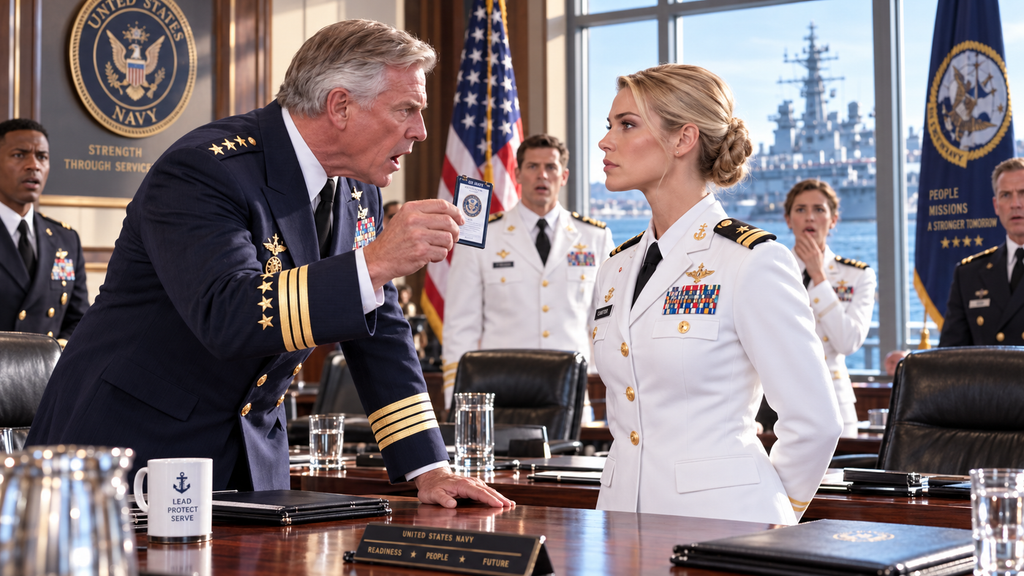
“The helicopter crashed because its emergency transmitter had been disabled.”
A chair creaked behind me.
“The maintenance crew testified otherwise,” Harlan said.
“Three did.”
I slid a photograph across the table.
“The fourth disappeared.”
Harlan stared at the image.
Petty Officer Marcus Vale.
Aircraft electrician.
Officially absent without leave.
Unofficially, the last man who inspected Pierce’s helicopter.
“Vale sent me something yesterday,” I continued.
Harlan’s eyes lifted sharply.
“A recording.”
His hand moved toward his pocket.
Immediately, two armed security officers stepped through the door.
Nobody had seen them waiting outside.
“Take your hand away from your phone, Admiral,” I said.
For the first time, anger cracked through his polished expression.
“You have no idea what you’ve uncovered.”
“I know Pierce discovered someone was redirecting classified operations through an unauthorized channel.”
Harlan laughed again.
But this laugh sounded different.
Almost relieved.
“You think it was me?”
The room went still.
He leaned toward me.
“Commander, I tried to stop it.”
Then every light in the conference room died.
The electronic locks slammed shut.
A second later, the projector flickered on by itself.
Jonah Pierce appeared on the screen.
Alive.
And staring directly into the camera.
“If Evelyn Hart is watching this,” he said, “then Admiral Harlan has already failed.”
My blood turned cold.
PART 3 — FINAL
“If Evelyn Hart is watching this,” Jonah Pierce said from the screen, “then Admiral Harlan has already failed.”
My blood turned cold.
For three full seconds, nobody in the conference room breathed.
Jonah’s face filled the projection screen.
He looked thinner than I remembered.
Tired.
There were dark circles beneath his eyes, and his uniform shirt was open at the collar as though he had recorded the message at the end of a very long day.
But it was unmistakably him.
Captain Jonah Pierce.
The man we had buried without a body.
The man whose wife had stood beside an empty casket while two children clutched folded programs and asked why their father was not coming home.
The man whose name had followed me halfway around the world.
Behind Jonah was a plain metal wall.
No windows.
No markings.
No clue where the recording had been made.
The timestamp in the bottom corner was seven days before his helicopter went down.
I stepped toward the screen.
“Jonah…”
The word escaped before I could stop it.
Admiral Harlan’s head turned toward me.
For the first time since I had entered the room, there was no mockery in his expression.
Only dread.
Jonah continued.
“Evelyn, if you’re seeing this, then three things have happened.”
He raised one finger.
“I’m dead.”
Another.
“Harlan tried to contain this without trusting anyone outside his command.”
A third finger.
“And somebody sent you to remove him.”
Every officer in the room slowly turned toward Admiral Harlan.
Harlan did not look at them.
He looked at me.
Then at the black envelope lying open on the table.
My orders.
The orders carrying the authority of Fleet Commander Leonard Voss.
Jonah leaned closer to the camera.
“If that order came from Fleet Commander Voss, do not obey another word written on it.”
A sound came from the back of the room.
Not quite a gasp.
Not quite a curse.
I felt the floor shift beneath me even though I knew it had not moved.
Admiral Leonard Voss.
Four-star fleet commander.
Thirty-eight years of service.
Presidential commendations.
Congressional testimony.
A man whose photograph hung in command buildings from California to Japan.
A man who had personally selected me for the Maritime Readiness Review six months earlier.
A man who had looked across his desk at me in Pearl Harbor and said:
“Commander Hart, I need someone who cannot be intimidated by stars.”
I remembered the way he had said it.
I remembered feeling honored.
Now those words sounded entirely different.
Behind me, one of the security officers reached for his radio.
Harlan snapped his head toward him.
“Don’t.”
The officer froze.
Jonah continued speaking from the screen.
“Harlan isn’t innocent.”
That landed hard.
Harlan’s eyes closed for half a second.
“He buried reports. He withheld evidence. He altered readiness records. And because he believed he could handle this inside the family, people got hurt.”
Harlan stared at the floor.
“But he did not kill me.”
Silence.
“He tried to stop the man who did.”
My mouth had gone dry.
I looked at Harlan.
“You knew.”
His answer was barely audible.
“Yes.”
“You knew Voss was involved.”
“Yes.”
“And you let me walk in here thinking you were responsible?”
Harlan finally met my eyes.
“I needed to know whose orders you were carrying.”
I almost laughed.
There was nothing funny in it.
“You humiliated me in front of a room full of officers to test me?”
“No.”
His voice hardened.
“I humiliated you because I wanted you angry.”
“What?”
“Angry people stop performing.”
He nodded toward the officers around us.
“They stop saying what they rehearsed.”
My hands curled at my sides.
“That may be the stupidest explanation I have ever heard.”
“It worked.”
“Did it?”
I pointed toward the screen.
“A dead man had to explain your plan to me.”
Pain moved across Harlan’s face.
Just for a second.
Then it disappeared.
Jonah’s recording continued.
“The operation is called Black Current.”
The projector image changed.
Documents appeared beside Jonah’s face.
Shipping schedules.
Mission authorizations.
Maintenance waivers.
Transfer orders.
Rows of numbers.
Names.
Dates.
I stepped closer.
Jonah spoke slowly.
“Black Current began as a classified contingency program four years ago. The original purpose was legal. Limited. Temporary.”
Another document appeared.
“Then Voss changed it.”
The Marine colonel beside the coffee urn whispered, “Jesus.”
Jonah went on.
“Voss created an off-book operational channel. Missions were reassigned without appearing in ordinary fleet review. Aircraft were moved. Crews were substituted. Maintenance deficiencies were concealed.”
His face returned full-screen.
“And every time somebody asked why, they were told the same thing.”
He paused.
“National security.”
I felt something ugly settle in my stomach.
There were two words powerful enough to end almost any question in uniform.
National security.
People heard them and stepped back.
People heard them and assumed somebody above them understood more.
People heard them and sometimes forgot that an oath did not require blindness.
Jonah looked directly into the camera.
“Most of the officers involved didn’t know what they were supporting. Some signed routine paperwork. Some followed legal orders that had been altered farther up the chain.”
His expression tightened.
“But a small group knew.”
Names appeared.
Rear Admiral Thomas Bell.
Captain Adrian Reyes.
Commander Malcolm Trent.
Civilian contractor Victor Dane.
Then one final name.
ADMIRAL LEONARD VOSS.
Nobody moved.
I looked across the room.
Captain Reyes was standing beside the projection screen.
His face had become completely expressionless.
The same Captain Reyes who had snapped to attention when I opened my envelope.
The same man who had watched Harlan’s reaction.
The same man who had been standing ten feet from me the entire time.
Jonah’s voice continued.
“Evelyn, if Adrian Reyes is in the room when this plays…”
Reyes moved.
Fast.
His hand disappeared beneath his jacket.
“DOWN!”
Harlan hit me from the side.
We crashed into the conference table.
A gunshot exploded through the room.
The projector screen jerked.
Glass shattered behind us.
People shouted.
The Marine colonel overturned the coffee table and dragged the young lieutenant behind it.
The security officers reached for their weapons.
“DON’T SHOOT!” someone screamed.
Another shot.
Then another.
I pressed myself against the carpet.
Harlan was half across me.
For a sixty-two-year-old man, he moved with frightening speed.
“Stay down.”
I shoved him.
“Get off me.”
“Gladly.”
He rolled aside.
Reyes was moving toward the rear exit.
The electronic lock was still engaged.
He struck the release pad.
Nothing happened.
Jonah’s face continued speaking on the damaged screen as though the chaos had been planned.
“If Reyes is there, do not let him leave.”
Every face turned toward him.
Reyes stopped.
For a fraction of a second, he looked almost offended.
Then his gun swung toward the projection equipment.
The young lieutenant came out from behind the overturned table and slammed into him.
They hit the wall.
The gun discharged into the ceiling.
Harlan was moving before I was fully upright.
The Marine colonel followed.
Three officers crashed into Reyes.
The weapon skidded underneath a chair.
One of the security officers kicked it away.
Reyes fought like a man who knew that surrender meant the end of his life as he knew it.
He elbowed Harlan across the mouth.
Harlan staggered backward.
Reyes tore free.
I stepped directly into his path.
His eyes widened.
Maybe because he had forgotten I was there.
Maybe because he still saw the silver oak leaf and thought it meant I was smaller than the men around me.
His mistake.
He reached for me.
I moved sideways.
His momentum carried him past me.
I caught his wrist.
Turned.
The Marine colonel seized his other arm.
Together we drove him against the table.
“Enough!” I shouted.
Reyes stopped struggling.
His cheek was pressed against polished wood.
Blood ran from the corner of Harlan’s mouth.
The Marine colonel twisted Reyes’s arm behind him.
One of the security officers secured his wrists.
Nobody spoke for several seconds.
Then the young lieutenant said, almost apologetically:
“Ma’am?”
I looked at him.
He pointed toward the screen.
Jonah was still talking.
We all turned.
“If Reyes tried to destroy this message,” Jonah said, “that was predictable too.”
Despite everything, something close to a smile touched my mouth.
That was Jonah.
Always three moves ahead.
The image changed again.
A progress bar appeared.
DATA PACKAGE TRANSMISSION COMPLETE.
Then beneath it:
MULTIPLE EXTERNAL RECIPIENTS CONFIRMED.
Harlan stared at the words.
“What did he do?”
The young lieutenant stepped toward the terminal.
“Sir… it looks like the video triggered an automatic release.”
“To whom?”
The lieutenant typed quickly.
Then he stopped.
His eyebrows rose.
“Inspector General.”
Another keystroke.
“Naval Criminal Investigative Service.”
Another.
“House Armed Services oversight office.”
Another.
His voice became smaller.
“And three civilian attorneys.”
Harlan wiped blood from his lip.
“Pierce insured himself.”
“No,” I said quietly.
Everyone looked at me.
“He insured his family.”
The thought hit me hard.
Jonah had known.
Not with certainty, perhaps.
But enough.
Enough to record his own final testimony.
Enough to arrange for the truth to survive him.
Enough to leave breadcrumbs because he no longer trusted the people above him to leave his children anything except a flag.
The screen returned to Jonah.
He looked exhausted now.
“This part matters.”
His voice had softened.
“Black Current isn’t about one mission.”
Behind him appeared records of equipment contracts.
Invoices.
Payments.
Maintenance subcontractors.
“It became a machine.”
Jonah explained that Voss and several senior officials had been steering sensitive contracts toward companies connected through hidden financial relationships.
Nothing as obvious as money deposited directly into personal accounts.
It was smarter than that.
Consulting agreements.
Real-estate partnerships.
Private foundations.
Advisory boards promised after retirement.
Family trusts.
Jobs for relatives.
Favors exchanged so slowly and carefully that each individual piece looked harmless.
Then Black Current gave them something even more valuable than money.
Control.
If a contractor failed inspection, records could be altered.
If an aircraft should have been grounded, a waiver appeared.
If an officer objected, a transfer followed.
If someone asked too many questions, their clearance could suddenly be “reviewed.”
Jonah had discovered discrepancies after one of his pilots reported equipment failures that did not match the maintenance log.
He kept digging.
He found another.
Then another.
Eventually, the paper trail led upward.
All the way to Voss.
“The dangerous part,” Jonah said, “was not that equipment failed.”
He stared directly into the camera.
“Equipment fails.”
His jaw tightened.
“The dangerous part was that they knew.”
I felt my nails bite into my palm.
“They knew certain systems were unreliable. They knew maintenance records had been falsified. They knew crews were being placed at risk.”
The room had become painfully quiet.
“And they kept sending people anyway.”
A photograph appeared.
Jonah and his helicopter crew.
Five men standing beneath a bright Pacific sky.
One had his sunglasses pushed onto his head.
Another held a water bottle.
Jonah stood in the middle.
Alive.
Smiling.
Human.
Not a case number.
Not an incident report.
Not a folded flag.
“They weren’t supposed to die,” Jonah said.
I closed my eyes.
That sentence hurt more than if he had said they were murdered.
Because most evil did not begin with somebody deciding that five men should die.
Sometimes it began with somebody deciding that five men were an acceptable risk.
“They were supposed to complete the mission,” Jonah continued. “Then everybody would go home, another report would be filed, and the machine would keep moving.”
The photograph disappeared.
“But when my crew developed an emergency, the transmitter we depended on had already been disabled.”
The image changed.
A maintenance authorization.
Electronic signature.
CAPT. A. REYES.
Everyone looked at Reyes.
He said nothing.
His face was gray.
Jonah continued.
“Marcus Vale discovered the alteration. He confronted Reyes. Twenty-four hours later, Vale disappeared.”
The video paused.
Then Marcus Vale appeared.
Alive.
My heart jumped.
He was sitting in what looked like a motel room.
His beard had grown unevenly.
His eyes darted toward the window every few seconds.
“My name is Petty Officer Marcus Vale.”
His voice shook.
“I did not desert.”
He held his identification toward the camera.
“I was ordered by Captain Reyes to disable the emergency locator system on Captain Pierce’s aircraft.”
Somebody behind me whispered a curse.
Vale swallowed hard.
“He told me it was part of a classified electronic-security test and that the system would be restored before flight.”
His eyes filled.
“It wasn’t.”
For several seconds he could not continue.
I watched a grown man struggle against tears he clearly hated himself for showing.
“When I found out the helicopter was missing, I went to Reyes.”
Vale looked down.
“He told me I had two choices.”
His fingers trembled.
“Accept responsibility for unauthorized tampering…”
He swallowed.
“Or disappear.”
The room seemed colder.
“He said if I talked, they would say I sabotaged the aircraft.”
Vale’s eyes lifted to the camera.
“And people would believe them.”
That was the terrifying part.
He was right.
A petty officer against a decorated captain.
An enlisted technician accused of sabotage.
A man who disappeared after a fatal crash.
The story practically wrote itself.
“I ran,” Vale said.
His voice broke.
“I shouldn’t have.”
He wiped his face.
“I was scared.”
No one in the room moved.
“I had a wife. A little boy. I thought if I could get proof first, I could come back.”
His mouth trembled.
“But every day I stayed gone made me look guiltier.”
I thought of all the documents I had read.
AWOL.
Suspected sabotage.
Person of interest.
Possible foreign contact.
They had constructed a villain out of a terrified man.
And somewhere, for six months, Marcus Vale’s wife had probably wondered whether her husband was dead, guilty, or both.
The recording switched back to Jonah.
“If Vale is alive when you see this, protect him.”
Then Jonah did something that nearly destroyed me.
He smiled.
Not the tired smile of the officer making a classified statement.
The old one.
The crooked one.
The smile he used when he knew he was about to irritate me.
“And Evelyn?”
I stopped breathing.
“Stop blaming yourself.”
My vision blurred.
Nobody in that room knew what he meant.
Harlan looked at me.
I looked away.
Jonah continued.
“You’re going to.”
My throat tightened.
“You’ll decide there was some report you should have read faster, some call you should have returned sooner, some pattern you should have recognized.”
His smile faded.
“There wasn’t.”
I could barely see the screen anymore.
“You warned me to stop digging alone.”
I remembered.
God, I remembered.
We had argued three weeks before his final flight.
He had called me from Guam.
I had been in Singapore reviewing readiness records.
He told me he had found something wrong.
I told him to send everything through official channels.
He laughed.
I had said:
“Jonah, I mean it. You have two kids. Don’t make yourself a hero.”
He had been quiet.
Then he answered:
“Heroes are people who want statues. I just want my paperwork to add up.”
I had promised to call him the next morning.
I did not.
A crisis in Singapore ran late.
Then another meeting.
By the time I called, he was airborne.
By the next morning, his helicopter was missing.
For six months, I had carried that unanswered call like a stone beneath my ribs.
Jonah looked through the camera as though he could see me.
“You didn’t put us in that aircraft.”
A tear slipped down my face.
“You didn’t disable the beacon.”
Another.
“You didn’t falsify the reports.”
His voice softened.
“So when this is over, go see my kids.”
I covered my mouth.
“Tell Noah I’m sorry I missed his science fair.”
The conference room disappeared around me.
“Tell Ellie I kept the bracelet she made me.”
Jonah lifted his wrist.
A tiny string of blue and yellow beads was tucked beneath his watchband.
I heard someone behind me inhale sharply.
“And tell Sarah…”
Jonah stopped.
For the first time in the entire recording, Captain Jonah Pierce looked afraid.
Not of death.
Of grief.
He looked down.
When he spoke again, his voice had changed.
“Tell Sarah the last good thing I thought about was her.”
I shut my eyes.
A sob tried to escape.
I forced it down.
Jonah nodded once.
Then the officer returned.
Controlled.
Focused.
“The evidence is hidden in three places. Harlan knows one.”
Everyone looked at the admiral.
“Vale has another.”
Jonah paused.
“And Evelyn…”
His eyes locked with mine through seven months of death and distance.
“You’ve had the third one the entire time.”
The screen went black.
No one moved.
I stared at my own reflection in the dark projection surface.
Then I looked at Harlan.
“What does that mean?”
He shook his head slowly.
“I don’t know.”
“You were supposed to know one location.”
“I do.”
“Where?”
His eyes moved toward Reyes.
“Not while he can hear.”
Reyes laughed.
It was quiet.
Almost pathetic.
“You still don’t understand.”
Harlan stepped closer to him.
“Understand what?”
Reyes raised his head.
His lip was bleeding where it had struck the table.
“You think Voss is going to let any of you walk out carrying this?”
The young lieutenant looked toward the door.
The locks were still engaged.
Reyes smiled.
“Why do you think the building went dark?”
Nobody answered.
His smile widened.
“That wasn’t Pierce.”
The room changed.
Harlan turned toward the terminal.
“Lieutenant, get the doors open.”
“I’ve been trying, sir.”
“Try harder.”
The young officer’s fingers moved.
“Internal network isn’t responding.”
“External?”
“Nothing.”
The Marine colonel checked his phone.
“No service.”
Reyes laughed again.
“Voss knew Hart was coming.”
I looked at him.
“How?”
“You really think a commander flies across three oceans carrying an order to relieve Knox Harlan and nobody tells the fleet commander she arrived?”
“He sent me.”
“Exactly.”
My stomach tightened.
Reyes leaned back against the table.
“You were never here to investigate Harlan.”
I stared at him.
“You were here to expose him.”
That sentence made no sense.
Then suddenly it did.
Not expose him as guilty.
Expose him.
Reveal what he had.
Force him to open whatever evidence he had been hiding.
I turned toward Harlan.
The realization reached him at the same time.
“The investigation,” I said.
He nodded slowly.
“Was bait.”
I thought of every sealed-log request.
Every denied demand.
Every aggressive order.
Voss had sent me to push Harlan.
To make him react.
To make him reveal where he had hidden the evidence.
And I had done exactly that.
Harlan laughed once under his breath.
There was no humor in it.
“He used you beautifully.”
I faced him.
“Careful.”
“I’m not insulting you.”
“You have a strange way of showing it.”
“He used me too.”
Harlan looked toward the black envelope.
“He knew I would never surrender evidence to him directly. So he sent someone I couldn’t easily dismiss.”
His gaze moved to my silver oak leaf.
“A mid-ranking officer with a spotless record.”
“Meaning?”
“Meaning if I cooperated, he learned where the evidence was.”
Harlan’s face hardened.
“And if I refused?”
I knew the answer.
“He removed you.”
“Either way, he won.”
Reyes smiled.
“There’s a reason he has four stars.”
Harlan looked at him.
“And how many did he promise you?”
Reyes’s smile vanished.
The damaged projector flickered.
Red emergency lights came on.
A low alarm began pulsing somewhere in the corridor.
The security officer beside the door touched the wall panel.
“Fire system.”
“No smoke,” the Marine colonel said.
Harlan’s head lifted.
“Not a fire.”
The lieutenant turned away from the terminal.
“Sir?”
Harlan looked at me.
“They’re clearing the building.”
“For what?”
He did not answer.
He did not need to.
The officer beside the door suddenly cursed.
“Override sequence just activated.”
The locking mechanism clicked.
The doors opened.
For half a second, nobody moved.
Then a voice thundered through the hallway.
“Federal security! Nobody leave the room!”
Boots approached.
Reyes smiled again.
“There.”
Harlan leaned toward me.
“Whatever happens next, do not give them the envelope.”
I stared at him.
“It’s an order signed by Voss.”
“Exactly.”
Eight armed personnel entered.
Not base security.
Different uniforms.
Different patches.
At their center walked a tall man in civilian clothes.
Gray suit.
Close-cropped hair.
No tie.
He carried credentials but did not immediately display them.
His eyes swept the room.
Stopped on Reyes.
Then Harlan.
Then me.
“Commander Hart?”
“Yes.”
“Mr. Aaron Fisk, Department of Defense Security Directorate.”
He held out his hand.
“Your investigation has been compromised. I need your authorization package.”
Harlan made a sound that might have been a laugh.
Fisk looked toward him.
“Admiral Harlan, you are relieved of command.”
“Second time today.”
“This one will stick.”
Fisk turned back to me.
“The envelope, Commander.”
I held it in my hand.
Every instinct I had been trained to obey told me to cooperate with properly credentialed federal security personnel.
The credentials looked real.
The uniforms looked real.
The command presence felt real.
Then I remembered Jonah.
Do not obey another word written on it.
“What office sent you?” I asked.
Fisk’s expression did not change.
“Commander—”
“What office?”
“Joint security coordination.”
“Under whose authority?”
His jaw tightened.
“Fleet Commander Voss.”
There it was.
Harlan looked at me.
I looked at Fisk.
“No.”
The room became silent.
Fisk stared as though he had misheard me.
“Excuse me?”
“I said no.”
“You are holding classified material covered by an active containment directive.”
“So are you.”
His eyes narrowed.
“You’re making a serious mistake.”
“Today seems full of them.”
Harlan coughed to hide a laugh.
Fisk ignored him.
“Commander Hart, surrender the package.”
“No.”
One of the armed men stepped forward.
I did not move.
Fisk raised a hand, stopping him.
He studied me.
Then his voice softened.
“You’ve had a difficult afternoon.”
That tone angered me more than if he had shouted.
“Do not do that.”
“Do what?”
“Talk to me like I’m confused.”
Something changed behind his eyes.
Small.
But there.
“I understand exactly what you’re asking.”
I held up the envelope.
“You want the only document that proves Admiral Harlan’s removal was ordered before I arrived.”
Fisk remained still.
“You want the authorization chain.”
No response.
“And if this order disappears, Voss can say I exceeded my authority.”
Harlan slowly smiled.
I continued.
“He can say I acted independently.”
Fisk’s jaw flexed.
“He can say the video was fabricated.”
Nothing.
“He can say Harlan staged everything to avoid investigation.”
The Marine colonel looked at Fisk.
Then at me.
I finished quietly.
“And I become the unstable commander who walked into a SEAL headquarters, illegally relieved an admiral, and triggered a classified-data breach.”
Harlan murmured, “That’s almost elegant.”
Fisk looked at him.
“Shut up.”
Harlan smiled wider.
“There he is.”
Fisk’s control cracked.
Only for a second.
But that was enough.
I slipped the envelope inside my jacket.
“Commander,” he said, “I will not ask again.”
The security personnel around him adjusted their stance.
The two base security officers near us exchanged glances.
Nobody wanted to be the first person to choose a side.
That was how systems broke.
Not always because everyone was corrupt.
Sometimes because decent people did not know who held legitimate authority anymore.
I looked at the youngest officer.
The lieutenant who had gone pale when Harlan touched my badge.
“What is your name?”
He blinked.
“Lieutenant Daniel Mercer, ma’am.”
“Lieutenant Mercer, who commands this facility’s internal security?”
He hesitated.
“Admiral Harlan until relieved.”
“Who formally received the relief order?”
“You did.”
“Has command authority been transferred?”
His eyes moved between Harlan and Fisk.
“No, ma’am.”
Fisk snapped, “Lieutenant, this is above your level.”
Mercer swallowed.
Then something surprising happened.
He stood straighter.
“Respectfully, sir, everything today is above my level.”
Harlan glanced at him.
Mercer continued.
“But she asked a procedural question.”
He looked at me.
“No formal transfer has been recorded.”
“Then who currently has authority over these spaces?”
Mercer hesitated.
Technically, Harlan had been relieved.
But no successor had assumed command.
The Marine colonel stepped in.
“Commander Hart is the appointed investigating officer carrying the removal directive.”
Fisk’s eyes hardened.
“This is not a courtroom.”
“No,” the colonel said. “Which is why nobody should be improvising one.”
Fisk slowly looked around the room.
He realized he was losing it.
Not tactically.
Institutionally.
There were too many witnesses.
Too many ranks.
Too many people who had just watched a dead officer name Voss.
Fisk tried a different approach.
“Fine.”
He lowered his hand.
“Keep the envelope.”
Nobody relaxed.
“Commander Hart, you and I will walk to the communications center and confirm directly with Admiral Voss.”
Harlan stepped forward.
“She stays here.”
Fisk laughed.
“You don’t command anything anymore.”
“True.”
Harlan nodded toward me.
“But she does.”
Every eye returned to me.
I hated him for that.
And respected him for it.
I looked at Fisk.
“I’ll speak with Voss.”
Fisk smiled faintly.
“Good.”
“From this room.”
His smile disappeared.
“Restore communications.”
“That isn’t possible.”
“Then neither is your verification.”
Fisk stared at me.
The emergency alarm continued its steady pulse.
Then a phone rang.
Everyone froze.
Not a cell phone.
The secure desk phone in the center of the conference table.
The line that had been dead thirty seconds earlier.
One ring.
Two.
Three.
Nobody touched it.
Four.
Harlan looked at me.
“Don’t.”
I picked it up.
“Commander Hart.”
Silence.
Then a familiar voice.
“Evelyn.”
My skin went cold.
Admiral Leonard Voss.
Calm.
Warm.
Almost paternal.
Exactly as he had sounded in Pearl Harbor.
“Sir.”
“I imagine this has been confusing.”
Across the room, Fisk’s shoulders relaxed.
Harlan watched me carefully.
Voss continued.
“I need you to listen very closely.”
“I’m listening.”
“Knox Harlan has manipulated a great deal of information.”
Harlan’s mouth twisted.
Voss said, “The recording you just watched was assembled using stolen classified materials and a statement Pierce made during an unrelated investigation.”
I looked at the black screen.
“Pierce named you.”
“Yes.”
No hesitation.
“That does not make the accusation true.”
He sounded almost disappointed in me.
“Harlan has spent months building a narrative to shield his own misconduct.”
I looked at the admiral.
Harlan gave me nothing.
Voss continued.
“Captain Reyes attempted to prevent the unauthorized dissemination of classified material.”
Reyes actually smiled.
I felt anger rise behind my ribs.
“He fired a weapon in a room full of officers.”
“I have been told the discharge occurred during an altercation.”
“He drew first.”
“I wasn’t there.”
“No.”
I looked directly at Fisk.
“You weren’t.”
The silence on the other end lasted a second too long.
Then Voss sighed.
“Evelyn, this is exactly why I selected you.”
The sentence hurt.
Not because I believed him.
Because once, I had.
“You are methodical. You do not jump to conclusions.”
“Then you won’t mind questions.”
Another pause.
“No.”
“Why was Captain Pierce’s emergency transmitter disabled?”
“That has not been conclusively established.”
“Marcus Vale says Reyes ordered it.”
“Vale is a deserter facing potential criminal charges.”
“Convenient.”
“Commander.”
His voice sharpened.
“Do not become emotional.”
There it was.
In a room full of men who had shouted, fought, drawn weapons, lied, and bled, I was apparently the emotional one.
I smiled.
Harlan noticed.
His eyebrows lifted.
I understood now why men like Voss preferred anger from the people beneath them.
Anger could be dismissed.
Calm questions were harder.
“Why did you send me to relieve Harlan?”
“Because he obstructed a lawful investigation.”
“That part appears true.”
Harlan nodded once.
I continued.
“Why send me?”
“Your record.”
“Twenty-seven officers outrank me and have comparable investigative experience.”
Voss said nothing.
I pressed.
“Why me?”
“Because I trust you.”
“No.”
My voice remained quiet.
“You trusted something about me.”
Voss went silent.
“That isn’t the same thing.”
Harlan looked down, almost smiling.
“What was it?”
I asked.
“My friendship with Pierce?”
Nothing.
“You knew Jonah and I served together.”
No answer.
“You knew I would react personally to his death.”
“Commander—”
“You knew if Harlan had evidence related to Jonah, I wouldn’t stop pushing.”
Fisk shifted his weight.
I continued.
“You didn’t send me because I was neutral.”
My voice hardened.
“You sent me because I wasn’t.”
That landed.
For the first time, Voss did not sound like a fleet commander.
He sounded like a cornered man trying not to appear cornered.
“Evelyn, put Harlan on the phone.”
“No.”
A long silence followed.
Then the warmth disappeared completely.
“That was not a request.”
Every officer in the room heard the change through the speaker.
I looked at Harlan.
He looked back.
And suddenly the entire story became clear.
Harlan had spent six months ignoring Voss.
Not because he believed himself above the chain of command.
Because the chain itself had become the weapon.
“Admiral,” I said, “did you order Captain Reyes to suppress maintenance evidence connected to Pierce’s crash?”
Fisk stepped forward.
“End the call.”
I held up a hand.
Voss said nothing.
“Did you order Marcus Vale classified as AWOL after he reported Reyes?”
Silence.
“Did you direct Admiral Harlan to close the Pierce inquiry?”
Still nothing.
Then Voss spoke.
“Be very careful.”
Not an answer.
A threat.
Something inside me became very still.
For six months, I had imagined this moment differently.
I had imagined discovering a villain.
A monster.
Some obvious evil person who would finally make Jonah’s death make sense.
Instead, I heard an old man on a telephone telling himself that his position made every terrible decision necessary.
That frightened me more.
Because men like that rarely thought they were villains.
They thought they were indispensable.
I looked around the room.
At Mercer.
At the Marine colonel.
At the two security officers.
At Harlan.
At Reyes.
Then I spoke clearly enough that every person could hear me.
“Admiral Voss, I am placing your instructions into the formal record as potentially connected to an active obstruction inquiry.”
Fisk lunged for the phone.
Harlan stepped between us.
Fisk stopped.
Voss’s voice came through the speaker.
“You have no authority to investigate me.”
“Maybe not.”
I looked at the transmission notice still faintly visible on the terminal.
“But the people receiving Jonah Pierce’s evidence do.”
Voss went silent.
Then he said something I will never forget.
“You have no idea what it costs to command at this level.”
Harlan’s face changed.
Pain.
Recognition.
Maybe because he had once believed the same thing.
I answered slowly.
“No, sir.”
Then I looked at Jonah’s frozen image on the damaged screen.
“But I know what it cost five men to obey you.”
The line went dead.
No dramatic final threat.
No confession.
Just silence.
Fisk stared at the phone.
Then at me.
His face had lost color.
I set the receiver down.
“Mr. Fisk.”
He did not answer.
“Who told you to retrieve the envelope?”
“You heard the admiral.”
“I’m asking who contacted you.”
His jaw tightened.
“Commander—”
“Was it Voss?”
No answer.
“Was it Reyes?”
Still nothing.
Harlan stepped closer.
“Or Bell?”
Fisk’s eyes moved.
Barely.
But Harlan saw it.
“So Bell’s involved.”
Fisk looked away.
The Marine colonel exhaled.
“Rear Admiral Bell commands regional communications security.”
“Which explains the blackout,” Mercer said.
Harlan pointed toward the secure terminal.
“Can Bell access the building network remotely?”
Mercer nodded slowly.
“With the right authorization.”
Harlan looked at Fisk.
“And Voss has it.”
Fisk said nothing.
A new sound came from the hallway.
Running footsteps.
Everyone tensed again.
The door opened.
A base security officer appeared.
“Commander Hart?”
“Yes?”
“Ma’am, you need to see this.”
He held out a tablet.
A video call was active.
The image shook.
Then steadied.
A woman appeared.
Mid-forties.
Hair pulled back.
No makeup.
Eyes red from exhaustion.
Beside her stood a man I recognized immediately.
Marcus Vale.
Alive.
Not a recording.
Alive.
He was thinner than in the video.
A healing cut crossed his forehead.
For several seconds nobody spoke.
Then Vale looked at me through the screen.
“Commander Hart?”
“Yes.”
He closed his eyes.
His whole body seemed to sag.
“Oh, thank God.”
“Where are you?”
“I’m safe.”
“Where?”
The woman beside him shook her head.
“Not on an unsecured call.”
“Who are you?”
She held up credentials.
“Special Agent Miriam Cho.”
NCIS.
Fisk turned pale.
Cho saw him.
Her expression changed.
“Why is Aaron Fisk in that room?”
Nobody answered.
Fisk backed toward the door.
One of the base security officers blocked him.
Cho leaned toward the camera.
“Do not let him leave.”
Fisk’s face hardened.
“This is absurd.”
Cho ignored him.
“Commander Hart, my team received Captain Pierce’s data package fourteen minutes ago. We had been working separately with Vale.”
Vale stepped closer.
“I sent you the recording yesterday because Jonah told me you were the only person he trusted who was still outside Voss’s circle.”
My throat tightened.
“You knew Jonah?”
“Not until the end.”
Vale’s eyes dropped.
“He found me.”
I stared.
“I thought you disappeared before the crash.”
“I did.”
His face twisted.
“Jonah found out where Reyes had sent me.”
Harlan’s head snapped toward the screen.
Vale continued.
“He got me out.”
“When?”
“Two days before his flight.”
A chill went through me.
“Then why did Jonah get on that helicopter?”
Vale’s eyes filled.
“Because Reyes changed the crew assignment.”
The room became silent.
Vale swallowed.
“Jonah wasn’t originally supposed to fly.”
Harlan took one step toward the screen.
“What?”
Vale nodded.
“He discovered the transmitter issue.”
My heart started pounding.
“He knew?”
“He knew somebody had tampered with it.”
Vale looked sick.
“He thought it had been repaired.”
Reyes stared at the floor.
Vale continued.
“Jonah told me he was going to confront Harlan after the mission.”
Harlan whispered, “He never did.”
“No.”
Vale closed his eyes.
“The flight went down first.”
I looked at Reyes.
Something in me wanted to cross the room.
Not as an officer.
Not as an investigator.
As Jonah’s friend.
As the woman who had watched his children bury an empty coffin.
I wanted to ask him whether he heard them crying.
Whether he slept.
Whether Jonah’s face ever appeared when he closed his eyes.
Instead, I asked one question.
“Did you know the transmitter had not been restored?”
Reyes said nothing.
“Look at me.”
Slowly, he did.
His eyes were hollow.
“Did you know?”
His mouth opened.
Nothing came out.
Harlan stepped toward him.
Reyes flinched.
That told me something.
Harlan saw it too.
His fists tightened.
I moved between them.
“No.”
Harlan stared at me.
“Move.”
“No.”
“He killed my people.”
“You touch him and Voss gets exactly what he needs.”
Harlan’s breathing became heavy.
“He killed five men.”
“And if you hit him now, tomorrow every story becomes about the unstable admiral who assaulted a restrained witness.”
Harlan’s jaw shook.
I stepped closer.
“Do not give them that.”
For several seconds, I did not know whether he would listen.
Then his hands slowly opened.
He stepped backward.
Reyes watched him.
Something like shame crossed his face.
Then Special Agent Cho spoke from the tablet.
“Commander Hart, we’re coming to you.”
“How long?”
“Soon.”
“Is Voss under restriction?”
A pause.
“Not yet.”
“Why not?”
“Because we need corroboration strong enough that nobody can call this an internal command dispute.”
I looked at Harlan.
“The other evidence.”
He nodded.
Cho heard me.
“What other evidence?”
“Pierce said there were three copies.”
Vale leaned toward the screen.
“I have one.”
“I know.”
I looked at Harlan.
“He said Harlan had one.”
Harlan slowly walked toward the conference table.
Then he stopped beside the huge bronze SEAL trident mounted to the wall behind the admiral’s chair.
Every person watched.
He reached underneath the lower edge.
Pressed something.
A tiny compartment clicked open.
The Marine colonel stared.
“You hid classified evidence inside a wall decoration?”
Harlan pulled out a small sealed drive.
“I had limited options.”
I shook my head.
“Of course you did.”
Harlan held the drive but did not hand it to anyone.
Special Agent Cho said, “Admiral, I need that preserved.”
“You’ll get it personally.”
“Fine.”
Vale looked at me through the screen.
“That leaves the third.”
I thought of Jonah’s words.
Evelyn, you’ve had the third one the entire time.
“I don’t.”
Vale looked confused.
Harlan studied me.
“What did Pierce give you?”
“Nothing.”
“Think.”
“I have been thinking.”
“Before the crash.”
“Nothing.”
“After?”
“A letter to his family that never arrived.”
“Anything else?”
“No.”
“Photographs?”
“No.”
“Documents?”
“No.”
My voice rose.
“Nothing.”
Then I stopped.
A memory surfaced.
Small.
Ridiculous.
Six months old.
A package.
I had forgotten about it.
The morning before Jonah disappeared, a padded envelope arrived at the Singapore hotel.
Inside had been a book.
An old paperback.
Joseph Conrad.
Lord Jim.
No note.
I thought Jonah was teasing me because we had argued years earlier about whether the book was brilliant or unbearable.
I had texted him.
You have terrible taste.
He answered:
Keep it. Might improve yours.
That was the last text he ever sent me.
I had carried the book home.
Then brought it with me on almost every deployment since.
Not because I read it.
Because Jonah had sent it.
My eyes widened.
Harlan saw it.
“What?”
I turned toward the chair where my travel bag sat.
I crossed the room.
Opened it.
There.
Beneath a folder and an extra uniform shirt.
The battered paperback.
My hands shook as I lifted it.
Harlan came closer.
“What is that?”
“A book.”
“Pierce gave it to you?”
“Yes.”
“When?”
“The day before he disappeared.”
Nobody spoke.
I opened the cover.
Nothing.
I flipped through the pages.
Nothing obvious.
Then I noticed something I had never noticed before.
The spine was too thick.
I pressed my thumb against it.
A section moved.
My breath caught.
Harlan found a pocketknife.
“May I?”
I nodded.
He carefully separated the interior lining.
Something small dropped into my palm.
A memory card.
No bigger than my fingernail.
For a moment I could not speak.
Jonah had trusted me with it.
And I had carried it through airports, hotels, briefings, and sleepless nights without knowing.
Harlan exhaled.
“Son of a…”
I stared at the card.
Then I laughed.
It came out tangled with tears.
“That arrogant bastard.”
Harlan looked at me.
“He knew you’d keep the book.”
“Yes.”
“Why?”
I wiped my eyes.
“Because he knew I hated it.”
For the first time that day, Harlan laughed like a human being.
Not the cruel laugh from when I entered the room.
Not the defensive laugh after being accused.
A tired, broken laugh.
“He sounds exhausting.”
“He was.”
I closed my fingers around the card.
“He was my friend.”
Special Agent Cho spoke softly.
“Commander.”
I looked at the tablet.
“Do not insert that into any base system.”
I nodded.
“We’ll preserve it offline.”
“Understood.”
Then Vale said, “There’s something else.”
Everyone looked at him.
He appeared almost frightened to continue.
“Jonah told me if all three pieces came together…”
He hesitated.
“What?”
“There was a master ledger.”
Harlan’s expression changed.
“What master ledger?”
Vale swallowed.
“Names.”
Fisk suddenly moved.
He drove his shoulder into the officer blocking the doorway and ran.
“STOP!”
Two men went after him.
Fisk reached the corridor.
Harlan shouted.
Boots pounded outside.
Then came a crash.
A grunt.
A few seconds later, two security officers dragged Fisk back inside.
His face had struck something.
Blood ran from his nose.
One officer held a phone.
“He was trying to destroy this.”
The screen was shattered.
Mercer examined it.
“Encrypted messaging.”
Cho’s voice came sharply through the tablet.
“Bag it. Do not unlock it.”
Fisk glared at me.
“You have no idea what you’re doing.”
That sentence had become very popular today.
I walked toward him.
“No.”
I stopped a few feet away.
“But I am beginning to understand what you were doing.”
He laughed bitterly.
“You think this ends with Voss?”
Harlan stiffened.
Fisk smiled through the blood.
“Do you really believe one fleet commander built this alone?”
The room went silent.
“There are senators.”
Harlan said, “Careful.”
“Contractors.”
Fisk’s smile widened.
“Flag officers.”
“Stop talking,” Reyes snapped.
Everyone turned.
Fisk looked at him.
Then laughed.
“Oh, now you care?”
Reyes’s face tightened.
“You idiot.”
Fisk tilted his head.
“You still think they’re protecting you?”
“Shut up.”
“You sabotaged the helicopter.”
Reyes lunged against the officers holding him.
“SHUT UP!”
There it was.
The room froze.
Reyes realized what he had done.
Fisk realized it too.
I stepped forward.
“What did you say?”
Reyes stared at me.
“Captain.”
No response.
“You heard him.”
His jaw trembled.
I kept my voice quiet.
“Did you sabotage Jonah Pierce’s helicopter?”
Reyes looked at the floor.
Harlan moved toward him again.
This time I did not have to stop him.
He stopped himself.
That mattered.
Reyes whispered, “It wasn’t supposed to crash.”
A sound left Harlan’s throat.
Not a word.
Not quite.
The sound of a man trying not to break another man’s neck.
I looked at Reyes.
“Explain.”
He shut his eyes.
“The transmitter was supposed to fail during the mission.”
“Why?”
“To force an abort.”
My stomach turned.
“Why?”
“Pierce was carrying evidence.”
There it was.
“He had copied files from Black Current.”
Reyes spoke faster now, as if the first admission had broken something.
“Voss knew he had them but didn’t know where.”
“So you disabled the emergency system.”
“To force him back.”
“That makes no sense.”
“Not just the transmitter.”
Reyes looked sick.
“There was supposed to be a warning indication.”
Harlan stepped closer.
“What warning?”
“A system fault. Enough that the pilot would turn around.”
“But he didn’t.”
“No.”
“Why?”
“I don’t know.”
Harlan’s voice shook.
“You signed the maintenance authorization.”
“Yes.”
“You knew an aircraft was launching with disabled emergency equipment.”
“Yes.”
“You let five men go anyway.”
Reyes looked at him.
“I was told they would abort.”
Harlan almost smiled.
“Who told you?”
Reyes said nothing.
“WHO?”
“Voss.”
The name fell into the room like a body.
I looked at the tablet.
Special Agent Cho’s expression had become perfectly still.
“Did everyone hear that?”
Mercer answered.
“Yes, ma’am.”
The Marine colonel said, “Clearly.”
Cho nodded.
“Good.”
Reyes looked toward the screen.
Panic hit him.
“Wait.”
Too late.
Cho said, “Captain Reyes, do not say another word unless you choose to continue voluntarily.”
He stared at her.
Then at me.
Then Harlan.
The arrogance was gone.
All of it.
What remained was a tired man suddenly realizing the people above him had already started sacrificing the people below.
That was how these systems survived.
Everybody thought loyalty traveled upward and protection traveled downward.
Until the moment protection stopped.
Reyes sank into a chair.
“I have a daughter.”
Harlan’s face became stone.
“So did Pierce.”
Reyes looked up.
Harlan corrected himself.
“Does.”
That single word cut deeper.
Does.
Jonah’s daughter still existed.
Still woke up.
Still went to school.
Still had birthdays.
Still waited for somebody to explain why her father had not come home.
Reyes covered his face.
Nobody comforted him.
Twenty-two minutes later, Special Agent Miriam Cho arrived.
She did not arrive alone.
Six investigators entered with her.
Two technicians.
A legal officer.
And one man from the Inspector General’s staff.
They separated everyone.
Collected phones.
Photographed the room.
Bagged the envelope.
Secured Harlan’s drive.
Took Jonah’s memory card from me only after I watched them seal it into an evidence container.
Reyes was taken into custody.
Fisk was detained separately.
Before they led him out, he stopped beside me.
“You think you won?”
I looked at him.
“No.”
That surprised him.
“This isn’t winning.”
I looked around the room.
At the bullet hole in the ceiling.
At the overturned chairs.
At blood on the edge of the conference table.
At Jonah’s dead screen.
“Winning would have been finding this six months earlier.”
Fisk said nothing.
“Winning would have been five men coming home.”
He lowered his eyes.
The officers led him away.
Reyes went next.
When he passed Harlan, they looked at each other.
Neither spoke.
Maybe there was nothing left to say.
Then Cho approached Harlan.
“Admiral.”
He gave her the sealed drive.
“I assume I remain relieved.”
“Yes.”
Harlan nodded.
“What happens to me?”
Cho was direct.
“You altered official records, withheld material evidence, ignored lawful reporting requirements, and conducted an unauthorized internal investigation.”
He gave a humorless smile.
“That sounds bad when you list it.”
“It is bad.”
His smile faded.
Cho continued.
“The fact that you were trying to expose criminal activity will matter.”
“But it won’t erase what I did.”
“No.”
Harlan nodded.
“Good.”
That answer surprised me.
Cho noticed.
Harlan looked toward the dark projector.
“I spent six months telling myself rules were the reason Pierce died.”
His eyes lowered.
“So I stopped following them.”
He rubbed his jaw.
“Took me longer than it should have to realize that was exactly how Voss started.”
Nobody spoke.
Harlan looked at me.
“I’m sorry.”
I waited.
“For what part?”
His mouth twitched.
“Fair question.”
He straightened.
“For touching your badge.”
I said nothing.
“For calling you sweetheart.”
Still nothing.
“For deliberately trying to humiliate you.”
I raised an eyebrow.
“Anything else?”
He sighed.
“This is becoming expensive.”
Despite myself, I almost smiled.
His expression grew serious.
“And for not trusting you sooner.”
That one mattered.
I looked at him.
“You should have.”
“I know.”
“You could have called me.”
“I didn’t know if Voss had compromised you.”
“So you treated me like an enemy.”
“Yes.”
I nodded.
“And that nearly made me one.”
His face tightened.
“I know.”
For several seconds, we stood there without rank.
Without the oak leaf.
Without the stars.
Just two officers who had both failed Jonah in different ways.
Then Harlan said, “He trusted you.”
I looked at the book still lying open on the table.
“Yes.”
Harlan’s voice softened.
“He trusted you more than he trusted me.”
“That doesn’t mean he respected me more.”
Harlan almost smiled.
“He respected everybody enough to annoy them.”
That made me laugh.
A real laugh.
Small.
Painful.
But real.
Cho called my name from the other side of the room.
“We have the memory card isolated.”
I crossed to the secure laptop she had brought.
“No network connection?”
“None.”
A technician inserted the card through an evidence adapter.
Three folders appeared.
BLACK CURRENT.
PERSONAL.
IF I AM DEAD.
My throat tightened.
Cho looked at me.
“Your call.”
I opened BLACK CURRENT first.
Hundreds of files.
Payment records.
Audio clips.
Authorization chains.
Photographs.
Scanned signatures.
Meeting notes.
Enough to keep investigators occupied for months.
The second folder contained something more disturbing.
A spreadsheet.
Names.
Dates.
Transfers.
Retirements.
Consulting payments.
The master ledger.
Harlan leaned closer.
His face changed.
“What?”
He pointed.
One name.
Rear Admiral Thomas Bell.
Another.
Victor Dane.
Another.
Leonard Voss.
Then dozens more.
Not all were criminals.
Jonah had marked categories.
KNOWING.
SUSPECTED.
UNWITTING.
That distinction told me everything about him.
Even when preparing evidence against people who might have contributed to his death, Jonah had refused to label someone guilty without proof.
At the bottom was a note.
Do not confuse obedience with conspiracy.
I read it twice.
Harlan did too.
He looked away.
The third folder waited.
IF I AM DEAD.
My hand rested on the mouse.
Cho stepped back.
“This may be personal.”
I looked at her.
“Stay.”
She hesitated.
“Commander—”
“If there’s evidence, I want a witness.”
She nodded.
I opened it.
There were four files.
SARAH.
NOAH.
ELLIE.
EVELYN.
My chest tightened.
Harlan started to leave.
I stopped him.
“Stay.”
He looked surprised.
“Why?”
“Because if I don’t finish it, somebody should know why.”
He remained.
I clicked EELYN.
The file name was misspelled.
I laughed through my tears.
“Idiot.”
A video opened.
Jonah appeared.
Different room.
Different day.
No uniform.
A gray T-shirt.
His hair was messy.
He was holding coffee.
“If you’re watching this, Hart, things have gone catastrophically wrong.”
I covered my mouth.
Cho looked down.
Jonah took a drink.
“And before you begin turning this into some elaborate story about how you should have saved me, stop.”
I laughed again.
Tears slipped down my cheeks.
“I know you.”
He pointed at the camera.
“You’re already doing it.”
Harlan looked at me.
I ignored him.
Jonah continued.
“You have this irritating belief that if you prepare enough, read enough, think enough, and care enough, you can keep everyone alive.”
His smile faded.
“You can’t.”
I stopped breathing.
“None of us can.”
His eyes softened.
“That isn’t permission to stop trying.”
He leaned forward.
“It’s permission to stop calling every loss a personal failure.”
My shoulders began shaking.
I had spent half a year holding myself together by refusing to cry properly.
At the funeral.
With Sarah.
In my apartment.
On aircraft.
In hotel rooms.
I had told myself grief could wait until the investigation ended.
As if sorrow belonged on a schedule.
As if I could order my heart to stand down.
Jonah looked through the camera.
“There was something I never told you.”
I wiped my face.
“You were right in Singapore.”
My eyes closed.
“I should have stopped.”
My breath caught.
“I should have brought everything to you.”
He shook his head.
“But I was angry.”
A sad smile.
“And arrogant.”
Harlan muttered, “That seems to be going around.”
I almost laughed.
Jonah continued.
“I thought I could solve one more piece first.”
He looked down at his hands.
“If something happens to me, that decision belongs to me.”
His voice hardened.
“Not you.”
I felt something inside me finally break.
Not violently.
Quietly.
Like ice giving way beneath sunlight.
For six months, I had needed somebody to say it.
And the only person whose words I would have believed had been dead.
“You were my best friend, Hart.”
The tears came harder.
“And if you tell anyone I said that, I’ll deny it.”
I laughed through a sob.
Jonah smiled.
“Look after Sarah if she lets you.”
He paused.
“Don’t hover.”
Another pause.
“You hover.”
I whispered, “I do not.”
Harlan looked at me.
I pointed at him without taking my eyes from the screen.
“Not one word.”
Jonah said, “Make sure Noah learns to drive from literally anyone except Sarah.”
I laughed again.
“And Ellie is going to pretend she doesn’t remember me.”
His expression changed.
“She will.”
My heart cracked.
“She’s little.”
His voice became softer.
“Don’t let Sarah think that means Ellie didn’t love me.”
I wiped my cheeks.
“And Hart?”
“Yes,” I whispered.
Jonah stared into the camera.
“When this is over…”
A long pause.
“Go live.”
I closed my eyes.
“Not investigate.”
He pointed at the camera.
“Not review.”
Another point.
“Not fix.”
His smile returned.
“Live.”
The video ended.
I sat there staring at the black screen.
Nobody spoke.
Then Admiral Knox Harlan quietly pulled a chair beside me.
He did not touch me.
Did not tell me everything would be all right.
Did not offer one of those useless sentences people say because another person’s grief makes them uncomfortable.
He simply sat.
For the first time since I had met him, he seemed to understand silence.
Three hours later, the base changed.
You could feel it.
Rumors moved faster than official notices.
Senior officers disappeared into interviews.
Doors were sealed.
Computer systems were isolated.
Rear Admiral Bell was intercepted before boarding a government aircraft.
Victor Dane, the civilian contractor named repeatedly in Jonah’s files, was detained for questioning at a hotel outside San Diego.
By midnight, news had reached Washington.
By one in the morning, Voss’s office released a statement describing the matter as “an internal review.”
At 1:17 a.m., investigators executed preservation orders on three offices.
At 2:05, Leonard Voss was informed that his operational authority had been temporarily suspended pending investigation.
At 2:11, he called me.
I did not answer.
At 2:13, he called again.
I stared at the phone.
Harlan was sitting across from me in an empty office with an ice pack against his jaw.
“Going to answer?”
“No.”
“Good.”
The phone stopped.
Then rang again.
Harlan looked at it.
“Persistent.”
“So are cockroaches.”
He raised an eyebrow.
“Commander.”
“What?”
“That was almost insubordinate.”
“He is suspended.”
“Excellent point.”
The phone stopped.
A voicemail appeared.
I ignored it.
Harlan removed the ice pack.
“You know they’re going to investigate every order I’ve issued for the last year.”
“Yes.”
“Probably my entire command.”
“Yes.”
“I may never wear this uniform again.”
I looked at him.
“How do you feel about that?”
He stared at the stars on his collar.
For a long time.
“I used to think losing them was the worst thing that could happen to me.”
“And now?”
His eyes moved toward the wall.
Where Jonah’s face had appeared hours earlier.
“Now I can think of five worse things.”
I nodded.
Neither of us spoke again for several minutes.
At dawn, I walked outside.
Coronado was strangely beautiful.
The Pacific was turning silver beneath the morning light.
Sailors crossed the base carrying coffee.
Vehicles moved through checkpoints.
Flags lifted in the wind.
The world had kept going.
That always seemed cruel after death.
The first morning after losing someone, the sun still rose.
People still complained about traffic.
Coffee still brewed.
Phones rang.
Somewhere somebody laughed.
And you wanted to ask the entire world how it could possibly continue when one person was missing.
Seven months earlier, after Jonah disappeared, I had watched the sunrise from a hotel window in Guam and hated it.
Now I stood near the water and understood something I had not understood then.
The world continuing was not betrayal.
It was responsibility.
People died.
The living had to decide what happened to the truth they left behind.
My phone buzzed.
Sarah Pierce.
I stared at her name.
She had no idea what had happened yet.
Or perhaps investigators had contacted her.
I answered.
“Sarah.”
Silence.
Then:
“Is it true?”
Her voice was shaking.
I closed my eyes.
“Yes.”
Another silence.
“They found out what happened?”
“Yes.”
I heard her breathe.
“Was Jonah…”
She stopped.
I knew the question.
Was he afraid?
Was he guilty?
Did he suffer?
Had he made a mistake?
Had he known?
Grief carried a thousand questions inside one unfinished sentence.
“We found a recording.”
She started crying.
I pressed the phone against my ear.
“He left messages.”
“For us?”
“Yes.”
A sob.
“For the kids?”
“Yes.”
She tried to speak.
Could not.
I looked out at the ocean.
“There’s something he wanted me to tell you.”
Sarah became quiet.
I swallowed.
“He said the last good thing he thought about was you.”
The sound she made nearly brought me to my knees.
I leaned against the railing.
Neither of us spoke.
There was nothing to add.
Finally Sarah whispered:
“Come home.”
Two words.
Not Commander.
Not investigation.
Not evidence.
Come home.
I closed my eyes.
“I will.”
Three days later, I stood outside Sarah Pierce’s house carrying Jonah’s personal effects.
The front door opened before I reached it.
Noah came running out.
He had grown taller since the funeral.
Eleven years old.
Jonah’s eyes.
He stopped when he saw the box.
Children understand objects before adults sometimes.
He knew what the box meant.
“Is that Dad’s?”
“Yes.”
His face crumpled.
Sarah appeared behind him.
Ellie held her hand.
Six years old.
Yellow dress.
Messy hair.
She looked at me.
Then the box.
Then whispered:
“Did you find Daddy?”
There are questions no training prepares you to answer.
I knelt.
“No, sweetheart.”
Her eyes dropped.
“But we found something he left for you.”
I opened the box.
Inside was Jonah’s watch.
His notebook.
His wings.
And the blue-and-yellow bracelet.
Ellie stared at it.
Her mouth opened.
“I made that.”
“I know.”
“He kept it?”
I nodded.
“Every day.”
She reached for it.
Then stopped.
“Can I?”
“It belongs to you.”
I placed the bracelet in her palm.
She held it against her chest.
Sarah covered her mouth.
Noah looked away.
I took out a sealed drive.
“He left videos.”
Sarah stared at it.
“I don’t know if you want to watch them today.”
She reached for it immediately.
“I do.”
We went inside.
The living room still had Jonah everywhere.
A photograph near the stairs.
His old running shoes under a bench.
A coffee mug with a chipped handle.
A jacket Sarah had apparently been unable to move.
Death had removed the man without removing his shape from the house.
We watched Noah’s message first.
Jonah teased him about baseball.
Then told him being brave did not mean pretending not to be afraid.
Noah cried silently.
He wiped his face every few seconds because eleven-year-old boys often believe tears are something to apologize for.
I put an arm around him.
He did not pull away.
Ellie’s video was harder.
Jonah read her favorite bedtime story badly on purpose.
She laughed.
Then cried.
Then laughed while crying.
At the end he held up the bracelet.
“I keep this with me because the coolest person I know made it.”
Ellie pressed her face into Sarah’s side.
Then came Sarah’s.
I started to stand.
She grabbed my hand.
“Stay.”
“Sarah—”
“Please.”
So I stayed.
Jonah appeared on the television.
For almost ten minutes, he spoke to his wife.
There were no secrets.
No dramatic revelations.
He apologized for leaving wet towels on the bathroom floor.
For never fixing the back gate.
For buying a fishing boat before discussing it properly.
Sarah laughed so hard she cried.
Then Jonah became serious.
“I know people are going to tell you I died serving my country.”
He paused.
“That’s true.”
Another pause.
“But I need you to remember I lived loving you.”
Sarah folded forward.
I held her.
On the screen, Jonah smiled.
“Those are different things.”
I never forgot that sentence.
I died serving my country.
I lived loving you.
When the video ended, nobody spoke for a long time.
Then Noah asked me:
“Did the bad people get arrested?”
Sarah looked at me.
I chose my words carefully.
“Some people have been detained.”
“Are they going to prison?”
“I don’t know yet.”
His face tightened.
“But they killed Dad.”
I sat beside him.
“Some people made decisions that contributed to what happened.”
“That means they killed him.”
I could hear Jonah in my head.
Do not confuse obedience with conspiracy.
I looked at Noah.
“Your dad cared about evidence.”
He frowned.
“He wanted people held responsible for what they actually did.”
I touched the boy’s shoulder.
“Not what we are angry enough to say they did.”
Noah looked down.
“That doesn’t feel fair.”
“No.”
I nodded.
“It doesn’t.”
“Then what does?”
I thought for a moment.
“Truth.”
He looked at me.
“It’s slower than anger.”
I swallowed.
“And usually less satisfying.”
Sarah watched me.
“But it lasts longer.”
Six weeks later, the first public hearings began.
The investigation was larger than anyone predicted.
Jonah’s master ledger did not prove every name committed a crime.
That mattered.
Some officers had approved paperwork without knowing the underlying information was false.
Some contractors had received legitimate work and had no connection to the misconduct.
Some people had been careless.
Others had been cowardly.
A smaller group had knowingly manipulated the system.
Investigators spent months separating those categories.
Captain Adrian Reyes eventually agreed to cooperate.
He admitted ordering the emergency transmitter disabled.
He admitted falsifying maintenance documentation.
He admitted helping classify Marcus Vale as a deserter after Vale threatened to report him.
And he testified that Leonard Voss had personally directed the cover-up after Jonah Pierce’s crash.
Aaron Fisk admitted destroying and attempting to retrieve evidence on behalf of officials connected to Black Current.
Rear Admiral Bell retired before disciplinary proceedings concluded.
Retirement did not stop the investigation.
Victor Dane’s companies lost government contracts while financial investigators traced payments through shell entities Jonah had identified.
And Admiral Leonard Voss?
For weeks, he said nothing publicly.
Then came the hearing.
I sat behind counsel in a packed chamber in Washington while cameras flashed outside.
Harlan sat two rows behind me.
He wore his uniform.
No command insignia.
No entourage.
He looked older.
Not weaker.
Just older.
Marcus Vale sat nearby with his wife.
She held his hand tightly.
Sarah Pierce had declined to attend.
“I already buried my husband,” she told me. “I’m not giving those men another day away from my children.”
I understood.
Voss entered at nine in the morning.
Even without operational authority, he carried himself like a man accustomed to rooms changing when he walked into them.
People stood.
Some out of habit.
Some protocol.
Some respect accumulated over four decades.
I remained seated until instructed otherwise.
His eyes found mine.
Nothing showed on his face.
The hearing began.
For hours, attorneys and investigators walked through records.
Emails.
Orders.
Maintenance waivers.
Financial connections.
Voss denied knowingly placing crews at risk.
He denied ordering sabotage.
He denied directing a cover-up.
He said Black Current had been a legitimate security initiative distorted by subordinates.
Then they played Reyes’s recorded admission.
Voss barely moved.
They displayed Fisk’s messages.
Still nothing.
Then they produced Jonah’s files.
Voss called them incomplete.
Misinterpreted.
Removed from context.
Finally Harlan was called.
He walked to the witness table.
Raised his hand.
Swore to tell the truth.
Then sat.
For nearly three hours, Harlan admitted everything he had done wrong.
He did not hide it.
He admitted altering readiness reports.
He admitted concealing evidence.
He admitted refusing orders.
He admitted misleading investigators because he believed Voss controlled them.
One attorney asked:
“Admiral Harlan, are you asking this committee to believe you violated regulations for honorable reasons?”
Harlan looked at him.
“No.”
The attorney paused.
“No?”
“I’m asking you to believe I violated them.”
Harlan leaned toward the microphone.
“You can decide what my reasons were worth.”
That answer changed the room.
He did not ask for forgiveness.
Did not wrap himself in heroism.
Did not claim that exposing Voss erased his own misconduct.
Then came the question I knew would hurt him most.
“Did your decision to conceal your investigation delay accountability for Captain Pierce’s death?”
Harlan looked at the empty chair beside the counsel table.
Then at me.
“Yes.”
“How long?”
“Approximately six months.”
“Do you regret that?”
Harlan’s jaw tightened.
“Yes.”
“Why?”
He looked toward Marcus Vale.
Then toward the photograph of Jonah displayed on the monitor.
“Because I confused control with leadership.”
Nobody moved.
Harlan continued.
“I believed if I trusted fewer people, I could protect the investigation.”
His voice became quieter.
“What I actually protected was my own certainty.”
He swallowed.
“And people paid for it.”
When he stepped down, he passed my seat.
For one second our eyes met.
I nodded.
He nodded back.
Later that afternoon, I testified.
The attorney began with my assignment.
“Commander Hart, who instructed you to go to Coronado?”
“Admiral Leonard Voss.”
“Why?”
“To conduct a readiness review and enforce compliance with investigative orders.”
“Did you believe Admiral Harlan was obstructing the investigation?”
“Yes.”
“Was he?”
“Yes.”
A murmur moved through the room.
The attorney seemed surprised.
“You still maintain that?”
“It is not a matter of maintaining anything.”
I looked toward Harlan.
“He obstructed the investigation.”
The attorney nodded.
“Did he also expose evidence implicating Admiral Voss?”
“Yes.”
“Do those facts conflict?”
“No.”
The attorney leaned back.
“Explain.”
I took a breath.
“People are capable of being right and wrong at the same time.”
The room became still.
“Admiral Harlan correctly believed elements of the command structure were compromised.”
I continued.
“He incorrectly concluded that gave him unlimited discretion to bypass accountability.”
The attorney nodded.
“And Admiral Voss?”
I looked toward him.
“He used legitimate authority to conceal illegitimate conduct.”
Voss stared at me.
“Which was more dangerous?”
I knew what the attorney wanted.
A dramatic answer.
I refused to give him one.
“Both damaged the institution differently.”
That ended the spectacle.
Facts were enough.
Then Voss’s counsel stood.
He walked toward me slowly.
“Commander Hart, you were close to Captain Pierce.”
“Yes.”
“How close?”
“He was my friend.”
“Your best friend?”
I knew where this was going.
“Yes.”
“So you were emotionally invested in the investigation.”
“Yes.”
“Potentially biased.”
“Potentially.”
He seemed pleased.
“You acknowledge that?”
“Of course.”
“Yet you expect this committee to rely on your interpretation of evidence connected to your dead friend.”
“No.”
He paused.
“No?”
“I expect the committee to rely on the evidence.”
A few people shifted.
He tried again.
“You entered Admiral Harlan’s facility predisposed to believe he was responsible.”
“I considered him a primary subject.”
“You disliked him.”
“After meeting him?”
A tiny laugh moved through the chamber.
The attorney frowned.
“Commander.”
“I disliked his conduct.”
“Did he insult you?”
“Yes.”
“Belittle your rank?”
“Yes.”
“Touch your identification badge without permission?”
“Yes.”
“So you had personal reason to resent him.”
“Yes.”
“And yet you later worked with him.”
“Yes.”
“Why?”
“Because evidence changed.”
The attorney stopped.
I continued before he could redirect.
“That is what investigations are supposed to do.”
Silence.
“You begin with information.”
I looked directly at Voss.
“You follow evidence.”
His face remained expressionless.
“And when the evidence contradicts what you believed at the beginning…”
I paused.
“You change your belief.”
The attorney sat down.
At the end of the day, Voss requested to speak.
His legal team seemed surprised.
He leaned toward the microphone.
“For thirty-eight years, I have served this country.”
Nobody interrupted.
“I made decisions most people in this room cannot imagine.”
His voice remained controlled.
“Decisions where every option carried risk.”
He looked toward me.
“Commander Hart has presented a clean moral framework after the fact.”
I almost smiled.
There was nothing clean about any of it.
Voss continued.
“Real command is not clean.”
He looked toward the committee.
“You make compromises. You choose which systems remain operational. Which risks are acceptable. Which programs survive.”
Then his voice hardened.
“If every commander were prosecuted for decisions that ended badly, nobody would command.”
That argument had power.
That was what made it dangerous.
Because some of it was true.
Leadership required risk.
Military service could never be made perfectly safe.
Not every tragedy was a crime.
Not every failed decision was corruption.
But that was not what Jonah had exposed.
A committee member asked the question.
“Admiral Voss, did you know maintenance records had been falsified?”
Voss hesitated.
“Certain discrepancies were reported.”
“Did you know Captain Reyes ordered emergency equipment disabled?”
“I knew a security test was planned.”
“On Captain Pierce’s aircraft?”
A pause.
“Yes.”
“Did you know that aircraft was scheduled to fly?”
“I was informed safeguards were in place.”
“Did you verify that?”
Voss’s jaw tightened.
“No.”
“After the crash, did you order the inquiry closed?”
“It was my assessment that further exposure of Black Current created unacceptable security risks.”
The room changed.
Even Voss’s attorney stopped writing.
The committee member leaned forward.
“Five men were dead.”
“Yes.”
“And your concern was the program.”
Voss did not answer immediately.
Then:
“My concern was national security.”
From somewhere behind me, Harlan whispered:
“There it is.”
The same two words Jonah had warned about.
National security.
The phrase that had become a curtain.
The committee member stared at Voss.
“Is national security strengthened by falsified maintenance records?”
“No.”
“By sabotaging emergency equipment?”
“No.”
“By threatening witnesses?”
“No.”
“By concealing preventable deaths?”
Voss looked down.
“No.”
“Then stop using those words as a shield.”
No one spoke.
The hearing ended shortly afterward.
Outside, reporters shouted questions.
I ignored them.
Harlan caught up with me on the stone steps.
“Commander.”
I turned.
His uniform looked strange without the authority I had associated with him.
“What?”
He nodded toward the building.
“You did well.”
“So did you.”
“Don’t sound so surprised.”
“I’m not.”
“You are.”
“A little.”
He smiled.
Then his expression became serious.
“I’m retiring.”
I had expected it.
Still, hearing it felt strange.
“When?”
“As soon as they finish deciding which parts of my backside belong to the government.”
I laughed.
He looked toward the street.
“I won’t fight it.”
“You could.”
“I know.”
“You may lose benefits.”
“I know.”
“Your legacy will be complicated.”
He looked at me.
“It already is.”
A group of reporters noticed him.
He ignored them.
“I spent forty years worrying about legacy.”
He shook his head.
“Pierce spent his last week worrying about evidence.”
Harlan gave a tired smile.
“He wins.”
I looked at him.
“Jonah would hate you turning that into a competition.”
“Then he can file a complaint.”
My smile disappeared.
For an instant, grief hit both of us.
Harlan looked down.
“Sorry.”
“It’s okay.”
“No.”
He shook his head.
“But thank you.”
We stood quietly.
Then he looked at the silver oak leaf on my shoulder.
The same insignia he had laughed at the first day.
“You know…”
“No.”
“I haven’t said anything yet.”
“I know where this is going.”
His mouth twitched.
“I underestimated that oak leaf.”
“You underestimated the person wearing it.”
Harlan nodded.
“Fair correction.”
Then, to my surprise, he came to attention.
Admiral Knox Harlan.
Former SEAL commander.
A man with more ribbons than I could name without a reference card.
A man who had laughed in my face.
He raised his hand.
And saluted me.
Not because a commander outranked an admiral.
I did not.
Not because protocol demanded it.
It did not.
He did it because respect sometimes arrived after authority was gone.
I returned the salute.
He lowered his hand.
“Commander Hart.”
“Admiral.”
“You know what the strangest part is?”
“What?”
“Two words destroyed everything.”
I knew which words he meant.
Fleet Commander.
The words that had frozen his hand around my badge.
The words that had started the collapse.
I shook my head.
“No.”
He frowned.
“No?”
“Those words didn’t destroy anything.”
I looked back toward the hearing room.
“Everything was already broken.”
Harlan became quiet.
“The two words just made people look.”
He nodded slowly.
“Pierce would like that.”
“Pierce would rewrite it.”
“He was that kind of man?”
“Insufferably.”
Harlan smiled.
Then walked down the steps.
That was the last time I saw him in uniform.
The official findings took almost a year.
Captain Reyes entered a guilty plea on multiple charges connected to falsification, obstruction, and unlawful tampering.
Aaron Fisk was prosecuted for obstruction and destruction-related offenses arising from the investigation.
Several officers received administrative or disciplinary consequences depending on their involvement.
Others were cleared when evidence showed they had acted without knowledge of the falsified information beneath their orders.
Marcus Vale’s desertion classification was withdrawn.
His record was formally corrected.
The day that happened, he called me.
“I got it.”
His voice was shaking.
“What?”
“The paperwork.”
I knew immediately.
“They cleared it?”
“Yes.”
He started crying.
“I can go home.”
For months he had been living under protection while investigators worked.
His wife had known where he was only after the case broke open.
His son had believed his father had simply disappeared.
“Go home, Marcus.”
“I don’t know what to say to my boy.”
“The truth.”
“He’s eight.”
“Then use eight-year-old truth.”
Vale laughed weakly.
“What is eight-year-old truth?”
I thought about Ellie.
About Noah.
About all the complicated language adults used because simple words frightened us.
“Tell him you were scared.”
Silence.
“Tell him you made mistakes.”
Another silence.
“Tell him you never stopped loving him.”
Vale sniffed.
“That simple?”
“No.”
I looked out my office window.
“But simple isn’t the same as easy.”
Two months later, a photograph arrived.
Marcus standing in his front yard.
His son wrapped around his waist.
His wife pressed against his shoulder.
On the back he had written:
HOME.
I kept it.
Admiral Knox Harlan retired quietly.
There was no enormous ceremony.
No aircraft flyover.
No parade of speeches about an unblemished career.
Because his career was not unblemished.
Neither was mine.
Neither was Jonah’s.
Real people were rarely as clean as the stories told about them afterward.
Harlan sent me one letter.
Handwritten.
Three pages.
Most of it was complaints about retirement.
Apparently he hated gardening.
His wife had ordered him to learn how to cook.
He had nearly burned down a patio grill.
At the end he wrote:
Hart,
I spent most of my career believing respect followed rank.
I was wrong.
Rank can make people stand.
Fear can make them obey.
Neither can make them trust you.
Took me forty years and one extremely irritating commander to learn the difference.
Do not become me.
—Knox
Beneath that, he added:
P.S. I still think your first briefing was terrible.
I wrote back:
Admiral,
My briefing was excellent.
Your comprehension was limited.
Enjoy retirement.
—Hart
He replied two weeks later with a single sheet of paper.
Two words.
Sweetheart, please.
I laughed for five straight minutes.
Then mailed him a coffee mug that said:
THE SEALS TAKE COMMANDS FROM DECORATIONS NOW.
His wife later told me it became his favorite mug.
Leonard Voss’s case took longer.
Men at that level did not fall quickly.
There were lawyers.
Challenges.
Closed hearings.
Arguments over classified evidence.
Questions about what could be made public without damaging legitimate operations.
He never delivered the dramatic confession people expected.
There was no courtroom moment where he suddenly lowered his head and admitted everything.
Reality rarely cooperated with drama.
Instead there were records.
Messages.
Testimony.
Financial trails.
Orders.
Dates.
One fact stacked on another until denial became less and less believable.
Eventually, he lost the thing he had protected most fiercely.
Not merely rank.
Control.
The official process would continue long after my direct role ended.
And eventually I stopped following every update.
That surprised me.
For almost a year, Black Current had consumed my life.
Then one morning I realized I had gone three days without checking the case.
I felt guilty.
Then I remembered Jonah.
Go live.
So I tried.
At first, I was terrible at it.
I took leave and spent the first two days reorganizing my apartment.
Sarah came over on the third morning.
She watched me alphabetizing books.
“This is pathetic.”
“I’m relaxing.”
“You color-coded your pantry.”
“It needed structure.”
“You’re coming with me.”
“Where?”
“Beach.”
“No.”
“Evelyn.”
“I have work.”
“You are on leave.”
“I have personal work.”
She took the folder from my hands.
“You are going outside.”
“I was outside yesterday.”
“The parking garage does not count.”
Twenty minutes later, I was sitting on sand while Ellie buried my feet.
Noah tried to teach me how to throw a football properly.
Sarah drank lemonade beneath an umbrella.
For two hours nobody mentioned Jonah.
At first that felt wrong.
Then Ellie found a shell shaped like a heart.
She ran toward Sarah.
“Mom! Dad sent us this!”
The world stopped.
Sarah looked at the shell.
Then at me.
Her eyes filled.
She smiled.
“Maybe he did.”
Ellie ran away again.
Sarah wiped one tear.
“Some days I can talk about him for hours.”
I nodded.
“Other days I don’t want to say his name.”
“That’s okay.”
“Is it?”
“Yes.”
She looked toward the ocean.
“I used to think healing meant missing him less.”
“What do you think now?”
She considered.
“I think maybe it means missing him doesn’t ruin every good thing that happens after.”
I looked at Ellie chasing Noah.
I thought about Jonah’s video.
Go live.
“Yeah.”
I smiled.
“Maybe.”
A year after the crash, the Navy held a memorial ceremony for the entire helicopter crew.
Not just Jonah.
Chief Warrant Officer Luis Ramirez.
Lieutenant Jacob Kim.
Petty Officer First Class Nathan Cole.
Petty Officer Daniel Avery.
Captain Jonah Pierce.
Five names.
Five families.
Five lives that had been compressed into one “incident” for far too long.
This time there were bodies represented by more than empty words.
This time the official account acknowledged that preventable misconduct had contributed to the disaster.
Families deserve truth.
Even ugly truth.
Especially ugly truth.
Sarah stood beside me.
Noah wore a jacket that was slightly too big.
Ellie wore the bracelet.
Marcus Vale stood at the back.
He had not wanted to come.
He told me he had no right.
I told him Jonah had specifically ordered us to protect him.
“That doesn’t mean he wanted me at his memorial.”
“No.”
I looked at him.
“But it means he knew who was responsible.”
Vale cried through most of the ceremony.
So did I.
I did not hide it.
At the end, people slowly drifted away.
I stayed.
The memorial wall was simple.
Black stone.
Five names.
I touched Jonah’s.
“You were right.”
Wind moved through the trees.
No answer.
Obviously.
That did not stop me.
“I hate admitting that.”
Still nothing.
“You’d be unbearable about it.”
I smiled.
Then my eyes filled.
“I went to the beach.”
A laugh escaped through my tears.
“You’d be proud.”
I stood there another minute.
Then heard footsteps behind me.
Noah.
He came to stand beside me.
“Mom says we’re leaving.”
“I’ll come.”
He looked at his father’s name.
Then at my uniform.
“Are you going to be an admiral?”
The question surprised me.
“Maybe.”
“Do you want to?”
I thought about it.
Once, desperately.
Every promotion had seemed like proof that the sacrifices meant something.
That I had earned a place in rooms where decisions were made.
Now?
“I want to be useful.”
Noah frowned.
“That’s not what I asked.”
I laughed.
“You sound like your father.”
“Mom says that when she’s annoyed.”
“She’s correct.”
He waited.
I looked at the silver oak leaf.
Then at the memorial.
“If becoming an admiral lets me do useful things, maybe.”
“And if it doesn’t?”
I looked at him.
“Then it’s just another decoration.”
Noah smiled.
I froze.
Because for one second he looked exactly like Jonah.
Not vaguely.
Not sentimentally.
Exactly.
The crooked smile.
The eyes.
Everything.
It knocked the air from my lungs.
Noah noticed.
“What?”
“Nothing.”
“You’re crying.”
“Allergies.”
“There aren’t flowers here.”
“Very aggressive trees.”
He rolled his eyes.
Jonah would have been proud.
We walked back toward Sarah.
Halfway there, Noah stopped.
“Aunt Evelyn?”
He had started calling me that after the investigation.
“Yes?”
“Dad trusted you, right?”
My throat tightened.
“Yes.”
“Why?”
I thought of the book.
The memory card.
The video.
The unanswered call.
The guilt.
The truth.
“Because we told each other when we were wrong.”
Noah looked confused.
“That’s it?”
“It’s harder than it sounds.”
He considered this.
Then nodded.
At the parking lot, Sarah hugged me.
Ellie waved.
Marcus Vale shook my hand.
People left.
I returned to my car.
Before getting inside, I looked once more at the memorial.
For years, I had thought courage looked like charging toward danger.
Sometimes it did.
But I had learned there were quieter forms.
Marcus Vale admitting he had run because he was afraid.
Harlan admitting his secret investigation had become another kind of arrogance.
Sarah admitting healing did not mean forgetting.
Jonah admitting he should have stopped.
And me finally admitting I could not save everyone.
The silver oak leaf on my shoulder caught the afternoon sun.
I touched it.
The insignia had not changed.
I had.
Months later, I walked into another classified briefing room.
Different base.
Different officers.
Different investigation.
A young ensign stood when I entered.
A captain barely glanced up.
An admiral looked at my rank.
Then at me.
I remembered Harlan’s fingers pinching my badge.
Sweetheart.
Decorations.
The laughter.
I remembered saying two words.
Fleet Commander.
Back then I thought power lived in those words.
I was wrong.
Power had never belonged to the title.
Power belonged to what people did when authority became uncomfortable.
Whether they stayed silent.
Whether they looked away.
Whether they obeyed because questioning someone important felt dangerous.
Or whether they remembered that every rank, every star, every ribbon, every command existed beneath something larger.
Duty.
Not to one admiral.
Not to one program.
Not to one institution’s reputation.
To the people entrusted to it.
The captain across the table said:
“Commander Hart?”
I looked up.
“Yes?”
“We’re ready.”
I opened the folder in front of me.
“Then let’s begin.”
Nobody laughed.
That evening, after the briefing, I found an envelope waiting in my office.
No return address.
Inside was a photograph.
Admiral Knox Harlan standing beside a barbecue grill.
Smoke everywhere.
His wife in the background holding a fire extinguisher.
Harlan looked furious.
On the back he had written:
Apparently command authority does not apply to charcoal.
I laughed.
Then noticed another line underneath.
Pierce was right about one more thing.
I turned the photograph over.
Nothing.
Turned it back.
At the bottom, written in smaller letters:
People like us spend too much time preparing to die correctly and not enough learning to live well.
I sat quietly.
Then looked at the framed photograph beside my desk.
Jonah and me years earlier.
Both younger.
Both sunburned.
Both arguing over something neither of us probably remembered five minutes later.
Beside it sat the battered copy of Lord Jim.
The spine had been repaired.
Inside the front cover, I had written four words.
YOU WERE STILL WRONG.
Sarah thought it was disrespectful.
Noah thought it was hilarious.
I knew Jonah would have approved.
My phone buzzed.
A message from Sarah.
Beach Saturday. Kids insist. No excuses.
I stared at it.
The old version of me would have checked the calendar.
Reviewed outstanding work.
Found three reasons I was too busy.
Instead I typed:
I’ll bring lunch.
Three dots appeared.
Sarah replied:
Who are you and what have you done with Evelyn?
I smiled.
Outside my office window, evening settled across the harbor.
Ships moved slowly beneath the fading light.
Somewhere, young sailors were beginning watches.
Pilots were checking aircraft.
Mechanics were signing logs.
Officers were making decisions whose consequences they might never fully see.
The system continued.
Imperfect.
Human.
Vulnerable.
Worth protecting from the people who believed protecting it meant hiding its failures.
I looked once more at Jonah’s photograph.
For months I had wanted justice to bring him back.
That was the secret bargain grief kept trying to make with me.
Solve it.
Punish them.
Find the truth.
Then somehow the dead will return.
They never do.
Justice could not bring Jonah home.
It could only stop his death from becoming a lie.
Maybe that was enough.
Not emotionally.
Never emotionally.
But morally.
Yes.
Enough.
I turned off the desk lamp.
Picked up my bag.
Then paused at the door.
There was a small mirror beside the coat rack.
My reflection looked back.
Commander Evelyn Hart.
Silver oak leaf.
A few more lines around the eyes.
A little less certainty.
A little more patience.
I remembered Admiral Harlan laughing at my rank.
I remembered the room laughing with him.
And I remembered how quickly everyone had stood when the right authority entered the conversation.
Back then, I had believed the moment mattered because those two words frightened him.
Fleet Commander.
Now I understood the deeper truth.
The important moment had happened afterward.
When the stars stopped mattering.
When the lights went out.
When the chain of command became uncertain.
When obedience became dangerous.
When every person in that room had to decide what kind of officer they were without rank telling them.
Lieutenant Mercer had chosen procedure over intimidation.
The Marine colonel had chosen evidence over politics.
Marcus Vale had chosen to return after fear made him run.
Harlan had finally chosen accountability over control.
And I had chosen not to let grief make the decision for me.
That was the moment Jonah’s truth survived.
Not because one person was fearless.
None of us were.
It survived because enough frightened people finally stopped pretending fear was an excuse.
I opened the office door.
A young lieutenant standing outside immediately stepped aside.
“Good night, Commander.”
“Good night.”
I started walking.
Then he called after me.
“Ma’am?”
I turned.
He looked nervous.
“I heard about Coronado.”
I waited.
He hesitated.
“Is it true Admiral Harlan laughed at your oak leaf?”
I almost smiled.
“Yes.”
“What did you do?”
For a second I considered giving him the dramatic version.
The legend.
The version officers would tell years from now.
How an arrogant admiral mocked a commander until two words made the entire room rise.
How I stared him down.
How everything changed.
It would make a good story.
But Jonah had taught me the difference between good stories and true ones.
So I answered:
“I kept asking questions.”
The lieutenant frowned.
“That’s it?”
“That’s usually where trouble starts.”
He laughed.
Then his expression became thoughtful.
“What were the two words?”
I looked down the long corridor.
Fleet Commander.
Two words that once sounded like authority.
Two words that revealed fear.
Two words that opened the door to everything Jonah had died trying to expose.
I looked back at the lieutenant.
“They aren’t important.”
He looked disappointed.
I smiled.
“The question that came after them was.”
“What question?”
I thought about Harlan.
Voss.
Reyes.
Vale.
Jonah.
Then I answered.
“Why?”
The lieutenant said nothing.
I nodded toward the files he carried.
“Learn to ask that without becoming cynical.”
He looked down.
“And learn when an answer deserves another question.”
“Yes, ma’am.”
I walked away.
Behind me, the lieutenant returned to his work.
Ahead of me, the building doors opened onto the night.
Warm wind moved in from the harbor.
For once, I was not carrying a classified folder.
Not chasing a flight.
Not heading toward another interview.
Sarah was expecting me for dinner.
Noah had apparently decided I needed to learn how to grill.
Ellie wanted me to help paint a cardboard solar system for school.
Ordinary things.
Beautiful things.
Things Jonah would never do again.
That hurt.
It always would.
But pain and gratitude could apparently live in the same heart.
Nobody had told me that.
Maybe they had.
Maybe I simply had not been ready to hear it.
I stepped outside.
My phone buzzed.
A photograph from Sarah.
Ellie stood in the kitchen covered in blue paint.
Noah was pointing at a burned tray behind her.
The caption read:
YOUR GODCHILDREN REQUIRE MILITARY ASSISTANCE.
I laughed aloud.
A sailor passing nearby glanced at me.
I did not care.
I typed back:
Tell them reinforcements are coming.
I put the phone away.
Then I looked toward the dark Pacific.
Somewhere beyond the horizon was the place where Jonah Pierce had spent his final minutes.
For a long time, I had imagined only darkness there.
Cold water.
Broken metal.
Silence.
Now another image came.
Jonah recording a message.
Jonah hiding a memory card inside a book he knew I would keep.
Jonah fastening his daughter’s bracelet beneath his watch.
Jonah thinking of Sarah.
Not the crash.
Not Voss.
Not Black Current.
Her.
The last good thing.
I finally understood why he had included that detail.
A person should not be remembered only by what killed them.
Jonah Pierce was not a helicopter crash.
He was not evidence.
He was not a hearing.
He was not a scandal.
He was a husband who left towels on the bathroom floor.
A father who missed science fairs.
A friend with terrible taste in books.
A captain who asked one question too many.
And a man whose last good thought belonged to the woman he loved.
I whispered into the wind:
“I told her.”
The ocean gave no answer.
I smiled anyway.
Then turned toward the parking lot.
Toward dinner.
Toward children.
Toward ordinary life.
Toward everything Jonah had told me not to waste.
And for the first time since his helicopter disappeared, I walked away from the water without looking back.
THE END! THANK YOU FOR READING!❤️