
“Ray, come here.” He hesitated, confused. I took the keys from my biological father’s hand, crossed the driveway, and placed them carefully into Ray’s palm.
“This car is yours.” For several seconds, nobody moved. Nobody even seemed to breathe. My mother stared at me. Danny’s mouth dropped open.
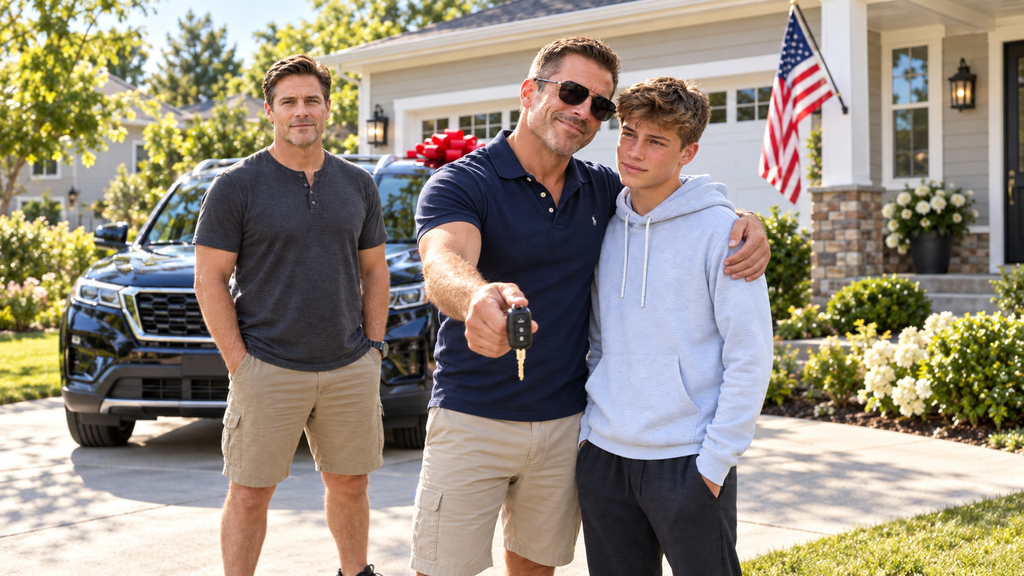
Cara looked from me to Ray and back again like she was trying to figure out whether I was joking.
And my biological father’s smile vanished so quickly it was almost frightening.
“What are you doing?” he demanded.
I turned toward him.
“You bought a car to prove you’re my father.”
Then I looked at Ray.
“He never had to prove anything.”
Ray’s fingers slowly closed around the keys.
His eyes were already shining.
“He showed up every day,” I said. “That’s what a father does.”
My biological father stared at me.
For the first time since arriving, he had absolutely nothing to say.
But I wasn’t finished.
Because there really was one more surprise waiting inside.
And unlike the car sitting in our driveway, that surprise hadn’t been purchased that morning.
It had taken nearly a year to make.
I turned toward the house.
“Come inside.”
My father folded his arms.
“For what?”
“You wanted everyone to know who my real father is.”
I looked directly into his eyes.
“So let’s finish that conversation.”
My mother whispered my name.
There was nervousness in her voice.
Maybe she thought I was about to explode.
Maybe she was afraid fourteen years of anger were finally going to come pouring out in front of everybody.
But I wasn’t angry anymore.
Not in the way I had imagined I would be if I ever saw him again.
When I was younger, I had dreamed about confronting him.
At eight years old, I imagined screaming.
At eleven, I imagined refusing to speak to him.
At thirteen, I imagined becoming so successful that someday he would see my name somewhere and regret leaving.
By seventeen, though, I had learned something.
Sometimes the opposite of love isn’t anger.
Sometimes it is simply understanding that someone no longer has the power to define you.
I walked into the house.
Everyone followed.
Ray came last.
He still had the car keys in his hand.
Mom’s birthday cake was sitting on the kitchen counter.
The candles had already been removed.
There were paper plates beside it and a half-melted tub of ice cream sweating on the counter.
It should have been an ordinary family birthday.
Instead, everyone gathered around our kitchen table while two men stood on opposite sides of the room.
One had given me his DNA.
The other had given me his time.
I walked toward the small cabinet beside the refrigerator.
On the top shelf was a plain brown envelope.
I had hidden it there the night before.
I pulled it out.
Ray frowned.
“What’s that?”
I smiled at him.
“You’ll see.”
My biological father let out a short laugh.
“This is ridiculous.”
I ignored him.
I slid one finger beneath the envelope flap.
Inside were several pieces of paper.
The first was a photograph.
It had been taken seven months earlier.
Ray and I were standing outside the high school gym after one of my basketball games.
We had lost by twelve points.
I had played maybe four minutes.
But you would never have known that from Ray’s face.
In the picture, he had one arm around my shoulders and was grinning like I had scored the winning shot in the state championship.
I placed the photograph on the table.
Then another.
Ray teaching me how to change a tire.
Another.
The two of us painting my bedroom.
Another.
Ray asleep on the couch with my chemistry textbook open on his chest.
Danny had taken that one.
Another.
All five of us crowded around a tiny Christmas tree the previous December because the larger ones had been too expensive.
Another.
Ray standing beside me at my school awards ceremony.
Another.
Ray helping me tie a necktie before my junior formal.
Another.
Ray grilling hamburgers while rain poured down because he had promised us a cookout and refused to cancel it.
There were dozens.
None of them were dramatic.
That was the point.
Fatherhood hadn’t happened to me in dramatic moments.
It had happened in hundreds of ordinary ones.
It was rides home after practice.
It was asking whether I had eaten.
It was leaving the hallway light on when I studied late.
It was reminding me to bring a jacket.
It was pretending not to notice when I took the biggest piece of chicken.
It was knocking before entering my room.
It was listening when I talked.
It was staying.
Ray stared at the photographs.
His lips parted, but nothing came out.
“I started collecting those last year,” I said.
He looked at me.
“Why?”
“Because I knew I wanted to give you something.”
His expression changed.
“Kid, you don’t have to give me anything.”
“I know.”
I swallowed.
“That’s why I wanted to.”
My biological father shifted impatiently.
“So this whole thing is some kind of performance?”
That finally made Mom turn toward him.
“No,” she said quietly.
He looked at her.
Mom’s face had gone pale.
But her voice didn’t shake.
“You arriving after fourteen years with a brand-new car and insulting the man who helped raise your son?”
She pointed toward the driveway.
“That was the performance.”
My father stared at her.
“I came here to do something nice.”
“You came here to be admired.”
“I bought him a car.”
“And?”
Mom’s voice sharpened.
“You think money erases fourteen birthdays?”
He looked annoyed.
“I knew this would happen. You’ve poisoned him against me.”
That sentence hit the room like a slammed door.
Mom took one step backward.
I saw pain flash across her face.
Ray moved slightly toward her.
But I spoke first.
“She never poisoned me against you.”
My father looked at me.
“She barely talked about you at all.”
His expression changed.
I continued.
“When I asked why you weren’t around, she told me adults sometimes make choices children don’t understand.”
Mom looked down.
“She never called you selfish.”
I took another photograph from the envelope.
“She never told me you didn’t care.”
Another photograph.
“She never told me to hate you.”
Another.
“She didn’t have to.”
His jaw tightened.
“You’re seventeen. You don’t understand what happened between your mother and me.”
“You’re right.”
I nodded.
“I don’t.”
For a second, he seemed surprised.
I continued.
“I don’t know every argument you had.”
I looked at Mom.
“I don’t know who said what.”
Then back at him.
“And maybe your relationship ended for reasons I’ll never completely understand.”
I paused.
“But your relationship with Mom ending didn’t require your relationship with me to end.”
Silence.
“You didn’t divorce me.”
He blinked.
“You left me.”
Those three words finally removed the last trace of confidence from his face.
I had imagined saying them for years.
Strangely, they didn’t feel satisfying.
They just felt true.
He looked away.
I reached deeper into the envelope.
There was a folded sheet of paper.
Unlike the photographs, Ray had never seen it.
Neither had Mom.
I unfolded it.
Across the top I had written:
WHAT MAKES SOMEONE A FATHER?
Ray looked at me.
I gave a nervous laugh.
“This is going to sound stupid.”
“No,” Ray whispered.
His voice was already breaking.
“It won’t.”
I looked down at the page.
“I wrote this for an English assignment.”
My teacher had asked us to write about someone who had changed our lives.
Most of the class wrote about athletes, grandparents, teachers, musicians or historical figures.
I had written about Ray.
I hadn’t told him.
I started reading.
“A father is not necessarily the man whose face you inherited.”
My throat tightened immediately.
“A father is the man who learns what scares you.”
Ray lowered his head.
“The man who notices when you are pretending to be okay.”
I continued.
“The man who works all day, comes home tired, and still asks how your game went.”
My voice shook.
“The man who has children of his own but never makes you feel like loving you takes something away from them.”
Danny moved closer to Ray.
Cara slipped her hand into his.
“A father is the man who teaches you things he knows and sits beside you while you learn things he doesn’t.”
Ray laughed through his tears.
“Chemistry,” he whispered.
I laughed too.
“Definitely chemistry.”
Everyone smiled except my biological father.
I returned to the page.
“A father is someone who understands that being present is not one grand gesture.”
“It is ten thousand small ones.”
“It is every ordinary Tuesday.”
“It is every boring ride home.”
“It is every question asked twice because he knows your first answer wasn’t honest.”
“It is standing in the rain beside a soccer field.”
“It is saving five dollars when you barely have five dollars to spare.”
“It is reminding a boy who has spent years wondering why one father left that he must have been worth staying for.”
My voice stopped.
I couldn’t read the next sentence.
The words blurred.
I wiped my eyes.
Ray was crying openly now.
I had never seen him cry before.
Not once.
Even when his father died.
Even when money got so tight the previous winter that he sold his old motorcycle without telling anyone why.
Even when Danny broke his arm falling out of a tree and Ray spent six hours at the emergency room.
He was the kind of man who swallowed his emotions because there was always something else that needed doing.
Now his face had crumbled.
I forced myself to continue.
“The man I call Ray entered my life only one year ago.”
“He did not make me.”
“He did not give me my eyes.”
“He did not give me my hair.”
“He was not there when I was born.”
“But he has spent every day since meeting me showing me what I used to think I had missed.”
I looked directly at him.
“So if anyone ever asks me who my father is, I know what I will say.”
Ray covered his mouth with one hand.
I read the final line.
“I will say his name is Ray.”
Nobody spoke.
I folded the paper carefully.
Then I placed it in front of him.
“That’s your birthday gift.”
He blinked.
“My birthday?”
“Your birthday is in three weeks.”
I shrugged.
“I figured today was close enough.”
That finally made him laugh.
He crossed the room before I could say anything else.
Then his arms were around me.
Ray hugged hard.
Not the awkward one-arm hug we usually did.
Not a quick pat on the shoulder.
He hugged me like he had been holding something inside since the moment he entered our lives.
I buried my face against his shoulder.
For one strange second, I was three years old again.
Except this time, somebody was holding on.
Ray whispered something only I heard.
“I’m not going anywhere.”
Four words.
That was all.
But I think some sentences arrive years after you need them and somehow still manage to heal something.
I nodded against his shoulder.
When we finally separated, his face was red.
He wiped his eyes.
“You’re still not giving me that car.”
Everybody laughed.
Even Mom.
I shook my head.
“I’m serious.”
“So am I.”
He looked toward the keys in his hand.
“This belongs to you.”
“I don’t want it.”
Ray studied me.
“You might feel differently tomorrow.”
“I won’t.”
“Next month?”
“No.”
“Next year?”
“No.”
He smiled faintly.
“You’re stubborn.”
“Learned it from you.”
“That is absolutely your mother’s fault.”
Mom threw a napkin at him.
For the first time since my biological father had arrived, the tension broke.
It lasted maybe three seconds.
Then he spoke.
“This is unbelievable.”
We all turned.
He stood near the kitchen doorway, arms folded, face flushed.
It occurred to me then that everything about this moment had gone differently than he expected.
He had imagined driving up in a new car.
He had imagined me shouting.
Maybe hugging him.
Maybe telling everyone how incredible he was.
He had probably rehearsed that line about my “real father.”
He probably thought Ray would shrink.
That Mom would be impressed.
That I would be overwhelmed.
Instead, the most expensive object in the driveway had become the least important thing in the house.
“You’ve known this man for one year,” my biological father said.
I nodded.
“Yes.”
“And you’re standing there acting like he raised you.”
“I didn’t say he raised me.”
I pointed toward Mom.
“She did.”
Mom’s eyes filled.
“She raised me for fourteen years while you were gone.”
He looked irritated.
“I sent money.”
I froze.
Mom’s face changed.
Ray looked at her.
My father noticed.
“There,” he said. “Funny how nobody mentions that.”
I turned toward Mom.
“Did he?”
She hesitated.
That hesitation told me there was more to the story.
“Mom?”
She exhaled slowly.
“Sometimes.”
My father threw his hands up.
“Exactly.”
Mom looked at him.
“You sent money six times.”
He went quiet.
“In fourteen years,” she continued.
“Six.”
His mouth tightened.
“I wasn’t exactly rich.”
“Neither was I.”
“I had problems.”
“So did we.”
“I was trying to get my life together.”
“For fourteen years?”
Her question hung in the room.
He looked toward the window.
Mom continued.
“The first payment came when he was five.”
She nodded toward me.
“One hundred dollars.”
I had never known any of this.
“The second came almost two years later.”
She swallowed.
“Three hundred.”
My father muttered something.
Mom kept going.
“The largest amount you ever sent was eight hundred dollars.”
She looked at him.
“You called me the next morning and asked if I had told him it came from you.”
He didn’t answer.
“I said no because he was nine years old and needed school clothes, not another reason to sit beside the window waiting for you.”
My chest hurt hearing that.
I remembered being nine.
I remembered asking why Mom suddenly let me buy new shoes instead of used ones.
I remembered how happy she looked when I found a pair on sale.
I hadn’t known any of it was connected to him.
My father looked at me.
“I did what I could.”
I shook my head.
“No.”
His eyes narrowed.
“You did what you wanted.”
“That’s not fair.”
“You were gone.”
“You don’t know anything about my life.”
“That’s true.”
I nodded.
“And whose fault is that?”
He fell silent.
I continued.
“I don’t know where you lived.”
“I don’t know what jobs you had.”
“I don’t know who your friends are.”
“I don’t know what you did on weekends.”
“I don’t know whether you drink coffee or tea.”
“I don’t know your favorite movie.”
“I don’t even know your middle name.”
His face shifted.
“My middle name is Thomas.”
I almost laughed.
Not because it was funny.
Because there was something incredibly sad about learning my father’s middle name seventeen years into my life while standing beside a half-eaten birthday cake.
“Okay.”
I nodded.
“Thomas.”
He looked wounded.
And for the first time, I realized something else.
He had probably imagined this reunion too.
Maybe not every day.
Maybe not for fourteen years.
But enough.
Perhaps in his version, the expensive gift opened the door.
Maybe we went for a drive.
Maybe I called him Dad before sunset.
Maybe we made up for fourteen years during one birthday.
But time doesn’t work like that.
You can’t return to an abandoned relationship and continue from where you left it.
The child grows.
The empty chair gets filled.
The questions eventually stop being asked.
People adapt around the absence.
And sometimes when the person returns, they discover there is no empty space waiting for them.
My biological father glanced at the photographs spread across the table.
Then his eyes landed on the essay.
His expression hardened again.
“This guy has been around for a year and suddenly I’m nothing?”
I sighed.
“This isn’t about making you nothing.”
“It sure feels like it.”
“You made yourself absent.”
“I came back.”
“Today.”
“I’m here now.”
“Why?”
He opened his mouth.
Then closed it.
I asked again.
“Why today?”
“It’s your birthday.”
“You knew my birthday last year.”
He looked away.
“And the year before that.”
No answer.
“And the year before that.”
He rubbed his jaw.
“I wasn’t ready.”
“For what?”
“To see you.”
I nodded slowly.
“At least that’s honest.”
He looked surprised.
I pulled out a chair and sat down.
The anger inside me had become something else.
Curiosity.
Sadness.
Maybe even pity.
Not enough to erase anything.
But enough to want the truth.
“So why now?”
He stared at the floor.
Mom started gathering the photographs.
Ray gently stopped her.
“Leave them.”
My father looked at the three of us.
Then at Danny and Cara.
Finally, he pulled out the chair across from me and sat.
For the first time that day, he didn’t look confident.
He looked old.
Not physically old.
He was only in his early forties.
But suddenly I could see the years.
The tiredness around his eyes.
The gray beginning at his temples.
The lines beside his mouth.
He rested his elbows on his knees.
“My mother died four months ago.”
I blinked.
I had never met my grandmother on his side.
I barely knew anything about her.
Mom sat down beside me.
My father continued.
“She kept asking about you.”
His voice was quieter now.
“Even near the end.”
He rubbed his hands together.
“She had pictures.”
“What pictures?”
“The ones your mother sent when you were little.”
I turned toward Mom.
She looked uncomfortable.
“You sent pictures?”
“For a few years.”
“To him?”
“To your grandmother.”
“Why didn’t you tell me?”
“Because she loved you.”
Mom glanced toward him.
“Whatever happened between your father and me, I wasn’t going to punish his mother for it.”
That was exactly the kind of thing Mom would do.
Quietly.
Without asking for credit.
My biological father stared at the floor.
“She had your kindergarten picture framed.”
He gave a small, humorless laugh.
“The one where you were missing two front teeth.”
I remembered that photograph.
“She kept telling me to call you.”
He swallowed.
“I kept saying I would.”
His eyes finally met mine.
“Tomorrow.”
“Next week.”
“After work calmed down.”
“When I had more money.”
“When I had something worth telling you.”
He paused.
“And then fourteen years were gone.”
Nobody interrupted.
“At the hospital, Mom asked me one more time.”
His voice cracked slightly.
“She said, ‘Do you even know what kind of person your son became?’”
He looked at me.
“And I realized I didn’t.”
I felt something twist inside my chest.
Not forgiveness.
Not yet.
Maybe not ever in the way people imagine forgiveness.
But understanding.
He continued.
“After she died, I found a box.”
“What box?”
“She had kept everything.”
He laughed faintly.
“Every school picture.”
“Every Christmas card.”
“Every note your mother sent.”
“She even had a newspaper clipping from when your middle school team won some tournament.”
I knew which one.
I had scored two points the entire tournament.
Ray probably would have been proud anyway.
My father looked toward me.
“I spent one night going through everything.”
He inhaled.
“And I realized your entire childhood existed in that box.”
His voice lowered.
“And I wasn’t in any of it.”
Nobody said anything.
For a moment, I could see the pain in him.
Real pain.
The type money can’t fix.
The type that arrives when time has already taken something you cannot purchase back.
“I thought the car would help,” he admitted.
Ray finally spoke.
“You thought a car would replace fourteen years?”
My father looked at him sharply.
“I wasn’t talking to you.”
Ray didn’t react.
That calm made my biological father even angrier.
“I’m his father.”
Ray nodded.
“Biologically, yes.”
My father stood so quickly the chair scraped across the floor.
“You think you can walk into his life and replace me?”
Ray remained seated.
“No.”
His voice stayed calm.
“You did the walking out.”
That sentence silenced everyone.
My biological father’s hands clenched.
Ray continued.
“I never tried to replace you.”
He pointed at me.
“When I met him, he was sixteen.”
“He already had a mother.”
“He already had a history.”
“He already had questions I couldn’t answer.”
“I didn’t ask him to call me Dad.”
“I never told him what to think about you.”
Ray leaned back.
“I took him to practice because he needed a ride.”
“I helped with homework because he asked.”
“I showed up because I told him I would.”
“That’s it.”
My father stared at him.
Ray’s voice softened.
“If that feels like competition to you, then maybe you’re angry at the wrong person.”
My father looked away.
Nobody had raised their voice.
Nobody had insulted him.
And somehow that seemed to hurt him more than shouting would have.
He sat down again.
I stared at my birthday cake.
Seventeen candles had been removed only half an hour earlier.
I thought about all the birthday wishes I had made as a child.
When I was six, I wished for a bicycle.
When I was eight, I wished for a puppy.
When I was ten, I wished Mom would get a better job so she would stop looking worried every time she opened the mailbox.
When I was twelve, I wished my biological father would call.
I remembered that one clearly.
I didn’t tell anyone.
I blew out the candles and waited all day.
Every time the phone rang, my heart jumped.
At midnight, I told myself maybe he had forgotten the time difference.
The next morning, I stopped waiting.
I looked at him now.
“Do you know what I wanted for my twelfth birthday?”
He shook his head.
“You.”
His face changed.
“I wanted one phone call.”
I smiled sadly.
“Funny, right?”
I pointed toward the driveway.
“That car probably cost more than Mom made in a year when I was little.”
He looked down.
“But at twelve, I would’ve traded it for a ten-minute phone call.”
His eyes filled.