 Reading Time: 38 minutes
For several seconds, nobody moved. The neighborhood around us was completely quiet. A sprinkler clicked somewhere across the street.
A dog barked two houses away. Natalie stood just behind my shoulder. Mom gripped Dad’s arm. “What is it?” she demanded again.
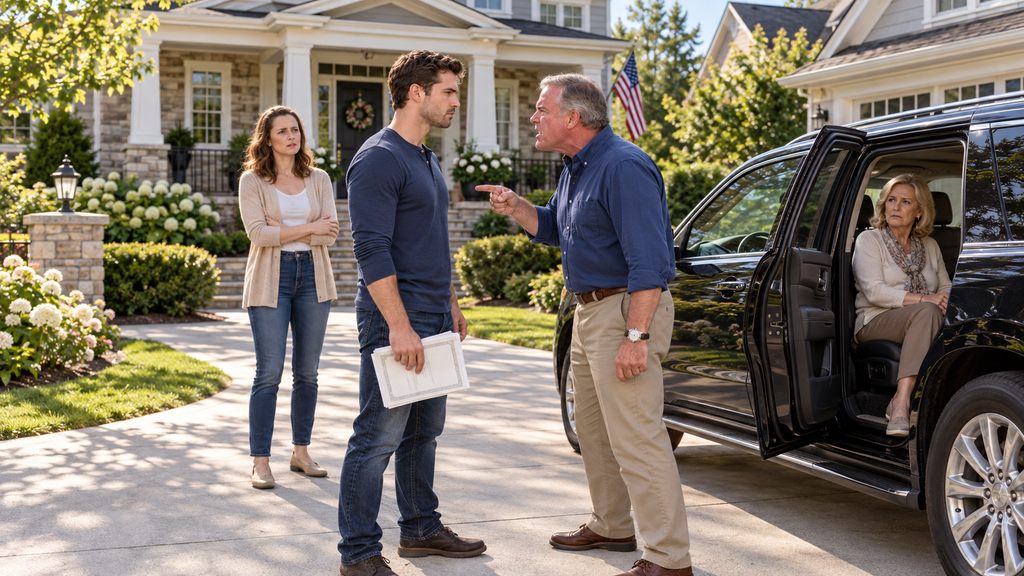
Dad didn’t answer her.
He just kept reading.
His mouth opened slightly.
Then closed.
Finally, he looked at me.
“You can’t do this.”
His voice had changed.
The anger was still there, but underneath it was something I had almost never heard from my father.
Fear.
I looked at the envelope in his hands.
“Yes,” I said quietly. “I can.”
Mom snatched the document from him.
Her eyes flew across the first page.
Then the second.
I watched the exact moment she understood.
“This is a threat.”
“No,” I said.
“It’s a boundary.”
She looked up.
“What is a partition action?”
Dad answered before I could.
“It means he’s trying to force us to sell the house.”
Mom’s head snapped toward me.
“You’re selling our home?”
“I’m giving you thirty days to refinance it and remove me completely.”
“You know we can’t qualify for that mortgage!”
“Yes.”
The word seemed to hit harder than yelling would have.
For years, that sentence had controlled me.
You know we can’t afford it.
You know Dad’s credit isn’t good enough.
You know Mom isn’t working enough hours.
You know the insurance went up.
You know the taxes increased.
You know the furnace broke.
You know family helps family.
Every emergency somehow ended at my bank account.
Every problem somehow became my responsibility.
And every time I tried to question it, I was reminded that without me, everything might collapse.
Standing in my driveway that afternoon, I finally understood something.
Maybe that was exactly why it needed to.
Not because I wanted my parents to suffer.
Because a life that could survive only by draining mine wasn’t sustainable.
Mom shook the papers at me.
“You would throw your own parents into the street?”
“No.”
“That is exactly what this says!”
“No, Mom. It says you have thirty days to talk to my attorney and either arrange a buyout, refinance the property, or begin discussing a sale.”
“A sale?”
Her voice cracked.
“You grew up in that house.”
“I know.”
“Your bedroom is still there.”
“No, it isn’t.”
She blinked.
“What?”
“You turned it into Aunt Lisa’s craft room six years ago.”
Natalie made a tiny sound behind me.
Not quite a laugh.
Not quite a gasp.
Mom stared at me.
“That’s not the point.”
“It actually is.”
I stepped closer.
“You keep talking about that house like it’s some sacred symbol of our family. But every time I look at it, I remember the first night you called me crying because the bank was going to start foreclosure proceedings.”
Dad looked away.
“I remember driving four hours after work because you said you needed me there.”
Neither of them spoke.
“I remember sitting at your kitchen table until almost two in the morning while Dad blamed the economy, the bank, his old employer, the interest rate, and everyone else.”
“That was a difficult year,” Mom said.
“It was.”
I nodded.
“For me too.”
She frowned.
“You were doing fine.”
That sentence almost made me laugh.
Doing fine.
I had been twenty-five.
Living in a one-bedroom apartment.
Working fifty-hour weeks.
Trying to build savings.
Trying to pay down student loans.
Trying to establish a life of my own.
And because I wasn’t drowning loudly enough, my parents had decided I was doing fine.
“I emptied most of my savings to stop the foreclosure,” I said.
“We paid some of that back,” Dad muttered.
“No. You didn’t.”
His eyes returned to mine.
“I have the records.”
Mom looked between us.
“Why are you doing this now?”
That question surprised me.
Not because I didn’t know the answer.
Because somehow she genuinely seemed confused.
“Why now?”
“Yes!”
Her voice rose.
“You’ve been helping us for years! Nobody forced you!”
Natalie’s hand moved gently against my back.
She didn’t speak.
She never had to.
I looked at my mother.
“You’re right.”
Her expression changed slightly.
“You didn’t force me.”
Dad folded his arms.
“Exactly.”
“I kept choosing to help because I believed if I did enough, eventually I would matter to you as much as everyone I was helping you impress.”
Mom’s face tightened.
“Oh, for heaven’s sake.”
And there it was.
The dismissal.
The familiar eye roll.
The subtle suggestion that any feeling I had was simply an inconvenience she needed to survive until I became reasonable again.
But something was different now.
I noticed it.
Instead of doubting myself, I noticed her doing it.
That was new.
I continued.
“When you needed mortgage money, I mattered.”
Mom sighed.
“When the electric bill was late, I mattered.”
“Connor—”
“When Dad’s truck needed repairs, I mattered.”
Dad stepped forward.
“Watch your tone.”
I stared at him.
“When your phone bill was due, I mattered.”
“Enough.”
“When you wanted me to guarantee a loan, I mattered.”
“I said enough!”
“But when I asked you to sit in the front row while I married the person I love…”
My throat tightened.
For the first time since they arrived, I had to stop.
Natalie slipped her hand into mine.
I squeezed it.
Then I looked at my parents.
“You picked a baby shower.”
Mom’s lips pressed together.
“It was family.”
“So was my wedding.”
“A baby is different.”
“How?”
“A first child is a once-in-a-lifetime thing.”
I actually smiled.
Not because it was funny.
Because I had finally heard the absurdity clearly enough that it couldn’t hurt the same way anymore.
“My wedding was also a once-in-a-lifetime thing.”
“You could have another wedding someday.”
Natalie went completely still beside me.
Dad immediately looked at Mom.
Even he knew.
Mom realized what she had said a second too late.
“I didn’t mean—”
“Yes, you did.”
My voice stayed calm.
“You’ve been waiting for my marriage to fail since before it started.”
“That is not true.”
“You told me Natalie didn’t fit our family.”
“I said I had concerns.”
“You called her ‘that girl’ for two years.”
“She was changing you.”
I nodded.
“She was.”
Mom looked almost triumphant.
Then I finished.
“She taught me that someone can love me without needing me to pay for the privilege.”
Silence.
Complete silence.
Mom’s face changed.
Dad looked down.
Behind me, Natalie inhaled sharply.
I hadn’t planned to say it.
But the second the words came out, I knew they were true.
For years, I had been useful.
Dependable.
Responsible.
Generous.
The son everybody called when something went wrong.
But I had confused usefulness with belonging.
And the wedding finally broke that illusion.
Mom looked at the legal notice again.
“So this is revenge.”
“No.”
“What else would you call it?”
“Ending an arrangement that never should have lasted this long.”
“You want to destroy us.”
“I want my name off your life.”
She flinched.
Maybe that sounded cruel.
But it was the cleanest sentence I had ever spoken.
My name was on their mortgage.
Their electricity.
Their phone bill.
Their insurance payment.
Their streaming subscriptions.
Their emergency credit card.
For years, my name had been attached to pieces of their survival.
But when I married Natalie, they couldn’t even attach their names to a wedding card.
Dad pointed at me.
“You’re going to regret this.”
“Maybe.”
“You think that woman is going to stay forever?”
Natalie stiffened.
I stepped between them.
“Do not speak about my wife like that.”
Dad laughed bitterly.
“Your wife. You’ve known her what, three years? We raised you.”
“And somehow she knows how to treat me better than the people who raised me.”
His face hardened.
“That’s enough.”
“No, Dad.”
I shook my head.
“It’s finally enough.”
He stared at me.
For years, those words from him had ended conversations.
That’s enough.
Stop talking.
Don’t disrespect your mother.
Family doesn’t keep score.
You’re being dramatic.
Let it go.
But not this time.
Dad shoved the legal notice into his pocket.
“We’ll fight you.”
“Then fight me.”
“You think some lawyer is going to scare us?”
“No.”
I met his eyes.
“I think the bank records will.”
His jaw shifted.
“And the deed.”
Mom suddenly looked at Dad.
“What does he mean?”
Dad didn’t answer.
I did.
“Do you remember the refinance documents from eight years ago?”
“Of course.”
“Do you remember why the bank required my name on the title?”
Mom hesitated.
“You were helping.”
“Yes.”
Dad interrupted.
“That doesn’t mean the house is yours.”
“I didn’t say it was.”
“Then stop pretending.”
“I’m not pretending anything.”
I pointed toward the papers.
“My attorney pulled the recorded deed. I’m a legal co-owner.”
Mom looked stunned.
I continued.
“Not just a co-signer on the loan. A recorded owner.”
“That was paperwork,” she said quickly.
“No.”
“Yes, it was! The bank needed your name!”
“And both of you signed the deed.”
Dad shook his head.
“You knew that house belonged to us.”
“I knew I was rescuing it.”
“There’s a difference!”
“Yes.”
I nodded.
“There is.”
That seemed to confuse him.
I stepped closer.
“You know what else my attorney found?”
Neither answered.
“The email you sent me the night before closing.”
Dad’s face went blank.
I could almost see him searching his memory.
I remembered every word.
He apparently didn’t.
So I reminded him.
“You wrote, ‘We can’t do this without you. You’ll be part owner, and someday all of this will come back to you anyway.’”
Mom’s eyes slowly moved toward him.
Dad said nothing.
“I saved that email.”
“That doesn’t prove anything.”
“Maybe.”
I shrugged.
“That’s what courts are for.”
The word courts changed the temperature of the driveway.
Until that moment, they had behaved as if this were still a family argument.
A disagreement they could win with enough guilt.
Enough shouting.
Enough pressure.
But paperwork doesn’t care who raised their voice.
Bank records don’t feel guilty.
Recorded deeds don’t get tired of arguing.
And judges don’t care who ruined Thanksgiving in 2017.
Dad knew that.
His voice dropped.
“What exactly do you want?”
Finally.
Not what’s wrong with you?
Not how could you?
Not what did Natalie do?
What do you want?
I had spent thirty-two years answering that question with whatever caused the least trouble.
That day, I knew.
“I want out.”
He frowned.
“Out of what?”
“Everything financial.”
Mom stared at me.
“No more mortgage.”
“No.”
“No utilities?”
“No.”
“What about the phone plan?”
“No.”
“Property taxes?”
“No.”
Dad scoffed.
“You expect us to suddenly cover all of that?”
“Yes.”
“How?”
“I don’t know.”
“You don’t know?”
“No.”
My voice remained steady.
“And for the first time, I understand that I don’t need to.”
Mom looked as though I had slapped her.
She turned toward Natalie.
“Are you proud of yourself?”
Natalie finally spoke.
Her voice was gentle.
Almost painfully gentle.
“I wish none of this were happening.”
Mom laughed bitterly.
“Of course.”
“But I’m proud of Connor for finally saying what he needs.”
“There it is.”
Mom pointed at her.
“She’s been planning this.”
“No,” Natalie said.
“You wanted our house.”
“I have never asked Connor for your house.”
“You wanted our money.”
At that, Natalie actually blinked.
Then she looked at me.
Then back at Mom.
“What money?”
I almost choked.
Even Dad looked embarrassed.
Mom’s face flushed.
Natalie immediately shook her head.
“I’m sorry. That came out wrong.”
“It came out exactly right,” Dad snapped.
“No,” she said calmly. “What I mean is, Connor has spent years supporting you. We paid for part of our wedding ourselves while he was still paying expenses at your house. I have never asked him to take anything from you.”
Mom crossed her arms.
“You think you’re better than us.”
“No.”
Natalie’s voice softened.
“I think your son deserved to have his parents at his wedding.”
For the first time, Mom had no immediate response.
Natalie continued.
“That’s the part I don’t understand.”
Her eyes were shining now.
“Connor didn’t ask you to pay for anything.”
Mom looked away.
“He didn’t ask you to organize anything.”
Silence.
“He didn’t even ask you to buy your own plane tickets.”
Dad’s shoulders dropped slightly.
“He paid for everything because he wanted you there.”
Natalie swallowed.
“And then, after you didn’t come, he spent part of our wedding night checking his phone because I could tell he was hoping you would at least send a message.”
I looked at her.
I hadn’t realized she noticed that.
Of course she had.
She noticed everything.
Natalie looked directly at Mom.
“You didn’t.”
Mom’s face finally cracked.
Only slightly.
But I saw it.
Natalie continued.
“Not ‘congratulations.’”
She shook her head.
“Not ‘we’re sorry.’”
Another pause.
“Nothing.”
Mom opened her mouth.
Natalie stopped her.
“And the next morning, your first concern was the mortgage.”
Nobody spoke.
I felt something inside my chest loosen.
Not disappear.
Just loosen.
Dad finally turned toward the car.
“Come on.”
Mom remained where she was.
“Richard—”
“We’re leaving.”
She looked at me.
“You’re really doing this?”
“Yes.”
Her eyes searched my face.
Maybe she was looking for the old Connor.
The one who would see her distress and immediately fix it.
The one who could be called selfish until he became generous again.
The one who would rather hurt himself than watch his parents struggle.
That Connor was still somewhere inside me.
But he was exhausted.
And for once, I didn’t force him back to work.
Mom climbed into the passenger seat.
Dad walked around the vehicle.
Before getting in, he looked at me one last time.
“You have no idea what you’re starting.”
I shook my head.
“No.”
Then I looked at Natalie.
“I know what I’m ending.”
Dad slammed the door.
They drove away.
I stood in the driveway until their car disappeared.
Then my knees nearly gave out.
Natalie caught my arm.
“Connor.”
“I’m okay.”
“You don’t have to be.”
That sentence did it.
I sat down on the front steps.
And for the first time since my wedding, I cried.
Not because I wanted the house.
Not because of the money.
Not even because I was afraid of what my parents might do next.
I cried because some ridiculous part of me had believed that if I finally explained everything correctly, they might understand.
That they might look at me and say:
We hurt you.
We were wrong.
We should have been there.
Instead, they had driven hundreds of miles to demand a signature.
Not an apology.
A deed.
Natalie sat beside me.
For several minutes, neither of us spoke.
Eventually, I whispered:
“I hate that this hurts.”
She leaned her head against my shoulder.
“Of course it hurts.”
“I thought I’d feel relieved.”
“You can feel both.”
I nodded.
That became the theme of the next six months.
Relief and grief.
Freedom and guilt.
Peace and chaos.
All at the same time.
Three days after the driveway confrontation, my parents hired an attorney.
Their first letter accused me of attempting to “wrongfully appropriate family property.”
My attorney, Melissa Grant, read the sentence twice and raised one eyebrow.
We were sitting in her office downtown.
“You have every payment record?”
“Almost every one.”
“How far back?”
“Seven years electronically. Older statements are archived, but the bank is retrieving them.”
“Property taxes?”
“I paid most years.”
“Insurance?”
“Me.”
“Major repairs?”
I pulled another folder from my bag.
“Roof.”
She opened it.
“Fourteen thousand?”
“Yes.”
“HVAC?”
“Six thousand eight hundred.”
“Foundation work?”
“Eleven thousand.”
Her eyebrows rose.
“What exactly did your parents pay?”
I leaned back.
“That’s complicated.”
“It usually is.”
Melissa wasn’t cold.
But she had the kind of calm that made emotional people nervous.
She dealt in documents.
Dates.
Signatures.
Amounts.
The exact opposite of how my family operated.
That was probably why I liked her.
She tapped the deed.
“You’re not the sole owner, Connor.”
“I know.”
“And I’m not going to tell you that paying more automatically means you own more. Property law is more complicated than that.”
“I understand.”
“But you are on the recorded title.”
“Yes.”
“And you are liable on the loan.”
“Yes.”
“And based on what I’ve seen, there’s substantial equity.”
I nodded.
“How much do you actually want from this?”
The question made me uncomfortable.
“I don’t know.”
“Then figure that out before this gets expensive.”
“I don’t want to destroy them.”
“Good.”
She folded her hands.
“Because revenge is expensive.”
I looked at her.
“What I want is to stop paying.”
“That part is easy.”
She pointed toward me.
“You can stop voluntarily paying expenses that aren’t legally required of you personally.”
Then she pointed at the mortgage statement.
“This part is not as easy.”
I knew.
As long as my name remained on the mortgage, missed payments could still damage me.
That was the trap.
I could cancel their phone bill.
Remove my card from the electric company.
Stop paying cable.
But if my parents stopped paying the mortgage simply to punish me, the bank wouldn’t care about our family history.
My credit would suffer too.
Melissa nodded toward the papers.
“That’s why we either need them to refinance, buy you out, sell voluntarily, or ultimately ask the court to resolve the ownership.”
I rubbed my face.
“They’ll never agree to sell.”
“Maybe.”
“You didn’t see my mother.”
“I’ve met many people who say they’ll never sell something.”
She leaned back.
“Banks and judges have a remarkable ability to make the word never more flexible.”
Despite everything, I laughed.
Then she became serious.
“There’s something else.”
“What?”
“If they’re threatening legal action, stop communicating by phone.”
“They call constantly.”
“Don’t answer.”
“Text?”
“Save everything.”
“I already am.”
“Good.”
She pointed toward me.
“And stop explaining yourself.”
That hit me harder than I expected.
“What do you mean?”
“You seem like someone who thinks if you find the perfect paragraph, unreasonable people will become reasonable.”
I stared at her.
Melissa smiled faintly.
“I’ve been practicing family-related property law for eighteen years.”
She tapped the file.
“You’re not unique.”
I looked down.
“What should I say?”
“Nothing unless necessary.”
“That feels rude.”
“It will.”
She paused.
“Especially if you’ve spent your life being trained to mistake boundaries for cruelty.”
I left her office thinking about that sentence.
My parents’ lawsuit arrived twelve days later.
They claimed my name had been placed on the deed only for financing purposes.
They claimed everyone involved understood the property was theirs.
They claimed I had never expected ownership.
They claimed my financial contributions were gifts.
That word appeared repeatedly.
Gifts.
Mortgage gifts.
Repair gifts.
Tax gifts.
Insurance gifts.
Apparently, tens of thousands of dollars had become gifts simply because nobody had written “please repay me” on every check.
Dad called twice after the filing.
I didn’t answer.
Mom sent seventeen messages.
Most were variations of the same idea.
How could you do this to us?
Your grandparents would be ashamed.
Family isn’t a business transaction.
Natalie has poisoned you.
Someday you’ll understand what you’ve done.
Then came the one that almost broke me.
I hope when you have children, they treat you exactly the way you’re treating us.
I stared at that message for a long time.
Then Natalie gently took the phone from my hand.
“Don’t.”
“What?”
“Don’t answer while you’re hurt.”
I stood at our kitchen counter.
“I want to tell her if we ever have children, I hope they never feel responsible for keeping me financially alive.”
Natalie’s expression softened.
“That would probably be true.”
“I want to tell her I hope our kids never have to buy our approval.”
“That too.”
“I want to tell her—”
She took my hand.
“I know.”
I breathed slowly.
Then I deleted the reply I had started.
Not the message.
Just my response.
Melissa had been right.
I didn’t need the perfect paragraph.
The truth didn’t become more true because I explained it twenty times.
The legal process moved painfully slowly.
There were document requests.
Bank statements.
Mortgage records.
Tax receipts.
Emails.
Texts.
Closing documents.
Every year of my financial relationship with my parents seemed to end up printed on white paper.
Seeing it all together was disturbing.
One Friday afternoon, Melissa called.
“You should come in.”
“What happened?”
“I received their financial disclosures.”
Something in her voice made me sit up.
“Is it bad?”
“It’s interesting.”
An hour later, I sat across from her.
She slid a stack of documents toward me.
“Your parents say they can’t afford the mortgage without you.”
“I know.”
“Do you know why?”
“Because Dad’s retirement isn’t enough and Mom only works part-time.”
Melissa gave me a look.
“What?”
She turned the paperwork around.
My eyes landed on a number.
Then another.
Then another.
I frowned.
“What am I looking at?”
“Your father’s retirement account.”
I stared.
“That can’t be right.”
“It appears to be.”
The balance was significantly higher than I expected.
Not millionaire money.
But enough.
More than enough that I couldn’t understand why I had spent years paying their utilities.
I looked up.
“There’s more.”
She handed me another page.
A brokerage account.
Then another.
A savings account.
Then a statement for a recreational vehicle loan.
I stared.
“They bought an RV?”
“Apparently.”
“When?”
“Four years ago.”
I felt sick.
Four years ago.
The same year Mom called me crying because their property tax bill had increased.
The same year I canceled a vacation with friends because I told myself my parents needed help more.
“How much?”
Melissa pointed.
Forty-three thousand dollars financed.
I read the statement twice.
Then again.
“They told me that belonged to Uncle Mike.”
“Maybe your uncle has an extremely generous habit of parking his recreational vehicle in your parents’ name.”
I closed my eyes.
Another statement showed payments to a country club.
Not a glamorous one.
But still.
Monthly dues.
For three years.
I thought about all the times Dad had complained that retirement meant “living on scraps.”
I thought about the electric bill I paid.
The insurance.
The roof.
The phone plan.
The mortgage.
Then Melissa slid one final sheet toward me.
This one hurt differently.
Regular monthly transfers.
From my parents’ checking account.
To my brother.
I looked at the amount.
“Evan?”
Melissa nodded.
My younger brother.
The one who came to my house and told me Mom and Dad couldn’t afford everything without me.
I followed the dates.
Five hundred dollars.
Seven hundred.
Four hundred.
Sometimes a thousand.
Month after month.
While I was paying my parents’ mortgage, my parents were sending money to my brother.
I felt something cold settle in my stomach.
“He knew.”
“I don’t know.”
“He came to my house.”
“Connor.”
“He told me they couldn’t survive without me.”
Melissa pushed the papers slightly closer.
“Ask him.”
I called Evan from the parking lot.
He answered on the third ring.
“Hey.”
“Did Mom and Dad send you money every month?”
Silence.
That was enough.
I closed my eyes.
“How long?”
“Connor—”
“How long?”
He sighed.
“A few years.”
I gripped the steering wheel.
“How many?”
“I don’t know. Three? Four?”
“While I was paying their mortgage?”
“It wasn’t like that.”
“What was it like?”
“They were helping with the kids.”
Evan had two daughters.
My nieces.
I loved them.
That wasn’t the point.
“With what?”
“Daycare. Some school stuff.”
“You told me they couldn’t afford their bills.”
“They can’t.”
“They have investment accounts.”
Another silence.
“You knew about those too?”
“I knew Dad had retirement savings.”
“And the RV?”
“It’s not worth what they paid for it.”
I almost laughed.
“That isn’t what I asked.”
“Connor, calm down.”
There it was again.
Calm down.
The phrase people use when your reaction is becoming inconvenient.
“I canceled my honeymoon upgrade because Mom called me crying about the property taxes.”
“I didn’t know that.”
“I spent thousands fixing their roof.”
“I know.”
“I paid their electric bill while they were paying country club dues.”
Evan said nothing.
“I paid their mortgage while they were sending you money.”
“It wasn’t that much.”
I laughed.
I couldn’t help it.
“It wasn’t that much?”
“Mom said you earned way more than I do.”
“So?”
“So they thought it made sense.”
I stopped laughing.
There it was.
The family equation.
My success didn’t belong to me.
It was excess.
Available inventory.
Because I earned more, my money hurt less to lose.
Because I didn’t have children yet, my expenses were less legitimate.
Because I was responsible, I required less care.
And because I had always said yes, everyone had gradually forgotten I was allowed to say no.
“Did you know they were skipping my wedding?”
Evan went quiet.
I already knew the answer.
“Evan.”
“Yes.”
My chest tightened.
“When?”
“A week before.”
“You knew a week before my wedding?”
“Yes.”
“And you didn’t tell me?”
“Mom told me not to get involved.”
I stared through the windshield.
People walked past my car carrying shopping bags.
A woman laughed into her phone.
Somewhere nearby, a car alarm chirped.
Normal life continued while something inside me quietly collapsed.
“You stood next to me at my wedding.”
“I know.”
“You saw those empty chairs.”
“I know.”
“And you knew.”
“I didn’t know what to say.”
“You could have said, ‘Connor, they told me they’re not coming.’”
“I thought maybe they’d change their minds.”
“They didn’t.”
“I know.”
“Did you go to the baby shower?”
“No.”
That surprised me.
“Why not?”
“Because I thought what they were doing was messed up.”
I almost shouted.
“Then why did you come to my house afterward defending them?”
He didn’t answer.
“Evan?”
“Because Mom asked me to.”
I closed my eyes.
Of course.
Of course she did.
He continued quickly.
“She was panicking, Connor. The payments stopped, Dad was furious, and she kept saying Natalie was going to convince you to sell the house.”
“So you came to pressure me.”
“I came to talk.”
“No. You came to pressure me because that was easier than telling them to face the consequences of their choices.”
“That’s not fair.”
“It’s completely fair.”
I paused.
Then I asked the question I suddenly needed answered.
“Why did they really skip the wedding?”
He went silent.
My grip tightened.
“Evan.”
“I don’t know.”
“You do.”
“I know what Mom said.”
“What?”
He hesitated.
“Connor…”
“What did she say?”
He exhaled.
“She said if they went, it would look like they approved.”
I felt my stomach turn.
“Approved of what?”
“Your marriage.”
I laughed once.
It sounded hollow.
“That’s it?”
“She thought if they didn’t go, you’d finally realize how serious they were.”
I couldn’t speak.
Evan continued.
“She thought you might postpone.”
I stared at nothing.
“She thought I would cancel my wedding?”
“Or at least rethink it.”
“Because they didn’t show up?”
“She said you’ve always cared about keeping the family together.”
That sentence landed differently than everything else.
They hadn’t simply chosen the baby shower.
The baby shower had been convenient.
Maybe even real.
But underneath it, they believed their absence would punish me.
Pressure me.
Teach me.
They thought the empty chairs would become leverage.
They assumed that if they withheld themselves, I would crawl back.
And maybe the worst part was that five years earlier, three years earlier, even one year earlier…
They might have been right.
I would have chased them.
Apologized for making things tense.
Begged them to reconsider.
Asked Natalie to be more patient.
More forgiving.
Less sensitive.
I would have sacrificed peace just to keep the illusion of family intact.
But I wasn’t that person anymore.
“Thanks for telling me,” I said.
“Connor, wait.”
“What?”
“I’m sorry.”
I looked out the window.
“For what part?”
He didn’t answer.
“That’s what I thought.”
I ended the call.
For two weeks, Evan and I didn’t speak.
Then something unexpected happened.
He called again.
“I need to show you something.”
“What?”
“I found messages.”
My heartbeat changed.
“Messages from who?”
“Mom.”
That evening, he came to my house.
He looked exhausted.
Natalie made coffee and then quietly went upstairs, giving us space.
Evan sat at my kitchen table.
For a minute, neither of us said anything.
Then he unlocked his phone.
“I went back through old texts.”
He slid it toward me.
The messages were from months before the wedding.
Mom to Evan.
Connor is getting too serious about Natalie.
Another.
Once he marries her, she’ll control everything.
Another.
We need to make him understand family comes first.
I kept scrolling.
Then I found one from three weeks before the wedding.
Aunt Lisa moved the baby shower to that weekend. Perfect excuse.
My hand stopped.
I looked at Evan.
“What does this mean?”
He rubbed his face.
“I called Aunt Lisa.”
My voice dropped.
“And?”
“She didn’t move it.”
I stared at him.
“What?”
“The baby shower had always been scheduled for that Saturday afternoon.”
“That’s the wedding day.”
“Yes.”
“Mom knew?”
“Yes.”
“From when?”
“Almost four months before.”
My throat tightened.
Four months.
My mother had known the dates conflicted for four months.
But I had spoken to her dozens of times.
I had booked flights.
Sent hotel confirmations.
Paid for a rental car.
Asked about meal preferences.
Discussed rehearsal dinner seating.
And she never said a word.
Not until two weeks before the ceremony.
Evan looked ashamed.
“There’s more.”
I didn’t want more.
But I nodded.
He scrolled.
Another message.
Mom to Evan:
If Connor thinks we’ll sit there smiling while he makes this mistake, he’s wrong.
Then:
He’ll come around. He always does.
I stared at those four words.
He always does.
That was the entire relationship.
He always does.
Connor pays.
Connor forgives.
Connor calls first.
Connor smooths things over.
Connor understands.
Connor shows up.
Connor fixes it.
Connor comes around.
They hadn’t expected consequences because there had never been consequences.
I pushed the phone back.
“Send those to me.”
“I already did.”
“Why?”
Evan looked at me.
“Because you were right.”
I said nothing.
He swallowed.
“I kept telling myself you were overreacting because that was easier.”
“Easier than what?”
“Admitting Mom and Dad use people.”
The room went quiet.
He stared at the table.
“And because sometimes I benefited from it.”
That surprised me.
“At least you’re admitting it.”
“I should’ve admitted it sooner.”
“Yes.”
He nodded.
“I know.”
For a second, he looked like the little brother I remembered.
The kid who used to climb into my room during thunderstorms.
The teenager I taught to drive.
The twenty-year-old who called me from college because he had forty-three dollars left for the month.
I had spent so much time angry at him that I had forgotten he had been raised inside the same system.
We simply had different roles.
I was the provider.
He was the protected one.
Neither of us had chosen those parts.
But as adults, we were responsible for deciding whether to keep playing them.
“I’m not going to hate you,” I said.
He looked up.
“But I’m not going to pretend this didn’t happen.”
“I don’t expect you to.”
“And I’m not paying for Mom and Dad anymore.”
“I know.”
“If they call you for money—”
“I know.”
“No.”
I leaned forward.
“You don’t.”
He frowned.
“I’m saying don’t replace me.”
His expression changed.
“Don’t become the new person who spends ten years fixing everything because you feel guilty.”
He slowly nodded.
“I won’t.”
“Good.”
“What happens with the house?”
“I don’t know yet.”
Evan looked uncomfortable.
“They’ll never sell willingly.”
“Then a judge may eventually make the decision for all of us.”
He nodded.
Before leaving, he stopped at the door.
“For what it’s worth…”
I waited.
“I liked the wedding.”
Despite everything, I smiled.
“You cried.”
“I had allergies.”
“In November?”
“Severe seasonal allergies.”
I laughed.
He smiled too.
It was the first time in months anything about my family felt normal.
But normal didn’t last.
Three weeks later, Mom showed up at my office.
No appointment.
No warning.
Reception called upstairs.
“Connor, there’s a woman here saying she’s your mother.”
I closed my eyes.
“Did she say what she wants?”
“She says it’s personal.”
Of course.
I went downstairs.
Mom was standing near the lobby windows wearing the same blue coat she had worn to my college graduation.
For a strange second, seeing it nearly broke me.
Memory is cruel that way.
A piece of fabric can carry an entire childhood.
She looked smaller than I remembered.
Tired.
I stopped several feet away.
“You shouldn’t come to my workplace.”
Her eyes flashed.
“I’m your mother.”
“And this is my job.”
“I needed to talk to you without that woman around.”
My jaw tightened.
“Her name is Natalie.”
“You know what I mean.”
“Yes.”
I did.
That was the problem.
“What do you want?”
Her eyes filled.
“We’re going to lose the house.”
I felt the old reflex rise instantly.
Fix it.
Help her.
Make the fear stop.
But I didn’t move.
“I’m sorry this is painful.”
Her face changed.
“Painful?”
She stepped closer.
“Your father can barely sleep.”
“I’m sorry.”
“He’s lost twelve pounds.”
“I’m sorry.”
“He keeps saying his own son is taking his house.”
“I’m not taking it.”
“You know we can’t refinance.”
“Then selling voluntarily is probably the cleanest option.”
Tears spilled down her cheeks.
“How can you say that?”
“Because it’s true.”
“You grew up there.”
“I know.”
“Your father taught you to ride your bike in that driveway.”
“Yes.”
“You broke your arm falling out of the maple tree.”
“I remember.”
“I still have the marks on the kitchen door where we measured your height.”
Her voice cracked.
I looked away.
She knew exactly where to press.
Maybe not consciously.
Maybe she was simply desperate.
But every memory felt like a finger finding an old bruise.
“Mom…”
“We were a family in that house.”
I looked at her.
“We were.”
She nodded quickly.
“Then help us keep it.”
There it was.
The past offered as collateral for one more payment.
“I can’t.”
“You mean you won’t.”
“Yes.”
She stared at me.
For once, I didn’t soften the word.
“I won’t.”
She wiped her cheeks.
“All because we missed one day.”
My heart sank.
“One day?”
“One wedding.”
I stared at her.
Even now.
Even after lawyers.
Even after months of silence.
Even after the documents.
She still thought this was about one event.
“Mom, the wedding didn’t create the problem.”
“Of course it did.”
“No.”
I shook my head.
“The wedding revealed it.”
She frowned.
“For years, I thought if I kept giving enough, eventually I’d feel like your son instead of your emergency fund.”
“That is disgusting.”
“What?”
“To reduce everything we’ve done for you to money.”
“I’m not.”
“We fed you.”
“I know.”
“We clothed you.”
“I know.”
“We sent you to school.”
“You were my parents.”
She recoiled.
“So none of that means anything?”
“It means a lot.”
“Apparently not.”
I sighed.
“Raising me doesn’t mean you purchased unlimited access to my adult life.”
Her face hardened.
“You sound like her.”
“No.”
I shook my head.
“I sound like me.”
Mom stared at me for a long moment.
Then her voice softened.
“We made mistakes.”
It was the closest she had come.
My heart actually lifted.
Then she continued.
“But you have made this so much worse.”
There it went.
I almost laughed at myself for hoping.
“Mom.”
“What?”
“Can you say one thing without adding a ‘but’?”
She frowned.
“What are you talking about?”
“Say, ‘We shouldn’t have skipped your wedding.’”
“We’ve already discussed this.”
“No.”
“We have.”
“No, we’ve discussed why you think it was justified.”
She crossed her arms.
“This is ridiculous.”
“Say it.”
Her eyes narrowed.
“Connor.”
“Just say the sentence.”
People were walking through the lobby.
A receptionist looked down quickly when I glanced toward her.
I didn’t care anymore.
Mom lowered her voice.
“We probably should have handled it differently.”
“That’s not the sentence.”
“What do you want from me?”
“The truth.”
“I am telling you the truth.”
“No. You’re negotiating.”
Her eyes widened.
“Everything with you becomes a negotiation.”
I continued.
“You’re sorry if the apology gets you something.”
“That is unfair.”
“You’re emotional because the house is at risk.”
“I’m emotional because I’m losing my son!”
“No.”
My voice cracked.
“You lost me when you decided making a point about Natalie mattered more than watching me get married.”
Her mouth fell open.
I immediately wished I hadn’t said it.
Not because it wasn’t true.
Because I could see it hurt.
But pain and cruelty are not always the same thing.
Sometimes the truth hurts because it closes the door on pretending.
Mom wiped another tear.
“So that’s it?”
“I don’t know.”
“What does that mean?”
“It means I don’t know what our relationship looks like after this.”
“I’m your mother.”
“I know.”
“That doesn’t change.”
“No.”
I swallowed.
“But what I allow does.”
She stared at me.
Then she reached into her purse.
For one terrible second, I thought she had brought another document.
Instead, she pulled out a small white envelope.
She handed it to me.
“What’s this?”
“Your wedding card.”
I didn’t take it.
“You bought a wedding card?”
“Yes.”
“When?”
She looked away.
“Before the wedding.”
My chest tightened.
“You had a card.”
“Yes.”
“You bought a card for the wedding you had already decided not to attend?”
She said nothing.
That hurt more than it should have.
Maybe because a wedding card meant she had walked into a store.
Gone to the greeting card section.
Read messages about sons and marriage and love.
Picked one.
Paid for it.
Carried it home.
And still stayed away.
“Why didn’t you mail it?”
“I don’t know.”
I finally took the envelope.
My name was written on the front.
Connor & Natalie.
Both names.
For once, she had written Natalie’s name.
Not that girl.
Natalie.
I looked at it.
Mom whispered:
“I don’t want the last thing between us to be lawyers.”
“It doesn’t have to be.”
Hope appeared immediately in her eyes.
I continued.
“But the house still has to be resolved.”
The hope disappeared.
She shook her head.
“You just can’t let it go.”
“No.”
For the first time, I understood the phrase differently.
Let it go had always meant:
Connor absorbs the damage.
Everyone else moves on.
I was finished doing that.
Mom left without hugging me.
I stood in the lobby holding the unopened wedding card.
I didn’t open it until that night.
Natalie sat beside me on the couch.
“You don’t have to read it now,” she said.
“I know.”
I opened it.
The card itself was simple.
To our son on his wedding day.
Inside, Mom had written:
We may not understand every choice you make, but we will always love you. We hope someday you understand that everything we do comes from wanting what is best for you.
Dad had signed his name underneath.
That was it.
No congratulations.
No welcome to the family for Natalie.
No wish for our marriage.
Just a reminder that even on my wedding day, they believed my life was a decision they were entitled to approve.
I handed it to Natalie.
She read it.
Then quietly closed it.
“Are you okay?”
I nodded.
Surprisingly, I was.
Because months earlier, that card would have devastated me.
Now I saw it differently.
It wasn’t proof that my parents didn’t love me.
I believed they did.
But love and respect are not interchangeable.
People can love you and still control you.
Love you and still dismiss you.
Love you and still use guilt to keep you in a role that serves them.
Love without healthy behavior can still hurt.
I didn’t need to decide my parents had never loved me.
I only needed to accept that the way they loved me was no longer enough to determine how I lived.
Two months later, mediation began.
My parents sat on one side of a long conference table.
Natalie didn’t come.
I had asked her not to.
Not because I didn’t want her there.
Because this wasn’t hers to carry.
Dad looked older.
Mom barely looked at me.
Their attorney spoke first.
There were arguments about intent.
Ownership.
Payments.
Equity.
Expectations.
Then Melissa opened our financial summary.
The room changed.
Numbers have a way of doing that.
Mortgage principal paid by me.
Property taxes paid by me.
Insurance paid by me.
Major repairs funded by me.
The mediator studied the totals.
Then looked at my parents.
“Do you dispute these payments?”
Dad crossed his arms.
“They were gifts.”
The mediator nodded.
“I understand that is your position.”
Mom spoke.
“Our son wanted to help us.”
Melissa slid forward an email.
The mediator read it.
It was one Dad had sent me six years earlier.
Connor, I don’t know what we’d do without you. Once things stabilize, we’ll make this right.
The mediator looked up.
“What did ‘make this right’ mean?”
Dad shifted.
“It was just something you say.”
Another email.
Mom this time.
Thank you for covering the taxes. We’ll repay you once Richard’s retirement distribution comes through.
The mediator looked toward Mom.
“Was that repayment made?”
She didn’t answer.
Melissa did.
“No.”
Another document.
Another promise.
Another emergency.
Another payment.
For years, each incident had seemed small.
Together, they told a story.
Dad’s lawyer eventually asked for a break.
I walked into the hallway.
A few minutes later, Evan appeared.
I stared at him.
“What are you doing here?”
“Mom asked me to come.”
I almost laughed.
“Of course she did.”
“Not like that.”
He shoved his hands into his pockets.
“She’s scared.”
“I know.”
He stood beside me.
For a while, we watched cars pass through the window below.
Then he said:
“They’re going to sell.”
I turned.
“What?”
“Dad told me this morning.”
I didn’t speak.
“He doesn’t want to.”
“I know.”
“They found a smaller place about twenty minutes away.”
Something moved inside my chest.
Not victory.
Definitely not victory.
Grief, maybe.
The house of my childhood.
The maple tree.
The kitchen marks.
The dent in the garage door from my first attempt at backing out alone.
The basement where Evan and I used to build blanket forts.
Mom’s roses beside the porch.
Dad’s workshop.
For all the damage tied to that place, there had also been good memories.
Life is inconvenient that way.
People who hurt you are rarely monsters every minute of every day.
If they were, leaving would be easy.
I looked at Evan.
“Can they afford the smaller place?”
“With the equity from the sale, yes.”
“And after?”
“If they stop spending like they’re still forty-five, probably.”
I smiled faintly.
“Dad won’t like that.”
“He already canceled the country club.”
“Tragic.”
Evan laughed.
Then we both went quiet.
He looked at me.
“Are you going to take everything you’re asking for?”
“What do you mean?”
“The reimbursement.”
I understood.
Melissa had argued that certain payments should be considered in the accounting.
What I might receive depended on settlement terms and legal conclusions.
But if we settled, there was room to negotiate.
“I don’t know.”
Evan nodded.
“I’m not telling you what to do.”
“Good.”
He smiled slightly.
“I learned.”
Back in mediation, the offer eventually came.
The house would be listed.
The mortgage would be paid from the proceeds.
Closing costs handled.
Then the remaining equity would be divided according to a negotiated settlement.
My parents would receive enough to purchase the smaller property they had found with a manageable payment.
I would receive substantially less reimbursement than Melissa believed we could fight for.
She looked at me.
“You understand you may be leaving money on the table.”
“Yes.”
“You’re comfortable with that?”
I looked across the table.
Mom stared at her hands.
Dad looked exhausted.
I didn’t want to own their suffering.
I also didn’t want to own their house.
I wanted my freedom.
“Yes.”
Melissa nodded.
The mediator asked my parents.
Dad looked at me.
For once, there was no anger in his expression.
Just defeat.
Maybe disappointment.
Maybe shame.
Maybe something else I couldn’t name.
He signed.
Mom signed next.
Then the paperwork came to me.
I stared at the signature line.
For years, I thought freedom would feel dramatic.
Like slamming a door.
Like winning an argument.
Like watching someone finally admit they were wrong.
Instead, freedom looked like black ink on white paper.
I signed.
The house sold seven weeks later.
I didn’t go to the closing.
I didn’t want to.
Evan helped Mom and Dad move.
I offered to pay for movers once.
Then caught myself halfway through the sentence.
Evan noticed.
“So close,” he said.
I laughed.
“They’ve got it?”
“They’ve got it.”
Good.
The evening before the buyers took possession, I drove past the old house.
I told Natalie I was going to the grocery store.
Technically, I did eventually go.
But first, I parked across the street from the house where I had grown up.
The porch light was on.
Most of the windows were dark.
A moving truck had already taken almost everything.
For twenty minutes, I sat there.
Then I got out.
The house was empty.
Evan had left a key under the planter so I could walk through one last time if I wanted.
I opened the front door.
The smell hit first.
Every house has one.
You never notice it while you live there.
But after enough time away, you can smell childhood.
Wood.
Old carpet.
Laundry detergent.
Something faintly sweet from Mom’s candles.
My footsteps echoed.
The living room was empty.
So was the dining room.
In the kitchen, the wall beside the pantry still had pencil marks.
Connor — age 7.
Connor — age 9.
Evan — age 6.
Connor — age 13.
Mom had written the dates beside each one.
I ran my fingers over them.
For a moment, I saw everything.
Mom packing lunches.
Dad flipping pancakes on Sunday mornings.
Evan chasing me through the hallway.
Christmas mornings.
Birthday cakes.
Arguments.
Homework.
Laughter.
People are complicated.
Families even more so.
My parents had hurt me.
That did not erase every good thing they had ever done.
But the good didn’t erase the damage either.
Both could exist.
That realization gave me more peace than anger ever had.
I walked upstairs.
My old bedroom was empty except for a curtain rod and one cardboard box.
The craft room.
I smiled.
Inside the box were things Mom apparently didn’t know what to do with.
A Little League trophy.
My high school yearbook.
An old model airplane.
And a framed photograph.
Me at twelve.
Dad beside me.
Mom behind us.
Evan making rabbit ears over my head.
We were all laughing.
Really laughing.
I sat on the floor holding the photograph.
And cried.
Not the desperate crying from the driveway.
This was quieter.
I cried for the family we had been.
For the family I wished we could have become.
For the years I had spent believing that love meant never saying no.
For the boy in the photograph who had no idea that someday he would need to learn that protecting himself did not mean hating his parents.
Eventually, I stood.
I took the photograph.
Everything else stayed.
At the front door, I looked back once.
Then turned off the porch light.
Locked the door.
Placed the key under the planter.
And left.
My parents moved into a two-bedroom townhouse.
It was smaller.
Much smaller.
Dad complained about the garage.
Mom complained about the kitchen counters.
But they could afford it.
Without me.
That part mattered.
Within three months, Dad sold the RV.
Mom increased her hours at work.
They reorganized their budget.
They switched phone plans.
Canceled subscriptions.
Started cooking at home more.
All the things they had insisted were impossible suddenly became possible when there was no one left to rescue them.
That taught me something.
Sometimes helping people endlessly doesn’t prevent a crisis.
It prevents adaptation.
I had spent years shielding my parents from the consequences that might have forced them to change.
Once I stopped, they changed.
Not because they wanted to.
Because they had to.
My relationship with them remained complicated.
Dad didn’t speak to me for almost four months.
Then, on my birthday, a card arrived.
No money.
No guilt.
No long speech.
Just:
Happy birthday, son.
Hope you’re doing well.
Dad.
I stared at it for a while.
Then put it on the mantel.
I didn’t call.
Not yet.
Mom texted occasionally.
At first, the messages still carried hooks.
Your father misses you even though he won’t admit it.
Family shouldn’t stay divided forever.
Life is short.
Then, gradually, they changed.
Hope you and Natalie are doing well.
I saw the weather near you. Stay safe.
Happy anniversary.
That one made me stop.
Happy anniversary.
Not a criticism.
Not a reminder.
Not a guilt trip.
Just two words.
I replied:
Thank you.
Mom responded almost immediately.
You’re welcome.
Nothing else.
It sounds insignificant.
But sometimes healing begins with people learning to stop adding the second sentence.
Six months after the house sold, Natalie and I invited Evan and his family over for dinner.
My nieces ran through our living room with paper crowns on their heads.
One knocked over a glass of juice.
She froze.
Her eyes widened.
“I’m sorry!”
I grabbed a towel.
“It’s juice.”
She looked surprised.
Evan looked at me.
Something passed between us.
Maybe both of us were thinking about how quickly small mistakes could become big emotional events in the house where we grew up.
I wiped up the juice.
My niece helped.
Then she went back to playing.
Life continued.
Later that night, after everyone left, Natalie and I sat on the porch.
She had her feet tucked beneath her.
I had two glasses of wine between us.
She looked at me.
“Do you ever regret it?”
“What?”
“All of it.”
I knew exactly what she meant.
I thought for a moment.
“I regret that it had to happen.”
She nodded.
“But do I regret stopping?”
“No.”
She smiled.
“Good.”
I looked at our house.
It wasn’t huge.
We didn’t need huge.
We had bought it after the legal settlement was complete.
Three bedrooms.
A little backyard.
A porch Natalie fell in love with immediately.
For the first time in my adult life, the only mortgage payment leaving my account belonged to the home where I actually lived.
That felt almost absurdly luxurious.
Natalie rested her head on my shoulder.
“You know something funny?”
“What?”
“Your mom sent me a message.”
I sat up.
“What?”
“When?”
“This morning.”
“What did she say?”
Natalie handed me her phone.
I read it.
Natalie, I know things have been difficult. I wanted to tell you happy anniversary. I’m sorry I wasn’t there when you became part of this family. I understand if you don’t want to respond.
I read it again.
Then a third time.
I looked at Natalie.
“Did you answer?”
“Yes.”
“What did you say?”
She took the phone and scrolled.
Thank you. I hope someday we can all have a healthier relationship.
Mom had replied:
I hope so too.
I handed the phone back.
“How do you feel?”
Natalie thought.
“Careful.”
“Same.”
She smiled.
“But maybe hopeful.”
I nodded.
“Maybe.”
We didn’t rush it.
That was important.
Forgiveness does not require pretending trust was never broken.
An apology does not erase history.
And reconciliation isn’t real if everyone has to immediately return to their old roles.
So we moved slowly.
Very slowly.
A few months later, Mom and Dad met us for lunch.
Neutral territory.
A small restaurant halfway between our homes.
Dad arrived first.
He stood when we walked in.
For a moment, neither of us knew what to do.
Then he held out his hand.
I looked at it.
“Seriously?”
His face twitched.
Then I hugged him.
He froze.
Just for a second.
Then his arms closed around me.
Dad wasn’t a crier.
At least not where anyone could see.
But when we stepped apart, his eyes were red.
Mom hugged Natalie before she hugged me.
That surprised everyone.
Lunch started awkwardly.
Weather.
Traffic.
Evan’s daughters.
Dad’s complaints about the townhouse garage.
Then there was a silence.
Mom set down her fork.
“I owe both of you an apology.”
My entire body tightened automatically.
Old instincts.
Brace for the but.
Mom looked directly at Natalie.
“I was cruel to you.”
Natalie didn’t speak.
Mom continued.
“I decided who you were before I ever really tried to know you.”
Her voice shook.
“And I blamed you for changes in Connor that I didn’t like because those changes meant I couldn’t depend on him the way I had before.”
I stared at her.
Dad looked down.
Mom swallowed.
“We should have attended your wedding.”
There it was.
The sentence.
No probably.
No but.
No explanation.
No excuse.
Just the sentence.
I felt tears sting my eyes.
Mom continued.
“We knew it would hurt you if we didn’t go.”
She looked at me now.
“And if I’m being truthful, part of me wanted it to.”
My throat tightened.
Dad closed his eyes.
Mom’s voice broke.
“I thought you would choose us.”
I whispered:
“I did choose you.”
She looked confused.
“For years.”
Silence.
“I chose you over vacations.”
Mom looked down.
“Over savings.”
Dad swallowed.
“Over weekends.”
My hands trembled beneath the table.
“I chose you so many times that when I finally chose my own life, you treated it like betrayal.”
Mom began crying.
“I know.”
For once, I believed she did.
Not perfectly.
Maybe not completely.
But enough to start.
Dad cleared his throat.
“My turn, I guess.”
I looked at him.
He stared at his hands.
“I spent a lot of years telling myself you were helping because you could afford it.”
I said nothing.
“And because…”
He paused.
“Because admitting I needed my son to keep my house made me feel like a failure.”
That surprised me.
Dad continued.
“So I started acting like it was normal.”
He rubbed his thumb across his palm.
“Like you owed us.”
Mom watched him.
“And when you stopped, I got angry because it was easier than being embarrassed.”
He looked up.
“I shouldn’t have come to your house with those deed papers.”
“No.”
“I shouldn’t have spoken to Natalie that way.”
“No.”
“And I should’ve been at your wedding.”
My eyes burned.
He nodded once.
“I’m sorry, son.”
It wasn’t cinematic.
Nobody in the restaurant applauded.
There was no music swelling behind us.
No perfect reconciliation.
Just four people sitting around a table with years of damage between them.
But it was real.
And real was enough.
I didn’t tell Dad everything was fine.
It wasn’t.
I didn’t say I had forgotten.
I hadn’t.
I simply said:
“Thank you.”
That was where we started.
Not where we finished.
Started.
Over the next year, things improved.
Slowly.
My parents never asked me for money again.
Not once.
That boundary became permanent.
When Dad’s car needed a transmission repair, he didn’t call me.
I heard about it later from Evan.
Apparently, Dad sold some tools he no longer used and covered the repair himself.
When Mom mentioned their dishwasher had broken, she immediately added:
“We’ve already ordered another one.”
I smiled.
“Good.”
She smiled too.
We both understood why the sentence mattered.
They began visiting occasionally.
Natalie and Mom never became best friends.
That would have felt fake.
But they became respectful.
Then warm.
One afternoon, I walked into the kitchen and found them laughing over a recipe.
I stopped in the doorway.
Neither noticed me.
For a few seconds, I simply watched.
The sight hurt.
And healed.
At the same time.
Evan and I became closer too.
Real closeness this time.
Not the kind based on both of us playing our assigned roles.
He stopped letting Mom send him to deliver messages.
I stopped acting like I needed to solve every problem he mentioned.
Once, he called and said:
“My water heater died.”
I immediately asked:
“How much do you need?”
He started laughing.
“Nothing.”
“Oh.”
“I was just complaining.”
“People can do that?”
“Apparently.”
We both laughed.
Retraining yourself takes time.
About eighteen months after my wedding, Natalie found me in the garage assembling shelves.
She was holding something behind her back.
“What?”
She smiled.
“Nothing.”
“That is definitely not your nothing face.”
“What does my nothing face look like?”
“Less suspicious.”
She laughed.
Then handed me a small plastic stick.
For half a second, I didn’t understand.
Then I saw the two lines.
The screwdriver fell out of my hand.
“Natalie.”
She started crying.
I did too.
“Are you serious?”
She nodded.
I wrapped my arms around her.
We stood in the garage crying and laughing like idiots.
For the next hour, we talked about everything at once.
Doctors.
Names.
The spare room.
Money.
Whether we were ready.
Whether anyone was ever ready.
Then we stopped.
Natalie looked at me.
“When do you want to tell people?”
I thought about it.
“Evan first.”
She smiled.
“I figured.”
“And…”
I hesitated.
“My parents?”
I nodded.
Not because I felt obligated.
Because I wanted to.
That difference meant everything.
We invited Mom and Dad over the next weekend.
Mom immediately knew something was strange.
“Why are you both smiling like that?”
“We always smile.”
“No, you don’t.”
Dad looked offended.
“I smile.”
Mom glanced at him.
“You scowl in different moods.”
Natalie laughed.
Then she slid an ultrasound photo across the table.
Mom stared at it.
Her hands flew to her mouth.
Dad looked at the photo.
Then at us.
Then back at the photo.
“You’re…”
“Yes.”
Mom started crying.
She came around the table and hugged Natalie.
Then me.
Dad hugged me afterward.
Hard.
“Congratulations, son.”
“Thanks.”
For a few minutes, everything was pure joy.
Then Mom stepped back.
Her expression changed.
“What?”
She wiped her eyes.
“I was just thinking.”
I waited.
She looked at Natalie.
“I missed your wedding.”
The room became quiet.
Mom continued.
“I’m never getting that day back.”
Natalie looked at her gently.
“No.”
Mom nodded.
“I know.”
Then she looked at both of us.
“But if you’ll let me, I’d like to show up for everything from here forward.”
My throat tightened.
I looked at Natalie.
She nodded.
I turned back to Mom.
“Then show up.”
She did.
Every appointment we invited her to.
The baby shower.
Ironically enough.
I almost laughed when Natalie’s friend mentioned the phrase.
A baby shower.
The event that had once been used as an excuse to miss our wedding.
This time, Mom arrived early.
Helped decorate.
Stayed late.
Carried boxes to the car.
At one point, I found her standing alone beside the gift table.
She was looking around the room.
“What are you thinking?”
She smiled sadly.
“That I was very stupid.”
I didn’t rescue her from the statement.
I didn’t say no, you weren’t.
Because sometimes love means allowing people to own their regret.
She looked at me.
“Thank you for letting me be here.”
“You’re welcome.”
Our daughter, Sophie, was born on a rainy Tuesday morning.
Seven pounds, six ounces.
A ridiculous amount of dark hair.
Natalie was exhausted.
I was terrified.
And the first time Sophie wrapped her tiny fingers around mine, something in me changed permanently.
Mom and Dad visited the following afternoon.
Dad stood beside the hospital bassinet staring down at Sophie like she was the most important object ever placed on Earth.
Mom held her carefully.
Then looked at me.
“You were this small once.”
“I find that difficult to believe.”
She laughed.
Then tears filled her eyes.
“I hope you know…”
She stopped.
“What?”
“You don’t owe us anything for raising you.”
I froze.
She looked embarrassed.
“I’ve been thinking about it for a long time.”
I didn’t know what to say.
Mom continued.
“We chose to have children.”
She looked down at Sophie.
“You weren’t born with a debt.”
My eyes filled.
Of every apology she had given me, that one reached deepest.
Because that had been the invisible contract of my entire adult life.
They raised me.
Therefore I owed.
They sacrificed.
Therefore I repaid.
They were my parents.
Therefore their needs came first.
But children are not retirement plans.
They are not insurance policies.
They are not emotional debts waiting to mature.
You raise children because you chose to bring them into the world.
If they love you when they become adults, that love should be a relationship.
Not a repayment schedule.
I hugged my mother.
Not because everything was erased.
Because something had changed.
Years later, the photograph from my childhood still sits on my bookshelf.
The one I took from the empty house.
Mom.
Dad.
Evan.
Me.
All of us laughing.
Beside it is another photograph.
My wedding day.
Natalie and me standing under the arch.
My brother beside us.
And two empty chairs in the front row.
I kept that photograph too.
For a long time, I thought I should throw it away.
Eventually, I understood why I couldn’t.
Those empty chairs changed my life.
Not because my parents missed one ceremony.
Because for the first time, their absence made a pattern impossible to ignore.
I had spent years buying plane tickets for people who wouldn’t show up emotionally.
Paying mortgages for people who treated my boundaries like betrayal.
Covering bills for people who considered my success family property.
And quietly believing that if I became useful enough, generous enough, patient enough, forgiving enough…
I would finally become impossible to dismiss.
But that isn’t how love works.
You cannot purchase respect.
You cannot finance loyalty.
And sacrificing yourself indefinitely does not guarantee that anyone will eventually notice what it costs you.
Sometimes the most loving thing you can do is stop.
Stop paying.
Stop explaining.
Stop rescuing.
Stop accepting guilt as proof that you’ve done something wrong.
The house my parents were convinced they couldn’t survive without is gone now.
They survived.
The bills I thought only I could handle?
They learned to handle them.
The family I thought would collapse if I stopped holding everything together?
It didn’t collapse.
It changed.
And strangely enough, once I stopped being the financial foundation of my relationship with my parents, we finally had the chance to build an actual relationship.
Not a perfect one.
A real one.
There are still awkward moments.
Dad still gets defensive sometimes.
Mom occasionally starts a sentence with:
“After everything we’ve done…”
Then catches herself.
I raise an eyebrow.
She sighs.
“Old habit.”
We laugh.
Healing rarely happens in one dramatic conversation.
Usually, it happens in hundreds of small corrections.
A different response.
A boundary respected.
An apology without an excuse.
A phone call made for no reason except to say hello.
A broken dishwasher mentioned without an implied request for money.
A birthday celebrated without old grievances.
Showing up.
Especially showing up.
On our fifth wedding anniversary, Natalie and I renewed our vows in our backyard.
Nothing elaborate.
Twenty people.
String lights.
Evan grilled too much food.
My nieces picked flowers.
Sophie, now three, refused to wear shoes.
And in the front row sat my parents.
Both of them.
Mom cried through almost the entire ceremony.
Dad pretended he had something in his eye.
When it was over, Mom hugged Natalie.
“I’m glad I got to see this one.”
Natalie smiled.
“So am I.”
Dad walked over to me afterward.
He looked toward the chairs.
Then toward the backyard where everyone was laughing.
“Connor?”
“Yeah?”
“I think about those empty seats sometimes.”
“So do I.”
He nodded.
“I’m sorry they were empty.”
I looked at him.
“I know.”
And I did.
That was enough.
Not because the past no longer mattered.
Because it no longer controlled the future.
Later that night, after everyone went home, I carried sleeping Sophie upstairs.
Natalie followed behind me.
We tucked our daughter into bed.
Then stood in the doorway watching her sleep.
Natalie whispered:
“You know what I’m proudest of?”
“What?”
“You broke it.”
I looked at her.
“What?”
“The cycle.”
She nodded toward Sophie.
“She won’t grow up believing love has to be earned by becoming useful.”
My eyes burned.
“She’ll probably find some completely new way to need therapy.”
Natalie covered her mouth to keep from laughing loudly.
I smiled.
Then looked at my daughter again.
A few minutes later, downstairs, I noticed something sitting on the kitchen counter.
An envelope.
For one terrifying second, the sight of it transported me back years.
Dad in my driveway.
Deed papers in his hand.
Mom in the car.
Sign these.
Prove you love your family.
But this envelope was different.
My name was written on it in Dad’s handwriting.
I opened it.
Inside was a photograph.
Our vow renewal.
Natalie and me standing together.
Sophie between us.
Mom and Dad visible in the front row.
Every chair filled.
On the back, Dad had written six words.
This time, we didn’t miss it.
I stood there for a long time.
Then Natalie came up beside me.
“What is it?”
I handed her the photograph.
She read the back.
Her eyes immediately filled.
“Oh.”
“Yeah.”
She leaned against me.
I looked at the photograph once more.
For years, I believed the happiest ending would be my parents realizing how badly they had treated me.
It wasn’t.
The happiest ending was realizing I no longer needed them to understand before I was allowed to change my life.
Their apology mattered.
Their growth mattered.
Their presence mattered.
But none of those things created my freedom.
My freedom began much earlier.
It began on the morning after my wedding when thirty-seven missed calls appeared on my phone and, for the first time in my life, I didn’t call back.
It began when their emergency stopped automatically becoming mine.
It began when my father shoved deed papers toward my chest and demanded I prove I loved my family by surrendering one more piece of myself.
And I finally said no.
Not angrily.
Not cruelly.
Just clearly.
No.
That tiny word cost me months of chaos.
Lawyers.
Tears.
Arguments.
A house.
A version of my family I had spent years trying to preserve.
But it gave me something back.
My marriage.
My peace.
My financial independence.
My relationship with my brother.
Eventually, even a healthier relationship with my parents.
Most importantly, it gave me myself.
So whenever I look at that photograph now—the one with every chair filled—I don’t think about the $15,000 I spent trying to guarantee my parents would attend my wedding.
I don’t think about the plane tickets.
The hotel.
The rental car.
The canceled mortgage payment.
The legal papers.
Or the house.
I think about the lesson it took me thirty-two years to learn.
You can remove every obstacle for someone.
Pay every cost.
Make every arrangement.
Solve every problem.
And they can still choose not to show up.
When that happens, your job is not to spend the rest of your life making it easier for them to disappoint you.
Sometimes your job is simply to believe what their absence is telling you.
And then build a life with the people who are already there.
Natalie was there.
My brother eventually learned to be there.
My parents, after nearly losing me, learned how to be there too.
And me?
I finally learned to show up for myself.
THE END! THANK YOU FOR READING!❤️