 Reading Time: 39 minutes
Mr. Lawson looked directly at Carter. Then he said the words that made my son take one slow step backward. “As of eight forty-two this morning, Carter is no longer the beneficiary of this property.”
Silence. Not ordinary silence. The kind that seems to remove all the air from a room. Kendall blinked. Douglas’s mouth opened slightly. Rita’s fingers slipped from the handle of her suitcase.
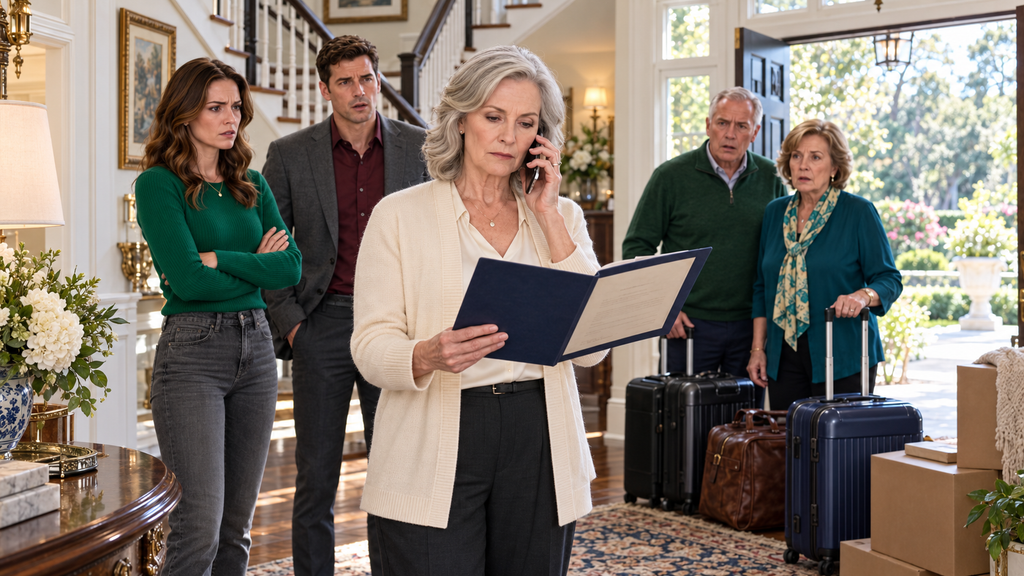
And Carter…
Carter simply stared at me.
I had imagined that moment several times since meeting with Mr. Lawson the previous afternoon.
In some versions, my son became angry.
In others, he understood immediately.
In none of them had I imagined the expression he wore now.
He looked like a little boy who had reached for something he had always assumed would be there and discovered empty space.
“What do you mean I’m not the beneficiary?” he whispered.
Mr. Lawson rested one hand on his briefcase.
“The deed was recorded electronically this morning. The property is now held under Donna’s newly restated revocable living trust. Donna remains the sole trustee and retains complete control during her lifetime.”
Kendall’s eyes snapped toward me.
“Complete control?”
“Yes,” Mr. Lawson said.
She gave a short, incredulous laugh.
“Well, obviously. Until she dies.”
Mr. Lawson did not smile.
“And after Donna’s death, the house does not transfer to Carter.”
Kendall stopped breathing for a second.
I saw it.
Her chest went still.
Douglas took one step closer.
“Who gets it?”
I looked at the three suitcases sitting on my heart-pine floor.
Suitcases brought into my home without permission.
Suitcases belonging to people who had discussed changing my rooms before they had even asked whether they could stay.
Then I looked at my son.
“Harper and Miles.”
Carter’s eyes widened.
Kendall’s face changed completely.
“What?”
Mr. Lawson opened the document.
“The trust names Donna’s grandchildren as equal beneficiaries of the property interest after her death.”
Kendall’s expression flickered.
For one strange second, I almost saw relief.
Of course I did.
Harper and Miles were children.
Children did not control property.
Parents did.
At least that was clearly what she thought.
Then Mr. Lawson continued.
“The trust will be administered by an independent successor trustee until both beneficiaries meet the age requirements established by Donna. Neither parent has authority to sell, mortgage, borrow against, occupy, transfer or otherwise exercise control over the property on behalf of either child.”
Kendall’s relief disappeared.
Completely.
Douglas stared at him.
“What age requirements?”
“Thirty.”
His answer landed like a hammer.
Rita actually sank onto one of the suitcases.
“Thirty?”
Mr. Lawson nodded.
“There are also provisions allowing the trustee to sell the property if maintaining it becomes impractical. Any resulting proceeds would remain protected within the trust.”
Kendall looked at me as if I had betrayed her.
Which was almost funny.
Almost.
“You put the house in the children’s names?”
“No.”
My voice was calm.
“That is exactly what Mr. Lawson just explained.”
“You know what I mean.”
“I know exactly what you mean.”
She folded her arms.
“So instead of giving it to your only son, you’re dangling it over your grandchildren?”
That was when I understood something.
She still thought this conversation was about inheritance.
Money.
Assets.
Winning.
It had never occurred to her that I might simply want to prevent my home from becoming a prize people fought over while I was still alive.
“I’m not dangling anything,” I said. “Harper and Miles don’t even need to know about it.”
Carter finally spoke.
“Mom…”
His voice cracked.
I looked at him.
He swallowed.
“Why?”
One word.
But behind it were years.
Why didn’t you trust me?
Why did you change everything?
Why didn’t you tell me?
Why are you doing this to me?
I could have answered cruelly.
I could have looked at him and said, Because you stood there while your wife threatened me with my grandchildren.
I could have said, Because you let three people enter my home with luggage after I explicitly said no.
I could have said, Because you watched your father-in-law choose a bedroom in the house your father restored and did nothing.
Every one of those answers would have been true.
But anger had already done enough work in that room.
I wanted him to hear me.
So I told him the deeper truth.
“Because somewhere along the way, Carter, you stopped seeing this house as mine.”
His face tightened.
“I never—”
“Yes.”
I held up one hand.
“You did.”
He stopped.
“You may never have said it out loud. But you started thinking of this place as something you were waiting to receive.”
His eyes dropped.
I continued.
“When Warren and I bought this house, half the windows didn’t close. Rain came through the porch roof. The kitchen floor dipped so badly that if you put a marble near the refrigerator, it rolled all the way to the pantry.”
A tiny, painful smile touched Carter’s face.
He remembered.
“You were nine,” I said. “Your father let you write your initials beneath the staircase before we sealed the wall.”
His eyes lifted toward the hall.
The wall was still there.
Thirty years later.
“You helped us paint the back bedroom yellow because you wanted a room that looked like sunshine.”
“Mom…”
“I remember everything.”
My voice trembled for the first time.
“I remember your father sanding these floors at midnight because we couldn’t afford to hire anyone. I remember eating Chinese takeout on overturned paint buckets. I remember the first Christmas tree we put in that front window. I remember sitting right there after the doctor told us Warren’s cancer had returned.”
Nobody moved.
“This house is not four unused bedrooms.”
I looked at Kendall.
“It is not a solution to someone else’s financial problems.”
Then Douglas.
“It is not your future renovation project.”
Then Carter.
“And it is not an inheritance you are entitled to before I am dead.”
Carter’s face crumpled slightly.
He looked away.
Kendall didn’t.
She hardened.
“You’re being incredibly dramatic.”
I almost smiled.
Of course.
That word.
Dramatic.
The favorite word of people who dislike boundaries.
Douglas stepped forward.
“Donna, nobody is trying to steal your home.”
I looked at his suitcases.
Then at the box labeled IMPORTANT DOCUMENTS.
Then at Rita sitting on her luggage.
“No?”
He followed my gaze.
His face flushed.
“We were told this was settled.”
“By someone who does not own the house.”
“Kendall is your daughter-in-law.”
“Yes.”
“And Carter is your son.”
“Yes.”
“So why are you acting like we’re strangers off the street?”
“Because strangers off the street would probably have knocked.”
Carter closed his eyes.
Douglas stared at me.
Rita whispered, “This is humiliating.”
That finally made something sharp rise inside me.
I turned toward her.
“Humiliating?”
She looked up.
“You arrived at my house with luggage after I said you could not live here.”
Rita’s lips parted.
“You selected one of my bedrooms.”
She looked away.
“Your husband discussed removing my furniture.”
Douglas muttered, “I was making conversation.”
“You discussed installing a hot tub.”
Nobody said anything.
“And now you are humiliated because I am explaining who owns the property?”
I shook my head.
“No, Rita. Humiliation would have been me standing here at sixty-three years old, watching four adults take over my home because I was too afraid someone might punish me by withholding my grandchildren.”
That sentence hit Kendall exactly where I intended it to.
Her face changed.
Not guilt.
Anger.
“You think I was threatening you?”
I stared at her.
“You said, ‘Then we’ll have to reconsider how often the children come over.’”
She immediately looked at Carter.
“That isn’t what I meant.”
For the first time, something shifted in my son’s expression.
His eyes narrowed.
“Kendall.”
“What?”
“You said that.”
She turned on him.
“I was upset.”
“You said it before we even left Mom’s kitchen.”
“I said we would reconsider the schedule.”
“No.”
His voice became firmer.
“You knew exactly what you were saying.”
Kendall stared at him.
Perhaps she heard the difference before I did.
His voice had changed.
Only slightly.
But for years, Carter’s sentences around his wife seemed to arrive looking for permission.
That one didn’t.
Kendall recovered quickly.
“This is ridiculous. My parents need a place to live. Your mother has five bedrooms.”
“Four.”
Everyone looked at me.
I folded my arms.
“One of them is mine.”
Douglas gave an irritated sigh.
“You know what she means.”
“Yes. Unfortunately, I do.”
Mr. Lawson quietly closed his briefcase.
“I believe the larger question has been answered.”
Douglas turned to him.
“Stay out of this. It’s family business.”
Mr. Lawson raised one eyebrow.
“You are standing in my client’s residence discussing her estate plan. That makes it very specifically my business.”
Douglas’s face darkened.
I almost heard Warren laughing.
He would have liked Mr. Lawson.
Actually, he had liked him.
That was one reason we kept him for twenty years.
Kendall looked around the foyer as though expecting the house itself to take her side.
Then she did what she always did when control began slipping.
She reached for the strongest weapon she believed she had.
“Fine.”
Her voice became icy.
“If this is how you want things, Donna, maybe you won’t see Harper and Miles for a while.”
Carter’s head snapped toward her.
“Kendall.”
“No.”
She held up a hand.
“I’m serious. I’m done pretending this is normal.”
I felt the threat hit me physically.
Not metaphorically.
Physically.
Like someone had put a hand beneath my ribs and closed their fist.
Harper’s crooked smile.
Miles asleep beneath my knitted blanket.
The sound of sneakers pounding up my porch steps.
The way Harper always shouted, “Grandma, we’re here!” as though I might somehow fail to notice two children exploding through my front door.
I loved those children more deeply than Kendall would ever understand.
Which was precisely why she had believed this threat would work forever.
For one terrible second, instinct screamed at me to surrender.
Tell them they could stay.
Give them the rooms.
Move my office.
Smile.
Apologize.
Anything.
Anything to preserve Sunday afternoons.
Then another memory came.
Warren.
Three weeks before he died.
We had been sitting on the back porch.
He was thin by then.
So thin his wedding ring had become loose.
He looked around the yard and said, “Promise me you’ll keep living after I’m gone.”
I had cried.
He squeezed my hand.
“I mean it, Donna. Don’t turn your life into a waiting room.”
I had promised.
And standing in that foyer, I realized that giving away control of my home because I was frightened of losing access to my grandchildren would be exactly that.
A waiting room.
A life organized around someone else’s permission.
So I looked at Kendall.
My heart was breaking.
But my voice didn’t.
“I hope you don’t do that to them.”
She blinked.
That was not the answer she expected.
“I mean it,” I said. “Whatever you think of me, Harper and Miles love their grandmother. Don’t teach them that love disappears when adults don’t obey you.”
Her face flushed.
“Don’t tell me how to raise my children.”
“I didn’t.”
I nodded toward the suitcases.
“I told you how to behave in my house.”
Then I looked at my watch.
“You have fifteen minutes to remove your belongings.”
Douglas laughed.
A hard, disbelieving sound.
“You’re throwing us onto the street?”
“No.”
I glanced toward the window.
“You have a vehicle.”
His smile disappeared.
Rita stood.
“Donna, please.”
Her tone changed so quickly that I almost admired it.
Almost.
“We have nowhere prepared.”
“I’m sorry to hear that.”
“You know our lease ended.”
“I know Kendall told me you needed somewhere stable. She never explained why.”
Douglas’s jaw tightened.
“That’s personal.”
“So is my home.”
Rita took a step toward me.
“What are we supposed to do tonight?”
I looked at her.
There were dozens of answers I could have given.
A hotel.
Extended-stay lodging.
Another relative.
Their storage facility.
Kendall and Carter’s house.
But I suddenly understood that answering the question would pull me back into the role they had assigned me.
Problem solver.
Rescuer.
Woman who absorbs everyone else’s emergencies.
So I simply said, “That is something the four of you should have discussed before arriving here without my permission.”
Rita stared.
Carter flinched.
Kendall’s voice became low.
“You’re enjoying this.”
That hurt more than I expected.
Because part of me was angry enough to enjoy seeing her confidence collapse.
I won’t pretend otherwise.
But beneath the anger was grief.
I had not wanted any of this.
I had wanted my son to say one sentence three days earlier.
Mom said no.
That was all.
Four words.
If Carter had said them, Mr. Lawson might never have needed to visit that morning.
So I answered truthfully.
“No.”
I looked at the suitcases.
“I hate this.”
Something in my face must have convinced her.
She had no immediate reply.
Then the doorbell rang again.
Everyone looked toward it.
Kendall’s eyes narrowed.
“Who is that?”
I opened the door.
Marcus Bell stood outside.
Marcus owned the locksmith company Warren and I had used for years.
He carried a small tool case.
Beside him was one of his technicians.
Marcus smiled politely.
“Morning, Mrs. Reynolds.”
Carter’s face went completely white.
Kendall looked from Marcus to me.
“You called a locksmith?”
“I scheduled him yesterday.”
Carter whispered, “Yesterday?”
“Yes.”
That mattered.
I wanted him to understand.
The trust had not been created because Douglas insulted me five minutes earlier.
The locks were not being changed because Kendall had angered me that morning.
I had made my decision before their suitcases crossed the threshold.
After Carter told me at the coffee shop that Kendall had informed her parents everything was settled, I drove straight to Mr. Lawson’s office.
Then I called Marcus.
I had spent too many years waiting for the next boundary violation before responding to the previous one.
That ended Wednesday afternoon.
Marcus glanced at the luggage.
“Bad time?”
“No,” I said.
“Perfect.”
Kendall stepped toward Carter.
“Are you going to let her do this?”
Carter looked at the floor.
My stomach tightened.
There it was again.
The moment.
The choice.
Would he hide?
Would he apologize?
Would he tell me privately that he disagreed while allowing Kendall to continue publicly?
He lifted his head.
“No.”
Kendall seemed relieved.
Then Carter finished.
“I’m not going to stop her.”
Nobody moved.
His voice trembled.
But he kept going.
“It’s her house.”
Three words.
It’s her house.
I had waited three days to hear them.
Maybe years.
Kendall stared at her husband.
“What did you just say?”
Carter looked at me.
Then at the suitcases.
Then at his wife.
“I said it’s her house.”
“You told my parents they could come.”
“No.”
“You agreed with me.”
“I stopped fighting with you.”
“That is the same thing.”
“No.”
His answer came faster this time.
“It isn’t.”
Kendall’s mouth tightened.
“Interesting.”
She picked up one of the smaller bags.
“So now you suddenly have a backbone because Mommy threatened your inheritance?”
Carter recoiled.
I felt that one land.
She saw it too.
And pushed harder.
“Do you honestly think she’ll leave anything to you now?”
He looked at me.
For half a second, I worried.
Then he slowly shook his head.
“I don’t know.”
He turned back to Kendall.
“And that shouldn’t matter.”
Something in my chest loosened.
Not forgiveness.
Not yet.
But perhaps the first small movement toward it.
Douglas grabbed two suitcases.
“This family is insane.”
I opened the front door wider.
“Drive safely.”
He glared at me.
Rita muttered something beneath her breath and followed him.
Kendall remained in the foyer.
Her face was bright red now.
“You realize what you’re doing, Donna?”
“Yes.”
“No. I don’t think you do.”
She stepped closer.
“You are choosing a house over your family.”
The old Donna might have panicked.
The old Donna might have chased that accusation around the room trying to prove she was a good mother.
The old Donna might have begged her to understand.
But that morning had stripped something unnecessary from me.
Fear, perhaps.
Or the need to be misunderstood kindly.
So I looked into her eyes.
“No, Kendall.”
My voice was quiet.
“You asked me to choose between surrendering my house and losing my family.”
I paused.
“That choice was yours.”
For once, she had nothing to say.
She walked out.
Carter remained.
Marcus cleared his throat gently.
“Should we…?”
“Yes.”
I handed him the emergency key.
“Front, back and side doors.”
He nodded.
Carter watched the key leave my hand.
He had carried copies of that key for almost fifteen years.
When Harper was born, I gave one to him because I wanted him to know my home would always be open.
Somewhere along the way, “open” had become “unlocked.”
Those are not the same thing.
Carter rubbed his palms together.
“Mom.”
I looked at him.
He seemed exhausted.
“I’m sorry.”
I had imagined him saying those words too.
In my imagination, I hugged him immediately.
I cried.
He cried.
Everything softened.
Real life is rarely so clean.
“I believe you’re sorry.”
His eyes filled.
“But I’m still angry.”
He nodded.
“You should be.”
“I’m still hurt.”
“I know.”
“No.”
My voice broke.
“I don’t think you do.”
That was the first moment I cried.
Not when they entered.
Not when Kendall threatened to take my grandchildren.
Not when I changed my estate.
Then.
Because anger can carry you through a battle.
But when the battle pauses, grief catches up.
“I needed you,” I whispered.
Carter’s face collapsed.
“Mom…”
“I needed my son to say no.”
He covered his mouth.
“One word, Carter.”
Tears spilled down my cheeks.
“I should not have needed an attorney and a locksmith to feel safe in my own home while you stood ten feet away.”
He stepped toward me.
Then stopped.
He didn’t assume he was allowed to touch me.
That small hesitation mattered.
“I was scared,” he said.
“I know.”
“She kept saying she would take the kids.”
“I know.”
“She said she would move to Arizona. She said I’d barely see them. She said her parents had nowhere to go and everything would be my fault.”
“I know.”
His eyes were red.
“I didn’t know what to do.”
I wiped my cheek.
“Yes, you did.”
He looked at me.
“You just didn’t want to pay the price for doing it.”
That hurt him.
I saw it.
But I would not take it back.
Because it was true.
Courage is rarely not knowing what is right.
Most of the time, courage is knowing exactly what is right and accepting that doing it might cost you something.
Carter had spent years trying to purchase peace by handing other people the bill.
Usually me.
Maybe sometimes himself.
That morning, the account finally closed.
“I’m sorry,” he whispered again.
“I know.”
“Can I fix it?”
“Not today.”
His shoulders dropped.
I hated the pain in his face.
He was still my son.
That was the hardest part.
Boundaries would be much easier if the people crossing them were people we did not love.
“I need time,” I said.
He nodded.
“I understand.”
“And Carter?”
He stopped at the door.
“If Kendall keeps Harper and Miles from me…”
He turned.
“I will survive it.”
My voice shook.
“But I will never forget who made that decision.”
He closed his eyes briefly.
Then nodded.
“I won’t either.”
He walked outside.
Marcus changed the locks.
The entire process took twenty-three minutes.
Twenty-three minutes to replace metal cylinders.
Years to understand why I needed them.
When the final lock clicked into place, Marcus handed me three new keys.
I put one on my key ring.
One went into the small safe in my bedroom.
The third I gave to no one.
Not that day.
For the first time in years, I was the only person with unrestricted access to my home.
That night, I sat alone at my kitchen island.
Four mugs sat in the cupboard where they always had.
Harper’s pink one.
Miles’s blue one.
Carter’s old college mug with a cracked handle.
Mine.
I poured one cup of tea.
Just one.
The silence hurt.
Winning, I discovered, can sound terribly lonely.
For the next nine days, Kendall did exactly what she had threatened.
Nothing.
No calls.
No Sunday visit.
No photographs from the children’s soccer game.
No messages in the family group chat.
Actually, there was no family group chat for me anymore.
I discovered Kendall had removed me two hours after leaving my house.
The first Sunday was the worst.
At ten-fifteen, I found myself standing near the front window.
That was when Harper and Miles usually arrived.
I knew no car was coming.
Still, I waited.
At ten-thirty, I went into the kitchen and began making pancake batter by habit.
Two eggs.
Milk.
Vanilla.
Cinnamon because Miles liked “brown pancakes.”
I had already mixed the flour before I realized what I was doing.
I stood there holding the whisk.
Then I cried so hard I had to sit on the floor.
Nobody sees that part when they tell stories about standing up for yourself.
They tell you about empowerment.
Freedom.
Strength.
They rarely tell you about sitting on a kitchen floor beside a bowl of pancake batter because the people you finally stopped allowing to manipulate you know exactly what absence will hurt most.
I almost called.
God help me, I almost did.
I picked up my phone.
Kendall’s name was still there.
My thumb hovered over it.
I could hear myself saying the words.
I’m sorry.
Let’s work something out.
Your parents can stay temporarily.
Maybe a month.
Maybe two.
The thought made me physically sick.
Because I knew what would happen.
One month would become three.
Three would become six.
Furniture would arrive.
Mail would start coming to my address.
Douglas would install something without asking.
Rita would rearrange the kitchen.
My office would become a television room.
Every attempt to reclaim space would become another threat involving Harper and Miles.
And the children would learn something terrible from all of us.
That Grandma’s no did not mean no if you punished her long enough.
I put down the phone.
Then I poured the pancake batter into the trash.
Not because I didn’t want the children anymore.
Because I wanted them enough not to teach them that love requires surrender.
On Monday afternoon, a small envelope arrived.
No return address.
Inside was a folded drawing.
Four stick figures stood in front of a yellow house.
One had gray hair.
Two were children.
The fourth was a bird.
At the top, in Miles’s crooked handwriting, were the words:
GRANDMA HOUSE.
I sat at the dining table holding that piece of paper for almost an hour.
I did not know how it had been mailed.
I later learned Harper had found one of my old stamped envelopes in her backpack from a school project.
She had addressed it herself.
I framed the drawing.
It is still in my kitchen.
The next change came from a place none of us expected.
Carter.
He called eleven days after the suitcases arrived.
I nearly didn’t answer.
Then I did.
“Hello?”
For several seconds, he said nothing.
Then:
“Mom, did Dad ever tell you to leave him alone when he was angry?”
The question was so unexpected that I sat down.
“What?”
“When you fought.”
“All married couples fight.”
“I know. But did he ever tell you that if you disagreed with him, he’d take me somewhere and make sure you couldn’t see me?”
My chest tightened.
“No.”
“Did he ever tell you he’d leave with me?”
“No.”
“Did he ever threaten to punish you with me?”
“No.”
Silence.
Then Carter said, “I think I’ve been pretending things are normal for a long time.”
I closed my eyes.
There are moments when a mother wants to say I told you so.
There are also moments when saying it would be the cruelest thing imaginable.
That was one of them.
So I asked, “Are you safe?”
“Yes.”
“The children?”
“Yes.”
“Then start there.”
He exhaled shakily.
“I found something.”
“What?”
“Messages.”
My stomach dropped.
“What kind of messages?”
“Between Kendall and her mother.”
I didn’t speak.
Carter continued.
“They were talking about your house months ago.”
Cold moved across my skin.
“How many months?”
“Six.”
Six.
Long before Rita and Douglas’s lease ended.
Long before Kendall stood in my kitchen holding herbal tea.
Long before I was told their housing crisis had suddenly become my responsibility.
Carter’s voice sounded hollow.
“Kendall sent Rita photographs of the upstairs rooms.”
I closed my eyes.
“What photographs?”
“Your rooms.”
“How did she get them?”
He went silent.
I already knew.
The emergency key.
Those afternoons when I came home and noticed something moved.
Those strange little moments I dismissed.
A chair at a different angle.
A closet door open.
A lamp turned on.
I had assumed Kendall dropped something off.
Picked something up.
Used the bathroom.
“Carter.”
“She took pictures while you weren’t home.”
My hand tightened around the phone.
He continued.
“One message said your office would make a good television room.”
I remembered Douglas saying exactly that when he arrived.
Not an observation.
A plan.
Another message.
“Mom probably won’t like it at first, but she always gives in when the kids are involved.”
My eyes filled.
Carter’s voice broke.
“She wrote that, Mom.”
I stared at the framed drawing on my counter.
Grandma house.
“What else?”
“You don’t need to hear all of it.”
“Yes.”
He inhaled.
“Kendall told Rita that once they were established in the house, you wouldn’t have the heart to throw them out.”
Something about the wording chilled me.
“Established?”
“Yes.”
“And Douglas?”
“There are messages from him too.”
“What did he say?”
Another pause.
“He asked whether the property taxes would become his responsibility ‘once the house was Carter’s.’”
I almost laughed.
Not because it was funny.
Because sometimes arrogance grows so large the only reasonable response is disbelief.
“I’m alive.”
“I know.”
“They planned around my death while I was still buying groceries.”
“I know.”
Carter sounded sick.
“I’m sorry.”
There was more.
Of course there was.
Douglas had contacted a contractor.
Not to begin work.
He had no legal authority to do that.
But he had requested estimates.
Converting part of the upstairs.
Adding a shower.
Enclosing a section of the back porch.
And yes.
Electrical work for a hot tub.
I closed my eyes when Carter told me that.
The hot tub.
The ridiculous detail that had made me think perhaps Douglas was simply socially oblivious.
He wasn’t.
He had been planning.
“They thought the house was basically mine,” Carter said.
“No.”
His voice cracked.
“I know that now.”
That sentence mattered.
Not because he had said “mine.”
Because he corrected it himself.
“Kendall keeps telling me this is just how families help each other.”
“What do you think?”
A long silence.
“I think helping is something you ask for.”
I smiled sadly.
“Yes.”
“And I think I’ve spent a long time confusing peace with obedience.”
I looked toward the back porch.
Warren’s chair still sat beside mine.
“That happens.”
“I’ve spoken to someone.”
“A counselor?”
“And an attorney.”
My heart sank.
“Carter…”
“I’m not filing anything today.”
He said it quickly.
“I just needed to understand my rights if she really tries to take the kids across the country.”
I exhaled.
That was wise.
Not dramatic.
Not retaliatory.
Information.
“Good.”
“I told her I wanted counseling.”
“And?”
“She said the problem is you.”
Of course.
I said nothing.
“She said everything was fine until you decided to punish us.”
“Was everything fine?”
“No.”
His answer was immediate.
Then he whispered, “I think everything was quiet.”
There it was.
The difference.
Quiet is not peace.
Sometimes quiet is simply the sound made by people who have stopped objecting.
Three days later, Carter came to my house.
Alone.
He stood on the porch.
I watched through the window for several seconds before opening the door.
He looked terrible.
Unshaven.
Wrinkled shirt.
Dark circles beneath his eyes.
“Can I come in?”
I stepped aside.
That mattered too.
He asked.
Inside, his eyes moved immediately toward the front door.
New lock.
New keyhole.
He noticed.
But he said nothing.
I made coffee.
We sat at the kitchen island where this had all begun.
For a while, neither of us spoke.
Then Carter slid his phone toward me.
“I want you to read something.”
On the screen was a message from Kendall.
If you go crawling back to your mother, don’t bother coming home.
I looked up.
“Did you?”
“What?”
“Go home?”
He shook his head.
“I’m staying at a hotel.”
I pushed the phone back.
“Carter, whatever happens between you and Kendall, I need you to understand something.”
He waited.
“You are not moving in here.”
For half a second, he looked startled.
Then something unexpected happened.
He laughed.
A tired, broken laugh.
Then he covered his face.
“I deserved that.”
“I’m serious.”
“I know.”
“I love you.”
“I know.”
“And if you need help finding an apartment, I’ll help you look.”
He nodded.
“But you are not replacing one dependency with another.”
He looked at me through wet eyes.
“Dad would’ve said the same thing.”
“No.”
I smiled.
“Your father would have carried your suitcase upstairs and complained to me six months later.”
Carter laughed again.
That was the first time we had laughed together since the morning they arrived.
It lasted maybe five seconds.
But it was enough to remind me that my son was still inside the man sitting across from me.
Hurting.
Flawed.
Frightened.
But there.
“I miss the kids,” I whispered.
His smile disappeared.
“I know.”
“Are they okay?”
“Yes.”
“Does Harper understand what’s happening?”
“Too much.”
My heart broke.
“She asked Kendall why Grandma was in trouble.”
I closed my eyes.
“What did Kendall say?”
“That you were being selfish.”
I turned away.
Carter continued quickly.
“I corrected her.”
I looked back.
“In front of the kids?”
“Yes.”
That surprised me.
“What did you say?”
“I told them adults were having a disagreement and none of it was their fault. I told them you love them.”
My throat tightened.
“And I told Kendall later that if she says anything else to make them feel responsible, we have a much bigger problem.”
I looked at him for a long time.
That was the first moment I understood something important.
Carter’s apology would not matter nearly as much as his behavior after it.
Anyone can become brave once.
The harder work is staying brave when the person who benefited from your silence realizes the silence is gone.
“Thank you,” I said.
He nodded.
Then his eyes moved toward the blue folder on the far counter.
I had left it there intentionally.
He stared at it.
“Can I ask you something?”
“Yes.”
“Am I really out?”
There it was.
I had been waiting.
Not because I wanted him to ask.
Because some part of me feared that eventually he would.
“Of the house?”
“Yes.”
“Yes.”
He swallowed.
“Permanently?”
“I don’t know.”
He looked surprised.
“The trust is revocable.”
“I know.”
“But I’m not changing it now.”
His gaze dropped.
“Okay.”
That was all.
No argument.
No anger.
No reminder that he was my only child.
No accusation.
Just okay.
I studied him.
“Does that bother you?”
“Yes.”
At least he was honest.
“But not because I think you owe me the house.”
He rubbed his thumb over the edge of his coffee cup.
“It bothers me because I understand what I had to do for you to feel like you needed to protect your home from me.”
That nearly broke me.
I reached across the island.
For the first time since everything happened, I took my son’s hand.
“I wasn’t protecting it from you.”
He looked at me.
“I was protecting it from what you were allowing.”
His fingers closed around mine.
There is a difference.
A very important one.
That evening, Carter returned to the hotel.
A week later, he signed a six-month lease on a small apartment twelve minutes from Harper and Miles’s school.
He did not ask me for money.
I offered to help with the security deposit.
He refused.
“I need to know I can do something hard without you rescuing me.”
I had to look away so he wouldn’t see how proud that made me.
Not proud because his marriage was failing.
I would never celebrate that.
Kendall was the mother of my grandchildren.
Whatever happened between them would change those children’s lives.
There was no victory in that.
But I was proud that my son had begun understanding the difference between support and rescue.
Then came the phone call I had been waiting for.
It was a Thursday afternoon.
My phone rang.
Carter.
I answered immediately.
“Everything okay?”
“Can you be home Sunday?”
My heart stopped.
“What?”
“Sunday. Around ten?”
I gripped the phone.
“Why?”
A pause.
Then I heard a little voice in the background.
“DAD, YOU SAID I COULD TELL HER!”
My knees nearly gave out.
Harper.
Carter laughed.
“Apparently I have lost control of the announcement.”
Then Harper shouted again.
“GRANDMA! WE’RE COMING FOR PANCAKES!”
I sat down.
I couldn’t speak.
“Grandma?”
“I’m here.”
“Do you still have cinnamon?”
That did it.
I started crying.
“Yes, sweetheart.”
“And whipped cream?”
“I’ll buy some.”
“Miles wants chocolate chips too.”
From the background, Miles yelled, “A LOT.”
I laughed through tears.
“A lot.”
Harper lowered her voice, suddenly serious.
“Grandma?”
“Yes?”
“Are you mad at us?”
The question shattered me.
“No.”
I said it too loudly.
Then softer.
“Oh, sweetheart, no. Never.”
“Mom said—”
Carter’s voice gently interrupted.
“Harper.”
There was silence.
I understood.
Not on the phone.
Not through the child.
Not this way.
So I said, “Listen to me. Whatever happens between grown-ups, you and Miles are not responsible. Do you understand?”
“Yes.”
“I love you when you’re at my house.”
“Okay.”
“I love you when you’re at your mom’s house.”
“Okay.”
“I love you when you’re angry, happy, messy, loud, quiet, near me or a thousand miles away.”
She giggled.
“A thousand miles is far.”
“Exactly.”
“So you’d still love me?”
“Exactly.”
A pause.
Then:
“I love you too.”
Sunday morning, I woke at six.
Ridiculous.
I usually slept until seven-thirty.
By seven, the kitchen smelled like cinnamon.
At eight, I had already cleaned the counters twice.
At nine, I changed shirts because the first one suddenly seemed too formal for pancakes.
At nine-thirty, I stood at the front window.
Then I laughed at myself.
Some habits survive humiliation.
At nine fifty-eight, Carter’s car turned onto my street.
I stopped breathing.
The rear door flew open before he had fully parked.
Harper ran first.
Miles behind her.
I opened the front door.
“GRANDMA!”
They hit me at the same time.
Two bodies.
Four arms.
Backpacks.
Hair.
Noise.
Everything I had missed.
I dropped to my knees and wrapped myself around them.
Harper cried.
Miles pretended he wasn’t crying.
Carter stood by the car watching us.
I pressed my face against Harper’s hair.
She smelled like strawberry shampoo.
Miles had lost a tooth.
I noticed immediately.
“You lost another one!”
He grinned.
“Twenty dollars.”
My head snapped back.
“The tooth fairy has been affected by inflation.”
Carter laughed.
“Apparently.”
We went inside.
Harper stopped near the door.
She looked at the new lock.
“Dad said Grandma got safer locks.”
I glanced at Carter.
He looked embarrassed.
“Yes.”
Harper nodded approvingly.
“Good.”
Children sometimes understand boundaries faster than adults.
We made pancakes.
Miles poured too many chocolate chips into the batter.
Harper stole whipped cream directly from the can.
Carter burned bacon because he was trying to answer a work email.
For three hours, my house sounded like itself again.
Not the same.
Never the same.
But alive.
At one point Harper went upstairs for a sweater I kept in the guest room.
She stopped halfway up the staircase.
“Grandma?”
“Yes?”
“Is Grandpa Rita living here?”
I froze.
Carter closed his eyes.
“No, sweetheart.”
“Oh.”
She considered that.
“Why did he say he was?”
The room went still.
Carter immediately turned toward her.
“When did he say that?”
Harper shrugged.
“At their apartment.”
My skin prickled.
“What exactly did he say?”
Carter asked carefully.
Harper thought.
“He said we were all going to live at Grandma’s house soon because it would be Dad’s anyway.”
There it was.
Children hear everything.
Much more than adults realize.
Carter’s face hardened.
Harper looked worried.
“Did I say something bad?”
“No.”
He crossed the room and hugged her.
“You didn’t do anything wrong.”
She looked at me.
I forced myself to smile.
“Go get your sweater.”
She ran upstairs.
Once she was out of sight, Carter whispered, “I’m sorry.”
“Stop apologizing every time we discover something new.”
“I should have known.”
“Yes.”
He looked at me.
“But now you do.”
That became our rule.
Not literally.
We never wrote it down.
But it became the foundation of how we moved forward.
We did not endlessly punish ourselves for what we should have seen.
We paid attention to what we saw now.
Kendall did not take Carter’s change quietly.
Over the next several months, their marriage deteriorated.
They tried counseling.
Three sessions.
Carter attended all three.
Kendall attended two.
According to Carter, she spent most of the second session explaining why every conflict in their marriage could be traced to other people disrespecting her.
Her parents.
Her former employer.
Her friends.
Me.
Eventually Carter asked the counselor a simple question.
“If everyone who says no to you becomes your enemy, what does that make me when I disagree?”
Kendall walked out.
I did not hear that story from Carter.
I heard it months later from Kendall herself.
Because yes.
She eventually came back to my house.
Alone.
It was February.
Four months after the suitcases.
Rain tapped against the porch roof.
I opened the door and found Kendall standing beneath a black umbrella.
For several seconds, neither of us spoke.
She looked different.
Not physically.
Her hair was perfect.
Her coat expensive.
Makeup flawless.
But the certainty she usually carried like perfume was gone.
“Can I come in?”
She asked.
That mattered.
I stepped aside.
She wiped her shoes on the mat before entering.
That mattered too.
I offered coffee.
She asked for water.
We sat at the kitchen island.
The same places we had occupied that Tuesday morning in October.
Except this time, her hands were empty.
No herbal tea.
No announcement.
No plan.
She looked around the kitchen.
“I always loved this room.”
I said nothing.
She swallowed.
“Carter filed for legal separation.”
I knew.
He had told me three days earlier.
“I’m sorry.”
She gave a bitter laugh.
“Are you?”
“Yes.”
She looked genuinely surprised.
“You think I deserve it.”
“I think marriages are more complicated than one person deserving an ending.”
She stared at the countertop.
“He says I use people.”
I waited.
“He says I punish people when they don’t do what I want.”
Still I waited.
“He says I use the children to control him.”
Her eyes lifted.
“Do you think that?”
“Yes.”
She flinched.
Not dramatically.
Just enough.
I continued before she could turn the question into an argument.
“I think you learned that withholding something valuable is an effective way to get compliance.”
Her jaw tightened.
“You make it sound calculated.”
“Sometimes it was.”
“You don’t know that.”
“I was there.”
She looked away.
Rain ran down the windows.
Finally she whispered, “I was desperate.”
That was the first honest sentence I had heard from her about the house.
I leaned back.
“For your parents?”
She nodded.
“They had nowhere to go.”
“Why?”
Her mouth tightened.
I waited.
Kendall had spent months protecting that answer.
Then she finally gave it to me.
“They were in debt.”
I already suspected.
Carter had learned some of it.
But not all.
“How much?”
“A lot.”
“From what?”
She looked ashamed.
My anger changed shape.
Not disappeared.
Changed.
Douglas’s business had been struggling for almost two years.
Instead of downsizing, he borrowed against everything.
Their home.
Retirement accounts.
Credit lines.
Rita knew.
Kendall knew.
They kept spending.
Vacations.
Cars.
Country-club membership.
Not because they were evil.
Because admitting the lifestyle was no longer affordable felt more humiliating than quietly digging the hole deeper.
By the time the lease on their temporary condo ended, they had very little cash.
“But why my house?” I asked.
Kendall looked at me.
“Because it was there.”
Four words.
No elaborate justification.
No lie.
Because it was there.
Empty bedrooms.
A widowed woman.
A son who hated conflict.
Grandchildren she adored.
To Kendall, the solution had seemed obvious.
I shook my head.
“You could have asked me.”
“You would have said no.”
“Yes.”
“Exactly.”
“No.”
She looked confused.
“The point of asking is not to guarantee the answer you want.”
I leaned forward.
“The point is to respect the other person’s right to answer.”
She looked away.
“My parents were terrified.”
“So you decided their fear mattered more than my consent.”
She rubbed her hands together.
“When you say it like that…”
“How else should I say it?”
No answer.
Then she whispered, “I didn’t think you’d really refuse.”
That sentence hurt.
Not because she expected generosity.
Because she had stopped believing my words carried weight.
“Why?”
She stared at me.
“You always gave in.”
There it was.
The truth I needed to hear.
Not because it excused her.
Because it implicated me.
Every time she entered with the emergency key and I said nothing.
Every time she borrowed something without asking and I turned irritation into a joke.
Every time a weekend babysitting request became an assumption and I swallowed the inconvenience because I wanted time with the children.
Every boundary I failed to enforce had taught her a lesson.
The wrong lesson.
My kindness had not created her entitlement.
But my silence had certainly failed to challenge it.
“You’re right,” I said.
Kendall blinked.
“What?”
“I did.”
She stared.
“I gave in.”
I folded my hands.
“And that was my mistake.”
For the first time, the conversation stopped feeling like a courtroom.
There was no winner.
Just two women finally looking at the pattern without decoration.
Kendall’s eyes filled.
“I was angry when you changed the trust.”
“I know.”
“I thought you were trying to hurt Carter.”
“I wasn’t.”
“I know that now.”
I studied her.
“Why?”
“Because he doesn’t seem angry about the house anymore.”
That surprised me.
“He told me something last week.”
“What?”
“He said losing the inheritance was probably the first consequence in his adult life that you didn’t protect him from.”
My throat tightened.
Kendall smiled sadly.
“He said maybe he needed that.”
We sat quietly.
Then she asked the question I least expected.
“Do you hate me?”
I could have given her the satisfying answer.
Yes.
After everything you did.
But it would have been a lie.
“No.”
She looked at me.
“I don’t trust you.”
That was harder.
“But I don’t hate you.”
Her eyes dropped.
“I don’t know how to fix that.”
“Trust?”
She nodded.
“You don’t fix it by asking me to forget.”
A tear slid down her cheek.
“You fix it by becoming trustworthy.”
She wiped her face.
“How long does that take?”
“As long as it takes.”
She laughed softly through her tears.
“That sounds awful.”
“It can be.”
Another silence.
“Are my parents banned from your house forever?”
The directness almost made me smile.
“No.”
She looked surprised again.
“But they aren’t staying here.”
“Ever?”
“Ever.”
She nodded.
“And they need to ask before visiting.”
“Okay.”
“And Douglas is not installing a hot tub.”
That finally did it.
Kendall laughed.
A real laugh.
I did too.
It felt strange.
Not reconciliation.
Not yet.
But perhaps the first crack in a wall that did not need to remain solid forever.
Before leaving, Kendall stopped at the door.
“Donna?”
“Yes?”
“I’m sorry I used the kids.”
My eyes filled immediately.
She looked down.
“I knew how much it would hurt you.”
I said nothing.
“And I said it anyway.”
She inhaled shakily.
“That was wrong.”
For months I had imagined receiving that apology.
I thought it would feel triumphant.
It didn’t.
It felt sad.
Because real apologies often arrive after everyone has already paid for the lesson.
“Thank you for saying that.”
She nodded.
I did not hug her.
She did not ask me to.
She opened the door.
Then she stopped.
“Oh.”
She looked over her shoulder.
“My father hates his apartment.”
I raised an eyebrow.
“How unfortunate.”
“It has one bedroom.”
“That sounds cozy.”
“And no porch.”
“Tragic.”
“And apparently the building doesn’t allow hot tubs.”
I smiled.
“Some rules exist for a reason.”
She laughed once.
Then left.
Douglas and Rita rented a small apartment across town.
They did not become homeless.
They did not collapse.
They did what millions of adults do every day.
They adjusted.
Douglas sold his second car.
Rita took a part-time position at a boutique.
They canceled several expensive memberships.
For a while, according to Carter, Douglas told anyone who would listen that I had “turned against family.”
I never responded.
Eventually people stopped listening.
There is a peculiar freedom in discovering you do not have to attend every argument you are invited to.
Carter and Kendall remained separated.
They never reconciled as husband and wife.
I won’t pretend I know whether that was the right outcome.
That belonged to them.
What I do know is that they eventually learned to speak to each other more calmly as parents than they had spoken to each other during the final years of their marriage.
Perhaps distance removed the constant struggle for control.
Perhaps therapy helped.
Perhaps exhaustion did.
Life rarely gives us one clean explanation.
Harper and Miles spent time with both parents.
Which meant they spent time with me.
Regularly.
No leverage.
No bargaining.
No conversations about inheritance.
Just pancakes.
Movies.
Homework.
Porch stories.
The ordinary things I had almost surrendered my home to preserve.
And slowly, my relationship with Kendall changed too.
Not back.
There was no “back.”
Trust does not reverse like a car.
You build something new.
She began texting before dropping the children off.
“Is 10:30 okay?”
I began answering honestly.
Sometimes yes.
Sometimes no.
And something remarkable happened.
When I said no, the world did not end.
Kendall would answer:
“No problem. Another day.”
Those messages probably looked meaningless to anyone else.
To me, they were evidence.
Evidence that people can learn.
Evidence that boundaries do not always destroy relationships.
Sometimes they reveal whether a healthier relationship was possible all along.
One year after the suitcase morning, Carter came for dinner.
It was October again.
The air was cool enough to leave the windows open.
Harper sat at the dining table doing homework.
Miles was on the porch trying to convince a neighborhood cat to become his best friend.
Carter was chopping vegetables badly.
“You’re holding the knife wrong,” I said.
He looked offended.
“I am forty years old.”
“And somehow still holding the knife wrong.”
He laughed.
The doorbell rang.
Carter froze automatically.
So did I.
Old reflexes.
Then Harper shouted, “I’LL GET IT!”
“No!”
Three adults shouted it simultaneously.
Harper stopped.
“What?”
Carter and I looked at each other.
Then laughed.
“I’ll get it,” I said.
Kendall stood outside holding a pie.
Behind her were Douglas and Rita.
For half a second, the past flashed in front of me.
Suitcases.
Duffel bags.
A coffee maker.
Douglas choosing bedrooms.
Rita claiming the corner suite.
My fingers tightening around the banister.
Then I looked again.
No luggage.
Just a pie.
Douglas cleared his throat.
“Carter said dinner was at six.”
I looked at my son.
He appeared nervous.
“I told them to ask you first.”
Kendall nodded quickly.
“I texted.”
I had missed the message while cooking.
I checked my phone.
There it was.
Would it be okay if Mom and Dad joined us for dessert? Totally fine if not.
Totally fine if not.
Four words more valuable than any pie.
I looked at Rita.
She smiled uncertainly.
“We can come another time.”
Douglas looked deeply uncomfortable.
Good.
A little discomfort is sometimes healthy.
I stepped aside.
“Come in.”
Rita exhaled.
Douglas wiped his shoes carefully.
Very carefully.
I noticed.
Of course I noticed.
He carried the pie into the kitchen.
“This is from that bakery on Broad Street.”
“Thank you.”
He placed it on the island.
Then he glanced toward the back porch.
I waited.
He looked at me.
“I heard the old wiring out there was replaced.”
“Yes.”
“Good.”
A pause.
“No hot tub?”
I stared at him.
For two full seconds.
Then I laughed.
He laughed too.
Even Rita laughed.
It did not erase what happened.
Forgiveness is not amnesia.
I will never forget that morning.
But memory does not have to remain a weapon forever.
Dinner was imperfect.
Which is to say it felt like family.
Harper complained about vegetables.
Miles knocked over his water.
Kendall and Carter disagreed about a school event and resolved it without turning anyone into a hostage.
Rita asked permission before opening a kitchen cabinet.
Douglas praised the porch without redesigning it.
Progress.
After dinner, Harper followed me into the kitchen.
“Grandma?”
“Yes?”
She glanced toward the adults.
Then lowered her voice.
“Dad told me something.”
That phrase always worried me.
“What?”
“He said this house might belong to me and Miles someday.”
I stopped drying the plate in my hand.
Carter looked over from the dining room.
His face changed.
He had clearly not expected Harper to repeat that.
I put down the towel.
“When did he tell you?”
Harper shrugged.
“We were talking about Grandpa.”
I looked at Carter.
He stood.
“I didn’t explain the trust. She asked if you would always live here.”
Fair enough.
I turned back to Harper.
She looked around the kitchen.
“Is it true?”
Children make complicated questions simple.
Sometimes dangerously simple.
I pulled out a chair.
“Sit.”
She did.
Miles wandered in.
“What happened?”
“Grandma’s house.”
He climbed into the chair beside Harper.
“What about it?”
Harper rolled her eyes.
“You might get half.”
Miles looked horrified.
“Half a house?”
I smiled.
“Relax.”
He frowned.
“Which half?”
That made everyone laugh.
Even Douglas.
I crouched in front of them.
“Listen to me.”
They became serious.
“This house belongs to me.”
Harper nodded.
“Right now?”
“Yes.”
“And when you’re a hundred?”
“Hopefully still mine.”
Miles squinted.
“You’ll be really old.”
“Thank you.”
Carter covered his mouth to hide a laugh.
I continued.
“What happens many, many years from now is something grown-ups have planned so nobody has to worry.”
Harper looked toward Carter.
“Dad said Grandpa built part of it.”
“He repaired part of it.”
“Do you want us to keep it forever?”
Interesting question.
A year earlier, I might have said yes.
Preserve everything.
Protect every board.
Every memory.
But that year had taught me something else.
People matter more than property.
Even when property carries memories.
“No.”
Harper looked surprised.
“No?”
“No.”
I smiled.
“I want you to have choices.”
Her brow furrowed.
“If this house makes you happy someday, wonderful.”
I touched her hand.
“If selling it helps you build another life somewhere else, that can be wonderful too.”
Miles looked relieved.
“So I don’t have to live in half a house?”
“No.”
“Good.”
Everyone laughed again.
Harper remained thoughtful.
“Then why did you give it to us?”
I looked at Carter.
Then Kendall.
Then Douglas and Rita.
Nobody spoke.
The entire year seemed to gather inside that question.
Why them?
Why not Carter?
Why change anything?
I looked back at my granddaughter.
“Because I wanted the house to stop being something people were waiting to get.”
She did not fully understand.
She was eleven.
She shouldn’t.
But Carter did.
His eyes filled.
So did Kendall’s.
I continued.
“I wanted everyone to remember something.”
“What?”
“A house is just a house.”
Miles looked around dramatically.
“This one is pretty big.”
“Yes.”
I smiled.
“But still just a house.”
I touched Harper’s chest lightly.
“This is more important.”
She looked down.
“My shirt?”
Everyone burst out laughing.
“No.”
I was laughing too.
“You.”
“Oh.”
“And him.”
I pointed at Miles.
“And your dad.”
Then I looked around the room.
“People.”
Harper nodded.
“That makes sense.”
Children often accept truths adults spend decades resisting.
Later that evening, after everyone left, Carter remained behind to help me wash dishes.
He stood at the sink.
I dried.
For a while, we worked without speaking.
Then he said, “Mom?”
“Yes?”
“I want you to know something.”
I waited.
“I don’t want the house.”
I looked at him.
He smiled slightly.
“Not because it isn’t beautiful.”
“Good recovery.”
He laughed.
“I mean I don’t want to spend the next thirty years measuring our relationship against whether my name ends up in a document.”
My hands went still.
“If you someday change the trust, fine.”
He handed me a plate.
“If you don’t, fine.”
Another plate.
“If you sell the house and spend every dollar traveling around Europe, fine.”
I smiled.
“That sounds tempting.”
“I’m serious.”
“So am I.”
He laughed.
Then his expression softened.
“I spent too long thinking being your son meant there was always a safety net under me.”
I listened.
“Money.”
“The house.”
“You.”
His eyes filled.
“Dad.”
He swallowed.
“When Dad died, I think I started treating this place like proof that nothing else would change.”
That was the first time I truly understood him.
The entitlement had been real.
So had the fear beneath it.
Carter had lost his father.
He had a marriage he knew was unstable but did not know how to confront.
Children he was terrified of losing.
A mother who always rescued him.
And an old house that had existed through almost every important moment of his life.
He had turned inheritance into permanence.
As if owning the house someday would mean childhood had not completely ended.
“You know what your father would tell you?” I asked.
“What?”
“That houses require too much maintenance.”
Carter laughed.
“No.”
I touched his arm.
“He’d tell you that this place was never what he was leaving you.”
Carter’s eyes lowered.
“What was?”
“The example.”
He looked at me.
“Your father worked.”
“He failed at things.”
“He apologized when he was wrong.”
“Eventually.”
I smiled.
“He loved you.”
“He loved me.”
“He fixed what he could and accepted what he couldn’t.”
My throat tightened.
“That is the inheritance.”
Carter wiped one eye with the back of his wrist.
“I wasted a lot of time.”
“You’re forty.”
“That sounds old when Harper says it.”
“It sounds young when I say it.”
He smiled.
Then he asked, “Do you forgive me?”
The question hung between us.
I wanted to answer correctly.
Not quickly.
“Yes.”
His shoulders dropped.
“But?”
He knew me too well.
“But forgiveness doesn’t mean the old key comes back.”
He laughed through tears.
“Fair.”
“It doesn’t mean we pretend nothing happened.”
“I know.”
“It means I’m not going to make you spend the rest of your life paying for the worst week of ours.”
His face crumpled.
He pulled me into his arms.
This time, I let him.
I held my son in the kitchen his father and I had rebuilt.
Neither of us spoke.
We didn’t need to.
A year earlier, I thought protecting my home might cost me my family.
Instead, protecting my home forced my family to decide whether we could love one another without possession, fear and leverage.
Not everyone changed immediately.
Not everyone changed completely.
Neither did I.
But we changed enough.
The blue estate folder remained in the cabinet beside my desk.
Not displayed.
Not waved during arguments.
Not used as a warning.
It was simply paperwork again.
Exactly where paperwork belonged.
The emergency key stayed gone.
Months later, I eventually gave Carter another key.
Not because he asked.
He never did.
I gave it to him before leaving for a weekend trip with friends.
“For emergencies,” I said.
He stared at it.
“Are you sure?”
“Yes.”
He took it carefully.
Then smiled.
“I’ll knock anyway.”
That may have been the moment I trusted him again.
Not when he apologized.
Not when he separated from Kendall.
Not when he defended me.
When he finally understood that having a key was not the same as having permission.
As for Kendall, we never became the kind of mother-in-law and daughter-in-law who took vacations together or called each other every afternoon.
That was fine.
Real peace does not require pretending closeness.
We became respectful.
Eventually warm.
Sometimes even affectionate.
Years later, when Harper graduated from high school, Kendall and I stood side by side while Harper walked across the stage.
Kendall cried first.
I handed her a tissue.
She laughed.
“You came prepared.”
“I’m a grandmother.”
Afterward, we took photographs.
One with Carter.
One with Kendall.
One with everyone.
Nobody argued about who stood where.
I thought about that morning in October.
The suitcases.
The raised seal.
Douglas’s certainty.
Kendall’s threat.
Carter’s silence.
Sometimes a family changes because of a great tragedy.
Ours changed because four adults carried luggage through the wrong front door.
People sometimes ask whether I regret changing the estate plan.
I don’t.
Not because Carter deserved punishment.
He didn’t.
Punishment was never the point.
The trust forced all of us to stop treating my eventual death like a financial transition already underway.
I was alive.
That was the fact everyone had somehow forgotten.
I was not a placeholder.
I was not a grandmother whose access to the children could be exchanged for compliance.
I was not an aging woman temporarily occupying rooms that other people had already assigned to themselves.
I was Donna Reynolds.
Sixty-three years old that morning.
Widowed.
A mother.
A grandmother.
An interior designer.
A homeowner.
A woman who had spent decades making spaces beautiful for other people and finally understood that she was allowed to protect her own.
I still live in the house.
I am older now.
The porch needs repainting again.
Warren would complain about the price of lumber.
The mockingbirds still visit the feeder.
Harper is nearly grown.
Miles is taller than I am and still believes chocolate chips belong in excessive quantities.
Carter knocks.
Every time.
Even when he has the key.
Kendall texts before coming over.
Rita brings pie.
Douglas has never mentioned another hot tub.
And every October, on the anniversary of that morning, I take the blue folder from the cabinet.
Not because I need to change anything.
I simply hold it for a moment.
Then I look around the house.
At the staircase Warren restored.
At the old floors.
At the kitchen island.
At the windows we replaced one paycheck at a time.
And I remember the most important sentence I learned far later than I should have.
Love does not require you to surrender ownership of yourself.
Family is not permission.
Generosity is not obligation.
And a boundary is not cruelty simply because someone else preferred you without one.
The morning Douglas told me, “This place will belong to Carter someday,” he thought he was stating a fact.
He wasn’t.
He was revealing an assumption.
An assumption that my life had already been divided into what everyone else would receive when I was gone.
That assumption died before I did.
And perhaps that was the greatest inheritance I could ever leave my family.
Because Harper and Miles will someday receive more than a house.
They will receive a story.
The story of a grandmother who loved them desperately…
who was threatened with losing them…
who cried on a kitchen floor when they didn’t come for pancakes…
and who still refused to teach them that love meant letting people walk over you.
They will know their father made a terrible mistake and then chose to become better instead of defending it.
They will know their mother hurt people, faced what she had done and slowly learned that “no” was not an act of war.
They will know adults can fail one another without remaining permanently frozen inside their worst failure.
And if either of them ever stands inside a home of their own while someone they love says,
“If you really cared about me, you would let me…”
I hope they remember me.
I hope they remember the suitcases.
The blue folder.
The changed locks.
The pancakes.
And I hope they understand that the sentence following love should never be a threat.
One summer evening, years after everything happened, I sat on the porch with Harper.
She was twenty-one then.
College student.
Opinionated.
Brilliant.
Far too perceptive.
The sun was dropping behind the oak trees.
She had come home for a weekend and asked to stay with me.
Not because she needed somewhere.
Because she wanted to.
We drank lemonade.
For a while she said nothing.
Then she looked at me.
“Grandma?”
“Yes?”
“Can I ask you something weird?”
“Those are usually your best questions.”
She smiled.
“Dad told me more about what happened when I was little.”
My fingers tightened slightly around the glass.
“The house thing?”
“The house thing.”
I nodded.
“What do you want to know?”
She looked toward the yard.
“Were you scared you’d lose us?”
Twenty-one years old.
Old enough now for the truth.
“Yes.”
“How scared?”
I thought about the pancake batter.
The silent Sunday.
The phone in my hand.
“Terrified.”
She swallowed.
“Then why didn’t you just let them stay?”
I smiled sadly.
Because that was the question underneath the entire story.
Why not surrender?
Why not trade space for access?
Why not pay the price if the children mattered that much?
I set down my glass.
“Because you were watching.”
She frowned.
“I wasn’t there.”
“Yes, you were.”
I touched her hand.
“Not in the room.”
“In the lesson.”
Her eyes filled.
“If I had given in because your mother threatened to keep you away from me, eventually you would have learned that threatening someone’s relationships is how you get your way.”
Harper looked down.
“And Miles would have learned it.”
I continued.
“And your father would have learned it.”
“And your mother would have learned it worked.”
I paused.
“And I would have learned that my own no meant nothing.”
Harper wiped one eye.
“That sucks.”
I laughed.
“Beautifully summarized.”
She laughed too.
Then she became serious.
“Mom told me she regrets it.”
“I know.”
“She said you had every right to hate her.”
“I never hated her.”
“I know.”
Harper leaned her head against my shoulder.
“Dad said you saved the family.”
I shook my head.
“No.”
She lifted her head.
“You didn’t?”
“No.”
“Then who did?”
“All of us.”
I smiled.
“Eventually.”
She thought about that.
Then asked, “What if Dad had never changed?”
My chest tightened.
“That would have been his choice.”
“And you would’ve stayed away?”
“No.”
I looked at her.
“I would have loved him.”
“From farther away.”
Harper nodded slowly.
That night, after she went upstairs, I stood alone in the foyer.
I touched the banister.
Warren’s banister.
My banister.
Someday, maybe Harper’s.
Maybe Miles’s.
Maybe a stranger’s.
And for the first time, I felt completely at peace with every possibility.
Because the house had done its job.
It sheltered us.
It held birthdays.
Funerals.
Arguments.
Christmas mornings.
Homework.
Illness.
Laughter.
Betrayal.
Forgiveness.
It never belonged to the future.
It belonged to whoever was alive inside it.
That was me.
Then Carter.
Then Harper and Miles.
Then perhaps someone none of us would ever meet.
And that was all right.
A house is meant to hold life.
Not control it.
I turned off the foyer light.
Before going upstairs, I checked the front door.
Locked.
I smiled.
Some habits stay for good.
And somewhere in the darkness, I could almost hear Warren’s voice.
Not dramatic.
Not mystical.
Just the memory of him teasing me whenever I checked a lock twice.
“Donna, nobody’s stealing the house.”
I would always answer, “I know.”
Back then, I thought I was checking the lock to keep strangers out.
Now I understand something different.
The most dangerous people are not always strangers.
Sometimes they are people you love.
People who do not intend to become cruel.
People who become accustomed to your yielding.
People who mistake your generosity for permanent access.
And sometimes protecting a relationship requires closing a door.
Not forever.
Just long enough for everyone standing outside to remember they are supposed to knock.
So yes.
I changed the trust.
I changed the locks.
I lost Sunday pancakes for a while.
I cried.
My son left his marriage.
My daughter-in-law had to confront parts of herself she did not want to see.
Her parents had to learn to live within their means.
And I had to learn the hardest lesson of all.
That being needed is not the same as being loved.
For years I had confused the two.
I thought if I kept saying yes, kept babysitting, kept lending, kept forgiving without consequence, kept making everything comfortable, I would guarantee my place in the family.
But love that depends on endless access to your time, money, property or silence is not security.
It is a negotiation.
Real love survived my no.
It limped.
It shouted.
It cried.
It went silent for a while.
But it survived.
And what came back through my front door months later was different from what had walked out.
My son came back asking instead of assuming.
My grandchildren came back loving me without being used as messengers.
Kendall came back apologizing instead of demanding.
Even Douglas eventually came back carrying dessert instead of luggage.
That was enough.
More than enough.
The house never needed to belong to Carter for him to belong inside it.
The children never needed to be mine for me to love them.
And I never needed anyone’s permission to call the place I had built, paid for, protected and grieved inside what it had always been.
Mine.
One evening, not long ago, everyone came for dinner.
Harper brought someone she was dating.
Miles arrived late from work.
Carter brought bread.
Kendall brought salad.
Rita brought pie.
Douglas brought absolutely nothing large enough to require electrical wiring.
I considered that progress.
We crowded around the table.
Too many plates.
Too many voices.
Someone spilled wine.
Someone laughed too loudly.
Harper argued with Carter about politics until I threatened to assign them separate rooms like children.
Miles ate half the pie.
Rita protested.
Kendall rolled her eyes.
Douglas asked whether I needed help fixing a loose porch board.
He asked.
I said yes.
He fixed it the next morning.
No takeover.
No assumptions.
Just help.
After dinner, everyone stood to leave.
One by one, they hugged me.
At the door, Carter waited until the others had reached their cars.
He looked back into the foyer.
“You happy, Mom?”
I looked past him.
Harper laughing beside the driveway.
Miles stealing leftover pie from Rita’s container.
Kendall telling him to put it back.
Douglas pretending not to notice.
My home behind me.
My family in front of me.
Both mine in completely different ways.
“Yes.”
Carter smiled.
“Good.”
He stepped onto the porch.
Then stopped.
“Lock the door.”
I laughed.
“I always do.”
“I know.”
He walked away.
I watched until the cars disappeared.
Then I closed the door.
Turned the new lock that had not been new for many years.
And listened.
The house became quiet.
Not the terrible quiet of that first Sunday.
Not the frightened quiet of people swallowing what they need to say.
A peaceful quiet.
Earned quiet.
The kind that comes when everyone has finally learned the difference between belonging somewhere…
and owning it.
I switched off the light.
Upstairs, the blue folder remained inside the cabinet.
Untouched.
Unneeded.
Exactly where it belonged.
And the house?
The house still belonged to me.
But the life inside it—
the laughter,
the apologies,
the second chances,
the memories,
the people who finally learned to knock—
that belonged to all of us.
And in the end, that was worth far more than a million-dollar house ever could be.
THE END! THANK YOU FOR READING!❤️