 Reading Time: 32 minutes
For several seconds, nobody in the conference room moved. The photographs of the wire transfers glowed on the screen behind me. $842,000.
$1.6 million. $975,000. Payment after payment. Different project codes. Different descriptions. “Strategic consulting.” “International market research.”
“Design coordination.”
“Brand development.”
But every dollar had eventually found its way to the same place.
A company called Northstar Advisory.
A company registered to Vanessa’s brother.
And from Northstar, millions had moved again.
To a private account Vanessa controlled.
Adrian stared at the screen.
His face slowly drained of color.
Vanessa didn’t.
Not immediately.
She folded her arms.
“This proves nothing.”
Peter Han looked at her.
Our CFO had worked for Valecrest for almost eighteen years.
He had been there when Adrian’s father was still alive.
He had watched Adrian inherit an empire he did not understand.
He had watched me spend three years quietly preventing that empire from collapsing.
Peter removed his glasses.
“It proves twelve million dollars left projects that were already over budget.”
Vanessa rolled her eyes.
“Then talk to accounting.”
Peter’s expression hardened.
“I am accounting.”
She went quiet.
Around the table sat nine people.
Two outside directors.
Three representatives from institutional investors.
Valecrest’s general counsel.
Peter.
Adrian.
Vanessa.
And me.
Adrian finally pushed himself away from the table.
“You went through my private records.”
“No.”
“You were spying on me.”
“No.”
“You were planning this.”
I looked at him.
“For six months.”
His mouth opened.
A strange expression crossed his face.
Not anger.
Not yet.
Something closer to disbelief.
“You knew?”
“Yes.”
“Six months?”
“Yes.”
Vanessa glanced at him.
That was the first crack.
Small.
Almost invisible.
But I saw it.
She had apparently believed Adrian had hidden everything from me.
Adrian had apparently believed Vanessa had hidden everything from everyone.
Neither of them seemed prepared for the possibility that I had known almost the entire time.
“You knew about Vanessa?” he asked.
“I knew about the money.”
His jaw tightened.
“That wasn’t my question.”
“No,” I said. “It wasn’t.”
Peter looked down.
One of the directors shifted uncomfortably.
I could have humiliated Adrian then.
I could have told the room about the hotel receipts.
The private messages.
The photographs.
The flights.
The suite in Miami.
The weekend in Montreal Adrian had told me was a lender retreat.
The diamond bracelet he had bought Vanessa two weeks after telling me Valecrest needed to reduce employee bonuses because cash was tight.
But none of that mattered anymore.
I had learned something during the six months I spent quietly collecting evidence.
Betrayal feels enormous when it is still personal.
When you step far enough away, sometimes it becomes bookkeeping.
Dates.
Amounts.
Signatures.
Patterns.
The heartbreak had happened in private.
This meeting was about consequences.
I turned toward the screen.
“The affair was your business,” I said. “Until you started using company money to finance it.”
Adrian slammed his palm against the conference table.
“I did not steal twelve million dollars.”
The sound echoed through the room.
Vanessa flinched.
I didn’t.
“Then explain the transfers.”
“They were legitimate consulting fees.”
“For what consulting?”
He looked toward Vanessa.
She answered first.
“My brother advised Valecrest on international investors.”
Peter blinked.
“Which investors?”
Vanessa hesitated.
“The European group.”
“What European group?”
“The ones Adrian was speaking with.”
Peter looked at Adrian.
Adrian looked at Vanessa.
And there it was again.
The crack widening.
Peter opened another document.
“Northstar Advisory submitted forty-seven invoices over eighteen months. No employee can identify a single meeting with the firm. No deliverables exist in the document system. No reports. No research. No correspondence. The registered business address is a condominium owned by your brother.”
Vanessa’s lips pressed together.
Adrian leaned toward her.
“You told me he had a team.”
“He does.”
“Where?”
Vanessa stared at him.
“Don’t start.”
I almost laughed.
Not because anything was funny.
Because that sentence told me everything.
Their great love story had survived exactly forty-eight hours before pressure found the weakest beam.
Adrian turned to me.
“You’re doing this because I left you.”
“No.”
“Don’t lie.”
His voice rose.
“You stood there in front of everyone yesterday acting like some wounded saint, but you already had all of this ready.”
“Yes.”
“You wanted me to leave.”
That accusation surprised me.
Not because it was entirely wrong.
But because I had never admitted it aloud.
Even to myself.
I looked at Adrian for a long moment.
Then I said the truth.
“I wanted you to choose.”
His anger flickered.
“What?”
“I knew enough to know our relationship was over.”
The room disappeared for a second.
The board.
The screen.
Vanessa.
Peter.
All of it.
I saw Adrian two years earlier, barefoot in our kitchen at midnight, eating strawberries from the carton while I finished refinancing documents.
I saw him bringing me coffee during those first months after his father died.
I saw him asleep beside me on a sofa, one hand resting over mine.
Not every memory had been false.
That had made leaving harder.
People like to imagine betrayal rewrites everything.
It doesn’t.
Sometimes the cruelest part is remembering that there were good days too.
Days when you were loved.
Or thought you were.
I swallowed.
“I spent six months hoping there was some explanation that would make me wrong.”
Adrian’s face shifted.
I continued.
“I waited for you to tell me.”
“You could have asked.”
“I shouldn’t have needed to.”
Silence.
I looked directly at him.
“Then you proposed.”
Vanessa’s head turned sharply toward Adrian.
Apparently he had omitted that detail.
I almost admired the efficiency.
“You proposed to me while you were sending money to another woman.”
Adrian rubbed his forehead.
“It wasn’t like that.”
I laughed then.
Once.
Quietly.
“What was it like?”
He had no answer.
“So yes,” I said. “By yesterday morning, I wanted you to choose.”
My throat tightened.
“I needed to know whether, when everything was stripped away—money, appearances, family expectations, the company—you would choose the woman you had asked to marry.”
Adrian stared at me.
“And you did.”
I paused.
“You answered one phone call.”
The room was completely silent.
“You heard Vanessa’s voice, and you walked away from me in front of two hundred people.”
His eyes dropped.
“I didn’t even have to ask twice.”
That hurt more to say than I expected.
For six months I had prepared for fraud.
I had prepared for lawyers.
For audits.
For board fights.
For shareholder votes.
I had prepared for every financial consequence Adrian could create.
But there are no spreadsheets for grief.
No contracts for the moment someone proves that every instinct you had tried to silence was right.
Adrian’s voice was quieter when he spoke.
“Claire—”
I raised one hand.
“No.”
He stopped.
“You made your choice.”
I turned toward the directors.
“Now we make ours.”
Our general counsel, Martin Reyes, opened the folder in front of him.
Martin was not an emotional man.
He had the unnerving habit of speaking in exactly the same tone whether discussing a zoning permit or a hundred-million-dollar lawsuit.
“Based on what has been presented,” he said, “the board has sufficient grounds to authorize an independent forensic investigation.”
Adrian laughed bitterly.
“Forensic investigation?”
“Yes.”
“Over consulting fees?”
“Among other things.”
Adrian’s eyes narrowed.
“What other things?”
Martin turned another page.
“Unauthorized guarantees attached to the Meridian Hotel debt.”
Adrian froze.
That was the second moment I saw fear.
Real fear.
Not losing-a-fight fear.
Not losing-face fear.
The kind of fear that comes when a locked door opens and you suddenly realize somebody knows what is behind it.
Vanessa looked at him.
“What guarantees?”
He ignored her.
Martin continued.
“Transfers from the executive reserve.”
Peter slid another document across the table.
“Personal expenses charged to project entities.”
Another page.
“Undisclosed pledges of company shares.”
Another.
“Possible manipulation of vendor bids involving Northstar and three subcontractors.”
Adrian’s chair scraped backward.
“That is enough.”
Martin didn’t even blink.
“I’m not finished.”
“I said that’s enough.”
One of the outside directors, Eleanor Finch, spoke for the first time.
“No, Adrian.”
She was in her seventies.
Silver-haired.
Tiny.
The kind of woman people underestimated exactly once.
Eleanor had known Adrian since childhood.
She had served on Valecrest’s board when his father ran the company.
Adrian looked at her.
Her expression held something worse than anger.
Disappointment.
“We should have done this a year ago.”
“Eleanor—”
“Your father built this company for thirty-five years.”
“Don’t bring him into this.”
“You brought him into it when you used his name as collateral.”
Adrian’s face went red.
“I own Valecrest.”
“No,” Eleanor said. “You inherited shares in Valecrest.”
The distinction landed hard.
“You were given responsibility.”
She closed the folder.
“You mistook it for permission.”
Vanessa grabbed her handbag.
“This is ridiculous.”
She walked toward the door.
Martin spoke calmly.
“Ms. Cross, I recommend you remain available.”
She stopped.
“For what?”
“Questions.”
“I don’t work for this company.”
“No. But Northstar received company funds tied to an entity controlled by your family.”
Her eyes flashed.
“Are you threatening me?”
“I am advising you not to destroy documents.”
That shut her up.
Adrian looked between us.
Then something inside him snapped.
“You all planned this.”
Nobody answered.
He pointed at me.
“She planned this.”
His finger trembled.
“She manipulated the investors. She scared the banks. She turned everyone against me because she knew I was going back to Vanessa.”
Vanessa’s face changed at that.
Going back.
Not choosing.
Not love.
Going back.
There is a difference.
Eleanor sighed.
“Adrian, sit down.”
“No.”
He looked around the conference room.
“These people work for me.”
Peter stared at him.
“Actually, most of us work for Valecrest.”
Adrian’s expression became almost unrecognizable.
Then he looked at me.
“You think you can take my company?”
“I don’t want your company.”
“Bullshit.”
“I want the truth about where the money went.”
“You want revenge.”
I stood.
“No.”
My voice was soft.
“But I understand why you need to believe that.”
He blinked.
“Because if this is revenge, then you can tell yourself I’m the problem.”
I took a step closer.
“If this is revenge, you never have to admit that you did this.”
His jaw tightened.
“To yourself.”
Another step.
“To Valecrest.”
Another.
“To the employees whose bonuses you cut.”
Peter looked down.
“To the investors you lied to.”
I stopped several feet from him.
“And to me.”
Something moved in Adrian’s face.
For one second, I saw the man I had almost married.
Then it vanished.
“Get out,” he whispered.
I almost smiled.
“Adrian.”
His hands curled into fists.
“Get out of my building.”
Martin closed his folder.
“You no longer have authority to issue that instruction.”
Adrian turned slowly.
Martin slid a final document across the table.
“The board voted this morning.”
Adrian didn’t touch it.
Nobody breathed.
Eleanor spoke.
“Effective immediately, you are suspended as chief executive officer pending investigation.”
The color left his face.
Vanessa whispered, “What?”
Adrian stared at Eleanor.
“You can’t do that.”
“We already did.”
“I’m the largest shareholder.”
“You are a shareholder.”
“This is my company.”
Eleanor’s expression softened.
“No, Adrian.”
She looked almost sad.
“That is exactly what your father spent twenty years trying to teach you.”
Adrian’s eyes moved to me.
“You did this.”
And finally, I let him have one small piece of the truth.
“I made sure they had the information.”
He laughed.
It was a broken sound.
“Of course.”
Then he pushed the documents from the table.
Pages scattered across the floor.
Vanessa stepped backward as if she did not want to be touched by them.
Adrian walked toward the door.
When he reached me, he stopped.
For a moment, we stood close enough that I could smell the cologne I had bought him for Christmas.
He lowered his voice.
“You’ll regret this.”
It should have frightened me.
Once, maybe it would have.
Instead, I looked at the man I had almost promised forever to.
“No,” I said.
“I regret yesterday.”
His eyes flickered.
“But not for the reason you think.”
I stepped aside.
“I regret spending so many years believing you would become the man you kept promising to be.”
Adrian stared at me.
Then he left.
Vanessa hurried after him.
The door closed.
The entire room seemed to exhale.
Peter looked at me.
“You okay?”
“No.”
He nodded.
That was one reason I respected Peter.
He did not tell me I would be.
He simply slid a bottle of water across the table.
“Drink.”
I did.
My hands started shaking the moment the adrenaline faded.
I hid them beneath the table.
Eleanor noticed anyway.
She came around and rested one hand over mine.
“Your dress was beautiful yesterday.”
That nearly broke me.
Not the board vote.
Not Adrian leaving.
Not the millions.
That.
My wedding dress.
Still hanging in the bridal suite at the cathedral.
A dress I had spent six months choosing.
A dress my sister had cried when she saw.
A dress meant for photographs that would never exist.
I looked away.
“Thank you.”
Eleanor squeezed my hand.
Then Martin said, “Claire, we need to discuss something else.”
I closed my eyes.
“Of course we do.”
He almost smiled.
“The acting CEO position.”
My eyes opened.
“No.”
Peter laughed.
Eleanor did too.
It was the first normal sound I had heard in two days.
Martin folded his hands.
“The board believes—”
“No.”
“Claire.”
“I was left at the altar yesterday.”
“I’m aware.”
“I haven’t slept.”
“We’re aware of that too.”
“My wedding cake is probably still sitting in a refrigerator somewhere.”
Peter said, “Actually, the shelter took it.”
I stared at him.
He cleared his throat.
“Sorry.”
I laughed.
I couldn’t help it.
A ridiculous, exhausted laugh escaped me.
Then another.
Soon I was covering my face while Eleanor chuckled beside me.
For ten seconds, we were not discussing corporate fraud.
We were simply human beings sitting inside the wreckage of a spectacularly terrible weekend.
When I finally lowered my hands, Martin was still waiting.
“No,” I repeated.
“Temporary.”
“No.”
“Thirty days.”
“Absolutely not.”
Eleanor raised one eyebrow.
“You spent three years doing most of the job anyway.”
“That was different.”
“How?”
“Adrian got the headaches.”
Peter nearly choked on his water.
I smiled despite myself.
Then I shook my head.
“I’ll oversee the investigation and lender communications. Nothing else.”
Eleanor studied me.
“Sixty days.”
“Thirty.”
“Forty-five.”
“Thirty.”
She sighed.
“Your father would have been impossible in negotiations.”
I smiled faintly.
“My father sold used cars.”
“That explains everything.”
We settled on thirty.
I became acting CEO of Valecrest less than twenty-four hours after my fiancé left me at the altar.
It was the strangest promotion of my life.
It was also the beginning of Adrian’s collapse.
Not because I destroyed him.
That distinction mattered.
I opened the door.
He ran through it himself.
By Tuesday, the forensic accountants arrived.
By Wednesday, two lenders froze discretionary draws on three projects.
By Thursday, the board’s special committee had uncovered another six million dollars in questionable payments.
By Friday, Vanessa stopped posting photographs.
The picture from the penthouse disappeared.
Then the caption.
Then her entire account went private.
Adrian called me seventeen times.
I answered none of them.
On Saturday morning, someone rang the bell at my lake house.
I was sitting on the back porch wearing old sweatpants and drinking coffee.
For the first time in years, I had nowhere I needed to be before noon.
No lender call.
No wedding appointment.
No crisis Adrian had created and expected me to solve.
The September air smelled like wet leaves.
I heard the bell again.
Then knocking.
Hard.
I knew who it was before I opened the door.
Adrian looked terrible.
I had never seen him unshaven.
Not once.
Even on vacations he shaved before breakfast.
That morning his hair was messy, his shirt wrinkled, his eyes bloodshot.
For one dangerous second, my heart remembered him.
That was another thing nobody tells you about leaving someone.
Love does not disappear on schedule.
You can understand exactly who a person is and still remember what it felt like to hold them.
You can know they betrayed you and still recognize the curve of their shoulders.
Healing is not forgetting.
It is learning not to confuse familiarity with safety.
I stayed behind the screen door.
“What are you doing here?”
He looked toward the driveway.
“Can I come in?”
“No.”
His eyes returned to mine.
“Claire.”
“No.”
“I need to talk to you.”
“We’re talking.”
“Not through a door.”
“This is the only conversation you’re getting.”
He rubbed his face.
For a moment, he looked exhausted rather than angry.
“Vanessa left.”
I said nothing.
He waited.
I still said nothing.
Finally he laughed bitterly.
“That’s it?”
“What would you like me to say?”
“I don’t know.”
“She left?”
“Yes.”
“Okay.”
His eyes narrowed.
“You’re enjoying this.”
“No.”
“You hated her.”
“I barely knew her.”
“She helped ruin our relationship.”
“No.”
That stopped him.
I opened the screen door just enough to step onto the porch, then closed it behind me.
“Vanessa didn’t ruin our relationship.”
“She called me at our wedding.”
“And you answered.”
His mouth closed.
“She asked you a question.”
I folded my arms.
“You answered that too.”
He looked away.
“She said she was coming back because she loved me.”
“And?”
“She lied.”
I almost smiled.
Not because I enjoyed his pain.
Because there was something astonishing about watching a man discover that someone capable of deceiving another person might also deceive him.
“She was moving money out of Northstar,” Adrian said.
“How much?”
“I don’t know.”
“You signed the payments.”
“She handled the invoices.”
“You signed the payments.”
His jaw tightened.
“I trusted her.”
The words hung between us.
I nodded slowly.
“So did I.”
His face changed.
He looked down at the porch.
That one landed.
Good.
Adrian sat on the wooden bench near the railing.
I remained standing.
“She told me her brother was investing the money overseas.”
I said nothing.
“She said we would use it for the resort project after the financing closed.”
“So you knew the invoices were false.”
His head snapped up.
“That’s not what I said.”
“Yes, it is.”
“No.”
“You knew Northstar wasn’t performing the services listed on those invoices.”
He stood again.
“Don’t interrogate me.”
“Then don’t confess on my porch.”
He stared at me.
I could almost see him recalculating.
For years, Adrian had survived by making every conversation emotional.
If I questioned a risky deal, he accused me of not trusting his instincts.
If I challenged spending, he told me I was obsessed with control.
If I asked why he hadn’t come home, he said I worked too much to notice him anyway.
Emotion was fog.
He knew how to disappear inside it.
That morning, I refused to enter.
He lowered his voice.
“Help me.”
I blinked.
It was the first honest thing he had said.
Not apologize.
Not forgive me.
Help me.
The same request he had made a thousand times.
Help me fix the financing.
Help me calm the investors.
Help me rewrite the presentation.
Help me talk to the bank.
Help me clean up this contract.
Help me make everyone understand.
Help me.
I had built half our relationship around being needed.
I mistook it for being valued.
“I can’t.”
His eyes hardened.
“You mean you won’t.”
“Yes.”
He stared at me.
“I could lose everything.”
“Yes.”
“Valecrest.”
“Maybe.”
“The house.”
“Maybe.”
“My shares.”
“Possibly.”
“Do you even care?”
I thought about that.
Then I answered carefully.
“I care that employees keep their jobs.”
His face twisted.
“That’s not what I asked.”
“I care that the projects survive.”
“Claire.”
“I care that innocent investors aren’t forced to absorb losses because of decisions they didn’t make.”
His voice cracked.
“Do you care what happens to me?”
There it was.
The question beneath everything.
I looked at him.
And I told the truth.
“Yes.”
His shoulders relaxed slightly.
“But caring about you no longer means protecting you from yourself.”
The relief disappeared.
“Claire—”
“No.”
I stepped closer.
“For three years, every time you made a reckless decision, I found a way to soften the consequences.”
“You were my partner.”
“I was your shield.”
“That’s not fair.”
“It’s exactly fair.”
I felt tears rise.
I hated that.
I had wanted to be colder.
Stronger.
But perhaps strength was never about not crying.
Maybe it was about telling the truth while you did.
“When your father died, I told myself you were grieving.”
Adrian’s face softened.
“When you stopped attending operations meetings, I covered for you.”
I wiped one tear away.
“When the Denver project failed, I told the board the assumptions were mine.”
“That was because—”
“Let me finish.”
He stopped.
“When you signed the Meridian deal without reading the debt covenants, I spent four months fixing it.”
My voice shook.
“When you started coming home at two in the morning, I told myself you were under pressure.”
He looked away.
“When you stopped touching me, I blamed my schedule.”
Another tear fell.
“When I found the first payment to Northstar, I spent two weeks trying to convince myself it was something I had forgotten approving.”
I laughed softly at the absurdity.
“I was so determined to believe in you that I started doubting my own memory.”
Adrian closed his eyes.
“And then you proposed.”
His voice became a whisper.
“I did love you.”
The words hit somewhere tender.
I believed him.
That was the worst part.
“I know.”
His eyes opened.
“I did.”
“I know.”
“Then why does it sound like you don’t?”
“Because love is not the same thing as loyalty.”
He flinched.
“Love is not honesty.”
Silence.
“Love is not respect.”
I looked toward the lake.
“And if you have to destroy someone to keep loving them, maybe what you’re calling love is just hunger.”
He didn’t speak.
Neither did I.
Wind moved through the trees.
Somewhere across the lake, a dog barked.
Adrian finally sat down again.
“What happens now?”
“With the company?”
“With us.”
My chest tightened.
“There is no us.”
He nodded once.
Then again.
Like repetition could make the sentence easier to understand.
“So that’s it.”
“That was it yesterday.”
“At the church.”
“Yes.”
He stared at the lake.
“You really would have married me.”
I smiled sadly.
“I put on the dress.”
His eyes filled.
“I’m sorry.”
I had imagined those words hundreds of times.
During the six months before the wedding.
During the night after he left.
During the first board meeting.
I thought hearing them would bring something dramatic.
Relief.
Rage.
Closure.
Instead, they landed quietly.
A pebble in deep water.
“I believe you.”
He looked at me.
“Do you?”
“Yes.”
I paused.
“I think you’re sorry now.”
His face tightened.
“That’s cruel.”
“No.”
“It is.”
“It’s honest.”
I looked at him.
“You weren’t sorry when you got in the car.”
He swallowed.
“You weren’t sorry at the airport.”
I remembered the security photograph investigators had obtained.
Adrian meeting Vanessa outside baggage claim.
His arms around her.
Her mouth against his.
“You weren’t sorry in the penthouse.”
His eyes lowered.
“You became sorry when everything started costing you something.”
He said nothing.
“That doesn’t mean your apology is fake.”
I drew a breath.
“But it does mean I don’t have to build my life around it.”
Adrian sat in silence for a long time.
Then he stood.
At the bottom of the porch steps, he turned.
“Vanessa said you were always trying to control me.”
I almost laughed.
“Vanessa said a lot of things.”
“She said you wanted Valecrest.”
“I never wanted Valecrest.”
“You’re running it now.”
“For thirty days.”
He looked at me.
“What do you want?”
It was such a simple question.
And I realized nobody had asked me that in years.
Not what the company needed.
Not what Adrian needed.
Not what the wedding required.
Not what the investors expected.
What did I want?
I looked at the lake.
“I don’t know yet.”
For the first time, saying that didn’t scare me.
I smiled faintly.
“But I’m looking forward to finding out.”
He nodded.
Then he walked toward his car.
I watched him go.
Just before he opened the door, he looked back.
“Claire.”
“Yes?”
“I should have stayed.”
My throat tightened.
“Yes.”
Then Adrian drove away.
I did not say perfect timing.
I didn’t need to.
Three days later, Vanessa called me.
I almost ignored it.
Curiosity won.
“Claire.”
Her voice sounded different.
No laughter.
No confidence.
No polished social-media charm.
“What do you want?”
“You need to stop Adrian.”
I leaned back in my office chair.
“From what?”
“He’s telling investigators everything was my idea.”
That did not surprise me.
“Was it?”
“Of course not.”
“Then tell them that.”
“You don’t understand.”
“No, Vanessa. I understand perfectly.”
“He signed everything.”
“I know.”
“He approved the transfers.”
“I know.”
“He knew what Northstar was.”
“I know.”
Silence.
Then she said something remarkable.
“You’re going to let him ruin me.”
I looked out over the city.
Thirty floors below me, traffic moved through downtown like streams of light.
“I’m not doing anything to you.”
“You started the investigation.”
“The board authorized the investigation.”
“Because of you.”
“Because twelve million dollars disappeared.”
Her breathing changed.
“He told me the money was his.”
I sat straighter.
“What?”
“Adrian said the executive reserve was basically family money.”
I closed my eyes.
Of course he had.
“He said his father moved money between companies all the time.”
“His father documented intercompany transfers.”
“Well, Adrian said—”
“Vanessa.”
She stopped.
“He lied to you.”
The sentence came out more gently than I intended.
Perhaps because I knew what that felt like.
For the first time, Vanessa didn’t sound like my rival.
She sounded like another person standing in the wreckage of Adrian’s promises.
Then she said, “I loved him.”
I closed my eyes.
“I know.”
“You don’t believe me.”
“I do.”
She sounded surprised.
“I think you loved the version of Adrian who existed when there were no consequences.”
Silence.
“You got airports.”
“Claire—”
“Hotels.”
I kept my voice calm.
“Champagne. Secret weekends. Late-night calls. A man telling you his fiancée didn’t understand him.”
Her breath caught.
“I got the rest.”
That silenced her.
“I got the unpaid invoices.”
I looked around the office.
“The bank meetings. The employee complaints. The projects he forgot about. The panic attacks before investor calls.”
I swallowed.
“I got his father’s funeral.”
Vanessa said nothing.
“I got the part where Adrian woke up at three in the morning and cried because he was terrified he could never become the man his father had been.”
My eyes burned.
“You got the version of him who could pretend none of that existed.”
Her voice softened.
“He told me you didn’t love him.”
I smiled sadly.
“I’m sure he did.”
“He said you only cared about the company.”
“I cared about the company because every time it started falling apart, he fell apart too.”
Silence.
Then Vanessa whispered, “He said he was going to leave you.”
“When?”
She hesitated.
“Last year.”
I laughed softly.
Not because it was funny.
Because I finally understood something.
Adrian had probably meant it every time he said it.
Just as he meant his proposal.
Just as he meant that he loved Vanessa.
Just as he meant that he loved me.
Some people do not lie because they feel nothing.
They lie because their feelings change faster than their promises.
And they expect everyone else to keep paying the difference.
“What do you want from me?” I asked.
“I have records.”
My hand tightened around the phone.
“What records?”
“Messages.”
I sat very still.
“Emails.”
“Between you and Adrian?”
“And between Adrian and two contractors.”
My heartbeat changed.
“What contractors?”
“Claire…”
Her voice broke.
“I think Northstar was only part of it.”
That was the beginning of the end.
Vanessa arrived at my lawyer’s office the following morning with two phones, a laptop, and a terrified attorney.
What she brought changed the investigation.
The twelve million dollars had not simply funded an affair.
Part of it had.
Almost four million had gone to travel, apartments, gifts, private memberships, and speculative investments Vanessa believed would eventually become part of a joint future with Adrian.
But another portion had moved through Northstar into two subcontractors connected to the Meridian Hotel project.
Those subcontractors had inflated invoices.
The difference had been routed back through a series of consulting companies.
Adrian had used the money to cover personal guarantees on a separate hotel deal the board had explicitly rejected.
In other words, Adrian had not merely hidden losses.
He had used Valecrest funds to protect himself from them.
Vanessa had known some of it.
Not all.
Her brother had known more.
The forensic team spent another three weeks reconstructing the flow of money.
By the time they finished, the total questionable transactions exceeded twenty-one million dollars.
Adrian resigned before the board could formally remove him.
The resignation arrived at 6:42 on a Thursday morning.
No apology.
No explanation.
Three sentences.
Martin forwarded it to me.
I read it twice.
Then I went downstairs and ordered coffee.
That was all.
No celebration.
No champagne.
No dramatic speech.
Real endings are rarely as cinematic as people imagine.
Sometimes a person who dominated years of your life simply becomes an attachment in an email.
Adrian sold part of his remaining shares to satisfy lender demands.
He resigned from three affiliated boards.
The company clawed back several million dollars in compensation under provisions his father had inserted years earlier.
There was something almost poetic about that.
Graham Vale had spent his life preparing Valecrest to survive irresponsible leadership.
He had just never imagined that leader would be his own son.
The investigation was referred to authorities.
Lawyers took over.
From that point, I stopped trying to predict what consequences Adrian might face.
That was no longer my job.
My job was keeping 1,700 employees from losing theirs.
So I worked.
Not the way I had worked before.
That surprised everyone, including me.
I stopped answering messages at midnight.
I canceled Sunday meetings.
I told department heads to solve problems instead of waiting for me to rescue them.
I hired people smarter than I was in areas where I was weak.
When I didn’t know something, I said so.
Within two months, Valecrest closed the refinancing.
Within four, we sold the vanity hotel project that had nearly destroyed us.
Within six, three delayed developments were back on schedule.
And something strange happened.
People stopped asking when Adrian was coming back.
Then another strange thing happened.
The board stopped calling me acting CEO.
At the end of my thirty-day term, Eleanor placed a contract in front of me.
I stared at it.
“No.”
She smiled.
“You haven’t read it.”
“I know what it is.”
“Read it.”
“No.”
“Claire.”
I folded my arms.
“I told you thirty days.”
“And then you stayed another thirty.”
“Because Martin guilted me.”
Martin, sitting across the room, looked offended.
“I presented facts.”
“You weaponized facts.”
Eleanor slid the contract closer.
“One year.”
“No.”
“Six months.”
“No.”
“Claire.”
I looked at both of them.
Then Peter walked into the room carrying coffee.
He saw the contract.
“Oh good.”
I glared at him.
“You knew?”
“Everyone knows.”
“Everyone?”
He handed me a coffee.
“Legal, finance, operations, investors, probably the janitor on twenty-eight.”
I stared at him.
“You people are impossible.”
Eleanor smiled.
“Three years.”
“No.”
“Two.”
“No.”
“One.”
I looked at the contract.
The truth was, I had started enjoying the work again.
Not cleaning Adrian’s disasters.
The actual work.
Building.
Planning.
Negotiating.
Walking onto a development site and seeing something exist where there had only been numbers months earlier.
I loved watching good people become confident when you trusted them.
I loved solving difficult problems that actually needed solving.
What I had hated was carrying someone who refused to walk.
I picked up the contract.
“One year.”
Eleanor smiled.
“One year.”
“And I get operational independence.”
“Within board oversight.”
“I choose the executive team.”
“Subject to standard approval.”
“No family appointments.”
Eleanor laughed.
“I think we’re safe there.”
I signed.
One year became two.
Valecrest survived.
Then it changed.
The company became less glamorous.
Less obsessed with headlines.
We sold two trophy properties.
Reduced leverage.
Expanded workforce housing projects.
Created an employee profit-sharing program.
Peter said Adrian would have hated half of it.
I told him that was not a strategy.
He said it was at least a pleasant side effect.
Mara, my sister, moved into the lake house with me temporarily after a breakup.
Temporarily became seven months.
She filled the refrigerator with terrible sparkling water and left shoes everywhere.
I complained constantly.
I loved every second.
One Sunday morning, nearly a year after the wedding, she found my veil.
I had forgotten it was there.
The bridal shop had packed everything from the cathedral and sent it to the house after the canceled ceremony.
The dress remained sealed in a preservation box in the upstairs closet.
The veil was tucked inside another box.
Mara held it carefully.
“What are you going to do with this?”
I looked at the lace.
For months I had avoided that closet.
Not because I still wanted the wedding.
Because the woman who bought that veil felt like someone I had abandoned.
She had believed marriage would be the reward at the end of years of endurance.
She had believed Adrian choosing her publicly would make all the private doubts disappear.
I felt sorry for her.
I loved her too.
She had done the best she could with what she knew.
“Give it to me.”
Mara handed it over.
I ran the lace through my fingers.
“You could donate it,” she said.
“Maybe.”
“Or burn it.”
I laughed.
“You watch too much television.”
“I’m serious. We could make margaritas.”
“Those two activities should never happen together.”
She smiled.
Then her expression softened.
“Do you ever wish he hadn’t answered the phone?”
That question stayed with me.
I sat on the edge of the bed.
“Sometimes.”
Mara looked surprised.
I smiled.
“I’m human.”
She sat beside me.
“Sometimes I wonder what would have happened if Vanessa called ten minutes later.”
The cathedral.
The vows.
The photographs.
The champagne.
Maybe Adrian would have married me.
Maybe I would have discovered everything a month later.
Maybe a year.
Maybe after children.
Maybe after buying another house.
Maybe after giving up more of myself trying to stabilize a life that had never been stable.
“I used to think that call ruined my wedding,” I said.
Mara waited.
“Now I think it saved my life.”
She rested her head against my shoulder.
We sat there quietly.
Then she said, “Still think you should burn the veil.”
I smiled.
“No.”
“What then?”
I looked at it.
“Something better.”
Two weeks later, the veil became part of a charity auction benefiting women rebuilding their lives after financial abuse.
I did not attach my name.
I did not tell the story.
It was simply a beautiful veil.
Someone bought it for three thousand dollars.
I hoped she wore it.
I hoped she had a wonderful wedding.
I hoped when the person beside her made promises, they meant them.
Adrian and I did not speak for almost fourteen months.
I heard things.
People always make sure you hear things.
He rented a smaller apartment.
He sold two cars.
He spent months in negotiations with lenders and investigators.
Vanessa accepted an agreement requiring her to return a substantial portion of the money she had received.
Her brother faced separate legal proceedings.
The penthouse disappeared from everyone’s life when Valecrest terminated the lease.
Celeste called me once.
I almost didn’t answer.
“Claire.”
Her voice still carried that polished sharpness.
“Celeste.”
“I need to speak with you about Adrian.”
“No.”
A pause.
“You don’t know what I’m going to ask.”
“Yes, I do.”
“He is struggling.”
“I’m sorry to hear that.”
“He has lost nearly everything.”
I said nothing.
“You could stop this.”
“No.”
“You control the board.”
“No, I run the company.”
“You know what I mean.”
“I do.”
Her tone hardened.
“His father would never have allowed this humiliation.”
That sentence almost made me smile.
“His father wrote the clawback provisions.”
Silence.
“That’s not the point.”
“It is exactly the point.”
“Claire, he loved you.”
My throat tightened.
I looked out my office window.
“I loved him too.”
“Then how can you do this?”
“I’m not doing this.”
“You’re letting strangers tear apart everything Graham built.”
“No.”
My voice sharpened.
“I’m keeping what Graham built alive.”
Celeste inhaled sharply.
“You always thought you were better than him.”
“No.”
“That was the problem.”
I closed my eyes.
For years, I had tried desperately to make Celeste like me.
I bought thoughtful birthday gifts.
Remembered anniversaries.
Hosted holidays.
Helped with charity galas.
Listened while she explained, repeatedly, that women marrying into families like theirs needed to understand tradition.
I had spent years auditioning for approval from a woman committed to misunderstanding me.
Suddenly I felt tired.
Not angry.
Just finished.
“Celeste.”
“Yes?”
“Do you remember what you said at the wedding?”
Silence.
“You told me your family had suffered enough humiliation.”
“I was upset.”
“I know.”
I smiled faintly.
“But you were right about one thing.”
“What?”
“Humiliation was coming.”
Her voice chilled.
“Is that supposed to be funny?”
“No.”
“It sounds like you’re proud of what happened.”
“I’m proud of what I did after.”
She had no response.
“So am I.”
I ended the call.
Then I blocked her number.
Fourteen months after the wedding, I saw Adrian again.
Not at a courtroom.
Not at Valecrest.
Not somewhere dramatic.
At a grocery store.
I was comparing two jars of pasta sauce when someone beside me said my name.
“Claire?”
I knew the voice instantly.
My body knew before my mind did.
I turned.
Adrian looked older.
Not dramatically.
Just enough.
There were lines around his eyes that hadn’t been there before.
He wore jeans and a dark sweater.
No tailored suit.
No driver waiting outside.
No assistant following him with a phone.
For several seconds, neither of us spoke.
Then he smiled faintly.
“Hi.”
“Hi.”
He looked at the sauce in my hands.
“You still buy the spicy one?”
I looked down.
I was holding the mild jar.
“No.”
He nodded.
A tiny thing.
A meaningless thing.
Yet somehow it summarized everything.
He had known a version of me.
That did not mean he still knew me.
“How are you?” he asked.
“Good.”
“I hear Valecrest is doing well.”
“It is.”
“You opened the River District project.”
“Last month.”
“I saw the pictures.”
I nodded.
Silence.
“I’m glad,” he said.
I studied his face.
He meant it.
“Thank you.”
He put his hands in his pockets.
“I owe you something.”
“You don’t owe me anything.”
“I owe you an apology.”
“You already apologized.”
“No.”
He looked at the floor.
“I said I was sorry because I wanted you to help me.”
I said nothing.
He raised his eyes.
“That wasn’t an apology.”
Something in my chest softened.
Not enough to let him back in.
Enough to listen.
“I blamed you for everything.”
His voice was quiet.
“The board. The investigation. Vanessa. The money.”
A customer pushed a cart behind us.
Somewhere above, the store speakers announced a sale on cereal.
It was so ordinary.
Perhaps that made it more real.
Adrian continued.
“I spent months telling myself you had been waiting for a chance to take Valecrest.”
He smiled bitterly.
“Then Peter sent me something.”
“What?”
“The old restructuring files.”
I frowned.
“Why?”
“I asked him.”
Adrian looked at me.
“I wanted proof that I had been right about you.”
I almost laughed.
“And?”
“I found your emails from after my father died.”
I remembered them.
Hundreds.
Maybe thousands.
Messages to banks.
Investors.
Lawyers.
Contractors.
Every one an attempt to hold together a company drowning in grief and debt.
“You gave up your bonus that year.”
“Yes.”
“You never told me.”
“It didn’t matter.”
“You personally guaranteed the bridge loan.”
My stomach tightened.
“That guarantee was released.”
“I know.”
He swallowed.
“But you could have lost your apartment.”
“Yes.”
“And you never told me.”
“You were burying your father.”
Adrian looked away.
“I spent years telling people you cared more about Valecrest than me.”
My throat tightened.
He laughed softly.
“You almost bankrupted yourself saving it because you knew losing the company right after Dad would have destroyed me.”
There were tears in his eyes.
I said nothing.
“I’m sorry, Claire.”
This time the words felt different.
Not bigger.
Quieter.
“I’m sorry I made your loyalty feel like control.”
I looked down at the jar in my hand.
“I’m sorry I made your competence feel like criticism.”
My eyes burned.
“And I’m sorry I let you stand in that church thinking there was something wrong with you.”
I looked at him.
“I never thought there was something wrong with me.”
He smiled.
“Good.”
I almost told him that was a lie.
For a while, I had.
But I didn’t need to.
Not anymore.
“I hope things get better for you,” I said.
He nodded.
“They are.”
“Good.”
“I’m in therapy.”
That surprised me.
He noticed.
“I know.”
I smiled.
“That wasn’t what I was going to say.”
“It was in your face.”
I laughed.
For one strange moment, we were us again.
Not lovers.
Not enemies.
Just two people who once knew how to make each other laugh.
Then the moment passed.
Adrian stepped aside.
“I won’t keep you.”
“Okay.”
I placed the mild sauce in my cart.
He looked at it again.
“Take care of yourself, Claire.”
“You too.”
I started walking.
“Claire?”
I turned.
His expression was gentle.
“I’m glad you smiled.”
I frowned.
“What?”
“At the wedding.”
My chest tightened.
He must have heard.
Mara had told someone.
Or Celeste.
Or maybe one of two hundred guests.
“You took off your veil and smiled.”
He swallowed.
“For a long time, I thought it meant you never loved me.”
I didn’t speak.
“Now I think maybe some part of you already knew you were going to be okay.”
I looked at him.
Then I smiled.
“Maybe.”
Adrian nodded.
I walked away.
I did not look back.
Two years after the wedding that never happened, Valecrest held the opening gala for Harbor House.
It was not our most expensive development.
Not our tallest.
Not the one business magazines cared about most.
It was my favorite.
Harbor House contained 280 mixed-income apartments, a childcare center, a small public library, and retail space reserved for local businesses.
Graham Vale had purchased the land years earlier.
Adrian wanted to turn it into luxury condos.
I had wanted something else.
The night of the opening, I stood on the rooftop terrace surrounded by employees, investors, city planners, construction crews, and residents.
Lights shimmered on the river.
Peter approached carrying two glasses of champagne.
“You know,” he said, handing me one, “this company used to throw parties with ice sculptures.”
“We were less profitable then.”
“True.”
“And the sculptures melted.”
“Also true.”
Mara joined us.
She had brought a date.
Not for me.
For herself.
She still acted as though this required clarification.
Eleanor stood near the railing arguing with a banker half her age.
Martin was actually laughing at something.
I looked around.
This was not the life I had planned.
Thank God.
Peter raised his glass.
“To disaster.”
Mara frowned.
“What?”
Peter smiled.
“The useful kind.”
I touched my glass to his.
“To useful disasters.”
We drank.
Then someone behind me said, “Claire?”
I turned.
A man stood several feet away.
Tall.
Dark hair beginning to gray at the temples.
Navy suit.
No theatrical confidence.
No expensive-watch-first handshake.
I recognized him.
“James.”
James Mercer.
An architect from Boston whose firm had partnered with us on Harbor House.
We had argued for six months about balconies.
He thought my requested redesign was too expensive.
I thought his original design was ugly.
Eventually we discovered we were both right.
“Congratulations,” he said.
“You too.”
He looked toward the river.
“It turned out well.”
“High praise from you.”
He smiled.
“I said well.”
“Careful. Someone might think you’re becoming pleasant.”
“Let’s not damage my reputation.”
Mara looked between us.
Then at Peter.
Peter suddenly became extremely interested in the skyline.
I narrowed my eyes.
“Both of you disappear.”
Mara smiled innocently.
“What?”
“Now.”
She kissed my cheek.
“Love you.”
Then she dragged Peter away.
James watched them go.
“Should I be concerned?”
“Always.”
He laughed.
We walked toward the quieter end of the terrace.
James and I had become friends during the project.
Real friends.
He knew about Adrian, though I had never given him every detail.
Everyone in development knew some version of the story.
Runaway groom.
Fraud investigation.
CEO resignation.
Bride takes over company.
The business press had tried to turn it into a fairy tale.
I hated that.
There was nothing fairy-tale-like about rebuilding yourself after someone leaves.
No magical transformation.
No single victorious moment.
Healing was boring most days.
Eating breakfast.
Answering emails.
Going for walks.
Sleeping through the night again.
Learning not to check the door when someone came home late because nobody was coming home late anymore.
Then one day you realize weeks have passed without remembering the worst moment of your life.
That is how freedom arrives.
Quietly.
James rested his arms on the railing.
“I’m going to ask you something.”
“That sounds ominous.”
“It’s not.”
“People always say that before asking ominous things.”
He smiled.
“Dinner.”
I looked at him.
“Dinner?”
“With me.”
“We’ve had dinner.”
“For work.”
“Still counts.”
“No laptops.”
“Suspicious.”
“No floor plans.”
“Now I’m worried.”
He laughed.
“No Peter calling you halfway through.”
“That part is unrealistic.”
“I’ll confiscate your phone.”
“I’d like to see you try.”
He looked at me.
Then his expression changed.
Softer.
“I’m asking you on a date, Claire.”
There it was.
Simple.
No grand gesture.
No roses.
No audience.
No cathedral.
Just a question.
For a second, fear moved through me.
Not fear of James.
Fear of history.
I had worked hard to build a life that nobody could pull out from under me.
Letting someone close meant giving uncertainty a key again.
James seemed to understand my hesitation.
“No pressure.”
I smiled.
“I know.”
“You can say no.”
“I know.”
“We’ll still finish the Boston project.”
“That was going to be my first concern.”
“It should be. Your redesign is already late.”
I laughed.
Then I looked at him.
“What day?”
His eyebrows lifted.
“Friday?”
“I have a lender dinner.”
“Saturday?”
“Mara’s birthday.”
“Sunday?”
“I’m free.”
He smiled.
“Sunday.”
“One dinner.”
“One dinner.”
“No promises.”
“No promises.”
That mattered.
We did not fall madly in love.
Not immediately.
I would have run if we had.
We went to dinner.
Then another.
Then took a walk.
Then argued about buildings.
Then about movies.
Then about whether pineapple belonged on pizza.
James said no.
I told him that was his worst professional opinion.
He reminded me he was an architect, not a chef.
We learned each other slowly.
He did something Adrian rarely did.
He asked questions and waited for the answer.
When I said I needed space, he gave it.
When I disagreed with him, he did not hear rejection.
When work became stressful, he did not punish me for caring about it.
Once, almost eight months after our first date, he canceled a weekend trip because his mother fell and broke her wrist.
My entire body went cold when he called.
Old memories.
Canceled plans.
Family emergencies that somehow became my responsibility.
Then James said, “I’m flying to Denver tonight. I’m really sorry. I’ve already called the hotel so they won’t charge your card. You should still go if you want. Or we can reschedule when I get back.”
I sat silently.
“Claire?”
“Yes?”
“You okay?”
I almost laughed.
“Yes.”
And then, because healing sometimes announces itself in strange moments, I started crying.
James panicked.
“What happened?”
“Nothing.”
“That doesn’t sound like nothing.”
“You didn’t tell me what to do.”
“What?”
“You didn’t decide my weekend for me.”
There was a pause.
Then he said gently, “Why would I?”
I covered my mouth.
Because some people teach you to expect disrespect so consistently that ordinary consideration feels extraordinary.
James did not understand that.
I was grateful.
We rescheduled.
Eighteen months later, he proposed.
At home.
In my kitchen.
No photographers.
No hidden family.
No restaurant staff waiting nearby.
He burned dinner.
The smoke alarm went off.
Mara called halfway through because she couldn’t find a password.
It was perfect.
James stood beside the kitchen island holding a ring while smoke drifted from a pan behind him.
“I had a speech.”
I laughed.
“I’m sure it was excellent.”
“It was.”
“The chicken disagrees.”
He looked toward the stove.
“The chicken is dead to me.”
“It was dead before you cooked it.”
“Claire.”
I smiled.
He became serious.
“I love you.”
My heart tightened.
“I love the life you built before me.”
Tears filled my eyes.
“I don’t want to rescue you.”
A tear slipped down my cheek.
“I don’t want you to rescue me.”
Another.
“I just want to stand beside you.”
He opened the ring box.
“For as long as you’ll let me.”
I looked at him.
And for the first time, marriage did not feel like a finish line.
It did not feel like proof.
It did not feel like winning.
It felt like a question I was free to answer.
“Yes.”
James smiled.
“Yes?”
“Yes.”
He kissed me.
The smoke alarm screamed above us.
We both started laughing.
Then he turned off the stove.
That was important.
A year later, I stood in another wedding dress.
Not the old one.
I had considered wearing it.
For about three seconds.
Then Mara threatened to physically remove it from my house.
My second dress was simple.
Ivory silk.
No cathedral train.
No ten-foot veil.
No two hundred guests.
Forty-eight people gathered at Harbor House on the rooftop terrace overlooking the river.
Peter cried before the ceremony even started and denied it.
Eleanor wore blue.
Martin actually danced.
Mara stood beside me.
Before we walked outside, she adjusted a loose strand of my hair.
“You nervous?”
“Yes.”
“Want to run?”
I smiled.
“No.”
She studied me.
“You sure?”
“Yes.”
Music began beyond the doors.
Mara took my hand.
Then she looked at my head.
“You know what’s missing?”
“What?”
“A veil.”
I laughed.
“Absolutely not.”
“Good answer.”
The doors opened.
James stood at the end of the aisle.
He looked nervous too.
That helped.
I walked toward him.
Halfway down the aisle, my mind betrayed me.
For one second, I saw another aisle.
White roses.
Rain against cathedral windows.
Adrian’s back disappearing through the doors.
My own hands removing a veil.
Perfect timing.
I stopped walking.
Only for a second.
James saw.
He did not move toward me.
He did not call my name.
He simply waited.
That was who he was.
A man who understood that love did not mean dragging someone forward.
It meant being there when they chose to continue.
I took another step.
Then another.
When I reached him, James whispered, “You okay?”
I smiled.
“Perfect.”
He smiled back.
“No timing joke?”
I stared at him.
“You know about that?”
“Mara tells me everything.”
“I’m firing her.”
“She doesn’t work for you.”
“I’ll find a way.”
He laughed.
The ceremony began.
When it was time for vows, I did not promise never to leave.
Neither did James.
Life had taught me that forever is not something you prove by saying the word loudly enough.
We promised smaller things.
Honesty.
Kindness.
Space for each other to change.
To tell the truth when it was uncomfortable.
To never use love as an excuse for disrespect.
When James slid the ring onto my finger, my hands were steady.
Afterward, we ate dinner under strings of lights.
There was no enormous ballroom.
No ice sculpture.
No press.
No political donors.
No carefully planned seating chart designed to impress people I barely knew.
Mara gave a speech that was ninety percent embarrassing stories.
Peter gave one that somehow included debt covenants.
Eleanor threatened to seize the microphone from both of them.
I laughed until my face hurt.
Near midnight, I stepped away from the reception.
Just for a moment.
I walked to the railing.
The river moved beneath the lights.
Behind me, music played.
Someone shouted.
Someone else laughed.
James was dancing terribly with my sister.
I touched the ring on my finger.
For years, I thought the worst moment of my life was watching Adrian’s car disappear down the church driveway.
I was wrong.
The worst moments came before that.
The months I spent shrinking my instincts.
The nights I lay awake beside someone and told myself loneliness was normal.
The meetings where I took responsibility for mistakes I had warned against.
The quiet compromises.
The constant forgiveness.
The endless hope that if I were patient enough, useful enough, successful enough, loving enough, Adrian would finally become the man he promised he was.
The car leaving was not destruction.
It was revelation.
That phone call did not take my future away.
It returned it.
Mara appeared beside me.
“There you are.”
“I’m right here.”
She rested her elbows on the railing.
“You disappeared from your own wedding.”
“For ninety seconds.”
“Trauma.”
I smiled.
She looked at me.
Then she became quiet.
“What?”
“Nothing.”
“Mara.”
Her eyes became glossy.
“You look happy.”
I took her hand.
“I am.”
She squeezed mine.
We watched the river.
After a moment, she smiled.
“Do you remember what you said when Adrian drove away?”
I laughed.
“I think everyone remembers.”
“Perfect timing.”
“Yeah.”
“Did you actually know what was going to happen?”
I thought about it.
“No.”
She looked surprised.
“I knew the governance clauses would protect the company.”
I smiled.
“I knew the investigation was ready.”
I looked back toward the reception.
“I knew Adrian had underestimated me.”
“But?”
“But I had no idea what came after.”
James noticed me watching him and raised one hand.
I raised mine back.
“That was the best part.”
Mara rested her head against mine.
Behind us, the band changed songs.
Guests returned to the dance floor.
Life kept moving.
And maybe that was what I had finally learned.
You do not need to know exactly what comes next to walk away from something that is destroying you.
You do not need a replacement love waiting.
You do not need a perfect plan.
You do not need everyone to understand.
Sometimes you only need one clear moment.
One answer.
One door opening.
One car disappearing into the rain.
And the courage not to chase it.
I had once watched Adrian leave and thought I was witnessing the end of my life.
Instead, I had been watching the beginning.
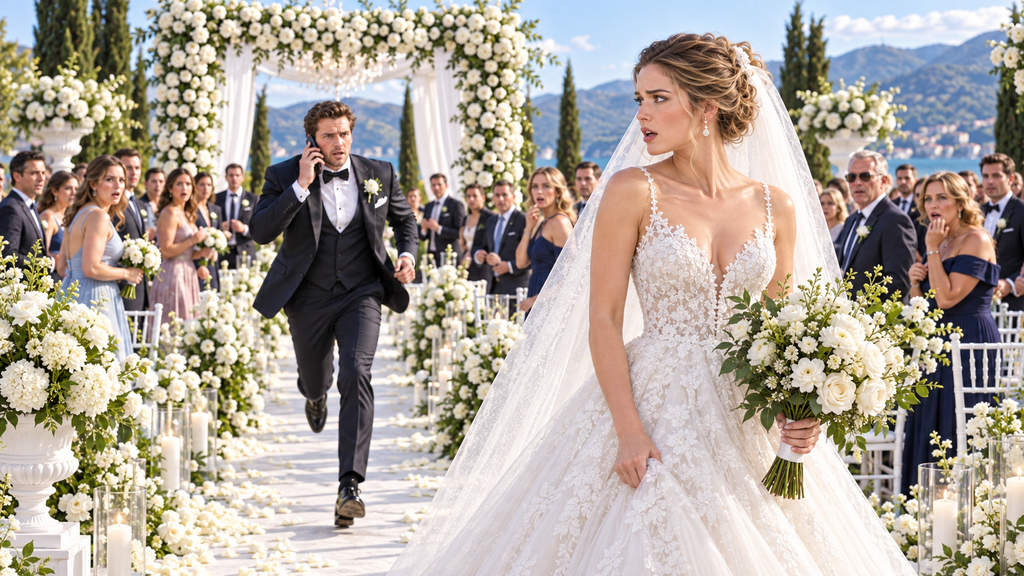
The woman standing under those white roses did not know that yet.
She only knew her fiancé had chosen someone else in front of two hundred guests.
She only knew her heart was breaking.
She only knew the secret documents waiting in her office meant the next morning would be very different.
So she removed her veil.
She looked at the doors.
And somehow, beneath all the humiliation and grief, she smiled.
Not because she had won.
Not because Adrian had lost.
Not because revenge was coming.
She smiled because, for the first time in years, the decision was no longer hers to make.
Adrian had made it.
Clearly.
Publicly.
Irrevocably.
And sometimes the greatest gift a person can give you is showing you exactly who they are at the moment you finally have enough strength to believe them.
James walked toward me from the dance floor.
“Mrs. Mercer?”
I smiled.
“I kept my name.”
He put a hand over his heart.
“Rejected on our wedding night.”
“You signed the paperwork.”
“I was emotional.”
“Too late.”
He laughed and held out his hand.
“Dance with me?”
I looked toward Mara.
She waved me away.
I took his hand.
James led me beneath the lights.
Halfway to the dance floor, he leaned closer.
“Something funny?”
“What?”
“You’re smiling.”
I looked around.
At the people I loved.
At the company we had saved.
At my sister.
At the river.
At the man holding my hand without trying to own it.
Then I remembered another wedding.
Another man.
Another question.
If I come back right now, will you still choose me?
And Adrian’s immediate answer.
Yes.
For years, I believed that yes was the cruelest word anyone had ever said to me.
Now I understood.
It had simply been the truth arriving on time.
I looked at James.
“Just thinking about timing.”
“Good timing or bad timing?”
I rested my head against his shoulder.
“Perfect.”
And this time, when I said it, nothing was ending.
Everything was beginning.
THE END! THANK YOU FOR READING!❤️