 Reading Time: 51 minutes
“Commander… there’s something you need to see about the fourth boy.” Major Bishop’s words hung between us. I glanced through the narrow window in the hospital door.
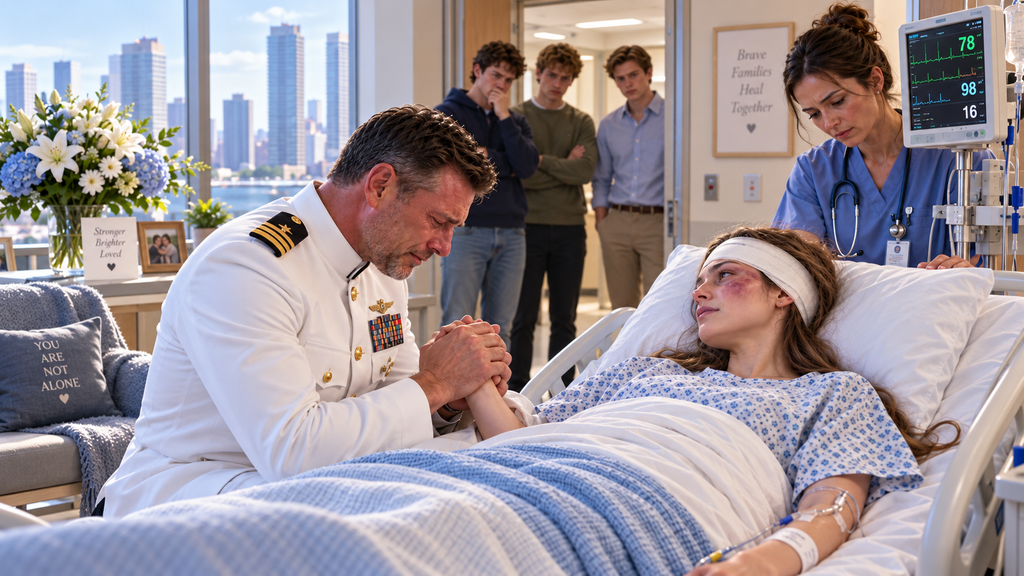
Nora had fallen asleep beneath a thin white blanket. Even unconscious, she kept one hand curled near her chest, as though she were holding on to something no one else could see.
“What about Preston Caldwell?”
Bishop did not answer immediately.
That bothered me more than if he had sworn.
Finally, I heard him exhale.
“Preston didn’t leave campus with the other three.”
I tightened my grip on the phone.
“Explain.”
“He left in an ambulance.”
I went still.
“What?”
“I pulled hospital intake records through an old contact who owes me more favors than either of us should admit. Preston Caldwell was admitted to St. Matthew’s Medical Center forty-seven minutes after Nora.”
My eyes moved toward my sleeping daughter again.
“For what?”
“Three fractured ribs. A dislocated shoulder. Concussion. Split lip.”
There was another pause.
“And bruising around his throat.”
For several seconds, the only sound in the hallway was the distant electronic beeping of medical equipment.
“Who did it?”
“We don’t know yet.”
I stared at the floor.
Four names had been written on that bloodstained piece of paper.
Chad Kensington.
Brantley Sterling.
Wyatt Holbrook.
Preston Caldwell.
I had assumed they were four attackers.
Maybe Nora had been telling me something more complicated.
“Where is Preston now?”
“That’s the interesting part.”
Bishop’s keyboard started clicking again.
“Officially, he was discharged to his family.”
“And unofficially?”
“Nobody has seen him since.”
A coldness settled inside me.
“Bishop.”
“Yes, Commander?”
“Find him.”
His answer came without hesitation.
“Already looking.”
I ended the call.
Then I walked back into Nora’s room.
She was awake.
Her eyes were barely open, but they were fixed on me.
I sat beside her.
“Hey.”
She blinked slowly.
Because of the wires holding her jaw in place, she couldn’t speak.
So I handed her my phone.
“Can you type?”
Her fingers trembled.
It took almost a minute.
Then she handed the phone back.
Four words appeared on the screen.
PRESTON TRIED TO HELP.
I looked at her.
My daughter’s eyes filled with tears.
I typed a question.
Did the other three hurt him?
She nodded.
Then she took the phone again.
Her fingers moved painfully across the screen.
He brought me there.
Another pause.
He said they only wanted to talk.
Then:
When Chad hit me, Preston tried to stop them.
Her hands began shaking harder.
I reached toward her.
She pulled back.
Not because she was afraid of me.
Because she needed to finish.
They beat him too.
My chest tightened.
Nora looked at me.
Then she typed one final sentence.
Dad, they weren’t trying to scare me because of some party.
I read it twice.
I looked up.
Her expression had changed.
There was fear in it.
But beneath the fear was something else.
Something I recognized.
Determination.
I gave the phone back.
“Why did they attack you?”
Nora typed slowly.
Because of Emma Ruiz.
I had never heard the name.
“Who is Emma?”
Nora swallowed painfully.
Then she typed.
A freshman.
She disappeared from school six months ago.
And suddenly, the attack on my daughter became something much bigger.
THE GIRL WHO DISAPPEARED
Nora had always been stubborn about injustice.
Her mother used to laugh about it.
When Nora was six, she saw a boy shove another child off a swing and marched directly between them.
When she was eleven, she found out a classmate was eating lunch alone because other kids mocked his stutter.
For the next four months, Nora sat beside him every day.
When she was fifteen, she confronted a teacher for humiliating a girl who couldn’t afford a field trip.
That was Nora.
She was gentle.
Until someone weaker than her needed help.
Then she became steel.
According to what she typed over the next twenty minutes, Emma Ruiz had entered Worthington University on a full academic scholarship.
First person in her family to attend college.
Straight-A student.
Pre-law.
Her father repaired elevators.
Her mother cleaned offices at night.
Emma had spent eighteen years doing everything right.
Six months into her freshman year, she suddenly withdrew from school.
No explanation.
No goodbye.
People were told she had suffered “emotional difficulties.”
Nora didn’t believe it.
Because two weeks before Emma vanished, she had shown up at Nora’s dorm room crying.
She claimed Chad Kensington had assaulted her after a fraternity fundraiser.
She had gone to campus security.
Two days later, she was summoned to the university president’s office.
A lawyer was waiting.
So was Chad’s father.
Emma was told there had been “a misunderstanding.”
She was also reminded that her scholarship was funded through a foundation connected to the Kensington family.
Then a confidential settlement appeared.
Emma refused to sign.
Three days later, security footage from the fraternity house mysteriously became corrupted.
Witnesses changed their stories.
A disciplinary complaint disappeared.
Within two weeks, Emma was gone.
Nora had tried calling her.
No answer.
Then, one month ago, Nora received an envelope.
No return address.
Inside were photocopies.
Complaints.
Settlement agreements.
Security reports.
Internal university emails.
Not one victim.
Seven.
Seven young women over four years.
Different accusations.
Different dates.
Same names appearing again and again.
Chad Kensington.
Brantley Sterling.
Wyatt Holbrook.
And sometimes—
Preston Caldwell.
But Preston’s name appeared differently.
He wasn’t identified as an attacker.
He was listed as a witness.
Twice.
In one complaint, Preston had allegedly told an investigator that Chad had been intoxicated and aggressive.
Three days later, his statement had been withdrawn.
In another report, Preston said he saw Wyatt dragging an unconscious student toward a vehicle.
That statement disappeared too.
Nora had begun copying everything.
She contacted two former students.
Then a third.
And eventually—
Emma.
Emma finally responded.
She had never willingly left Worthington.
Her parents had been threatened with financial ruin.
Her father’s employer suddenly lost a major contract.
Her younger brother’s private-school scholarship disappeared.
The Ruiz family understood the message.
Stop talking.
Or everyone you love suffers with you.
Nora wanted to expose it.
She had arranged to meet a reporter.
But someone discovered what she was doing.
Three days later, Preston Caldwell approached her.
He told Nora that Chad knew.
He begged her to destroy the documents.
Nora refused.
Preston insisted she didn’t understand how powerful their families were.
She asked him why he was warning her.
Preston said something she had never forgotten.
Because I’ve spent my entire life watching my father make problems disappear.
The night Nora was attacked, Preston called her.
He told her Chad wanted to meet.
Five minutes.
Public campus parking structure.
He promised nothing would happen.
Nora went because Preston claimed he was finally willing to testify.
Instead, Chad, Brantley, and Wyatt were waiting.
Preston realized too late that he had been used to lure her there.
Chad demanded the documents.
Nora refused.
He slapped her.
Preston stepped between them.
Brantley struck him from behind.
Then all three turned on Nora.
By the time Preston got back to his feet, Nora was already on the ground.
He threw himself over her.
That was how he got the broken ribs.
The last thing Nora remembered was Preston screaming at them to stop.
Then someone kicked her in the face.
Everything went black.
I sat beside my daughter, reading the final message she had typed.
I thought Preston left me there.
A tear slid into her hair.
Another message.
But I heard him call 911 before I passed out.
Then:
Dad, if he disappeared, they did something to him.
My daughter was asking me to help one of the people I had arrived prepared to destroy.
I studied her swollen face.
A strange feeling moved through me.
Pride.
Even after what had happened to her, Nora still cared whether somebody else was suffering.
I covered her hand with mine.
“I’ll find him.”
Her eyes closed.
Then she typed one final word.
Promise?
I leaned forward and kissed her forehead.
“Promise.”
At 3:12 that morning, Task Force Vanguard came back from the dead.
Not with guns.
Not with uniforms.
Not with helicopters.
We were older now.
Some of us had gray hair.
One had an artificial knee.
Another wore reading glasses.
But the thing that had once made Vanguard dangerous had never been firepower.
It was the fact that each member knew how to find the truth when somebody powerful wanted it buried.
Major Thomas Bishop arrived first.
He walked into the hospital waiting room carrying an old leather laptop bag and wearing a charcoal suit that looked slept in.
He had been thirty-two the last time I saw him.
Now he was fifty-one.
His hair was almost completely silver.
But his eyes were the same.
Sharp.
Patient.
Always noticing.
He stopped six feet away from me.
Neither of us spoke for several seconds.
Then he smiled faintly.
“You got old, Commander.”
“So did you.”
“Speak for yourself.”
I almost smiled.
Then his expression changed.
“How is she?”
“Alive.”
Bishop nodded.
Sometimes soldiers understand everything contained inside one word.
Alive meant broken.
Alive meant hurting.
Alive meant we still had a chance.
Behind him came Colonel Lena Ortiz.
She had left the Army and spent twelve years as a federal prosecutor before entering private practice.
She carried no weapon.
Just a red legal folder.
Frankly, Lena had always frightened more people with folders than the rest of us did with rifles.
She hugged me.
No salute.
No formalities.
Just a hug.
“I’m sorry, David.”
“Thank you.”
The third person through the door was Marcus Reed.
Former intelligence specialist.
Now an investigator for financial crimes cases.
Six foot four.
Broad shoulders.
Thick beard.
He looked at me.
Then toward Nora’s room.
“Which one do you want first?”
Lena shot him a look.
“Marcus.”
“What?”
“We are not murdering college students.”
“I meant interviewing.”
“No, you didn’t.”
Marcus shrugged.
I stared at all three of them.
Nineteen years.
Nineteen years since we had stood in the same room.
Nineteen years since I walked away.
And yet none of them asked why I had called.
None hesitated.
Bishop placed his bag on a table.
“You said everything.”
“Yes.”
He opened the laptop.
“So here’s everything.”
The screen filled with names.
Companies.
Foundations.
University board members.
Political donations.
Construction contracts.
Private-security firms.
Banking connections.
Bishop pointed.
“Chad’s father, Lawrence Kensington, controls Kensington Development Group. They have roughly two billion dollars in active university and municipal construction projects.”
Next.
“Brantley Sterling’s family owns Sterling Capital Partners. Private equity, commercial property, debt acquisition.”
Next.
“Wyatt Holbrook’s mother sits on the state university oversight commission. His father owns Sentinel Strategic Services.”
I frowned.
That name.
Sentinel.
Something inside me shifted.
Bishop saw it.
“Recognize it?”
“Yes.”
I stepped closer.
Sentinel Strategic Services had once been called Sentinel Defense Logistics.
Nineteen years earlier, Sentinel had been one of the private contractors attached to an operation that destroyed Task Force Vanguard.
Lena noticed my expression.
“What is it?”
I didn’t answer immediately.
There are memories you bury so deeply that even thinking about them feels like digging up a grave.
A desert road.
Burning vehicles.
Radio silence.
Seven men waiting for extraction that never came.
Four of them never leaving that valley.
Sentinel had been responsible for logistics.
They changed a route.
Delayed an aircraft.
Then claimed miscommunication.
For years I believed it had been incompetence.
Later I discovered evidence suggesting otherwise.
But before I could prove it, the investigation was classified.
Vanguard was dissolved.
My record vanished.
And I was given a choice.
Keep digging.
Or disappear and keep my family safe.
Nora had been six months old.
I chose her.
“What about Caldwell?” I asked.
Bishop looked down.
And I knew.
There it was.
The thing he had hesitated to tell me.
“Preston Caldwell’s father isn’t just a banker.”
A photograph appeared.
Malcolm Caldwell.
White hair.
Expensive suit.
Polished smile.
I knew him.
I had known him before half the country knew his name.
Nineteen years earlier, Malcolm Caldwell had been Sentinel Defense Logistics’ chief legal adviser.
He had been one of the civilians sitting in the room when Task Force Vanguard was ordered to stand down.
He had looked me directly in the eyes after four of my men died and told me there would be no investigation.
I whispered his name.
“Caldwell.”
Lena looked at me.
“You know him.”
“He helped bury Vanguard.”
Silence.
Marcus stopped smiling.
Bishop turned the laptop toward me.
“There’s more.”
A scanned document appeared.
CLASSIFIED.
OPERATION NIGHT LANTERN.
My old designation appeared beneath it.
VANCE, DAVID A.
COMMANDING OFFICER.
My throat tightened.
“Where did you get this?”
“I didn’t.”
Bishop clicked.
“Preston did.”
I stared at him.
“What?”
“Three months ago, someone using an encrypted account uploaded portions of the Vanguard archive into a protected cloud server. I found the access trail because Preston’s laptop synchronized with it.”
“Why would Caldwell’s son have my file?”
Bishop leaned back.
“My guess?”
“Yes.”
“He found his father’s private archive.”
Something shifted inside my chest.
Bishop opened another document.
This one wasn’t military.
It was a personal letter.
Handwritten.
Malcolm Caldwell’s handwriting.
The recipient was Wyatt Holbrook’s father.
The date was nineteen years ago.
Bishop read one sentence aloud.
“Vance has refused to let the matter die. If necessary, we will ensure he does.”
Lena went pale.
Marcus muttered something under his breath.
I continued staring at the letter.
For nineteen years, I had wondered whether I had been paranoid.
Whether I had imagined the threat.
Whether disappearing had really been necessary.
Now I was looking at proof.
My old life and Nora’s attack were connected by the same families.
Not because anyone knew who Nora’s father was.
But because the machine that had buried my soldiers nineteen years ago had never stopped operating.
It had simply found new things to bury.
Contracts.
Crimes.
Victims.
Young women.
And now my daughter.
Bishop spoke quietly.
“David.”
I looked at him.
“If Preston found all this, his father knows.”
“And if his father knows…”
“He knows Preston can destroy him.”
I turned toward the hospital window.
“Find the boy.”
Bishop nodded.
Then Lena caught my arm.
“And David?”
I looked at her.
“We do this right.”
Her eyes held mine.
“No bodies.”
“No revenge.”
“No disappearing people.”
“You understand me?”
I thought of Nora.
Of the swelling around her face.
Of the surgeon pointing to six fractures.
For one dark second, an older version of me whispered that justice was too slow.
That men like Caldwell understood fear better than courtrooms.
Then I remembered my daughter typing through trembling fingers.
Promise?
I looked at Lena.
“We do it right.”
She held my gaze for another second.
Then nodded.
“Good.”
Marcus sighed.
“I liked the old Commander better.”
Lena looked at him.
“No, you didn’t.”
Marcus considered it.
“Fair.”
THE FIRST CRACK
At 6:40 a.m., Bishop found Preston’s phone.
Or rather, he found where it had stopped moving.
Forty miles outside the city.
A private property belonging to Caldwell Agricultural Holdings.
Which sounded wholesome until you realized Malcolm Caldwell hadn’t grown anything in his life.
The property was an old hunting lodge surrounded by six hundred acres.
Preston’s phone had arrived there at 11:18 p.m.
Then gone dark.
“We call law enforcement,” Lena said.
Marcus shook his head.
“Local sheriff’s campaign committee received twenty-seven thousand dollars from Caldwell interests last year.”
“Then state police.”
“Caldwell’s brother-in-law chaired their appropriations committee for eight years.”
“Federal?”
Bishop looked at me.
“We need probable cause.”
I stared at the map.
Then Nora texted me from her hospital bed.
Ask about the watch.
I walked back into her room.
“What watch?”
She pointed toward my phone.
Then typed.
Preston always wears one.
Old black sports watch.
He told me his mother gave it to him before she died.
Said he never takes it off.
Bishop heard me repeat the message.
His expression changed.
“What brand?”
Nora typed it.
Bishop smiled.
“I love your daughter.”
I raised an eyebrow.
“Respectfully.”
He started typing.
“Certain models retain independent location data even if the paired phone is disabled.”
Lena crossed her arms.
“Can you access it legally?”
“No.”
“Then don’t.”
Bishop sighed dramatically.
“Lawyers ruin everything.”
But Nora had something better.
She knew Preston’s sister.
Claire Caldwell.
Twenty-three.
Graduate student in Boston.
Nora had met her twice.
At 7:03 a.m., Nora sent Claire a message.
Your brother is in danger. Call me.
Claire called in twelve seconds.
I answered.
“Who is this?”
“My name is David Miller. I’m Nora’s father.”
Silence.
Then:
“Oh my God.”
“You know what happened?”
“My father said Nora was injured in an accident.”
“She was beaten.”
Claire began breathing faster.
“Where’s Preston?”
“That’s what we’re trying to determine.”
“My father said he sent Preston abroad.”
“He didn’t.”
Silence again.
Then Claire whispered:
“I knew it.”
“What?”
“Preston called me last night.”
Everyone in the room looked toward the phone.
Claire continued.
“He was crying. I’ve never heard my brother cry.”
“What did he say?”
“He said he’d done something terrible.”
My stomach tightened.
“He said he brought Nora to Chad.”
Claire’s voice broke.
“He said he thought they were just going to frighten her. Then Chad started hitting her.”
I closed my eyes.
“He tried to stop them.”
“I know.”
“How?”
“Because Preston told me Chad and Wyatt beat him until he couldn’t stand.”
Nora turned her face away.
Claire continued.
“He called 911. Then he called me from the hospital. He said Dad was coming.”
“What happened when your father arrived?”
“He told Preston not to say anything.”
“Then?”
“Preston told him he was done protecting everyone.”
Claire swallowed.
“He said he had copies.”
Bishop moved closer.
“Copies of what?” I asked.
“Everything.”
The room became completely silent.
“Claire, I need you to tell me exactly what your brother said.”
She took a breath.
“He said, ‘If Dad comes after Nora, I’m burning the whole kingdom down.’”
Marcus slowly smiled.
I didn’t.
Because men like Malcolm Caldwell did not hear threats from their children as rebellion.
They heard them as problems.
“Does Preston have the watch Nora mentioned?”
“Yes.”
“Can you access the account?”
“Yes.”
Lena spoke immediately.
“Claire, if you voluntarily access your brother’s shared family-location account, can you see his device?”
There was tapping.
Then a gasp.
“Yes.”
“Where is he?”
Claire gave us the address.
The hunting lodge.
But the watch had not stopped there.
It was moving.
Fast.
North.
Bishop opened a map.
Claire read the location updates aloud.
Highway 18.
Then Route 6.
Then an industrial road.
Marcus leaned toward the screen.
“Where are they taking him?”
Bishop zoomed out.
There was almost nothing ahead.
Except an airfield.
Private.
Owned by Caldwell Aviation Holdings.
Lena was already dialing.
“Now we have a witness reporting possible unlawful detention, a live location and evidence he may be transported.”
She looked at me.
“I have someone at the U.S. Attorney’s Office who will listen.”
I nodded.
“Call.”
For nineteen years, I had lived with the belief that institutions could be bought.
Some could.
Some people could.
But corruption makes one mistake repeatedly.
It assumes everyone has a price.
They don’t.
At 7:32 a.m., Lena reached Assistant U.S. Attorney Rachel Monroe.
At 7:41, Monroe contacted a federal magistrate.
At 7:52, federal agents were moving.
At 8:06, the vehicle carrying Preston Caldwell reached the private airfield.
At 8:11, a Gulfstream began preparing for departure.
At 8:14, three black SUVs entered through the main gate.
Not ours.
Federal agents.
The plane never left the ground.
Preston Caldwell was found in the rear cabin.
No passport.
No luggage.
One hospital bracelet still around his wrist.
Two private security employees claimed he was voluntarily traveling to Switzerland for medical treatment.
Preston told agents three words.
“I was kidnapped.”
And with that—
the first crack appeared in the wall.
PRESTON CALDWELL
I met him that afternoon.
Federal protection placed him in another wing of the same hospital.
When I entered, Preston looked nothing like the arrogant billionaire’s son I had imagined.
His left eye was swollen.
His shoulder was immobilized.
Bandages wrapped his ribs.
He looked twenty years older than twenty-one.
When he saw me, fear crossed his face.
“You’re Nora’s father.”
“Yes.”
He tried to sit up.
Pain stopped him.
“I’m sorry.”
I said nothing.
Tears appeared in his eyes.
“I didn’t know they were going to hurt her.”
Still, I said nothing.
“I swear.”
“Did you bring my daughter to them?”
His face collapsed.
“Yes.”
“Then you bear responsibility.”
“I know.”
“Do you?”
He looked away.
I stepped closer.
“For the rest of your life, Preston, when Nora touches the plates in her jaw, part of that belongs to you.”
He began crying silently.
I didn’t enjoy it.
That surprised me.
Twenty-four hours earlier, I would have imagined satisfaction.
There was none.
Only exhaustion.
“You made a coward’s decision,” I said.
He nodded.
“My whole life has been cowardly.”
“No.”
He looked at me.
“One decision doesn’t get to become your entire identity unless you let it.”
His breathing shook.
“You tried to stop them.”
“Too late.”
“Yes.”
I pulled a chair beside his bed.
“But you called 911.”
“Yes.”
“You kept evidence.”
His eyes snapped toward me.
“How do you know?”
“Because you’re not the only person who knows how to hide things.”
Something changed in his expression.
Recognition.
He stared at me.
Then whispered:
“Vance.”
The room seemed to shrink.
I stood very still.
Preston swallowed.
“Commander David Vance.”
I closed the door.
“How do you know that name?”
“My father.”
He looked toward the hallway.
“He kept files.”
“What files?”
“Everything.”
Preston spoke for almost an hour.
His mother had died when he was sixteen.
Afterward, Preston began drinking.
Getting into trouble.
His father covered everything.
Traffic tickets vanished.
A drug possession charge disappeared.
A school fight became a misunderstanding.
At first, Preston loved it.
Then he began noticing how easy it was.
Not just for him.
For everyone around his father.
Judges attended Caldwell fundraisers.
University presidents called him personally.
Police chiefs played golf at his estate.
Business partners received contracts after private dinners.
Problems vanished.
People vanished from careers.
Complaints disappeared.
Eventually Preston began wondering what else his father had erased.
One night, he opened a locked room in Caldwell’s study.
Inside were physical files.
Decades of them.
Politicians.
Executives.
Judges.
Military contractors.
Journalists.
Victims.
Enemies.
Leverage.
And one thick gray folder labeled:
VANGUARD.
Preston opened it.
That was how he learned about me.
About Operation Night Lantern.
About Sentinel.
About the extraction that never came.
And about a handwritten order instructing Caldwell’s people to monitor my wife.
My blood turned cold.
“What?”
Preston nodded.
“Your wife.”
“Her name was Sarah.”
“I know.”
I grabbed the bedrail.
Sarah had died twelve years ago.
Cancer.
Nothing suspicious.
Nothing anyone caused.
But the thought that Caldwell had watched her while Nora was an infant made something ancient wake inside me.
Preston continued.
“Your family was under surveillance for almost eight months.”
“Why?”
“Because my father believed you had copied documents.”
I remembered.
Of course.
The missing procurement files.
The altered route orders.
The payments routed through shell companies.
I had copied everything onto an encrypted drive.
Then hidden it.
But Sarah had begged me to let it go after men began following her.
So I did.
Or I thought I did.
“Where are those files now?” I asked.
Preston stared at me.
“My father doesn’t have them.”
“Then who does?”
He swallowed.
“I think you do.”
I frowned.
“That’s impossible.”
“No.”
He leaned closer despite the pain.
“My father wrote a note about you.”
“What note?”
Preston recited it from memory.
“Vance never destroyed his insurance policy. He hid it inside the only thing he trusted more than Vanguard.”
My heart stopped.
The only thing I trusted more than Vanguard.
Sarah.
I stood.
Memories crashed through me.
Our first apartment.
Nora’s birth.
Sarah standing in the kitchen holding our baby.
The night I came home and told her everything.
Her crying.
My promise.
I had given Sarah the drive.
I told her to hide it somewhere nobody connected to my work could find it.
I never asked where.
Because not knowing was safer.
After Sarah died, I packed away her belongings without going through most of them.
Twelve years.
The answer might have been in my house for twelve years.
Preston watched my face.
“You know where it is.”
“I know where to look.”
Then his expression changed.
“There’s something else.”
“What?”
“The university.”
He reached for water.
I helped him.
After drinking, he continued.
“Those girls weren’t the beginning.”
“What do you mean?”
“My father and the others have used Worthington for years.”
“For what?”
“Money.”
Bishop had been right.
Universities receive enormous construction funding.
Research grants.
Defense partnerships.
Real-estate financing.
Technology contracts.
Scholarship foundations.
Each of the four families had interests intersecting through Worthington.
Kensington built facilities.
Sterling financed them.
Holbrook supplied private security and data systems.
Caldwell arranged capital and political connections.
Together, they moved hundreds of millions.
And according to Preston, some contracts were inflated.
Some companies barely existed.
Some money flowed into shell organizations.
Anyone who asked too many questions was pressured.
Employees were fired.
Audits were delayed.
Students were easy to intimidate.
Especially students without powerful families.
The assault allegations had become part of the same culture.
The sons had grown up watching their fathers erase consequences.
Eventually, they believed consequences did not exist.
Nora threatened that belief.
“She had copies of complaints,” Preston said.
“I know.”
“No.”
He shook his head.
“She had more.”
I stared at him.
“What?”
“Emma Ruiz didn’t just send her assault documents.”
Preston looked terrified.
“She sent financial records.”
That explained everything.
The attack had not merely been three spoiled young men protecting themselves.
Their fathers had something at stake too.
Nora had unknowingly been carrying evidence of federal crimes.
“How much did Nora know?”
“Almost nothing. She thought the spreadsheets were university budget records.”
“Who knew she had them?”
“Chad.”
“How?”
“His father told him.”
I leaned back.
There it was.
The fathers had known before the attack.
Maybe they never explicitly ordered their sons to break Nora’s jaw.
People like Caldwell were smarter than that.
They didn’t say:
Destroy her.
They said:
Handle the problem.
Young men raised without consequences supplied the rest.
I looked at Preston.
“Will you testify?”
Fear moved across his face.
“My father will destroy me.”
“Maybe.”
“He can ruin Claire too.”
“Maybe.”
“He’ll go after Nora.”
“He already did.”
Preston looked down.
I waited.
Courage is rarely the absence of fear.
Usually, it is a person looking at everything they could lose and deciding some things matter more.
Finally Preston raised his eyes.
“Yes.”
I nodded.
“Yes what?”
“I’ll testify.”
“About all of it?”
His jaw tightened.
“All of it.”
For the first time, Preston Caldwell stopped being his father’s son.
SARAH’S BOX
I had not been home in thirty-one hours.
The house felt wrong without Nora.
Her sneakers sat beside the front door.
A mug she had used during her last visit was still in the dishwasher.
On the refrigerator was a photograph of her and Sarah taken months before Sarah died.
Nora was seven.
Two missing front teeth.
Sarah’s arms wrapped around her.
For a moment, the mission disappeared.
I was just a widower standing in a dark kitchen, wishing the dead could answer questions.
I walked upstairs.
Sarah’s belongings were in the cedar chest at the foot of my bed.
I had opened it perhaps five times in twelve years.
Her scarf lay on top.
Then letters.
Photographs.
A tiny pair of Nora’s baby shoes.
Sarah kept everything.
I sat on the floor.
For twenty minutes, I found nothing.
Then I saw the blue cookbook.
Sarah couldn’t cook.
She once burned boiled eggs.
I used to tease her because she owned exactly one cookbook and never opened it.
The spine felt too thick.
I opened it.
Pages had been cut away from the center.
Inside was a small black drive.
My hands began shaking.
Beneath it was an envelope.
My name.
Sarah’s handwriting.
I stared at it for almost a minute before opening it.
Inside was a letter.
David,
If you’re reading this, then something you hoped would stay buried has come back.
I stopped breathing.
I could almost hear her voice.
You gave me this because you said I was the one person you trusted more than yourself.
You also told me to destroy it if you ever became obsessed with revenge.
Despite everything, I laughed once.
That sounded exactly like Sarah.
Then I kept reading.
I didn’t destroy it.
Not because I wanted you to fight.
Because truth should not belong only to powerful people.
My vision blurred.
If Nora is grown when you find this, then I hope you kept the promise you made me. I hope she knows you as her father before she ever knows you as a soldier.
I covered my mouth.
For nineteen years, that had been my greatest fear.
That my old life would enter Nora’s world.
That she would look at me differently.
Sarah had known.
She always knew.
David, if the past comes back, don’t become the man you were before us.
Be the man we made together.
Below that:
Protect Nora.
Protect the truth.
And come home.
I sat on the bedroom floor crying.
Not loudly.
There are some kinds of grief that don’t need sound.
After twelve years, my wife had reached through time and reminded me who I was.
Not the Phantom Commander.
Not Commander Vance.
David.
Nora’s father.
Sarah’s husband.
I wiped my face.
Then I picked up the drive.
Bishop called thirty seconds after I plugged it into an isolated computer.
“Well?”
“I found it.”
His voice became serious.
“Bring it.”
“No.”
“Commander—”
“If Caldwell has watched me before, assume someone may still be watching the house.”
Silence.
“Good point.”
“I’ll contact Lena. We transfer it properly.”
Bishop chuckled.
“Look at you using chain of custody.”
“Don’t get emotional.”
“I’m proud.”
I almost hung up.
Then he said:
“David?”
“Yes.”
“We found Emma Ruiz.”
I stood.
“Where?”
“Two states away.”
“Is she safe?”
“She is now.”
EMMA’S STORY
Emma did not look like somebody waiting to become a hero.
When I met her through a protected video call, she wore an oversized sweatshirt and kept glancing toward the door.
Her mother sat beside her.
Her father stood behind them.
They looked exhausted.
I introduced myself.
Emma nodded.
“I know who you are.”
That surprised me.
“Nora told me about you.”
Something inside my chest softened.
“What did she say?”
Emma almost smiled.
“She said you were annoyingly protective.”
“That sounds like her.”
“She said if you ever found out what she was doing, you’d lock her in a bunker.”
“That also sounds like her.”
For a moment, Emma smiled fully.
Then it disappeared.
“How is she?”
“Hurting.”
Emma looked down.
“This is because of me.”
“No.”
Her mother reached for her hand.
Emma continued.
“If I hadn’t sent her those files—”
“Stop.”
She looked at me.
“What happened to Nora belongs to the people who hurt her.”
Emma’s eyes filled with tears.
“You sound like her.”
I leaned forward.
“Then help me understand.”
Emma began talking.
The night Chad assaulted her, she had not been completely alone.
A sophomore named Rachel Kim had seen Chad pull Emma into an upstairs room.
Rachel reported it.
Two days later, Rachel received notice that her campus employment position was being eliminated.
Then her father’s small architecture company lost a subcontract tied to Kensington Development.
Coincidence.
That was the word administrators used.
Emma filed a complaint anyway.
The university hired an outside investigator.
The investigator’s firm had received consulting fees from Sentinel Strategic Services.
The complaint went nowhere.
Then Malcolm Caldwell appeared.
Not personally.
People like Caldwell rarely touched anything directly.
A lawyer representing the university met Emma’s parents.
He showed them records of Emma drinking at the fundraiser.
He warned them about defamation claims.
He explained how expensive litigation could become.
Then he offered money.
Emma refused.
A week later, her scholarship entered “administrative review.”
Her father’s employer lost two contracts.
Her mother’s supervisor told her fewer shifts were available.
Her younger brother’s school suddenly claimed his scholarship application was incomplete.
The message was obvious.
Emma’s father began crying during the call.
“I told her to take the deal.”
Emma reached for him.
“Dad.”
“I did.”
He looked into the camera.
“I told my own daughter to sign a paper saying she misunderstood what happened because I was scared.”
I recognized the shame.
Not because I had lived his exact situation.
But because powerful people rely on ordinary people blaming themselves for survival.
“You protected your family the only way you knew how,” I said.
Emma’s father wiped his face.
“Didn’t feel like protection.”
“No.”
I understood that too.
Sometimes survival feels too much like surrender.
Emma signed.
She withdrew.
But before she left, someone inside the university mailed her a flash drive.
No name.
No note.
Just records.
Contracts.
Invoices.
Security-system logs.
Settlement payments.
Seven years of patterns.
Emma was terrified.
She hid them.
Then months later, she found Nora online.
Nora had posted a message in a private student group asking whether anyone had experienced intimidation after reporting misconduct.
Emma contacted her.
At first she sent only the complaint files.
Then she sent the financial documents.
“Why?”
Emma stared into the camera.
“Because Nora believed me.”
Three words.
That was all.
Because Nora believed me.
My daughter had nearly died because one frightened young woman needed one person to believe her.
I looked toward Nora’s room through the glass.
My anger changed shape.
Until that moment, it had been personal.
They hurt my child.
That was enough.
But now I understood something.
Nora had stepped into a line of people who had been hurt before her.
She wasn’t the beginning.
She was simply the first victim whose father happened to know where bodies were buried.
Figuratively.
Mostly.
I looked at Emma.
“Will you speak to federal investigators?”
Fear returned.
“My family—”
“Will be protected as much as the law allows.”
“What if it doesn’t work?”
I could not promise her nothing bad would happen.
That would be dishonest.
So I told her the truth.
“Then we keep going.”
Emma studied me.
“Are you really that Phantom Commander person?”
My eyebrows rose.
Her mother looked confused.
“Emma.”
“What? Nora mentioned it once as a joke. She said her dad was so mysterious he probably had a secret code name.”
Despite everything, I laughed.
“No.”
Emma looked disappointed.
“I’m just her dad.”
That answer felt better.
THE OFFER
At 4:15 that afternoon, Malcolm Caldwell called me.
Not through an attorney.
Personally.
I answered from the hospital hallway.
“Mr. Miller.”
His voice had changed less than I expected.
Still calm.
Still smooth.
Still carrying the quiet certainty of a man accustomed to being listened to.
“Malcolm.”
Silence.
He knew immediately.
“David.”
There it was.
Nineteen years vanished between us.
“I wondered when you would stop pretending,” he said.
“I stopped pretending a long time ago.”
“Then why the new name?”
“To raise my daughter without people like you knowing where she slept.”
He sighed.
“You always were dramatic.”
I looked through the glass.
Nora was asleep.
A feeding tube delivered nutrition because she could not chew.
Six fractures.
“Tell me something, Malcolm.”
“Yes?”
“When you saw what they did to her, did you feel anything?”
He paused.
“That was regrettable.”
Regrettable.
I closed my eyes.
Not horrifying.
Not unforgivable.
Regrettable.
Like a delayed flight.
A bad investment.
A scratch on a car.
“She’s nineteen.”
“I am aware.”
“Your people erased the cameras.”
“I have no idea what you’re referring to.”
“Your people pressured the detective.”
“Careful.”
“Your people tried putting your own son on a plane against his will.”
This time his voice sharpened.
“Preston is unwell.”
“He’s talking.”
Silence.
A beautiful silence.
For the first time, Malcolm Caldwell did not know what to say.
I continued.
“He’s talking about Worthington.”
No response.
“Sentinel.”
Still nothing.
“Night Lantern.”
He finally spoke.
“You should be very careful with old ghosts.”
I smiled faintly.
“Ghosts don’t scare me.”
“They should.”
“What do you want?”
“Reason.”
I almost laughed.
He continued.
“Your daughter has endured a terrible event. I’m prepared to ensure she receives the best medical care available anywhere in the world.”
“She already has excellent doctors.”
“Her future could be secured.”
“Her future isn’t for sale.”
“Ten million dollars.”
There it was.
The number was delivered casually.
As if a father could hear ten million and forget the sound his daughter made while trying to breathe through wires.
“No.”
“Twenty.”
“No.”
“Think carefully.”
“I already did.”
Malcolm became quiet.
Then:
“Thirty million.”
I stared through the glass.
Nora opened her eyes.
Saw me.
Lifted one hand.
I lifted mine.
“No.”
Caldwell’s voice hardened.
“You are an aging widower running a modest security consultancy. Do not pretend you are above money.”
“This isn’t about being above money.”
“What is it about?”
“My daughter waking up and knowing I didn’t put a price on what happened to her.”
His breathing changed.
“That righteousness was always your problem.”
“No, Malcolm.”
I looked at Nora.
“Men like you were.”
He stopped pretending to be polite.
“You think Preston’s testimony will survive cross-examination?”
“Yes.”
“A spoiled, intoxicated boy with a disciplinary history?”
“Yes.”
“You think Emma Ruiz will stand up to my attorneys?”
“Yes.”
“You think those old Vanguard records are enough to revive a nineteen-year-old classified investigation?”
“I don’t know.”
That answer surprised him.
I continued.
“But I don’t need to know.”
“What does that mean?”
“For nineteen years, you’ve won because everyone believed they had to beat you alone.”
I looked down the hallway.
Bishop.
Lena.
Marcus.
Federal agents.
A prosecutor.
A nurse who had preserved Nora’s clothes.
A dispatcher quietly recovering deleted call logs.
Students beginning to talk.
Parents beginning to talk.
Victims realizing other victims existed.
“But you made one mistake this time.”
Caldwell said nothing.
“You hurt someone who doesn’t stand alone.”
His voice dropped.
“You are threatening me.”
“No.”
I almost smiled.
“I’m telling you what’s happening.”
Then Malcolm said the sentence that destroyed him.
“You should remember what happened to the last men who stood beside you.”
I froze.
Every part of me became still.
“What did you say?”
He realized it.
Too late.
“That operation was tragic.”
“No.”
My voice became quiet.
“You said I should remember what happened to them.”
He said nothing.
“Almost as if you know exactly why extraction never came.”
The call ended.
I stared at the phone.
Lena stepped out of the room behind me.
Her eyes were wide.
“Please tell me that call was being recorded.”
I looked at her.
She smiled.
“Because mine was.”
For the first time in thirty-six hours, something resembling hope entered the room.
THE BOYS
The arrests began that evening.
Not because their families suddenly lost power.
Because evidence makes power expensive.
Chad Kensington was arrested first.
Investigators recovered blood matching Nora and Preston from the underside of his vehicle’s running board.
He claimed he had never been near Nora.
That lie lasted forty minutes.
Brantley Sterling was next.
His attorney insisted he had been home.
Then a rideshare driver produced dashcam video showing him three blocks from campus at 1:18 a.m.
Wyatt Holbrook surrendered through counsel.
His family released a statement describing the situation as “an unfortunate confrontation among students.”
Confrontation.
That word traveled across television screens while my daughter learned how to swallow liquid without choking.
I hated it.
I hated every sanitized word.
Incident.
Altercation.
Dispute.
Mistake.
People use small words when the truth is too ugly.
Nora had been kicked while lying on concrete.
Preston had been beaten when he tried to shield her.
That was not an altercation.
But Lena reminded me of something important.
“Let the evidence do the talking.”
I tried.
Then Chad’s attorney held a press conference.
He said Chad came from “a respected family.”
He said the accusations threatened “a promising young man’s future.”
I watched from Nora’s hospital room.
She stared at the television.
Then typed something.
Turn it off.
I did.
She typed again.
They always talk about their future.
I looked at her.
Another line appeared.
Nobody asked what happened to mine.
I sat beside her.
“It’s still there.”
She shook her head.
“Nora.”
She looked at me.
“I know it doesn’t feel like it.”
Tears appeared.
“I know everything hurts.”
She looked away.
“And I know I can’t promise things will go back to exactly how they were.”
Her eyes closed.
“But your future is still yours.”
She typed.
What if I look different forever?
That question hurt more than any threat Caldwell had made.
I looked at my daughter’s bruised face.
The swelling.
The wires.
The bandages.
I wished I could lie.
Tell her no scars would remain.
Tell her she would forget.
Tell her healing would erase everything.
Instead, I touched her hand.
“You might.”
She looked at me.
“You may have scars.”
A tear slid from her eye.
“You may feel angry when everyone expects you to be grateful you survived.”
Another tear.
“You may have days when you feel strong and days when getting out of bed feels impossible.”
I took her hand carefully.
“But none of that makes you less Nora.”
Her fingers tightened.
“You were my daughter when you had two front teeth missing and cut your own hair because you thought bangs looked easy.”
Her eyes widened.
I smiled.
“You were my daughter when you failed your first driving test because you argued with the examiner.”
She typed:
HE WAS WRONG.
“There she is.”
Something that might have been a laugh escaped through her nose.
I continued.
“And you will still be my daughter if you have scars.”
She stared at me.
“Nothing those boys did gets to decide whether your life is beautiful.”
Her eyes closed.
This time, when she cried, she didn’t turn away.
And neither did I.
THE SECOND CRACK
The recovered 911 call changed everything.
Someone had deleted it from the campus dispatch archive.
But an off-site backup retained fragments.
Preston’s voice.
Panicked.
Breathless.
“Send an ambulance. Parking structure C. Please. They’re killing her.”
Then shouting.
A second voice.
Chad.
“You stupid—give me the phone.”
The recording ended.
Next came the security footage.
Campus administrators had insisted the cameras malfunctioned.
Technically, they had.
Because someone remotely disabled them.
At 12:54 a.m.
Fourteen minutes before Nora entered the parking structure.
The account used belonged to the deputy director of campus security.
He initially denied everything.
Then investigators showed him transfer records.
Two hundred and fifty thousand dollars had been deposited into a consulting company owned by his brother.
The payment originated from a Sentinel subsidiary.
The deputy director asked for a lawyer.
Six hours later, he asked for a deal.
Then he started talking.
He had erased footage before.
Not once.
Nine times.
Always when the request came through the same university vice president.
That vice president reported directly to President Harold Mercer.
Mercer had been Worthington University’s president for eleven years.
He had cultivated a reputation for integrity.
Photographs showed him shaking hands with governors.
Donors.
Business leaders.
Students.
Behind closed doors, according to the security director, Mercer maintained what employees privately called the Quiet Desk.
Problems involving major donors were routed there.
Sexual misconduct.
Drugs.
Assaults.
Academic cheating.
Anything that could embarrass a family giving enough money.
The Quiet Desk made noise disappear.
Sometimes with settlements.
Sometimes with threats.
Sometimes by turning victims into problems.
Nora’s complaint file had landed on that desk at 5:26 p.m.
Hours before she was attacked.
Someone inside Worthington knew.
Someone alerted the families.
The sons acted that night.
Then the cover-up began.
Lena laid out the timeline across a conference-room table.
5:26 p.m.—Nora’s document request flagged.
5:43—Mercer’s office contacted outside counsel.
6:02—outside counsel called Malcolm Caldwell.
6:11—Caldwell called Lawrence Kensington.
6:18—Kensington called Chad.
8:47—Preston contacted Nora.
12:54 a.m.—security cameras disabled.
1:08—Nora entered parking structure.
1:11—the attack began.
1:16—Preston called 911.
1:23—first ambulance dispatched.
1:31—campus IT received instruction to classify camera failure as a technical malfunction.
Before Nora even reached the hospital—
the story had been written for her.
No witnesses.
No footage.
No case.
But people make mistakes when they believe nobody can challenge them.
They become lazy.
They leave records.
They send messages.
They assume employees will stay loyal forever.
They assume frightened people will remain frightened.
And they underestimate fathers.
Not because fathers are superheroes.
Because some fathers are willing to sit beside a hospital bed for three days and read every page.
NORA SPEAKS
Four days after the attack, surgeons removed part of the external stabilization hardware.
Nora still couldn’t speak normally.
But she could whisper through clenched teeth.
Her first clear word was:
“Water.”
Her second was:
“Dad.”
I pretended not to cry.
She noticed anyway.
“You’re… crying.”
My hand went to my face.
“No.”
Her swollen mouth moved slightly.
“You are.”
“Medication side effect.”
“You’re not… taking medication.”
“Very observant.”
She managed the smallest smile.
It hurt her.
So she stopped.
Later that afternoon, federal prosecutors asked whether she felt ready to give an initial recorded statement.
I told them no.
Nora touched my arm.
“Yes.”
I looked at her.
“You don’t have to do anything today.”
“I know.”
Her voice was barely more than air.
“Then wait.”
She shook her head.
“I want… them to hear me.”
I wanted to protect her.
But protection is a dangerous word.
Sometimes it becomes another way of taking away someone’s choices.
So I stepped back.
“Okay.”
The interview lasted twenty-six minutes.
Nora cried twice.
Stopped once.
Asked for water three times.
But she finished.
When the prosecutor asked whether Chad had said anything during the attack, Nora stared at the table.
Then whispered:
“He said nobody would believe me.”
The prosecutor waited.
Nora continued.
“He said his father owned half the people I would call.”
“Did anyone else say anything?”
“Wyatt.”
“What did Wyatt say?”
She closed her eyes.
“He laughed.”
My hand curled beneath the table.
“What did he say?”
Nora opened her eyes.
“He said…”
She swallowed.
“He said, ‘By Monday, you’ll be the crazy girl who fell down the stairs.’”
Silence filled the room.
That sentence would eventually appear in headlines across the country.
Not because we released it.
Because it represented everything.
Arrogance.
Power.
Certainty.
They weren’t afraid of what they had done.
They were confident they controlled what everyone else would believe.
Then the prosecutor asked:
“Why did they attack you?”
Nora looked directly into the camera.
“Because they thought silence belonged to them.”
I felt something inside me break.
Not from pain.
From pride.
My daughter was nineteen.
Her jaw was held together with surgical hardware.
And she was braver than every powerful man trying to frighten her.
THE UNIVERSITY FALLS SILENT
By the end of the week, Worthington University had placed President Mercer on administrative leave.
That announcement lasted six hours.
Then the board fired him.
Two vice presidents resigned.
The campus security director was arrested for obstruction and evidence tampering.
Three trustees stepped down.
Students held candles outside the administration building.
At first, twelve people attended.
Then eighty.
Then four hundred.
By Friday night, more than two thousand students filled the lawn.
They held signs.
WE BELIEVE NORA.
WE BELIEVE EMMA.
NO MORE QUIET DESK.
And one sign that made Nora cry when she saw it on television:
SEVEN GIRLS. SEVEN STORIES. ONE TRUTH.
More victims began contacting investigators.
Some stories involved Chad.
Some did not.
Some went back ten years.
A former employee brought emails.
A retired professor brought disciplinary records.
A janitor remembered seeing administrators remove security equipment after another assault.
A former university attorney turned over calendars.
Every secret created another crack.
Every crack let in light.
Then Bishop found the money.
Not metaphorically.
Literally.
Forty-three shell companies.
Four countries.
University contracts padded by tens of millions.
Sentinel billed for security services never performed.
Kensington Development billed for construction materials never purchased.
Sterling companies financed projects through deliberately inflated debt.
Caldwell affiliates moved profits through consulting agreements.
It was bigger than student misconduct.
Much bigger.
Federal investigators expanded the case.
Search warrants were executed.
Offices were sealed.
Servers seized.
Phones collected.
Financial records frozen.
Suddenly, the men who had spent decades making calls were receiving them.
From lawyers.
From investigators.
From business partners desperate to distance themselves.
Power changes shape quickly when everyone realizes the emperor’s phone records are evidence.
MALCOLM CALDWELL COMES TO THE HOSPITAL
I should have expected him.
People like Malcolm do not accept losing through intermediaries.
He arrived on the seventh day.
No entourage.
No visible security.
Just an expensive gray coat and the same polished expression he had worn nineteen years earlier.
I saw him from the far end of the corridor.
For a moment, we were young again.
A secure briefing room.
Four dead operators.
Malcolm telling me national interests required discretion.
Me telling him my men deserved the truth.
He walked toward me.
I stood.
Two federal agents were nearby.
Lena had insisted.
Malcolm stopped ten feet away.
“David.”
“You shouldn’t be here.”
“I came to see my son.”
“Then wrong floor.”
He glanced toward Nora’s room.
“I also wanted to express my sympathy.”
“No.”
His eyebrows moved slightly.
“No?”
“You don’t get to stand near her and pretend you have sympathy.”
His face hardened.
“You still believe the world is divided into good people and bad people.”
“No.”
I stepped closer.
“I learned a long time ago that decent people can do terrible things and terrible people can occasionally do decent ones.”
“Then perhaps there is hope for nuance.”
“There is.”
I looked at him.
“And after considering all the nuance, I still think you should leave.”
His jaw tightened.
“There he is.”
“Who?”
“The Phantom Commander.”
I shook my head.
“You still don’t understand.”
“What?”
“He’s gone.”
Malcolm almost smiled.
“Men like us don’t change.”
“Maybe men like you don’t.”
The smile disappeared.
“I spent nineteen years changing.”
He glanced at the agents.
“You think these people will protect you when this becomes inconvenient?”
“I don’t need them to protect me.”
“You always needed someone, David.”
“No.”
I looked through the window at Nora.
“She did.”
Malcolm followed my gaze.
For the first time, something human crossed his face.
Maybe regret.
Maybe envy.
I couldn’t tell.
“My son betrayed me,” he said.
“Your son told the truth.”
“He stole private documents.”
“He exposed crimes.”
“He destroyed his family.”
I looked at Malcolm.
“No.”
His eyes narrowed.
“You did that.”
Silence.
“You taught Preston that love meant cleaning up his mistakes instead of teaching him not to make them.”
Malcolm stared at me.
“You taught him that consequences were things poor people had.”
His face reddened.
“You taught him that truth was negotiable.”
“Enough.”
“And somehow, despite you, he finally became a man.”
Malcolm stepped toward me.
An agent moved.
I lifted one hand.
The agent stopped.
Malcolm lowered his voice.
“Do you think Nora will thank you when every detail of her attack is dragged through court?”
The words hit exactly where he intended.
“She will be questioned.”
I said nothing.
“Her medical records examined.”
Nothing.
“Her relationships discussed.”
My jaw tightened.
“Her mistakes publicized.”
I knew.
Of course I knew.
“The internet will turn her into a symbol and then tear the symbol apart.”
He leaned closer.
“You can still end this.”
For one second—
one tiny second—
fear got through.
Not fear of Malcolm.
Fear for Nora.
Because he wasn’t entirely wrong.
Trials are painful.
Public attention is cruel.
Truth does not protect people from cruelty.
Then the hospital door opened.
Nora stood there.
A nurse supported one arm.
She wore pajama pants.
Hospital socks.
Her face still swollen.
Malcolm turned.
My heart stopped.
“Nora, you should be in bed.”
She ignored me.
She looked directly at Malcolm Caldwell.
He recovered quickly.
“Miss Miller.”
Nora’s voice was weak.
But understandable.
“You’re Preston’s father.”
“Yes.”
She studied him.
Then said:
“He’s afraid of you.”
Malcolm’s expression froze.
Nora continued.
“He shouldn’t be.”
“Nora—”
She lifted her hand.
Not to me.
To Malcolm.
“He told me you made everything disappear.”
Malcolm glanced toward the agents.
His lawyer instincts returned.
“I don’t know what my son has told you.”
Nora took one painful breath.
Then another.
“You can’t make me disappear.”
Nobody spoke.
Malcolm looked at my daughter.
And I watched him understand.
Money would not work.
Threats would not work.
Shame would not work.
Because the thing he had always purchased was silence.
And Nora had decided silence was the one thing she would never sell.
The nurse guided her back toward the room.
Before disappearing inside, Nora looked at me.
“Dad.”
“Yes?”
“Don’t punch him.”
Marcus, standing twenty feet away, coughed to hide a laugh.
Malcolm looked furious.
I nodded solemnly.
“I wasn’t planning to.”
Nora raised an eyebrow.
Then went inside.
Malcolm stared after her.
“You raised a difficult child.”
I smiled.
“My wife gets most of the credit.”
Then I stepped aside.
“Leave.”
This time—
he did.
THE THING PRESTON STOLE
Two days later, Preston asked to see Nora.
I left the decision entirely to her.
She thought for a long time.
Then nodded.
Preston entered in a wheelchair.
Nora sat by the window.
I remained near the door.
So did a nurse.
Preston looked at her face.
His own injuries were healing faster.
That seemed to make him ashamed.
“Nora.”
She said nothing.
“I’m sorry.”
Still nothing.
“I know that doesn’t fix anything.”
Nora whispered:
“No.”
He looked down.
“I thought I could control Chad.”
“Why?”
“Because I’d stopped him before.”
Nora’s eyes narrowed.
Preston continued.
“There were times I talked him out of things. I thought if you met him somewhere public, I could convince him to leave you alone.”
Nora touched her jaw.
“This was public.”
Preston began crying.
“I know.”
She looked away.
“I hate you.”
I watched Preston absorb it.
He nodded.
“You should.”
“I don’t know if I’ll always hate you.”
He looked up.
“But I do now.”
“That’s okay.”
Nora’s voice trembled.
“No. It isn’t.”
She took a breath.
“None of this is okay.”
Preston nodded again.
“You’re right.”
Silence.
Then he reached carefully into the bag hanging beside his wheelchair.
A nurse tensed.
He pulled out a small envelope.
“I had this before they took me.”
He placed it on the table.
“What is it?” Nora asked.
“A key.”
“To what?”
“Everything my father kept.”
Preston had copied his father’s archive onto multiple encrypted drives.
One went to a lawyer.
One went to his sister.
One he had hidden.
The envelope contained access credentials to the third backup.
“If something happened to me, I wanted someone outside my family to have it.”
Nora stared at him.
“Why me?”
“Because you did what I couldn’t.”
“What?”
“You weren’t afraid of our names.”
Nora looked down.
“I was terrified.”
Preston shook his head.
“That’s not the same thing.”
He was right.
Courage and fear are not opposites.
Courage needs fear.
Otherwise it’s just carelessness.
Nora picked up the envelope.
Then held it out toward me.
“No.”
I shook my head.
“It belongs to you.”
She frowned.
“Dad.”
“You decide.”
She stared at the envelope.
Then at Preston.
Finally she said:
“I want prosecutors to have it.”
Preston nodded.
“Okay.”
“And Emma.”
“What?”
“If those records contain anything about Emma or the other girls, they get copies through their lawyers.”
“Okay.”
“And your sister.”
Preston looked surprised.
“Claire?”
“She shouldn’t lose her life because your father made choices.”
Preston covered his face.
For several seconds, he couldn’t speak.
Finally he whispered:
“Thank you.”
Nora looked at him.
“I’m not doing it for you.”
“I know.”
He wheeled himself toward the door.
Then stopped.
“Nora?”
She looked up.
“I’m going to plead guilty.”
Her expression changed.
“To what?”
“Whatever they charge me with for helping bring you there.”
“You tried to stop them.”
“After I brought you.”
Nora stared at him.
Preston’s voice broke.
“I spent my whole life watching my father escape consequences.”
He wiped his face.
“I can’t become him.”
Nora said nothing.
Neither did I.
There are moments when a person’s life turns on one decision.
Not because everything after becomes easy.
But because they finally choose who they intend to be.
Preston rolled out.
Nora watched him disappear down the hallway.
Then whispered:
“Dad?”
“Yes?”
“Can someone do something unforgivable and still become better?”
I thought of myself.
Of operations I regretted.
Orders I wished I had challenged.
Years spent carrying dead men inside me.
“Sometimes.”
She looked at me.
“Do you forgive him?”
“No.”
That surprised her.
I continued.
“Forgiveness isn’t a switch.”
I sat beside her.
“And becoming better doesn’t erase what you did before.”
She nodded slowly.
“But people should be allowed to become better anyway.”
Nora looked toward the door Preston had gone through.
“Maybe someday.”
“Maybe.”
THE ARCHIVE
Preston’s files were worse than we imagined.
Vanguard was only one folder.
There were hundreds.
Payments.
Threats.
Settlements.
Blackmail.
Private investigations.
Political favors.
Corporate pressure.
University interference.
Judicial contacts.
Not proof that every person mentioned had committed a crime.
But enough documented transactions and communications to trigger investigations across multiple jurisdictions.
Lena called it “a career-ending library.”
Bishop called it something less printable.
The file that mattered most to me contained Operation Night Lantern.
For nineteen years, I had believed four members of my team died because extraction had been delayed.
The truth was worse.
The extraction route had been changed intentionally.
Sentinel Defense Logistics had been secretly moving restricted equipment through the region.
Our team accidentally discovered it.
We photographed manifests.
Serial numbers.
Vehicle movements.
Someone at Sentinel panicked.
Our evacuation was redirected into an exposed corridor.
An ambush followed.
Four men died.
Evan Price.
Miguel Santos.
Cole Ramsey.
Nathan Briggs.
Men with families.
Men whose funerals had used phrases like sacrifice and unforeseeable operational failure.
It had not been unforeseeable.
They had been expendable.
The conspiracy after the operation was designed to hide Sentinel’s involvement.
Malcolm Caldwell helped coordinate the legal strategy.
Wyatt Holbrook’s father, then a Sentinel executive, approved payments.
Others buried the investigation.
When I refused to stop asking questions, they monitored Sarah.
Then Nora.
Not directly as targets.
As leverage.
My hands shook when I read the report.
Bishop stood beside me.
For once, he had nothing sarcastic to say.
“We were right.”
I stared at the page.
For nineteen years, I thought hearing those words would feel good.
It didn’t.
I wanted to call four dead men and apologize.
I wanted to tell their wives.
Their children.
Their parents.
I wanted to go back in time and refuse the mission.
Instead, I sat there.
“What happens now?”
Lena answered.
“We give it to the investigators.”
“And the families?”
“The families of the Vanguard men deserve to know.”
I nodded.
My voice barely worked.
“I’ll tell them.”
Bishop put one hand on my shoulder.
“You don’t have to do it alone.”
I looked at him.
That had always been my mistake.
Believing commanders carried everything alone.
“No.”
I stood.
“We’ll tell them together.”
CHAD KENSINGTON’S FATHER
Lawrence Kensington lasted eleven days.
He gave television interviews describing his son as innocent.
He accused investigators of conducting a “media-driven witch hunt.”
He promised to clear the Kensington name.
Then federal agents searched three company offices.
They seized computers.
A chief financial officer asked for immunity.
An accountant produced a second set of books.
Two project managers admitted invoices had been manipulated.
Suddenly Lawrence stopped appearing on television.
Sterling Capital followed.
Lenders froze credit facilities.
Investors requested explanations.
Board members resigned.
Brantley Sterling’s father hired three law firms.
Wyatt Holbrook’s father stepped down from Sentinel Strategic Services after internal messages showed him discussing the deletion of university security files.
Then prosecutors found a text he had sent the morning after Nora’s attack.
Make sure the girl’s version remains unverifiable.
Seven words.
People have lost empires over fewer.
But Malcolm Caldwell remained standing.
He was too careful.
Too experienced.
Most instructions passed verbally.
Most documents were written to imply rather than say.
For weeks, investigators built the case around him.
Obstruction.
Financial conspiracy.
Witness intimidation.
Kidnapping connected to Preston’s attempted removal.
And potentially crimes tied to old defense contracts.
Still, Malcolm acted untouched.
Until Bishop found a recording.
Not from surveillance.
From Preston.
For years, Preston had secretly recorded conversations with his father.
One recording took place three months before Nora’s assault.
Preston confronted him about the old Vanguard documents.
Malcolm laughed.
Then said:
“You are young enough to believe truth matters on its own.”
Preston asked:
“Those soldiers died because of Sentinel?”
Malcolm answered:
“Those soldiers died because they became inconvenient.”
That sentence ended Malcolm Caldwell’s freedom.
He was arrested at 6:23 on a rainy Tuesday morning.
No dramatic raid.
No explosions.
No Phantom Commander kicking down doors.
Two federal agents met him outside his townhouse.
They showed him a warrant.
He turned around.
Placed his hands behind his back.
And entered history the same way countless ordinary suspects do.
In handcuffs.
Bishop sent me a photograph.
I looked at it for a long time.
Then deleted it.
Nora was beside me.
“That’s it?”
“What?”
“You waited nineteen years for him to get caught.”
“Yes.”
“And you’re deleting the picture?”
“Yes.”
She stared at me.
“I thought you’d frame it.”
I smiled.
“Your mother would never let me hang something that ugly in the house.”
Nora laughed.
It still hurt when she laughed.
But less than before.
THE TRIALS
Justice was not fast.
Stories make it seem fast because no one wants to read about twelve months of motions.
Real cases move slowly.
Hearings.
Continuances.
Evidence disputes.
Depositions.
Experts.
Medical evaluations.
Lawyers arguing over words.
Nora turned twenty during that year.
Her jaw healed.
Mostly.
She underwent three surgeries.
Then months of therapy.
She developed headaches.
Certain sounds triggered panic.
Parking structures were impossible.
For a while, even the sound of footsteps behind her made her freeze.
She took a semester away from school.
At first she hated that.
“It feels like they stole a year.”
Her therapist asked her something Nora later repeated to me.
“Why do you think healing is wasted time?”
Nora had no answer.
Eventually, she stopped measuring recovery by what she should have been doing.
She learned to sleep again.
Learned to eat solid food again.
Learned to sit in a car without checking every mirror.
Learned that trauma does not move in a straight line.
Some weeks she seemed like herself.
Then a smell, a sound, a headline would send her backward.
I learned too.
I learned not to say:
“You’re safe.”
Because her body did not always believe it.
I learned to ask:
“What do you need?”
Sometimes she needed me nearby.
Sometimes she needed me gone.
Both were love.
Preston pleaded guilty to charges connected to luring Nora to the meeting and initially misleading investigators.
His cooperation mattered.
So did the fact that he intervened, called emergency services and became a central witness.
The court considered all of it.
He received a sentence that included confinement, probation and extensive community requirements.
When reporters asked Nora whether she thought Preston’s punishment was enough, she refused to answer.
“It isn’t my job to design his whole life,” she said.
“He has to live with what he did. I have to live with what happened to me. Those are different things.”
Chad went to trial.
He showed no remorse.
His lawyers attacked Nora’s memory.
Suggested she had exaggerated.
Suggested injuries could have occurred differently.
Suggested Preston was lying to protect himself.
Then prosecutors played the emergency call.
They showed medical evidence.
Messages.
Location data.
Recovered security logs.
And finally—
a video.
Not campus security footage.
A student had been recording a time-lapse video from a dorm window overlooking the garage.
The attack itself could not be seen clearly.
But three figures were visible dragging a fourth toward the interior.
Minutes later, Preston appeared at the entrance.
He stumbled into view.
Covered in blood.
He waved frantically toward the road.
Then disappeared back inside.
It destroyed the defense timeline.
The jury deliberated eight hours.
Guilty.
Multiple counts.
Brantley accepted a plea before his trial.
Wyatt followed after prosecutors produced the message about making Nora’s version unverifiable.
Their sentences were measured in years.
Not because they were wealthy.
Not despite it.
Because eventually, in that courtroom, their last names became irrelevant.
Their fathers faced separate financial and obstruction cases.
Some counts were dismissed.
Others stuck.
A few defendants were acquitted of certain charges.
Real justice is messy.
It does not deliver perfect symmetry.
Not every wrong becomes a conviction.
Not every victim feels whole afterward.
But the machine they believed could erase everything—
broke.
MALCOLM CALDWELL’S SENTENCING
I attended.
Not because I wanted to watch him suffer.
At least, that’s what I told myself.
Maybe part of me did.
But mostly, I went for Evan.
Miguel.
Cole.
Nathan.
Their families sat behind prosecutors.
Some had gray hair now.
Some brought adult children who had grown up with photographs instead of fathers.
Miguel Santos’s daughter, Isabella, was twenty-four.
He died when she was five.
She had almost no memories of him.
Only stories.
At sentencing, she stood at the lectern.
Malcolm watched her.
Isabella unfolded a piece of paper.
Then put it aside.
“I practiced a speech,” she said.
“But I don’t want to read it.”
She looked at Malcolm.
“You called my father inconvenient.”
The courtroom went silent.
“He was a person.”
Malcolm looked down.
“He liked terrible coffee.”
A tiny laugh moved through the Santos family.
“He sang off-key.”
Another.
“He called my grandmother every Sunday.”
Isabella’s voice cracked.
“And when I was five, he promised he would teach me to ride a bicycle when he came home.”
She wiped her eyes.
“He never came home.”
No one moved.
“For nineteen years, people told me my father died serving his country.”
She looked at Malcolm.
“Now I know he also died because people with money thought his life was cheaper than their secrets.”
Malcolm finally looked at her.
Isabella continued.
“I don’t hate you.”
That surprised everyone.
“I don’t know you well enough to hate you.”
She took a breath.
“But I needed you to see me.”
Her voice broke.
“I am what happened after my father didn’t come home.”
I lowered my head.
That sentence stayed with me.
I am what happened after.
Victims are not only moments.
They are everything that comes after.
Birthdays.
Empty chairs.
Therapy appointments.
Nightmares.
Graduations.
Weddings.
Children asking about grandparents they never met.
Nora had an after too.
So did Emma.
So did Preston.
So did I.
The judge sentenced Malcolm Caldwell on the counts for which he had been convicted.
Years.
Enough that, statistically, he might never again live outside controlled walls.
When the hearing ended, Malcolm turned before marshals led him away.
Our eyes met.
For nineteen years, I had imagined that moment.
I thought I would feel victory.
Instead, I felt tired.
He looked smaller.
Not physically.
Mythologically.
That is one of power’s greatest tricks.
From far away, powerful people look enormous.
Up close—
they are people.
Flawed.
Afraid.
Temporary.
Malcolm mouthed something.
I couldn’t hear.
Maybe my name.
Maybe a curse.
It didn’t matter.
I turned away first.
That mattered.
THE PHANTOM COMMANDER
Reporters eventually discovered my identity.
It was inevitable.
“David Miller” appeared beside old Vanguard documents.
Commander David Vance became a headline.
Articles called me the Phantom Commander.
Television producers wanted interviews.
Documentary companies called.
Publishers offered money.
One streaming service offered an amount so ridiculous that Marcus told me I was morally obligated to take it and buy him a boat.
I declined everything.
Nora thought that was hilarious.
“You spent my entire childhood telling me college is expensive.”
“Yes.”
“And now someone offers you millions for talking?”
“Yes.”
“And you say no?”
“Yes.”
She stared at me.
“You’re terrible at capitalism.”
“Apparently.”
Eventually, I agreed to one interview.
Not about missions.
Not about covert operations.
Not about which rumors were true.
The interviewer asked why.
I looked toward Nora, sitting off-camera.
“Because people keep making this story about me.”
The interviewer tilted her head.
“Aren’t you central to it?”
“No.”
I shook my head.
“My daughter was attacked.”
“Seven women were ignored.”
“A student risked everything to testify against his own family.”
“Employees chose truth over careers.”
“Investigators did their jobs even when powerful people pressured them.”
I leaned back.
“The interesting thing isn’t that a former commander came back.”
“What is?”
“That ordinary people stopped being afraid at the same time.”
That became the headline.
I hated headlines.
But that one I could live with.
EMMA RETURNS
Eighteen months after leaving Worthington, Emma Ruiz enrolled at another university.
She chose one three hundred miles from her old campus.
On move-in day, Nora went with her.
So did I.
Emma’s father drove a rented truck.
Her mother carried enough food to feed an infantry platoon.
At one point, Emma stood in the doorway of her new dorm room and froze.
Nora noticed.
“What?”
Emma shook her head.
“Nothing.”
“Emma.”
She looked around.
“I didn’t think I’d ever do this again.”
Nora hugged her.
Carefully.
For both of them.
“You’re doing it.”
Emma cried.
Her mother cried.
Her father cried.
Then I cried because apparently I had become that person.
Nora looked at me.
“Medication?”
“Seasonal allergies.”
“We’re inside.”
“Very aggressive allergies.”
Emma laughed.
That laugh was worth every hearing.
Every sleepless night.
Every old file reopened.
Before we left, Emma pulled me aside.
“Mr. Miller?”
“David.”
She nodded.
“David.”
She handed me an envelope.
Inside was a photograph.
Nora and Emma standing together outside the new university.
On the back, Emma had written:
Because she believed me.
I still have it.
PRESTON’S LETTER
Two years after the attack, Nora received a letter from Preston.
She left it unopened on her desk for three days.
Then she read it.
She didn’t show me.
I didn’t ask.
A week later, she mailed a response.
I didn’t ask about that either.
Eventually she told me.
“He apologized again.”
“What did you say?”
“I told him to stop apologizing to me every time he feels guilty.”
“That sounds healthy.”
“I told him guilt isn’t the same as accountability.”
“That sounds like your mother.”
Nora smiled.
“I also told him I don’t forgive him.”
I nodded.
“But I said I don’t hate him anymore.”
“How did that feel?”
She thought about it.
“Lighter.”
That was enough.
Preston completed his sentence.
Afterward, he did not return to Caldwell money.
Most family assets were tied up in litigation anyway.
He finished college quietly.
Then began working with an organization supporting whistleblowers and victims facing institutional retaliation.
When I heard, I had complicated feelings.
Nora noticed.
“You don’t like that?”
“I didn’t say that.”
“You made the Commander face.”
“What Commander face?”
“The one where your forehead looks like it’s planning an invasion.”
I rubbed my forehead.
“He hurt you.”
“Yes.”
“And now he’s helping people.”
“Yes.”
“Both things can be true.”
I looked at her.
She smiled.
“See?”
“What?”
“You’re learning nuance.”
“Your mother would blame college.”
VANGUARD
The government formally reopened parts of the Night Lantern investigation.
Years too late.
But not meaningless.
The official record was corrected.
Evan Price.
Miguel Santos.
Cole Ramsey.
Nathan Briggs.
Their deaths were no longer described simply as unforeseeable operational losses.
Their families received formal acknowledgment that contractor misconduct and deliberate concealment contributed to the circumstances surrounding their deaths.
No document could return them.
No ceremony could erase nineteen years.
But truth matters even when it arrives late.
Especially then.
The surviving members of Vanguard met at Arlington one autumn morning.
Bishop.
Lena.
Marcus.
Me.
And three others who had traveled from different states.
Nobody wore uniforms.
Nobody saluted at first.
We just stood near the graves.
Older.
Quieter.
Bishop carried the old black challenge coin.
Silver eagle.
Four words.
VANGUARD NEVER DIES.
He placed it beneath Evan’s name.
Marcus placed another at Miguel’s.
Lena at Cole’s.
I stopped at Nathan’s grave.
Nathan had been twenty-eight.
Newly married.
His wife was pregnant when he deployed.
His son had grown up never meeting him.
I knelt.
Placed the coin.
And whispered:
“I’m sorry it took so long.”
Footsteps approached behind me.
Nora.
She had asked to come.
I stood.
She took my hand.
For several minutes, we said nothing.
Then she asked:
“Were you different back then?”
“Yes.”
“Better or worse?”
I thought about it.
“Both.”
She nodded.
“Do you miss him?”
“Who?”
“The Phantom Commander.”
I looked across the rows of white stones.
“No.”
That answer surprised me with how true it was.
“I’m grateful for some things he taught me.”
“Like what?”
“Stay calm.”
She smiled.
“You’re not calm.”
“I appear calm.”
“You threatened a vending machine when it ate your dollar.”
“It knew what it did.”
She laughed.
Then I became serious.
“He taught me loyalty.”
“Planning.”
“How to keep people alive.”
I looked at her.
“But he also thought carrying pain alone made him strong.”
Nora squeezed my hand.
“He was wrong.”
“Yes.”
She leaned her head against my shoulder.
For the first time in nineteen years, I let Commander Vance remain where he belonged.
In the past.
THE LAST SURGERY
Nora’s final surgery happened two years and three months after the attack.
The surgeons removed the last corrective plate that needed to come out.
I sat in the same hospital waiting room where everything had begun.
Same terrible coffee.
Same buzzing lights.
Different man.
When the surgeon came through the doors, I stood so fast my chair nearly fell.
He smiled.
“She did beautifully.”
I closed my eyes.
“Thank you.”
Several hours later, Nora woke.
Her face was swollen again.
But this swelling meant healing.
Not violence.
She looked at me.
“Dad?”
“Right here.”
She touched her jaw.
Then whispered:
“Is it done?”
“It’s done.”
Tears appeared.
“Really?”
“Really.”
She closed her eyes.
I thought she was falling asleep.
Then she said:
“I’m tired of being brave.”
I took her hand.
“Then don’t be.”
Her eyes opened.
“What?”
“You don’t have to be brave today.”
I sat beside her.
“You don’t have to inspire anyone.”
“You don’t have to make meaning out of anything.”
“You don’t have to be the girl who exposed Worthington.”
“Or the survivor.”
“Or the Phantom Commander’s daughter.”
She smiled weakly.
“That one sounds ridiculous.”
“It really does.”
I leaned closer.
“Today you can just be Nora.”
Her fingers closed around mine.
“I like being Nora.”
“I like it too.”
THREE YEARS LATER
The auditorium was full.
I hated auditoriums.
Too many entrances.
Too many people.
Old habits.
Nora called it “tactical dad nonsense.”
She was graduating.
Not from Worthington.
She had transferred.
Started over.
Changed her major from economics to law and public policy.
Then changed it again because, in her words:
“I refuse to let trauma choose my career.”
Eventually she studied journalism and legal studies.
Her thesis examined how institutions use confidentiality agreements and financial pressure to suppress misconduct complaints.
Of course it did.
Emma sat three rows ahead of me.
Her parents were beside her.
Claire Caldwell sat near the aisle.
Bishop had somehow acquired six extra tickets.
Marcus claimed this proved military intelligence remained superior to university administration.
Lena told him somebody had probably just emailed the box office.
When Nora’s name was called, we all stood.
Every one of us.
She walked across the stage.
There was a thin scar near her jaw.
If you didn’t know, you might not notice.
I noticed.
I always would.
But the scar was not the first thing I saw anymore.
I saw my daughter.
Alive.
Moving.
Smiling.
Becoming.
After the ceremony, she found me outside.
Graduation cap tilted sideways.
Flowers in both arms.
“Dad!”
She ran toward me.
I hugged her.
She groaned.
“Ribs.”
“Sorry.”
“Three years and still no spatial awareness.”
“I used to command military operations.”
“And yet hugs remain beyond your training.”
She pulled back.
Her eyes were wet.
“So?”
“So what?”
“Are you proud?”
I stared at her.
Sometimes children ask questions so enormous they don’t understand why parents need a moment.
“More than anything.”
She smiled.
Then reached into her gown.
“I got you something.”
“You graduated and bought me a gift?”
“Technically Bishop helped.”
“That concerns me.”
She handed me a small wooden box.
Inside was my old challenge coin.
The silver eagle.
VANGUARD NEVER DIES.
I frowned.
“I thought Bishop left these at the graves.”
“He had one more.”
“Of course he did.”
Nora took the coin from the box.
She turned it over.
Something had been engraved beneath the original words.
Four new ones.
A FATHER ALWAYS COMES HOME.
I stopped breathing.
“Nora.”
“You called Vanguard because of me.”
I looked at the coin.
“But you didn’t become him again.”
“Who?”
“The man you were afraid of becoming.”
My eyes blurred.
She continued.
“You came home.”
I closed my hand around the coin.
Then I pulled my daughter into another hug.
She didn’t complain about her ribs this time.
ONE LAST VISITOR
That evening, after graduation dinner, someone approached me outside the restaurant.
A young woman.
Maybe twenty.
She looked nervous.
“Mr. Miller?”
“Yes?”
“I’m sorry to bother you.”
“It’s okay.”
She held a folded piece of paper.
“My sister went to Worthington.”
I waited.
“She was one of the girls.”
My chest tightened.
“I’m sorry.”
The young woman nodded.
“She never wanted to be public.”
“That’s her right.”
“She knows.”
A small smile.
“She’s doing better now.”
“I’m glad.”
The woman handed me the paper.
“She asked me to give you this if I ever met you.”
I unfolded it later.
It contained one sentence.
Please tell Nora that when she spoke, eight of us finally slept.
I read it twice.
Then a third time.
Nora found me sitting alone on the restaurant patio.
“What happened?”
I handed her the note.
She read it.
Her hand covered her mouth.
Then she sat beside me.
For a long time, neither of us spoke.
Finally Nora whispered:
“Eight?”
I nodded.
“She thought there were seven.”
“So did we.”
She looked at the note again.
Tears slipped down her cheeks.
“Dad?”
“Yes?”
“Was it worth it?”
I knew what she meant.
All the pain.
The surgeries.
Courtrooms.
Public attention.
Fear.
Loss.
But it wasn’t a question I could answer for her.
“That belongs to you.”
She looked at me.
“I can tell you I’m proud of what you did.”
I pointed toward the note.
“I can tell you people are safer because you spoke.”
“But whether your pain was ‘worth’ something?”
I shook my head.
“Nobody gets to demand that suffering become useful.”
Nora stared at the message.
Then folded it carefully.
“I don’t think what happened to me was worth anything.”
I nodded.
“But speaking afterward was.”
“That makes sense.”
She slipped the note into her purse.
Then leaned against me.
THE THING ABOUT REVENGE
People later asked whether I got revenge.
They expected a certain answer.
Maybe because of the Phantom Commander stories.
Maybe because people like clean endings.
A father’s daughter is hurt.
The father hunts the men responsible.
They suffer.
Balance restored.
But life does not work that way.
Revenge would not have repaired Nora’s jaw.
It would not have given Emma back her freshman year.
It would not have returned four dead men to their families.
It would not have erased Preston’s cowardice.
It would not have restored the years Malcolm Caldwell stole from people.
Pain does not become justice merely because you send it back.
What destroyed those families was something far more frightening to them.
Consequences.
Documents they couldn’t erase.
Witnesses they couldn’t silence.
Employees they couldn’t buy.
Victims finding one another.
A frightened son deciding his father was wrong.
A detective eventually admitting he had been pressured.
A dispatcher preserving a recording.
A nurse sealing torn clothing in an evidence bag.
A prosecutor answering Lena’s call.
A jury listening.
A daughter refusing to disappear.
They thought money made them untouchable.
They were wrong.
Money can hire lawyers.
It can build walls.
It can delay.
Distract.
Intimidate.
Make people question whether fighting is worth the cost.
But money has one weakness.
It cannot change what happened.
Not forever.
Truth may arrive injured.
It may arrive late.
It may arrive shaking.
Sometimes truth arrives with its jaw wired shut.
But it can still arrive.
FIVE YEARS AFTER THE ATTACK
Nora stood in my kitchen making coffee.
She was twenty-four.
I watched her from the doorway.
“You’re staring.”
“I’m your father.”
“That’s not an explanation.”
“It explains most strange behavior.”
She rolled her eyes.
She had moved into her own apartment the previous year.
Only fifteen minutes away.
Close enough that she still stole groceries from my refrigerator.
Far enough that she considered herself independent.
She was working for an investigative nonprofit.
Not because she felt obligated.
She had tried other things first.
Publishing.
Research.
One spectacularly short experience at a marketing company she described as “a hostage situation involving spreadsheets.”
Eventually she found work she loved.
Emma was in law school.
Claire Caldwell had become a therapist.
Preston remained involved in whistleblower advocacy.
They were not all friends.
That would have been too neat.
But their lives continued.
That mattered.
Nora poured two cups.
“Are you coming tonight?”
“To what?”
She stared at me.
“Dad.”
“I’m joking.”
“You’re terrible at jokes.”
Worthington’s former administration building had been renovated.
The university itself had survived.
Institutions are larger than the people who corrupt them.
New leadership established an independent student-protection office.
Outside oversight.
Transparent reporting rules.
No Quiet Desk.
That evening, they were dedicating a small courtyard to students whose reports had forced reforms.
Nora had resisted having her name included.
She finally agreed only if every known survivor was listed equally.
When we arrived, there were no statues.
Nora insisted.
“No statues of me while I’m alive. Absolutely creepy.”
Instead, there was a stone wall.
Names were included only with consent.
Some victims remained anonymous.
In the center were words chosen by the survivors:
SILENCE PROTECTS POWER.
TRUTH PROTECTS PEOPLE.
Nora stood in front of it.
I stood several feet behind.
She touched the scar near her jaw.
She still did that sometimes when nervous.
Then she saw me watching.
“You okay?” I asked.
She nodded.
“Yeah.”
“You sure?”
“No.”
I smiled.
“Also acceptable.”
She smiled back.
People began gathering.
Students who knew the story.
Students who didn’t.
Parents.
Faculty.
Reporters.
Survivors.
I saw Emma.
Preston stood at the far edge of the courtyard.
He did not approach Nora.
He knew better.
But when their eyes met, Nora gave him one small nod.
Preston returned it.
That was all.
Sometimes peace is not reconciliation.
Sometimes peace is simply being able to exist in the same world without needing the past to change.
The ceremony began.
Nora had been asked to speak.
She walked toward the microphone.
I felt that familiar tightening in my chest.
Not fear.
Something bigger.
She unfolded her notes.
Then folded them again.
Of course.
She never used prepared speeches.
“My name is Nora Miller.”
Her voice carried across the courtyard.
“Five years ago, I believed courage meant not being afraid.”
She looked toward Emma.
“I was wrong.”
“I was terrified.”
A few people smiled.
“I was terrified before I reported what I found.”
“I was terrified in the hospital.”
“I was terrified when investigators asked me to explain what happened.”
“I was terrified in court.”
She paused.
“And some days, I am still afraid.”
Silence.
“Fear did not disappear when the people who hurt me were convicted.”
“It did not disappear when corrupt officials resigned.”
“It did not disappear when newspapers called me brave.”
Nora touched her scar.
“What changed is that I stopped believing fear was evidence that I should be silent.”
My eyes burned.
She continued.
“Powerful people survive by convincing everyone else that speaking is useless.”
“They want victims to believe they are alone.”
“They want employees to believe no one else has noticed.”
“They want witnesses to believe memory is weaker than money.”
“They want ordinary people to ask one question.”
She paused.
“What can someone like me possibly do?”
Nora looked around the courtyard.
“The answer is: usually not everything.”
A few people laughed softly.
“But maybe something.”
“You save an email.”
“You tell a friend.”
“You make a call.”
“You preserve a recording.”
“You believe someone.”
“You refuse to repeat a lie.”
“You say a name out loud.”
“You stand beside somebody who is scared.”
Her eyes found mine.
“Sometimes you answer a phone after nineteen years.”
I lowered my head.
Bishop elbowed me.
“Medication?” he whispered.
“Shut up.”
Nora smiled.
Then finished.
“None of us ended this alone.”
“That’s the point.”
She stepped back.
Applause filled the courtyard.
Not wild.
Not theatrical.
Human.
Emma hugged her first.
Then Claire.
Then Lena.
Then Marcus nearly squeezed the air out of her lungs.
Bishop hugged her and whispered something that made her laugh.
Eventually, she reached me.
“Well?”
I looked at her.
“You didn’t mention the Phantom Commander once.”
“That was intentional.”
“Terrible speech.”
She laughed.
Then hugged me.
“Thank you, Dad.”
“For what?”
She pulled back.
“For coming.”
My throat tightened.
“There was nowhere else I would have been.”
She smiled.
“I know.”
That night, after everyone left, I returned home alone.
The house was quiet.
I walked upstairs.
Opened the cedar chest.
Sarah’s scarf was still there.
So was the cookbook.
Her letter remained folded between its pages.
I sat on the edge of the bed and read the final lines again.
Protect Nora.
Protect the truth.
And come home.
I had spent years believing home was a place.
A house.
An address.
A porch light.
I was wrong.
Home was Sarah laughing because I couldn’t assemble a crib without reading the instructions.
Home was Nora asleep against my chest when she was two.
Home was hospital coffee at three in the morning because my daughter needed me beside her.
Home was graduation.
Scars.
Arguments.
Bad jokes.
Empty grocery shelves after Nora visited.
Home was surviving long enough to become ordinary.
I placed Sarah’s letter back inside the cookbook.
Then I took out the challenge coin Nora had given me.
On one side:
VANGUARD NEVER DIES.
On the other:
A FATHER ALWAYS COMES HOME.
I held it for a moment.
Then placed it beside Sarah’s letter.
And closed the chest.
The Phantom Commander had spent his life preparing for enemies.
David Miller had learned something harder.
How to stay.
How to grieve.
How to let his daughter fight her own battles without taking the sword from her hand.
How to protect someone without controlling them.
How to understand that justice and revenge were not the same thing.
And how to come home.
Downstairs, my phone buzzed.
Nora.
A photograph.
She and Emma were sitting in a diner booth.
Huge plates of pancakes in front of them.
Nora’s message said:
Remember when doctors said I might have trouble eating normally again?
Another message appeared.
Tell Marcus I’m about to destroy six pancakes.
I laughed.
Then typed:
I’m informing the Pentagon.
Three dots.
Dad.
Yes?
You’re ridiculous.
I looked around the quiet house.
Then at the photograph of my daughter smiling.
No swelling.
No wires.
No blood.
Just Nora.
A scar along her jaw.
A life ahead of her.
I typed one last message.
I love you too.
Her answer came almost immediately.
Love you, Dad.
I set the phone down.
Outside, rain tapped softly against the windows.
For decades, I had slept lightly.
Listening for danger.
Remembering old missions.
Waiting for ghosts.
That night, for the first time I could remember, I did not check the locks twice.
I did not place a phone beside my pillow.
I did not dream about the desert.
I dreamed about Sarah.
She was standing beneath the old maple tree behind our first house.
Young again.
Nora was little, running through the grass toward her.
Sarah looked at me.
Smiled.
And said the same two words she used to say whenever I came through the door after being gone too long.
“You’re home.”
When I woke the next morning, sunlight was coming through the curtains.
My face was wet.
But I was smiling.
Because Malcolm Caldwell had been wrong about one thing.
Men like us could change.
The Phantom Commander had disappeared nineteen years earlier.
He had returned for one final mission.
Not to destroy four boys.
Not to burn powerful families to the ground.
Not to become the weapon he once was.
He came back long enough to uncover the truth.
Then he did something much harder.
He laid the weapon down.
And became a father again.
As for the boys who once laughed that their money and political connections could make my daughter’s broken jaw disappear?
They learned something their fathers had failed to teach them.
A last name can open doors.
Money can buy silence for a while.
Influence can make frightened people look away.
But there comes a moment when one witness refuses.
Then another.
Then another.
Until the thing you thought you buried becomes the ground collapsing beneath your feet.
Nora never became famous because she wanted revenge.
She never asked anyone to call her fearless.
Whenever people told her she had destroyed four powerful families, she corrected them.
“No,” she would say.
“They destroyed themselves.”
And she was right.
All Nora did—
was survive long enough to tell the truth.
And all I did—
was believe her.
That was enough.
Because sometimes the most dangerous person in the world isn’t a soldier with a secret name.
Sometimes it’s a nineteen-year-old girl with a broken jaw who looks at the people trying to silence her…
and decides she is going to speak anyway.
THE END! THANK YOU FOR READING!❤️