
For thirty-two years, Daniel had seen me angry. He had seen me exhausted. He had seen me cry at funerals, panic in emergency rooms, lose sleep over taxes,
Fight with contractors, sit beside his mother through two surgeries, and drive through freezing rain because Melissa had called saying one of her children had a fever.
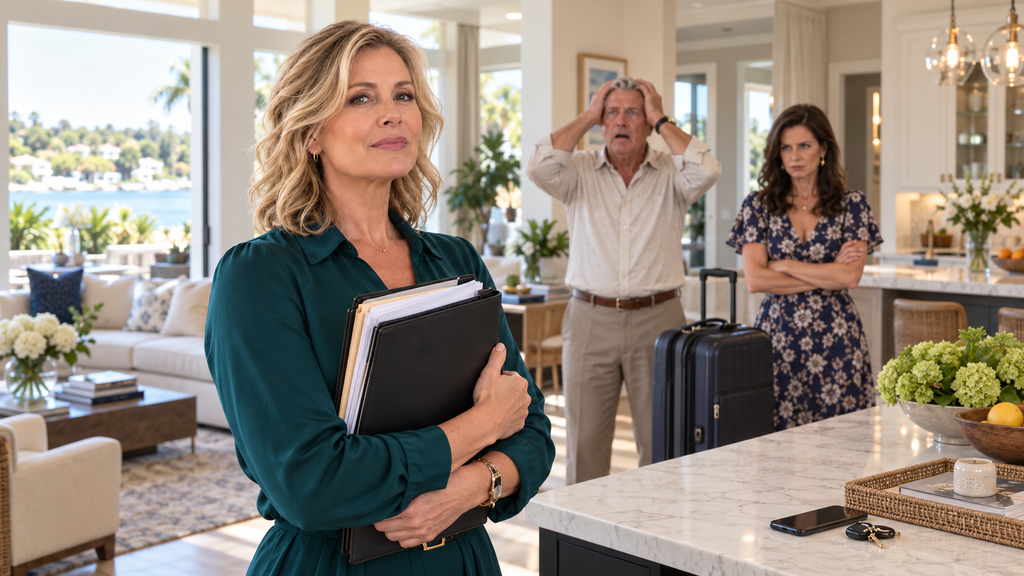
But until that night, I don’t think he had ever seen me finished.
There is a difference.
Anger still wants something.
An apology.
An explanation.
A promise.
Finished wants nothing.
Daniel stared at the folder on the kitchen table as though it were something dangerous.
“A divorce consultation?”
His voice came out quieter the second time.
“Yes.”
“You met with a divorce attorney because I canceled a vacation?”
I leaned back in my chair.
“No.”
He shook his head sharply.
“That is exactly what you’re doing.”
“No, Daniel. I met with a divorce attorney because you canceled our vacation without speaking to me, volunteered me to babysit your sister’s children, told me family comes first while you planned to leave for a golf weekend, and then acted confused when I objected.”
“That’s one argument.”
“No. That’s one evening.”
I watched his expression change.
Not much.
Just enough.
He knew exactly what I meant.
I continued.
“The argument is thirty years old.”
He laughed once, but there was no humor in it.
“Oh, come on.”
“That reaction right there.”
“What reaction?”
“The one where anything that matters to me becomes ridiculous the moment it inconveniences you.”
His jaw tightened.
“That’s not fair.”
“Neither was canceling ten days of my life because Melissa wanted a spa weekend.”
“She needed help.”
“She wanted help.”
“She has children.”
“So do millions of other people.”
His voice rose.
“She’s my sister.”
“And I’m your wife.”
Silence.
There it was.
The sentence that should never have needed saying.
Daniel looked away first.
I had spent most of my marriage believing silence meant someone was thinking.
That night I realized sometimes silence simply meant they had run out of excuses.
He walked to the counter and poured himself water.
His hands weren’t quite steady.
“This is insane.”
I didn’t answer.
“You’re really going to throw away thirty-two years?”
I looked at him.
“Do you know what’s interesting?”
“What?”
“You keep saying I’m throwing away thirty-two years.”
“You are.”
“But you don’t seem interested in asking what those thirty-two years felt like for me.”
His face tightened.
“Oh, so now our entire marriage was miserable?”
“I didn’t say that.”
“That’s what you’re implying.”
“No. Our marriage had good years. Very good years.”
That seemed to surprise him more than if I had called the whole thing terrible.
I folded my hands on the table.
“You were funny when we were young. You used to bring me coffee in bed on Sundays. You once drove four hours in a snowstorm because my father’s furnace broke. When we were first married, you couldn’t afford flowers, so you stole—”
“I did not steal them.”
Despite myself, I almost smiled.
“You cut daffodils from the median strip.”
“They were city flowers.”
“They were not your flowers.”
“They were taxpayer flowers. I paid taxes.”
For half a second, the kitchen felt like ours again.
Two young people in a tiny apartment laughing over flowers wrapped in newspaper.
Then the moment disappeared.
I looked at the man across from me.
“I remember those things, Daniel. That’s why this hurts.”
His eyes dropped.
“Then don’t do this.”
“You’re still not listening.”
“I am listening.”
“No. You’re waiting for me to stop.”
He started to speak.
I held up my hand.
“Please. Just once. Let me finish without deciding what I mean before I say it.”
That stopped him.
I took a slow breath.
“I don’t think you woke up one morning and decided to treat me badly. I think something worse happened.”
His brow furrowed.
“You got used to me.”
He stared at me.
“You got used to the bills being paid. You got used to your mother’s prescriptions being picked up. You got used to taxes being filed, insurance being renewed, tenants being handled, your invoices being sent, your appointments being scheduled, holidays being organized, gifts being purchased, and every family problem somehow finding its way to my phone.”
I swallowed.
“You got so used to me keeping everything running that eventually you stopped seeing the person doing it.”
“That isn’t true.”
“When was my last dentist appointment?”
He blinked.
“What?”
“My dentist appointment. When was it?”
“How would I know?”
“Exactly.”
“That’s ridiculous. You manage your own appointments.”
“And yours.”
“That’s different.”
“Why?”
No answer.
I continued.
“What book am I reading right now?”
He frowned.
“What does that have to do with anything?”
“What was the name of the restaurant I wanted to try for my birthday?”
“Claire—”
“What did I tell you I wanted to see most on this road trip?”
He opened his mouth.
Nothing came out.
I felt something inside me crack.
Not because he couldn’t remember.
Because he looked irritated that I expected him to.
I whispered, “Bryce Canyon at sunrise.”
His eyes shifted away.
“I told you three times.”
“I’ve been busy.”
“So have I.”
“That’s not the same.”
I looked at him for a long moment.
Then I nodded.
“There it is.”
“What?”
“The whole marriage.”
He sat down heavily across from me.
For the first time, he didn’t have an immediate answer.
After a while, he glanced at the folder.
“What did the lawyer say?”
“She explained my options.”
“You actually gave her our financial information?”
“I gave her my financial information.”
“Our finances are joint.”
“Some of them.”
His eyes narrowed.
“What does that mean?”
I pulled the folder toward me.
“You know what it means.”
“No. Apparently I don’t.”
“That’s part of the problem.”
I opened the folder.
Inside were copies Eleanor had prepared that afternoon.
Property records.
Business documents.
Estate records.
Tax filings.
The office lease.
Daniel watched me spread them across the table.
His expression grew more unsettled with every page.
“This building,” I said, touching the first document, “was inherited from my father.”
“I know.”
“The account holding what remains of his estate was kept separately.”
“I know that too.”
“These rental properties were purchased partly with money from that account.”
“So?”
“So the contributions are documented.”
His eyes sharpened.
“Are you trying to take the houses?”
“No.”
“Then what are you saying?”
“I’m saying Eleanor told me not to let you intimidate me with the idea that everything is yours because you earned more income.”
“I’ve never said everything was mine.”
“You told me tonight that I wouldn’t last six months without you.”
His mouth closed.
I slid another paper forward.
“And then there’s this.”
He glanced down.
“What is it?”
“You signed it six years ago.”
He picked it up.
I could almost see the exact moment he recognized his own signature.
“What the hell is this?”
“It was part of the refinancing package when your company expanded.”
“I signed hundreds of documents that week.”
“Yes.”
“You handled all that.”
“Yes.”
“What does it say?”
“Read it.”
His eyes moved across the page.
Then back.
Then across it again more slowly.
His face changed.
Six years earlier, when Daniel’s engineering firm needed additional financing, the bank required clean documentation of ownership.
The building his firm occupied was mine.
Not ours.
Mine.
My father had purchased the property decades earlier and left it to me through his estate.
Daniel knew that.
But because we had spent years treating nearly everything casually inside our marriage, the company’s arrangement had never bothered either of us.
The firm paid below-market rent.
I handled much of its administrative accounting.
And when the bank refinanced its expansion, lawyers had insisted that everything be formalized.
Daniel had signed an acknowledgment that the building was my separate property.
He had signed the commercial lease.
He had signed the company operating agreement confirming that we each held an ownership interest in the firm.
And he had signed a document acknowledging that certain inherited funds were not company assets and had never been contributed to the business.
At the time, he had joked that he would sign anything if I put a yellow sticker next to the signature line.
He had trusted me completely.
So completely that he never bothered to understand what I had built beside him.
He put the document down.
“So that’s your plan?”
“No.”
“You’re going to throw my company out of the building?”
“No.”
“You already sent notice!”
“I sent notice that the lease will not automatically renew under the existing terms.”
“That’s the same thing.”
“It isn’t.”
“The company can’t afford market rent there.”
“That sounds like something the owner should have considered before telling the landlord she couldn’t survive without him.”
His face flushed.
“That’s vindictive.”
“No. Vindictive would be changing the locks.”
“You can’t do that.”
“I know.”
That stopped him.
I met his eyes.
“I’m not trying to hurt you, Daniel.”
“Could have fooled me.”
“That’s because for thirty-two years, any boundary from me has felt like an attack to you.”
He pushed away from the table.
“I’m going to bed.”
“I moved your things into the guest room.”
He froze.
“You what?”
“Just the essentials. The rest are still upstairs.”
“You moved me out of my bedroom?”
“Our bedroom.”
He gave me a look I had seen hundreds of times.
The look that meant I was supposed to reconsider simply because he was displeased.
I didn’t.
After several seconds, he walked toward the stairs.
At the bottom step, he turned.
“Claire.”
“Yes?”
“If I hadn’t canceled the trip, would you have done this?”
It was the first honest question he had asked all evening.
I thought carefully before answering.
“No.”
Relief flickered across his face.
Then I continued.
“Not yet.”
The relief disappeared.
I looked at the suitcase still sitting near the hall.
“That’s what scares me most.”
He said nothing.
“If you hadn’t canceled the trip, I probably would have gone. I would have driven beside you for ten days. I would have taken pictures. I would have posted smiling photographs. We would have come home, and I would have kept doing everything exactly the same way.”
My throat tightened.
“I might have given you another five years.”
He stared at me.
“And five years after that, maybe I would have looked up and been seventy and wondered why I spent my entire adult life waiting for people to ask whether I had plans before assigning me theirs.”
Daniel looked suddenly older.
For the first time that night, I think he understood that the road trip had never been the thing I was losing.
It had simply shown me everything else I had already lost.
He went upstairs.
I stayed at the kitchen table until almost two in the morning.
I expected to cry.
Instead, I opened my road-trip binder.
I had printed everything months earlier.
Hotel confirmations.
Routes.
Restaurant names.
Hiking trails.
Notes written in blue ink.
Outside Moab, I had drawn a tiny star beside one overlook because I had wanted us to stop there before sunset.
In Colorado, I had circled a small mountain town where I’d booked a room with a balcony.
At the bottom of the final page, I had written:
ONE REAL ADVENTURE. JUST US.
I ran my finger over those words.
Then I crossed out the last two.
At 6:14 the next morning, I made coffee.
At 6:52, Melissa arrived.
By 7:03, she was gone.
By 7:15, Daniel had called eleven times.
By 8:30, I was dressed.
By noon, I was sitting across from Eleanor Shaw.
And by five that evening, for the first time in decades, I had begun separating my life from everyone else’s assumptions.
Not secretly.
Not cruelly.
Carefully.
Eleanor kept repeating the same thing.
“Documentation, Claire. No games.”
I agreed.
I didn’t want games.
Games were what people played when they still wanted to win against each other.
I wanted out.
That distinction mattered.
The following morning, Daniel went to work before I woke up.
At 9:17, he texted.
We need to talk tonight.
I read it.
Then put my phone down.
At 9:42, another message appeared.
I spoke to an attorney.
That made me pause.
At 10:05:
You have no right to freeze me out of anything.
I hadn’t frozen him out of anything.
The joint checking account remained untouched.
His business accounts remained untouched.
Our household bills remained paid.
I had simply removed his online access to an inheritance account where he had been an authorized viewer, even though the money legally belonged to me.
I replied with one sentence.
Please have your attorney contact Eleanor.
His answer came immediately.
So that’s how it is now?
I stared at those words.
Then typed:
For legal matters, yes.
He called.
I let it ring.
A minute later, he called again.
Then again.
Finally, I silenced the phone.
At eleven, Melissa called.
I didn’t answer that either.
She left a voicemail.
“Claire, I don’t know what’s going on with you and Daniel, but dragging attorneys into this because I needed one weekend of help is completely insane. You’ve always been there for us, and I don’t understand why you’re suddenly punishing everyone. The kids keep asking why they can’t come to Aunt Claire’s. Call me.”
I listened twice.
Not because I doubted myself.
Because I wanted to hear whether somewhere in that message she asked how I was doing.
She didn’t.
Not once.
By lunchtime, Daniel’s mother called.
Then one of his cousins.
Then his aunt.
Apparently our marriage had become breaking news.
I turned my phone off.
Around three, the doorbell rang.
Melissa.
Of course.
She stood on my porch with her arms crossed.
This time there were no children in the SUV.
“Can I come in?”
“I’d rather talk here.”
Her eyes widened.
“You’re serious?”
“Yes.”
She looked past me as though I were hiding something.
“Daniel said you’re divorcing him.”
“I met with an attorney.”
“Because of Saturday?”
“No.”
“That’s what he said.”
“Then Daniel still isn’t listening.”
Melissa sighed dramatically.
“Claire, marriages have arguments.”
“Yes.”
“People say things.”
“Yes.”
“You don’t blow up an entire family over babysitting.”
I looked at her.
“Why didn’t you ask me yourself?”
She blinked.
“What?”
“About your children. Why didn’t you call me?”
“Daniel said he would handle it.”
“No. He said I would handle it.”
“That’s basically the same thing.”
I actually laughed.
Melissa frowned.
“What?”
“That sentence.”
“What about it?”
“You don’t even hear it.”
She shifted impatiently.
“I knew you wouldn’t mind.”
“How?”
“Because you always help.”
“That wasn’t my question.”
She said nothing.
“How did you know I wouldn’t mind?”
“Well… you always do it.”
“Exactly.”
“I don’t understand.”
“I know.”
I leaned against the doorframe.
“You didn’t know I wouldn’t mind. You never asked. You knew I usually said yes after somebody had already arranged my time for me.”
“That’s not fair.”
“Do you know where I was supposed to be Saturday morning?”
“On that trip.”
“What trip?”
Her expression changed slightly.
“I don’t know.”
“Exactly.”
She looked away.
“Daniel said you’d been planning some driving vacation.”
“Ten days. Utah and Colorado.”
“Oh.”
“I saved for it for a year.”
That surprised her.
“You did?”
“Yes.”
“I thought Daniel paid for it.”
There was no cruelty in her voice.
That almost made it worse.
She genuinely thought anything significant in my life had probably come from Daniel.
I smiled faintly.
“No.”
Melissa looked uncomfortable.
“I didn’t know.”
“You never asked.”
“Claire—”
“I booked every hotel. Planned every route. Researched every stop. Daniel knew how much it meant to me.”
“He probably thought family was more important.”
“Then why was he going golfing?”
Her mouth closed.
I waited.
There was no answer.
Finally, she said, “Greg was already expecting him.”
“And your children were apparently expecting me.”
“That’s different.”
“Why?”
Again, no answer.
I stepped closer.
“Melissa, who was supposed to sacrifice their weekend?”
She looked annoyed now.
“I didn’t think of it like that.”
“No. You thought of it as Claire.”
Her face hardened.
“So now you’re going to hold every favor you’ve ever done over my head?”
“No.”
“Sounds like it.”
“I did those things because I loved your family.”
“Then what changed?”
“I realized love had become an expectation.”
She stared at me.
I continued more gently.
“I love your children. None of this is their fault. I have never regretted spending time with them.”
“Then why—”
“Because I am their aunt, Melissa. Not your emergency childcare department.”
Her cheeks flushed.
“You could have just said no.”
I almost smiled.
“I did.”
That silenced her.
For several seconds, neither of us spoke.
Then she whispered, “You embarrassed me.”
“At your house?”
“No. At the spa.”
I frowned.
“What?”
“I had to cancel.”
I looked at her.
She looked genuinely wounded.
Not because I had been hurt.
Not because my vacation had been canceled.
Because she had lost her spa reservation.
And something in me settled.
Any remaining guilt I had evaporated.
“I’m sorry you lost your reservation.”
She relaxed slightly.
Then I added, “Maybe next time you’ll ask before assuming someone else will give up theirs.”
Her expression hardened again.
“You’ve changed.”
“No.”
I looked back into the house.
“I think I finally stopped hiding how much I minded.”
She left without saying goodbye.
That evening, Daniel returned with flowers.
Tulips.
Not daffodils.
He set them on the counter.
“I thought we could talk.”
I stared at the bouquet.
Thirty years earlier, flowers might have saved an argument.
Twenty years earlier, they might have softened one.
Ten years earlier, I would have thanked him and put them in water even if I was still angry.
That night, I saw them for what they were.
A habit.
He had a problem with his wife.
Flowers were what husbands bought when wives were upset.
He had not bought them because he knew me.
He had bought them because he knew marriage.
There was a difference.
“They’re beautiful,” I said.
He looked relieved.
“I called the hotel.”
I looked up.
“What hotel?”
“The first one on the road trip.”
My heart gave an involuntary jump.
He saw it.
“They still have a room next month.”
I said nothing.
“I can move some meetings. We’ll do the trip.”
“Daniel.”
“No golf. No Melissa. No calls. Nothing.”
“Daniel.”
“I mean it.”
He stepped toward me.
“I screwed up. Fine. I screwed up badly. I shouldn’t have canceled it.”
I felt tears gathering behind my eyes.
Not because I wanted to go.
Because for one dangerous second, the old version of me wanted desperately to accept.
Ten days.
Mountains.
Bryce Canyon.
Maybe he meant it.
Maybe this had scared him enough.
Maybe people could change.
Maybe thirty-two years deserved another chance.
Maybe leaving was selfish.
Maybe staying was loyal.
Maybe—
Then he said, “I just need you to withdraw that lease notice first.”
Everything inside me went still.
He must have seen it on my face.
“That’s not why I’m offering the trip.”
I looked at him.
“Isn’t it?”
“No.”
“Then why mention the lease?”
“Because the company needs stability.”
“And you think the vacation is payment?”
“For God’s sake, Claire.”
He turned away.
“I’m trying here.”
“No.”
“What do you want from me?”
“I wanted you to ask before you canceled it.”
“I apologized.”
“After attorneys became involved.”
“I said I was wrong.”
“After the building became a problem.”
“You’re twisting everything.”
I shook my head.
“I’m finally seeing everything.”
He stared at me.
“What does that even mean?”
“It means you are still trying to restore the system.”
“What system?”
“The one where I make your life work.”
He laughed bitterly.
“This is unbelievable.”
“I agree.”
“You think I used you?”
“I think you depended on me so completely that you stopped respecting the cost.”
“That is not the same thing.”
“No.”
I nodded.
“It’s worse.”
His face changed.
I picked up the flowers.
For a moment, he looked hopeful.
Then I carried them to the sink, filled a vase, and arranged them carefully.
I had spent too many years turning hurt into housekeeping.
This time, I did it because the flowers were beautiful.
That didn’t mean the marriage was saved.
Daniel slept in the guest room.
Three days later, his attorney sent Eleanor a formal letter.
The language was aggressive.
Eleanor read it without expression.
Then she placed it on her desk.
“Standard opening posture.”
“He says I’m intentionally damaging the business.”
“He says your lease notice is retaliatory.”
“Is it?”
She looked at me over her glasses.
“You tell me.”
I thought about it.
“No.”
“Why change the lease?”
“Because if we divorce, I don’t want my former husband’s company operating indefinitely in my inherited building for half market rent.”
“That’s reasonable.”
“I also don’t want to throw fifty employees into chaos.”
“Also reasonable.”
“So what happens?”
“We negotiate.”
That word became the soundtrack of the next six months.
Negotiate.
The word sounds calm.
Civilized.
Two adults sitting across a table.
What it doesn’t capture is the strange grief of watching thirty-two years reduced to categories.
Assets.
Liabilities.
Equity.
Retirement.
Business valuation.
Personal property.
Separate property.
Marital property.
Furniture.
Vehicles.
Insurance.
Pensions.
Tax consequences.
You sit across from someone who once held your hand while you gave birth—or buried a parent, or sat in an emergency room—and lawyers discuss who keeps the dining table.
That table had survived three houses.
Christmas dinners.
Birthday cakes.
Daniel’s father carving a turkey badly enough that we had laughed until we cried.
Melissa’s children coloring underneath it.
My father sitting at one end during the final Thanksgiving before he died.
And suddenly it was listed on a spreadsheet.
DINING SET — ESTIMATED VALUE $1,800.
There is something almost insulting about putting a number on things that contain your life.
But the numbers came anyway.
The company was valued.
The rentals were appraised.
The office building was appraised.
Retirement accounts were examined.
Bank statements arrived.
Tax returns were copied.
And for the first time in our marriage, Daniel was forced to look directly at the financial architecture of the life we had built.
He did not enjoy what he saw.
Not because he was poor.
Daniel had earned good money.
Very good money.
But he had spent decades believing earning money and building wealth were the same thing.
They weren’t.
He earned.
I organized.
I saved.
I invested.
I kept records.
I refinanced at favorable rates.
I questioned insurance renewals.
I documented improvements.
I negotiated leases.
I remembered filing deadlines.
I chased late invoices for his company before they became bad debt.
I transferred money into retirement accounts while he joked that he would “work forever anyway.”
He had been the engine.
I had been the steering wheel.
An engine can make a lot of noise.
Without steering, it doesn’t get very far.
One afternoon, about six weeks after he moved into the guest room, he came home carrying a thick report.
He dropped it on the kitchen island.
“Did you see this?”
I looked at the cover.
BUSINESS VALUATION.
“Yes.”
He opened it.
“You own half.”
“I know.”
“You never told me this was worth that much.”
“I didn’t know the exact number until the valuation.”
“But you knew.”
“I knew the company had value.”
He paced.
“This means if you demand your share, I have to borrow money.”
“I know.”
“Or sell.”
“I know.”
“Do you want me to sell?”
“No.”
He stopped.
“What do you want?”
“I want a fair settlement.”
“You keep saying that.”
“Because it’s true.”
“You could destroy me if you wanted.”
The words hung between us.
I studied him.
He looked frightened.
Not theatrically.