 Reading Time: 37 minutes
Officer Bell didn’t cut the lock immediately. That was the first thing I remembered clearly afterward. Not Derek’s voice still crackling through my phone.
Not the brass padlock hanging between the white closet handles. Not even the terrible thought that flashed through my mind when Lily pointed toward the hallway.
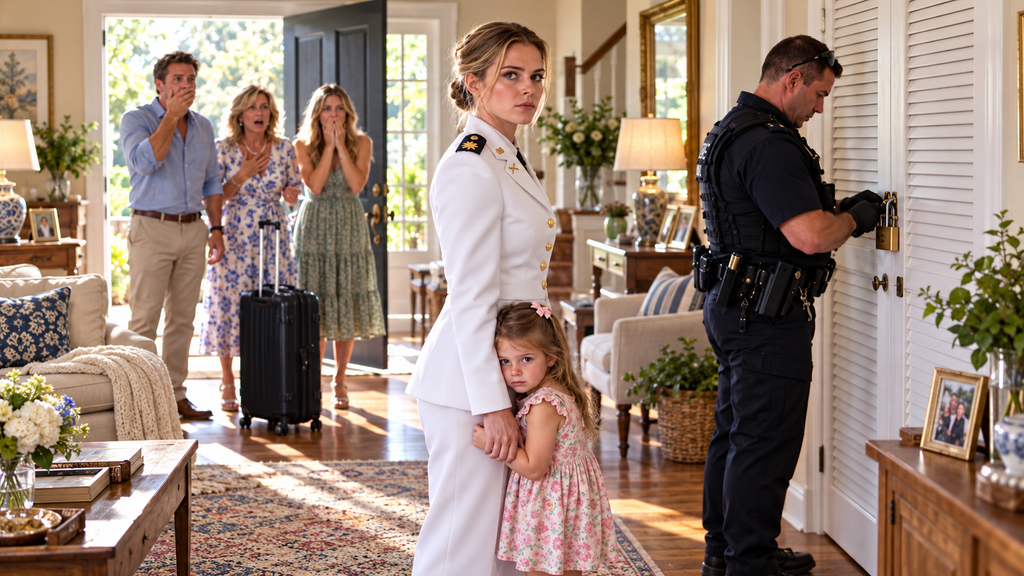
I remembered Officer Marcus Bell lowering the bolt cutters and looking at me.
“Major Nolan,” he said quietly, “before we open anything, I want to make sure we do this correctly.”
Behind him, one of the paramedics was kneeling beside Lily.
My four-year-old daughter was wrapped in a silver emergency blanket even though the house wasn’t cold.
She looked impossibly small inside it.
Her cereal bowl still sat on the floor where she had dropped it when I came through the front door.
I looked at the closet.
Then at my phone.
“Derek?”
He was still there.
I could hear him breathing.
The music on the cruise ship had vanished into the background.
“What is in the closet?”
He didn’t answer.
Officer Bell held out his hand.
“May I?”
I gave him the phone.
Bell raised it.
“Mr. Nolan, this is Officer Marcus Bell with Chesapeake Police. Your wife has given us permission to be inside the residence. Your daughter has been examined by emergency medical personnel after apparently being left without adult supervision.”
Derek immediately changed.
It was almost frightening how quickly he changed.
Thirty seconds earlier, he had been shouting.
Now his voice became controlled.
Polite.
Reasonable.
The voice he used with bank managers and teachers and people he wanted to impress.
“Officer, there’s been a misunderstanding.”
Bell glanced at me.
“What misunderstanding?”
“My wife wasn’t supposed to be home yet.”
“I understand that.”
“And arrangements had been made for our daughter.”
“There is currently no caregiver in this residence.”
“She must have left.”
“Your daughter says no adult has been here for three days.”
Silence.
Bell continued.
“And your neighbor reports being told through your doorbell camera that a babysitter was upstairs.”
Derek exhaled.
“That was my mother.”
I felt something cold move through me.
Patricia.
Of course.
Bell’s expression didn’t change.
“Your mother was monitoring the doorbell camera from the cruise ship?”
“Yes.”
“Then she knew no babysitter was physically present.”
“That isn’t what I said.”
“It’s exactly what you said.”
Derek’s voice hardened.
“This conversation is getting twisted.”
Then Bell looked toward the closet.
“Tell me what is behind this lock.”
Nothing.
“Mr. Nolan?”
Derek finally spoke.
“Private property.”
I almost laughed.
Private property.
Inside our house.
In the hallway twelve feet from our daughter’s bedroom.
Bell asked, “Does it belong to you?”
“Yes.”
“Is there anything dangerous inside?”
“No.”
“Weapons?”
“No.”
“Chemicals?”
“No.”
“Anything that could harm your daughter?”
“No.”
Bell looked at me.
I knew the question before he asked it.
“Mrs. Nolan, do you have access to this closet normally?”
“Yes.”
My voice sounded distant.
“It’s our linen closet. Towels. Sheets. Cleaning supplies. Lily’s extra blankets.”
“When did you last see it unlocked?”
“Before I deployed.”
Six months earlier.
The thought made my stomach turn.
Bell looked at the brass padlock again.
Then at the second officer standing near the kitchen.
“Photograph it.”
The officer took several pictures.
Derek heard the camera shutter through the phone.
His voice rose again.
“Stop. Hannah, stop them.”
I stared at the phone in Bell’s hand.
“Why?”
“Hannah.”
“Tell me why.”
“It doesn’t concern you.”
I actually looked around the destroyed house as if maybe I had misheard him.
Our daughter had spent three days eating dry cereal.
Nineteen thousand dollars was gone.
Police were standing in our living room.
And my husband was telling me something inside our home did not concern me.
I walked closer to the phone.
“Derek, Lily asked me if I was really here.”
He said nothing.
“She touched my face because she thought I might not be real.”
Still nothing.
“She told me she slept on the floor near the front door because she was afraid she wouldn’t hear anyone come home.”
His breathing changed.
“Hannah—”
“She has lost weight.”
“That’s not my fault.”
The entire room went still.
Even Bell looked at the phone differently.
Derek must have realized what he had said.
He tried to correct it.
“I mean, kids get picky. Lily hasn’t been eating well lately.”
The paramedic looked up sharply.
I felt my hands curl into fists.
Bell gave me the phone back.
“Don’t say anything else to him.”
But I couldn’t stop myself.
Not yet.
“Did you know the babysitter canceled?”
Derek didn’t answer.
“Before you boarded the ship, did you know?”
“Hannah, you’re emotional.”
That sentence.
After six months sleeping in temporary quarters thousands of miles from my child.
After missed birthdays and terrible internet connections.
After watching the clock every night because 2:00 a.m. for me meant Lily might still be awake back home.
After walking into my own house and finding my little girl hungry and alone.
My husband called me emotional.
Something inside me became perfectly calm.
“I’m going to ask once more.”
I spoke slowly.
“Did you know the babysitter canceled before you left?”
Derek stayed silent for five seconds.
Then ten.
Finally he said, “Mom said she had a backup plan.”
I looked at Officer Bell.
He had heard it too.
“What backup plan?”
“I don’t know.”
“You left anyway?”
“Hannah, it was a prepaid trip.”
A paramedic actually whispered, “Jesus.”
Derek continued as though the sentence made sense.
“There were twelve people going. We couldn’t just cancel everything because one sitter got unreliable.”
One sitter.
One four-year-old child.
As though those things belonged on opposite sides of a reasonable equation.
I looked down the hallway.
At the padlock.
“Open it.”
Officer Bell hesitated.
Then nodded toward the other officer.
The bolt cutters came up.
Derek heard the metal move.
His voice exploded through the speaker.
“HANNAH!”
The cutter closed.
The brass shackle snapped.
Lily flinched.
I moved instantly toward her, but the medic already had an arm around her shoulders.
Officer Bell pulled the lock free.
He didn’t open the doors immediately.
He put on gloves.
The second officer did the same.
Then Bell pulled the handles.
The closet opened.
For a moment, none of us understood what we were seeing.
Because it wasn’t a linen closet anymore.
There were no towels.
No sheets.
No vacuum cleaner.
No boxes of detergent.
Someone had removed the shelves.
A narrow metal rack stood against the back wall.
Three small monitors were mounted above it.
A laptop sat open on a folding shelf.
Wires ran through holes drilled into the wall.
There were external hard drives.
A router.
Two power banks.
A stack of folders.
And six black-and-white camera feeds.
Our living room.
Our kitchen.
The back door.
Lily’s bedroom.
The front porch.
And the hallway.
For several seconds, the only sound in the house was the faint electronic hum of the equipment.
My skin went cold.
Officer Bell stepped forward.
“Don’t touch anything.”
I couldn’t have moved if I wanted to.
One monitor showed us standing outside the closet.
A tiny timestamp glowed at the bottom.
LIVE.
I looked at Lily’s bedroom feed.
Her pink blanket.
Her stuffed rabbit.
The night-light beside her bed.
I had installed none of those cameras.
I turned toward the phone.
“Derek.”
He had gone completely silent.
“Why is there a camera in Lily’s bedroom?”
Nothing.
“Why are there cameras inside this house?”
He disconnected.
The call ended.
I stared at the screen.
CALL ENDED.
And somehow those two words frightened me more than his shouting had.
Officer Bell’s posture changed.
He spoke into the radio clipped to his shoulder.
I didn’t catch everything.
I heard “additional units.”
I heard “possible digital evidence.”
I heard “minor child.”
Then Bell looked at me.
“Major Nolan, I need you and your daughter to stay out of this hallway.”
“What is that?”
“We don’t know yet.”
“You’re looking at it.”
“We know what the equipment is. We don’t know what’s on it.”
I looked at the folders.
One had my name written across the tab.
HANNAH.
Another said LILY.
A third said FINANCIAL.
And underneath them was one marked EXIT.
I pointed.
“That’s my name.”
“I see it.”
“Open it.”
“I can’t start going through everything casually. We need detectives here.”
“This is my house.”
“I understand.”
“That is a file about me.”
“I understand.”
“Then open it.”
Bell stepped closer.
His voice softened.
“I also understand that whatever this is may become evidence.”
That word stopped me.
Evidence.
I was an intelligence officer.
I understood chain of custody.
Documentation.
Contamination.
Procedure.
I had spent my career telling people that emotion could not dictate what happened to information once that information mattered.
Now I was standing twelve feet from my daughter with my entire marriage apparently stored inside labeled folders, and every part of me wanted to tear through them with my bare hands.
But Bell was right.
So I stepped back.
The paramedic touched my arm.
“Your daughter needs to go to the hospital.”
I looked at Lily.
She was watching the closet.
Not curiously.
Fearfully.
That terrified me.
I crouched beside her.
“Sweetheart?”
She looked at me.
“Have you seen that before?”
Her eyes moved toward the monitors.
Then back to me.
She nodded.
My throat tightened.
“When?”
“Daddy goes there.”
“What does Daddy do?”
She squeezed the emergency blanket.
“He watches.”
The room became very quiet again.
“What does he watch?”
Her answer was almost a whisper.
“Me.”
I felt something break inside my chest.
Not loudly.
Not dramatically.
It just broke.
I reached for her and pulled her against me.
She buried her face against my shoulder.
“He watches when I’m bad.”
Every muscle in my body tightened.
Officer Bell crouched several feet away so he wouldn’t tower over her.
“Lily,” he said gently, “you aren’t in trouble.”
She peeked at him.
He pointed toward himself.
“My job is to make sure people are safe. Okay?”
She nodded.
“Did Daddy ever tell you about those cameras?”
Another nod.
“What did he say?”
Lily twisted the edge of the blanket around one finger.
“He said Mama can see me too.”
I closed my eyes.
No.
No, no, no.
I forced myself to breathe.
“I couldn’t see you, baby.”
She looked at me.
Her eyes filled.
“Daddy said you could.”
“I couldn’t.”
“He said you watched.”
“Lily, I swear to you, I didn’t know there were cameras.”
Her bottom lip trembled.
“But when I cried for you…”
My voice disappeared.
She finished quietly.
“You didn’t call.”
I had imagined many terrible things during deployment.
Missiles.
Attacks.
Emergency notifications.
Accidents at home.
Never this.
Never my daughter sitting alone in her bedroom crying toward a camera because her father told her I could see her.
I pulled her close enough that I could feel her heartbeat.
“I didn’t know.”
She began crying.
“I thought you were busy.”
“Never too busy for you.”
“I thought soldiers can’t call when kids are bad.”
I pulled back so I could see her face.
“Listen to me.”
She sniffed.
“You are not bad.”
Her eyes stayed on mine.
“You have never been bad because you cried.”
A tear rolled down her cheek.
“You have never been bad because you missed me.”
Another tear.
“You have never been bad because you wanted someone to hug you.”
Her face crumpled.
I pressed my forehead against hers.
“And if I had known you were crying for me, I would have moved heaven and earth to get to a phone.”
That was when my daughter finally made a sound.
Not the silent tears from when I first entered the house.
A real cry.
Deep.
Broken.
The kind a four-year-old should never have learned to hold inside.
I wrapped both arms around her and let her cry into my uniform.
Nobody in the room spoke.
Not the police.
Not the medics.
Not Evelyn.
They just let me hold my child.
Eventually the paramedic touched my shoulder.
“We need to go.”
I nodded.
As I stood, Lily wrapped her arms around my neck.
She refused the stretcher unless I sat beside her.
So I did.
As they rolled us toward the front door, I looked back once.
Officer Bell stood beside the open closet.
The monitors glowed behind him.
And on one of them, a camera pointed at the exact place where Lily had been sitting when I came home.
The cereal bowl was visible on the floor.
That meant Derek hadn’t just installed cameras.
There was a possibility that someone had been able to watch her.
Watch her hungry.
Watch her alone.
Watch her waiting.
I whispered one sentence before the front door closed.
“Find out who was watching.”
Bell met my eyes.
“We will.”
At the hospital, they weighed Lily.
I won’t tell you the number.
I still hate the number.
What mattered was the doctor’s expression when he compared it with the weight recorded at her pediatric visit five months earlier.
He asked me questions.
How long had I been overseas?
Who had primary responsibility for Lily?
Had Derek ever mentioned trouble feeding her?
Any illness?
Any stomach problems?
Any recent doctor appointments?
I answered everything.
Then a nurse brought Lily a stuffed yellow duck.
She named it Sunny.
She held Sunny through bloodwork.
She held Sunny through the examination.
She held Sunny when the social worker came in.
And when anyone asked her a question she didn’t like, she reached one hand toward me without looking.
Every time, I took it.
At 6:12 that evening, after hours of examinations and interviews, a detective named Carla Ruiz walked into the room.
She was maybe forty-five.
Short dark hair.
Tired eyes.
A navy blazer over a gray blouse.
She introduced herself and looked at Lily, who had finally fallen asleep curled beside me.
“Can we talk?”
“Here.”
She glanced at Lily.
“Some of this may be difficult.”
“I’m not leaving her.”
Ruiz nodded.
“Understood.”
She pulled a chair close.
“We obtained authorization to secure and examine the digital equipment found in the closet.”
My stomach tightened.
“What did you find?”
“We’re still working.”
“Detective.”
She studied my face.
Then she opened a notebook.
“The surveillance system appears to have been installed approximately four months ago.”
Two months after I deployed.
“There are cameras in seven locations.”
“Seven?”
“The six visible feeds plus one additional camera.”
“Where?”
She hesitated.
I knew immediately that I wasn’t going to like the answer.
“Your bedroom.”
My jaw tightened.
“Where?”
“Inside a smoke detector.”
I stared at her.
“Our bedroom?”
“Yes.”
“Was it recording?”
“It appears so.”
I felt sick.
Ruiz continued carefully.
“There is cloud access. More than one device had login credentials.”
“How many?”
“We know of at least four.”
My voice came out flat.
“Derek.”
“Yes.”
“Patricia?”
“We are not confirming individual users yet.”
That meant yes.
Or maybe worse.
I looked toward Lily.
“What did they record?”
“We’re still reviewing.”
“Did they watch her during the last three days?”
Ruiz didn’t answer immediately.
That was answer enough.
I stood so quickly the chair scraped backward.
Lily moved in her sleep.
I froze.
Ruiz lowered her voice.
“Sit down.”
“Did they watch?”
She waited until I sat.
Then she said, “The system logged remote access several times after Derek left the residence.”
My eyes burned.
“From the ship?”
“At least one login appears consistent with the ship’s network. We are verifying it.”
I stared at the wall.
For three days, my daughter had been alone.
But she had not been unseen.
There is a special kind of horror in that distinction.
If Derek had simply disappeared and assumed someone else was caring for her, that would have been unforgivable.
But this?
This meant somebody had looked through a camera and seen the house.
Seen the empty rooms.
Seen Lily.
And then continued ordering drinks beside a swimming pool.
Ruiz opened her notebook again.
“There’s more.”
Of course there was.
“There were documents in the closet.”
“The folders.”
“Yes.”
I looked at her.
“What was in the one with my name?”
She drew a breath.
“Copies of your deployment orders.”
I frowned.
“Why?”
“Copies of your pay statements. Your Social Security information. Your military ID information. Banking documents. Your life insurance documents.”
My stomach dropped.
“Life insurance?”
“Yes.”
I sat very still.
“Am I the policyholder?”
“You’re insured.”
“I know that. Derek is my beneficiary.”
“He was.”
I looked at her.
“Was?”
“Someone attempted to make changes.”
My mouth went dry.
“What changes?”
“That is part of what we’re investigating.”
“Tell me.”
“Your husband appears to have submitted documents requesting changes to several accounts while you were overseas.”
“What kind of changes?”
“Beneficiary designations. Account access. A home equity application.”
I stared at her.
“I never applied for a home equity loan.”
“We know.”
“Then who signed it?”
Ruiz looked at me.
I understood.
My signature.
Forged.
“How much?”
“Seventy-five thousand dollars was requested.”
“Approved?”
“Not yet.”
Something close to relief passed through me.
Then Ruiz added, “But there are two credit accounts opened in your name that you may not know about.”
The relief vanished.
“How much?”
“Approximately thirty-two thousand dollars in available credit. We are still tracing transactions.”
I looked toward the window.
Outside, normal people were driving home from work.
Stopping for groceries.
Complaining about traffic.
Inside that room, my marriage was becoming a criminal case one sentence at a time.
Ruiz continued.
“The EXIT folder is what concerns us most.”
I turned back.
“What’s in it?”
“A timeline.”
“What kind of timeline?”
She opened the notebook.
“Your expected return date.”
My heart slowed.
“Derek knew I was due home in three weeks.”
“Yes.”
“Keep going.”
“Notes about financial transfers. Documents related to selling or refinancing the house. Copies of Lily’s birth certificate and passport application materials.”
I stopped breathing for a second.
“Passport?”
“Did you authorize a passport application for your daughter?”
“No.”
“Did you sign one?”
“No.”
Ruiz nodded as though she expected the answer.
“There’s also correspondence with an attorney.”
“Divorce?”
“Yes.”
That hurt.
Not because I wanted the marriage anymore.
That marriage had ended the second I saw Lily on the floor.
But betrayal has layers.
You can know someone is horrible and still discover another basement underneath the first one.
“He was going to divorce me?”
“It appears he had discussed filing shortly after your scheduled return.”
“Why wait?”
Ruiz didn’t answer.
I thought about it.
Then I understood.
“He wanted me home first.”
“Yes.”
“Why?”
“There are notes.”
“What notes?”
Ruiz looked down.
One sentence had been underlined in her notebook.
She read it carefully.
“‘Need her reaction documented after return. Don’t engage unless camera is running.’”
I stared at her.
For several seconds, I couldn’t make sense of the words.
Then I did.
He had been preparing for my homecoming.
Not emotionally.
Strategically.
He knew I would discover money missing.
He knew I would discover things had changed.
He expected me to confront him.
And he wanted cameras running when I did.
Ruiz continued.
“There are several references to you being ‘unstable after deployment.’”
I almost laughed.
“That’s his plan?”
“We don’t know the entire plan yet.”
“I do.”
I could suddenly see it.
All of it.
Derek had always hated that I was better under pressure than he was.
When something went wrong, he called me cold.
When I didn’t cry during arguments, he called me detached.
When I did get angry, he called it my “military mode.”
He had spent years turning normal parts of my personality into evidence against me.
Now he had built cameras around that story.
“He was going to provoke me.”
Ruiz didn’t respond.
“He was going to empty the accounts, let me find it, record me losing my temper, then tell people deployment changed me.”
“That is one possibility.”
“No.”
I looked at her.
“That was the plan.”
And then another thought arrived.
It was worse.
“Lily.”
Ruiz’s eyes shifted.
I felt my stomach twist.
“He was going to use Lily.”
She didn’t answer.
“What was in Lily’s folder?”
Ruiz closed the notebook for a moment.
“Hannah…”
“What was in my daughter’s folder?”
“Behavior notes.”
I didn’t understand.
“What does that mean?”
“Dates. Times. Comments.”
“About what?”
“Tantrums. Crying. Bedwetting. Refusing meals. Asking for you.”
My hands began shaking.
“They kept records?”
“Yes.”
“Why?”
“One note says, ‘Document attachment problems before Hannah returns.’”
I looked at sleeping Lily.
She was holding the yellow duck under her chin.
Attachment problems.
My daughter missed her mother.
That was their evidence.
A four-year-old cried because her mother was deployed, and my husband had written it down like a symptom.
Ruiz continued.
“There are also several recorded conversations between Derek and his mother.”
“From the closet?”
“Apparently the system recorded audio from the laptop.”
“About me?”
“Yes.”
“About Lily?”
“Yes.”
My voice dropped.
“I want to hear them.”
“Not tonight.”
“Detective—”
“Not tonight.”
There was something in her expression that made me stop.
“Why?”
“Because your daughter needs you present. Not physically present while your mind is somewhere inside those recordings.”
That was probably the kindest thing anyone could have said to me.
I looked down at Lily.
Ruiz stood.
“There’s one more thing you need to know tonight.”
I waited.
“The sitter did not cancel at the last minute.”
Every hair on my arms rose.
“What?”
“She canceled nine days before the cruise.”
I stared at Ruiz.
Nine days.
Derek knew nine days before leaving.
Not nine minutes.
Not while boarding.
Nine days.
“He had time.”
“Yes.”
“To find someone.”
“Yes.”
“To cancel.”
“Yes.”
“To tell me.”
“Yes.”
“To do anything.”
“Yes.”
“But he left.”
Ruiz’s face hardened.
“Yes.”
“Why?”
“We’re still establishing motive.”
I already knew part of the answer.
Because the cruise mattered more.
Because he assumed someone else would solve it.
Because Patricia told him they deserved the vacation.
Because he believed cameras counted as parenting.
Maybe because he thought Lily could survive three days until somebody checked.
Maybe because people like Derek rarely imagine consequences applying to them.
I looked at my sleeping child.
“Where is he now?”
“Still aboard.”
“Can he leave?”
“We have been in contact with authorities and the cruise line.”
“Is he under arrest?”
“Not at this moment.”
I hated those words.
Ruiz saw it.
“This has to be done correctly.”
I had heard that sentence twice that day.
I understood it.
I hated it anyway.
“What about Patricia?”
“We are investigating everyone who may have known Lily was alone.”
“And Jenna?”
“Same answer.”
I nodded.
Ruiz went to the door.
Before she left, I called her name.
“Detective?”
She turned.
“When you listen to those recordings…”
“Yes?”
“If there’s one where Lily cries for me…”
My voice almost failed.
“Don’t let me hear it.”
Ruiz looked at me for a long moment.
Then she nodded.
“All right.”
That night, the hospital put a reclining chair beside Lily’s bed.
I didn’t use it.
I climbed into the narrow hospital bed beside her instead.
At 1:38 in the morning, Lily woke suddenly.
Her whole body jerked.
“Mama?”
“I’m here.”
“Don’t go.”
“I’m not going.”
“Promise?”
“I promise.”
“You went before.”
That hurt because she wasn’t accusing me.
She was stating a fact.
I had gone.
For my job.
For my country.
For an obligation I believed my family understood.
But four-year-olds don’t understand deployment orders.
They understand absence.
I stroked her hair.
“I did.”
“Do you have to go again tomorrow?”
“No.”
“What about the soldiers?”
“They’ll be okay.”
“What about your boss?”
“He knows where I am.”
“What if he gets mad?”
“Then he gets mad.”
She considered this.
“Daddy gets mad.”
I swallowed.
“I know.”
“When I wake him.”
I went very still.
“What happens when you wake Daddy?”
Her eyes were half closed.
“He says big girls stay in rooms.”
“What room?”
She didn’t answer.
“Lily?”
Her thumb moved toward her mouth.
She hadn’t sucked her thumb in nearly two years.
“What room, baby?”
“The quiet place.”
Something in my body went cold.
“Where is the quiet place?”
She looked toward the hospital door.
“The closet.”
For a second, I thought she meant the surveillance closet.
Then she whispered, “Not the camera one.”
I pressed the nurse button.
Detective Ruiz returned to the hospital at 2:26 a.m.
Officer Bell came with her.
Lily had fallen asleep again by then.
I stood in the hallway.
“She said there’s another closet.”
Ruiz nodded.
“We found it.”
My heart dropped.
“Where?”
“Basement utility room.”
I pictured the basement.
Furnace.
Water heater.
Storage.
A small closet beneath the stairs.
“What did he do?”
Ruiz chose every word carefully.
“The space appears to have been used as a time-out area.”
I stared at her.
“What does that mean?”
“There’s a small foam mat inside. A battery lamp. A plastic cup. Children’s books.”
My throat tightened.
“Lock?”
Her silence answered.
“On the outside?”
“Yes.”
I closed my eyes.
Bell spoke quietly.
“Hannah, we don’t yet know how often.”
I opened my eyes.
“My daughter called it the quiet place.”
Neither of them spoke.
“She said he put her there when she woke him.”
Ruiz nodded once.
“We’ll arrange a forensic interview with a specialist. You shouldn’t question her repeatedly yourself.”
Again, I understood.
Again, I hated it.
“What kind of man locks a four-year-old child under the stairs?”
Bell looked toward Lily’s room.
“The kind we’re building a case against.”
I leaned against the hospital wall.
For months, whenever Lily and I video-called, Derek had positioned the phone.
Always the kitchen.
Always the sofa.
Never her bedroom.
If she grew upset, he ended the call.
“She’s tired.”
“She’s being dramatic.”
“She needs consistency.”
Once, Lily had whispered, “I don’t like nighttime.”
I had assumed she missed me.
Once she said, “Daddy has a new thinking room.”
I thought she meant his home office.
Once she asked, “Can soldiers unlock doors?”
I laughed.
I actually laughed.
I told her, “Some of us can.”
She had smiled.
I hadn’t understood what she was asking.
The guilt hit me so hard I had to sit on the hallway floor.
Bell crouched nearby.
“I should have known.”
He didn’t answer immediately.
Good.
I didn’t need someone telling me I couldn’t possibly have known.
Maybe I couldn’t have.
But guilt does not care about logic.
I stared at my hands.
“I’m intelligence.”
Bell waited.
“My job is to notice patterns.”
“This wasn’t an assignment.”
“It was my daughter.”
“It was a husband who controlled what you saw.”
“I should have noticed.”
Bell sat on the bench across from me.
“You noticed today.”
“I came home by accident.”
“You came home.”
“Three weeks early.”
“And you called for help within minutes.”
“Three days late for Lily.”
That sentence broke me.
I covered my face.
I had cried quietly before.
At funerals.
At airports.
On my first night of deployment after hearing Lily ask Derek if she could sleep with my old sweatshirt.
But I had never cried the way I cried on that hospital floor.
Not gracefully.
Not silently.
I cried with my palms over my face and my shoulders shaking while a police officer I had met less than twelve hours earlier sat across from me and said nothing.
Eventually Bell spoke.
“Your daughter isn’t measuring this in days.”
I lowered my hands.
“What?”
“She’s measuring it in whether you came through the door.”
I looked at him.
“She knows you came.”
I wiped my face.
Bell stood.
“So keep coming.”
Those words stayed with me.
Keep coming.
When she wakes up scared.
Come.
When she asks the same question for the hundredth time.
Come.
When she gets angry at the parent who stayed because she cannot safely be angry at the parent who frightened her.
Come.
When healing becomes inconvenient.
Come.
When court dates replace normal weekends.
Come.
When strangers ask whether you saw warning signs.
Come.
When your own guilt tells you to disappear.
Come.
So I did.
The next morning, Lily ate half a pancake.
Then she hid the other half inside a napkin.
I noticed.
I didn’t say anything until the dietitian left.
“Saving it?”
She froze.
Her face changed instantly.
Fear.
Not guilt.
Fear.
“I can eat it later.”
“You can.”
“I’m not stealing.”
“I know.”
“I didn’t take Daddy’s.”
My heart hurt.
“Sweetheart, you never have to hide food from me.”
She looked at the pancake.
“What if there’s no breakfast tomorrow?”
“There will be.”
“What if you forget?”
“I won’t.”
“What if you go away?”
I pulled my chair closer.
“Then whoever stays with you will feed you.”
“What if they don’t?”
There are questions no mother should have to answer.
I picked up the hospital menu.
“Then we make a plan.”
She looked at me.
“When we go home, we’re going to have snacks you can reach yourself. There will be food in the refrigerator. There will be people you know you can call.”
She frowned.
“Police?”
“If you need them.”
“Mrs. Price?”
“Yes.”
“Grandpa?”
“My dad lived three hours away, but I nodded.
“Yes.”
“You?”
“Always me.”
She looked at the pancake.
Then slowly ate another bite.
Later that afternoon, my commanding officer called.
Colonel Reeves didn’t ask when I planned to return.
He said, “Your place is with your daughter. We will handle everything else.”
That was the first time since coming home that I allowed someone to remove a problem from my hands.
The investigation moved quickly after that.
Not quickly enough for me.
But quickly.
Police seized the surveillance system.
Financial investigators documented the accounts.
My bank froze disputed transactions.
An attorney helped me file for emergency custody.
A judge signed a temporary protective order.
Derek was prohibited from contacting Lily directly.
Patricia was also ordered not to contact her while the investigation continued.
That enraged Patricia more than anything else.
She called me eleven times the first day.
I didn’t answer.
Then she began leaving voicemails.
The first said this had been “blown out of proportion.”
The second said families handled mistakes privately.
The third said Derek was “under enormous stress.”
The fourth blamed the babysitter.
The fifth blamed Evelyn.
The sixth blamed me.
That one I listened to twice.
Not because I believed it.
Because I wanted to remember exactly who she was.
“You disappear for six months and expect everyone else to rearrange their lives around your career. Derek deserved one vacation. We all did. Lily was monitored. She was perfectly safe. If you had been home taking care of your own child instead of playing soldier overseas, none of this would have happened.”
Playing soldier.
I saved the voicemail.
Then forwarded it to Detective Ruiz.
Three minutes later Patricia left another.
This time she was crying.
Not for Lily.
For Derek.
“Please, Hannah. He could lose everything.”
I stared at the phone.
That sentence told me more than she realized.
He could lose everything.
Not Lily could have died.
Not Lily must have been terrified.
Not how can I help my granddaughter?
Derek.
His job.
His reputation.
His future.
Everything meant him.
I blocked her number.
Jenna tried next.
Her message was shorter.
“Hannah, I didn’t know Lily was actually alone. Mom told us a neighbor was checking in.”
That mattered.
Detective Ruiz interviewed her separately.
Later I learned Jenna had believed an adult was visiting the house several times each day.
That did not make her innocent of everything.
But it did matter.
Truth matters even when rage would prefer simplicity.
And the truth became uglier in pieces.
The cruise had been Patricia’s idea.
Derek had paid for much of it using money transferred from our joint emergency account.
The sitter, a twenty-year-old college student named Kayla, had canceled nine days before departure because her father was having surgery.
She had texted Derek.
He responded:
NO PROBLEM. WE’LL FIGURE IT OUT.
The next day he texted Patricia.
SITTER BAILED.
Patricia wrote back:
DON’T YOU DARE CANCEL THIS TRIP.
Derek:
WHAT ABOUT LILY?
Patricia:
EVELYN IS NEXT DOOR. SET UP THE CAMERAS. IT’S THREE NIGHTS, NOT THREE WEEKS.
Derek:
HANNAH WOULD KILL ME.
Patricia:
HANNAH IS ON THE OTHER SIDE OF THE WORLD.
That message was entered into evidence.
I read it once.
Only once.
Hannah is on the other side of the world.
Those seven words explained everything.
They believed distance made me powerless.
They believed my absence meant permission.
They believed I would never know what happened inside my own home.
And if my deployment hadn’t ended early, they might have been right.
The original plan had been for me to return twenty-two days later.
By then Derek would have cleaned the house.
Filled the refrigerator.
Deleted whatever footage he could.
Lily would have been told it had all been normal.
Maybe she would have believed him.
Maybe she would have told me strange things months later.
Maybe I would have explained them away because adults are very good at turning children’s truths into misunderstandings.
That possibility still keeps me awake sometimes.
But the cameras betrayed him.
Because Derek had not installed them merely to watch Lily.
He installed them to build a story about me.
And people building stories often record too much.
Detective Ruiz called me six days after I came home.
“We found the audio.”
I was sitting at my father’s house.
Lily was in the backyard blowing bubbles with him.
I watched her through the kitchen window.
“What audio?”
“The conversation about the cruise.”
My grip tightened around the phone.
“Who?”
“Derek and Patricia.”
“When?”
“Eight days before they left.”
I closed my eyes.
“What did they say?”
Ruiz hesitated.
Then she summarized.
Patricia wanted Derek to go.
Derek said he was nervous someone would find out Lily was alone.
Patricia told him Evelyn would “poke her head in.”
Derek said Evelyn didn’t have a key.
Patricia said Lily could eat cereal, fruit cups, and crackers.
Derek said, “She’s four.”
Patricia responded, “She can turn five without being spoon-fed every ten minutes.”
I gripped the countertop.
Then came the sentence that changed the case.
Derek said:
“If something happens, Hannah will bury me.”
And Patricia replied:
“Then make sure Hannah never knows.”
They knew.
There was no misunderstanding.
No absent-minded assumption.
No sitter who vanished unexpectedly.
They discussed the danger.
Then they boarded the ship.
But the recording continued.
Derek asked about the indoor cameras.
Patricia told him to keep them running.
Then she said, “You need footage anyway.”
“What footage?” I asked Ruiz.
Ruiz took a breath.
“The custody footage.”
My stomach dropped.
Derek had been collecting videos of Lily crying.
But not simply because he was cruel.
He was editing them.
He had created folders with dates and labels.
MOM MISSED CALL.
MOM UNAVAILABLE.
LILY DISTRESSED AFTER MOM CALL.
NIGHTMARE AFTER VIDEO CALL.
He intended to claim my deployments were emotionally damaging Lily.
He wanted sole physical custody after the divorce.
Not because he wanted to raise her.
Because he wanted leverage.
Lily was not his priority.
She was his argument.
Ruiz told me there was a draft email Derek had written to his attorney but never sent.
One line read:
“If Hannah fights the house or retirement, I need to be able to show that staying with her isn’t in Lily’s best interest.”
I sat down.
There it was.
The house.
The retirement.
Money.
He had turned our child into a bargaining chip.
I thought about all the times Derek accused me of being too focused on my career.
All the times he told people how difficult deployments were “for him.”
All the praise he accepted for being a military spouse.
At ceremonies, he shook hands and smiled.
He told commanders, “We hold down the home front.”
And while I was overseas, he had been quietly preparing to use my service against me.
I looked through the window.
Lily was chasing a bubble.
It landed on her nose.
She laughed.
My father laughed.
For one beautiful second she looked completely four years old.
Then she saw me watching.
Her smile vanished.
She ran toward the back door.
I opened it.
“You’re still here?”
I crouched.
“I’m still here.”
She threw her arms around me.
That became our ritual.
You’re still here?
I’m still here.
Every morning.
Every nap.
Every time I stepped outside.
Every time I went to shower.
Every time she woke from a nightmare.
You’re still here?
I’m still here.
The first week, she asked thirty times a day.
The second week, maybe twenty.
A month later, five.
Healing is not a movie montage.
There was no magical day when Lily woke up and trusted the world again.
There were setbacks.
She hoarded crackers under her pillow.
She cried if I closed the bathroom door.
She panicked when my phone rang because she thought it was “Army calling you back.”
She refused to sleep alone.
For a while, she wouldn’t enter any room with a closed closet.
So we removed every closet door from my father’s guest room.
All of them.
My father didn’t ask questions.
He just brought a screwdriver.
When Lily saw the doors leaning against the garage wall, she stared at them.
“Closets don’t need doors?” she asked.
“Not if you don’t want them.”
She thought about that.
Then smiled.
“No doors.”
“No doors.”
The next morning she helped Grandpa carry the screws into a jar.
Two weeks after I came home, Derek returned.
Not to the house.
He wasn’t allowed there.
He flew back with Patricia and the others after the ship reached port.
Detective Ruiz told me he had retained an attorney.
He had been advised not to speak.
Apparently that advice arrived several days too late.
Because Derek had already sent me seventeen messages from the cruise.
I hadn’t replied.
Each message was different.
At first:
HANNAH, PLEASE CALM DOWN.
Then:
YOU DON’T UNDERSTAND WHAT YOU FOUND.
Then:
THE CAMERAS WERE FOR SECURITY.
Then:
MY LAWYER SAYS YOU CAN’T KEEP LILY FROM ME.
Then:
MY MOM HAD NOTHING TO DO WITH THIS.
Then:
PLEASE DON’T GIVE THE POLICE MY LAPTOP.
Then:
WE CAN FIX THIS.
Then:
I LOVE YOU.
That one made me angrier than all the others.
I love you.
Three words people use as if saying them can erase everything that came before.
I saved every message.
I answered none.
Then Derek sent the one message I did respond to.
TELL LILY DADDY MISSES HER.
I stared at the screen for a long time.
Then typed:
You can tell that to the court.
Nothing else.
The first time I saw Derek after returning home was at the emergency custody hearing.
He looked smaller.
That surprised me.
For twelve years, Derek had taken up enormous space in my life.
His moods controlled rooms.
If he was angry, everyone adjusted.
If he was tired, plans changed.
If he was embarrassed, someone else paid for it.
But in the courtroom he looked ordinary.
Gray suit.
Blue tie.
No cruise tan could disguise the fear in his face.
Patricia sat two rows behind him.
She stared at me as though I had betrayed the family.
I almost admired the arrogance required to believe that.
My attorney, Rachel Kim, placed a hand on my arm.
“Don’t look at them.”
“I’m okay.”
“I know. Don’t look anyway.”
So I looked at the judge.
The hearing lasted forty-eight minutes.
Forty-eight minutes to discuss the worst seventy-two hours of my daughter’s life.
Detective Ruiz testified.
The hospital records were submitted.
The neighbor’s statement was summarized.
The surveillance system was discussed.
The basement closet was mentioned.
Derek’s attorney objected several times.
The judge overruled him several times.
Then Derek testified.
Against his lawyer’s advice, I later learned.
He said he loved Lily.
I believed he believed that.
That was the disturbing part.
He said he had made “a catastrophic parenting mistake.”
He said Patricia had assured him Evelyn would check on Lily.
He said he believed Lily had enough food.
He said the cameras allowed them to monitor the home.
The judge interrupted him.
“You believed remote video monitoring was an adequate substitute for adult supervision of a four-year-old child?”
Derek swallowed.
“No, Your Honor.”
“Then why are you telling me about the cameras?”
“I’m explaining that I didn’t simply abandon her.”
The judge’s face changed.
“Mr. Nolan, your daughter was four years old.”
“Yes.”
“She could not call emergency services reliably.”
“She knew 911.”
My heart stopped.
Even his lawyer closed his eyes.
The judge leaned forward.
“Your defense is that your four-year-old daughter knew how to summon police if your vacation arrangement failed?”
“No. I—”
“Because that is what I just heard.”
Derek looked toward his attorney.
Too late.
Then the judge asked about the basement closet.
Derek’s face flushed.
“It was a time-out space.”
“Locked from the outside?”
“Only briefly.”
“How briefly?”
“A few minutes.”
“Why was a lock necessary?”
“She would come out.”
The judge stared at him.
Derek realized too late that he had just answered the question.
She would come out.
So he locked her in.
My nails dug into my palm beneath the table.
Rachel touched my wrist.
A warning.
Stay still.
Stay calm.
Not because Derek’s cameras were still watching.
Because I no longer needed to prove anything to him.
The judge asked, “Did Major Nolan know you placed the child in a locked utility closet for discipline?”
“No.”
“Why not?”
Derek hesitated.
“We have different parenting philosophies.”
I heard someone behind me inhale sharply.
The judge removed her glasses.
“Locking a preschool-aged child alone inside a utility closet is not a parenting philosophy.”
Derek said nothing.
The judge granted me sole temporary physical custody.
All contact between Derek and Lily would be supervised and only after recommendation from Lily’s therapist and the appropriate child-welfare professionals.
Derek was prohibited from entering our residence.
The financial restrictions remained.
When the judge finished, Patricia stood in the hallway and called my name.
I kept walking.
“Hannah!”
Rachel stepped between us.
Patricia ignored her.
“You’re destroying this family!”
I stopped.
I wish I could tell you I had some brilliant speech prepared.
I didn’t.
I turned around.
Patricia’s face was red.
Jenna stood behind her looking exhausted.
Derek was still inside with his attorney.
Patricia pointed at me.
“You’re enjoying this.”
That was so absurd I almost didn’t understand.
“Enjoying what?”
“Punishing him.”
I looked at her.
“My daughter asked whether there would be breakfast tomorrow.”
Patricia’s mouth closed.
“She hides food under pillows.”
No answer.
“She wakes up asking whether I’ve left.”
Patricia’s eyes moved away.
“She’s afraid of closed closets.”
“Hannah—”
“She is four.”
Patricia started crying.
“I never wanted her hurt.”
And finally I understood something.
People like Patricia believe intent is a magic eraser.
I never wanted it.
I didn’t mean it.
I thought it would be fine.
As though consequences check your intentions before arriving.
“You knew she was alone.”
“I thought Evelyn would—”
“Evelyn didn’t have a key.”
“I didn’t know that.”
“You texted Derek that she could eat crackers.”
Her face changed.
She knew I had seen the messages.
“We were checking the cameras.”
“That makes it worse.”
“I was making sure she was safe.”
“No.”
I stepped closer.
“You were making sure nobody caught you.”
Patricia shook her head.
“That’s not fair.”
“Fair?”
My voice remained quiet.
“Do you know what Lily did when I walked into the house?”
Patricia didn’t answer.
“She touched my face.”
Tears blurred my eyes, but I continued.
“She touched me because she wasn’t sure I was real.”
Patricia’s mouth trembled.
“And you’re standing here asking me to worry about what is fair to Derek?”
She whispered, “He’s my son.”
I nodded.
“And Lily is my daughter.”
That was all.
I walked away.
Derek’s criminal case took months.
Real life moves slower than anger.
There were hearings.
Interviews.
Financial records.
Digital evidence.
Expert evaluations.
Lawyers.
Continuances.
Paperwork.
More paperwork.
I learned that justice is often boring while it is happening.
People imagine dramatic confessions.
Most of the time it is dates, signatures, authentication logs and people sitting beneath fluorescent lights answering questions.
But boring evidence is still evidence.
The digital records showed Derek accessed the cameras repeatedly during the cruise.
On the first night, he logged in at 9:14 p.m.
Lily was asleep on the sofa.
At 11:03 p.m., Patricia logged in.
At 6:51 the next morning, Derek logged in again.
Lily was in the kitchen.
At 1:17 p.m., someone accessed the living room feed for fourteen minutes.
At 8:40 p.m., Derek watched again.
He saw her.
He knew.
The second day was worse.
Lily stood at the front window for almost an hour.
The recording had no usable audio from that camera, but her posture was clear.
She was waiting.
At one point she dragged a dining chair to the pantry.
She climbed up.
She fell.
Not badly.
Thank God.
She cried.
Then she sat on the floor.
Six minutes later, someone remotely accessed the camera.
They watched for thirty-two seconds.
Then disconnected.
I never asked who.
Ruiz knew.
I decided I didn’t need to.
Some truths inform you.
Others only injure you.
By then I knew enough.
Derek had not simply made one terrible decision.
He had built an entire system around avoiding responsibility.
A camera instead of a parent.
A neighbor instead of a sitter.
Crackers instead of meals.
A locked closet instead of patience.
Edited videos instead of honesty.
My military service instead of his own failures.
And when every layer collapsed, he tried one final thing.
He blamed me.
During a recorded interview, Derek told investigators:
“If Hannah hadn’t come home early, none of this would have happened.”
Detective Ruiz later repeated the sentence to me.
I actually laughed.
Not because it was funny.
Because it was perfect.
Not:
If I hadn’t left Lily alone.
Not:
If I had canceled the trip.
Not:
If I had found another caregiver.
If Hannah hadn’t come home early.
He still believed discovery was the crime.
Several financial charges were pursued separately from the child-endangerment case.
The forged credit applications mattered.
The attempted loan mattered.
The altered account access mattered.
So did the surveillance.
I will not pretend every accusation became the most serious possible charge.
Courts are not revenge machines.
Evidence matters.
Statutes matter.
Plea negotiations happen.
Some things that are morally monstrous fit inside smaller legal boxes than people expect.
In the end, Derek accepted an agreement that included criminal consequences, financial restitution, mandatory counseling requirements, and strict restrictions regarding Lily.
The family court proceedings lasted longer.
Our divorce lasted longer still.
The house became mine.
Not because of some grand punishment.
Because the financial records showed where the equity had come from, what he had attempted to do with it, and because I fought for stability for Lily.
I refinanced what needed refinancing.
The fraudulent accounts were disputed.
The bank recovered part of the missing money.
Some cruise expenses were never recovered.
I stopped caring.
Money can be replaced.
Trust cannot.
Childhood cannot.
The strangest part came when I finally returned to the house.
Almost three months after that first day.
Lily had been living with my father while repairs were made and the investigation released the property.
I stood in the hallway where the locked closet had been.
The police had removed the equipment.
The walls were bare.
Holes remained where cables had passed through drywall.
The brass lock was gone.
So were the closet doors.
I had asked the contractor to remove them.
He suggested installing new ones.
I said no.
“Open shelves?”
“Yes.”
“What are you putting there?”
I didn’t know yet.
Then Lily answered from behind me.
“Blankets.”
I turned.
She stood in the hallway holding Sunny, the stuffed hospital duck.
“Blankets?”
She nodded.
“The soft ones.”
So that’s what we did.
We painted the inside pale yellow.
We installed open shelves.
Lily picked baskets.
My father bought more blankets than any human household reasonably needs.
Yellow ones.
Blue ones.
Green ones.
One covered in tiny stars.
We filled the space with towels, blankets and extra pillows.
No lock.
No doors.
No cameras.
Just an open closet.
The first night back, Lily refused to sleep in her room.
That was fine.
We made a bed on my floor.
At midnight, she whispered, “Mama?”
“I’m here.”
“Can I ask something?”
“Anything.”
“Did Daddy leave because I was bad?”
There it was.
The question every adult around her had been trying to prevent.
I rolled onto my side.
“No.”
“Because I spilled juice before.”
“No.”
“And I cried.”
“No.”
“And I woke him up.”
“No.”
She was quiet.
“Then why?”
There are times adults lie to children because the truth is too heavy.
But there are also ways to tell the truth without making children carry adult weight.
“Daddy made choices that were not safe.”
“Because of me?”
“No.”
“Because of you?”
“No.”
“Then because of what?”
I thought carefully.
“Because sometimes grown-ups think what they want is more important than what they are supposed to do.”
She stared at the ceiling.
“Daddy wanted the giant ship.”
“Yes.”
“More than staying?”
I swallowed.
“He chose the trip when he should have chosen to stay with you.”
Her face tightened.
“But that was his bad choice.”
I touched her hair.
“His choice.”
“Not mine?”
“Never yours.”
She thought about that for a long time.
Then she asked the question that nearly destroyed me.
“Did you choose soldiers more than me?”
I could have defended myself.
I could have talked about orders.
Duty.
Service.
Contracts.
Deployment cycles.
I could have explained that parents in uniform love their children.
All of it would have been true.
But she was four.
So I said the truth she needed.
“I chose a job that sometimes made me go far away.”
Her eyes filled.
“And I know that hurt.”
She nodded.
“I missed you every day.”
“I missed you too.”
“Would you go again?”
That question followed me long after she fell asleep.
The Army had been part of my identity for most of my adult life.
It gave me structure.
Purpose.
Education.
Friends who became family.
Work I believed mattered.
I was proud of my service.
I remain proud of it.
But pride does not mean every sacrifice is owed forever.
I had spent years believing strength meant fulfilling every obligation no matter what it cost me.
Lily taught me a different definition.
Sometimes strength is admitting the cost has become too high.
I requested reassignment.
Then, after long conversations with my command and family, I began planning the next chapter of my career.
Not because Derek deserved to take the Army from me.
He didn’t.
And not because mothers should have to abandon careers when fathers fail.
They shouldn’t.
I did it because I had choices available, and I wanted to make them consciously.
For months, my entire life had been shaped by other people’s decisions.
Derek deciding to lie.
Patricia deciding a cruise mattered more.
Lawyers deciding dates.
Judges deciding access.
Investigators deciding what evidence could be released.
I wanted one choice to belong entirely to me.
So I chose stability.
For Lily.
For myself.
Derek’s first supervised visit happened almost six months after I came home.
Lily’s therapist prepared her.
I did not attend.
A trained supervisor did.
Before they left, Lily stood in our kitchen twisting Sunny’s wing between her fingers.
“Do I have to hug Daddy?”
“No.”
“What if he asks?”
“You can say no.”
“What if he gets sad?”
“That is not your job to fix.”
She looked surprised.
Four-year-olds should not understand the sentence “That is not your job to fix.”
Mine did.
“What if I want to hug him?”
“Then you can.”
“What if I change my mind?”
“You can.”
She nodded.
Then she asked, “Will you be here when I come back?”
I crouched.
“I’ll be right here.”
She touched my cheek.
The same way she had the day I returned.
“You’re real?”
I smiled even though my eyes burned.
“I’m real.”
She hugged me.
When she returned ninety minutes later, she was quiet.
I didn’t question her.
Her therapist had told me not to.
So I made grilled cheese.
We colored.
She put stickers on Sunny.
At bedtime, she finally said, “Daddy cried.”
I waited.
“He said sorry.”
I nodded.
“How did that make you feel?”
She shrugged.
“I don’t know.”
“That’s okay.”
“He said he misses me.”
“I’m sure he does.”
“He asked if I miss him.”
My stomach tightened.
“What did you say?”
“I said sometimes.”
“That was okay.”
She looked relieved.
Then she whispered, “I didn’t hug him.”
“That was okay too.”
“He cried more.”
I pulled the blanket around her.
“Lily, grown-ups are responsible for their own feelings.”
She studied my face.
“Even Daddy?”
“Especially Daddy.”
The visits continued only as professionals recommended.
Some went well.
Some didn’t.
I learned not to predict the future.
I didn’t know what relationship Lily would want with her father at ten.
Or fifteen.
Or twenty-five.
I decided something important early on.
I would never force her to hate him to prove she loved me.
What Derek had done belonged to Derek.
Lily’s feelings belonged to Lily.
If she loved him, I would not punish her.
If she was angry, I would not shame her.
If someday she forgave him, that would be hers.
If she never did, that would be hers too.
My responsibility was not to write her feelings for her.
It was to make sure she was safe enough to discover them.
Patricia did not understand that.
Almost a year after the cruise, she sent me a letter through her attorney asking to reestablish contact.
Three pages.
She wrote about grandparents’ rights.
Family bonds.
Forgiveness.
She said she had “made mistakes.”
She said losing access to Lily was “the greatest punishment of my life.”
I read that sentence twice.
Then kept reading.
Near the end, she wrote:
“I hope one day you will understand that I never believed Lily was in true danger.”
That was the problem.
She still thought the question was whether she believed it.
As though danger required her permission.
I did not answer personally.
The attorneys handled it.
Eventually, after evaluations and boundaries, limited supervised communication became possible.
I didn’t do it for Patricia.
I did what professionals believed was appropriate for Lily.
That distinction mattered.
Evelyn Price became family in the way neighbors sometimes do after surviving something terrible beside you.
She apologized to me for months.
She had seen Lily at the window and believed the voice on the doorbell speaker.
“I should have called police.”
“You knocked.”
“I should have known.”
“You were lied to.”
“I should have gone around back.”
“Evelyn.”
She looked at me.
“You came inside the moment you realized something was wrong.”
Her eyes filled.
“Was she scared?”
“Yes.”
That answer hurt her.
I reached across the table.
“But you did not put her there.”
Evelyn nodded.
Then whispered, “I keep thinking about the crackers.”
“What crackers?”
“Patricia texted me once. Asked if I could leave snacks on the porch because Lily was ‘under the weather’ and the babysitter didn’t want visitors.”
I stared at her.
“When?”
“The second day.”
Another piece.
Always another piece.
“You left them?”
“Yes. A box of crackers and juice pouches.”
“Did Lily get them?”
“I don’t know.”
She covered her mouth.
“I left food twenty feet from a hungry child.”
“You didn’t know.”
“I was twenty feet away.”
“You didn’t know.”
We sat quietly.
Guilt creates strange communities.
People who did wrong.
People who were deceived.
People who arrived late.
People who wish they had asked one more question.
Healing meant learning the difference.
One afternoon, nearly fourteen months after I came home, Officer Bell stopped by.
Not officially.
He was in the neighborhood and had something for Lily.
A small plastic police badge.
She recognized him immediately.
“Closet policeman!”
I nearly choked on my coffee.
Bell laughed.
“I’ve been called worse.”
Lily proudly showed him the hallway.
“Look!”
The old closet was filled with blankets.
Bell walked over.
“No doors.”
“No doors,” Lily announced.
“Good design.”
“I picked yellow.”
“I can tell.”
Then Lily grabbed one of the blankets and handed it to him.
“You can have this one.”
Bell looked at me.
I shrugged.
He accepted it solemnly.
“Thank you.”
“It’s for if you’re scared.”
Bell’s smile changed.
He folded the blanket over his arm.
“I’ll remember that.”
After Lily ran outside, Bell stood beside the open closet.
“Big difference.”
“Yes.”
He looked toward the kitchen.
“She looks good.”
“She is.”
“How are you?”
That question still caught me sometimes.
“I’m learning.”
He nodded.
Before leaving, he returned the blanket to the shelf.
“I think she needs it here more than I do.”
I watched him drive away.
Then I stood in that hallway alone.
The first time I had stood there, the closet contained a secret system built to control a story.
Cameras.
Files.
Plans.
Lies.
Now it contained blankets.
There was something almost ridiculous about the simplicity of that transformation.
But maybe safety often looks simple.
Food in the refrigerator.
A door that does not lock.
A mother who comes back.
A neighbor with a key.
A child allowed to cry.
No secret cameras.
No secret rooms.
No one telling her she is bad for needing comfort.
Lily turned six the following spring.
For her birthday, my father rented a small pavilion at a park.
Nothing extravagant.
Cupcakes.
Balloons.
A magician who was not nearly as skilled as he believed.
Twelve children running around with bubbles.
At one point Lily climbed onto the picnic table and announced she wanted everyone to sing again because the first version “wasn’t loud enough.”
So we sang twice.
She laughed so hard she nearly dropped her cupcake.
I stood beneath a tree watching her.
Rachel, my divorce attorney, had come with her wife.
Evelyn was there.
Detective Ruiz stopped by for twenty minutes.
Even Colonel Reeves sent a card.
I looked around and realized Lily’s life had become full of people who came.
People who showed up.
Not because a camera told them to.
Not because someone might catch them failing.
Because they loved her.
Late that afternoon, after everyone left, Lily and I collected wrapping paper.
She found one final present beneath the table.
A small box from Grandpa.
Inside was a child’s wristwatch.
Bright purple.
Lily immediately put it on.
“What time is it?”
I checked.
“Five twenty-three.”
She studied the watch.
Then looked up.
“Is that when you came home?”
I froze.
She remembered almost nothing about that day clearly anymore.
At least that was what the therapist believed.
Children’s memories change.
Blur.
Rebuild.
But apparently some details remain in strange forms.
“No.”
“What time did you come home?”
“I don’t remember exactly.”
She considered that.
“Was it morning?”
“Yes.”
She nodded.
Then asked, “Were you scared?”
I sat beside her on the bench.
“Yes.”
“Soldiers get scared?”
“All the time.”
She frowned.
“But soldiers are brave.”
“Brave doesn’t mean you aren’t scared.”
“What does it mean?”
“It means you do what you need to do even while you’re scared.”
She thought about this carefully.
“Was I brave?”
My throat tightened.
“Yes.”
“Because I was scared?”
“Because you kept going.”
She smiled.
“Like soldiers?”
I wrapped an arm around her.
“Better than soldiers.”
She leaned against me.
We watched Grandpa struggle to fit a folding table into his truck.
Then Lily asked, “Mama?”
“Yeah?”
“You’re still here?”
The question came much less often now.
Sometimes weeks passed without it.
But every time she asked, I answered the same way.
“I’m still here.”
She looked at her purple watch.
“Will you be here at six?”
“Yes.”
“At seven?”
“Yes.”
“At eight?”
“Yes.”
“What about tomorrow?”
“Yes.”
She grinned.
“What about when I’m one hundred?”
I smiled.
“I’m going to have to work pretty hard on that one.”
She laughed.
And that laugh followed me all the way home.
People sometimes ask what was really inside the hallway closet.
They expect one answer.
The cameras.
The financial documents.
The recordings.
The custody plan.
The forged paperwork.
But the truth is, the worst thing hidden inside that closet wasn’t a piece of equipment or a folder.
It was the life Derek had been building behind my back.
A version of our marriage where I was the unstable absent mother.
A version of our daughter where her fear was evidence.
A version of himself where every selfish choice belonged to somebody else.
He thought if he controlled the cameras, he controlled the truth.
He was wrong.
The truth was sitting on the floor when I came home.
Four years old.
Hungry.
Holding a dirty cereal bowl.
And still hoping her mother would walk through the door.
I used to replay that moment constantly.
My duffel hitting the floor.
Lily looking up.
“Mama?”
Her touching my face.
“Are you really here?”
For a long time, that memory felt like failure.
Now I understand it differently.
It was the moment the lie ended.
Derek thought my coming home early destroyed everything.
In one sense, he was right.
It destroyed the marriage he had already hollowed out.
It destroyed the financial scheme.
It destroyed the story he was preparing to tell about me.
It destroyed the secrecy around what had been happening to Lily.
But it did not destroy my family.
It revealed who my family actually was.
My father taking closet doors off hinges.
Evelyn keeping an extra key.
Detective Ruiz calling on her day off.
Officer Bell accepting a yellow blanket from a little girl.
My command telling me to stay with my daughter.
A therapist teaching Lily that other people’s emotions were not her responsibility.
And Lily herself.
The bravest person I know.
Sometimes she still hides a cracker.
Not often.
I find one behind a book or beneath a stuffed animal every few months.
I never scold her.
I put a fresh one in its place.
She’ll stop when her body learns what her mind already knows.
There will be breakfast tomorrow.
The refrigerator will not be empty.
The doors will not be locked.
And if she wakes in the middle of the night and calls for me, someone will answer.
Me.
One evening, almost two years after the day I returned, I was folding towels in the hallway.
Lily ran past me toward her bedroom.
Then stopped.
She backed up.
She looked inside the open closet.
“You know what?”
“What?”
“I don’t remember why I used to hate this closet.”
I stopped folding.
For a moment I couldn’t speak.
She shrugged.
“Can we put my pink blanket on the bottom shelf?”
“Of course.”
She threw it inside.
Then ran away.
I stood there holding a towel against my chest.
And I cried.
Quietly this time.
Not because she remembered.
Because she was beginning to forget.
That was the victory nobody had warned me about.
Not revenge.
Not Derek losing money.
Not courtroom orders.
Not seeing Patricia finally forced to understand that family did not mean immunity from consequences.
The victory was my daughter forgetting to be afraid of a closet.
The victory was finding half a sandwich on her plate instead of under her pillow.
The victory was closing the bathroom door without hearing panic on the other side.
The victory was going to the grocery store while Grandpa stayed with her and returning to find that she had not spent the entire hour watching the driveway.
The victory was Lily asking whether I was still there less and less.
Until one ordinary Tuesday morning, I realized something.
She hadn’t asked in more than three months.
She was eating toast at the kitchen table.
Sunlight came through the window.
Her backpack waited by the door.
I poured coffee.
She complained that one sock felt “weird.”
The dog next door barked.
Nothing dramatic happened.
And suddenly I understood.
This was what I had fought for.
Ordinary.
Safe.
Boring.
Breakfast before school.
Clean clothes.
Open doors.
A child who expects the adults around her to come back.
I sat across from her.
She looked up.
“Why are you smiling?”
“No reason.”
“That’s weird.”
“I’m allowed to smile.”
She narrowed her eyes.
“Did Grandpa send you another old-person joke?”
I laughed.
“No.”
She returned to her toast.
I watched her for another second.
Then she noticed again.
“Mama.”
“What?”
“Stop staring.”
“Yes, ma’am.”
She giggled.
And just like that, the moment passed.
No dramatic music.
No courtroom.
No police.
No locked closet.
Just my daughter eating breakfast.
Exactly where she belonged.
Derek once screamed that opening the hallway closet would destroy everything.
He was wrong about one final thing.
Opening that closet saved us.
Because some doors are dangerous only while everyone agrees to keep them closed.
And sometimes the most important thing you can do is open one, turn on the light, and refuse to look away.
I came home three weeks early intending to surprise my husband.
Instead, I discovered the life he had been hiding.
But when I think about that day now, Derek is no longer the first person I remember.
Lily is.
My daughter sitting on the hardwood floor.
My daughter whispering my name.
My daughter reaching for my face.
And me finally being close enough to answer.
“Yes, baby.
I’m really here.”
And this time—
I stayed.
THE END! THANK YOU FOR READING!❤️