 Reading Time: 30 minutes
The sedan had barely cleared the gates when my phone began vibrating. Julian. I watched his name glow on the screen. Once. Twice. Three times.
I turned the phone facedown on the leather seat. The driver glanced at me through the rearview mirror but said nothing. Outside, rain streaked across the windows, smearing the city lights into long silver lines.
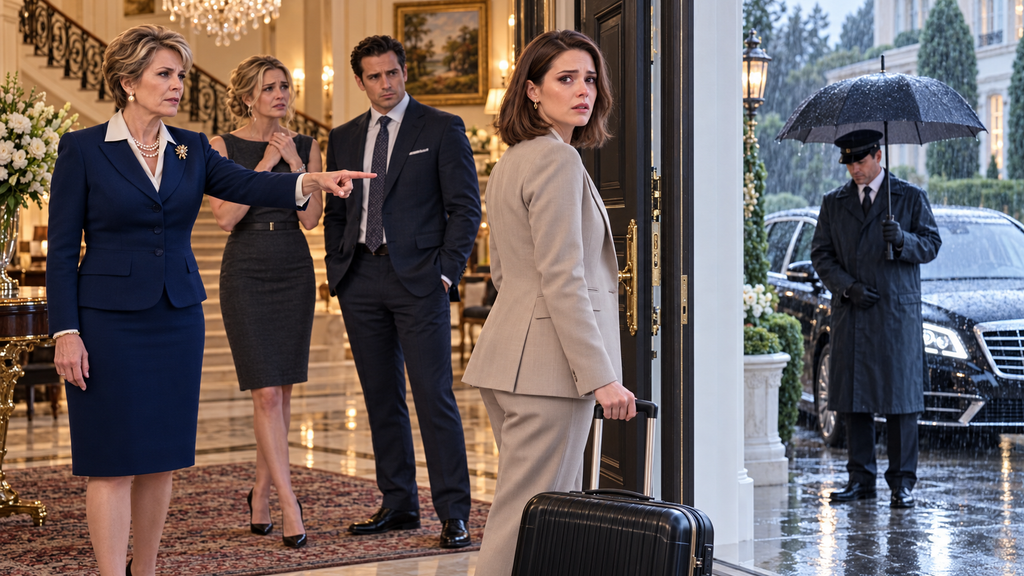
The folder rested beside me.
My hand stayed on top of it.
Not because I was afraid someone would take it.
Because for the first time in fifteen years, I understood exactly what it represented.
Not revenge.
Not humiliation.
Not even money.
Proof.
Proof that I had existed inside that company.
Proof that the contracts Julian took credit for had not magically appeared on his desk.
Proof that the partnerships Eleanor called “Vance family relationships” had actually been built through hundreds of meetings she had never attended.
Proof that while they introduced me at charity dinners as Julian’s quiet wife, I had been sitting across conference tables from bankers, developers, investors, attorneys, and government officials, keeping their business alive.
My phone vibrated again.
This time it was Eleanor.
I ignored that call too.
Then a message appeared.
WHERE ARE YOU GOING?
I almost laughed.
Twenty minutes earlier, she had ordered me out of her house as if I were something unpleasant being removed before guests arrived.
Now she suddenly cared where I was going.
I typed four words.
You’ll know in the morning.
Then I turned the phone off.
The driver took me downtown.
Not to a hotel.
Not to a friend’s apartment.
And definitely not to some miserable little rental Eleanor had probably imagined me crying inside before sunrise.
We stopped beneath the covered entrance of the Halston Hotel.
Arthur Vance was waiting in the lobby.
He rose the moment he saw me.
At seventy-one, Arthur still carried himself with the quiet authority of someone who had spent his life entering rooms where everyone already knew his name.
He was Eleanor’s late husband’s second cousin.
That technical connection was why the family always called him Uncle Arthur when they wanted something.
When they didn’t, Eleanor referred to him as “the investor.”
Arthur owned ten percent of Vanguard Architects.
But percentages did not explain his influence.
Arthur had financed two of the company’s expansions.
He knew every senior partner.
He knew the banks.
He knew the developers.
He knew the board.
Most importantly, Arthur had known me before Julian ever did.
His eyes dropped to the folder under my arm.
“You brought it.”
“Yes.”
“And the drive?”
“In my bag.”
Arthur nodded.
Then he looked at my single suitcase.
“That’s everything?”
“That’s everything I wanted.”
Something softened in his expression.
“Leah.”
I looked at him.
“You’re sure?”
He didn’t need to explain the question.
He had asked me the same thing three weeks earlier.
Then again four days ago.
And once more that afternoon before I signed my divorce papers.
Was I sure I wanted to let the marriage end?
Was I sure I wanted to stop protecting Julian?
Was I sure I was prepared for what would happen after the board saw the documents?
I looked toward the rain outside.
“For fifteen years, I kept telling myself that if I worked harder, they would eventually see me.”
Arthur said nothing.
“I thought Eleanor would respect me if I helped save the company.”
I gave a small laugh.
“I thought Julian would defend me if I proved I was useful enough.”
Arthur’s jaw tightened.
“And did he?”
“No.”
“Then there’s your answer.”
We took the elevator to the twenty-second floor.
Arthur had reserved a private conference suite.
Two attorneys were waiting inside.
So was Evelyn Cho, Vanguard’s independent audit committee chair.
The moment I saw Evelyn, I knew the meeting tomorrow morning was no longer theoretical.
This was happening.
She stood.
“Leah.”
“Evelyn.”
She glanced toward the folder.
“Is that what I think it is?”
“Yes.”
I placed it on the conference table.
For a few seconds, nobody touched it.
Then I untied the red cord.
The first document I removed was fourteen years old.
The paper had begun to yellow slightly along the edges.
At the top were the words:
SUBORDINATED CAPITAL AGREEMENT.
Underneath were two signatures.
Arthur Vance.
And mine.
Evelyn looked at me.
“I knew Arthur had arranged the emergency financing.”
“He did.”
“But I didn’t know the capital came from you.”
“Almost nobody did.”
Arthur sat down.
“Eleanor didn’t want anyone knowing.”
One of the attorneys opened the agreement.
I remembered the day it had been signed.
I had been married to Julian for less than eighteen months.
Vanguard Architects had expanded too quickly.
They had purchased a regional firm in Atlanta.
Then another in Chicago.
The economy shifted.
Two major developments were canceled.
A government contract was delayed.
Suddenly Vanguard had a serious cash problem.
Eleanor never discussed that part of the company history.
At anniversary dinners, she told people the expansion had been a triumph of “Vance family courage.”
It hadn’t been.
It had nearly destroyed them.
Payroll was three weeks from becoming a problem.
Their primary lender refused to extend another line of credit.
One afternoon, Julian came home, poured himself three fingers of whiskey, and sat silently in the kitchen.
I had never seen him frightened before.
I asked what was wrong.
He told me.
Then he asked me not to mention it to anyone.
What Julian did not know at the time was that my grandmother had died seven months earlier and left me considerably more money than he realized.
Grandmother had owned industrial property.
She had invested quietly.
She lived in the same modest house for forty years and drove a ten-year-old Volvo.
Nobody looking at her would have guessed the size of her estate.
I had inherited just over eight million dollars.
I had told Julian I received an inheritance.
I had never told him the amount.
Not because I distrusted him then.
Because my grandmother had given me one instruction before she died.
“Never let money announce itself before character does.”
So when Vanguard began collapsing, I called Arthur.
We met in his office.
I told him I was willing to put four million dollars into the company.
But I did not want Julian knowing the money came from me.
Arthur stared at me for almost a full minute.
Then he said, “Why?”
“Because he’ll feel humiliated.”
“And you’re willing to risk four million dollars to protect his pride?”
“I’m willing to risk it to protect his company.”
Arthur corrected me.
“His family’s company.”
At the time, I didn’t understand why he emphasized the distinction.
I understood now.
The investment was structured through Sutton Holdings.
My company.
My inheritance.
My premarital property.
Arthur acted as representative.
Eleanor knew outside capital had saved Vanguard.
She never knew the majority of that emergency money belonged to her daughter-in-law.
Or at least that was what she claimed.
The agreement contained a conversion provision.
Normally, it was simply debt.
But if Vanguard violated certain financial covenants through undisclosed related-party transactions, intentional financial misrepresentation, or unauthorized transfers exceeding a specified amount, the debt could convert into equity according to a formula written into the agreement.
For fourteen years, that clause meant nothing.
Until six months ago.
Evelyn turned another page.
Her expression changed.
“What is Vantage Development Group?”
I leaned back.
“That is why I started looking.”
I removed several bank records.
“Eight months ago, Vanguard transferred eight hundred thousand dollars to Vantage Development Group for what was described as international hospitality consulting.”
Evelyn looked down.
“There was no hospitality project.”
“No.”
Another document.
“Two months later, another one-point-two million.”
Another.
“Then six hundred thousand.”
Another.
“Then one-point-four.”
Evelyn stared at the papers.
“Four million dollars?”
“Just under.”
“Who owns Vantage Development?”
I slid the final document across the table.
Corporate registration.
The company had been formed eighteen months earlier.
The listed managing member was not Julian.
That would have been too obvious.
The listed managing member was Camille Mercer.
Julian’s sister.
The same woman who had laughed in the foyer while Eleanor inspected my suitcase.
Evelyn went still.
Arthur looked toward the window.
One attorney spoke.
“Does Camille have development experience?”
“No.”
“Architecture?”
“No.”
“Hospitality?”
“No.”
“Consulting?”
“No.”
“What does she do?”
I almost smiled.
“She describes herself as a lifestyle entrepreneur.”
The attorney removed his glasses.
“That sounds expensive.”
“It is.”
Evelyn began flipping through the documents faster.
“What happened to the money?”
I reached for the hard drive.
“That’s where this comes in.”
I placed it on the table.
The drive did not contain stolen files.
It contained copies of records I was authorized to maintain as part of my work overseeing strategic partnerships and risk management.
Records Julian apparently forgot I could access.
Invoices.
Internal approvals.
Emails.
Project codes.
Expense authorizations.
Payments.
Metadata.
Enough to follow the money.
Some of it had funded a condominium in Miami.
Some had paid renovation invoices connected to a property Eleanor used during the winter.
Some went toward a boat Julian insisted had been purchased by “friends in an investment group.”
A portion had paid for luxury travel.
And nearly three hundred thousand dollars had moved through a marketing company connected to Camille’s husband.
Nobody spoke for a long moment.
Finally Evelyn whispered, “My God.”
I shook my head.
“No.”
They all looked at me.
“This isn’t the worst part.”
I reached back into the folder.
There were twenty-seven pages clipped together.
Emails.
Julian to the chief financial officer.
Julian to Camille.
Julian to Eleanor.
The message that mattered most had been sent fourteen weeks earlier.
Julian had written:
LEAH IS STARTING TO ASK QUESTIONS. KEEP HER AWAY FROM Q3 DETAIL UNTIL WE CLEAN THIS UP.
Eleanor replied twenty-three minutes later.
SHE HAS NO FORMAL AUTHORITY. REMIND HER OF THAT.
Camille responded with a laughing emoji.
Then Julian wrote:
EASIER SOLUTION IS TO END THE MARRIAGE. MOM THINKS ONCE SHE’S OUT OF THE HOUSE SHE’LL LOSE ACCESS AND MOVE ON.
I had read that email alone in my office at 1:17 in the morning.
I remembered the exact time because I stared at the clock after reading it.
For almost ten minutes, I did not move.
Not because the divorce surprised me.
By then, our marriage had already become distant.
What broke something inside me was the casualness.
Easier solution is to end the marriage.
Fifteen years reduced to an administrative solution.
Remove Leah.
Remove the problem.
Remove the witness.
Arthur had been the first person I called.
Not a divorce lawyer.
Arthur.
I asked him one question.
“Does the old capital agreement still exist?”
He said yes.
Then I asked him to send me a copy.
That had been the beginning.
Evelyn finished reading the email.
She placed it carefully on the table.
“So Julian filed for divorce because you discovered the transfers.”
“I believe that was one reason.”
“One reason?”
I looked toward the dark window.
“There was someone else.”
Arthur’s expression hardened.
He already knew.
Evelyn did not.
“A woman?”
“Yes.”
“How long?”
“About eleven months.”
“Do you know who?”
“Yes.”
“Leah…”
I shook my head.
“That part doesn’t matter tomorrow.”
And it didn’t.
Whatever Julian had done to our marriage belonged to me.
The company belonged to hundreds of employees who had mortgages, children, medical bills, tuition payments, and no idea that executives had been using corporate accounts like a family wallet.
I wasn’t going to turn a board meeting into a wounded wife’s performance.
I had spent too many years being dismissed as emotional.
Tomorrow would be numbers.
Dates.
Signatures.
Facts.
Evelyn looked at Arthur.
“What happens if the agreement converts?”
Arthur nodded toward the attorney.
He answered.
“Based on the original formula and the company’s current valuation, Sutton Holdings becomes the beneficial owner of approximately twenty-three-point-eight percent.”
Evelyn stared at me.
“You?”
“Yes.”
“Twenty-three-point-eight percent?”
“Yes.”
Arthur added, “Plus my ten.”
Evelyn leaned back slowly.
“That changes everything.”
I looked at the documents spread across the table.
“No.”
They waited.
“It reveals everything.”
There was a difference.
At 7:10 the next morning, I woke before my alarm.
For several seconds, I did not know where I was.
Then I saw the hotel curtains.
The suitcase.
The folder.
The empty side of the bed.
I expected grief.
Instead, I felt quiet.
I showered.
Dried my hair.
Put on a navy suit I had owned for six years.
No designer label.
No dramatic jewelry.
No attempt to look like someone Eleanor might finally respect.
At breakfast, I drank coffee and ate toast.
My hands did not shake.
At 7:52, I turned my phone back on.
One hundred and fourteen notifications appeared.
Julian had called twenty-seven times.
Eleanor had called nine.
Camille had sent six messages.
The rest were texts.
Julian:
WHERE ARE YOU?
CALL ME.
LEAH THIS ISN’T FUNNY.
WHAT DID YOU MEAN ABOUT THE PRESS?
DID YOU CONTACT ARTHUR?
PLEASE CALL ME BEFORE YOU DO SOMETHING YOU’LL REGRET.
That last one made me stop.
Something I would regret.
For years, Julian had used that sentence whenever I disagreed with him.
Don’t say something you’ll regret.
Don’t embarrass me in front of my mother.
Don’t make this bigger than it is.
Don’t be dramatic.
Don’t overreact.
Don’t do something you’ll regret.
Strange how often people warn you about regret when what they really mean is obedience.
I opened the final message.
It had arrived at 6:42 a.m.
LEAH, WHATEVER YOU THINK YOU HAVE, WE CAN TALK ABOUT IT. PLEASE DON’T DESTROY EVERYTHING WE BUILT.
I read it twice.
Then I typed:
I’m not destroying what we built.
I’m protecting what you were destroying.
I sent it.
At 8:30, I walked into Vanguard Architects.
I had entered that lobby thousands of times.
Usually carrying coffee.
Sometimes project binders.
Occasionally flowers for Eleanor’s office because she liked fresh lilies on Mondays.
That morning, the security guard stood when he saw me.
“Mrs. Vance.”
I smiled gently.
“Miss Sutton now, Raymond.”
His face changed.
He had heard.
Everyone probably had.
“I’m sorry.”
“Thank you.”
He glanced behind me.
Arthur entered with Evelyn and two attorneys.
Raymond’s posture straightened.
The elevators opened.
Nobody stopped us.
The boardroom occupied most of the thirty-fourth floor.
Floor-to-ceiling windows overlooked the city.
A twenty-foot walnut table ran through the center.
Portraits of Vanguard’s founders hung along one wall.
Eleanor was already there.
So was Julian.
And Camille.
Julian stood the moment he saw me.
Eleanor didn’t.
She remained seated at the head of the table wearing cream silk and pearls.
The same pearls she wore when she wanted people to remember she considered herself the most important woman in the room.
Camille sat two chairs away, tapping one manicured fingernail against her phone.
Julian looked exhausted.
Good.
Not because I wanted him to suffer.
Because for once, I wanted him to know what it felt like to spend a night wondering what someone else had decided about his future.
His eyes moved from me to Arthur.
Then to the attorneys.
“Leah.”
I took the empty chair opposite him.
Eleanor’s voice was cold.
“This is a board meeting.”
“I know.”
“You are no longer family.”
“I know that too.”
“Then I’m afraid I don’t understand why you’re here.”
Arthur removed his coat.
“You will.”
Eleanor turned toward him.
“Arthur, I have no idea what Leah told you, but this is clearly an emotional reaction to the divorce.”
I almost admired how quickly she said it.
Emotional.
There it was.
The word women like Eleanor used when another woman possessed information they did not want discussed.
Arthur sat down.
“I haven’t come because of the divorce.”
Eleanor looked toward Evelyn.
“And why is she here?”
Evelyn placed a thick packet on the table.
“Because I chair the audit committee.”
For the first time, Eleanor’s expression shifted.
Only slightly.
But I saw it.
Fear.
Camille stopped tapping her phone.
Julian sat down.
“What exactly is going on?”
I opened my folder.
Eleanor looked at it.
Her eyes widened.
The folder she had laughed at less than twelve hours earlier.
“What is that?”
I met her gaze.
“My memories.”
Nobody smiled.
I removed the capital agreement.
Arthur pushed it toward her.
“Fourteen years ago, Vanguard received emergency financing of four million dollars.”
Eleanor barely glanced at the paper.
“I’m aware.”
“Are you?”
“Of course.”
“You told the board my investment group provided it.”
“You did.”
Arthur shook his head.
“I administered it.”
Then he pointed toward me.
“She provided it.”
Silence.
Not ordinary silence.
The kind that changes the temperature of a room.
Eleanor looked at Arthur.
Then at me.
Then back at the document.
“That’s absurd.”
“It’s documented.”
“Leah didn’t have four million dollars.”
I said nothing.
Eleanor looked directly at me.
“You didn’t.”
“I did.”
“From where?”
“My grandmother.”
Julian stared at me.
“Your inheritance?”
“Yes.”
“You told me she left you some property.”
“She did.”
“You said there were investments.”
“There were.”
“You never said eight million dollars.”
“You never asked.”
His mouth opened.
Closed.
For the first time since I met him, Julian appeared unable to decide whether he felt betrayed, embarrassed, or amazed.
Eleanor recovered faster.
“Fine.”
She waved one hand.
“So Leah invested money fourteen years ago. Vanguard paid its obligations.”
“Not all of them,” Arthur said.
Her hand stopped.
Arthur continued.
“The agreement was never fully redeemed. It was extended twice during expansion.”
Julian leaned forward.
“What does that mean?”
Arthur looked at him.
“It means the conversion provision remains active.”
I watched Julian’s face.
He had negotiated hundred-million-dollar developments.
He knew exactly what those words meant.
“What conversion provision?”
Eleanor asked the question.
Julian did not.
Arthur slid the document toward her.
“Section twelve.”
She read.
At first, her expression remained blank.
Then her lips parted.
Camille looked at her.
“What?”
Eleanor kept reading.
“What does it say?”
Still no answer.
Camille reached for the paper.
Eleanor pulled it away.
Too late.
Evelyn spoke.
“Certain covenant violations allow the remaining capital obligation to convert to voting equity.”
Julian looked at me.
“How much?”
I held his gaze.
“Twenty-three-point-eight percent.”
Camille laughed.
Actually laughed.
“That’s impossible.”
Nobody joined her.
Her smile disappeared.
Eleanor stood abruptly.
“This is nonsense. You cannot walk into this company the morning after a divorce and declare yourself a quarter owner.”
“I didn’t declare anything.”
I nodded toward the signatures.
“You signed the original board consent.”
Eleanor froze.
Arthur opened another section of the folder.
There it was.
Her signature.
Dated fourteen years earlier.
Eleanor stared at it.
“I didn’t know the capital was hers.”
“Your failure to ask who provided the money does not invalidate the agreement.”
One of the attorneys spoke calmly.
Eleanor turned on him.
“And who are you?”
“Counsel for Sutton Holdings.”
“Sutton Holdings?”
“My company,” I said.
Her eyes snapped toward me.
“You have a company?”
“I’ve had it since before I married Julian.”
Julian whispered, “Jesus, Leah.”
I looked at him.
“No.”
My voice was quiet.
“Just Leah.”
Eleanor sat down again.
Her face had lost some color.
Then instinct took over.
If Eleanor could not deny something, she attacked it.
“So this was your plan.”
I almost smiled.
“What was?”
“You married Julian, waited fifteen years, and then positioned yourself to take control.”
Julian looked at me.
For one painful second, I saw him wanting to believe her.
That hurt more than I expected.
Not much.
But enough.
I folded my hands.
“Fourteen years ago, your company was weeks away from a payroll crisis.”
Eleanor’s jaw tightened.
“I gave Vanguard four million dollars because I loved your son.”
I looked at Julian.
“I protected his pride by letting Arthur’s group appear to be the source.”
Then I turned back to Eleanor.
“I spent more than a decade helping build the company without once demanding recognition for that investment.”
I leaned slightly forward.
“If this was my plan, Eleanor, it was an extremely patient one.”
Nobody spoke.
Then Evelyn opened her packet.
“Unfortunately, ownership is not the only matter before us.”
Camille stiffened.
Julian closed his eyes briefly.
Eleanor looked at him.
“What did you do?”
It was interesting.
She didn’t ask what happened.
She asked Julian what he did.
Somewhere inside her, she already knew.
Evelyn placed the Vantage Development records on the table.
“Approximately four million dollars has been transferred to a related entity over the past eight months.”
Camille’s face changed.
Eleanor noticed.
“Camille?”
My former sister-in-law stood.
“This is ridiculous. Vantage is legitimate.”
Evelyn looked at her.
“What services did it provide?”
“Consulting.”
“What kind?”
“Development consulting.”
“For which projects?”
Camille hesitated.
“Several.”
“Name one.”
She glanced at Julian.
That glance told the room everything.
Eleanor turned slowly toward her son.
“Julian.”
He rubbed both hands over his face.
“Mom.”
“Did you authorize these payments?”
“It’s complicated.”
“No.”
Eleanor’s voice sharpened.
“Did you authorize them?”
Julian looked at me.
Not his mother.
Me.
“Leah, can we speak privately?”
Eleanor slammed one palm against the table.
“Answer me!”
“Yes!”
The word exploded out of him.
Nobody moved.
Julian lowered his voice.
“Yes.”
Eleanor stared.
“How much?”
“Not all of it was—”
“How much?”
“About four million.”
Eleanor’s face became very still.
“You moved four million dollars into your sister’s company?”
Camille crossed her arms.
“Don’t say it like that.”
Eleanor turned on her.
“How would you like me to say it?”
“You benefited too.”
That was the moment everything broke.
Eleanor’s eyes widened.
Camille realized what she had done.
Julian whispered, “Camille, shut up.”
But Camille had inherited one of Eleanor’s strongest traits.
She could not tolerate being the only person blamed.
“The Miami renovations weren’t for me.”
Eleanor stood.
“Stop talking.”
“And the winter property wasn’t mine.”
“I said stop.”
“Why? So Julian and I take everything while you pretend you had no idea?”
“Camille!”
Arthur leaned back in his chair.
Evelyn looked down at her papers.
I said nothing.
I didn’t need to.
This was the part people misunderstand about families built around power.
You rarely have to destroy them.
You only have to stop protecting them from one another.
Julian stood.
“This isn’t helping.”
Camille laughed bitterly.
“You think?”
“You signed invoices.”
“Because you told me to!”
“You owned the company!”
“Because you said your name couldn’t be on it!”
Eleanor closed her eyes.
“Enough.”
The room fell quiet.
She sat slowly.
When she looked at me again, the hatred had changed.
It was no longer contempt.
Contempt requires believing the other person is beneath you.
Now she was afraid of me.
“What do you want?”
I had imagined that question for three months.
At first, my answer had changed every day.
An apology.
Money.
My marriage restored.
Public recognition.
Revenge.
I had imagined Eleanor forced out of the mansion.
Julian begging.
Camille humiliated.
I had imagined buying the company and removing the Vance name from the building.
Pain creates childish fantasies before clarity arrives.
Eventually, I realized none of those things would repair fifteen years of making myself smaller so they could remain comfortable.
So when Eleanor asked what I wanted, my answer was simple.
“An independent forensic audit.”
Julian stared at me.
“Leah—”
I continued.
“Effective immediately, all related-party payments are frozen.”
Eleanor said nothing.
“Camille’s vendor agreement is suspended pending review.”
Camille looked furious.
“Julian steps aside from financial authority during the investigation.”
Julian’s face hardened.
“And you take over?”
“No.”
That surprised him.
I looked toward Evelyn.
“An independent interim executive can handle operations.”
Then toward Arthur.
“No layoffs tied to this investigation without board review.”
Arthur nodded.
I continued.
“Every employee pension contribution gets verified.”
Evelyn wrote something down.
“All vendors connected to directors or family members are reviewed.”
Eleanor’s mouth twisted.
“And after you finish humiliating us?”
I looked at her.
“This isn’t about humiliation.”
“Please.”
“For you, maybe everything is.”
I paused.
“But four hundred and eighty-three people work for Vanguard.”
She blinked.
I knew the exact number.
Of course I did.
“Four hundred and eighty-three people,” I repeated.
“They do not deserve to lose their jobs because three members of one family confused company money with personal money.”
Camille scoffed.
“You’re acting like some saint.”
I turned toward her.
“No.”
I had no interest in pretending.
“I was stupid too.”
That silenced everyone.
I looked at Julian.
“I covered for problems.”
His eyes dropped.
“I rewrote failed proposals and let Julian present them.”
His jaw tightened.
“I repaired client relationships and let Eleanor call them family connections.”
Eleanor looked away.
“I knew this company’s internal controls were too weak because everyone was afraid of upsetting the family.”
I placed my hand over the folder.
“And for years, I stayed quiet because I thought protecting the people I loved was the same thing as loving them.”
My voice cracked slightly.
It was the first time that morning emotion reached it.
I didn’t apologize.
“I was wrong.”
Julian looked at me then.
Really looked at me.
And I saw something I had not seen throughout the divorce.
Shame.
Not fear.
Not anger.
Shame.
“Leah.”
I met his eyes.
He swallowed.
“I’m sorry.”
Eleanor immediately spoke.
“Julian.”
He ignored her.
“I’m sorry.”
I waited.
“For what?”
He looked stunned by the question.
“For…”
His voice faded.
I shook my head.
“That’s the problem.”
He stared at me.
“You’re sorry because this is happening.”
I gestured toward the boardroom.
“You’re sorry because Arthur knows.”
Toward Evelyn.
“Because the audit committee knows.”
Toward the attorneys.
“Because consequences finally entered the room.”
His face tightened.
“But I needed you to be sorry when it was just me.”
He looked down.
“And you never were.”
Nobody spoke.
For fifteen years, I had wanted Julian to choose me in front of his mother.
I had wanted him to say:
Enough.
Don’t speak to my wife like that.
She helped build this.
She matters.
Not once had he done it when it counted.
Now, sitting inside the boardroom where he had once accepted praise for my work, he finally found the courage to apologize.
It was too late.
That was sad.
But it was not tragic.
Some doors should close after enough chances have walked through them.
Eleanor straightened.
“You mentioned the press last night.”
“Yes.”
“Did you contact reporters?”
“No.”
For the first time all morning, she looked relieved.
I continued.
“But Vanguard’s lenders require disclosure of material governance changes.”
Her relief vanished.
“And three major institutional clients require notification if executive authority changes during an investigation.”
Arthur added quietly, “We also cannot conceal a board-level financial review.”
Eleanor looked from him to me.
“So our name will be dragged through the papers.”
I considered that.
“Your name?”
I glanced around the room.
“The employees downstairs did not move four million dollars.”
Eleanor’s face hardened.
“The junior architects didn’t.”
I continued.
“The project managers didn’t.”
I looked at Camille.
“The receptionist didn’t.”
Then Julian.
“The engineers didn’t.”
Finally Eleanor.
“So if the Vance name appears in the press, perhaps the people carrying it should consider why.”
At 10:14, the first vote was called.
Julian was temporarily removed from financial and executive authority pending the audit.
Six votes in favor.
Two opposed.
One abstention.
At 10:22, Camille’s consulting agreement was suspended.
Seven in favor.
One opposed.
At 10:31, the forensic audit was approved unanimously.
Even Eleanor voted yes.
She had no choice.
Then came the matter everyone had been avoiding.
Chairmanship.
Arthur spoke first.
“Given that several transactions may involve or benefit the current chair, I move that Eleanor Vance step aside pending review.”
Eleanor stared at him.
“Arthur.”
He did not look away.
“We have known each other forty-two years.”
“That’s correct.”
“My husband trusted you.”
“He did.”
“And now you’re doing this?”
Arthur’s expression barely changed.
“No, Eleanor.”
He nodded toward the records.
“You did this.”
The vote passed.
Eleanor was removed as chair.
Temporary.
Pending review.
But we all understood what temporary sometimes means.
When the meeting ended, nobody stood immediately.
It felt strange.
For so long, Eleanor had controlled rooms by being the last person to speak.
Now there was nothing left to say.
Camille was the first to leave.
She grabbed her handbag and headed for the door.
Before stepping out, she turned toward me.
“I hope you’re happy.”
I considered the accusation.
“No.”
That surprised her.
“I’m free.”
Her face changed.
Then she left.
Eleanor remained seated.
Julian walked toward the windows.
Arthur and Evelyn gathered their papers.
The attorneys stepped into the hallway.
I began placing documents back into my folder.
“Leah.”
Eleanor’s voice.
I stopped.
She was looking at me.
Not with anger now.
Something closer to exhaustion.
“Did you enjoy this?”
I thought carefully before answering.
“No.”
She studied my face as if searching for triumph.
I gave her none.
“You could have told me.”
I almost couldn’t believe she said it.
“Told you what?”
“About the money.”
“The investment?”
“Yes.”
“Why?”
“I would have treated you differently.”
There it was.
Fifteen years summarized in one sentence.
I closed the folder.
“That’s exactly why I didn’t tell you.”
Her forehead creased.
“If knowing I had millions would have made you respect me, then you never respected me.”
She looked away.
For once, Eleanor had no answer.
I stood.
Then something unexpected happened.
She said my name.
Not Leah.
Not Julian’s wife.
Not dear in that sharp little voice she used when criticizing me.
“Miss Sutton.”
I turned.
Her mouth tightened.
“I suppose that’s what you prefer now.”
“Yes.”
She nodded once.
It was the smallest concession imaginable.
But I understood how difficult it was for her.
And I realized something else.
I didn’t need it.
That was the real freedom.
Outside the boardroom, Julian caught up with me near the elevators.
“Can we talk?”
Arthur glanced at me.
I nodded.
“I’ll meet you downstairs.”
He left.
Julian and I stood alone.
For several seconds, neither of us spoke.
He looked terrible.
His tie was loose.
His eyes were red.
I remembered helping him choose that suit.
Three years earlier.
London.
We had been happy that weekend.
Or I had believed we were.
“How long have you known about Vantage?” he asked.
“Six months.”
His eyes closed.
“Six months.”
“Yes.”
“Why didn’t you confront me?”
“I did.”
His eyes opened.
“When?”
“Remember dinner at LaRue?”
He frowned.
“The night I asked whether anything was happening inside Vanguard that could damage the company?”
His face changed.
“I asked whether there were transactions I should know about.”
“You didn’t say Vantage.”
“No.”
“Why?”
“Because I wanted to know whether you would tell me the truth without being trapped.”
He looked away.
“You didn’t.”
For a moment, the only sound was the elevator moving somewhere behind the wall.
Then Julian whispered, “I thought I could put it back.”
I almost laughed.
Money.
Trust.
Marriage.
People always think they can put things back.
“How?”
“The hotel development was supposed to close. Camille’s company would return the funds.”
“Camille’s company bought property.”
“It got out of control.”
“No.”
My voice remained calm.
“You made choices.”
He flinched.
“There’s a difference.”
He stepped closer.
“I know what I did was wrong.”
“Which part?”
His expression tightened.
“The transfers?”
I continued.
“The emails?”
He said nothing.
“The divorce?”
Still nothing.
“The other woman?”
His face went pale.
There.
Finally.
“You know.”
“Yes.”
“How?”
“I stopped being the only person in our marriage who wasn’t looking.”
He rubbed his forehead.
“It wasn’t serious.”
I stared at him.
Eleven months.
Hotel rooms.
Trips.
A bracelet purchased through a corporate card and later reclassified as a client expense.
Not serious.
It was amazing how small betrayal became in the mouth of the person who committed it.
“I don’t care.”
“You do.”
“No, Julian.”
I surprised myself.
“I really don’t.”
His expression broke.
Maybe anger would have been easier for him.
Anger leaves a connection.
Indifference tells someone the bridge is already gone.
He whispered, “Did you ever love me?”
That one hurt.
I hated him a little for asking.
Not because the answer was difficult.
Because it was easy.
“Yes.”
His eyes filled.
“I loved you enough to put four million dollars into a company that was failing because watching you lose it would have broken your heart.”
He looked down.
“I loved you enough to work beside you for years while your family treated my contribution like a hobby.”
My throat tightened.
“I loved you enough to make myself smaller because your mother thought there was only room for one important woman in your life.”
He closed his eyes.
“And when I finally stopped doing that, you divorced me.”
“Leah—”
“So never ask me if I loved you.”
My voice remained quiet.
“Ask yourself what you did with it.”
The elevator doors opened.
I stepped inside.
Julian stood outside.
He looked like he wanted to follow me.
He didn’t.
Just before the doors closed, he said, “Is there any chance?”
I looked at the man I had shared fifteen years with.
His morning coffee.
His birthdays.
His father’s funeral.
Two miscarriages we never discussed properly.
Christmases.
Flights.
Hospital waiting rooms.
Inside jokes.
Sunday mornings.
All the ordinary pieces that make a marriage feel permanent until suddenly they belong to the past.
“There was.”
The elevator doors began closing.
“For years.”
Then they shut.
At 1:00 p.m., Vanguard issued a statement.
It was short.
The company announced an independent financial review and temporary leadership changes.
No accusations.
No dramatic language.
No family details.
By 1:17, business reporters began calling.
By 2:00, three industry websites had published stories.
By 3:30, Eleanor’s photograph was everywhere.
So was Julian’s.
Mine appeared in only one early article.
The caption described me as:
LEAH SUTTON, INVESTOR AND LONGTIME STRATEGIC ADVISER TO VANGUARD ARCHITECTS.
I stared at those words for several seconds.
Investor.
Strategic adviser.
Not wife.
Not daughter-in-law.
Not Julian Vance’s former spouse.
Me.
It was strange how emotional that felt.
Arthur found me staring at the screen.
“You all right?”
I locked my phone.
“Yes.”
“You don’t look all right.”
“I spent fifteen years being introduced through somebody else.”
Arthur nodded.
“And?”
I smiled.
“I think I’m getting used to my own name again.”
The audit took nine weeks.
Those nine weeks were ugly.
There is no beautiful way to examine years of entitlement.
More related-party transactions appeared.
Some were legitimate.
Some were sloppy.
Several were indefensible.
The final amount associated with questionable transfers exceeded six million dollars.
Not all of it was theft.
That mattered.
I refused to exaggerate the findings.
Some expenditures were technically authorized but improperly disclosed.
Others violated company policy.
A smaller group appeared fraudulent enough that outside counsel referred them for further investigation.
Camille’s company had received more money than anyone initially realized.
Her husband had invoiced Vanguard for marketing services that could not be substantiated.
Julian had signed several approvals.
Eleanor had approved two transactions directly.
The Miami property became the center of weeks of legal fighting.
So did the boat.
The press became brutal.
For the first time in her life, Eleanor discovered that a famous surname could attract scrutiny as easily as admiration.
Then something happened I had not expected.
Vanguard survived.
At first, employees were terrified.
People expected layoffs.
Clients paused projects.
Competitors circled.
Rumors spread.
But the company had something stronger than the Vance family legend.
It had talented people.
Architects.
Engineers.
Project leaders.
Designers.
Administrators.
People who had spent years doing actual work while the family polished its mythology.
Arthur asked me to help stabilize the largest client relationships.
I agreed.
Temporarily.
Not for Julian.
Not for Eleanor.
For the employees.
One Tuesday morning, I walked into a meeting with the CEO of Clarion Development.
He shook my hand.
“Good to finally meet the mysterious Leah Sutton.”
I laughed.
“Mysterious?”
“For years, Julian would call me after meetings and say, ‘My team came up with a solution.’”
He smiled.
“Then one night I happened to be in the office at eleven and discovered his team was apparently one exhausted woman with a yellow legal pad.”
I laughed despite myself.
“Julian contributed.”
“I’m sure he did.”
The CEO leaned forward.
“But I always knew who returned my calls.”
That sentence stayed with me.
I always knew who returned my calls.
Maybe that was what reputation really was.
Not plaques.
Not portraits.
Not family names carved into buildings.
It was who answered when something went wrong.
Six months after the divorce, Vanguard held its annual shareholder meeting.
Eleanor did not attend.
Camille had moved to Florida.
Her attorneys advised her not to speak publicly.
Julian attended through video.
The forensic review had resulted in his permanent removal as chief executive.
He still owned shares.
He still had money.
He was not destitute.
Despite what certain headlines suggested, nobody had dragged him into the street.
He simply no longer occupied the position he believed belonged to him by birth.
That distinction mattered.
Consequences are not always ruin.
Sometimes they are simply the removal of privileges someone mistook for rights.
The board asked me to become CEO.
I declined.
They asked again.
I declined again.
Arthur called me stubborn.
I reminded him he had known that for twenty years.
Eventually, the board hired an experienced executive from Chicago.
A woman named Marisol Vega.
No family connection.
No inherited title.
Thirty years in architecture and infrastructure management.
The first day she arrived, she walked every floor of the building and introduced herself to the employees.
Eleanor would have considered that unnecessary.
Marisol considered it leadership.
I stayed on the board.
Sutton Holdings retained its equity.
My investment, the one nobody knew existed, had become worth considerably more than the amount I originally put in.
But that was not the part that mattered most.
Three months after Marisol took over, Vanguard reinstated employee bonuses that had been frozen during the investigation.
The email announcing it arrived while I was sitting in a small café.
I read it twice.
Then I cried.
Not loudly.
Just enough that the waitress quietly brought me extra napkins without asking.
Because fourteen years earlier, I had put four million dollars into Vanguard to protect Julian.
Now, finally, I understood what had actually been worth protecting.
The people.
Not the family name.
Not the mansion.
Not the portraits.
The people.
I moved into a townhouse across the river.
Three bedrooms.
Big windows.
A kitchen half the size of Eleanor’s.
No marble foyer.
No carved staircase.
No portraits of dead men watching me eat breakfast.
I loved it immediately.
The first thing I placed on the mantel was the photograph of my grandmother.
The one Eleanor had watched me pack.
In the picture, Grandmother was sixty-eight years old, standing beside her ridiculous old Volvo with one hand on her hip.
Two weeks after I moved in, Arthur came for dinner.
He looked at the picture.
“She would have enjoyed all this.”
I poured wine.
“No.”
Arthur laughed.
“No?”
“She would have hated the attention.”
“That’s true.”
Then I smiled.
“But she would have enjoyed Eleanor finding out where the four million came from.”
Arthur nearly choked on his wine.
Some evenings were like that.
Quiet.
Ordinary.
Mine.
Then, nine months after the divorce, Eleanor called me.
I almost didn’t answer.
Her name appeared on my screen at 8:06 on a Sunday evening.
I stared at it.
Then answered.
“Hello?”
Silence.
“Leah.”
Her voice sounded different.
Older.
“Eleanor.”
“I hope I’m not disturbing you.”
That sentence alone nearly convinced me I had answered the wrong phone.
“No.”
“I wanted to speak with you.”
I waited.
She cleared her throat.
“The house is being sold.”
I hadn’t known.
The mansion.
The marble foyer.
The oak staircase.
The portraits.
The place from which she had given me twenty-four hours to disappear.
I felt something shift inside me.
Not pleasure.
Not sadness.
Just memory.
“I’m sorry,” I said.
She gave a short, humorless laugh.
“Are you?”
“Yes.”
That seemed to surprise her.
“The maintenance is ridiculous,” she said.
“It always was.”
“And the taxes…”
“I remember.”
Another silence.
Then Eleanor said, “I found something.”
“What?”
“In the office.”
My fingers tightened slightly around the phone.
“One of the drawers.”
I waited.
“A note from Richard.”
Richard had been her husband.
Julian’s father.
He died seven years into our marriage.
Unlike Eleanor, Richard had been warm toward me.
Not openly affectionate.
But kind.
He asked questions.
He listened to answers.
When I spoke about work, he never called it helping Julian.
“What did it say?”
Eleanor breathed slowly.
“He wrote that Vanguard would not have survived the expansion without you.”
I closed my eyes.
“He knew?”
“Apparently.”
“How?”
“Arthur told him near the end.”
I smiled faintly.
Of course Arthur had.
Eleanor continued.
“Richard wrote that I underestimated you.”
My throat tightened.
“He said it was one of my worst habits.”
Despite myself, I laughed.
Eleanor did too.
Barely.
A strange little sound.
Then she said something I never expected.
“He was right.”
I said nothing.
“I underestimated you.”
Her voice cracked.
Just slightly.
“And I was cruel to you.”
There it was.
An apology would have been easy to ruin by making it too perfect.
Eleanor did not suddenly become a different woman.
She did not sob.
She did not beg forgiveness.
She did not say I had been like a daughter.
That would have been a lie.
She simply admitted the truth.
“I treated you as though you were fortunate to be allowed into our family.”
I looked around my little living room.
At my books.
My grandmother’s photograph.
A half-finished cup of tea.
Rain touching the windows.
“Yes,” I said.
“You did.”
“I told myself I was protecting what Richard built.”
“I know.”
“But I think…”
She stopped.
Then began again.
“I think I was protecting my importance.”
That sentence was more honest than anything Eleanor had said to me in fifteen years.
I sat down.
“Why are you telling me now?”
“Because the house is almost empty.”
I waited.
“And when people remove the furniture, Leah, rooms become very honest.”
For a moment, I could picture her there.
Alone.
No parties.
No board members.
No daughter arranging flowers.
No son entering through the side door.
Just Eleanor in the enormous foyer where she had once demanded I open my suitcase.
She continued.
“I found the place on the rug where your suitcase wheels scratched the floor.”
I almost smiled.
“You always hated those rugs.”
“I still do.”
Another small laugh.
Then silence.
Finally she said, “I am sorry.”
I looked at the rain.
For years, I had imagined hearing those words.
I thought they would feel like winning.
They didn’t.
They felt sad.
And strangely gentle.
“Thank you,” I said.
“Do you forgive me?”
That was harder.
I thought about lying.
About giving her a beautiful answer because people prefer endings where everyone embraces and becomes family again.
But real forgiveness isn’t theater.
“I don’t know.”
She was silent.
Then she said, “That’s fair.”
“I’m not angry the way I was.”
“That isn’t the same.”
“No.”
Another pause.
“But maybe it’s a beginning.”
Eleanor breathed out slowly.
“I’ll take that.”
Before we hung up, she asked one more question.
“Leah?”
“Yes?”
“When you left that night…”
I knew.
“The folder?”
“Yes.”
“You said we would understand the next day.”
“I remember.”
“Did you know exactly what you were going to do?”
I thought about it.
“No.”
She sounded surprised.
“I knew I was done protecting everyone.”
I looked toward my grandmother’s picture.
“That was enough.”
We said goodnight.
I never moved back into the mansion.
Of course I didn’t.
The house sold two months later to a hotel developer.
The newspapers described it as the end of an era.
Maybe it was.
Julian eventually sent me a handwritten letter.
Six pages.
I almost threw it away.
Instead, I read it once.
He apologized without asking me to come back.
That was how I knew something in him had finally changed.
He admitted the affair.
The money.
The cowardice.
His dependence on his mother’s approval.
The way he let me carry responsibility while he accepted praise.
At the end, he wrote:
I used to think losing you happened the day the divorce became final.
Now I understand I lost you slowly, every time you needed me to stand beside you and I chose the easier side of the room.
I folded the letter.
Placed it back in the envelope.
And put it in a drawer.
Not because I wanted to preserve our marriage.
Because some memories deserve a place without deserving another chance.
A year after the night Eleanor ordered me out, Vanguard hosted its annual employee celebration.
Marisol asked me to attend.
I almost declined.
Then she said something that changed my mind.
“This isn’t a board event.”
“What is it?”
“A thank-you.”
So I went.
No ballroom.
No society photographers.
No expensive family speeches.
They held it in the renovated central atrium of Vanguard headquarters.
Employees brought spouses.
Children ran between tables.
Young architects displayed project models.
A jazz trio played near the windows.
I wore a simple black dress.
No pearls.
Arthur found me near the entrance.
“Look at you.”
“What?”
“You’re smiling inside Vanguard.”
“I’ve done that before.”
“Not like this.”
He was right.
Halfway through dinner, Marisol walked onto the small stage.
She spoke about the company.
Not the Vance legacy.
The company.
Its employees.
Its clients.
Its future.
Then she announced a new professional development fund for young architects.
I had helped establish it anonymously.
Arthur ruined the anonymous part.
He leaned toward Marisol and whispered something.
She looked at me.
I shook my head.
Too late.
Marisol smiled.
“One more thing.”
I closed my eyes.
“Arthur insists I clarify that the initial endowment for this program came from one of our directors.”
Several people turned.
“Leah Sutton.”
Applause filled the atrium.
I hated attention.
My grandmother had passed that down too.
But something was different.
Nobody was applauding because I was Julian’s wife.
Nobody was clapping because Eleanor had approved my presence.
Nobody saw me as an accessory to a more important person.
They were looking at me.
I stood.
For several seconds, I couldn’t speak.
Then I walked onto the stage.
Marisol handed me the microphone.
I looked around the room.
Four hundred and eighty-three employees had become more than five hundred.
Young architects.
Senior engineers.
Assistants.
Project managers.
People whose names Eleanor might never have known.
I thought of the night Julian came home terrified that Vanguard might fail.
The four million dollars.
The secret agreement.
The late nights.
The negotiations.
The divorce.
The mansion.
The suitcase.
The folder.
The rain.
I thought of Eleanor telling me:
Take whatever little belongings are actually yours.
How strange.
That sentence had been intended to make me feel as though I owned nothing.
Instead, it forced me to discover exactly what was mine.
My money.
My work.
My reputation.
My judgment.
My future.
My name.
I looked at the crowd.
“I spent a long time believing being valuable and being valued were the same thing.”
The room became quiet.
“They aren’t.”
Arthur watched me from the front table.
“So if I could tell the younger people in this room one thing, it would be this.”
I tightened my grip on the microphone.
“Do good work.”
“Help people.”
“Be generous.”
“But do not disappear inside what you build for someone else.”
Nobody moved.
“Keep your name attached to your work.”
“Know what you contributed.”
“Know what you own.”
“And when someone repeatedly benefits from your silence…”
I paused.
“…understand that your silence may be helping them more than your kindness is helping you.”
The applause began quietly.
Then grew.
I stepped away from the microphone.
Arthur was smiling.
Marisol hugged me.
And for the first time, standing inside the company I had once helped save in secret, I did not feel like someone’s wife.
I did not feel like Eleanor’s unwanted daughter-in-law.
I did not feel like the woman who had been given twenty-four hours to disappear.
I felt like Leah Sutton.
That was enough.
Later that night, I walked outside alone.
Rain had started falling.
Just like the night I left the mansion.
For a moment, I stood beneath the awning.
Cars moved through the wet streets.
The city glowed around me.
A black sedan pulled toward the curb.
Arthur had sent a driver again.
The same driver, by coincidence.
He stepped out with an umbrella.
“Miss Sutton?”
I smiled.
“Yes.”
He opened the rear door.
Before getting inside, I looked up at Vanguard’s building.
A year earlier, Eleanor believed forcing me out of her house meant removing me from everything that mattered.
She thought power lived in the mansion.
In the surname.
In Julian’s title.
In portraits.
In boardrooms.
In invitations.
In who was allowed to stay.
She had been wrong.
Power was knowing what you could walk away from.
Power was knowing what you carried with you.
And sometimes the most important thing you take when someone orders you out…
is not the suitcase.
Not the folder.
Not even the proof.
It is yourself.
I got into the car.
The driver closed the door.
As we pulled away, my phone lit up with a message from Arthur.
YOU DID GOOD TONIGHT.
I smiled and typed back.
WE DID.
Then another message appeared.
This one from Eleanor.
I stared at her name.
For a second, I considered waiting until morning.
Then I opened it.
She had sent a photograph.
The mansion foyer.
Empty now.
No furniture.
No flowers.
No family standing beneath the staircase.
Only the Persian rug remained.
And near its edge was the faint scratch my suitcase had left behind the night she threw me out.
Under the photograph, Eleanor had written:
Funny. After everything that happened in this house, this is the mark I keep noticing.
I looked at the picture for a long time.
Then I replied:
Some things only become visible after everything else is removed.
Three dots appeared.
Disappeared.
Appeared again.
Finally Eleanor sent:
I suppose you were always better with words.
I smiled.
No anger.
No satisfaction.
Just peace.
I turned off my phone.
Outside the window, the lights of the city moved past.
A year earlier, I had left one house believing fifteen years of my life had ended.
I know better now.
My life had not ended when Eleanor gave me twenty-four hours to leave.
My marriage had ended.
My illusions had ended.
My willingness to be invisible had ended.
But my life?
That began the moment I picked up that folder, closed my suitcase, and walked through the door.
They thought they were throwing out a woman who had nothing without their family.
They thought the mansion was power.
They thought the Vance name was protection.
They thought Julian was the company.
They thought my silence meant ignorance.
They thought my patience meant weakness.
They thought wrong.
Because the thick folder Eleanor mocked contained the agreement that proved I had quietly saved Vanguard fourteen years earlier.
The hard drive contained the records proving who had been quietly draining it.
And the woman they dismissed as the insignificant ex-wife?
She walked out owning nearly a quarter of the company they believed belonged only to them.
But even that wasn’t the real victory.
The real victory came later.
When I stopped needing them to know what I was worth.
When I stopped hoping Julian would choose me.
When I stopped waiting for Eleanor’s approval.
When I stopped believing that being invited into a powerful family made me powerful.
I had spent fifteen years standing beside people who needed me to feel small.
The moment I stopped shrinking, everything changed.
So no…
I never went back asking Eleanor for a place to stay.
I never begged Julian to reconsider the divorce.
I never fought Camille in the newspapers.
I never needed to.
Their own signatures told the story.
Their own emails exposed the truth.
Their own choices created the consequences.
And the house Eleanor once ordered me out of?
It belongs to someone else now.
The company Julian believed could never function without him?
It is stronger under new leadership.
The folder?
Locked safely in my office.
The hard drive?
Preserved with the legal records of the investigation.
And me?
I still have the photograph of my grandmother.
It sits on the mantel of my townhouse.
Some mornings, I drink coffee beneath it and think about what she told me all those years ago.
Never let money announce itself before character does.
She had been right.
Money eventually announced everyone.
Julian.
Camille.
Eleanor.
Me.
But character told the more important story.
And if there is one thing I learned from losing a marriage, a mansion, a family name, and the life I thought I was supposed to want, it is this:
Never be afraid when people who underestimate you finally decide you are no longer useful to them.
Sometimes that is the exact moment you become free enough to discover how powerful you were all along.
Eleanor gave me twenty-four hours to leave her house.
I needed less than one.
And I never looked back.
THE END! THANK YOU FOR READING!❤️