 Reading Time: 23 minutes
He Saw His Ex-Wife Counting Coins to Feed Twin Boys—Never Knowing They Were His Sons Nathan Harrison had negotiated billion-dollar contracts across the world. From New York to Dubai, from London to Singapore, people knew him as the man who never hesitated.
They called him the King of Concrete. His signature could turn empty land into luxury towers, shopping districts, and exclusive communities worth hundreds of millions. Nothing surprised him anymore. At least, that was what he believed.
Until one ordinary Friday afternoon in Chicago.
Nathan stopped at a small bakery on the North Side, expecting nothing more than a quick coffee before the biggest land acquisition meeting of his career.
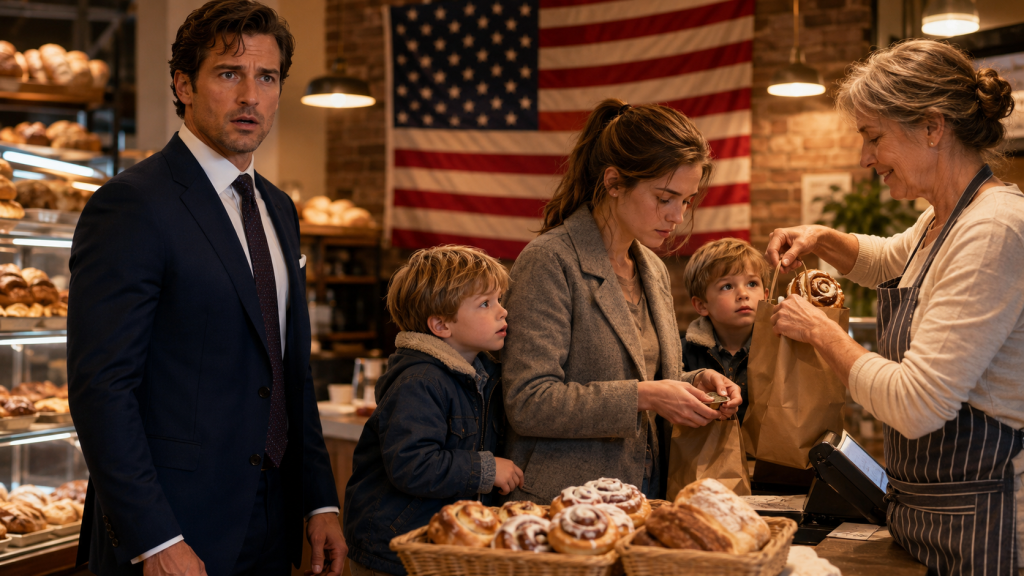
The bakery was warm, narrow, and smelled of butter, cinnamon, and fresh bread.
It was the kind of place he would normally walk past without noticing.
No marble.
No valet.
No polished hostess with a reservation list.
Just a bell over the door, handwritten prices on a chalkboard, and a line of regular people waiting for coffee and rolls.
Nathan had only entered because his driver had taken a wrong turn and the meeting was still forty minutes away.
He was checking messages on his phone when he heard a voice he had not heard in five years.
Soft.
Tired.
Still unmistakable.
“Just one loaf, please. And two small milk cartons.”
Nathan looked up.
And the world stopped.
Emma Parker.
His ex-wife.
For a moment, he did not recognize the woman at the register because his memory kept trying to dress her in the version of herself he had last known.
Emma in silk gowns.
Emma laughing at charity galas.
Emma standing barefoot in his penthouse kitchen, stealing bites of pasta from the pan.
Emma with her hair loose over her shoulders and her eyes bright enough to make even his coldest rooms feel warm.
But the woman in front of him now wore an old gray coat, practical shoes, and a ponytail that looked as if she had tied it quickly before rushing out the door.
Her face was thinner.
Her shoulders looked tired.
The confidence she had once carried through business dinners and society events had been replaced by something quieter.
Not weakness.
Exhaustion.
Beside her stood two identical little boys.
One stared longingly at a tray of cinnamon rolls behind the glass.
The other clutched a notebook filled with hand-drawn rockets and planets.
Nathan’s first thought was that they were beautiful.
His second thought made his chest tighten.
They looked familiar.
Too familiar.
The quieter boy looked up at Emma and said, “Mom, if there isn’t enough money, I don’t need any bread.”
The words hit Nathan harder than any business loss ever had.
Emma smiled gently, but Nathan saw the effort it took.
“There’s enough, sweetheart,” she said. “We just have to count carefully.”
Then she opened her palm and began counting coins.
Nickels.
Dimes.
Quarters.
One by one.
At the register of a neighborhood bakery, the woman Nathan had once bought diamonds for was counting change to feed two little boys.
The bakery owner, an older man with flour on his sleeves, quietly slipped extra pastries into the bag.
Emma immediately tried to refuse.
“Oh, Mr. Bell, no. I can’t—”
“Day-old extras,” the man said, lying kindly. “They’ll go to waste.”
The boys’ faces lit up.
Emma’s eyes filled, but she blinked the tears back before either child could see.
Nathan stepped backward.
He could not breathe.
Five years earlier, Emma had signed the divorce papers without asking for a fight.
Without demanding half his company.
Without taking the penthouse.
Without touching the cars, the accounts, or the properties his lawyers warned him she might use to destroy him.
She had simply left.
At the time, Nathan told himself she had never truly wanted the life he was building.
He told himself she was too soft for his world.
Too sensitive.
Too demanding.
Too unwilling to understand that empires required sacrifice.
Now he stood in a bakery doorway watching her count coins, and something inside him cracked.
Before she could turn and recognize him, Nathan walked out into the cold.
For the first time in years, his hands were shaking.
His driver opened the door when he approached.
“Sir?”
Nathan did not answer.
He got into the back seat and sat there, staring through the tinted glass as Emma stepped out of the bakery with the boys.
The one holding the rocket notebook skipped once, then stopped himself, as if he had remembered happiness cost energy.
The other boy held the bread bag carefully against his chest like it was treasure.
Emma took one small hand in each of hers and led them down the sidewalk.
Nathan watched until they disappeared around the corner.
His meeting that afternoon was supposed to secure a massive lakefront acquisition.
He signed nothing.
He barely heard the presentations.
Architectural renderings passed across the conference table.
Lawyers spoke.
Investors asked questions.
His phone buzzed with messages.
But all he could see was Emma’s open palm.
Coins.
Two little boys.
A quiet voice saying, if there isn’t enough money, I don’t need any bread.
That night, Nathan sat alone in his glass office overlooking downtown Chicago.
Below him, the city glittered like proof that he had won at life.
Towers with his name in their files.
Developments built by his company.
Land shaped by his decisions.
Everything he had chased stood before him in steel and light.
But it no longer looked like victory.
It looked empty.
Finally, he called his executive assistant.
“I need information on Emma Parker.”
There was a long silence.
“Your ex-wife, sir?”
Nathan closed his eyes.
“Yes.”
“Is this a legal matter?”
“No.”
Another silence.
“Then what kind of matter is it?”
Nathan looked out at the skyline.
“The kind I should have handled five years ago.”
The report arrived the next morning.
Emma Parker.
Middle-school science teacher.
Apartment in Rogers Park.
Two children.
Twin boys.
Ethan and Noah.
Four years old.
Nathan kept reading.
Then he stopped.
The twins had been born seven months after the divorce.
Seven months.
His pulse quickened.
Suddenly, nothing else on the page mattered.
Not the school name.
Not the address.
Not the salary.
Seven months.
He ordered a full background report.
Employment history.
Financial records.
Medical expenses.
Everything.
He hated himself for doing it like a businessman instead of a man.
But shame had made a coward of him.
By noon, the second report was on his desk.
By twelve fifteen, Nathan Harrison’s perfect control was gone.
Emma commuted across the city every day to teach science at a struggling public school.
She tutored on weekends.
She had no family nearby.
She carried more than $120,000 in debt from complications surrounding the twins’ premature birth.
Premature.
That word made Nathan sit back.
Seven months after the divorce.
Premature birth.
Twins.
The report included one small school photograph taken at a science fair.
Emma stood between the boys, smiling with tired pride.
One boy held a cardboard rocket.
The other held a little handmade volcano.
Nathan stared at their faces.
One had Emma’s serious eyes.
The other had Nathan’s exact habit from childhood, tapping two fingers against his leg when thinking.
The shape of their faces.
The angle of their noses.
The stubborn line of their mouths.
His sons.
The words came before proof.
His sons.
Nathan wanted to call Emma.
He wanted to demand answers.
He wanted to ask why she had never told him.
But shame held him still.
Because a memory came back.
The night before the divorce, Emma had stood in the doorway of his study, pale and trembling.
“Nathan,” she had whispered. “There’s something I need to tell you.”
He had not even looked up from the contract in front of him.
“Tell my lawyer.”
Three words.
That was all he had given her.
Tell my lawyer.
Now, five years later, those words felt like a sentence passed against his own life.
He remembered the look on her face.
The small inhale.
The way her hand had gone to her stomach.
He had been too angry to notice.
Too proud.
Too busy protecting his empire from the woman who had only been trying to speak.
Nathan closed the report.
Then opened it again because pain had a strange way of demanding proof.
He read every line twice.
Medical expenses.
Hospital stays.
Delayed rent payments.
Teaching salary.
Tutoring income.
No child support.
No trust.
No insurance beyond what her school provided.
And beneath it all, two boys who were four years old.
Four years of birthdays.
Four years of fevers.
Four years of first steps, first words, first drawings, first fears.
Four years of Emma doing alone what should never have been hers to carry alone.
Nathan wanted to help.
Without forcing Emma to see him.
Without reopening wounds.
Without barging into the life she had clearly built without him.
So he did the one thing men like Nathan always did when emotion terrified them.
He used money.
Quietly, he donated five million dollars to Emma’s school.
The donation went through a foundation attached to his company.
No public announcement.
No name on the lab.
No photo opportunity.
The money funded a cutting-edge science laboratory, new books, teacher stipends, student meals, and after-school programs.
He told himself it was enough.
He told himself it was generous.
He told himself she would never know.
But generous secrets are still secrets.
And secrets had already ruined enough.
Three days later, everything changed.
Emma overheard a contractor speaking on the phone in the hallway outside her classroom.
“Yes, Mr. Harrison. Ms. Parker loved the new lab. Nobody knows you paid for it.”
The moment she heard Nathan’s name, she froze.
That evening, after putting Ethan and Noah to bed, her phone rang.
The caller ID showed a name she had not seen in years.
Nathan Harrison.
She answered immediately.
“Nathan.”
Her voice was cold.
Careful.
Guarded.
“Emma,” he said quietly. “We need to talk.”
For a moment, neither of them spoke.
Then Emma glanced toward her apartment door, almost as if she already knew where he was.
Finally, she broke the silence.
“Come upstairs.”
Nathan exhaled.
But before he could respond, Emma added one final sentence.
A sentence that made his stomach drop.
“Before you walk through that door, understand something.”
“What?”
Her voice hardened.
“You still have absolutely no idea what you’ve done.”
Ten minutes later, Nathan stood outside her apartment with his hand raised to knock.
Before he could, the door opened.
Emma stood there in an old sweater, arms crossed, eyes exhausted but unafraid.
Behind her, two little boys peeked from the hallway.
The bolder one whispered, “Mom, is that the man from the picture?”
Nathan’s chest tightened.
“What picture?”
Emma did not answer.
She stepped aside.
The apartment was small but warm.
Too warm for the cheap building, maybe because Emma had filled it with color.
Children’s drawings lined the refrigerator.
A secondhand bookshelf leaned slightly near the window.
The kitchen table had scratches, glue stains, and a bowl of apples in the center.
Nathan saw two small backpacks by the door.
Two pairs of rain boots.
Two toothbrushes in a cup near the bathroom sink.
Evidence of a life he had never been invited into because he had closed the door before Emma could knock.
On the small kitchen table sat a folder.
Old letters.
Returned envelopes.
Medical records.
Ultrasound photos.
And one document stamped by Nathan’s own legal department.
Communication restricted.
Do not forward to Mr. Harrison.
Nathan’s blood went cold.
Emma looked at him.
“I tried to tell you I was pregnant.”
His mouth went dry.
“I never knew.”
“I know,” she said softly. “That’s the problem.”
Then she opened the folder to the final page.
A signed instruction from his former attorney.
And beneath it, a second signature.
His mother’s.
Nathan stared at the paper.
For several seconds, the room moved around him without sound.
His mother’s elegant handwriting sat below the order like a knife pressed into paper.
Helen Harrison.
The woman who taught him which fork to use, which board members to flatter, which emotions to hide.
The woman who had smiled at Emma during the wedding and called her “a charming little distraction.”
The woman who had told Nathan after the divorce, “Some women are not built for legacy.”
Emma’s voice broke for the first time.
“Your family didn’t just keep you from your sons, Nathan.”
She looked toward the boys.
“They made sure I raised them believing you had chosen to abandon them.”
Nathan could not speak.
For five years, he had believed Emma walked away because she wanted a simpler life.
For five years, Emma had believed he knew about the pregnancy and chose money over his sons.
Ethan and Noah stood in the hallway, watching him with cautious eyes that looked too much like his own.
“Emma,” he whispered, “I swear I never saw any of this.”
Her laugh broke softly.
“I wanted to hate you, Nathan. It was easier than believing your family erased us.”
He reached for the returned letters.
Each one was marked undeliverable.
Each one had been sent back by people paid to protect his empire.
His empire.
The thing he had worshiped had quietly devoured his family before he even knew he had one.
Then Noah stepped forward, holding the rocket notebook against his chest.
“Are you our dad?”
Nathan’s eyes filled before he could stop them.
He lowered himself to one knee.
“Yes,” he said. “And I am so sorry I wasn’t there.”
Ethan frowned.
“Mom said sorry doesn’t buy groceries.”
Emma closed her eyes, ashamed he had heard that.
Nathan looked at the boys and said, “Then I’ll do more than say sorry.”
Noah tilted his head.
“Can you fix rockets?”
Nathan almost laughed, but it came out wounded.
“I can learn.”
Ethan looked at him suspiciously.
“Do you know dinosaurs?”
“Not enough.”
“That’s a problem,” Ethan said.
For the first time in years, Emma almost smiled.
Almost.
Then she shut the folder.
“You can’t buy your way into their lives.”
“I know.”
“Do you?”
Nathan looked around the apartment.
At the old couch.
The taped window seal.
The stack of unpaid bills half-hidden beneath a science magazine.
“No,” he admitted. “But I want to learn.”
Emma studied him for a long moment.
“Learning will hurt.”
“It should.”
The next morning, Nathan walked into Harrison Development and fired his former attorney in front of the entire board.
Martin Vale had served the Harrison family for twenty-six years.
He was polished, gray-haired, and arrogant in the way men become when they have mistaken proximity to power for power itself.
Nathan placed copies of the communication restriction order on the conference table.
Martin’s face went pale.
“Where did you get that?”
Nathan’s voice was low.
“From the woman you helped silence.”
Several board members shifted uncomfortably.
Nathan looked at them all.
“Effective immediately, Martin Vale is terminated. His access is revoked. All files connected to my divorce, Emma Parker, or any communications received from her are to be preserved for legal review.”
Martin stood.
“Nathan, you need to think carefully. Your mother approved—”
“That sentence is the only reason I am not handling this quietly.”
Martin swallowed.
“You don’t understand everything.”
Nathan leaned forward.
“Then start explaining.”
But Martin said nothing.
Cowards rarely confess before consequences arrive.
Security escorted him out.
Then Nathan called his mother.
Helen answered on the second ring.
“Nathan, darling. I was just about to call you. Someone told me you caused a scene at the office.”
“You didn’t protect me,” he said coldly. “You stole my sons.”
There was a pause.
Then his mother sighed.
Not with guilt.
With irritation.
“So Emma finally showed you.”
His stomach turned.
“You admit it?”
“I admit I did what had to be done. You were building something enormous, Nathan. She would have ruined your focus.”
“She was pregnant.”
“She was inconvenient.”
The word struck him like a slap.
Inconvenient.
Two children struggling over bread in a bakery.
A woman counting coins.
Four years of absence.
All of it dismissed as inconvenience.
Nathan’s voice dropped.
“You are never to contact Emma or the boys.”
Helen laughed softly.
“Your sons? You met them yesterday.”
“And lost four years because of you.”
“No,” she said sharply. “You lost four years because Emma left.”
“She tried to tell me.”
“She signed the papers.”
Nathan froze.
“What?”
“If you think Emma was innocent, ask her what she signed the night she left you.”
The line went dead.
Nathan stood still in his office.
For the first time since seeing the boys, doubt entered like poison.
What had Emma signed?
He hated the question.
Hated that his mother had planted it.
Hated even more that he needed an answer.
That evening, he went back to Emma’s apartment.
This time, he brought groceries.
Not luxury baskets.
Not imported chocolates.
Real groceries.
Milk.
Eggs.
Chicken.
Apples.
Pasta.
Bread.
Cereal.
Laundry detergent.
The things he had never once thought about needing.
Emma opened the door and stared at the bags.
“Nathan.”
“I didn’t know what they eat.”
“They eat food.”
“Right.”
She looked like she wanted to be angry, but Noah ran past her and gasped.
“Strawberries!”
Ethan appeared behind him.
“Are those dinosaur nuggets?”
Nathan glanced at Emma.
“There were three kinds. I panicked.”
Emma pressed her lips together.
It might have been the start of a smile.
The boys pulled the bags into the kitchen.
Nathan waited until they were distracted before he said quietly, “My mother called.”
Emma’s face changed.
“She told you.”
“She told me to ask what you signed the night you left.”
All warmth disappeared from the room.
Emma turned away and began putting groceries into the refrigerator.
Nathan watched her shoulders tighten.
“Emma.”
“I signed a confidentiality agreement.”
“Why?”
She closed the refrigerator.
“Because your mother and Martin came to me after you told me to speak to your lawyer. They said you wanted a clean divorce. No press. No scandal. No emotional appeals.”
“I never said that.”
“I know that now.”
“What did they offer you?”
“Nothing at first. Then threats.”
Nathan went still.
“What kind of threats?”
Emma’s voice stayed controlled, but her hands trembled.
“They said if I tried to claim pregnancy publicly, they would accuse me of fraud. That they would bury me in court. That your family had doctors, experts, judges, and money. That they would make sure I looked like a desperate ex-wife trying to trap you.”
Nathan could barely breathe.
“I would have stopped them.”
Emma turned.
“You told me to tell your lawyer.”
The words were quiet.
Fair.
Devastating.
“I was twenty-seven,” she continued. “Pregnant. Alone. Your legal department had returned my letters. Your office blocked my calls. Your mother told me you knew and wanted nothing to do with me unless I signed.”
Nathan closed his eyes.
“What did the agreement say?”
“That I would not contact you directly, publicly discuss the marriage, or make financial claims against you.”
“And the pregnancy?”
Her voice broke.
“It said any future claim regarding paternity would be treated as disputed and potentially fraudulent unless addressed through Harrison legal counsel.”
Nathan sat down slowly.
Emma hugged herself.
“I thought signing was the only way to protect them from being dragged through court before they were even born.”
“That’s why you didn’t fight for child support.”
“I thought you would destroy me if I tried.”
“Emma…”
“And then they were born early,” she said, tears finally filling her eyes. “Two tiny babies in incubators. Hospital bills piling up. I called your office one last time from the NICU. Someone told me if I continued harassing Mr. Harrison, legal action would be taken.”
Nathan put his face in his hands.
His mother had not just hidden the boys.
She had built a wall and made Emma bleed against it.
“I am going to make this right,” he said.
Emma wiped her cheeks.
“You can’t give them back four years.”
“I know.”
“You can’t buy first steps.”
“I know.”
“You can’t pay your way into bedtime stories, birthdays, fevers, nightmares, school forms, or the first time Noah asked why other kids had dads at pickup.”
Nathan looked up.
“What did you tell him?”
“I told him some families are shaped differently.”
“And Ethan?”
Emma smiled sadly.
“Ethan said different was just a word adults used when something hurt.”
Nathan looked toward the kitchen.
The boys were arguing over whether rockets could carry dinosaurs to Mars.
“I don’t deserve them,” he said.
“No,” Emma answered.
The honesty hurt.
Then she added, “But they deserve the chance to know the truth.”
That was where they began.
Not forgiveness.
Not reunion.
Truth.
Nathan took a paternity test voluntarily the next morning.
He did not need it to know, but Emma needed legal protection and the boys deserved certainty.
The results came back days later.
Probability of paternity: 99.9999%.
Ethan and Noah Harrison Parker were his sons.
Nathan stared at the paper in his office until the numbers blurred.
Then he placed it beside the bakery receipt he had kept from that Friday.
A receipt for coffee he never drank.
The day his life split open.
His next move was not money.
It was time.
Emma allowed him one supervised dinner at her apartment.
Then a Saturday trip to the museum.
Then a visit to Ethan and Noah’s school science night.
The first dinner was awkward.
Nathan wore a suit.
Emma opened the door and said, “You look like you’re here to acquire the building.”
He looked down.
“Should I change?”
Ethan appeared behind her.
“You don’t have play clothes?”
Nathan did not.
So Emma handed him an old sweatshirt from a school fundraiser.
It was too small in the shoulders and said Jefferson Middle School Science Fair.
Noah laughed so hard he fell onto the couch.
That was the first sound Nathan heard from his son that did not contain caution.
He would remember it forever.
At dinner, Nathan burned the garlic bread.
He cut Noah’s pasta too small.
He called Ethan’s brontosaurus a diplodocus and was corrected for seven full minutes.
Emma watched from across the table, not soft exactly, but less guarded.
After dinner, Noah brought him the rocket notebook.
“Can buildings fly?”
“No.”
“Why?”
Nathan began explaining gravity, structural loads, and aerodynamics.
Noah stared.
Emma interrupted.
“He is four.”
Nathan tried again.
“No, because buildings are too heavy.”
Noah nodded.
“Then make a light one.”
Ethan leaned over.
“That’s called a spaceship, Noah.”
The boys argued.
Nathan smiled.
It felt strange.
Like using a muscle that had been locked away.
Meanwhile, Helen Harrison did what powerful people do when losing control.
She escalated.
First came calls.
Then messages through board members.
Then an invitation to lunch Emma ignored.
Then a legal letter suggesting Emma had violated the confidentiality agreement.
Nathan responded personally.
The letter he sent back was three sentences.
Any further contact with Emma Parker or my sons will be treated as harassment.
Any attempt to enforce the agreement will expose the circumstances under which it was obtained.
Choose carefully.
Helen chose poorly.
She filed a private petition questioning whether Emma had concealed the children for financial advantage and whether Nathan should seek primary custody now that paternity was established.
Nathan found out from his own attorney.
He called his mother immediately.
“You filed against Emma?”
“She kept them from you.”
“You kept them from both of us.”
“She is a schoolteacher with debt.”
“She is their mother.”
“And you are a Harrison.”
Nathan looked through his office window at the city he once thought mattered more than anything.
“No,” he said. “I am their father. That is bigger.”
The custody hearing was brutal in the way family court can be brutal without anyone raising their voice.
Helen arrived in pearls and dignity, her face arranged into wounded concern.
Her attorney painted Emma as secretive, unstable, financially strained, and resentful.
Emma sat very still beside her attorney.
Nathan could feel her humiliation like heat.
Then it was his turn to speak.
He stood.
“My mother and my former attorney restricted communications from Emma Parker during and after our divorce,” he said. “I have reviewed the documents. Emma attempted to contact me repeatedly regarding the pregnancy. Those attempts were blocked without my knowledge.”
Helen’s face tightened.
Nathan continued.
“Emma did not hide my sons from me. My family hid all three of them from me.”
His mother whispered, “Nathan.”
He did not look at her.
“For four years, Emma Parker raised Ethan and Noah alone. She fed them, protected them, taught them, and loved them while carrying debts caused by their birth. I will not allow her character to be attacked by the people who created the conditions she survived.”
The judge listened.
The documents spoke louder than Helen’s pearls.
Returned letters.
Call logs.
The confidentiality agreement.
The legal department restriction.
The paternity result.
The petition was dismissed.
The judge warned Helen’s attorney against further bad-faith filings.
Outside the courtroom, Helen approached Nathan.
“You embarrassed me.”
Nathan looked at her as if seeing her clearly for the first time.
“No,” he said. “I told the truth. If that embarrassed you, sit with it.”
“You would choose her over your own mother?”
He glanced across the hallway.
Emma was kneeling beside the boys, buttoning Noah’s coat while Ethan showed her a sticker from the courthouse security guard.
Nathan’s voice softened.
“I choose them over the lie you built.”
Helen’s eyes filled with anger.
“You will regret this.”
Nathan shook his head.
“I already regret waiting this long.”
Months passed.
Nathan did not become a father all at once.
He became one in pieces.
One Saturday morning at a time.
One bedtime story at a time.
One small failure at a time.
He learned Ethan liked dinosaurs, rules, and strawberry jam.
He learned Noah loved rockets, questions, and drawing planets on anything that did not move.
He learned both boys hated peas but would eat them if mixed into rice.
He learned Emma drank coffee only after it had cooled halfway and always kept emergency crayons in her purse.
He learned school pickup was not as simple as arriving.
You had to know which door.
Which teacher.
Which child needed a snack immediately.
Which child needed to tell you every detail of the day before getting into the car.
He learned that money could pay bills, but it could not make a child trust your hand automatically.
That part had to be earned.
The first time Ethan fell asleep against Nathan during a movie, Nathan did not move for ninety minutes.
His arm went numb.
He did not care.
The first time Noah called him Dad, it was accidental.
He was asking for juice.
“Dad, can you—”
Then he froze.
Nathan froze too.
Emma looked up from the sink.
Noah’s face went red.
“I mean Nathan.”
Nathan crouched beside him.
“You can call me Nathan. You can call me Dad. You can call me whatever feels right. I’m not going anywhere.”
Noah studied him.
“Even if Grandma Helen is mad?”
Nathan’s chest tightened.
“Especially then.”
Noah nodded.
“Dad, can I have juice?”
Nathan went into the kitchen and cried quietly while pouring apple juice into a plastic cup with dinosaurs on it.
Emma saw.
She said nothing.
But later, when the boys were asleep, she placed a cup of coffee beside him.
“You meant it?” she asked.
“What?”
“That you’re not going anywhere.”
“Yes.”
She sat across from him.
“I don’t know how to trust you.”
“I know.”
“I’m still angry.”
“You should be.”
“I’m angry at you, even if you didn’t know.”
“You should be,” he repeated.
That made her look at him.
“You keep saying that.”
“Because it’s true. I may not have known about the boys, but I know who I was when you tried to tell me. I know what kind of man says, tell my lawyer, to his wife while she’s trembling in a doorway.”
Emma’s eyes softened with pain.
“I loved you so much that night.”
“I know.”
“That was the worst part.”
Nathan looked down.
“I loved you too. I was just too trained to choose power to recognize it.”
For a long time, neither spoke.
Then Emma said, “The boys need stability. Not guilt. Not grand gestures. Stability.”
“Tell me what that looks like.”
She did.
A schedule.
Boundaries.
No surprise gifts without asking.
No expensive replacements for ordinary parenting.
No using lawyers to solve emotional problems.
No speaking badly about Helen in front of the boys, even when she deserved it.
No disappearing when things became uncomfortable.
Nathan wrote it all down.
Emma stared at him.
“You’re taking notes?”
“I ruin things when I assume I already know.”
That time, she really smiled.
Just a little.
It was enough.
Nathan also changed the company.
At first, people thought it was temporary guilt.
They were wrong.
He created paid family leave across Harrison Development.
He funded childcare support for employees.
He established emergency medical debt assistance for staff families.
When a board member complained that the changes were expensive, Nathan looked at him and said, “So is losing your humanity.”
The room went quiet.
The King of Concrete had become inconveniently human.
The biggest change came one year after the bakery.
Nathan bought the building where Emma lived.
When she found out, she nearly threw a mug at him.
“I told you no grand gestures.”
“It was not a grand gesture.”
“You bought my apartment building.”
“It had mold, bad wiring, and a landlord ignoring repairs.”
“Nathan.”
“I did not evict anyone. Rents are frozen. Repairs start Monday. A tenants’ board will oversee complaints. You do not have to live here if you don’t want to, but everyone else deserves heat that works too.”
Emma stared at him.
“You could have just called housing inspectors.”
“I did that too.”
She tried not to smile.
“You are impossible.”
“I’m improving.”
Slowly, carefully, they built something that was not the old marriage.
The old marriage had been beautiful on the outside and lonely underneath.
This was different.
Messier.
Slower.
More honest.
Nathan attended school plays and sat in chairs too small for him.
He learned how to pack lunches.
Badly at first.
Ethan once opened his lunchbox to find sushi, a protein bar, and three loose strawberries.
Emma sent Nathan a photo with the caption: He is four, not closing a merger.
Nathan improved.
On the boys’ fifth birthday, they held a party in a park.
Not a ballroom.
Not a private club.
A park with balloons, cupcakes, and a rocket-shaped piñata Noah chose because Ethan said a dinosaur piñata would be “too emotionally difficult to destroy.”
Nathan watched Emma light the candles.
The boys stood between them.
Ethan made a wish with serious concentration.
Noah tried to blow early.
Everyone laughed.
For one second, Nathan saw the life that should have been theirs from the beginning.
Then he let that thought go.
Regret could not raise children.
Only presence could.
After cake, Emma stood beside him under a tree.
“You’ve changed,” she said.
“I’m trying.”
“No,” she said. “Trying is what people say when they want credit before the work is done. You’re doing the work.”
Nathan looked at the boys chasing bubbles across the grass.
“Do you think they’ll forgive me?”
Emma’s voice was gentle.
“They already are. Children do that faster than adults. That’s why we have to be careful with them.”
“And you?”
She did not answer right away.
A breeze moved through the trees.
Finally, she said, “I don’t know if forgiveness is one thing. Maybe it’s a hundred small choices.”
Nathan nodded.
“I can wait for each one.”
Two years after the bakery, Emma invited Nathan inside after dropping the boys off from a weekend visit.
Not just to the doorway.
Inside.
She had made soup.
The boys were asleep in the back room after a day at the planetarium.
Nathan stood in the kitchen, watching Emma stir the pot.
“This feels familiar,” he said.
She glanced back.
“The kitchen?”
“You.”
Her expression changed.
The past moved between them, but it no longer felt like a locked door.
It felt like a room they might someday enter without bleeding.
“I missed you,” Nathan said quietly.
Emma looked down.
“I missed who I thought you were.”
He accepted that.
“I’m sorry he wasn’t real.”
She turned off the stove.
“I think parts of him were.”
Nathan looked at her.
“The good parts?”
“The parts that loved me but didn’t know how to fight for me.”
“I know how now.”
Emma studied him.
“I believe you.”
Those three words meant more to Nathan than any contract he had ever signed.
They did not remarry quickly.
This was not a story where pain disappeared because a rich man apologized and bought groceries.
Emma had built a life from ashes.
Nathan had to prove he wanted to belong to that life, not replace it.
So they went to counseling.
Together.
Separately.
They talked about pride, fear, money, family, betrayal, and the damage silence can do when people mistake it for strength.
Helen never apologized.
She sent gifts to the boys twice.
Emma returned them.
Nathan supported the decision.
Years later, when the boys were old enough to ask why they rarely saw their grandmother, Nathan told them the truth in careful words.
“She made choices that hurt your mother and me. Until she can take responsibility, we keep distance to protect our family.”
Ethan asked, “Does she love us?”
Nathan answered honestly.
“I think she loves control more.”
Noah frowned.
“That’s not good love.”
“No,” Nathan said. “It isn’t.”
Three years after the bakery, Nathan took Emma and the boys back to Mr. Bell’s bakery.
The same bell rang over the door.
The same cinnamon smell filled the air.
Mr. Bell recognized Emma immediately, then looked at Nathan with suspicion.
Emma smiled.
“He’s with us.”
Mr. Bell raised an eyebrow.
“For now?”
Nathan said, “For good, if they let me.”
The old baker studied him.
Then handed the boys two cinnamon rolls.
“Day-old extras,” he said.
Noah whispered loudly, “These are warm.”
Mr. Bell winked.
“Very special day-old extras.”
Emma’s eyes filled.
Nathan took her hand under the table.
This time, she did not pull away.
They sat near the window while Ethan drew a dinosaur eating a croissant and Noah sketched a rocket launching from the bakery roof.
Nathan watched them and remembered the first time he saw Emma there.
Counting coins.
Trying not to cry.
He had thought then that the sight cracked something inside him.
But now he understood.
It had not cracked him.
It had opened him.
That night, after the boys fell asleep, Emma handed Nathan an envelope.
His chest tightened.
“What is this?”
“Open it.”
Inside was a photograph.
Emma, younger and pregnant, standing in front of the hospital mirror, one hand on her belly.
On the back, written in her handwriting, were the words:
I wish you knew.
Nathan stared at it until his vision blurred.
“I took it the night before they were born,” she said. “I was scared. I was angry. But some part of me still wanted you there.”
Nathan pressed the photo to his chest.
“I wish I had been.”
“I know.”
He looked at her.
And this time, when he said, “I love you,” it was not a claim.
Not a plea.
Not a way to make the past easier.
It was simply the truth.
Emma touched his face.
“I love who you became.”
Six months later, they married again.
Not in a cathedral.
Not in front of business leaders.
Not with society pages waiting outside.
They married in a small garden behind the boys’ school.
Ethan carried the rings.
Noah insisted on wearing a bow tie with rockets on it.
Mr. Bell brought pastries.
Nathan’s board chairman attended and cried quietly, though he denied it afterward.
Emma wore a simple cream dress.
Nathan wore the same suit he had worn the first night he brought groceries, because Emma said it reminded her of the first time he looked less like a billionaire and more like a man trying not to fall apart in a hallway.
When it was time for vows, Nathan did not promise perfection.
He knew better.
He promised presence.
“I once thought love could wait until after success,” he said, voice shaking. “I was wrong. Love is the only success that matters when the room gets quiet. I cannot give back the years we lost, but I promise every year I have left will know your name, your voice, and our sons’ laughter.”
Emma cried.
Nathan cried too.
This time, he did not hide it.
Ethan whispered, “Adults cry a lot at weddings.”
Noah whispered back, “It’s probably because of taxes.”
Everyone laughed.
Years later, people still called Nathan Harrison the King of Concrete.
But the title no longer mattered to him.
The buildings remained.
The deals continued.
The company grew.
But his real life was not in towers.
It was in a kitchen where dinosaur magnets held school drawings to the refrigerator.
It was in two boys racing through the hallway shouting about Mars.
It was in Emma reading on the couch with her feet tucked under his leg.
It was in the bakery receipt he kept framed in his office.
The day he bought coffee and found his family.
Sometimes Nathan thought about that younger version of himself, the man who had told his trembling wife, “Tell my lawyer.”
He wished he could go back and shake him.
But he could not.
All he could do was live differently now.
So he did.
He answered calls.
He came home for dinner.
He learned the difference between apologies and repair.
He taught his sons that power means nothing if it cannot protect the people you love.
And whenever Ethan or Noah asked for bread at the bakery, Nathan remembered the little voice that once said, if there isn’t enough money, I don’t need any bread.
There was enough now.
Not just money.
Enough truth.
Enough courage.
Enough love to rebuild what pride and cruelty had broken.
Nathan had once believed he could shape cities.
But Emma and the boys shaped him.
They turned a man of concrete back into flesh.
And on the anniversary of the day he saw Emma counting coins, Nathan returned alone to Mr. Bell’s bakery before sunrise.
He ordered coffee.
A loaf of bread.
And two cinnamon rolls.
Then he placed a sealed envelope on the counter.
Inside was a donation large enough to keep the bakery open for the rest of Mr. Bell’s life, and a note written by hand.
For the man who fed my sons when I did not know they were mine.
Thank you for being kind before I learned how.
Mr. Bell found it after Nathan left.
He never mentioned it.
But every time Nathan came in with Emma and the boys, the old baker slipped extra pastries into the bag and said the same thing.
“Day-old extras. They’ll go to waste.”
And every time, Emma would smile.
Nathan would take her hand.
The boys would cheer.
And the life he nearly lost would remind him that sometimes the smallest moment in an ordinary bakery can expose the biggest lie.
Sometimes a handful of coins can weigh more than a fortune.
And sometimes, the family you thought you lost is standing right in front of you, waiting for you to become worthy of coming home.
THE END! THANKS FOR READING!