 Reading Time: 34 minutes
PART 3: THE NIGHT I STOPPED KEEPING THE PEACE
My husband’s newest message was only six words long. You need to delete that video. I stared at the screen until the words blurred.
Not Is our daughter okay?
Not I’m sorry.

Not even I should have stopped her.
Delete the video.
That was what mattered to him.
Evidence.
I looked toward the mattress where my two-year-old daughter, Lily, was sleeping beside a pile of borrowed pillows in my friend Rachel’s guest room. Her little hand rested beneath her cheek.
The red mark from her grandmother’s slap was still visible.
I looked back at my phone.
Another message appeared.
Mom is terrified you’re going to use this against her. She’s sixty-two, Amanda. Think about what you’re doing.
I almost laughed.
Think about what I was doing?
For years, that family had trained me to believe that reacting to cruelty was somehow worse than committing it.
If Elaine insulted me, I was supposed to understand that she was “old-fashioned.”
If she criticized my parenting, I was supposed to remember that she had “raised three children successfully.”
If she mocked Lily for being slow to speak, I was supposed to recognize that she was “just concerned.”
If she grabbed Lily’s arm too roughly, I was told she was “from another generation.”
And now she had slapped a two-year-old across the face in front of thirty-seven people.
Yet somehow I was still being asked to protect her.
I finally typed back.
The video is already saved in three places. Do not contact me again tonight unless it concerns Lily’s health or immediate safety.
His reply came almost instantly.
Amanda, don’t be ridiculous.
I blocked his number.
Then I forwarded the video to myself, Rachel, and a new email account I had created a month earlier when I first started preparing for the possibility that I might have to leave.
I had created that account because something inside me had already understood what my conscious mind refused to admit.
I was not preparing for a bad argument.
I was preparing to escape a pattern.
Rachel appeared quietly in the doorway.
She was still wearing the gray sweatshirt she had pulled on when I arrived.
“You okay?”
“No.”
She nodded.
It was one of the reasons I loved her.
Rachel never tried to turn pain into an inspirational quote before you had actually survived it.
She sat beside me.
I handed her my phone.
She watched the clip once.
Then again.
Her expression changed the second time.
“You heard that?”
I nodded.
She repeated my husband’s whisper softly.
“Mom, I told you—not in front of everyone.”
Rachel lowered the phone.
“Oh, Amanda.”
“I thought he was weak.”
“He is.”
“No.” I wiped my eyes. “Weak would mean he was surprised and froze. This wasn’t freezing. He knew.”
Rachel said nothing.
I looked at Lily.
“He knew she was capable of doing this.”
That realization changed everything.
Until that night, I had imagined Daniel’s failure as passivity.
I told myself he loved us but lacked courage.
That explanation had allowed me to remain married to him far longer than I should have.
But the video revealed something worse.
Daniel had not merely failed to defend his daughter after an unexpected attack.
He had anticipated his mother’s behavior.
Maybe not that exact slap.
But something.
He had known enough to warn Elaine not to do it publicly.
Which meant there had been conversations I did not know about.
Warnings I had never heard.
Incidents Daniel had minimized.
Possibly things that had happened when I wasn’t present.
My stomach tightened.
I reached for my phone again and unblocked Daniel.
Then I typed:
What did you mean when you told your mother, “Not in front of everyone”?
Three dots appeared.
Disappeared.
Appeared again.
Finally:
You’re taking it out of context.
I felt something inside me go completely still.
Then give me the context.
No answer.
A minute passed.
Then two.
Then five.
Finally:
Mom has been worried about Lily’s behavior for a while. She gets frustrated. I told her if she had concerns she should discuss them privately instead of making scenes. That’s all.
I read the message twice.
Rachel read it over my shoulder.
“Behavior?” she said. “She’s two.”
Exactly.
Lily was a cheerful toddler who loved strawberries, picture books, plastic dinosaurs, and saying the word “yellow” incorrectly.
Her greatest criminal act that week had been coloring on the underside of our coffee table with a green crayon.
“What behavior?” I typed.
Daniel answered:
Her speech. Her tantrums. How sensitive she is. Mom thinks you baby her too much.
There it was.
The family diagnosis.
A two-year-old child behaved like a two-year-old, so obviously something was wrong with her.
I remembered Elaine’s words at the banquet.
This girl has defective genetics.
At the time, I had assumed she was insulting me.
Now I wondered whether something deeper had been happening.
How long has your mother been discussing Lily’s “genetics” with you?
Daniel stopped answering.
That silence was an answer too.
I blocked him again.
The next morning, I called a lawyer.
Her name was Rebecca Chen.
Rachel’s sister had used her during a complicated custody dispute years earlier and described her with one sentence:
“She doesn’t create drama, but she documents everything.”
That was exactly what I needed.
Rebecca’s office was on the third floor of a brick building twenty minutes away. I arrived carrying Lily, the video, screenshots of Daniel’s messages, copies of our bank statements, my employment records, and a folder containing documents I had quietly collected during the previous month.
Rebecca was in her late forties, calm, direct, and completely unimpressed by theatrics.
She watched the banquet video.
She listened to Daniel’s whisper.
Then she read his texts.
“Has your mother-in-law ever struck your daughter before?”
“Not that I’ve seen.”
“Has your husband ever struck her?”
“No.”
“Has your mother-in-law threatened her?”
“Not directly. She insults her. Says she’s weak. Spoiled. Slow.”
Rebecca made notes.
“Who normally provides childcare?”
“Day care Monday through Friday. Daniel sometimes watches her on Saturdays. His mother occasionally visits.”
“Occasionally alone?”
The question landed like a stone.
“I don’t know.”
Rebecca looked at me.
“You don’t know?”
“Daniel told me his mother rarely came over without me because they didn’t get along well enough for long visits.”
“Do you have cameras at home?”
I suddenly remembered something.
A small camera above our living-room bookshelf.
We had bought two indoor security cameras after a neighbor’s apartment was broken into the previous winter. One pointed toward the front door and living area.
I mostly forgot it existed.
The recordings were stored in the cloud for thirty days.
My heart started pounding.
“Yes.”
Rebecca stopped writing.
“Can your husband access the recordings?”
“Yes.”
“Can you?”
I pulled out my phone.
The app was still installed.
I opened it.
My password worked.
Rebecca said, “Before you watch anything, download whatever is available.”
I spent the next hour saving clips from the previous month.
Most were painfully ordinary.
Daniel leaving for work.
Lily carrying toys through the living room.
Me folding laundry.
Food deliveries.
Rachel visiting.
Then I saw Elaine.
She had been in our home far more often than Daniel had told me.
At least six times in three weeks.
Always during hours when I was at work.
Sometimes Daniel was home.
Sometimes he wasn’t.
My hands became cold.
Rebecca noticed.
“Do you want to continue?”
“Yes.”
The fourth recording was the one that ended my marriage.
Elaine entered our apartment at 2:14 on a Saturday afternoon.
Daniel was home.
He opened the door for her.
Lily came running toward the hallway, excited because she recognized her grandmother.
Elaine did not hug her.
Instead, she held up a small flash card.
A picture of an elephant.
She asked Lily what it was.
Lily said, “Eh-fant.”
My daughter was two.
Elaine corrected her.
“Elephant.”
Lily repeated, “Eh-fant.”
Elaine’s face tightened.
Again.
“Elephant.”
Lily became nervous.
She looked toward her father.
Daniel sat on the couch staring at his phone.
Elaine repeated the word several times until Lily stopped answering.
Then Elaine grabbed her beneath the chin and forced her face upward.
“You are going to speak properly.”
Lily whimpered.
Daniel looked over.
“Mom.”
Elaine released her.
“What?”
“She’s tired.”
“She’s lazy.”
“She’s two.”
“And at two, you could say complete sentences.”
Daniel shrugged.
“Okay.”
Elaine looked down at Lily.
“Your mother is making you weak.”
I pressed pause.
My hands were shaking so badly I nearly dropped the phone.
Rebecca waited.
I wanted to scream.
Instead I whispered, “He told me she never came over.”
We watched another recording.
Elaine tried to make Lily stack wooden blocks according to colors.
When Lily became bored and walked away, Elaine dragged her back by the arm.
Daniel watched from the kitchen.
“Mom, relax.”
“I’m testing something.”
“She’s fine.”
“You don’t know that.”
Elaine lowered her voice.
“There’s something wrong with that child.”
Daniel sighed.
“Amanda will lose her mind if she hears you say that.”
“Because Amanda knows.”
“Mom.”
“She knows something is wrong. That’s why she babies her.”
Daniel glanced toward Lily.
Then said something I would never forget.
“Just don’t say it around Amanda.”
I stopped the recording.
The room became completely silent.
Rebecca finally spoke.
“This matters.”
I could barely breathe.
“He knew.”
“Yes.”
“He knew his mother thought something was wrong with Lily. He let her come into our home and treat her like some kind of experiment.”
Rebecca closed her notebook.
“Amanda, I need you to understand something. I can help you legally. But right now, before divorce, before property, before anything else, your priority is your daughter’s safety.”
“It is.”
“Good. Then we move carefully.”
That afternoon, following Rebecca’s advice, I took Lily to her pediatrician.
Dr. Patel had treated her since birth.
He examined the red mark and documented it.
Then I told him about Elaine’s comments.
“Defective genetics.”
“Slow.”
“Weak.”
“Something wrong.”
Dr. Patel looked genuinely confused.
“Amanda, has anyone told you Lily has developmental concerns?”
“No.”
“Because I haven’t.”
He reviewed her chart.
Lily’s speech was slightly behind the average number of words expected at certain milestones, but still within a range that could be monitored.
Her hearing had been normal.
Her motor skills were normal.
Her social development was normal.
Her growth was normal.
“She’s two,” Dr. Patel said gently. “Children develop at different rates. If you’d like, I can refer you to a speech-language pathologist for an evaluation. But nothing here supports someone calling her genetically defective.”
I felt ashamed that the words relieved me.
Not because I would have loved Lily differently if she had needed help.
I wouldn’t.
But because Elaine had planted fear where no medical professional had.
That was her method.
Create insecurity.
Then appoint herself the authority.
I scheduled the speech evaluation anyway.
If Lily needed support, she would get it.
From qualified professionals.
Not from a grandmother who believed humiliation was education.
That evening Daniel tried calling from another number.
I answered because Rebecca had advised me not to completely cut off communication regarding Lily.
“Where is she?” he demanded.
“With me.”
“I want to see my daughter.”
“You will communicate through writing for now.”
“Amanda, stop acting insane.”
I closed my eyes.
There it was.
Insane.
The woman who protected the child was unstable.
The man who watched the child be mistreated was reasonable.
“You saw your mother hit Lily.”
“I already told you, she lost her temper.”
“She’s two years old.”
“I know how old my daughter is.”
“Do you?”
Silence.
Then Daniel said, “What’s that supposed to mean?”
“It means you behaved like Elaine’s son before you behaved like Lily’s father.”
“That’s not fair.”
“No, Daniel. What wasn’t fair was Lily looking at me in the parking lot and whispering, ‘Grandma mad,’ because she thought she had done something wrong.”
His voice softened.
“She said that?”
For half a second, I heard the father I had once believed existed.
Then he ruined it.
“Mom feels terrible.”
I almost couldn’t speak.
“You still don’t understand.”
“Amanda—”
“No. You’re telling me your mother feels terrible while asking nothing about the child she struck.”
“I know Lily is okay.”
“You don’t know anything because you haven’t asked.”
He became defensive again.
“I’ve been dealing with the disaster you created.”
“The disaster I created?”
“You shoved a sixty-two-year-old woman into a cake.”
“After she slapped our toddler.”
“You also hit me.”
“Yes.”
There was no point pretending otherwise.
I had slapped him hard enough that his glasses landed in the stew.
I was not proud of it.
I would not rewrite history to make myself perfect.
But I also would not allow him to erase what had caused the chaos.
“You assaulted me in front of my entire family,” he said.
“And if you want to report it, tell the truth about the whole incident.”
That stopped him.
I continued.
“Tell them your mother struck a two-year-old. Tell them you watched. Tell them the video captured you saying, ‘I told you—not in front of everyone.’ Tell them you had secretly allowed her into our home repeatedly while she grabbed Lily, insulted her, and tried to test her intelligence.”
The silence changed.
“How do you know about that?”
My skin turned cold.
He had not denied it.
“How do you think?”
“The cameras.”
“Yes.”
“Amanda, you had no right to go through—”
“Our security system?”
“That isn’t what I meant.”
“It’s exactly what you meant. You’re angry I discovered what you hid.”
“You’re twisting everything.”
“No, Daniel. For the first time, I’m seeing everything without you standing beside it explaining why I shouldn’t trust my own eyes.”
I hung up.
The next forty-eight hours were chaos.
Elaine began calling relatives.
According to her version, I had arrived at her birthday celebration “emotionally unstable,” become offended by a harmless comment, assaulted both her and Daniel, kidnapped Lily from her own father, and fled.
She left out the slap.
Unfortunately for Elaine, there were thirty-seven witnesses.
And at least four people had recordings.
Daniel’s cousin, Melissa, was the first relative to publicly contradict her.
She sent a message into the family group chat.
Aunt Elaine hit Lily first. I recorded it. Please stop telling people otherwise.
Elaine responded almost immediately.
Stay out of things you don’t understand.
Melissa wrote:
I understand what I saw.
Then another cousin spoke up.
Then Daniel’s uncle.
Then one of Elaine’s oldest friends, who had attended the banquet.
The family began splitting into camps.
Some insisted Elaine had been wrong but claimed I had “overreacted.”
Others said anyone who saw the video could understand why I lost control.
One aunt wrote the sentence that perfectly summarized three generations of dysfunction:
Elaine has always had a temper. We’ve learned not to provoke her.
I read that sentence again and again.
We’ve learned not to provoke her.
That was exactly how abusive family systems survived.
Everyone adjusted themselves around the cruelest person in the room.
Then called the arrangement peace.
I had spent five years doing the same thing.
But Lily was not going to spend her childhood learning how to keep Grandma calm.
Three days after the banquet, Rebecca filed the initial paperwork requesting temporary custody arrangements and protections limiting unsupervised contact between Lily and Elaine while the incident was reviewed.
Daniel was furious.
He arrived at Rachel’s apartment that evening.
He knocked hard enough that Lily woke from her nap crying.
Rachel looked through the peephole.
“It’s him.”
I immediately began recording audio.
Daniel shouted through the door.
“Amanda! Open this door!”
I called him.
“I’m not opening the door.”
“You’re keeping my child from me.”
“You were told to communicate through my attorney.”
“I am her father!”
“And screaming outside a strange apartment while she’s inside frightened is not helping your case.”
His voice dropped.
“This is my mother’s fault. Why are you doing this to me?”
That sentence told me more than he realized.
Even then, he saw consequences as something being done to him.
“You chose this, Daniel.”
“I didn’t hit Lily.”
“You enabled someone who did.”
“That’s not the same.”
“It is when you knew what was happening and kept giving her access.”
“I never thought Mom would actually hit her.”
“You told her not in front of everyone.”
“That was about yelling!”
“Then explain the home recordings.”
He fell silent.
I continued.
“You watched her grab Lily’s chin.”
“She wasn’t hurting her.”
“You watched her drag Lily by the arm.”
“She was trying to teach her something.”
“You listened while she called our daughter lazy and said something was wrong with her.”
“I told Mom to stop.”
“No. You told her not to say it around me.”
Daniel breathed hard into the phone.
“Amanda, I was trying to manage both of you.”
I almost felt sorry for him.
Almost.
“Your wife and your mother were not two equal sides requiring management. Your mother was mistreating your child. Your job was to protect your child.”
He went quiet.
Then said, “Can I see Lily?”
I looked toward the bedroom.
Rachel had gone in to comfort her.
“I’m not making that decision at the door while you’re angry. Talk to the lawyers.”
“You’re going to regret this.”
I froze.
“What did you say?”
He immediately changed tone.
“That wasn’t a threat.”
“It sounded like one.”
“I meant you’ll regret destroying our marriage over one bad night.”
I felt strangely calm.
“Our marriage wasn’t destroyed in one night.”
I looked through the peephole.
Daniel stood in the hallway with his hands on his hips.
“This happened slowly,” I said. “Every time you asked me to swallow disrespect so you wouldn’t have to confront your mother. Every time you made me doubt myself. Every time you let her criticize Lily. Every time you lied about her coming to our home.”
He lowered his head.
“You destroyed it one compromise at a time.”
Then I ended the call.
Daniel finally left.
But Elaine was not finished.
Two days later, someone sent me screenshots from a private family chat.
Elaine was telling relatives that Lily’s developmental issues were inherited from me.
She said my family had “bad blood.”
She claimed Daniel had always suspected I concealed medical problems before marriage.
None of it was true.
But one message caught my attention.
Daniel should have listened to me before they had that child. I warned him what could happen.
I stared at the screen.
Before we had Lily?
That meant Elaine’s obsession had begun earlier than I realized.
I searched my memory.
When Daniel and I first started trying to have a baby, Elaine had insisted we should undergo extensive genetic testing.
At the time, I thought she was being overly cautious.
She constantly talked about the importance of “strong family lines.”
Her father had been a physician.
Her older brother had become a surgeon.
Daniel’s sister had graduated from an Ivy League university.
Elaine treated the family’s achievements almost like inherited property.
When I became pregnant, she asked whether prenatal screening could measure intelligence.
I laughed because I thought she was joking.
She wasn’t.
After Lily was born, Elaine studied every milestone.
When she smiled.
When she rolled over.
When she crawled.
When she walked.
When she said “Mama.”
At Lily’s first birthday, Elaine complained that another grandchild had already said twenty words.
Daniel told me his mother was simply competitive.
I believed him.
Now I understood she had been evaluating my child since infancy.
Not loving her.
Evaluating her.
The speech-language pathologist saw Lily the following week.
Her name was Catherine.
She spent almost an hour playing with blocks, pictures, bubbles, and toy animals while I sat nearby.
At the end, she smiled.
“Lily has a mild expressive language delay.”
My heart tightened.
“What does that mean?”
“It means she understands more language than she currently expresses verbally. That’s quite common at this age. Her receptive language looks strong. Her social communication looks good. She makes eye contact, seeks interaction, uses gestures, follows directions, shares attention.”
“Is something wrong with her?”
Catherine immediately shook her head.
“She may benefit from some speech therapy. But please don’t think of this as something being wrong with her.”
I swallowed hard.
“Her grandmother called her genetically defective.”
Catherine’s face changed.
“That’s not a clinical term. And nothing I’ve observed today justifies anyone speaking about your daughter that way.”
I started crying.
I hated that Elaine had managed to make me afraid of a perfectly manageable developmental difference.
Catherine handed me a tissue.
“Children should not be made to feel ashamed while they’re learning to communicate.”
That sentence became important to me.
Children should not be ashamed while they are learning.
Neither should adults.
I was learning too.
Learning boundaries.
Learning that forgiveness without change is permission.
Learning that family titles do not grant automatic access to a child.
Learning that love does not require silence.
The temporary custody hearing was scheduled eleven days after the banquet.
Daniel arrived wearing a navy suit and new glasses.
Elaine was not supposed to attend, but she showed up anyway and sat outside the courtroom with Daniel’s sister.
She stared at me as I passed.
No apology.
No embarrassment.
Only hatred.
Rebecca leaned toward me.
“Don’t engage.”
I didn’t.
Inside the courtroom, the video was played.
Watching it in a quiet legal setting was different from watching it in Rachel’s apartment.
There was no shouting to distract from the details.
Everyone could see Elaine grip Lily’s wrist.
Everyone could hear her insult.
Everyone could see the slap.
Then my reaction.
My hand striking Daniel.
My shove sending Elaine backward into the cake.
I felt ashamed watching my own loss of control.
Rebecca had prepared me for that.
“We don’t pretend your reaction didn’t happen,” she had said. “We distinguish between accountability and false equivalence.”
So when I was asked about it, I told the truth.
“Yes, I struck my husband.”
“Do you believe that was appropriate?”
“No.”
“Do you regret it?”
“I regret losing control. I should have picked up my daughter and left immediately.”
Daniel’s attorney asked, “Yet you’re asking this court to question Mr. Carter’s judgment while admitting you responded violently yourself?”
“Yes.”
He seemed surprised.
I continued.
“My worst moment is on that video. I’m not hiding it. But it happened after an adult struck my two-year-old daughter while her father watched. What concerns me is that my husband’s behavior did not begin or end at that table.”
Rebecca then introduced the home recordings.
Daniel’s face changed.
The judge watched excerpts.
Elaine grabbing Lily’s chin.
Elaine pulling her arm.
Elaine insulting her.
Daniel telling his mother not to say things around me.
Then came the banquet whisper.
“Mom, I told you—not in front of everyone.”
Daniel’s attorney tried to argue the sentence was ambiguous.
The judge asked Daniel directly what he had meant.
Daniel looked at the floor.
“My mother can be harsh.”
“That was not my question.”
Daniel swallowed.
“I had asked her not to criticize Lily publicly.”
“Why?”
“Because she had concerns.”
“What concerns?”
“Developmental concerns.”
“Was your mother qualified to diagnose developmental problems?”
“No.”
“Did you share those concerns with the child’s pediatrician?”
“No.”
“With your wife?”
“No.”
“Why not?”
Daniel hesitated.
“Because I didn’t think they were serious.”
The judge stared at him.
“Yet you repeatedly allowed your mother to conduct what appeared to be informal developmental tests on your child?”
Daniel looked embarrassed.
“I didn’t see them that way.”
“Your mother grabbed your daughter’s face while requiring her to repeat words.”
Daniel said nothing.
The judge continued.
“You were present.”
“Yes.”
“And you did not intervene beyond telling your mother the child was tired.”
“Yes.”
I looked down at my hands.
There was no victory in hearing him admit it.
Only grief.
Because somewhere beneath all the anger was the memory of the man who had cried when Lily was born.
Daniel had held her against his chest and whispered, “I’ll protect you forever.”
I had believed him.
Maybe he had believed himself.
Promises are easy before they cost you something.
Daniel’s promise had eventually required him to confront his mother.
That price had been too high for him.
The temporary order allowed Daniel scheduled parenting time but required that Elaine have no contact with Lily during those visits.
For the first several weeks, exchanges were arranged through a neutral location.
The judge also emphasized that neither parent should disparage the other or expose Lily to family conflict.
Outside the courthouse, Elaine exploded.
She waited until Daniel’s attorney walked away.
Then she marched toward me.
“You happy now?”
Rebecca stepped between us.
“Mrs. Carter, do not approach my client.”
Elaine ignored her.
“You’ve turned my son against his own family.”
I almost smiled.
Daniel was standing beside her.
Not against her.
Still beside her.
“You slapped a toddler,” I said.
“She needed correction!”
The courthouse hallway went silent.
Rebecca’s eyebrows rose slightly.
Elaine realized too late what she had said.
Daniel whispered, “Mom, stop.”
But Elaine had spent decades being obeyed.
Stopping was not one of her skills.
“She was screaming at dinner!”
“She dropped a spoon.”
“She threw food!”
“She knocked over peas.”
“She’s two.”
Elaine pointed at me.
“That excuse is exactly why she behaves like that.”
Daniel grabbed his mother’s arm.
“Mom.”
She yanked it away.
“No! I am tired of everyone pretending Amanda is some perfect mother because she lets that child run wild.”
I stared at Daniel.
He looked mortified.
Not because his mother believed hitting Lily was acceptable.
Because she was saying it publicly again.
That was when something inside me finally stopped hoping.
Until that moment, a tiny foolish part of me still believed Daniel might wake up.
That the court video might shock him.
That hearing strangers describe his behavior might force him to recognize what he had enabled.
But watching him stand beside Elaine in that hallway, embarrassed by her volume instead of horrified by her beliefs, I understood.
He was still trying to manage the scene.
Not change the truth.
I walked away.
Three weeks later, I filed for divorce.
Daniel begged me not to.
Then blamed me for doing it.
Then begged again.
Then threatened financial consequences.
Then apologized.
Then accused Rachel of poisoning me against him.
Then blamed Rebecca.
Then blamed his mother.
Then blamed stress.
At no point did he consistently blame himself.
The divorce forced open other parts of our marriage I had not expected to examine.
For years, Daniel handled most household investments because he worked in finance.
I had access to our joint checking account but rarely questioned the transfers he described as retirement contributions.
During financial disclosure, Rebecca’s team discovered something strange.
Over eighteen months, Daniel had transferred nearly $46,000 from our joint savings into an account associated with his mother.
I thought there had to be some mistake.
“What is this?”
Rebecca pointed to the statements.
“Payments to Elaine Carter.”
“For what?”
“That’s what we’re asking.”
When Daniel finally answered through his attorney, he claimed they were repayments for an old family loan.
There was one problem.
I had never heard of any family loan.
I searched our old records.
No loan agreement.
No promissory note.
No transaction showing Elaine giving us the money in the first place.
Rebecca demanded documentation.
Daniel could not produce it.
Eventually the truth came out.
Elaine had lost money in a failed investment.
Rather than admit it publicly, she asked Daniel for help.
He secretly used our marital savings.
When I confronted him during mediation, he rubbed his forehead.
“She’s my mother.”
“And I was your wife.”
“She was going to lose her condo.”
“She owns two properties.”
“The other one is rented.”
“So sell it.”
“You don’t understand.”
I laughed bitterly.
“No, Daniel. I understand perfectly. Everyone in your life was expected to sacrifice so Elaine would never experience discomfort.”
“That money would have come back.”
“When?”
He had no answer.
“Were you ever going to tell me?”
“I planned to.”
“When?”
Silence.
“Before or after Lily’s college fund disappeared?”
“That’s unfair.”
I leaned toward him.
“You keep saying that word whenever someone describes what you did.”
His attorney shifted uncomfortably.
Daniel looked away.
The financial betrayal did not make me angrier than the banquet.
Nothing could.
But it confirmed the pattern.
His mother’s needs came first.
Her money problems.
Her emotions.
Her reputation.
Her preferences.
Her birthday.
Her anger.
Her comfort.
Lily and I existed in the leftover space.
Then something happened that no one expected.
Daniel’s younger sister, Nicole, called me.
We had never been close.
Nicole lived three states away and visited only twice a year.
She was polite but distant.
When I answered, she said, “I need to tell you something about Mom.”
My stomach tightened.
“Okay.”
Nicole took a long breath.
“When my son Evan was three, she slapped him.”
I closed my eyes.
“When?”
“Six years ago.”
“Did Daniel know?”
“I don’t know. Probably.”
“What happened?”
“We were visiting for Christmas. Evan spilled orange juice on one of her dining chairs. Mom slapped the back of his leg.”
“Did you confront her?”
“Yes.”
“What did she say?”
“That he needed discipline.”
Nicole’s voice began shaking.
“My husband and I left. We didn’t speak to her for eight months.”
I remembered that period.
Elaine had told everyone Nicole’s husband was controlling and had isolated her from the family.
I said slowly, “She told us Mark wouldn’t let you visit.”
Nicole gave a humorless laugh.
“Of course she did.”
“Why didn’t you tell me?”
“I thought Daniel had.”
That sentence hurt.
“He never told me.”
“I’m sorry.”
“Did Elaine ever hit Evan again?”
“No. Because we never left him alone with her again.”
I leaned against the kitchen counter.
Lily was in the living room building a tower.
“Nicole, why are you telling me now?”
“Because Daniel called me and asked me to write a statement about what a wonderful grandmother Mom is.”
I almost laughed.
“And?”
“I told him no.”
“Thank you.”
“He said you’re trying to destroy her.”
“I’m trying to protect Lily.”
“I know.”
Nicole paused.
“There’s more.”
My chest tightened.
“Tell me.”
“When we were kids, Mom hit us.”
I said nothing.
“Mostly me,” Nicole continued. “Sometimes Daniel. Never our older brother because Dad favored him.”
“Did Daniel remember?”
“He remembers.”
“Did he think it was normal?”
“We all did for a long time.”
I suddenly saw Daniel differently.
Not excused.
But explained.
He had grown up in a house where surviving Elaine required appeasing Elaine.
When she became angry, everyone adjusted.
When she insulted someone, they stayed quiet.
When she hit someone, the family called it discipline.
Daniel had learned the system so thoroughly that even fatherhood had not broken it.
That realization gave me compassion.
But compassion did not require reconciliation.
Understanding why someone fails you does not mean you must volunteer to be failed again.
Nicole eventually provided a sworn statement describing her own experiences and the incident involving Evan.
Elaine was furious.
She called Nicole a traitor.
Then she made a mistake that permanently changed her relationship with Daniel.
She blamed him.
“You should have controlled Amanda from the beginning,” she screamed during a phone call he later told me about.
Not “handled.”
Not “reasoned with.”
Controlled.
Apparently Daniel finally heard the word differently.
Maybe because he had lost his wife.
Maybe because court orders were involved.
Maybe because his sister had confronted him.
Maybe because he was beginning to recognize his childhood in Lily’s experience.
Whatever the reason, something shifted.
About two months into our separation, Daniel asked if we could speak after a custody exchange.
I agreed, but only in a public park while Lily played nearby with Rachel.
Daniel looked exhausted.
He had lost weight.
For once, he did not begin by asking me to come home.
He said, “Nicole told me she spoke with you.”
“She did.”
“I should have told you about Mom hitting Evan.”
“Yes.”
“I convinced myself it was different.”
“How?”
He stared toward the playground.
“I don’t know.”
“That’s not true.”
He looked at me.
“You want the ugly answer?”
“Yes.”
“It was easier.”
There it was.
Finally.
No excuses.
No misunderstanding.
No context.
Just truth.
He rubbed his hands together.
“If I told you what Mom was really like, you would have stopped letting her around Lily. Mom would have blamed me. Holidays would have become impossible. My family would have chosen sides.”
“So you let me believe I was overreacting.”
“Yes.”
The word was barely audible.
“You lied about her coming to the apartment.”
“Yes.”
“You watched her treat Lily like something that needed fixing.”
“Yes.”
“You told her not to do it in front of people because you cared more about keeping it hidden than stopping it.”
His eyes filled.
“Yes.”
I looked away.
I had wanted that admission for months.
Hearing it did not feel satisfying.
It felt like standing at the grave of something I had once loved.
Daniel continued.
“I started therapy.”
I nodded.
“Good.”
“My therapist says I’ve spent my whole life trying to prevent Mom from exploding.”
“That sounds accurate.”
“I thought keeping her calm meant keeping everyone safe.”
“But it didn’t.”
“No.”
He looked toward Lily.
“It just meant everyone else had to absorb whatever she wanted.”
“Yes.”
He began crying.
Quietly.
I had seen Daniel cry only twice before.
At our wedding.
And when Lily was born.
“I failed her.”
I swallowed.
“Yes.”
He nodded as if he needed to hear it.
“I know.”
For the first time, I believed he actually did.
But regret does not rewind childhood.
It does not erase recordings.
It does not remove a red mark from a little girl’s cheek.
Daniel said, “I want to fix our marriage.”
“I know.”
“Is there any chance?”
I thought carefully before answering.
“No.”
His face crumpled.
I continued gently.
“I want you to become a better father. I want Lily to have a healthy relationship with you if you can give her one. I hope therapy helps you. I hope you learn how to set boundaries. I genuinely mean that.”
“But us?”
“Daniel, I spent years explaining my pain while you explained your mother.”
He closed his eyes.
“I can forgive parts of what happened someday. But I cannot build a marriage on the hope that next time you’ll choose us.”
“I would.”
“You’re saying that now because the cost of not choosing us finally reached you.”
He looked down.
Before leaving, he asked, “Do you hate me?”
“No.”
That surprised him.
“I don’t want to spend the rest of my life hating anyone.”
“What about Mom?”
I looked toward Lily.
“I don’t need to hate Elaine to keep her away from my child.”
That became another lesson I carried with me.
Boundaries are not revenge.
Sometimes the strongest boundary is completely unemotional.
No screaming.
No threats.
No dramatic speeches.
Just no.
No, you cannot speak to my daughter that way.
No, you cannot hit her.
No, you cannot demand access because you share DNA.
No, you cannot hurt someone and then call the consequences cruelty.
Elaine refused to understand that.
For months she attempted to reach me through relatives.
She sent letters.
I returned them unopened.
She sent gifts for Lily.
I photographed them for documentation and, after consulting Rebecca, donated anything appropriate to a children’s charity.
She sent a stuffed rabbit with a card addressed to Lily.
Grandma loves you even if Mommy is angry.
That one went directly to Rebecca.
Elaine also tried a different strategy.
She began presenting herself as a grieving grandmother being denied contact with her grandchild.
She posted vague messages online about “women who weaponize children.”
She shared quotes about forgiveness.
My personal favorite said:
A family that cannot forgive mistakes was never a family.
Melissa sent me a screenshot.
I did not respond.
Neither did Nicole.
Then Elaine escalated.
She filed a petition seeking grandparent visitation.
When Rebecca called to tell me, I was sitting at my kitchen table drinking coffee.
By then I had moved into a small rental townhouse with Lily.
It had two bedrooms, a tiny backyard, and a kitchen considerably less impressive than the house Daniel and I had shared.
I loved every square foot.
“What happens now?” I asked.
“We respond.”
“Can she get visitation?”
“Grandparent visitation laws vary and depend heavily on circumstances. But given the documented incident, existing restrictions, and prior evidence, she faces significant challenges.”
I looked toward the refrigerator.
Lily’s drawings were held up with magnets.
One was allegedly a giraffe.
It looked like an orange potato with legs.
“Do whatever we need to do.”
Elaine’s petition described our previous relationship as “close and nurturing.”
Rebecca asked me to gather evidence regarding Elaine’s actual involvement in Lily’s life.
That request uncovered one of the strangest parts of the entire situation.
For all Elaine’s obsession with Lily’s development, she had rarely done normal grandmother things.
She attended milestone events.
Birthdays.
Christmas.
Family photographs.
She bought expensive dresses.
She gave educational toys.
But she almost never sat on the floor and played with Lily.
She never took her to the park.
Never offered to read bedtime stories.
Never asked what cartoon she liked.
Never knew Lily hated bananas but loved blueberries.
Never knew she slept holding the corner of her blanket.
Never knew she called butterflies “flutter-bys.”
Elaine had not built a relationship with Lily.
She had built expectations.
And punished a toddler for failing to meet them.
The petition ultimately went nowhere.
The documented physical incident and existing court restrictions were impossible to ignore.
But Elaine did not interpret the result as a warning.
She interpreted it as humiliation.
That was the moment her anger shifted toward Daniel.
Because someone had to be blamed.
She could not blame herself.
Daniel stopped giving her money.
That caused an even bigger explosion.
Remember the $46,000?
As part of the financial proceedings, Daniel was forced to account for the marital funds he had transferred.
His attorney advised him that continuing to subsidize Elaine would make his financial position worse.
So he stopped.
Elaine called him ungrateful.
Then she demanded he pay the property taxes on her rental condo.
He refused.
According to Nicole, Elaine said, “That woman has turned all of you against me.”
But the truth was far less flattering.
I had not turned anyone against Elaine.
I had simply stopped absorbing the consequences of Elaine’s behavior.
Once I stepped away, other people were forced to deal with her directly.
They discovered the peace I had supposedly disrupted had never been peace.
It had been labor.
Mostly performed by women.
Me.
Nicole.
Aunts.
Daughters-in-law.
Friends.
Anyone required to smooth things over after Elaine created conflict.
Without that invisible labor, the family system began collapsing.
Daniel’s older brother stopped inviting Elaine to business functions after she insulted his wife in front of clients.
Nicole reduced contact again.
Melissa blocked her after receiving abusive messages.
Two relatives privately apologized to me for years of telling me to “just ignore” Elaine.
One aunt wrote:
We thought keeping her calm was easier than standing up to her. We didn’t understand the price other people were paying for our silence.
I saved that message.
Not for court.
For myself.
Because it reminded me that cowardice often disguises itself as practicality.
People say:
It’s easier not to argue.
It’s easier to ignore her.
It’s easier to let him have his way.
It’s easier to keep the peace.
But easier for whom?
That question changed how I saw my entire marriage.
Six months after the banquet, our divorce was almost finalized.
Daniel and I had settled most financial matters.
The $46,000 he secretly gave Elaine was accounted for in the division of assets.
I did not walk away wealthy.
I did not want to.
I walked away with enough.
My share of our savings.
My retirement accounts.
A fair division of property.
Most importantly, a parenting plan structured around Lily’s safety.
Daniel continued therapy.
His parenting time gradually became more stable.
To his credit, he followed the restrictions involving Elaine.
At first, I assumed he did it because he feared legal consequences.
Later, I began believing he was changing.
Not quickly.
Not perfectly.
But genuinely.
One Saturday during an exchange, Lily ran toward him carrying a paper crown she had made at preschool.
“Daddy! Princess!”
Daniel crouched.
“You’re a princess?”
“No. You princess.”
She placed the crown on his head.
He laughed.
I watched from several feet away.
For a moment, he looked like the father I had always wanted him to be.
Then Lily pointed toward me.
“Mommy queen.”
Daniel looked at me.
“Obviously.”
I almost smiled.
There were no dramatic reunions.
No last-minute decision to cancel the divorce.
That would have been a different story.
Sometimes a person changes after losing you.
You can be glad they changed without volunteering to become their reward.
The divorce was finalized eight months after Elaine’s birthday banquet.
I sat outside the courthouse afterward with a folder on my lap.
Rebecca shook my hand.
“You did well.”
“I shoved an old woman into a cake.”
Rebecca actually laughed.
“She’s sixty-two, Amanda. Stop making her ninety.”
I laughed too.
It was the first time I could laugh about any part of that night.
Then Rebecca became serious.
“You made mistakes. You owned them. You protected your daughter. There’s a difference between being imperfect and refusing accountability.”
I nodded.
“Thank you.”
“For what?”
“For never telling me I had to become some perfectly calm victim before I deserved protection.”
Rebecca smiled.
“You don’t.”
That sentence stayed with me.
Women are often expected to respond beautifully to ugly treatment.
We are expected to remain composed.
To gather evidence quietly.
To choose exactly the right words.
To never yell.
Never lose control.
Never make a mistake.
Then perhaps our pain will be considered legitimate.
I had not responded beautifully.
I slapped my husband.
I shoved Elaine into a birthday cake.
I shouted.
I cursed in the parking lot after Lily was asleep.
I cried so hard in Rachel’s bathroom that I vomited.
None of that made Elaine’s behavior acceptable.
And none of it erased Daniel’s responsibility.
My mistakes were mine.
Their choices were theirs.
Ten months after the banquet, something arrived in my mailbox.
A letter from Elaine.
Unlike the others, this one came through her attorney.
Rebecca reviewed it first.
Then she asked whether I wanted to read it.
“Is it threatening?”
“No.”
“Manipulative?”
“That depends on your definition.”
I sighed.
“Give it to me.”
The letter was handwritten.
For once, there were no accusations.
Elaine wrote that she had recently begun counseling after Daniel and Nicole both reduced contact with her.
She said she had spent months convinced I had destroyed her family.
Then her therapist asked her a question.
If Amanda had never existed, would your children still be afraid to disagree with you?
According to Elaine, she could not answer.
She wrote about her own mother.
A severe woman who believed children were reflections of their parents.
Elaine had been required to memorize multiplication tables before kindergarten.
Her mother corrected her handwriting until her fingers cramped.
When Elaine received a B in high school chemistry, her mother refused to speak to her for three days.
Elaine wrote:
I spent my entire childhood trying to become impressive enough to avoid being ashamed of myself. I believed I had overcome my mother because I became successful. I now understand I carried her voice into every room and used it on my own children.
I stopped reading.
For several minutes, I stared at the page.
Then I continued.
She did not ask to see Lily.
That surprised me.
Instead, she wrote:
What I did to Lily was wrong. There is no justification for striking a two-year-old. I will not call it discipline. I will not blame stress, embarrassment, genetics, or you. I hit a child because I was angry that she would not behave according to my expectations.
My eyes filled.
There it was.
The apology I had once thought I desperately needed.
But the strange thing was, I no longer needed it.
I appreciated it.
I hoped she meant it.
But my healing had already begun without her cooperation.
Elaine continued:
I also understand that apologizing does not give me a right to see her. I am writing because she deserves to grow up knowing that what happened was not her fault. If someday you believe she should read this, tell her Grandma was wrong. Tell her there was never anything defective about her.
I cried then.
Not for Elaine.
For Lily.
Because someday, maybe, those words might matter.
I gave the letter back to Rebecca.
“What do you think?”
“She sounds more accountable than before.”
“Do you think I should let her see Lily?”
“That isn’t a legal question anymore unless you want it to be.”
I nodded.
“What would you do?”
Rebecca smiled.
“I definitely don’t answer that question for clients.”
I laughed.
Of course she didn’t.
So I made my own decision.
I did nothing.
Not forever.
Just then.
An apology is not an emergency.
Change does not require immediate access to the person you harmed.
I decided Elaine could continue counseling.
She could rebuild relationships with her own adult children.
She could demonstrate change without Lily being used to test whether the change was real.
Six more months passed.
Lily turned three.
Her speech improved dramatically.
She attended therapy once a week for several months and loved Catherine.
Soon she was speaking in sentences.
Mostly about dinosaurs.
Her favorite was the triceratops.
For reasons known only to her, she called it a “tri-sara-top.”
I never corrected her harshly.
Sometimes I repeated the proper word naturally.
Sometimes I simply enjoyed the way she said it.
There would be time.
Childhood did not need to be rushed.
For Lily’s third birthday, I rented a pavilion at a local park.
Nothing elegant.
No banquet hall.
No designer cake.
No thirty-seven guests.
Just twelve people who made Lily feel safe.
Rachel.
Nicole and her family.
Melissa.
A few friends from day care.
Daniel.
And, after considerable thought, one additional person.
Elaine.
But there were conditions.
She could attend for one hour.
Daniel would remain present.
She was not to take Lily anywhere alone.
No comments about development.
No comments about discipline.
No physical correction of any kind.
And if Lily did not want contact, Elaine would accept it immediately.
When I told Daniel, he looked stunned.
“Are you sure?”
“No.”
He almost smiled.
“That’s reassuring.”
“I’m serious.”
“I know.”
“This isn’t forgiveness.”
“I understand.”
“It isn’t a restoration of her previous role.”
“I understand that too.”
“If she crosses one boundary, she leaves.”
“I’ll handle it.”
I looked directly at him.
“You will?”
He understood the question.
“Yes,” he said. “This time I will.”
Elaine arrived exactly at three o’clock.
She looked different.
Not physically.
She still wore expensive clothes.
Still carried herself with perfect posture.
Still had the same controlled expression that once made everyone around her nervous.
But she stopped several feet from Lily.
She did not rush forward demanding a hug.
She crouched.
“Happy birthday, Lily.”
Lily looked at her.
I held my breath.
Children remember more than adults sometimes understand.
Lily studied Elaine’s face.
Then looked at me.
I smiled gently.
“You can say hello if you want.”
Lily looked back.
“Hi.”
Elaine’s eyes filled.
“Hi.”
She handed Lily a small gift bag.
Inside was a picture book about dinosaurs.
Not flash cards.
Not an educational testing toy.
A storybook.
Lily opened it immediately.
“Tri-sara-top!”
Elaine’s mouth twitched.
I saw the old instinct.
The urge to correct.
For one terrible second I thought she would.
Instead Elaine said, “That’s a very good dinosaur.”
Daniel looked at me.
I said nothing.
Later Lily asked Elaine to sit beside her while Daniel read the book.
Elaine sat.
She did not interrupt.
Did not quiz.
Did not test.
Did not correct.
She simply listened.
One hour later, she stood.
“Thank you for letting me come.”
“You’re welcome.”
She looked toward Lily.
“Can I say goodbye?”
“Ask her.”
Elaine did.
Lily allowed a hug.
A brief one.
Then ran back toward the playground.
Elaine watched her go.
“She’s grown.”
“Yes.”
“She talks a lot.”
“She does.”
Elaine lowered her eyes.
“I was wrong about her.”
I folded my arms.
“You were wrong about more than her speech.”
“I know.”
There was nothing else to say.
She left.
That evening, after everyone was gone, Daniel helped me pick up paper plates.
We had become surprisingly functional co-parents.
Not friends exactly.
But no longer enemies.
Daniel held up a plastic dinosaur.
“Tri-sara-top.”
I laughed.
“Don’t you dare correct her.”
“I would never.”
He became quiet.
Then said, “Thank you for letting Mom come.”
“I didn’t do it for her.”
“I know.”
“I did it because I thought Lily could handle one hour.”
“I know that too.”
I tied a trash bag.
Daniel hesitated.
“You were right that night.”
I looked at him.
“About what?”
“I was thirty years old and couldn’t defend my own child.”
The words returned me instantly to the banquet.
The stew.
The broken glasses.
Red frosting.
Lily trembling against my neck.
For a moment neither of us spoke.
Daniel continued.
“I hated you for saying it.”
“I know.”
“Because I knew it was true.”
I looked toward the playground.
Lily was chasing bubbles Rachel had brought.
“You’re doing better now.”
“I’m trying.”
“That’s what matters for her.”
Daniel nodded.
He no longer asked whether that meant we might reconcile.
He had finally learned that improvement did not purchase a specific reward.
We finished cleaning.
Life moved forward.
Two years after the banquet, Lily started preschool.
On her first morning, she wore yellow sneakers and a backpack nearly as large as her torso.
She marched toward the classroom without looking back.
Then suddenly turned and ran to me.
“Mommy!”
I crouched.
“What?”
She wrapped both arms around my neck.
“I love you.”
“I love you too.”
Then she whispered dramatically, “I’m little nervous.”
I smiled.
“That’s okay.”
“I can still go?”
“Of course.”
She considered that.
Then nodded.
“Okay.”
And off she went.
I stood in the hallway crying like every ridiculous parent I had once promised myself I would never become.
Daniel arrived late and found me wiping my face.
“Did I miss it?”
“She’s already inside.”
“Did she cry?”
“No.”
“You?”
“Shut up.”
He laughed.
Then his expression softened.
“She’s amazing.”
“Yes.”
“She always was.”
That mattered.
Because once, my daughter had been surrounded by adults discussing whether she was too slow.
Too sensitive.
Too spoiled.
Too weak.
Defective.
Now she was surrounded by people who understood something Elaine had needed sixty years to learn.
A child is not a family trophy.
Not a test score.
Not proof of superior genetics.
Not a second chance for a grandparent to produce a perfect offspring.
A child is a person.
Still forming.
Still discovering.
Still learning the difference between safety and fear.
And adults teach that difference every day.
Not only through what they do.
But through what they allow.
I sometimes think about the woman I was before that birthday banquet.
She thought patience was always virtuous.
She believed leaving meant failure.
She confused being understanding with having no boundaries.
She worried constantly about appearing dramatic.
She spent so much energy trying not to become the difficult daughter-in-law that she forgot her daughter needed a difficult mother.
Difficult enough to say no.
Difficult enough to leave.
Difficult enough to refuse family pressure.
Difficult enough to document the truth.
Difficult enough to stand inside a courtroom and admit her own mistakes without allowing those mistakes to erase everyone else’s.
I wish I had become that woman earlier.
But regret is only useful when it teaches you something.
Mine taught me this:
The first time someone disrespects your child, pay attention.
The first time your partner minimizes it, pay even closer attention.
Because the greatest danger is not always the person openly behaving badly.
Sometimes it is the person beside you whispering:
“That’s just how she is.”
“Don’t make this bigger.”
“Keep the peace.”
“She didn’t mean it.”
“Let it go.”
Those sentences can become the bars of a cage.
And sometimes the door was never locked.
You simply forgot you were allowed to walk out.
People occasionally ask whether pushing Elaine into the cake was the beginning of my revenge.
It wasn’t.
Neither was the lawyer.
Neither was the divorce.
Neither was the court order.
My real revenge was much quieter.
I stopped participating.
I stopped protecting Elaine from consequences.
I stopped protecting Daniel from uncomfortable choices.
I stopped explaining away what I could clearly see.
I stopped offering my daughter as the price of family harmony.
Once I did that, the entire system changed.
Not because I destroyed the family.
Because I stopped holding together something that required my silence to survive.
Today, Elaine sees Lily occasionally under boundaries that she respects.
She has never been alone with her.
Maybe someday that will change.
Maybe it won’t.
I no longer make decisions based on what adults believe they deserve.
I make them based on what keeps Lily safe.
Daniel is a better father now.
Not perfect.
Neither am I.
But when his mother crosses a line, he no longer looks at me to handle it.
He handles it himself.
Last Christmas, Elaine commented that Lily should sit properly at dinner.
Daniel calmly said, “Mom, she’s fine.”
Elaine started to argue.
Daniel looked at her.
“Let it go.”
And she did.
I nearly dropped my fork.
Later he caught me smiling.
“What?”
“Nothing.”
“Tell me.”
“I’m just impressed you survived disagreeing with your mother.”
He laughed.
“Therapy is expensive. I’m getting my money’s worth.”
Even Elaine smiled when she overheard him.
That surprised me most.
Perhaps healing sometimes looks like people learning that disagreement is not abandonment.
A boundary is not hatred.
A child’s imperfection is not humiliation.
And an apology is not a transaction.
I never remarried.
Not yet, anyway.
I dated once or twice after the divorce, but I stopped feeling any urgency to rebuild the exact life I thought I had lost.
For years, I imagined a successful life looked like a husband, a house, family holidays, coordinated photographs, and everyone seated politely around the same table.
Now success looks different.
It looks like Lily dancing barefoot in our kitchen.
It looks like peace that does not depend on silence.
It looks like a smaller house where no one is afraid of footsteps coming down the hallway.
It looks like my daughter making mistakes without checking an adult’s face for anger.
It looks like Daniel picking her up for the weekend and hearing her shout, “Daddy!” with genuine happiness.
It looks like Elaine sitting with a dinosaur book on her lap, learning that she does not need to correct every word.
And sometimes it looks like me standing alone after Lily falls asleep, remembering that terrible birthday banquet.
I can still hear the sound.
The slap.
The chair scraping backward.
My palm striking Daniel.
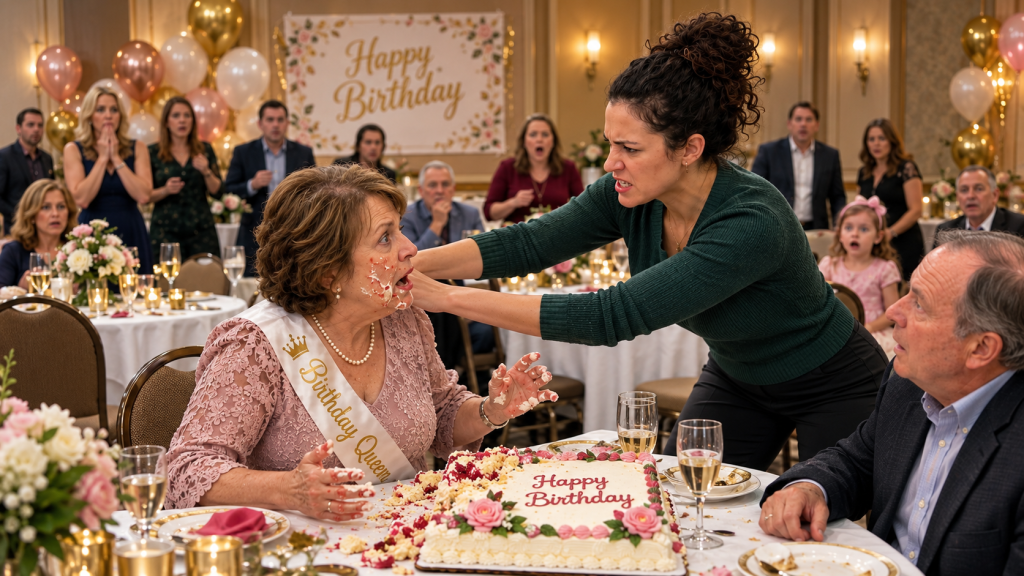
The gasp when Elaine fell into the cake.
I still remember the frosting sliding down the table.
I still remember Lily shaking against my neck.
If I could return to that room, I would change one thing.
I would not hit Daniel.
I would not shove Elaine.
I would simply pick up my daughter, look directly at both of them, and leave.
Because I know something now that I did not know then.
Walking away can be louder than any slap.
Silence can be powerful when it is no longer submission.
And the most devastating revenge against people who depend on your obedience is becoming impossible to control.
Lily is five now.
A few weeks ago, she climbed onto my bed early Sunday morning.
She was holding the dinosaur book Elaine had given her at her third birthday.
The cover was bent.
Several pages had been taped because she had loved it nearly to destruction.
She crawled beneath my blanket.
“Read.”
“It is six-thirty in the morning.”
“Please?”
I sighed dramatically.
“Fine.”
She opened the book.
Halfway through, we reached the triceratops.
I pointed.
“What’s that?”
She rolled her eyes.
“A triceratops, Mommy.”
Perfect pronunciation.
I smiled.
“What?”
“Nothing.”
“You’re weird.”
“Probably.”
She continued looking at the picture.
Then said, “Grandma Elaine gave me this.”
“She did.”
“Grandma Elaine used to be mean?”
The question surprised me.
Daniel and I had agreed that as Lily grew older, we would answer questions honestly but age-appropriately.
I closed the book.
“She made some bad choices.”
“Did she say sorry?”
“Yes.”
“Then everything fixed?”
Children ask enormous questions in tiny sentences.
I thought carefully.
“No.”
Lily frowned.
“Why?”
“Because saying sorry is important. But after you say sorry, you also have to show someone you can make better choices.”
She considered that.
“Grandma makes better choices now?”
“Mostly.”
“Daddy too?”
I smiled.
“Mostly.”
“What about you?”
That one made me laugh.
“I’m working on it.”
Lily nodded as if satisfied that all adults were equally under review.
Then she opened the book again.
“Keep reading.”
So I did.
And as morning sunlight came through the bedroom curtains, I realized something.
For so long, I had thought justice would arrive as some dramatic punishment.
I imagined Elaine losing everything.
Daniel begging me to return.
The entire family apologizing.
Some enormous moment when everyone who had underestimated me finally understood how powerful I was.
But real justice had been quieter.
Elaine did not lose everything.
She had to confront herself.
Daniel did not become a villain.
He had to become accountable.
I did not become a triumphant queen standing over the ruins of my enemies.
I became a mother raising a little girl who knows adults are allowed to apologize and children are allowed to have boundaries.
That was better.
Much better.
Because revenge keeps you tied to the people who hurt you.
Freedom doesn’t.
The family thought my revenge began when I walked out of that banquet.
They were wrong.
My revenge began the moment I stopped needing them to understand why I left.
And it ended the moment I realized I no longer wanted revenge at all.
I wanted peace.
Real peace.
The kind that does not require a frightened two-year-old to remain quiet so adults can enjoy dinner.
The kind that does not require a wife to swallow humiliation so her husband can avoid upsetting his mother.
The kind that allows people to disagree without punishment.
The kind that makes a child feel safe enough to pronounce a word incorrectly and laugh.
That is the home I have now.
And I would choose it again.
Every single time.
THE END
MORAL OF THE STORY: Keeping the peace should never mean allowing someone to mistreat your child. Family loyalty does not excuse cruelty, and understanding someone’s past does not require accepting their harmful behavior. Real change begins when people take responsibility without excuses—and sometimes the strongest revenge is simply setting boundaries, walking away, and building a peaceful life where your children feel safe, loved, and free to be themselves.